China Communist Party probes Jilin carmaker’s missing billions

Communist Party probes Jilin carmaker’s missing billions

Thursday, 11 April, 2013, 12:00am

Li Jing jing.li@scmp.com

More than 100 senior managers at one of the mainland’s leading carmakers, the First Automobile Works Group (FAW), have been questioned, and some have been detained, by Communist Party investigators looking into missing company assets, according to a report by the 21st Century Business Herald.

Citing anonymous sources, the report said that more than 10 billion yuan (HK$12.4 billion) worth of capital vanished from the Jilin -based company over an undisclosed period, and initial investigations found that the money had been embezzled.

Zhou Yongjiang, a deputy chief economist at FAW, and other managers have been placed under shuanggui, in which party members are detained and interrogated, the report said. Zhou was allegedly involved in irregular real estate deals. Calls to FAW’s publicity department went unanswered yesterday.

The far-reaching case is still unfolding and may send shockwaves as one of the region’s senior leaders, a deputy party secretary of Jilin province, was reportedly questioned by the party’s top graft-busting agency. Read more of this post

Prison Ties Bind Malaysia Opposition in Election: Southeast Asia

Prison Ties Bind Malaysia Opposition in Election: Southeast Asia

After Malaysia’s leaders locked up more than 100 dissidents in 1987, Lim Guan Eng found himself in the same prison as Muslim politicians whose party advocated Islamic punishments like stoning and amputation.

Lim, an ethnic Chinese member of a party pushing for a secular government in the Muslim-majority country, began interacting with members of the Pan-Malaysian Islamic party, known as PAS, for the first time. Following months of lengthy discussions on theology and politics, he realized they could work together even while disagreeing on Islamic law.

“When they detained us, they forced us to live together, and we found that we have the same stand on many issues,” Lim said last month in an interview. “It is a friendship formed in bondage of iron, of pain, of suffering. When you suffer together and you don’t give in, that is an unbreakable bond.” Read more of this post

How the CSIRO cheated a global drugs giant into buying anti-counterfeit technology which could be easily compromised – passing off cheap chemicals it had bought from China as a ”trade secret” formula

How the CSIRO cheated a global drugs giant

April 11, 2013, Linton Besser and Nicky Phillips

csiro-wide-620x349

The CSIRO has duped one of the world’s biggest pharmaceutical companies into buying anti-counterfeit technology which could be easily compromised – passing off cheap chemicals it had bought from China as a ”trade secret” formula.

The Swiss-based multinational Novartis signed up two years ago to use a CSIRO invention it was told would protect its vials of injectible Voltaren from being copied, filled with a placebo and sold by crime syndicates.

Police and drug companies are battling counterfeiters who are selling fake medicines that have killed hundreds of people. Last year Interpol seized 3.75 million units of fake drugs and arrested 80 people. Read more of this post

Europe’s Glitziest Show, Now In Austerity Mode; Eurovision Song Contest, one of the planet’s most wildly popular mega-events—which helped propel household names like ABBA and Celine Dion—is going on a financial diet

Updated April 10, 2013, 6:46 p.m. ET

Europe’s Glitziest Show, Now In Austerity Mode

By ANNA MOLIN

OB-XA332_EUROVI_G_20130410225103

As fiscal austerity sweeps the European continent, one of the planet’s most wildly popular mega-events—which helped propel household names like ABBA and Celine Dion—is going on a financial diet.

Every year in late spring, more than 100 million people in more than 40 nations pack into pubs, attend kitschy theme parties or dive into their couches at home—all glued to the same television broadcast. Their focus: the Eurovision Song Contest, a weeklong Olympics-meet-“American Idol” singing competition that features one chosen act from each participating nation. (Most are from Europe, but some countries outside the continent have also competed, including Israel and Cyprus.) The extravaganza is famous for its parade of aging crooners, exuberantly sequined pop singers and dark-horse acts like last year’s gaggle of singing grannies in babushka scarves.

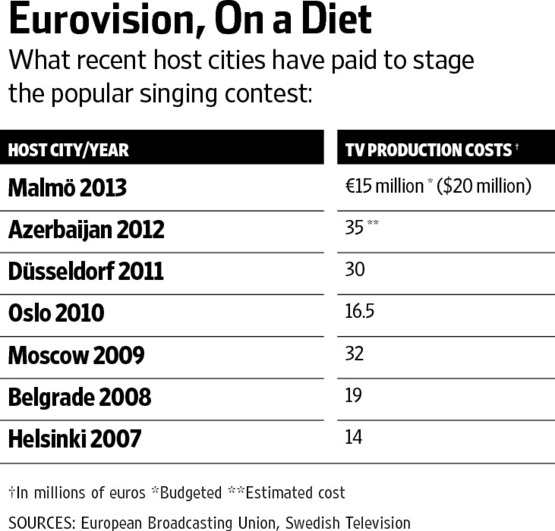
Sweden, the country set to host next month, plans to slash the 58-year-old event’s television-production budget to $20 million, less than half what it was last year, by using a smaller venue, fewer lights and less media fanfare. The goals: to survive in a tough economy, reignite the interest of nations hobbled by fiscal cutbacks—and in the process, create a more intimate affair that returns the focus to the music itself. Read more of this post

Gravity-Defying Aussie Gouges Industry as Prosperity Bites Back

Gravity-Defying Aussie Gouges Industry as Prosperity Bites Back

From skyrocketing rents in remote mining towns to the decline of the auto industry, Australia is grappling with the downside of world-beating economic growth that has driven the nation’s currency to record highs.

Policymakers and executives at the Bloomberg Australia Economic Summit in Sydney yesterday singled out the local dollar’s strength as the biggest challenge for business, while conceding there’s little that can be done to restrain it. Terry Davis, managing director at Coca-Cola Amatil Ltd., said the Aussie is “decimating” manufacturers, while Robert Mead, head of portfolio management in Sydney at Pacific Investment Management Co., said businesses are deferring spending.

Australia’s defiance of the global slowdown is now backfiring on manufacturing after the currency soared 75 percent against the U.S. dollar and 87 percent versus the yen from its low in October 2008 after the collapse of Lehman Brothers Holdings Inc. roiled financial markets. The government and Reserve Bank of Australia say the cash flowing into the economy — fueled by quantitative easing in the U.S. and Japan — is beyond the control of policy makers in a small nation.

“That’s the hand that the world has dealt us,” RBA Assistant Governor for economics Christopher Kent said at the summit, reiterating that the central has no plans for intervention to weaken the so-called Aussie. “Businesses in a number of industries are under quite a deal of pressure — part of that’s because of the exchange rate.” Read more of this post

Toronto Condo Kings Retreating to Avert Crash: Mortages

Toronto Condo Kings Retreating to Avert Crash: Mortages

Toronto condo builders are slowing development in a bid to avoid a crash after a decade-long boom led to 159 towers now under construction.

So far this year, they’ve announced 13 new condominium projects, the fewest since the recession in 2009, when there were just three over the same period, figures from real estate researcher RealNet Canada Inc. show. In the same period last year, 29 new projects were announced, including Tridel Corp.’s Ten York, the third-tallest residential tower in the country at 75-stories when it was first marketed.

“Most developers have their hands in their pockets right now,” said Brad Lamb, president of Brad J. Lamb Realty Inc., a developer and the city’s largest condominium broker. His firm, which is marketing more than 45 high-rise developments in the city, won’t start a new project until 2014, Lamb said in an interview at Bloomberg’s office in Toronto. Lamb said he has eight projects in Toronto and Ottawa “on the drawing board.”

The slowdown comes as a near-record supply of condos comes to market in a city with the most towers being constructed in the world, according to BuzzBuzzHome, a Toronto-based real estate listings and research firm. Developers are trying to manage the slowdown as buyers retreat amid tighter mortgage rules, a slowing economy and the burden of record consumer debt. The supply of new high-rise units reached 21,262 in February, 34 percent more than the same period a year ago and close to a record 21,696 in October 2012, RealNet figures show. About 61,000 units are currently under construction — the most ever — and a record 35,757 residential units will come on stream next year, RealNet said. Read more of this post

China Exports Miss Forecasts as ‘Absurd’ Data Probed; China Export Gains Miss Forecasts for First Time in Four Months

China Exports Miss Forecasts as ‘Absurd’ Data Probed; China Export Gains Miss Forecasts for First Time in Four Months

China’s exports rose less than forecast for the first time in four months, leaving the world’s second-largest economy with weaker global demand to support a recovery than previous figures indicated.

Shipments abroad increased 10 percent from a year earlier, the customs administration said today in Beijing. That compares with 21.8 percent growth in February and the 11.7 percent median estimate in a Bloomberg News survey of 36 economists. Imports rose by an above-forecast 14.1 percent in March, leaving an unexpected trade deficit of $880 million.

The slowdown breaks a pattern of above-forecast figures that spurred concerns by economists at banks including Goldman Sachs Group Inc. that export gains were overstated because of companies inflating reported trade. Weaker trade growth also adds to Chinese Premier Li Keqiang’s challenges in sustaining a rebound while he tries to limit nontraditional banking and damp housing prices. Read more of this post

Soil samples across China have revealed remnants of heavy metals dating back at least a century and traces of a pesticide banned in the 1980s, revealing the extent of the country’s pollution problems

Amid China air, water pollution, soil survey reveals century-old heavy metals

As much as 65 per cent of the fertiliser in China’s countryside was improperly used and left to pollute rivers and fields.

Wed, Apr 10, 2013
Reuters

BEIJING – Soil samples across China have revealed remnants of heavy metals dating back at least a century and traces of a pesticide banned in the 1980s, an environmental official said on Wednesday, revealing the extent of the country’s pollution problems.

Street-level anger over air pollution that blanketed many northern cities this winter spilled over into online appeals for Beijing to clean water supplies as well.

The rotting corpses of thousands of pigs found last month in a river that supplies tap water to Shanghai drew even more attention to water safety.

Mr Zhuang Guotai, head of the ecological department of the Ministry of Environmental Protection, said a nationwide soil survey showed the countryside had paid a heavy price for an agricultural revolution that has seen grain production almost double in the last 30 years, despite a much reduced workforce. Read more of this post

Analysis: How Goldman’s dollar-store bet reaped a fortune

Analysis: How Goldman’s dollar-store bet reaped a fortune

12:05am EDT

By Lauren Tara LaCapra and Carrick Mollenkamp

(Reuters) – Goldman Sachs Group Inc has likely generated around $1.2 billion of revenue over six years from its dealings with discount retailer Dollar General Corp, a Reuters review shows. Just don’t expect the investment bank to boast about it.

Much of the revenue stems from an equity investment that is lumped into a catchall earnings segment called “Investing and Lending.” Goldman created the segment in 2011 to shine some light on how much money it makes from investing its own money, but it still confounds analysts and investors because the bank does not provide details on the performance of individual assets. Read more of this post

China’s longest river is running out of fish, threatening industry and agriculture around the river basin that account for roughly 30-40% of China’s GDP, according to the WWF

China’s longest river is running out of fish

By Lily Kuo — April 9, 2013

Overfishing, pollution and infrastructure projects are quickly depleting the amount of fish in China’s Yangtze River, according to Chinese environmental officials. The consequences are environmental and economic–without enough fish the river’s eco-system could collapse, threatening industry and agriculture around the river basin that account for roughly 30-40% of China’s GDP, according to the WWF.

According to a report on April 1, Zhao Yimin, head of the fishery resource office with China’s ministry of agriculture told Global Times,”The ecological balance of the river has already collapsed.” Zhao said, noting that further exploitation could mean a recovery for the river may be too late. Read more of this post

Billabong CEO stands by turnaround strategy; At its pre-GFC peak in 2007, Billabong was valued at $3.8 billion. Today it is valued at just $256 million; Billabong, whose founder last year said he wouldn’t sell for $1 billion, slumps to a record low after entering talks on a $287 million takeover.

Billabong CEO stands by turnaround strategy

PUBLISHED: 8 HOURS 8 MINUTES AGO | UPDATE: 1 HOUR 34 MINUTES AGO

2a5d628e-a1ac-11e2-8535-6d0b98da702b_727165687--646x363

“I do believe the strategy is right,” Billabong CEO Launa Inman says. “The board has endorsed it. What we need to do now is implement this regardless of ownership at this point and time because you have to carry on with the business.” Photo: Louise Kennerley

Billabong International chief executive Launa Inman is resolute that her turnaround strategy is right for the troubled surfwear retailer but has declined to confirm guidance or earnings targets.

Ms Inman would not be drawn on the exclusive negotiations entered into on Tuesday with private equity suitor Sycamore Partners and former Billabong executive Paul Naude over their 60¢-a-share cash offer for the company. Read more of this post

Shadow banking brought America to its knees, and now it’s growing like crazy in China

Shadow banking brought America to its knees, and now it’s growing like crazy in China

By Matt Phillips — April 9, 2013

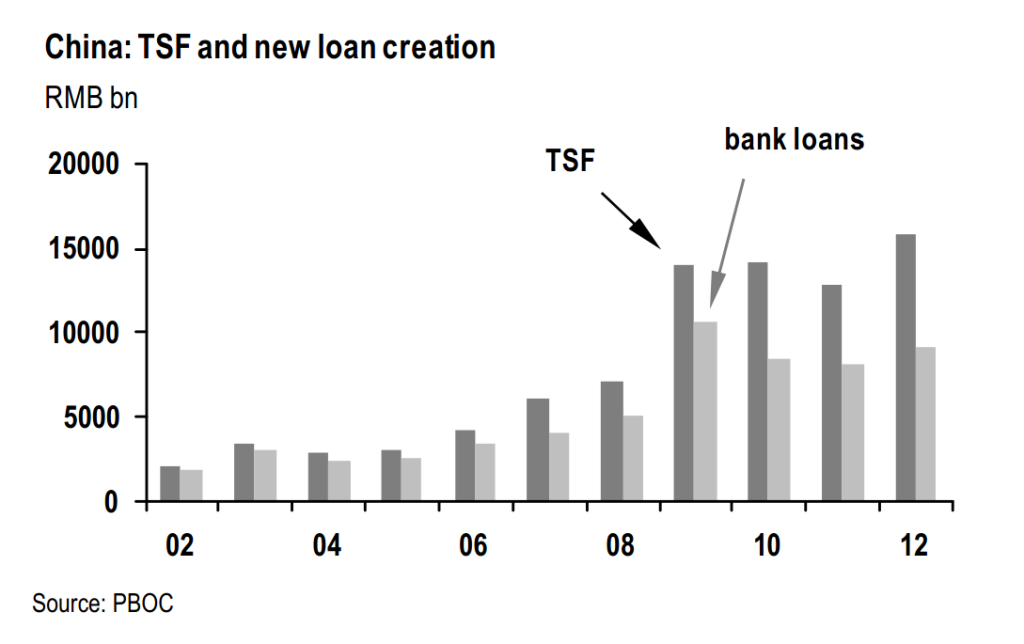
Just a few years ago, the shadow banking system brought the world’s largest economy to its knees. Will it do the same to the world’s second largest? Shadow banking—essentially when companies that aren’t regulated like banks start behaving like banks—is most definitely alive and well in China. And its growth is a key reason credit ratings firm Fitch cut its default rating on yuan-denominated debt today. The rationale is pretty plain. “Risks over China’s financial stability have grown. Credit has grown significantly faster than GDP since 2009. China experienced the second-fastest expansion of credit in real terms, behind only Qatar, between end-2009 and end-June 2012. The stock of bank credit to the private sector was worth 135.7% of GDP at end-2012, the third-highest of any Fitch-rated emerging market,” Fitch analysts wrote. And that credit growth is increasingly coming outside the banking system. Here’s a chart that shows how growth in Chinese credit—tracked using a statistic called “total social financing,” or TSF—is outpacing bank lending, from JP Morgan researchers.

screen-shot-2013-04-09-at-11-41-44-am Read more of this post

China banks “significantly exposed” to shadow financing: Fitch; “All Chinese banking is an arm of the government but that doesn’t stop loans going sour, it only stops them showing up as sour”

China banks “significantly exposed” to shadow financing: Fitch

4:18am EDT, By Kevin Yao

BEIJING (Reuters) – Chinese banks face growing risks as they are heavily exposed to the “shadow banking” being used by debt-laden local governments to raise funds, global ratings agency Fitch said on Wednesday.

Fitch’s warning over the health of China’s banking sector came a day after its cut of China’s long-term local currency debt rating by a notch to A-plus.

“The banking sector is “significantly exposed” to the shadow banking because there all sorts of ties between the banks and shadow credit channels,” Charlene Chu, head of China financial institutions at the ratings agency, told a teleconference.

Chu said a lot of “shadow credit” was going to many sectors, which included local governments. Read more of this post

Accuracy concerns over China trade data; The 3 Key Reasons Chinese Export Growth Slumped In March; still, March number could also be overstated because exports to bonded areas jumped a whopping 343 percent year-over-year in March

Last updated: April 10, 2013 4:50 am

Accuracy concerns over China trade data

By Jamil Anderlini in Beijing ©AFP

China’s latest trade figures showed a sharp decline in export growth combined with a strong rebound in imports in March, but volatility and discrepancies in the data have raised concerns about their accuracy.

Exports from China increased 10 per cent in March from the same month a year earlier, compared with a 22 per cent increase in February, while imports surged 14.1 per cent in March, compared with a year-on-year drop of more than 15 per cent the previous month, according to Chinese customs administration data released on Wednesday.

Part of the volatility was explained by the long Lunar New Year holiday, which shuts down most of the country for weeks and fell in February this year, but most analysts said there was also a problem with the data.

“The 10 per cent headline growth number [in exports] masks an uncomfortable reality – either the trade data are unreliable or if they are reliable then what are being booked as exports are not actually exports,” said Alistair Thornton, China economist at IHS Global Insight. “The breakdown of exports by destination veers towards the absurd.” Read more of this post

India car sales shrink for first time in decade, hit by a slowing economy and high interest rates

India car sales shrink for first time in decade

POSTED: 10 Apr 2013 2:50 PM
URL: http://www.channelnewsasia.com/news/business/international/india-car-sales-shrink/633898.html

India’s passenger car sales shrank for the first time in a decade, falling 6.7 percent in the year to March, hit by a slowing economy and high interest rates, a top industry body said Wednesday.

NEW DELHI: India’s once red-hot car market shrank for the first time in a decade in the last financial year, industry figures showed Wednesday, underlining the scale of the slowdown in Asia’s third-biggest economy.

Passenger car sales fell by 6.7 per cent in the financial year to March 2013 to 1.89 million units compared with from 2.03 million the previous year, the Society of Indian Automobile Manufacturers (SIAM) said in a statement.

Sales in March alone plunged 22.5 per cent year-on-year, raising questions about huge investment programmes announced by foreign car companies, such as Ford, which are building new manufacturing capacity.

“The basic problem has been the big downturn in the economy and high interest rates. They have knocked sales,” Sugato Sen, SIAM deputy director general, told AFP. Read more of this post

To Find Insider Trading, Follow The Kids’ Money

To Find Insider Trading, Follow The Kids’ Money

by SHANKAR VEDANTAM

April 09, 2013 2:56 AM

In New York and Washington, government regulators are cracking down on insider trading, the illegal practice in which people with internal information about important company events make stock market trades before ordinary investors find out what’s happening.

In recent months, regulators have launched a series of high-profile arrests and investigations. Even Congress has gotten into the spirit of things, voting to ban insider trading by members.

Now, social scientists are muscling in on the action, too.

In a new study accepted for publication in the Journal of Finance, Henk Berkman at the University of Auckland, Paul Koch at the University of Kansas and Joakim Westerholm at the University of Sydney have uncovered a novel way to spot insider trading.

The researchers tracked half a million stock market accounts over a 15-year period between 1995 and 2010. The accounts were in Finland on the Nasdaq OMX Helsinki Exchange. Why Finland? It offered researchers unusual access to information about trades and information about investors, including their age. To their surprise, when the researchers analyzed the data according to investor age, the accounts belonging to the youngest children blew all the others out of the water in terms of performance. “We were very surprised when we first found this evidence,” Koch said. “Again, we were not looking for the result we found. The group [of accounts belonging to children between the ages of zero and 10 years old] seemed to outperform all the others.” Koch isn’t implying that babies know how to make the right picks in the stock market. The people operating these children’s accounts were their parents and guardians. Read more of this post

The Fine Line Between Political Intelligence and Insider Trading

APRIL 8, 2013, 2:45 PM

The Fine Line Between Political Intelligence and Insider Trading

By PETER J. HENNING

Life in Washington is all about information – who will support or oppose an initiative, how will an agency address an issue in its rules, and when will a decision be announced. The pervasive role of the government in the economy makes that information particularly valuable to investors. And that can lead some to get a jump on the market if they learn about changes in policy before others.

“Well-timed” trading before a public disclosure of material information has all the hallmarks of insider trading. The problem is that the imprecise rules governing insider trading are an ineffective means to regulate how political intelligence firms gather, analyze and selectively disseminate such information to their clients.

Political intelligence has become a hot topic these days because of its potential to move markets. Last week, The Wall Street Journal reported about an investment firm in Washington that correctly predicted a decision by the government about reimbursement of Medicare costs; that information led to a jump of more than 6 percent in the shares of health insurers before the close of trading. Read more of this post

George Soros urges Angela Merkel to consider quitting euro

George Soros urges Angela Merkel to consider quitting euro

Billionaire speculator says single currency’s prospects would be better without Germany, the eurozone’s most dominant member

Simon Goodley, guardian.co.uk, Tuesday 9 April 2013 17.40 BST

George Soros, the billionaire speculator best known as “the man who broke the Bank of England” in 1992, has launched a stinging critique ofGermany‘s role in the euro crisis and suggested the single currency’s prospects would be improved if its most dominant member were to quit.

In an incendiary speech made on Tuesday afternoon in Germany’s financial centre of Frankfurt, the hedge fund trader told Europe‘s richest country it had gone too far during the bailout of Cyprus, was itself heading for recession and should either leave the euro or reverse its long held opposition to eurobonds – a form of sovereign debt that would mean each member country’s borrowings were guaranteed by the whole eurozone.

“My first preference is eurobonds; my second is Germany leaving the euro,” he said in his lecture, entitled: How to save the European Unionfrom the euro crisis. Read more of this post

ROSENBERG: The S&P 500 Is Nowhere Near Its All-Time High When Priced In Eggs

ROSENBERG: The S&P 500 Is Nowhere Near Its All-Time High When Priced In Eggs

Mamta Badkar | Apr. 9, 2013, 12:27 PM | 3,841 | 7

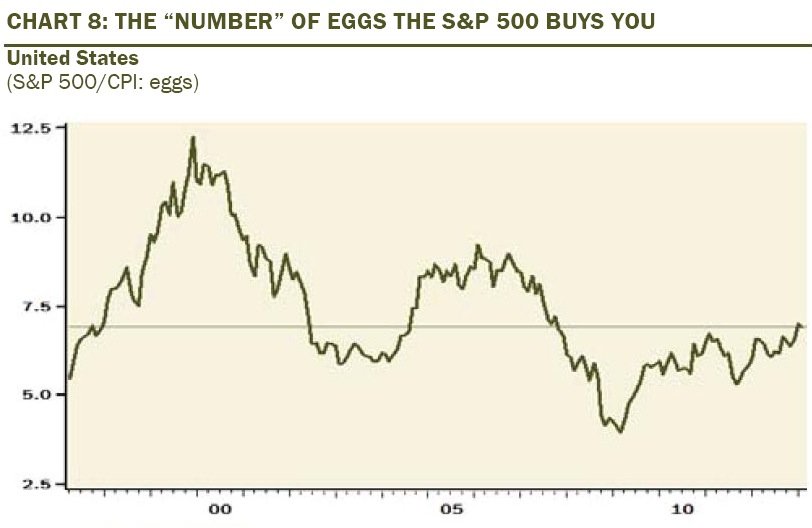
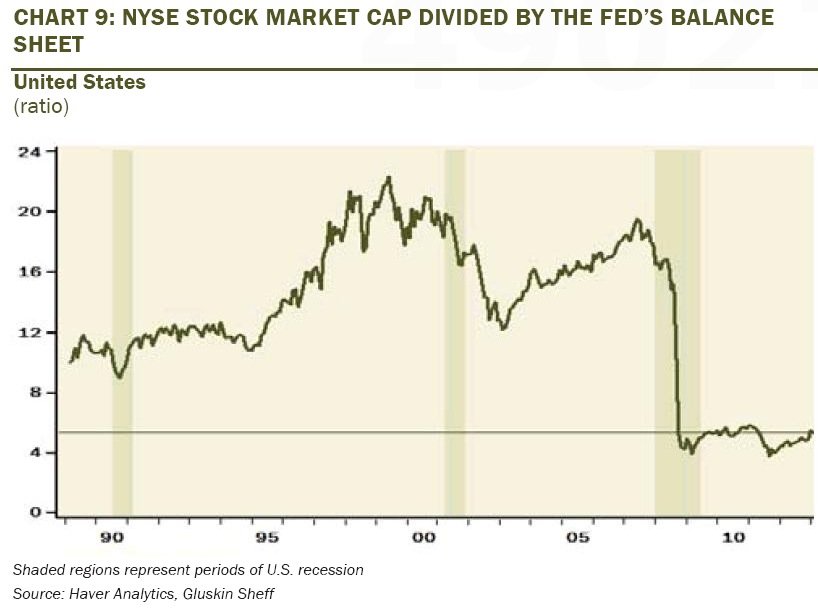
Stocks hit all-time highs in the first quarter. But many have argued that this has just been driven by central bank easing. In a new report, David Rosenberg quotes Kyle Bass (via Fred Hickey) as saying that stock market gains in real terms are weaker than those in nominal terms. In fact, Bass is quoted saying, “one of the best performing equity markets in the last decades has been Zimbabwe. But now your entire equity portfolio (in Zimbabwe) only buys you three eggs.” Rosenberg says that this made him think about the S&P 500 in egg terms. “While there has been a market recovery, it is far more subdued on this basis … in egg-adjusted terms, the S&P 500 is more than 20 percent below its pre-recession highs and about half what it was at the all-time highs 16 years ago. In milk terms, the S&P 500 is actually 15 percent below its its pre-recession highs, and in bread terms, the index is 10 percent lower. Just in case you thought I was cherry picking what’s on the breakfast table.” To really drive home his point, Rosenberg included a chart that shows the NYSE market capitalization when adjusted for the Fed’ balance sheet is still at 2009 lows.

screen shot 2013-04-09 at 11.56.46 amscreen shot 2013-04-09 at 12.04.13 pm

GlobeAsia MD Yanto Soegiarto: Our Society of Bullies; Thuggery haunts all levels of Indonesian society. Thuggery is crime

The Thinker: Our Society of Bullies
Yanto Soegiarto | April 05, 2013

Thuggery haunts all levels of Indonesian society. Thuggery is crime.

It can be petty in some instances, but it exists in drugs, religion, politics and even in business. Thugs rule ordinary people’s markets, parking spaces, bus stations, cafes and entertainment joints.

In religion, hard-liners attack Ahmadis and prevent Christians from worshipping. In politics, lawmakers use intimidation against rival politicians and in business, lower-echelon officials often resort to extortion, which makes it difficult for foreign investors to do business in Indonesia.

Thuggery, or “ premanisme ,” flourishes because of weak leadership, lax security and poor law enforcement. And the country now is witnessing thuggery at an alarming rate despite notorious gang leaders Hercules Rosario Marshal and John Kei being in jail.  Read more of this post

Why the Chinese Public is Telling Officials to Jump in a Lake; A new and unofficial measure of water quality is being used around the country: Will our mayor swim in that?

04.09.2013 16:48

Closer Look: Why the Public is Telling Officials to Jump in a Lake

A new and unofficial measure of water quality is being used around the country: Will our mayor swim in that?

By intern reporter Zou Zijian

1365497271192372

BEIJING – In March, the new president, Xi Jinping, had some words of advice for the major of Suzhou, in the eastern province of Jiangsu.

The mayor had just outlined a plan improve the water quality of the city’s lakes. But Xi said that, at least as far as Net users were concerned, the best measure of quality was whether the mayor himself dared to dive into local bodies of water.

A resident of Zhejiang Province, also in the east, made a splash in February when he challenged officials at the local environmental protection bureau to swim in a polluted river. Thus, a new and unofficial test of water quality was invented. Read more of this post

Poisoned Groundwater Creates Cancer Villages

Poisoned Groundwater Creates Cancer Villages

04-09 15:12 Caijing

China’s long-time practice of doling out light punishments to polluters has aggravated the problem of groundwater pollution.

By staff reporters Gao Shengke, Xu Jing, and He Tao

A recent claim that enterprises in Weifang, Shandong Province were illegally pumping wastewater underground into pressurized wells highlighted the threats to groundwater safety in China over the Spring Festival in February.

Groundwater pollution is an even bigger public hazard than the surface water pollution that contaminates China’s rivers and streams. It is also more difficult to clean up.

Underground water is the source of drinking water for 60 percent of China’s population. Currently, 360 million people in the countryside lack access to clean drinking water, while some people in rural regions drink untreated groundwater. In addition, underground water in nearly 20 percent of Chinese cities failed to reach Class III standards, which means it should not be used as a source of drinking water. Read more of this post

Catfight between Guo Meimei and Sports Car Club members revealed disturbing wealth gap in China. Chinese netizens shocked

Catfight between Guo Meimei and Sports Car Club members revealed disturbing wealth gap in China. Chinese netizens shocked

Alia | April 9th, 2013 – 9:24 pm

21

Each chip is of 50,000 yuan value; Guo showed off 10 casino chips worth RMB 5 million in total

aa

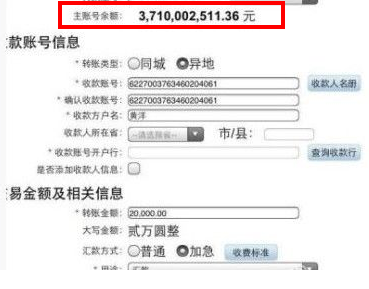
Over 3.7 billion yuan in balance; In response, one Sports Car Club (SCC) member showed off part of his bank account that had a balance of RMB 3,710,002,511.36 yuan

4

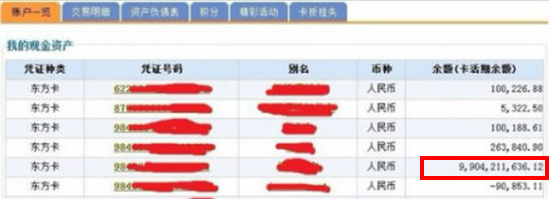
Over 9.9 billion yuan in balance Read more of this post

China’s Railways Ministry Gone, Problems Remain; with total debt at 2.66 trillion yuan, the MOR accrued 15 billion yuan in annual interest

Railways Ministry Gone, Problems Remain

04-09 15:00 Caijing

The CRC, a super monopoly which inherited all of the railways ministry’s assets, debts, and personnel, urgently needs to evolve into an efficient modern enterprise.

By staff reporters Chen Xiaoshu and Wang Kai

The dissolution of the Ministry of Railways (MOR) and subsequent establishment of China Railway Corporation (CRC) in March constitute the first step in marketization of the railways industry. But problems remain even though the MOR, which performed administrative functions and ran business operations at the same time, is no longer around.

“What about the MOR’s debts? What kind of business entity is the CRC? How will public transportation be subsidized? None of these questions have been answered yet,” said Zhao Jian, a professor at Beijing Jiaotong University who participated in brainstorming railway reform plans in 2001, 2007, and 2011 respectively.

The CRC, a super monopoly which inherited all of MOR’s assets, debts, and personnel, has 2 million staff, 1.036 trillion yuan in registered capital, and over 4.3 trillion yuan in fixed assets. The wholly state-owned enterprise urgently needs to evolve into an efficient modern enterprise.

Statistics show that the MOR had an asset-liability ratio of 61.81 percent as of Sept. 2012, with total debt at 2.66 trillion yuan, including 2.12 trillion yuan in long-term debt. With debt of that magnitude, the MOR accrued 15 billion yuan in annual interest. Read more of this post

High-rollers from China make Genting S’pore unit and others see red; gamblers have run up millions of dollars in debt and then scampered back to China, where they are effectively untouchable

Updated: Wednesday April 10, 2013 MYT 11:39:07 AM

High-rollers from China make Genting S’pore unit and others see red

An examination of court documents by Reuters and a series of interviews with lawyers and industry executives reveal that several of the gamblers have run up millions of dollars in debt and then scampered back to China, where they are effectively untouchable.

SINGAPORE: High-rollers get lavish treatment and hefty credit lines at Singapore’s two casinos, like any other gaming house in the world. But here, more of them skip town without paying their debt, a matter of increasing concern for investors.

Three years after Singapore allowed casinos to open, Genting Singapore PLC‘s Resorts World Sentosa and Las Vegas Sands Corp‘s Marina Bay Sands have become the world’s most profitable. Chinese nationals account for around half of the VIP gaming volume at their tables.

An examination of court documents by Reuters and a series of interviews with lawyers and industry executives reveal that several of the gamblers have run up millions of dollars in debt and then scampered back to China, where they are effectively untouchable.

Resorts World sued Chinese gambler Kuok Sio Kun in Singapore last year to recover S$2.2 million (1.1 million pounds). But more than six months on, the casino has not even managed to serve court papers to the Macau-based woman. Read more of this post

Companies such as Loblaw and Maple Leaf Foods that sell household staples are reaping the rewards as Canadian shoppers turn more frugal amid record consumer debt

Loblaw to Maple Leaf Surge as Need Beats Want

Companies such as Loblaw Cos. Ltd. (L) and Maple Leaf Foods Inc. (MFI) that sell household staples are reaping the rewards as Canadian shoppers turn more frugal amid record consumer debt.

The Standard & Poor’s/TSX index of consumer staples stocks has surged 11 percent in six months through yesterday, touching an all-time high on March 28, compared with a 0.6 percent decline for the Toronto benchmark. Ten of 11 members in the index have posted positive returns over that period, led by a 31 percent gain by beverage-maker Cott Corp. (COT) and a 25 percent return by Maple Leaf, a Toronto-based manufacturer of meat products and baked goods. Brampton, Ontario-based Loblaw, the nation’s biggest grocer, has returned 22 percent.

“The beauty about the consumer-staples group is what you’re really buying are companies that sell what people need, as opposed to what they want,” David Rosenberg, chief economist and strategist with Gluskin Sheff + Associates in Toronto said in a telephone interview on April 4. “You can tap into the consumer without really having to make a directional bet on the shape of the economy.”

The world’s 11th-largest economy is expanding at the slowest pace since emerging from recession in 2009, in part because the country’s indebted consumers are scaling back purchases of discretionary items and becoming more price conscious. Read more of this post

Slovenia Bailout Signaled by Worsening Debt Swaps: Euro Credit

Slovenia Bailout Signaled by Worsening Debt Swaps: Euro Credit

Slovenia’s creditworthiness is deteriorating at the fastest pace in the world after Cyprus as investors speculate a banking crisis will force it to follow the island nation and become the sixth euro country to need aid.

Credit-default swaps insuring Slovenian debt for five years soared as much as 66 percent to a six-month high of 414 basis points on March 28 from 250 on March 15, the last trading day before Cyprus announced plans for its rescue. It’s now up 35 percent at 338 basis points, compared with a 54 percent increase for Cyprus and 13 percent for Portugal in the period. Read more of this post

Andy Kessler: The Pension Rate-of-Return Fantasy; Counting on 7.5% when Treasury bonds are paying 1.74%? That’s going to cost taxpayers billions

Updated April 9, 2013, 7:21 p.m. ET

Andy Kessler: The Pension Rate-of-Return Fantasy

Counting on 7.5% when Treasury bonds are paying 1.74%? That’s going to cost taxpayers billions.

By ANDY KESSLER

It has been said that an actuary is someone who really wanted to be an accountant but didn’t have the personality for it. See who’s laughing now. Things are starting to get very interesting, actuarially-speaking.

Federal bankruptcy judge Christopher Klein ruled on April 1 that Stockton, Calif., can file for bankruptcy via Chapter 9 (Chapter 11’s ugly cousin). The ruling may start the actuarial dominoes falling across the country, because Stockton’s predicament stems from financial assumptions that are hardly restricted to one improvident California municipality.

Stockton may expose the little-known but biggest lie in global finance: pension funds’ expected rate of return. It turns out that the California Public Employees’ Retirement System, or Calpers, is Stockton’s largest creditor and is owed some $900 million. But in the likelihood that U.S. bankruptcy law trumps California pension law, Calpers might not ever be fully repaid. Read more of this post

What Europe’s Mistakes Teach Asia; Nations that sacrifice too much economic freedom for social security end up with neither

April 9, 2013, 3:55 p.m. ET

What Europe’s Mistakes Teach Asia

Nations that sacrifice too much economic freedom for social security end up with neither.

By SRI MULYANI INDRAWATI

A Chinese proverb tells us that it is wise to learn from your own mistakes but wiser to learn from the mistakes of others. Asian leaders should take this advice to heart as they juggle between policies for social welfare and economic dynamism. By keeping a keen eye on Europe’s fiscal crises, they can avoid the worst of the Continent’s productivity-reducing excess.

At the same time, it would be a mistake for Asia to look to Europe solely for lessons on which policies to avoid. Europe could not have attained the highest quality of life in human history without doing some things right—namely, trade and openness. Read more of this post

America’s New Energy Boom Is Bust for Foreign Suppliers

Updated April 9, 2013, 10:08 p.m. ET

America’s New Energy Boom Is Bust for Foreign Suppliers

By CHIP CUMMINS

P1-BL047_CANOIL_NS_20130409182116P1-BL048A_CANOI_G_20130409182124P1-BL050_CANOIL_G_20130409175714

EDMONTON, Alberta—For the better part of a year, Canadian officials and executives watched from afar as a shale-oil boom exploded south of the border.

But it wasn’t until last fall that the full impact of the U.S. energy boom hit the provincial government here in the heart of Canada’s oil patch.

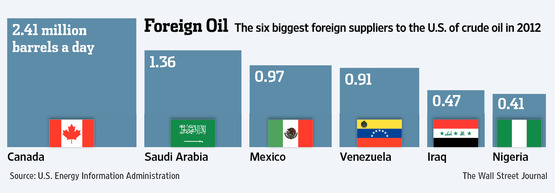
Around October, prices for Canadian bitumen—a heavy crude from the country’s vast oil sands developments—tanked, walloping the economy of America’s largest supplier of foreign oil, its biggest trading partner and one of its closest allies.

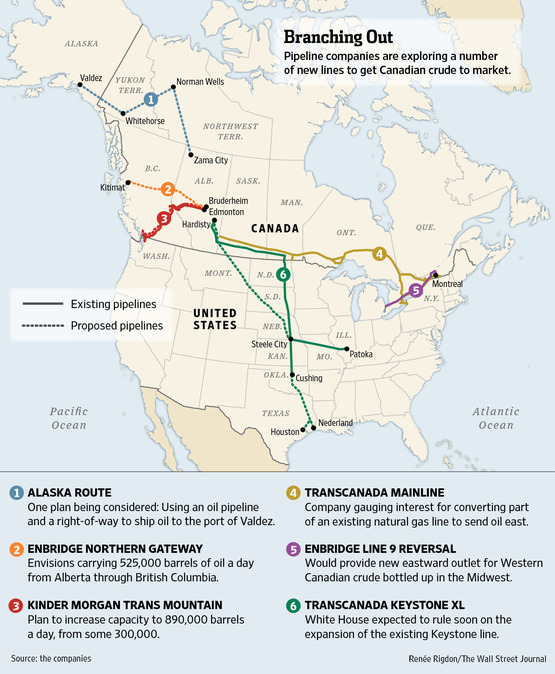
Amid a bottleneck of too few pipelines and too much new oil across the U.S. Midwest, Canadian producers had started agreeing to steeper and steeper discounts to get their oil to American refiners, their only foreign buyers. Read more of this post