Boom-Bust Vietnam Beats Emerging Stocks as State Considers Role

Boom-Bust Vietnam Beats Emerging Stocks as State Considers Role

Vietnam, the world’s most volatile stock market since 2009, is leading developing-nation gains this year as the Communist government slows inflation and considers easing its grip on the economy.

The benchmark VN Index (VNINDEX) posted more 20 percent swings than every major equity market in the past four years as policy makers grappled with consumer prices, currency devaluations and bad bank loans. Their efforts helped cut inflation to 6.6 percent in March from 23 percent in 2011 and produced the first annual trade surplus since 1992.

Now the government is preparing to remove bad debt from lenders, ease restrictions on foreign ownership of listed businesses and change the constitution to limit the “leading role” of state companies that comprise about a third of gross domestic product. The VN Index has climbed 22 percent in 2013, the most among equity gauges in 47 frontier and emerging markets. After adjusting for volatility, the measure had the 16th-biggest gain, data compiled by Bloomberg show. Read more of this post

Brazilian oil services provider Lupatech missed interest payments on $275 million of perpetual bonds two weeks after reporting annual losses doubled from a year earlier

Brazil’s Lupatech Misses Dollar Bond Payment After Loss Doubles

Lupatech Ezion

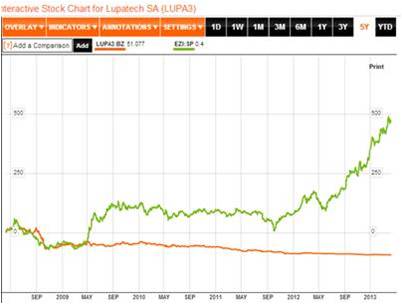
Brazilian oil services provider Lupatech SA (LUPA3) missed interest payments on $275 million of perpetual bonds two weeks after reporting annual losses doubled from a year earlier. Read more of this post

Bitcoin Trade Halted by Mt. Gox Exchange After Price collapsed by 46 percent to $123.40 from $230 in the past 24 hours

Bitcoin Trade Halted by Mt. Gox Exchange After Price Drop

Mt. Gox, a Tokyo-based exchange that handles bitcoin transactions, halted trading of the virtual currency to let the market “cool down” after a plunge in price.

The price of bitcoins collapsed by 46 percent to $123.40 from $230 in the past 24 hours, according to quotes on Mt. Gox’s website. In a statement, the company cited an increase in trade volume and not a cyber-attack, which has caused shutdowns in the past.

Bitcoin is a virtual currency that can be used to buy and sell a broad range of items — from cupcakes to electronics to illegal narcotics. Online exchanges across the world offer a market for bitcoins to be bought and sold against dollars, euros, yen and other currencies. Bitcoin has been subject to large swings in value in recent days.

“People started to panic, started to sell bitcoin in mass (panic sale) resulting in an increase of trade that ultimately froze the trade engine,” Mt. Gox said in the statement. Read more of this post

Meet the Bitcoin Millionaires; As of April 2, there were about 250 wallets with more than $1 million worth of Bitcoins

Meet the Bitcoin Millionaires

By Max Raskin on April 10, 2013

mf_bitcoin16__01__630x420

Many people have lost some data while reformatting a computer hard drive. Jered Kenna lost more than that. In 2010 he erased from his computer 800 Bitcoins that have been worth more than $200,000. Kenna isn’t upset: He has plenty more. He says he bought his first batch of virtual currency, 5,000 coins, at 20¢ each. On April 10, Bitcoins traded for as much as $258 each, according to Tradehill, a Bitcoin exchange in San Francisco, before plunging more than $100. Like other enthusiasts, Kenna shrugs off the volatility. While he won’t disclose his total holdings, he says, “I’m happy to be considered a member of the Bitcoin millionaires’ club.” Read more of this post

Tata’s Nano, the World’s Cheapest Car, Is Sputtering

Tata’s Nano, the World’s Cheapest Car, Is Sputtering

By Siddharth Philip on April 11, 2013

comp_nano16cargraphic_405

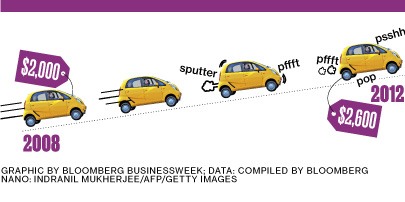
The old adage says a person can’t be too rich or too thin. Given Tata Motors’ (TTM) disappointing experience with the Nano, the $2,000 compact it introduced with great fanfare in 2008, it’s clear a car can be too cheap—at least for consumers who don’t want to be associated with a low-end ride. Ratan Tata, then chairman of parent Tata Group, made headlines a decade ago when he ordered up a “people’s car” that would appeal to Indian families who previously could only afford to travel by scooter. But Tata Motors has sold just 229,157 Nanos since deliveries began in 2009, and sales in March were off by 86 percent from a year earlier.

Tata Managing Director Karl Slym insists the company won’t kill the tiny, egg-shaped car. It will soon add improvements to breathe new life into the model, a move that would ultimately bring its price closer to those of rivals. The Nano’s marketing “didn’t jell with anybody,” Slym says. Scooter drivers weren’t attracted because others “don’t think I’m buying a car, they think I’m buying something between a two-wheeler and a car. Anyone who had a car didn’t want to buy it, because it was supposed to be a two-wheeler replacement.”

Slym points to the Pixel, a Nano-based concept vehicle Tata first showed in 2011, as an example of how the brand could evolve. The two-door hatchback takes the skeleton of the Nano and adds innovative doors that rotate up rather than open out, automatic transmission, and a diesel engine. Yet Haritha Saranga, an associate professor at the Indian Institute of Management in Bangalore, says in an e-mail that “just creating variations is not going to help increase sales. It is important to change the current image of Nano as a cheap car.” Read more of this post

Surge in Loans Puts Beijing in a Quandary; Stubborn Lending Spree Confronts Leaders With Choice of Cracking Down, and Risk Slowing Growth—or Face Crisis Later

Updated April 11, 2013, 3:33 p.m. ET

Surge in Loans Puts Beijing in a Quandary

Stubborn Lending Spree Confronts Leaders With Choice of Cracking Down, and Risk Slowing Growth—or Face Crisis Later

By BOB DAVIS and TOM ORLIK

WO-AN357_CDEBT_G_20130411171209

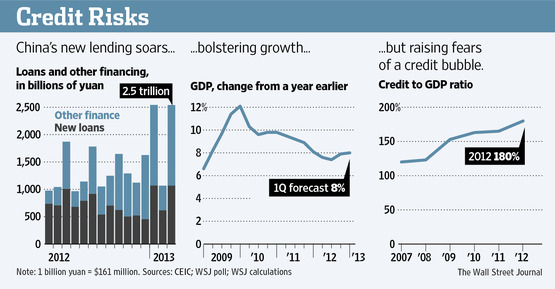
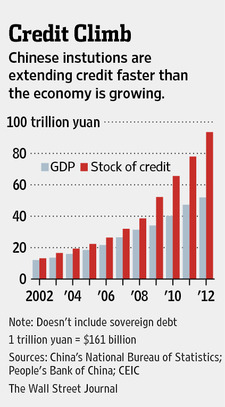
BEIJING—A surge in lending that defied Beijing’s efforts to mop up liquidity presents China’s new leaders with the tough prospect of risking a budding growth revival by cracking down too hard to head off a bad-loan crisis.

China has been on a credit binge since the global financial crisis of 2008, initially a deliberate strategy by leaders to finance investment and support economic growth. But the growing level of debt—domestic debt has topped 200% of gross domestic product, by some estimates—has prompted concerns that China faces a banking bust in the coming years. To forestall that prospect, Chinese regulators have tried to get banks and other financial institutions to somewhat dial back credit.

So far, those efforts have failed. Data Thursday showed that bank loans rose sharply in March to 1.06 trillion yuan ($171 billion) from 620 billion yuan a month earlier. A broader measure of credit that includes bonds and nonbank lending—also called total social financing—hit 2.54 trillion yuan in March, up from 1.07 trillion yuan the month before and just shy of January’s record.

“This is a reflection of the fact that China now has a much more diverse credit system” than it once did, said Charlene Chu, a Fitch Ratings Inc. senior director. “In the past, the authorities could give guidance to banks and it would be quickly followed. Now there are many other financial institutions out there” that don’t necessarily follow informal directions of the regulators. Read more of this post

A global shakeup of share markets, flow of funds and indices looms with the opening up of China’s US$3 trillion mainland share market, one of the world’s last big investment frontiers

Published: Friday April 12, 2013 MYT 8:37:00 AM

A global shakeup of share markets, flow of funds and indices looms

LONDON: The opening up of China’s US$3 trillion mainland share market, one of the world’s last big investment frontiers, is setting the stage for a huge shake up of equity indices and global fund flows.

The A-shares of the giant stock markets of Shanghai and Shenzhen have long been no-go areas for international investors, who have been largely confined to the offshore, Hong Kong-listed H-shares that represent China in global equity indices.

These have taken most of the $50 billion or so that EPFR Global estimates has flowed to China equity funds since 1995.

That is about to change. Beijing is expanding its QFII and RQFII quotas, schemes that allow foreigners to buy local assets. Just under 200 foreign money managers now hold total quotas worth nearly $42 billion. Regulators signalled earlier this year that a 10-fold quota increase is on the cards. Read more of this post

The True Chinese Credit Bubble: 240% Of GDP And Soaring

The True Chinese Credit Bubble: 240% Of GDP And Soaring

Tyler Durden on 04/11/2013 15:54 -0400

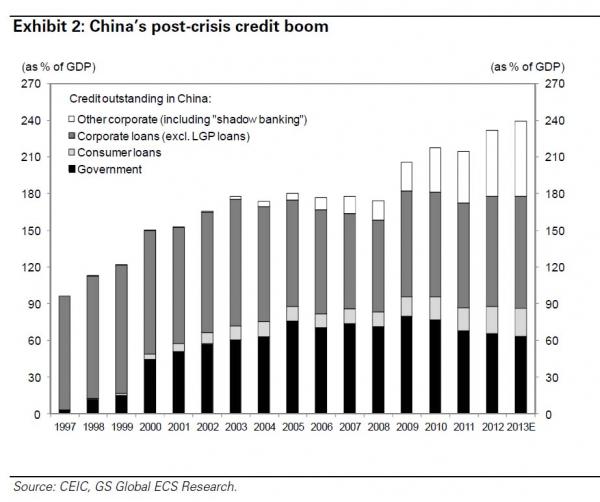
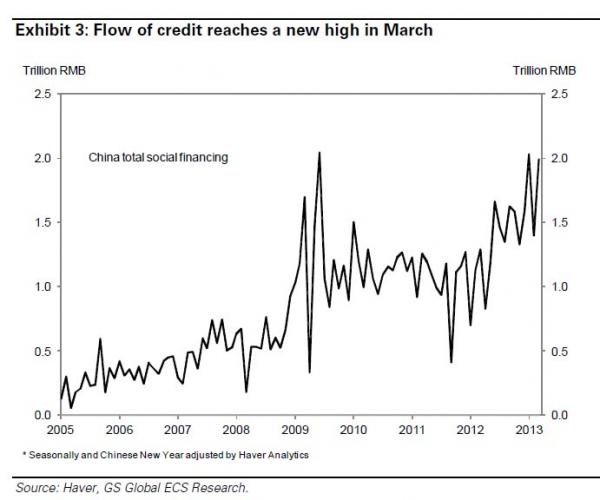
Several months ago we pointed out something not fully grasped by the broader public: the Chinese corporate debt bubble is the largest of any developed and developing country, and at 151% of GDP (and rising rapidly) is the biggest in the world. What is better known is that corporate debt is just one part of the total debt picture, which also includes consumer loans, government debt and other “shadow debt” credit in the case of China. So how does China’s true debt picture as a percentage of debt look? As the chart below from Goldman shows, in 2013 the total credit outstanding in China is expected to rise to a whopping 240% of GDP, and continue rising from there at an ever faster pace. What is even more concerning is that in order to maintain its breakneck economic “growth” of ~8% per year, China has to continue injecting massive amounts of debt, the so called “credit impulse” or “flow” which according to assorted views, is what is the true driver of an economy, and where GDP growth is merely a reflection of how much credit is entering (or leaving) the system. The chart below shows that total Chinese social financing flow just hit a record for the month of March. Completing the picture is the estimated economic response to a surge in credit. As the last chart shows, in China the biggest benefit to a surge in flow is felt in the quarter immediately following the credit injection, as one would expect, with the effect tapering off and even going negative in future quarters, thus requiring even more debt creation to offset the adverse impacts of prior such injections. What should become obvious is that in order to maintain its unprecedented (if declining) growth rate, China has to inject ever greater amounts of credit into its economy, amounts which will push its total credit pile ever higher into the stratosphere, until one day it pulls a Europe and finds itself in a situation where there are no further encumberable assets (for secured loans), and where ever-deteriorating cash flows are no longer sufficient to satisfy the interest payments on unsecured debt, leading to what the Chinese government has been desperate to avoid: mass corporate defaults. At that point it will be up to the PBOC to do what the Fed, the ECB, the BOE and the BOJ have been doing: remove any pretense of money creation via the commercial bank complex (even if these are merely glorified government-controlled entities), and proceed to outright monetization of de novo created assets, thus flooding the system with as much money as is needed to preserve the illusion of growth. Naturally, with the Chinese stock market having proven itself to be a horrible inflation trap (and as a result the bulk of new levered money creation goes into real estate), the inflation explosion that would result would be epic. At that point the chart of the price of gold (in any currency) due to on the ground demand for capital preservation will make the Bitcoin chart pre-bubble pop, seem outright flat.

China Credit_0China flow of credit_0China response to credit surge_0

A Chinese government spokesman said he gave “incorrect” and “groundless” investment data sourced from the Internet, underscoring concern at the credibility of official numbers.

China Customs Official Apologizes for Incorrect Data

A Chinese government spokesman said he gave “incorrect” and “groundless” investment data sourced from the Internet at a briefing yesterday, underscoring concern at the credibility of official numbers.

Zheng Yuesheng, spokesman and head of the statistics department at the Beijing-based General Administration of Customs, said in a statement today that he “expresses deep apologies” for citing unconfirmed investment data from online sources he didn’t identify.

Zheng was referring to remarks he made at a customs administration press conference yesterday where he also acknowledged concerns that China’s export data may be overstated. During the briefing, held to discuss March and first-quarter trade figures, Zheng said the National Development and Reform Commission, the nation’s top economic planning agency, had approved about 7 trillion yuan of investment projects in the fourth quarter of 2012, including new roads, railroads and airports.

He gave the figure when discussing the improvement in first-quarter trade to illustrate the recovery in China’s economic growth.

“The information was sourced from relevant reports on the Internet, which were groundless and must be corrected,” Zheng said in a seven-line statement on the agency’s website. Read more of this post

Pentagon Says Nuclear Missile Is in Grasp for North Korea

April 11, 2013

Pentagon Says Nuclear Missile Is in Grasp for North Korea

By THOM SHANKER, DAVID E. SANGER and ERIC SCHMITT

WASHINGTON — A new assessment by the Pentagon’s intelligence arm has concluded for the first time, with “moderate confidence,” that North Korea has learned how to make a nuclear weapon small enough to be delivered by a ballistic missile.

The assessment by the Defense Intelligence Agency, which has been distributed to senior administration officials and members of Congress, cautions that the weapon’s “reliability will be low,” apparently a reference to the North’s difficulty in developing accurate missiles or, perhaps, to the huge technical challenges of designing a warhead that can survive the rigors of flight and detonate on a specific target.

The existence of the assessment was disclosed on Thursday by Representative Doug Lamborn, Republican of Colorado, three hours into a budget hearing of the House Armed Services Committee with Defense Secretary Chuck Hagel and the chairman of the Joint Chiefs of Staff, Gen. Martin E. Dempsey. General Dempsey declined to comment on the assessment because of classification issues. Read more of this post

How to Defeat North Korea

How to Defeat North Korea

Let’s start with the bad news: The North Korean problem has no simple or quick solution. The North’s weapons-grade plutonium and nuclear devices have already been manufactured, and are now safely hidden in underground facilities. China, and to a lesser degree Russia, remains unwilling to support a truly rigorous (read: efficient) sanctions regime. More narrow financial sanctions that target the money used to reward regime insiders with perks, like bottles of Hennessy cognac and Mercedes cars, won’t have much impact. Most of the North Korean elite believe that regime stability is a basic condition for their survival. No doubt, they would be willing to put up with locally produced liquor and used Toyotas if the alternative was being strung from the lampposts.

More international aid would be most welcome in Pyongyang, no doubt — but not enough for the regime to give up its nuclear program. Once the money was spent (and it would be spent quickly), a nonnuclear North Korea would be just another impoverished country, competing for attention with places such as Sudan and Zimbabwe. A U.S. security guarantee — another carrot held out by some in Washington — wouldn’t be any more enticing. North Koreans don’t believe in the value of foreigners’ promises, especially when such promises are made in democratic systems where leaders and policies change every few years. Read more of this post

Tepco Faces Decision to Dump Radioactive Water in Pacific Ocean

Tepco Faces Decision to Dump Radioactive Water in Pacific Ocean

Tokyo Electric Power Co. (9501)’s discovery of leaks in water storage pits at the wrecked Fukushima atomic station raises the risk the utility will be forced to dump radioactive water in the Pacific Ocean.

Leaks were found in three of seven pits in the past week, reducing the options for moving contaminated water from basements of reactor buildings. Water in the basements is from the months after the earthquake and tsunami disabled the plant two years ago, when disaster teams used hose pipes and pumps to try and cool the reactors.

While the company has since built a makeshift sealed cooling system, underground water is breaching basement walls at a rate of about 400 tons a day and becoming contaminated, according to Tepco’s estimate. With Japan’s rainy season approaching, contaminated water levels are likely to increase at the plant 220 kilometers (137 miles) northeast of Tokyo.

Reducing radiation levels in the water and pouring it into the sea is one of two options the utility has, said Kazuhiko Kudo, a research professor of nuclear engineering at Kyushu University. The other option is “to keep building above-ground storage tanks,” said Kudo. That’s a fight Tepco can’t win without stopping the underground water that’s pouring into the basements, Kudo said.

“It is like a well. No matter how much water you draw from a well, underground water keeps seeping into the well,” said Kudo, who also served on a safety advisory board for the Fukushima plant after the disaster for the now defunct Nuclear and Industrial Safety Agency. Read more of this post

Rahul Gandhi’s Bumbling, Befuddling `Beehive Speech’; He offered, according to a member of the audience, “no road map, no plan, no solution.”

A Gandhi’s Bumbling, Befuddling `Beehive Speech’

The young Indian politician Rahul Gandhi, whose bloodline includes three former prime ministers, is widely expected to be his party’s nominee for that post when elections are held in the first half of 2014. But even Gandhi’s supporters within his Congress Party were frequently bemused by a speech he made to more than 1,000 prominent members of the Indian business community last week.

At a meeting organized by the Confederation of Indian Industry, the 42-year-old Gandhi stood out among the elegant suits and saris of businessmen and women. He chose to wear the male Indian politician’s traditional garb of a simple white kurta-pajama. His words, however, were less distinctive. It was always going to be difficult to recover from a beginning as hokey as:

“There is a tendency to look at India as a country. In our everyday life we see India as a national structure. But if you go back slightly more than that, go back a hundred, two hundred years, you would find that India is energy, it is a force.”

Holding the stage for more than an hour, he presented a vision of the state of the nation and its future that was a grab bag of disjointed metaphors and rambling platitudes. (“Embracing the excluded is essential to the wealth of the nation. If we do not embrace them, we will all suffer.”) He offered, according to a member of the audience, “no road map, no plan, no solution.” Read more of this post

Alibaba’s Taobao Bans Live Poultry Trading on Bird Flu

Alibaba’s Taobao Bans Live Poultry Trading on Bird Flu

(Corrects that Alibaba hasn’t banned poultry trading.)

Alibaba Group Holding Ltd. and other Chinese e-commerce sites are taking steps to protect against the spread of bird flu as concerns rise the H7N9 variant that’s killed nine people could spur an epidemic.

Alibaba’s e-commerce platform Taobao Marketplace said it would shut down online trading of live poultry “under necessary circumstances” this week. Shanghai-based Tony’s Farm and Beijing-based www.tootoo.cn have halted the sales. Web retailer 360buy Jingdong Inc. will cut down on face-face meetings with suppliers, and stop offering pork and poultry at its employee cafeteria, Richard Liu, chief executive officer of Jingdong, said in a letter to employees last week.

The H7N9 cases may become an opportunity for e-commerce companies as fears of infection prompt more people to stay home and shop online. A 2003 outbreak of Severe Acute Respiratory Syndrome helped make e-commerce popular just as it was getting started, said Cao Lei, a director at Hangzhou-based China e- Business Research Center. Read more of this post

Swedish Banks Make Money Ditching Cash as Krona Goes Virtual

Swedish Banks Make Money Ditching Cash as Krona Goes Virtual

If you’re looking for Swedish cash, don’t go to a Swedish bank.

Most of the country’s biggest lenders, SEB AB, Swedbank AB (SWEDA) and Nordea Bank AB (NDA), have stopped manual cash-handling services in 65 percent to 75 percent of their local branches. They say cash is out as Swedes rely on credit cards, the Internet and mobile phones to make all their payments.

The country’s bank notes, which are adorned with images of famous Swedes including botanist Carl Linnaeus and will soon also feature legendary actress Greta Garbo, are only used in about 20 percent of shop transactions, according to data from the Swedish Trade Federation. In the U.K., whose capital London is a global hub for high finance, all banks still offer cash at their branches.

“We’ve removed the manual cash handling simply because we’re seeing a change in behavior among our customers,” Swedbank spokeswoman Anna Sundblad said in an e-mailed reply to questions. “Only 5 percent of our customers make over-the- counter cash transactions.”

Customer demand for cash services at Nordea, Scandinavia’s biggest bank, is dropping by about 20 percent a year, spokesman Erik Durhan said. According to Nordea Chairman Bjoern Wahlroos, the end of cash is a natural next step in an evolutionary process that has already led to the extinction of cheque books. In this respect, Scandinavia is far ahead of the U.K. and the U.S., he said. Read more of this post

China’s New Leaders, New Credit Binge; China’s economy has new leaders, not yet new ways. A surge in lending and capital inflows in the first quarter may be a precursor for tightening down the road.

April 11, 2013, 3:13 a.m. ET

China’s New Leaders, New Credit Binge

By TOM ORLIK

WO-AN328A_CRATI_NS_20130409150005

China’s economy has new leaders, not yet new ways.

The first quarter brought a surge in credit creation. Total social finance, a measure that includes new loans as well as bond issuance and other forms of credit, increased 6.2 trillion yuan ($1 trillion)—a record high. China’s stash of foreign exchange came in at $3.44 trillion at the end of March—up $128.4 billion for the quarter after tepid increases in 2012.

It all looks like a throwback to China under its previous set of leaders. The People’s Bank of China is in the markets buying dollars, resulting in larger foreign-exchange reserves and more liquidity in the financial system. That should certainly allay fears about China’s growth. A 58% year-on-year increase in new finance will surely prop up an expansion in output above the government’s 7.5% target.

By extending the policies of previous Chinese leaders, though, Beijing exacerbates the risk of inflation and asset-price bubbles. Consumer price inflation for March came in at a moderate 2.1% year on year. But massive increases in credit can only add to the upward pressure on prices.

Equally worrying is the rapid rise in the ratio of credit to gross domestic product. That measure has moved from 120% in 2007 to about 180% at the end of 2012. On the current trajectory, it will end 2013 at 200%. Such a sharp shift raises concerns about the possible misallocation of credit on a grand scale, and a buildup of bad assets in the banking sector.

The central bank’s recent efforts to restrain credit growth have been limited to timid attempts to drain liquidity from the financial system. To head off problems down the road, much more aggressive moves will be required. A surge in lending and capital inflows in the first quarter may be a precursor for tightening down the road.

Billionaire “grave dancer” investor Sam Zell: “The Stock Market Feels Like The Housing Market Of 2006”

Sam Zell: “The Stock Market Feels Like The Housing Market Of 2006”

Tyler Durden on 04/10/2013 22:34 -0400

Instead of the endless procession of “different this time”, “buy-the-dip”, “money-on-the-sidelines” asset-gathering, Muppet-fleecers that CNBC so typically trots out, Sam Zell graced them with his presence and the truth was allowed a voice for a few minutes. Joined by David Rosenberg, who clarifies the insanity that engulfs US equities, explaining in wonderment that it is “not surprising the market rises even in the face of bad ISMs, worse jobs, and worst NFIB data, because Japan and the US are embarking on a gargantuan quantitative easing that is the lynchpin behind the stock market.” It is not about being bullish, or bearish, or agnostic, it is understanding the driver of this market – and that is not the economy, not earnings, “it is the mother of all liquidity-driven rallies.” Maria B, soundbite in hand, is slammed for her “glibness” at not fighting the Fed but it is Sam Zell’s brutal honesty that shocks even the money-honey. “This is a very treacherous market,” Zell explains – thanks to the giant tsunami of liquidity, “the problems of 2007 haven’t been dealt with,” and given the poor macro data and earnings, “we are suffering through another irrational exuberance,” leaving the entire CNBC audience speechless when he concludes, “the stock market feels like the housing market of 2006.” It’s hump-day, grab the popcorn, and treat yourself to a sanity-check.

Maria B:

“So don’t fight the Fed?“

Rosenberg:

“That’s a pretty glib comment for what is going on. You could have fought the Fed in 2000 and 2009 and done quite well… [thanks to the Fed] the market will tend to drift up – until something breaks.”

Zell:

“We’re debasing our currencies around the world.. which ultimately translates into a lot of inflation.”

“What we are seeing here is like a giant tsunami of liquidity.”

“People look at the market and think things are better. The level of uncertainty has reached a point where people are just throwing money [at risky assets] because they don’t know what else to do with it.”

“I would not be adding money to the stock market. This is a very treacherous market.”

“Yes, it’s gone up every day. Yes, you’re not supposed to fight the Fed, but sitting on the sidelines is preferable.”

“In our businesses, we are not seeing strong conditions.”

“The problems leading up to 2007 haven’t been dealt with.”

Then at 6:00

Zell:”The current stock market feels like the housing market of 2006. Everybody can’t afford to miss it.”

Maria B: “That’s a scary comment.”

Zell: “Why? Every single day it goes up. What were the headlines in 2006 – housing prices going up every day. What are you talking about every day now – new high in stocks every day!”

“We are suffering through another irrational exuberance.”
‘Dragons’ Fight ‘Samurai’ for Bigger Slice of Indonesian Sugar Market

‘Dragons’ Fight ‘Samurai’ for Bigger Slice of Indonesian Sugar Market
Michael Taylor & Yayat Supriatna | April 11, 2013

Workers load sacks of sugar from a warehouse onto a truck for distribution to the traders in Sidoarjo of Indonesia\’s East Java province February 12, 2013. White sugar prices hit a record in Indonesia last summer and further spikes are expected this year even though the world is awash with the sweetner. The main cause, say critics, is a small group of traders known in the industry as sugar samurai. (Reuters Photo/Sigit Pamungkas)

When Indonesian white sugar prices surged to record peaks last year, profits slumped at the small fruit and syrup drinks stall run by Lie Lie in Medan, the archipelago’s fourth-largest city.

Lie Lie is part of the household industry that Indonesia’s sugar refineries — dubbed “sugar dragons” because of their growing size and clout in the sector — want to supply with cheaper and better quality sweetener. Read more of this post

Asean bubble fears emerge

April 11, 2013 4:54 am

Asean bubble fears emerge

By Jeremy Grant in Singapore

When a team of analysts at Credit Suisse visited Indonesia a few weeks ago to take the temperature of Southeast Asia’s biggest economy, they were startled by what they were told by one of the country’s biggest property developers.

Ciputra Development, which builds luxury condominiums, said that, while prices in central Jakarta, the capital, had been growing at a rapid clip – about 30-40 per cent a year – a new trend had emerged.

Demand had started to spill over to greater Jakarta and even to so-called second-tier cities, where Ciputra had seen property prices jump by 50 per cent last year.

“We felt this was evidence of a property bubble,” says Robert Prior-Wandesforde, director of research in the bank’s Singapore office. Read more of this post

Land grabs rile Vietnam’s farmers

April 11, 2013 6:23 am

Land grabs rile Vietnam’s farmers

By Nguyen Phuong Linh in Haiphong

Fish farmer Doan Van Vuon was jailed last week for five years for shooting at police and local officials when they tried to confiscate his land near the northern port city of Haiphong last year. Those like him who oppose the powers-that-be in Vietnam, an authoritarian Communist state, are usually shunned by a fearful public.

But Mr Vuon has become a folk hero, symbolising popular resentment against land grabs by local officials, a problem that is also rampant in China, Vietnam’s fellow Communist neighbour.

On Wednesday, one of the officials responsible for Mr Vuon’s eviction was jailed for 30 months for destruction of property but Vietnam’s increasingly vocal bloggers and land activists were less than impressed.

“There was no justice in this trial, it is a joke,” says Vu Van Luan, another fish farmer from Mr Vuon’s village of Tien Lang. Read more of this post

The price of onions is making Indonesians cry, steal, and scapegoat

The price of onions is making Indonesians cry, steal, and scapegoat

By Roberto A. Ferdman — 3 hours ago

The price of onions in Indonesia has soared so high that people are resorting to stealing the crop. Farmers are spending nights in their fields to ward off thieves.

But while they cry over lost onions, government officials seem more concerned with finding a scapegoat for the extended spike in onion prices. A paltry 10% of Indonesia’s onions are grown domestically; they cost 10,000 rupiahs ($1.26) per kilogram, up 400% from the end of last year.

Indonesia is hardly the only country where the price of onions—a staple of Asian cooking—matters so much. A popular book titled The Price of Onions by Ashok Desai maintains they are at the heart of understanding the Indian economy. A more recent article in the Times of India refers to doubling prices as “the Great Onion Robbery.” Read more of this post

Chinese hipsters help Uniqlo thrive despite anti-Japanese xenophobia

Chinese hipsters help Uniqlo thrive despite anti-Japanese xenophobia

By Naomi Rovnick — 6 hours ago

Japanese brands have had a difficult time in China since the two Asian nations began rowing furiously over a set of uninhabited islands in the East China Sea. But one business has been spared: Uniqlo, the skinny jeans giant that is about to open a new, 6600 square meter flagship store in Shanghai that will be its largest worldwide.

Uniqlo parent Fast Retailing said the fashion brand’s China sales for the three months to last November exceeded its conservative expectations. (Fast didn’t break out actual numbers but did raise earnings estimates for its non-Japan business on the back of strong performance in Asia.) And this success came at a time when China’s anti-Japan propaganda and rioting were at fever pitch.

How is Uniqlo escaping anti-Japan sentiments? It basically comes down to Chinese hipsters. Uniqlo is positioned as a low-cost, affordably chic brand in the West, but lower average incomes mean that its Chinese customers there are middle or upper-middle class—a group whose outlook is more global than nationalist and who do not blindly follow anti-Japanese rhetoric. This is the type of Chinese person who would own or aspire to own an iPhone, and who might have used the Weibo microblog service to mock the Beijing government’s ongoing PR campaign against Apple. Read more of this post

Crony capitalism in Myanmar makes foreign investments dicey—at least for the West; “There are very few businesses or business people that our Western investors would consider to be clean.”

Crony capitalism in Myanmar makes foreign investments dicey—at least for the West

By Naomi Rovnick — 9 hours ago

Myanmar’s economy is forecast to grow over 6% this year as new foreign investment surges into the former hermit kingdom, but Western companies have been slow to join the party. Most investment is set to come from other emerging markets in Asia or beyond, where companies are more comfortable dealing with corruption and ethically questionable partners.

Despite recent reforms, doing business in Myanmar is still a murky affair. Take, for example, the country’s gas stations—potentially a great investment in a frontier market where many people are poised to grow rich enough to buy mopeds and eventually even cars. A local lawmaker has claimed 247 state-owned stations that were privatized in 2010 were sold at “very low prices” to a military-owned trading company and other firms with close ties to the generals. (In 2010, the junta lost some of its power and Myanmar got a semi-civilian government.)

Getting into bed with the military and former junta officials could be a reputational risk too far for Western corporations. The junta leaders were responsible for gross human rights violations such as conscripting child soldiers (which still happens) and colluding (pdf p.144) with drug and people traffickers. A deal with such partners raises the risk of a boycott at home or a US Foreign Corrupt Practices Act investigation. Read more of this post

Real money starts to pour into math-based currencies like bitcoin

Real money starts to pour into math-based currencies like bitcoin

By Zachary M. Seward — 1 hour ago

Chris Dixon, a partner at the venture capital firm Andreessen Horowitz, posted this brief observation on Tumblr the other day:

Three eras of currency
Commodity based, e.g. Gold
Politically based, e.g. Dollar
Math based, e.g. Bitcoin

Now Dixon’s firm and several other well known investors are putting some money—in this case, politically based US dollars—behind their conviction that the future of money is in “math-based” currencies like bitcoin. OpenCoin, a San Francisco startup that runs its own math-based currency, just announced a round of funding from Andreessen Horowitz, Founders Fund, Lightspeed Venture Partners, Vast Ventures, and Bitcoin Opportunity Fund. News of the round was embargoed until this morning, and its size wasn’t disclosed.

The currency operated by OpenCoin is called “ripple.” Like bitcoin, it’s both a currency and a network for facilitating payments that relies on cryptography to run smoothly. Thus, math-based currencies: They are backed by one’s faith that the math works rather than trust in government or a metal’s inherent value. Read more of this post

Gold, Long a Secure Investment, Loses Its Luster

April 10, 2013

Gold, Long a Secure Investment, Loses Its Luster

By NATHANIEL POPPER

Below the streets of Lower Manhattan, in the vault of the Federal Reserve Bank of New York, the world’s largest trove of gold — half a million bars — has lost about $75 billion of its value. In Fort Knox, Ky., at the United States Bullion Depository, the damage totals $50 billion.

And in Pocatello, Idaho, the tiny golden treasure of Jon Norstog has dwindled, too. A $29,000 investment that Mr. Norstog made in 2011 is now worth about $17,000, a loss of 42 percent.

“I thought if worst came to worst and the government brought down the world economy, I would still have something that was worth something,” Mr. Norstog, 67, says of his foray into gold.

Gold, pride of Croesus and store of wealth since time immemorial, has turned out to be a very bad investment of late. A mere two years after its price raced to a nominal high, gold is sinking — fast. Its price has fallen 17 percent since late 2011. Wednesday was another bad day for gold: the price of bullion dropped $28 to $1,558 an ounce.

It is a remarkable turnabout for an investment that many have long regarded as one of the safest of all. The decline has been so swift that some Wall Street analysts are declaring the end of a golden age of gold. The stakes are high: the last time the metal went through a patch like this, in the 1980s, its price took 30 years to recover. Read more of this post

The Two Innovation Economies

William Janeway

William Janeway, a managing director and senior adviser at the private-equity firm Warburg Pincus, is a visiting lecturer in economics at Cambridge University.

The Two Innovation Economies

10 April 2013

HONG KONG – For 250 years, technological innovation has driven economic development. But the economics of innovation are very different for those at the frontier versus those who are followers striving to catch up.

At the frontier, the innovation economy begins with discovery and culminates in speculation. From scientific research to identification of commercial applications of new technologies, progress has been achieved through trial and error. The strategic technologies that have repeatedly transformed the market economy – from railroads to the Internet – required the construction of networks whose value in use could not be known when they were first deployed.

Consequently, innovation at the frontier depends on funding sources that are decoupled from concern for economic value; thus, it cannot be reduced to the optimal allocation of resources. The conventional production function of neoclassical economics offers a dangerously misleading lens through which to interpret the processes of frontier innovation. Read more of this post

In China, Feudal Answers for Modern Problems; “How much longer will Mao’s portrait hang on Tiananmen?” “If Mao knew his China would be reduced to this, he’d insist that his portrait be taken down right away.”

April 10, 2013

In China, Feudal Answers for Modern Problems

By YU HUA

After Mao Zedong announced the establishment of the People’s Republic of China in 1949, the Communist Party began to get rid of all the vestiges of the “feudal” society that had preceded it.

This process culminated during the Cultural Revolution (1966-76) with the campaign to “Destroy the Four Olds”: old thought, culture, customs and habits. Cultural relics and temples were feudal, and so, too, were traditional celebrations, like the springtime Qingming (tomb sweeping) and Dragon Boat Festivals and the Mid-Autumn Festival.

In Beijing, restaurant names like Donglaishun (East Come Smoothly) and Quanjude (Consummate Virtue) were written off as feudal, and Tongren (Equal Kindness) Hospital and Xiehe (Assisting Harmony) Hospital were renamed Worker-Peasant-Soldier Hospital and Anti-Revisionism Hospital, respectively. In a little town between Shanghai and Hangzhou, the street I lived on as a child, Yang Family Alley, became Sunnyside Alley.

With Mao’s death in 1976 and the onset of market reforms under Deng Xiaoping, the four olds, so long vilified, all of a sudden became jewels of traditional culture. Donglaishun’s poached mutton and Quanjude’s roast duck are now culinary highlights in Beijing. Heritage sites everywhere are being protected and restored (though not always faithfully), while temples and monasteries are once more crowded with worshipers. Traditional festivals have become official public holidays. Soothsayers and fortunetellers, once forced into hiding, are now a dime a dozen. The Sunnyside Alley of my boyhood has reverted to being Yang Family Alley. Most strikingly, practices that used to be criticized as feudal have become, in the hands of some shrewd Communist officials, favored management techniques.

The corruption, income inequality and environmental degradation that have accompanied China’s breakneck economic development over the last 30 years have provoked social unrest. In 2010, China had 180,000 “mass incidents,” the official euphemism for protests — a fourfold increase over the previous decade. Methods of social control that once worked like charms are now losing their efficacy. So the Central Party School and its provincial subsidiaries, which train China’s leaders, are revamping curriculums. Each year they send student-officials to Harvard to study Western management.

But they are often finding that it’s the old feudal customs, so repugnant to Mao, that help them keep a grip on society. Read more of this post

Europe’s toxic air: Clearer but not clean

Europe’s toxic air: Clearer but not clean

LONDON / BRUSSELS — Europeans no longer see the kind of pollution that within living memory killed thousands of Londoners in the Great Smog of 1952, but the air they breathe still bears invisible threats scarcely less deadly, and little more controlled.

34 MIN 7 SEC AGO

LONDON / BRUSSELS — Europeans no longer see the kind of pollution that within living memory killed thousands of Londoners in the Great Smog of 1952, but the air they breathe still bears invisible threats scarcely less deadly, and little more controlled.

While attention is given to curbing the carbon dioxide emissions blamed for global warming, substances more directly harmful to human health, notably nitrogen oxides, are pumped out of diesel engines and from European power stations burning coal that is getting cheaper as Americans exploit new gas reserves.

The result, say those campaigning for change, is ever poorer air quality shortening lives. Yet a move by the European Commission to tighten vehicle emissions rules is being challenged by some car makers. Read more of this post

Iron Ore’s $250 Billion Glut Pressures Rio to Vale: Commodities

Iron Ore’s $250 Billion Glut Pressures Rio to Vale: Commodities

The world’s biggest iron-ore producers are planning $250 billion of new mines, threatening to deepen a price slump for the commodity already forecast to drop for at least the next three years.

Mining companies are facing growing investor pressure to defer or cancel projects to stem price declines. Rio Tinto Group (RIO), the second-largest iron ore exporter, will decide on one of the biggest industry expansions in Western Australia in the second half. A decision to delay would boost its earnings in 2015 by $3.7 billion, according to Liberum Capital Ltd.

The price of iron ore, the most shipped commodity after oil, more than tripled in the past decade, encouraging the biggest mining companies to boost output. That was before a surge in Chinese steel output that drove the bull market through 2011 started to wane. Given iron ore operations made up 78 percent of Rio’s earnings last year and more than 90 percent at Brazil’s Vale SA (VALE5), producers are being forced to review plans.

“It’s the most important issue the mining industry is facing today — whether or not to collectively act to destroy the single greatest source of value generation,” said Paul Gait, a London-based analyst at Sanford C. Bernstein & Co. “Getting this right and not repeating the mistakes of the past is absolutely key.” Read more of this post

Ghost of Suharto Seen in Boomtowns Leading Indonesia’s Growth

Ghost of Suharto Seen in Boomtowns Leading Indonesia’s Growth

Five years ago, property agent Daisul Akhyar took 20 minutes to drive to work in Pekanbaru, capital of Indonesia’s Riau province. Now, he can spend two hours in traffic after a surge in wealth transformed the city.

“If you live in Riau now, it’s like living in Jakarta, there are new residential and retail developments all over the city,” Akhyar, a director of local developer PT Asrindo Perdana Mandiri, said in Pekanbaru on Sumatera island. “Selling property in this place is like selling candy to children.”

The world’s fourth most-populous nation is seeing its economy reshaped as cities on islands including Sumatera and Borneo grow faster than Java, home to the nation’s capital, Jakarta. A transmigration program championed by former President Suharto in the 1980s, combined with China’s demand for palm oil, coal and iron from Indonesia’s rural provinces, helped outlying cities expand as much as 4 percentage points faster than the national average over the past decade.

As China’s expansion boosts incomes of miners and farmers in some of the sleepiest and most far-flung corners of Asia, companies from Unilever Plc (ULVR) to Toyota Motor Corp (7203). are flocking to Indonesia’s second-tier cities to tap their rising demand. At the same time, increasing urbanization raises pressure on President Susilo Bambang Yudhoyono to improve infrastructure and strains environmental resources.

“In future, the nation’s economy will be supported by cities outside Java,” Perry Warjiyo, the central bank’s executive director for monetary policy and economic research, said in an interview. “This is in line with the government’s program to spread out economic growth to all the provinces.” Read more of this post