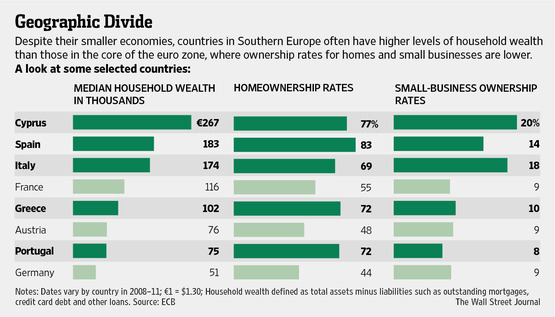
Europe’s Poorest? Look North; Households in Europe’s fragile southern rim have far higher wealth—on paper, at least—than those in Germany, according to an ECB report that may fuel resistance to more bailouts

Updated April 9, 2013, 4:24 p.m. ET

Europe’s Poorest? Look North

ECB Survey Puts Southerners on Top in Household Wealth, Germans Near Bottom

By BRIAN BLACKSTONE and NINA KOEPPEN
WO-AN327D_EUPOO_G_20130409162103

FRANKFURT—German households are among the poorest—on paper, at least—in the euro zone, according to a study by the European Central Bank that adds a new twist to the debate over how far taxpayers in Northern Europe should go to support weaker countries.

The ECB’s findings, released Tuesday, don’t give the full picture of a society’s living standards, which are affected by things like social protection and infrastructure as well. It also is based primarily on data from 2009 and 2010—early days in the still-festering euro crisis. Read more of this post
Japanese Rush to Sell Gold as Price in Yen Jumps; “I learned about the rising price of gold on television and came to sell for the first time,” said 61-year-old Masako Yoshida, as she waited for about an hour to sell

April 9, 2013, 1:53 p.m. ET

Japanese Rush to Sell Gold as Price in Yen Jumps

By KANA INAGAKI And CLEMENTINE WALLOP

MI-BV247_JGOLD_NS_20130409172103

The weak yen has triggered a gold rush, literally, among Japanese households, reflecting how bold new economic policies are shaking up long-entrenched deflationary attitudes, freeing up dormant assets, and sparking new economic activity.

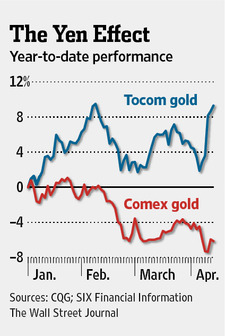
While gold prices have softened globally, the declining value of the yen against the dollar makes the precious metal worth a lot more in Japan. Japanese families are now scrambling to dig out gold objects from closets and jewelry boxes, and selling it to metals dealers, converting their passive assets into cash that some say they plan to put to work on everything from vacations to children’s allowances.

Long lines have formed this week outside jewelers from Tokyo to Osaka, with the price of gold in Japan jumping 4.8% this week as the dollar came close to hitting ¥100, up from about ¥80 late last year.

“I learned about the rising price of gold on television and came to sell for the first time,” said 61-year-old Masako Yoshida, as she waited for about an hour on Tuesday to sell a collection of gold rings she received from her mother about three decades ago. She said she planned to use the money to eat good food and buy souvenirs when she travels to Kyushu in southern Japan in May. Read more of this post

The Hazards of Betting on M&A in Asia

Updated April 9, 2013, 2:14 p.m. ET

The Hazards of Betting on M&A in Asia

By ISABELLA STEGER And CYNTHIA KOONS

AI-CA227_ASIADE_G_20130409222403

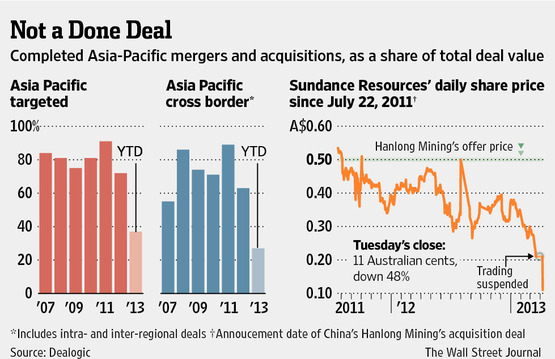
The collapse of Sichuan Hanlong Group’s acquisition of Australia’s Sundance Resources SDL.AU -2.73% —news that sent the iron-ore miner’s share price tumbling—has highlighted the challenges faced by hedge funds seeking to bet on such deals in Asia.

“The market has been saying for some time that the deal is probably off,” said Tom Elliot, chief investment officer at Beulah Capital. On Monday, Sundance said it terminated an agreement to be acquired by Sichuan Hanlong.

The collapse of the deal has burned hedge funds that have bought into Sundance, people with knowledge of the funds’ positions said, without identifying them. Hedge funds use merger-arbitrage strategies such as buying shares in a company that is being taken over at below the offer price, in hopes that the deal will be completed, yielding a profit.

“As far as I can tell, the hedge funds have not been able to fully exit the stock,” Mr. Elliot said. Read more of this post

Chinese Dilemma: 170 Auto Makers

Updated April 9, 2013, 10:31 p.m. ET

Chinese Dilemma: 170 Auto Makers

Local Government Incentives Keep Small Companies Expanding Even as Beijing Tries to Encourage Industry Consolidation

MK-CC276_CCAR_NS_20130409172708

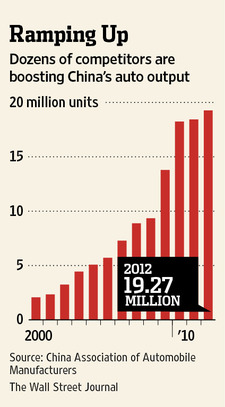
TAIZHOU, China—The U.S. auto industry has long had three big domestic car makers. China has more than 170, including tiny Zhejiang Jonway Automobile Co.

Jonway makes a sport-utility vehicle named after the Airbus A380 jumbo jet. Its A380 SUV starts at 70,000 yuan ($11,272) and is marketed as a smooth, low-maintenance ride.

Customers aren’t buying it. Last year Jonway sold about 5,000 cars compared with the more than 7,000 that Volkswagen AGVOW.XE -2.28% sells on average in China every day. Read more of this post

Why Capitalism Won’t Change North Korea’s Regime

Why Capitalism Won’t Change North Korea’s Regime

To an outside observer, the behavior of the North Korean leadership often appears short- sighted and irrational. There seems to be a tested and easy way out of their predicament — the path of Chinese-style economic reforms. While such gradual capitalist reforms might be good for the country, however, they would be far too dangerous for the current North Korean elite. As a consequence, they’re unlikely to be implemented anytime soon.

The history of East Asia after World War II has been, above all, one of spectacular economic growth. From 1960 to 2000, average per-capita gross-domestic-product growth in East Asia reached 4.6 percent, while the same indicator for the world was 2.8 percent. In 1960, in terms of per-capita GDP, South Korea ranked slightly below Somalia, while Taiwan lagged behind Senegal.

The remarkable economic transformation of those two Asian economies was overseen by governments that were decisively illiberal and undemocratic. These regimes are often described as “developmental dictatorships” — largely because they combined authoritarian politics with an obsessive focus on economic growth. The military regime in South Korea, and a hereditary dictatorship in Taiwan, spouted anti-Communist rhetoric and paid lip service to the principles of the “free world,” while pushing a market-driven but government-controlled development strategy. Lacking natural resources, they emphasized cheap labor and economic efficiency, and they were successful beyond anybody’s wildest expectations.

Perfect Machiavellians Read more of this post

Mongolia Scolds Rio Tinto on Costs as Mine Riches Replace Yurts

Mongolia Scolds Rio Tinto on Costs as Mine Riches Replace Yurts

Outside, it’s minus 30 degrees Celsius as a February wind blasts across the Central Asian steppe and through the Mongolian capital, Ulaanbaatar. Inside Government House, President Tsakhia Elbegdorj delivers a televised speech that simultaneously warms his people and chills foreign investors.

The country’s 76 legislators have convened to debate the future of one of the planet’s richest copper and gold mines, Oyu Tolgoi, which is 66 percent owned by London-based Rio Tinto Group (RIO) and 34 percent owned by the state. Elbegdorj tells them Rio Tinto has let the project’s total cost balloon by $10 billion. The higher expenses, which Rio Tinto disputes, would diminish and delay profits the government shares in, Bloomberg Markets magazine will report in its May issue.

“The time has come for the Mongolian government to take Oyu Tolgoi matters into its own hands,” Elbegdorj says to cheers from the lawmakers. His demands include giving Mongolian employees more management positions on the project, which is scheduled to begin exporting copper concentrate by June.

Few things matter more today in the political and economic life of this landlocked country of 2.8 million people than foreign investment to develop its mineral wealth. Mining money has spawned gleaming office towers, pricey gated communities and luxury-car dealerships in the capital. And yet, half of all Mongolians still live like their nomadic ancestors in circular felt yurts that can be dismantled and moved. Read more of this post

Mine Town Rents Beating Manhattan Show Aussie Pain: Commodities

Mine Town Rents Beating Manhattan Show Aussie Pain: Commodities

A furnished two-bedroom apartment in Port Hedland, the world’s biggest bulk export terminal, on Australia’s cyclone-battered north-western coast rents for almost the price of a three-bedroom penthouse in Manhattan.

The $8,155 a month price for the rental on Anderson Street – that’s typically used by mining companies to house personnel – compares with about $8,500 for three bedrooms with pool access and doorman on the Upper West Side. Port Hedland house prices gained 20 percent annually in the past 10 years, according to Real Estate Institute of Western Australia data. It’s a symptom of the high costs dogging Australia’s mining industry that’s at the tipping point of its biggest boom in a century.

The pain is set to worsen for producers, including Rio Tinto Group (RIO), which sell commodities in dollars and pay costs in the local currency that hit a 28-year high last month on a trade-weighted index. The so-called Aussie may not drop in tandem with metal prices, robbing miners of a traditional cost remedy in a nation where salaries for oil and gas industry professionals already average the equivalent of $163,600 a year, the world’s highest, according to recruiters Hays Plc. (HAS)

“If you’re in coal, it’s near a disaster at the moment,” Paul McTaggart, a Sydney-based resources analyst with Credit Suisse Group AG, said by phone. “It’ll be a problem for most sectors of the mining industry” should the so-called Aussie remain close to its near-record levels, he said. Read more of this post

South Korea Braces for Possible Missile Test From North Today

South Korea Braces for Possible Missile Test From North Today

South Koreans braced for a possible North Korean missile or a nuclear weapons test as soon as today as a top American military commander said the totalitarian state has moved at least one projectile to its eastern coast.

South Korean and U.S. forces upgraded their joint surveillance “Watchcon” status by one level to monitor an imminent ballistic missile test, Yonhap reported, citing unidentified military officials. Japan deployed missile interceptors around the country as Prime Minister Shinzo Abe’s government vowed to protect its citizens.

Admiral Samuel Locklear, head of U.S. Pacific Command, confirmed yesterday to Congress that North Korea moved at least one of its medium-range Musudan missiles to its eastern coast. Efforts by Kim Jong Un’s regime to build and test weapons of mass destruction “represent a clear and direct threat to U.S. national security and regional peace and stability,” he said.

Kim’s regime has threatened to launch pre-emptive nuclear strikes against its enemies, and this week pulled workers from a joint industrial complex with South Korea. Tensions have risen since North Korea’s February atomic weapons test in defiance of tightened United Nations sanctions that were backed by China, its closest ally and biggest trading partner. Read more of this post

A former KPMG LLP partner admitted passing on stock tips about clients to a friend in exchange for cash and gifts, in a scandal that led the big accounting firm to resign as auditor for two companies

Updated April 9, 2013, 8:42 p.m. ET

Trading Case Embroils KPMG

Herbalife, Skechers Scramble to Get New Auditors as Firm Resigns Their Accounts in Wake of Probe

By JEAN EAGLESHAM, JULIET CHUNG and HANNAH KARP

A former KPMG LLP partner admitted passing on stock tips about clients to a friend in exchange for cash and gifts, in a scandal that led the big accounting firm to resign as auditor for two companies.

Scott London, the Los Angeles-based partner in charge of the audits of the two clients until he was fired by KPMG, told The Wall Street Journal late Tuesday afternoon that “I regret my actions in leaking nonpublic data to a third party.”

Mr. London said his leaks “started a few years back,” adding that KPMG bore “no responsibility” for his actions.

“What I have done was wrong and against everything” he believed in, Mr. London said. Read more of this post

Corn Boom Goes Bust With U.S. Sales in Record Drop: Commodities

Corn Boom Goes Bust With U.S. Sales in Record Drop: Commodities

The record collapse in U.S. corn exports and shrinking domestic demand are leaving more grain in silos, spurring a bear market just eight months after drought drove prices to an all-time high.

Stockpiles will be 836 million bushels (21.2 million metric tons) on Aug. 31, or 32 percent more than the U.S. Department of Agriculture forecast last month, according to the average of 35 analyst estimates compiled by Bloomberg. Export sales from the world’s largest grower and shipper fell 54 percent in the year that began Sept. 1, heading for the biggest annual drop in government data that starts in 1960.

Surging grain costs last year forced Cargill Inc. and other meat producers to close plants and ethanol makers including Valero Energy Corp. (VLO) to shut distilleries, easing demand for corn supplies curbed by the worst drought since the 1930s. The USDA says output will rebound as farmers plant the most acres in 77 years. Futures fell 25 percent from their peak in August, joining wheat and soybeans in bear markets as global food costs tracked by the United Nations fell for five consecutive months.

“The corn-supply situation has gone from being underwater to having its head above water,” said Roger Fray, the executive vice president of grain at farmer-owned grain handler West Central Cooperative in Ralston, Iowa, who expects cash prices to drop 20 percent by December. “We have enough supply until what should be a record harvest.” Read more of this post

Fitch Lowers Rating on China Local-Currency Debt in one of the most prominent warnings to date over a credit buildup in the world’s second-largest economy

Updated April 9, 2013, 9:26 a.m. ET

Fitch Lowers Rating on China Local-Currency Debt

By AARON BACK

BEIJING—Fitch Ratings Inc. on Tuesday lowered one of its key ratings on China’s government debt, in one of the most prominent warnings to date over a credit buildup in the world’s second-largest economy.

The downgrade applies only to China’s yuan-denominated debt, which is primarily traded domestically—not the foreign-currency debt that it issues in international financial markets, so it is unlikely to have a big impact on global financial markets.

But the move highlights a risk to the Chinese economy that has been flagged recently by analysts and market players: that massive lending by China’s banks, as well as shadowy nonbank institutions, runs the risk of turning bad.

The credit rating agency lowered China’s long-term local currency rating to A+ from AA-, with a stable outlook. It kept China’s foreign-currency rating unchanged at A+, saying it is well supported by China’s massive foreign-exchange reserves, worth $3.387 trillion at the end of 2012.

“Risks over China’s financial stability have grown,” Fitch said in a statement. The stock of bank credit extended to the private sector was worth 135.7% of China’s gross domestic product at the end of 2012, the highest level of any emerging market economy rated by Fitch, it said. Read more of this post

H7N9 rumored to have hit Beijing as warnings censored

H7N9 rumored to have hit Beijing as warnings censored

Staff Reporter, 2013-04-09

The deadly new strain of avian influenza is rumored to have spread to Beijing after a local hospital worker issued a cryptic warning to friends on his microblog account, reports citizen journalism website Boxun. A new subtype of the bird flu, known as H7N9, has so far infected 24 people in eastern China and led to seven deaths, according to official figures. The victims have so far been geographically limited to the east of the country, with all reported cases coming from Shanghai and the provinces of Jiangsu, Zhejiang and Anhui. Internet rumors are circulating which suggest a government cover-up, with many microblog users believing that the virus has already spread to other major cities such as Beijing and Guangzhou, though hospital staff have been forced to remain silent. An alleged Beijing hospital worker recently posted a thinly veiled warning about the presence of the virus in the city on their Sina Weibo microblog account. “I cannot say anything. I can only hint that my friends in Beijing need to be careful. Hope you understand what I mean,” said the post, reportedly uploaded by a stem cell researcher from one of the city’s top hospitals. The warning was quickly deleted along with the microblog account that posted it.

Beijing’s health authorities have released a notice on preventing the spread of the flu, requiring all hospitals and medical centers to complete related training by Wednesday. City hospitals with patients suspected to have contracted the virus must also report directly to central health authorities within two hours. The notice also imposes strict restrictions on live poultry trading at markets and the transportation of birds into the city, including on public trains or buses. Food and health regulators will also increase supervision of the slaughter, processing, transportation and storage of poultry for human consumption.

IShares tests the waters for active ETFs

April 7, 2013 4:13 am

IShares tests the waters for active ETFs

By Jackie Noblett

IShares registered the launch of two active US equity products last Monday, the latest test of the waters for the world’s largest exchange traded fund company.

The US house unveiled plans for the iShares Enhanced US Large Cap ETF and the iShares Enhanced Small Cap ETF.

It is the latest attempt by iShares to register active ETFs. But, like other fund companies to have registered funds, including Legg Mason and Federated, iShares has yet to go live with any of those products.

Analysts believe, however, that a number of active ETFs will come to the market this year. Read more of this post

The Price Is Not Right in China; Alibaba’s Internet shopping price index shows that prices in February were up 11% from a year earlier. Alibaba sells a different range of goods than what’s in the CPI basket, but the difference between its number and the official figure is striking nonetheless.

Updated April 9, 2013, 5:32 a.m. ET

The Price Is Not Right in China

By TOM ORLIK

AM-AX988_CHINAH_NS_20130409050303

In China, it’s common for shoppers to haggle on prices. Investors should quibble over the country’s inflation data, too. Official figures show China’s consumer price index easing to 2.1% year-on-year in March from 3.2% in February. That’s not unexpected. In February, food prices were higher because of the Lunar New Year, which in 2012 occurred in January. With the celebrations over, food-price increases slowed.

But Chinese households have long harbored suspicions that the CPI is not capturing all of the price increases they face. Some Internet users joke that government statisticians don’t buy their own groceries so they don’t know how much things cost. Data from Alibaba, China’s biggest online-shopping platform, suggests the skeptics may have a point. Based on online transactions, Alibaba’s Internet shopping price index shows that prices in February were up 11% from a year earlier. Alibaba sells a different range of goods than what’s in the CPI basket, but the difference between its number and the official figure is striking nonetheless.

Property prices in major cities are rising fast too. Data from property agency Soufun shows prices in Guangzhou and Beijing rising at double-digit rates. Residential rent in Shanghai is up 13% from a year ago, according to Centaline, another property agency. That makes sense. China’s economy is awash in cash. Money supply expanded 13.8% year-on-year in 2012, compared with 7.8% growth in gross domestic product. A massive increase in new credit in the first two months of 2013 accelerated money-supply growth to 15.2%. Wages are rising at double digit rates. The markets cheered March’s relatively benign price rise. The Hang Seng China Enterprise Index gained 1.9% Tuesday. But if inflation is higher than CPI suggests, official data is not a good predictor of the need for tighter monetary policy.

North Korea said the Korean peninsula was headed for “thermo-nuclear” war and advised foreigners in South Korea to consider evacuation; Japan puts anti-North Korean missiles in Tokyo

N Korea urges South evacuation, warns of nuclear war

POSTED: 09 Apr 2013 2:28 PM
URL: http://www.channelnewsasia.com/news/asiapacific/n-korea-tells-foreigners/632736.html

North Korea said the Korean peninsula was headed for “thermo-nuclear” war and advised foreigners in South Korea to consider evacuation, in the latest in a series of apocalyptic threats.

SEOUL – North Korea said Tuesday the Korean peninsula was headed for “thermo-nuclear” war and advised foreigners in South Korea to consider evacuation, in the latest in a series of apocalyptic threats.

It followed a similar warning issued last week to foreign embassies in its capital Pyongyang to consider evacuating by April 10, saying it could not ensure the safety of their personnel if a conflict broke out.

“The situation on the Korean Peninsula is inching close to a thermonuclear war,” the North’s Asia-Pacific Peace Committee said in a statement carried by the North’s official Korean Central News Agency.

Saying it did not want to see foreigners in South Korea “fall victim”, the statement requested all foreign institutions, enterprises and tourists “to take measures for shelter and evacuation in advance for their safety”. Read more of this post

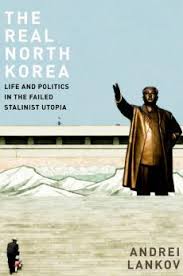
The Real North Korea–Life and Politics in the Failed Stalinist Utopia; “I have had enough of listening to talk about an irrational and unpredictable North Korea; they could be the greatest bunch of Machiavellians in the modern world”

April 9, 2013, 11:22 AM

North Korea Expert’s New Book Explores Regime’s Inner Logic

By Alexander Martin

NKorea

Andrei Lankov is one of the world’s top experts on North Korea with decades of experience studying the inner workings of the isolated regime. Born in St. Petersburg, Russia, he graduated from the Leningrad State University, while spending time in the mid-1980s studying as an exchange student at Pyongyang’s Kim Il Sung University. He speaks Korean and now teaches history at Kookmin University in Seoul.

In his new book, “The Real North Korea–Life and Politics in the Failed Stalinist Utopia,” Mr. Lankov delves into what he calls the “inner logic of the North Korean behavior,” and the peculiarities of a society that has seen it survive until this day despite mounting international pressure and domestic economic woes.

Mr. Lankov argues that contrary to the common Western portrayal of the North as a country run by irrational, sadistic madmen, its leaders were in fact cold-minded manipulators who have used saber-rattling successfully for decades to ensure its survival.

“I have had enough of listening to talk about an irrational and unpredictable North Korea … they could be the greatest bunch of Machiavellians in the modern world,” he told KRT. Read more of this post

China: Hunan’s rice sales plummet amid reports of cadmium-polluted crops

Hunan’s rice sales plummet amid reports of cadmium-polluted crops

Staff Reporter, 2013-04-09

Rice sales in parts of Hunan province in south-central China have plunged and local farmers are giving up planting following reports of rice being tainted by excessive levels of cadmium.

The amount of rice sold in parts of the province is said to have dropped by 60%, resulting in a decline in prices, after domestic media reported at the end of February that 10,000 tonnes of cadmium-tainted rice from Hunan was sold to Guangdong province. Read more of this post

New cancer case diagnosed every six minutes in China

New cancer case diagnosed every six minutes in China

Staff Reporter, 2013-04-09

China’s cancer rate has climbed to alarming new heights, with at least one person being diagnosed with a form of cancer every six minutes, according to the country’s National Cancer Registration Center. There are 3.12 million new cancer cases reported in China annually, an average of 8,550 people per day, according to a report published by the center earlier this year. At present, one in eight people diagnosed with cancer will die from it, a mortality rate of about 13%. Chen Wanqing, deputy director of the center, said China will have 6 million new cancer patients and 3 million cancer-related deaths every year by 2020. Experts note that cancer incidence will only continue to rise over the next decade, and have attributed the trend to the country’s serious air and water pollution.

Wei Kuangrong, director of the Cancer Research Institute at Zhongshan People’s Hospital in Guangdong province, said that 8.34 people were diagnosed and 5.27 people died from cancer in Zhongshan every day in 2009. In the 1970s, the rate for both was only 0.78. Wei said that nasopharyngeal carcinoma, a form of cancer that originates in the upper region behind the nose, has become extremely prevalent in the city. Other areas across the country have also reported high incidences of specific forms of cancer. The city of Qidong in Jiangsu province has reported unusually high rates of liver cancer. Experts have speculated that the geographical distribution of cancer across the country may be linked to local eating customs, environmental conditions or other factors, though no theory is regarded as conclusive. Wang Ning, the deputy director of the Beijing Cancer Institute and Hospital, predicts that China’s cancer rate will not drop over the next 10 years and the nation will be lucky if the rate remains steady.

Oishi’s founder Tan Passakornnatee deploys a superhero, social media and sugary bottled teas to build his second beverage empire Ichitan. The only thing in his way? His first beverage empire.

4/03/2013 @ 7:00AM |383 views

Thai Beverage Man Tan Passakornnatee Is On a Mission

By Susan J. Cunningham

Tan0402_tan_416x416

As he clowns around for a photo shoot in front of the giant fiberglass animals adorning his restaurant compound off of tony Thonglor Road, Tan Passakornnatee is sporting vivid yellow pants and a polka-dot shirt, his customary style for addressing college students or business groups. When he’s in an even more casual mood, he wears T-shirts with the image of a pig (he was born in the year of the pig). But either way he always dons a captain’s hat–not least when he flies amid tall buildings wearing a caped costume in the commercials for his company’s current promotion. The tubby superhero “Tan Man” is on his way to change the lives of 60 people–one a day for 60 days–who are about to win 1 million baht ($33,000). As consolation prizes, he’s also giving away 1,250 iPhone 5s.

Tan is the 53-year-old founder and chief executive of Ichitan Group, which started making flavored tea drinks less than two years ago. With his chubby face under the captain’s hat, the marketing is working. It’s gaining fast on Thailand’s No. 1 brand, Oishi, which Tan himself founded almost a decade ago. Last year Oishi controlled 34% of the country’s $385 million ready-to-drink tea market, while Ichitan was second at 19%, according to a Euromonitor estimate. And the market grew 38%. Read more of this post

Malaysia poll to test regional democracy; Political upsets could undermine southeast Asia’s success

April 8, 2013 4:37 pm

Malaysia poll to test regional democracy

Political upsets could undermine southeast Asia’s success

By Jeremy Grant in Singapore

With their signature royal blue shirts, the leaders of the governing coalition led by Najib Razak, Malaysia’s prime minister, fired up a crowd of thousands of party loyalists in a stadium in Kuala Lumpur at the weekend.

Launching its election manifesto, Barisan Nasional – Malay for “national front” – pledged a raft of election giveaways including more cash handouts for the poor.

So far, so normal in electoral politics in Malaysia, where taxi drivers have already received vouchers for new tyres. But what was unusual was the rally’s timing.

In past elections Barisan’s main party, the United Malays National Organisation (Umno) has waited until after a date has been set for polling day before unveiling its manifesto, such has been its confidence of repeating the thumping majorities it has enjoyed for decades.

But now the coalition is nervous, and with good reason. Read more of this post

Convincing Chinese Bird Flu Is Unrelated to Dead Pigs; “From SARS to H7N9, the most horrible Chinese virus has never been cured: a regime that doesn’t want to tell the truth. Human flu is much worse than bird flu.”

Convincing Chinese Bird Flu Is Unrelated to Dead Pigs

How does the Chinese Communist Party manage to calm a public convinced that — on matters of public health, at least — officials are probably lying to them?

It’s a critical question as infections and fatalities related to the H7N9 bird flu slowly tick upward, unnerving Chinese disinclined to trust their government. The crisis of confidence has its roots in the fatal consequences of the high- level coverup of SARS in 2003, and, more recently, in the still unexplained dead-pig tide that polluted Shanghai waterways. With this sorry history as a precursor and widely assumed precedent, Chinese seem ready to believe anything that doesn’t come from a government mouthpiece — especially if it contradicts the official story or fills a knowledge gap that the government hasn’t addressed.

Consider this sarcastic tweet to Sina Weibo, China’s most popular Twitter-like microblog, on Monday morning by Wu Yan, a popular Internet commentator and writer. In addition to bird flu and SARS, it invokes China’s crackdowns on corrupt officials and the country’s long-standing problems with contaminated dairy products: “From SARS to H7N9, the most horrible Chinese virus has never been cured: a regime that doesn’t want to tell the truth. The root of bird flu is not an animal but those nasty lies from lunatic officials, including: Dead pigs don’t influence the water quality, and domestic milk powder is the safest. And there is a very small ratio of greedy officials or even none! — Human flu is much worse than bird flu.” Read more of this post

China Failed Mining Deals Top $45 Billion on Hanlong Bungle

China Failed Mining Deals Top $45 Billion on Hanlong Bungle

Sichuan Hanlong Group’s botched $1.2 billion bid for Australia’s Sundance Resources Ltd. (SDL) brings the value of China’s recent failed mining deals to $45 billion, a record that’s prompted stricter Chinese scrutiny of acquisitions.

Chinese companies attempted $107 billion worth of mining takeovers over the past five years, with about $45 billion, or 42 percent by value, of deals ending in failure. Of $562 billion of deals proposed globally in the same period, $180 billion, or 32 percent, didn’t proceed, according to data compiled by Bloomberg.

The collapse yesterday of the bid for Sundance, seeking to develop a $4.7 billion iron ore project in Africa, comes after a string of failed investments by Chinese companies, including the demise of a $19.5 billion investment in Rio Tinto Group in 2009. Regulators under China’s new leadership team of Xi Jinping and Li Keqiang have told state-owned companies that overseas takeovers will face a more stringent approval process. Read more of this post

Western drugmakers may have to give hefty subsidies and forgo some profit on expensive cancer drugs if they want access to China’s “huge market,” the country’s former health minister said.

China Drugmaker Access May Require Profit Cut, Chen Says

Western drugmakers may have to give hefty subsidies and forgo some profit on expensive cancer drugs if they want access to China’s “huge market,” the country’s former health minister said.

With the cost of some oncology drugs topping $100,000 a year, Chinese officials may increasingly push for deals like one reached last year with Novartis AG (NOVN), in which the company agreed to donate three doses of its leukemia drug Gleevec for every one sold to the government, the former minister, Chen Zhu, said during an interview in Washington, D.C.

“If the cost is too high, maybe only a few percent of patients can benefit,” said Chen, who stepped down last month after seven years as China’s top health official. “If we can arrange an appropriate, acceptable, affordable price, then you can have a huge market.” Read more of this post

Soros Sees China Shadow-Banking Risk Matching Subprime

Soros Sees China Shadow-Banking Risk Matching Subprime

Billionaire investor George Soros said China has a “couple of years” to control risks from nontraditional financing whose expansion has parallels with the cause of the global financial crisis. “The rapid growth of shadow banking has some disturbing similarities with the subprime-mortgage market in the U.S. that caused the financial crisis of 2007-2008,” Soros said today in a speech at the Boao Forum for Asia in China. “I’m sure the authorities are aware of the dangers. They have both the skills and the resources to deflate an incipient bubble gradually.” The comments add to concerns that the increase in credit risks triggering turmoil that would cause an economic downturn. Aggregate financing, an indicator started by the central bank in 2011 to provide a broader gauge of funding, more than doubled to a record in January from a year earlier.

“If the American experience is any guide, the authorities have a couple of years to bring shadow banking under control,” said Soros, 82. “It’s of utmost importance that the authorities should succeed. Not only for China, but also, for the world.”

Soros also said that next year will be a turbulent one with the euro at the center of the storm, and the decline in the yen and pound will probably aggravate the recession in Europe. In 1992, Soros and his then-chief strategist Stan Druckenmiller made a $10 billion wager the Bank of England would be forced to devalue the pound, a trade that netted $1 billion.

To contact Bloomberg News staff for this story: Liza Lin in Shanghai at llin15@bloomberg.net; Scott Lanman in Beijing at slanman@bloomberg.net

China Export-Data Skepticism Deepens From Goldman to Nomura

China Export-Data Skepticism Deepens From Goldman to Nomura

China’s unprecedented run of better- than-forecast export growth has spurred deeper skepticism of the data at banks including Goldman Sachs Group Inc., casting doubt on the strength of the recovery.

Gains in overseas shipments exceeded forecasts by at least 7.5 percentage points in December, January and February, the first time that’s happened in three straight months in the eight years Bloomberg has compiled analyst estimates for the data. March figures are due to be released tomorrow at 10 a.m. at a briefing in Beijing, giving the customs administration an opportunity to address the issue.

Overstated exports would mean China is failing to get the boost from global demand that the data suggest as the new government under Premier Li Keqiang seeks to sustain an economic rebound. Theories include companies inflating the value of shipments to bring money into China, according to Nomura Holdings Inc., and exporting the same goods twice as local governments seek to boost data, Goldman Sachs says.

“The recovery in exports is there, but the magnitude probably is much weaker than the official data has been indicating,” said Zhu Haibin, chief China economist at JPMorgan Chase & Co. in Hong Kong. Read more of this post

Chinese Asked to Change Eating Habits as H7N9 Infections Rise

Chinese Asked to Change Eating Habits as H7N9 Infections Rise

China asked its citizens to avoid contact with live poultry as it tries to stem a deadly outbreak of H7N9 bird flu that’s killed six people and infected 15 others in three eastern provinces and Shanghai.

Consumers should avoid markets where poultry are butchered as authorities increase monitoring for the new influenza strain, Feng Zijian, head of emergency response at the Chinese Center for Disease Control and Prevention, said in Beijing today. A vaccine is being prepared in case the virus starts spreading from human to human, health officials said.

“Consumers should no longer pursue the kind of eating habits where they buy fresh chickens that are butchered on the spot,” Feng told reporters at a briefing held jointly with the World Health Organization. “Stalls and markets in cities where live poultry is being butchered need to be closely monitored as possible venues of infection.” Read more of this post

Garters Help Tell H&M’s Other Stories in Inditex Chase

Garters Help Tell H&M’s Other Stories in Inditex Chase

Counting on the old adage that sales of affordable luxuries like lipstick and scarves climb in tough times, Hennes & Mauritz AB (HMB) is rolling out a new chain called & Other Stories that focuses on upscale accessories.

As it seeks to make up ground lost to rival Inditex SA (ITX) and win a bigger share of the $111 billion market for shoes and accessories in western Europe, H&M is opening seven outlets of the chain across the crisis-ravaged region this spring.

Better known for dresses and ballet flats cheap enough to be almost disposable, H&M promises curated style at & Other Stories. The stores feature a selection of more expensive clothing jockeying for space with wardrobe add-ons such as jewelry, lingerie, and shoes in four basic styles ranging from “Industrial” to “Glamorous.”

“H&M is getting a lot of pressure from low-price retailers on the one hand and from retailers like Inditex, which reacts faster to demand in the fashion world, on the other,” said Soeren Loentoft Hansen, an analyst at Sydbank A/S. (SYDB) With & Other Stories, H&M can “build some bridges to a higher price segment.” Read more of this post

Australia 10% Unemployment for 9.6% Punctures Gillard Prosperity

Australia 10% Unemployment for 9.6% Punctures Gillard Prosperity

Keith Darley, a 34-year-old electrician, hears from the government that Australia is the envy of the developed world. Yet the father of two, who employed 22 people a year ago, now works alone and says he’ll be voting against Prime Minister Julia Gillard in the Sept. 14 election.

The world’s 12th biggest economy boasts the lowest benchmark interest rate in 53 years, unemployment less than half of Europe’s, contained inflation and an economic growth rate double the average of advanced nations. Even with these conditions — the best since Gough Whitlam took office in 1972 — Gillard’s ruling Labor Party is 16 percentage points behind the Tony Abbott-led opposition.

“When we see a story that Gillard claims the government has created 900,000 jobs, we know that doesn’t stack up here; that’s not our experience,” said Darley, who lives in Sydney’s western suburbs, where eight of Labor’s 72 national seats are threatened and the unemployment rate is as high as 14 percent. “The voters here are not going to support Tony Abbott because they think he’s better, they’re going to be voting against the current government because they’re sick of hearing everything’s great when they know it’s not.”

Darley reflects a widening gap among Australia’s regions and industries. While national unemployment was 5.4 percent in December, the rate was 10 percent or higher in 9.6 percent of the nation’s 1,402 regions, according to government data that dates back to 2008. In some parts of Brisbane, where five Labor seats are in play, joblessness exceeds 27 percent — the highest on record for the areas. Read more of this post

Billionaire Mittal in India Legal Spat Adds to Investor Unease

Billionaire Mittal in India Legal Spat Adds to Investor Unease

Billionaire Sunil Mittal and his company Bharti Airtel Ltd. (BHARTI) are locked in legal battles in India’s top court that some fund managers say could drive wary investors away from the world’s second-largest wireless market. India’s Supreme Court today ordered a lower court to halt proceedings against Mittal until April 15 when it will next hear his challenge to charges relating to Bharti’s purchase of mobile-airwaves beyond the legal limit. A three-judge panel headed by Chief Justice Altamas Kabir asked federal investigators to file a reply to Mittal’s petition. Mittal, 55, faces legal battles even as the Supreme Court in February 2012 canceled 122 licenses tied to India’s largest graft case that led to the exit of Bahrain Telecommunications Co. (BATELCO) and Emirates Telecommunications Corp. Foreign direct investment into India’s telecom industry shrank to $93 million in the first 10 months of the year ended March 31, from $2 billion for the previous 12-month fiscal period, according to data from the Department of Industrial Policy and Promotion.

“When I heard about this case, I thought ’Oh, here we go again’,” Taina Erajuuri, a Helsinki-based fund manager at FIM Asset Management Ltd., said by telephone on April 5, referring to Mittal’s case. “I don’t own telecom stock in India, and that’s for a reason. It’s become too unpredictable, with other places being much safer, without legal or regulatory problems.” Mittal, heralded as one of India’s entrepreneurial leaders who started his business in the 1970s by selling bicycle parts, has been charged with acquiring airwaves in excess of a government limit. India’s Central Bureau of Investigation filed criminal charges in December against Bharti, along with government officials and two other carriers, for revising rules to allocate wireless spectrum, which led to a loss of about 8.5 billion rupees ($155 million) to the exchequer. Read more of this post

The global popularity of sushi, coupled with the yen’s 18 percent decline in the past six months, is proving to be a sweet spot for Suzumo, Japan’s biggest producer of automatic sushi-making machines

Sushi machine maker upbeat about yen’s fall, high overseas demand

BY NAOKO FUJIMURA AND TAKASHI AMANO, BLOOMBERG

iPk8Ig.W0dwc

Ikuya Oneda, president of Suzumo Machinery Co., poses for a photograph with the company’s automatic sushi chefs in Tokyo.

The global popularity of sushi, coupled with the yen’s 18 percent decline in the past six months, is proving to be a sweet spot for Suzumo Machinery Co., Japan’s biggest producer of automatic sushi-making machines.

The company plans to triple overseas sales to as many as 3,000 units from the last fiscal year and is boosting manufacturing capacity to meet demand in foreign markets, President Ikuya Oneda, 69, said Thursday.

“A weaker yen will make it easier for us to do business” abroad, Oneda said, adding that Suzumo may start taking payments in dollars, if customers request, as the Japanese currency weakens.

The firm’s new production line turning out the automatic chefs, which shape rice into blocks to serve with raw fish or other ingredients, will open around November at its plant in Saitama, according to Oneda. Orders for the machines are pouring in from South America, Europe and Asia, as global consumption of seafood is expected to jump by as much as 17 percent per person over the next two decades. Read more of this post