China: Wenzhou’s financial reform fails to bear expected fruit; Wenzhou’s courts are currently in the processes of handling private debt collections exceeding 50 billion yuan (US$8 billion), while the total of private debt in the city has reached 100 billion yuan (US$16 billion)

Wenzhou’s financial reform fails to bear expected fruit

Staff Reporter, 2013-04-08

On the first anniversary of the State Council’s decision to set up the Wenzhou financial reform zone, an official has admitted that the program has not attracted robust investment as previously expected, the Beijing-based Economic Observer reports. Read more of this post

High inventory plagues China’s Fujian garment capital Jinjiang; Six leading sportswear producers, including Anta, 361 Degrees, Xtep, Peak, Li Ning and Dxsport have been forced to close more than 3,000 outlets across the country since last year, with heavy losses arising from their excess stock worth more than 3.72 billion yuan (US$594 million)

High inventory plagues Fujian garment capital Jinjiang

Staff Reporter, 2013-04-08

The city of Jinjiang in Fujian province is a major center of the Chinese garment and sportswear industry, but many of the businesses there are struggling to stay afloat owing to the heavy burden of excess inventory, reports the Beijing-based China Entrepreneur magazine.

Six leading sportswear producers, including Anta, 361 Degrees, Xtep, Peak, Li Ning and Dxsport have been forced to close more than 3,000 outlets across the country since last year, with heavy losses arising from their excess stock worth more than 3.72 billion yuan (US$594 million), said the magazine. Read more of this post

In China, off-balance-sheet lending risks lurk in the shadows

In China, off-balance-sheet lending risks lurk in the shadows

3:33am EDT

By Gabriel Wildau and Shengnan Zhang

SHANGHAI (Reuters) – China’s banks are feeding unwanted assets into the country’s “shadow banking system” on an unprecedented scale, reinforcing suspicions that bank balance sheets reflect only a fraction of the actual credit risk lurking in the financial system.

Banks’ latest earnings reports only added to concerns. Despite the slowest economic growth in 13 years in 2012, the banking system’s official non-performing loan (NPL) ratio actually declined, renewing a debate about how reliable those figures are.

But the key question is no longer how much risk banks are carrying. Rather, it’s how many risky loans have been shifted to the lightly regulated shadow banking institutions – mainly trust companies, brokerages and insurance companies.

The risk to the overall financial system is not clear, because of insufficient data about the quality of credit in the shadow banking sector. Read more of this post

China’s President Xi Jinping said the days of “ultra-high speed” growth in the world’s second-largest economy – which many hope can spur a global recovery – are probably over.

China’s Xi says “ultra-high speed” growth probably over

POSTED: 08 Apr 2013 5:32 PM

China’s President Xi Jinping said Monday the days of “ultra-high speed” growth in the world’s second-largest economy – which many hope can spur a global recovery – are probably over.

BOAO, China:  China’s President Xi Jinping said Monday the days of “ultra-high speed” growth in the world’s second-largest economy — which many hope can spur a global recovery — are probably over.

“I don’t think we will be able to sustain an ultra-high speed of economic growth and it is not what we want either,” Xi told about two dozen foreign business figures on the southern island of Hainan. Read more of this post

Hey, Fund Companies: Share the Wealth; The oft-practiced but rarely disclosed tactic of securities lending has landed BlackRock and State Street in the courts. Here’s what this practice is, and why it matters to you

SATURDAY, APRIL 6, 2013

Hey, Fund Companies: Share the Wealth

By BRENDAN CONWAY | MORE ARTICLES BY AUTHOR

The oft-practiced but rarely disclosed tactic of securities lending has landed BlackRock and State Street in the courts. Here’s what this practice is, and why it matters to you.

When funds lend their holdings to short sellers, shareholders take on all of the risk—but they don’t always get to keep all of the profits.

A handful of pension funds and trusts are suing giant asset managers, includingBlackRock (ticker: BLK) and State Street (STT), over the arcane realm of securities lending. The claim: The firms kept too much profit from this corner of fund management for themselves, instead of disbursing more of those profits to exchange-traded-funds’ shareholders and other fund investors.

The lawsuits focus attention on an industrywide practice whereby asset managers lend (usually to institutional short sellers) stock held by its funds in exchange for various fees and cash collateral, on which they collect interest. Securities lending is common enough that it probably contributes to your funds’ returns—so long as the asset manager rewards you with most of the income it collects, instead of keeping gobs of it at the corporate level. The latter is at the heart of the continuing lawsuits, and while it might not be a bad thing for the firms’ stockholders, it behooves you to know who’s getting what. It’s the fund shareholders, after all, taking on the risk of lending the securities. Read more of this post

Shanghai McDonalds Slashes McNuggets Price By Nearly Half As Birdflu Fears Drive Away Buyers

Shanghai McDonalds Slashes McNuggets Price By Nearly Half As Birdflu Fears Drive Away Buyers

Tyler Durden on 04/07/2013 22:48 -0400

How do you know when the people “just say no” to chicken over rampant bird flu concerns? When even McDonalds (whose ad campaign for the past decade “I am loving it” continues to be an anagram for “ailing vomit“) is forced to slash chicken-related prices, in this case the 20 piece McNuggets, from CNY36 to CNY20. Pretty soon not even giving away the McMystery meat will clear out the shelves of all chicken-related fast food first in Shanghai and soon elsewhere in China. Finally, we dread to imagine the horrors that will befall Yum (read China KFC sales), now that after so much pain, the fast-food chain had finally reported a modest bounce in Chinese sales. So much for that.

McD Nuggets Shanghai

Thousands of Dead Fish in Shanghai River prompt safety fears (Bloomberg TV)

Dead fish in Shanghai river prompt safety fears

A total of 250 kilograms of dead fish, mainly crucian carp, have been retrieved in suburban Shanghai’s Sijing pond since last week. -China Daily/ANN

i7U4oobTwK50
Shi Yingying
Mon, Apr 08, 2013
China Daily/Asia News Network

SHANGHAI – Hundreds of dead fish have washed up along the shorelines of a man-made river in Shanghai’s Songjiang district since April 3, but the local water authority and environmental protection bureau insist the water is safe.

A total of 250 kilograms of dead fish, mainly crucian carp, have been retrieved in suburban Shanghai’s Sijing pond since last week. Gao Yunchu, director of Songjiang water authority, said small fish with relatively weaker body defence systems were found dead at the beginning of April and the bodies of bigger fish such as carp were discovered on Saturday. Read more of this post

Beware of Index Funds That Aren’t; The new generation of investments aren’t nearly as passive— or as cheap—as you might think

Updated April 7, 2013, 7:51 p.m. ET

Beware of Index Funds That Aren’t

The new generation of investments aren’t nearly as passive— or as cheap—as you might think

By MICHAEL A. POLLOCK

IF-AB108A_INDEX_G_20130404152104

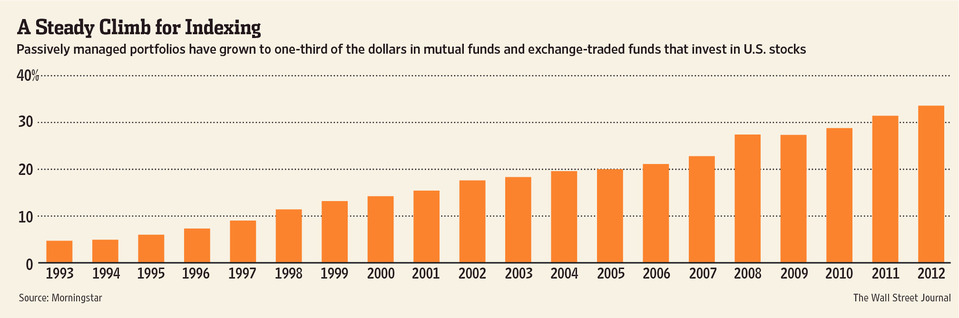
Index funds aren’t always what you think they are. And your innocence could cost you.

To most investors, of course, index funds are passive investments, providing returns that basically mirror the market they are designed to follow. They charge low fees and carry no hidden costs.

But the old definition is starting to change. Unlike simpler, earlier generations of index and exchange-traded funds, new variations are morphing into products that risk putting many investors afoul of the old rule about not investing in things you don’t understand.

As more money flows toward indexing, some fund firms are trying to capture a share of it by creating complex ETFs that blend active management and indexing. The fees charged by some of these funds can be several times those charged by traditional index funds. And, because they sometimes specialize in very narrowly defined, less-active markets, they can wrack up hidden trading costs. Read more of this post

Malaysia’s Prime Minister Najib Unveils Poll Manifesto Similar to Opposition leader Anwar’s; “My sincere apologies to all Malaysians if we have done anything wrong. At the end of the day, we are ordinary humans.”

Malaysia’s Najib Unveils Poll Manifesto Similar to Anwar’s

Malaysian Prime Minister Najib Razak pledged to fight corruption, bring down living costs and build a pan-Borneo expressway if his coalition retains power in elections due in a matter of weeks.

These were all policies mooted by opposition leader Anwar Ibrahim in his manifesto released six weeks earlier than the one Najib’s governing National Front unveiled at a weekend rally in Kuala Lumpur. The Election Commission meets this week to set a date for polls after the prime minister dissolved parliament on April 3.

“They had the benefit of time to study our manifesto over the past month and incorporate some elements,” Ong Kian Ming, a political analyst at Kuala Lumpur’s UCSI University and an opposition election strategist, said by phone. “Unlike us, there’s nothing in there about electoral reform. That’s something a lot of people are concerned about.”

In the lead-up to the polls, Najib has boosted government spending, distributed a second round of cash handouts to the poor, and raised salaries of civil servants, police and the military. He also delayed implementing a goods-and-services tax and froze plans to wind back state subsidies on essential items. The manifesto offers increased handouts for the poor, and lowered car costs and broadband fees.

“My sincere apologies to all Malaysians if we have done anything wrong,” the prime minister said in a speech at the rally, broadcast live on national television. “At the end of the day, we are ordinary humans. If we are given a strong mandate, I can assure you that we will do better in the next five years.” Read more of this post

Liquidity Carpet Bombs Fueling Asset Bubbles, Rohde Says

Liquidity Carpet Bombs Fueling Asset Bubbles, Rohde Says

Policy makers steering the global economy have pumped the financial system with so much liquidity that any exit risks popping potential asset bubbles or stunting a recovery, Danish central bank Governor Lars Rohde said.

“The risk is we stay in this climate too long and that the carpet bombing of liquidity spurs inflation,” Rohde, 59, said in an April 5 interview from his office in Copenhagen. Though there are no current signs of consumer price inflation “there is inflation, perhaps a bubble, in some asset classes,” he said. “Equities (MXWO) are trading close to all-time highs. Segments of property markets across the globe, for example London, also display symptoms of this. How do we exit this without killing whatever nascent recovery there might be at that time?”

The warning from the head of Denmark’s central bank, which has kept its deposit rate below zero since July, comes as policy makers in Japan, the euro area and the U.S. deliver unprecedented monetary stimulus to drag the global economy out of the worst crisis since the Great Depression. Easy money has fueled equity prices, helping send the Standard & Poor’s 500 Index to an all-time high on April 2. The yield on Japan’s benchmark 10-year bond hit its lowest on record last week.

“We’re in a landscape where we’ve never been before, with regard to extreme monetary accommodation over a very, very long period of time,” said Rohde, who took over as the head of Denmark’s central bank in February. “What does that end up doing to a society? It’s been a necessary policy, but I have my concerns about what the long-term risks are.” Read more of this post

Why Making Europe German Won’t Fix the Crisis

Why Making Europe German Won’t Fix the Crisis

Most people see Europe’s economic crisis as a cautionary tale of good and bad policy making, in which fiscally prudent countries, such as Germany, remain stable, while reckless ones, such as Greece, unravel.

So ingrained is this idea that it’s now common to hear analysts say Europe must become “German” to exit from the crisis, adopting Teutonic approaches to policy — from fiscal tightening to labor- and product-market reforms. If only societies on Europe’s periphery can learn to do what the Germans do, the argument goes, the European Union and its single currency will have a stable future.

This is wrong and we already have evidence to show it. The question isn’t whether Germany’s policies are correct. It is whether they will produce the same outcomes in different economic and political environments. To see that they don’t, you need to ignore Greece and look at its neighbor, Bulgaria.

Like Germany, Bulgaria went through several years of prudent budgets and economic reforms aimed at improving competitiveness before the financial crisis began in 2008. Both countries initially responded to the shock with sudden increases to their budget deficits, but also quickly reined these back in. Bulgaria’s deficit was 0.7 percent of gross domestic product in February, according to the Finance Ministry. Government debt was 16 percent of GDP. So pretty German already. Read more of this post

Vietnam Crony Communists Resist Constitution Backlash

Vietnam Crony Communists Resist Constitution Backlash

While filming a documentary about Ho Chi Minh as his compatriots battled U.S. forces in the 1960s, Tran Van Tan observed how the Communist leader’s embrace of a simple lifestyle endeared him to Vietnam’s poor.

Five decades later, Tan says the Communist Party’s leaders are more concerned with enriching themselves than adhering to Ho Chi Minh’s ideals. Abolishing the one-party system would lead to “healthy competition” and narrow the wealth gap, said Tan, 65, a retired civil servant who now sells tea in downtown Hanoi.

“There are people who don’t have enough food to eat, whose children don’t have enough clothes to cover their bodies in winter,” Tan said. “There are farmers who don’t have land. They are so poor, while many in the leadership are very wealthy. These leaders are so rich that even their children, grandchildren wouldn’t be able to use it all up.”

Tan is among more than 12,000 former bureaucrats, academics and rice farmers speaking out publicly against proposed constitutional changes that would strengthen the Communist Party’s grip on power. The unprecedented movement threatens to increase challenges to Prime Minister Nguyen Tan Dung as he seeks to turn around a slowing economy which posted Southeast Asia’s highest level of bad debt last year. Read more of this post

Alcoa No Better Than Coin Flip as Market Bellwether Status Fades

Alcoa No Better Than Coin Flip as Market Bellwether Status Fades

Alcoa Inc. (AA), the first Dow Jones Industrial Average member to report results each quarter, is losing its accuracy as a bellwether for the U.S. stock market.

The Standard & Poor’s 500 Index has usually followed Alcoa’s lead since 2002, rising 2.5 percent in quarters when the aluminum producer beat the market after earnings, less when it didn’t. That relationship has broken down since 2011, when the S&P 500 posted even bigger gains, about 3 percent, when Alcoa’s results hurt its stock, according to data compiled by Bloomberg.

Overtaken in size and market clout by diversified commodities companies such as BHP Billiton Ltd. (BHP) and Glencore International Plc, Alcoa has struggled to make a profit with aluminum prices sagging as production outpaces the metal’s use. Investors are looking beyond the New York-based producer, which announces results after the close of trading today, to companies such as International Business Machines Corp., which reports in ten days, according to Bespoke Investment Group.

“We don’t consider it much of a bellwether,” said Edward Dewees, who helps oversee about 3 million Alcoa shares among the $2.7 billion managed by New York-based Douglas C. Lane & Associates. “As far as did Alcoa beat or meet earnings, that’s a meaningless headline. Any investor who’s going to make a decision about other companies’ earnings based on Alcoa’s headline earnings, that’s silly.” Read more of this post

IPO Bankers Become Frogs in Hot Water Amid China Market Halt after China’s securities regulator mandated that two so-called baodai, or sponsor representatives, conduct due diligence and sign off on every IPO to curb fraud; “The baodai are like frogs in a pot of hot water that’s been on slow boil for nine years. The days of excess pay are gone. Rationality has returned.”

IPO Bankers Become Frogs in Hot Water Amid China Market Halt

Shen Wei, one of the first 600 investment bankers authorized to sign off on initial public offerings in China, said the license that made him one of the “golden collared” has lost its magic.

The teacher’s son studied 14-hours a day for a month in 2004 to qualify after China’s securities regulator mandated that two so-called baodai, or sponsor representatives, conduct due diligence and sign off on every IPO to curb fraud. Demand for such bankers is now being eroded by a freeze on IPOs, a surge in people getting licensed and an easing of underwriting rules.

“The baodai are like frogs in a pot of hot water that’s been on slow boil for nine years,” said Shen, 41, who is executive director of Citigroup Inc. (C)’s local joint venture in Shenzhen, overseeing a team of 20 bankers. “The days of excess pay are gone. Rationality has returned.” Read more of this post

Hong Kong nets only small fry for laundering illegal Chinese money

Hong Kong nets only small fry for laundering illegal Chinese money

Sun, Apr 7 2013

By Lawrence White

HONG KONG (Reuters) – Luo Juncheng, a delivery man and school dropout from China’s Guangdong province, was 19 years old when he opened an account at Bank of China subsidiary Chiyu Bank in Hong Kong in mid-2009.

Over the next eight months, he moved more than HK$13 billion ($1.7 billion) through the account, making nearly 5,000 deposits and more than 3,500 withdrawals in the largest money laundering case on record in the territory.

Luo is now serving a 10-and-a-half-year jail sentence for illegal money transfers. But his conviction raises wider concerns – how he got away with it for so many months despite the red flags that should have been raised by his transactions, and why no other arrests have been made despite evidence at trial that he did not act alone.

His conviction is one of the few in Hong Kong for money laundering, despite the city’s reputation as a hub in money transfers, both legal and illegal, carried out by wealthy Chinese. Experts estimate tens of billions of dollars are laundered in Hong Kong every year, much of it crime or drugs-related money funnelled from China or the gambling haven of Macau. Read more of this post

Seoul Residents Threatened With ‘Sea of Fire’ Carry On With Life; “Even if they were to launch a nuclear attack, we’d be dead within minutes anyway.”

Seoul Residents Threatened With ‘Sea of Fire’ Carry On With Life

Choi Yong Wook woke on his 29th birthday to the news that North Korea had repositioned a missile days after threatening to turn Seoul into a “sea of fire.” That didn’t stop him from a romantic dinner with his wife in one of the South Korean capital’s busiest areas.

“This is how we survive, we continue living our lives,” Choi, a Daewoo Electronics Corp. (0741) salesman, said in an interview. “North Korea has always threatened that war can break out any day. But who can believe them?”

As tensions escalate, life for 10 million South Koreans in their capital 40 kilometers (24 miles) from the world’s most fortified border goes on uninterrupted. Schools, businesses and public offices keep regular schedules and there are no reports of panic-buying in shops. While Choi and his wife blew out his birthday candles, Seoul’s LG Twins lost their baseball game against crosstown rivals the Nexen Heroes, 4-3. Read more of this post

Netherlands, the Next Chip to Fall? Consumer debt amounts to about 250 percent of available income. By comparison, in 2011 even the Spaniards only reached a debt ratio of 125 percent

Netherlands, the Next Chip to Fall?

Mike “Mish” Shedlock
http://globaleconomicanalysis.blogspot.com

Posted: 07 Apr 2013 07:36 AM PDT

Most attention lately has been on Cyprus, Spain, and Italy. Long-time troubles have been brewing in Portugal and I have an update coming up shortly.

First consider Underwater: The Netherlands Falls Prey to Economic Crisis.

The Netherlands, Berlin’s most important ally in pushing for greater budgetary discipline in Europe, has fallen into an economic crisis itself. The once exemplary economy is suffering from huge debts and a burst real estate bubble, which has stalled growth and endangered jobs.

“Underwater” is a good description of the crisis in a country where large parts of the territory are below sea level. Ironically, the Netherlands, widely viewed as a model economy, is facing the kind of real estate crisis that has only affected the United States and Spain until now. Banks in the Netherlands have also pumped billions upon billions in loans into the private and commercial real estate market since the 1990s, without ensuring that borrowers had sufficient collateral.

Private homebuyers, for example, could easily find banks to finance more than 100 percent of a property’s price. “You could readily obtain a loan for five times your annual salary,” says Scheepens, “and all that without a cent of equity.” This was only possible because property owners were able to fully deduct mortgage interest from their taxes. Read more of this post

Chinese President Xi Jinping said the global economy has entered a period of “profound readjustment” and recovery remains elusive

China President Xi Says Global Economic Recovery Remains Elusive

Chinese President Xi Jinping said the global economy has entered a period of “profound readjustment” and recovery remains elusive.

The international financial industry is fraught with risks and protectionism is on the rise, Xi said in a speech at the Boao Forum for Asia in the southern Chinese province of Hainan today. Countries are still facing difficulties in adjusting their economic structure and the global-governance mechanism needs improvement, he said. Read more of this post

Local Chinese governments may have more than 20 trillion yuan ($3.2 trillion) of debt, double the official estimates, former Finance Minister said

China Local Debt May Top Estimates, Former Minister Says

Local Chinese governments may have more than 20 trillion yuan ($3.2 trillion) of debt, exceeding the official estimates, former Finance Minister Xiang Huaicheng said at the Boao Forum for Asia.

Xiang’s estimate for provincial and city government borrowings is almost double the 10.7 trillion-yuan figure that the National Audit Office gave for such debt in a 2011 report. The combined debt of China’s central and local governments may currently be more than 30 trillion yuan, said Xiang, who served as finance minister from 1998 to 2003.

“It seems the central government’s debt level is quite transparent, while local government debt isn’t, and therefore it’s not easy to get a clear picture,” Xiang said yesterday. He added that since he retired, he’s no longer “within the system” and that his comments on government debt are based on his own personal estimates.

China has sought to curtail borrowing by local governments because of concerns that banks will be saddled with bad debts. The nation’s central bank estimated in 2011 that local governments, which are barred from directly taking bank loans or selling debt, had set up more than 10,000 financing arms to fund the construction of roads, bridges and sewage plants. Read more of this post

Billabong perilously close to a wipeout; In 25 years, the company has lost most of its street cred and its value has shrunk from billions to whatever is on offer

Billabong perilously close to a wipeout

April 6, 2013, Elizabeth Knight

In 25 years, the company has lost most of its street cred and its value has shrunk from billions to whatever is on offer, writes Elizabeth Knight.

art_n_tide_0604-300x0

Twenty-five years ago, Billabong basked in street cred. Today, as one fashion industry insider quipped, the brand has become the barbecue short for the sausage sizzle. If the 45-year-old dads are wearing boardies with elasticised or Velcro adjustable waists to accommodate a middle-aged muffin top, their 15-year-old sons are not in the market.

On Friday, the future ownership of this Australian iconic brand hung in the balance. Two American corporate sharks have been circling the bleeding Billabong carcass for a couple of months and intense talks are continuing over the weekend.

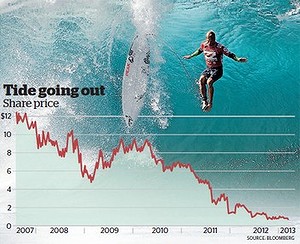
The decision by the Billabong board and its largest shareholder and founder, Gordon Merchant, to hang out the for sale sign, is the ultimate recognition the company has lost its way. Five years ago Billabong was a $5 billion company and its stock traded for $14. The prices being offered by these financial syndicates today are less than 70¢ a share – the financial equivalent of the bin out the front of the store housing the end-of-season/couldn’t-sell stock that customers rifle through. At this price the whole company is worth closer to $300 million. It is the final ignominy for the company whose financial performance has been in such steep decline that it has lost the support of many of its major investors and has been playing a dangerous game of dodgeball with its bankers. Read more of this post

India tackles entrenched culture of tax dodging; “In a country of holier than thou’s, no one thinks that it’s a blatant lie” to cheat on your taxes”

India tackles entrenched culture of tax dodging

BY TIM SULLIVAN

AP, APR 6, 2013

NEW DELHI – In a country long defined by its poverty, it’s now easy to find India’s rich.

They’re at New Delhi’s Emporio mall, where herds of chauffeur-driven Jaguars and Audis disgorge shoppers heading to the high-end designer stores. They’re shopping for Lambor- ghinis in Mumbai. They’re putting elevators in their homes and showing off collections of jewel-encrusted watches, and they’re buying real estate in comfortable but unpretentious neighborhoods thought of as simply upper-middle class just a couple years ago, where apartments now regularly sell for millions of dollars.

They’re just about everywhere — unless it’s income tax time. Then, suddenly, they barely exist.

The reality is simple: “There are very few people who are paying taxes,” said Sonu Iyer, a taxation expert at Ernst & Young in New Delhi. And tax dodging is everywhere, he said: “It’s rampant — rampant.” Read more of this post

Japan’s 13 Sigma Bond Swan

Japan’s 13 Sigma Bond Swan

Tyler Durden on 04/05/2013 14:27 -0400

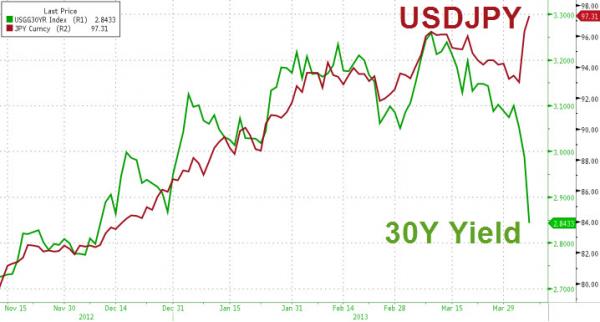
For six months the Japanese jawboning has seen investors front-running the BoJ, selling JPY and buying whatever risk-asset is the most correlated that day – whether it is the Nikkei 225 or the S&P 500. However, now that words have been replaced by actions, it appears that someone (cough Japanese institutions cough) has decided the 13.4-sigma swing in JGBs last night is just too much and have rotated to US Treasuries. The selling of JPY and buying of EUR (to fund peripheral bond buying) and USD (to fund Treasury buying) is very clear. That means, implicitly, thatevery ramp higher in JPY (weaker JPY) is simply more bond-buying – which leaves the algos directionless. If you were a risk-manager, what would you do? And as far as all those VaR risk models – oops!! It seems the ‘sellers’ of those JGBs have found a new place to put that capital to work (and in a non-devaluing currency)…

20130405_JPY_020130405_JPY1_0


Lessons from America’s long history of property booms

Lessons from America’s long history of property booms

Apr 6th 2013 |From the print edition

20130406_FNC339

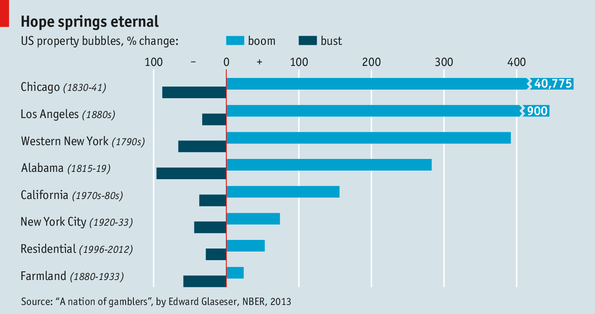
ROBERT MORRIS would have enjoyed the recent American housing boom. A signatory of the Declaration of Independence, he profited handsomely in the 1790s by “flipping” land on the American frontier. His business, acquiring millions of acres from Native Americans and friends of the crown and then selling them on to speculators, probably made him the richest man in America until dearer credit left him bankrupt. In a new paper Edward Glaeser of Harvard University argues that America’s long history of property manias has lessons for those aiming to minimise the pain of future busts. In particular, exuberant buyers may be more rational than many assume.

Robert Shiller, a Yale University economist and prescient housing-bubble spotter, reckons that “animal spirits” animate investors during bubbles. He sees America’s recent housing boom as an especially bad case of irrationality. Yet Mr Glaeser notes that the episode fits comfortably within America’s speculative past (see table). And assumptions of irrationality may let economists off the hook too easily. In fact, he writes, booms are often consistent with reasonable beliefs about the future—an important fact for bubble diagnosticians to note.

On sensible reckoning, for example, agricultural land in Alabama was a steal in the 1810s. Cotton production on Alabama farmland was highly productive, and cotton prices were surging on demand from British textile manufacturers. In 1817 land sold at about $35 per acre (in 2012 dollars), twice the national average for unimproved land. Prices almost quadrupled to $134 per acre the next year. Even those values implied large profits at going cotton prices, suggesting land remained a good buy. Yet when recession struck in 1819, farm prices dropped and leveraged buyers went bust. A prolonged price slump followed; by 1850 land cost just $5 per acre. Optimism, though warranted, led to financial carnage. Read more of this post

Exclusive: Some wealth advisers take a fee for client fund assets

Exclusive: Some wealth advisers take a fee for client fund assets

12:54pm EDT

By Jed Horowitz

(Reuters) – At least three wealth management firms that market themselves as objective financial advisers are getting payments for investing their clients’ money in certain mutual funds, a practice that even some of these firms say could create conflicts of interest.

The firms, known as registered investment advisers, are typically paid by clients with fees tied to the growth or contraction of client assets, and not to specific products. But Fidelity Investments and Charles Schwab Corp are paying these financial advisers as much as 0.25 percent of the assets that their clients put into no-transaction-fee mutual funds.

Such funds are popular with ordinary investors because they don’t have to pay commissions to buy or sell them, although some advisers say they have higher expenses than funds with commissions. Brokers such as Fidelity and Schwab make hundreds of millions of dollars in fees selling funds that they and others manage. Read more of this post

Shell, Glencore, and Other Multinationals Dominate Their Home Economies

Shell, Glencore, and Other Multinationals Dominate Their Home Economies

By Jennifer Daniel, April 04, 2013

While corporate revenues aren’t the same as GDP, the size of these companies in relation to their home countries is remarkable.

econ_gdpchart15B_405

Chinese Education: The Truth Behind the Boasts; Parents in China’s big cities sometimes pay donations and steep fees to middlemen to get their children into the best schools

Chinese Education: The Truth Behind the Boasts

By Dexter Roberts on April 04, 2013

In an international survey released just over two years ago, high school students from Shanghai scored at the top in math, science, and reading. Some Americans saw this as a Sputnik moment—a wake-up call for the rest of the world to better educate its young or risk falling behind the Chinese. In March, China’s leadership announced that education spending totaled 7.79 trillion yuan ($1.26 trillion) over the last five years, reaching a target of 4 percent of gross domestic product. “The quality and level of education in China was comprehensively raised,” said outgoing Premier Wen Jiabao on March 5.

The reality is China’s students receive educations of greatly varying quality. Their parents often pay a lot for it, depending on where they live and how ambitious their choice of school—even though China is committed to a system “implemented uniformly by the State,” with “no tuition or miscellaneous fee,” according to the 1986 Compulsory Education Law. Yet some rural families struggle to pay school costs as high as one-half their meager incomes, while up to 130 students crowd country classrooms, according to Yang Dongping, an education expert at the Beijing Institute of Technology and the dean of the 21st Century Education Research Institute. Yang adds that urban parents pay introduction fees of as much as $10,000 to middlemen to win entry into the better schools. Read more of this post

Hong Kong’s rich face exposure in tax-haven leak

Hong Kong’s rich face exposure in tax-haven leak

HONG KONG – A leak of more than two million documents detailing the offshore bank accounts and shell companies of wealthy individuals and tax-averse companies is making some of the richest and most powerful people in Hong Kong, on the mainland and elsewhere in the world very nervous, the South China Morning Post (SCMP) newspaper reported.

BY –

2 HOURS 59 MIN AGO

HONG KONG – A leak of more than two million documents detailing the offshore bank accounts and shell companies of wealthy individuals and tax-averse companies is making some of the richest and most powerful people in Hong Kong, on the mainland and elsewhere in the world very nervous, the South China Morning Post (SCMP) newspaper reported.

Described as the biggest information leak in recent history, the documents were leaked from the British Virgin Islands to the US-based International Consortium of Investigative Journalists (ICIJ). The group is working with dozens of journalists around the world to process the data and publish the secret financial information that surrounds what the Tax Justice Network estimates are assets worth at least US$21 trillion held in offshore havens, the New York Times (NYT) reported.

The investigation, titled “Secrecy for Sale”, details what it calls “complex offshore structures” used by wealthy people from all over the world, including government officials and their families. They disclose proprietary information about more than 120,000 offshore companies and trusts and nearly 130,000 individuals and agents, including the wealthiest people in more than 170 countries. Not all of those named necessarily have secret bank accounts, and in some cases only conducted business through companies they control that are registered offshore, the New York Times reported.

The ICIJ said its data analysis showed most people setting up offshore entities lived on the Chinese mainland and in Hong Kong and Taiwan, the SCMP said. “This explains why the second-largest source of capital investment flowing into China is the offshore tax haven of BVI,” it said. Read more of this post

India Jobs Program Scam Pays Wages to Dead Workers; “It’s an insult to a man who lived a life of dignity”

India Jobs Program Scam Pays Wages to Dead Workers

The corpse of Indian farmer Bengali Singh burned to ash atop a blazing funeral pyre on the banks of the river Ganges in 2006.

Five years later, the dead man was recorded as being paid by India’s $33 billion rural jobs program to dig an irrigation canal in Jharkhand state. Officials in his village and the surrounding region used at least 500 identities, including those of Singh, a disabled child of eight and a blind 94-year-old man, to fake work logs and steal wages, according to police reports.

“It’s an insult to a man who lived a life of dignity,” Rajendar Singh said, sitting next to the parched canal his father supposedly excavated in their village, Bishanpur, about six hours’ drive northwest of Kolkata. “He’s been wronged.”

District administrators and village heads have used tactics such as ghost workers, fake projects and over-billing to embezzle about $10 billion from the world’s largest workfare initiative, an investigation by Bloomberg News shows. The fraud in the seven-year-old program underscores the challenge of reducing poverty in India as graft permeates everything from food aid for children to the distribution of public grain stockpiles and debt relief for struggling farmers.

Embezzlement remains an intractable issue in the rural employment push, according to D.H. Pai Panandiker, president of the RPG Foundation, a New Delhi-based economic research group. Read more of this post

Will Singapore’s MAS match HKMA’s risk weighting move in property loans? HKMA order banks to set the risk weighting for new home loans at a minimum of 15% to help cushion against any drop in residential property values Vs Spore’s 10%, lowest in the world

Will MAS match HKMA’s risk weighting move?

Bloomberg News reported late last month Deutsche Bank analysts predicting that home prices in Hong Kong could fall by up to 20 per cent in the next two years.

BY COLIN TAN –

4 HOURS 6 MIN AGO

Bloomberg News reported late last month Deutsche Bank analysts predicting that home prices in Hong Kong could fall by up to 20 per cent in the next two years. The forecast came after major banks in the city, including HSBC and Standard Chartered, raised their home loan rates by 25 basis points in response to tighter risk rules imposed by the central bank in February. According to some property analysts, the rise in home loan rates may finally cause the housing market to cool where other measures, in particular, higher additional stamp duties, have failed to do so. On Feb 22, Hong Kong Chief Executive Leung Chun-ying doubled the stamp duty on all property transactions higher than HK$2 million (S$319,000).

However, what was not as well-publicised as the stamp duties was the Hong Kong Monetary Authority’s (HKMA) order to banks to set the risk weighting for new home loans at a minimum of 15 per cent to help cushion against any drop in residential property values. Usually, banks decide on the riskiness of their own assets, which in turn affects the capital they set aside. Depending on the banks’ own internal risk weightings before the minimum percentage imposed by the HKMA, significantly more capital may be needed to be set aside. The impact of the higher risk weightings has now worked itself into the market, leading to higher housing loan rates. One key factor driving home purchases — not just in Hong Kong but elsewhere in Asia — has been the sustained low mortgage costs. “Banks were mispricing their retail mortgage loans. Now, with the new measures from the HKMA, they will be forced to correct it,” the Bloomberg report quoted DBS Hong Kong Chief Executive Sebastian Paredes as saying.

Read more of this post

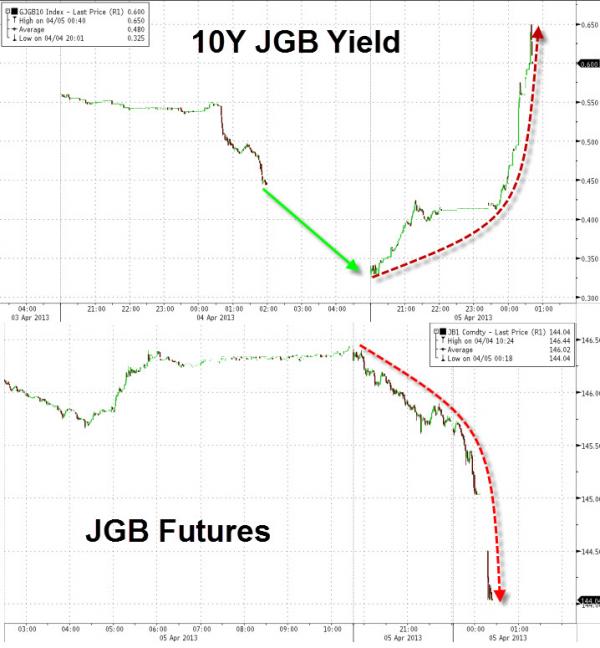
Is It Beginning? Biggest JGB Price Collapse In Over 10 Years Triggers TSE Circuit Breakers

Is It Beginning? Biggest JGB Price Collapse In Over 10 Years Triggers TSE Circuit Breakers

Tyler Durden on 04/05/2013 00:48 -0400

Just over 4 hours ago we discussed the stunning collapse in 10Y Japanese bond yields. Since then – things have taken a very dramatic turn for the worse for bonds. 10Y JGB yields have exploded higher. The move from 32bps to 65bps triggered circuit breakers on the Tokyo Stock Exchange in JGB Futures trading as JGB prices plunged by their largest amount since September 2002. We can only imagine there is liquidations galore occurring given the massive outsize moves we are seeing in Japanese bonds, stocks, FX, swaps, and CDS. Did the BoJ just lose control? Now that is a reversal!!

20130404_JGB_1_0_0

20130404_JGB_2_0