A U.S. investor won an unusual remedy in his fight against a Chinese company under an accounting cloud; Court Official Given Power to Seize Assets to Buy Back Burned Investor’s Shares

March 31, 2013, 8:44 p.m. ET

Novel Relief for China Woes

Court Official Given Power to Seize Assets to Buy Back Burned Investor’s Shares

By MICHAEL RAPOPORT

MI-BV059_ZST_NS_20130331172703

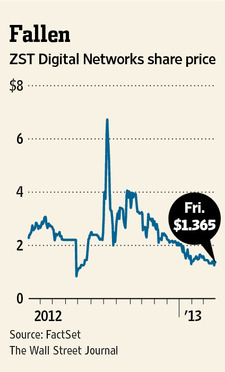
A U.S. investor won an unusual remedy in his fight against a Chinese company under an accounting cloud: A judge gave a court-appointed official the power to seize company assets needed to buy back the investor’s shares for far more than their current price. The ruling in Delaware Chancery Court by Vice Chancellor J. Travis Laster also offers a glimmer of hope to other investors who suffered steep losses on Chinese companies that listed their shares in the U.S., but have plummeted in value in the past two years. Such investors were pounded by billions of dollars in losses as short sellers targeted U.S.-listed Chinese companies, auditing firms backed away from previous work on financial statements and regulators questioned the accounting and disclosure practices of some companies.

The Delaware ruling came after ZST Digital Networks Inc. ZSTN +11.20% a network-equipment supplier, flouted an earlier court order to give the shareholder access to “certain books and records” of the company. Peter E. Deutsch, who runs a wine importer, began buying ZST shares in 2011 and eventually accumulated 3.9 million shares. But ZST ran into questions over its accounting in 2012, ultimately prompting Mr. Deutsch to sue.

Read more of this post

Superstitious investors jittery as bad omen actor Adan Cheng releases movie; Cheng has appeared in some 17 television series since 1992. The market fell while 11 of them were on air

Superstitious investors jittery as bad omen actor Cheng releases movie

Friday, 29 March, 2013, 8:06pm

Jeanny Yu jeanny.yu@scmp.com

Bulls beware. Adam Cheng Siu-chow is coming to a cinema near you.

The Hong Kong actor, whose every new television drama is said to herald a stock market crash, is returning to the big screen with a new release on April 4. And stock investors are scared stiff.

“It’s a self-fulfilling prophecy. Many locals, especially retail investors, are very superstitious,” said Ben Kwong Man-bun, chief operating officer at KGI Asia. “If everyone buys into this negative association and starts selling in panic, a sharp fall is inevitable.”

The new movie, Saving General Yang, is based on the legendary generals of the famed Yang family during the early years of the Northern Song dynasty. Cheng plays the senior General Yang, who fought a battle to defend the Song’s borders from foreign invaders.

The 66-year-old Cheng’s tryst with infamy began in 1992, when TVB launched a drama series called The Greed of Man. Cheng played the role of Ting Hai, an actor who makes a killing by short-selling derivatives and stocks in a bear market. The Hang Seng Index fell up to 13 per cent while the show was on. His bad influence on the index has been dubbed the “Ting Hai effect” since, and has proven largely true over the past decade. Cheng has appeared in some 17 television series since 1992. The market fell while 11 of them were on air. In 1997, when another series, Legend of Yung Ching , was running, the index fell below 10,000 points. TVB also happened to launch a new Cheng series in 1998, when the Asian financial crisis erupted, and in 2000, when the technology bubble burst. Read more of this post

Consultants’ fees slash workplace pensions

March 28, 2013 6:36 pm

Consultants’ fees slash workplace pensions

By Josephine Cumbo

Workplace pension savers could see up to 50 per cent of their retirement pots used to pay for pension advice given to an em-ployer, says a new report.

As millions of workers are automatically enrolled into workplace pensions, a probe by Which?, the consumer group, has exposed the size of “consultancy charges” that are being passed to pension savers without their knowledge. Read more of this post

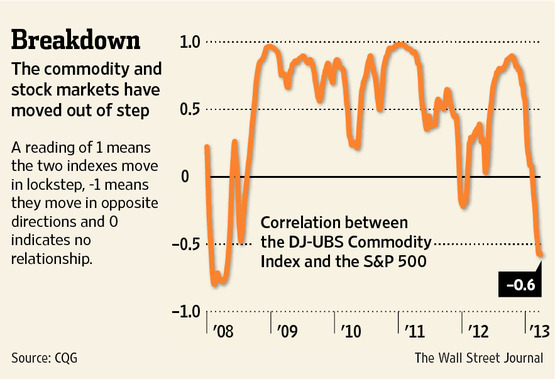
Stocks, Commodities Break Up the Band; The Correlation Between the Two Markets Is at its Lowest Since October 2008

March 31, 2013, 9:14 p.m. ET

Stocks, Commodities Break Up the Band

The Correlation Between the Two Markets Is at its Lowest Since October 2008

By JERRY A. DICOLO

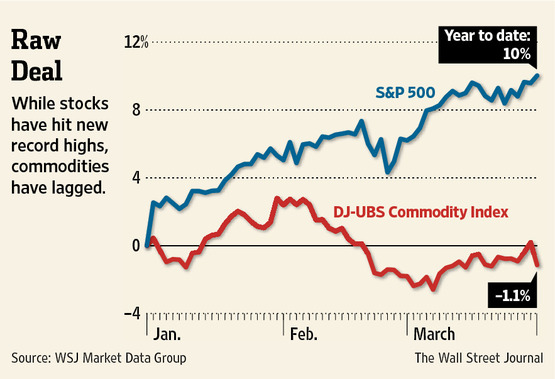
Commodities have been shut out of the stock market’s recent party.

Even as the U.S. stock market notched record highs in recent weeks, prices of raw materials, often used as a barometer of the global economy, have languished.

MI-BV041_ABREAS_G_20130331163004MI-BV042_ABREAS_G_20130331163304 Read more of this post

Himalaya, India’s Booming Ayurveda Herbal “Alternative Healthcare” Company; Sales have quadrupled in the last five years to reach 12 billion rupees ($220 million) in 2012

Himalaya, India’s Booming Herbal Healthcare Company
Adam Plowright | March 31, 2013

Bangalore, India. Its raw materials are plants and it bases its products on texts dating back millennia, but don’t dare call India’s biggest herbal healthcare group a maker of “alternative medicine.” “It’s high time people took us very seriously and did not view us as an alternative form of medicine,” says Philipe Haydon, the India chief executive of the Himalaya group from his office in tech and healthcare hub Bangalore. “This is not a feel-good product. This will save a man’s life,” he says, taking a box from a stack next to his desk.

It is marked Liv 52, a blend of six herbs used to treat liver disorders, and is one of the firms best-selling products. In two recent clinical tests, results published in the World Journal of Gastroenterology in 2007 and in the Antiviral Research journal in 2009 showed significant results. “It so happens that the input material is a herb but the rest of it is very very modern,” said the 50-year-old, who joined Himalaya in 1979. The group is an Indian healthcare success story, combining ancient traditional medicine known as Ayurveda with cutting-edge technology. Its air-tight production facility converts truck-loads of fragrant organic matter into eight million tablets a day and 10,000 bottles of medicine. In the quality control area, men and women in lab coats sit next to conveyor belts as tablets fly past on their way into plastic pots carrying Himalaya’s green and orange labels. In the research and development wing, 250 scientists are working to find new combinations of herbs whose active ingredients are extracted and concentrated to form products that are then tested by humans.

Sales have quadrupled in the last five years to reach 12 billion rupees ($220 million) in 2012. Its target is a billion dollars in annual revenue in the next four years as it spreads into foreign markets. Read more of this post

Thailand’s Pichai Chunhavajira will draw on his experience during the dark days to help him resolve SME Bank’s ingrained woes

Changing the system from the inside out

487292

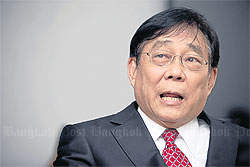
Pichai Chunhavajira will draw on his experience during the dark days to help him resolve SME Bank’s ingrained woes.

Published: 1 Apr 2013 at 00.00

Are we in a new bubble? It certainly seems like it, considering the massive trading volume on the stock exchange, the long queues at the Bangkok International Motor Show and the ever-changing city skyline as new buildings seemingly appear each day.

“You have to admit there are some areas that are overheating, but overall it’s not that bad,” said Pichai Chunhavajira, executive chairman of the Small and Medium Enterprise Development Bank of Thailand (SME Bank).

One major difference today is that speculation aside, most of the country’s banks and top companies remember the lessons learned from the Asian economic crisis. Risk management, asset diversification and balance sheets today for the country’s top firms have all significantly improved over the course of the past several years. Debt-to-equity ratios have fallen sharply, as many chief financial officers remember painfully the dangers of excessive leveraging and overdependence on banks for funds. Read more of this post

Malaysia/Asia: How much should chiefs of government linked companies be paid?

Monday April 1, 2013

How much should chiefs of government linked companies be paid?

Corporate Notes by Gurmeet Kaur

GLCs-pay-directors-graphic-b2

THE debate continues on how much top directors of government-linked companies (GLCs) should be paid. GLCs here are key drivers of the economy and on many occasions, they are substantial investors in the financial markets. But the one key feature is that GLCs are ultimately owned and controlled by the Government.

So the remuneration paid to GLC chiefs can be a touchy issue as shown during Bursa Malaysia Bhd’s shareholder meeting on Thursday. The seemingly high annual remuneration of RM5.54mil paid to its chief executive officer Datuk Tajuddin Atan in 2012 grabbed the attention of minority shareholders.

They wanted the board to explain why Tajuddin’s pay last year had more than doubled from 2011, considering the exchange’s performance was “not impressive”.

To be fair, Tajuddin was appointed to the top post at Bursa on April 1, 2011, meaning his remuneration for the year (amounting to RM3.55mil) covered a nine-month period. So Tajuddin’s salary for 2012 is actually only a 17% increase against a pro rated 2011 salary.

Still, his remuneration is far greater than his predecessor’s. In 2010, former Bursa CEO Datuk Yusli Mohamed Yusoff was paid RM1.54mil.

Then again, Tajuddin’s pay package does not surprise some recruitment specialists who reckon the position of a stock exchange head is perhaps the most coveted in Corporate Malaysia.

Bursa did not give a breakdown of Tajuddin’s RM5.5mil package, which does not include his share grant. It is interesting that Bursa had given its CEO a share grant last April before he had delivered any key performance indicators (KPIs).

So how are other stock exchange chiefs remunerated? Across the causeway, the Singapore Exchange Ltd dished out a remuneration package totalling S$3.901mil for its head honcho Magnus Bocker in 2012. The bulk of Bocker’s remuneration was in the form of a S$2.20mil bonus. Read more of this post

Datuk Hafsah Hashim, CEO of SME Corp Malaysia: Creating global champions from local companies was never heard of before. And, no one has ever given a thought to a Malaysian local company becoming a multinational corporation (MNC) in another far away land! Who says that it is impossible?

How much is a brand worth?

Published: 2013/04/01

In a blink of an eye, we are already in the second quarter of 2013… time really flies! How I wish I have the super power to stop time, just enough to encompass the moment to sit and reflect on how my life has changed ever since I embarked on this journey to do my bit in assisting small businesses.

Indeed, these little business entities are like own children. My life’s little pleasures are watching them grow from start-ups to become local and, thereafter, global champions. I watch their every little success as they etched their mark, the challenges they go through and the triumphs they get from winning contracts. The joy and satisfaction of being with them as they move from zero to hero is indeed immeasurable!

Creating global champions from local companies was never heard of before. And, no one has ever given a thought to a Malaysian local company becoming a multinational corporation (MNC) in another far away land! Who says that it is impossible? In any case, if we break the words of “impossible” into three parts, it becomes “I m possible”.  Read more of this post

How Funds Massage Numbers, Legally

March 31, 2013

How Funds Massage Numbers, Legally

By CAROLYN T. GEER

OB-WW353_31IBc_G_20130328162432

Most investors are familiar with the boilerplate disclaimer that past performance doesn’t guarantee future results. Far fewer are aware of how past performance numbers themselves can be misleading.

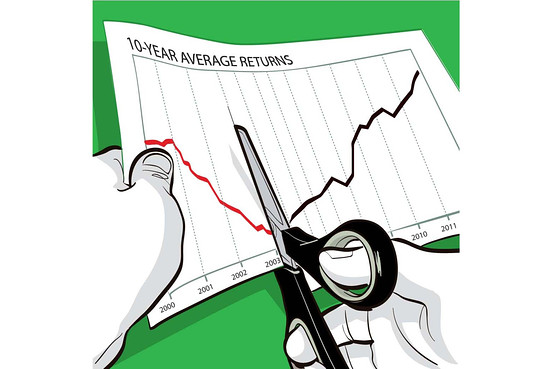
Sometimes only a “trick of the calendar” is to blame, as noted in a recent market commentary from Vanguard Group. The 10-year average annual return of the total U.S. stock market shot to 8% as of year-end 2012, from 4% a year earlier. Sure, U.S. stocks were up 16% in 2012, versus 1% for 2011. But more important, the negative 21% return from 2002—the last year of the 2000-2002 bear market—rolled out of the 10-year return calculations.

This year, the negative 37% return from 2008 rolls off the five-year return calendar, so that even if stocks go nowhere in 2013, their five-year average annual return will jump from the current 2% to 12%, by Vanguard’s calculations. Read more of this post

Martin Feldstein: When Interest Rates Rise

When Interest Rates Rise

Martin Feldstein, Professor of Economics at Harvard University and President Emeritus of the National Bureau of Economic Research, chaired President Ronald Reagan’s Council of Economic Advisers from 1982 to 1984. In 2006, he was appointed to President Bush’s Foreign Intelligence Advisory Board, and, in 2009, was appointed to President Obama’s Economic Recovery Advisory Board. Currently, he is on the board of directors of the Council on Foreign Relations, the Trilateral Commission, and the Group of 30, a non-profit, international body that seeks greater understanding of global economic issues.

30 March 2013

CAMBRIDGE – Long-term interest rates are now unsustainably low, implying bubbles in the prices of bonds and other securities. When interest rates rise, as they surely will, the bubbles will burst, the prices of those securities will fall, and anyone holding them will be hurt. To the extent that banks and other highly leveraged financial institutions hold them, the bursting bubbles could cause bankruptcies and financial-market breakdown. Read more of this post

Beijing, Shanghai announce detailed property curbs; The two mega-cities both vow to strictly implement the 20-percent tax on capital gains from property sales

Beijing, Shanghai announce detailed property curb

English.news.cn   2013-03-30

BEIJING, March 30 (Xinhua) — The municipal governments of Chinese capital Beijing and business hub Shanghai on Saturday spelled out detailed rules aimed at cooling the property market following the central government’s fresh regulatory plan earlier this month.

Single adults with a permanent Beijing residence registration, who have not made purchases in the city before, are allowed to buy only one apartment, according to the announcement.

Shanghai said banks will be banned from giving loans to local residents who are buying a third apartment or more, according to a government announcement.

Meanwhile, the two cities will raise down payments for second-home buyers.

The two mega-cities both vow to strictly implement the 20-percent tax on capital gains from property sales. Read more of this post

Investors wary of “slow panic” on growth after Cyprus rescue

Published: Saturday March 30, 2013 MYT 11:44:00 AM

Investors wary of “slow panic” on growth after Cyprus rescue

LONDON: World markets have reacted calmly to the twists and turns of Cyprus’s financial rescue in the last fortnight but many investors fear the economic fallout is yet to come.

They have sold European assets, rather than make a global dash for safety that could signal concerns about a euro breakup.

Euro blue chip and bank equity prices, regional bank bonds and the euro exchange rate have all fallen sharply this week but Wall St stocks set a record closing high.

Mutual fund data released by fund tracker EPFR on Friday showed that European equity, bond and money market funds all saw hefty redemptions this week even as investors continued to pile into Japanese and U.S. equity funds. Read more of this post

Innovation by Asian business leaders no longer a luxury; Amid the changing rules driven by the acceleration of globalisation, Asian leaders must be game-changing innovators to succeed in the new normal

Innovation by Asian business leaders no longer a luxury

The Nation March 30, 2013 1:00 am

Amid the changing rules driven by the acceleration of globalisation, Asian leaders must be game-changing innovators to succeed in the new normal, according to a study by global management consulting firm Hay Group.

Increasing globalisation is a given, with international competition likely to grow fiercer and markets even more diversified. The rise of India and China, coupled with the global economic power shift towards Asia, is reshaping the world before our very eyes. In the West, the number of jobs is falling; in the East, leaders have to learn how to manage in new markets as they expand westwards.  Read more of this post

Korean food and restaurants going global

2013-03-29 16:33

Korean food and restaurants going global

By Park Si-soo
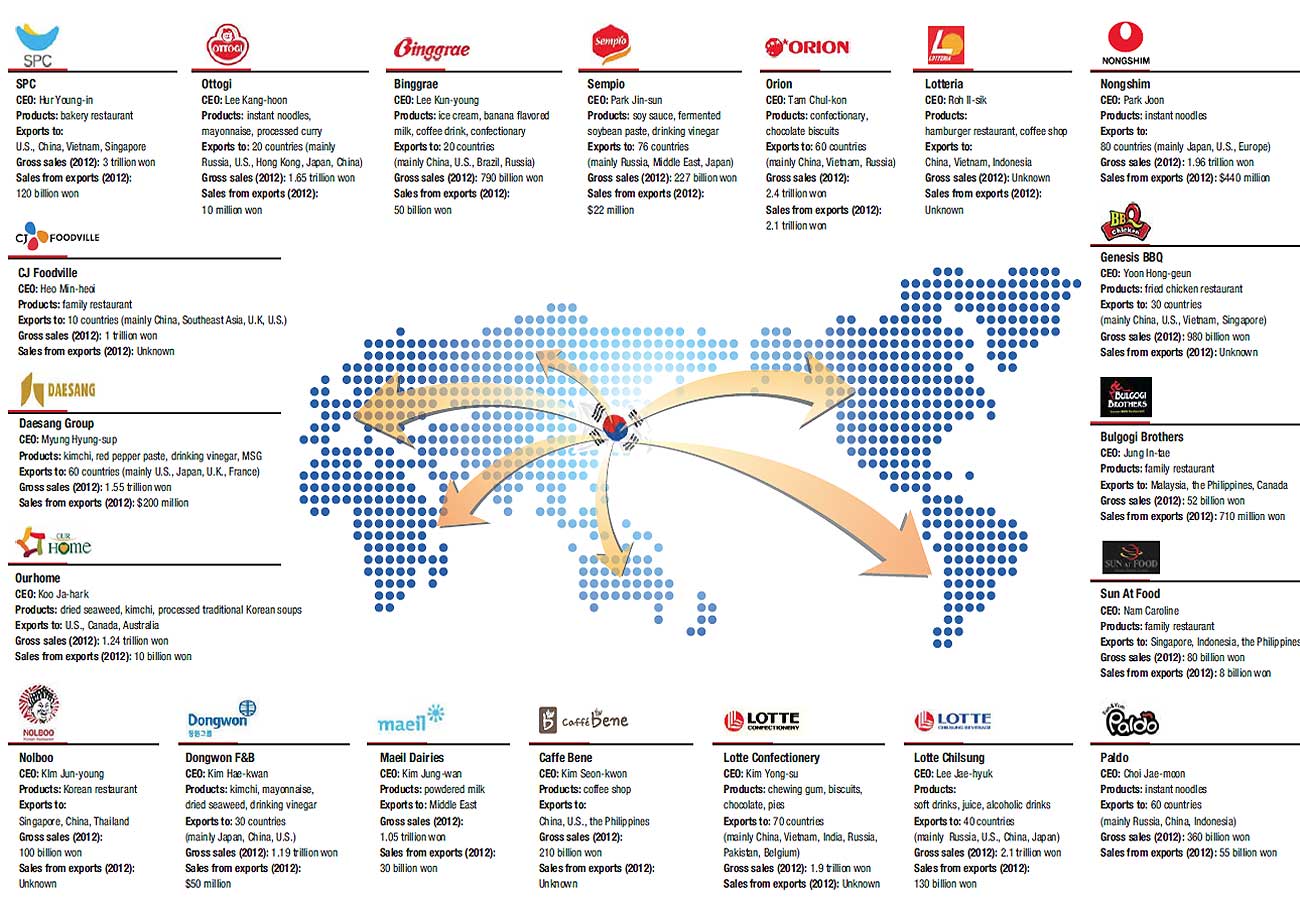
This is Korea’s next export item: food. A growing number of local food companies are carving out business footprints overseas, seeking to conquer dining tables around the world. The trend is facilitated by homegrown restaurant chains that are increasingly flexing their muscle to conquer what gourmets call “hubs of international cuisine” such as New York, London and Paris. Several companies have already set up sales networks in more than 60 countries and are trying to cement their presence by establishing manufacturing bases there. While their overseas sales have so far generated income from China, Japan, America and Southeast Asian countries that have many Korean immigrants, they are now trying to diversify revenue sources by taking advantage of the boom in Korean pop culture that is sweeping Russia, Europe and Latin American countries. The Korea Agro-Fisheries and Food Trade Corp. (aT) said the country exported kimchi worth $3.87 million to the U.S. last year, up 38.6 percent from the previous year. Shipments of red pepper paste to the U.S. surged by 24.9 percent during the same period, aT said. Exports of Korean ice cream to Brazil jumped a whopping 102.2 percent last year, it noted, saying its popularity is quickly spreading to surrounding countries. “We have a good start,” a spokesman for the company said. “I believe food products will emerge as a new growth engine for the country along with semiconductors, smartphones and automobiles.”

hally_1300_900

Tan Sri Andrew Sheng: Financial crises a result of governance failures

Saturday March 30, 2013

Financial crises a result of governance failures

THINK ASIAN By ANDREW SHENG

ROMAN emperor Julius Caesar was famously warned by a seer about the Ides of March, traditionally March 15.

On March 15 this year, banks in Cyprus were closed to allow politicians time to decide how to raise 5.8 billion euros so that the country could qualify for 10 billion euros in bailout funds from the rest of eurozone and the International Monetary Fund (IMF). The solution suggested was to levy a tax on depositors, sparking a realisation that finally, the Europeans had decided to “bail-in” investors and depositors, rather than using public funds to “bail-out” everyone else.

The Cyprus crisis caused a stir in global financial markets, because it punctured expectations that the worst was over. Instead, it demonstrated another episode of muddling through. Read more of this post

Wal-Mart is examining a groundbreaking plan to use shoppers in its stores to make deliveries to consumers who have ordered the retailer’s items online. The retailer could potentially offer a discount to entice shoppers to make the deliveries on their way home from stores.

Wal-mart to use its customers to deliver products

Wal-Mart is examining a groundbreaking plan to use shoppers in its stores to make deliveries to consumers who have ordered the retailer’s items online.

Wal-Mart is forecasting online sales of about $9bn (£5.9bn) this year

By Richard Blackden

8:58PM GMT 28 Mar 2013

The world’s biggest retailer is making a big push to drive online sales as more Americans stay connected to the internet throughout the day through phones and tablet devices. A small number of its more than 4,000 stores have begun delivering orders directly to consumers, rather than sourcing the items from warehouses. Using consumers in its stores would take that one step further. “I see a path to where this is crowd sourced,” Joel Anderson, who runs Walmart.com in the US, told Reuters. He said the retailer could potentially offer a discount to entice shoppers to make the deliveries on their way home from stores.

Read more of this post

Jim Rogers: Depositors Globally Should ‘Run for the Hills’

Jim Rogers: Depositors Globally Should ‘Run for the Hills’

Friday, 29 Mar 2013 08:35 AM

By Dan Weil

The losses imposed on Cyprus bank depositors by the European Union, European Central Bank (ECB) and International Monetary Fund (IMF) bailout should be a warning shot to bank depositors around the world, says investment legend Jim Rogers, chairman of Rogers Holdings. “What more do you need to know? Please, you better hurry, you better run for the hills. I’m doing it anyway,” Rogers tells CNBC. “I want to make sure that I don’t get trapped. Think of all the poor souls that just thought they had a simple bank account. Now they find out that they are making a ‘contribution’ to the stability of Cyprus. The gall of these politicians.”

Rogers’ idea is that the risk of a confiscation of bank deposits now exists anyplace on the globe. “I, for one, am making sure I don’t have too much money in any one specific bank account anywhere in the world, because now there is a precedent,” he says. The IMF and European Union have told Cyprus, “loot the bank accounts,’” Rogers adds. “So you can be sure that other countries when problems come, are going to say, ‘well, it’s condoned by the EU, it’s condoned by the IMF, so let’s do it too.’” As for what is a good investment right now, Rogers said he owns Swiss francs and some other long-term European investments, but has been investing in Russia and Japan recently, not the United States. “I’m certainly not investing in the U.S., because the U.S. is making all-time highs based on money printing,” he explains. “If you give me a trillion dollars, I’ll show you a good time too and a lot of people are having a good time. I’m somewhat skeptical because I know it’s going to end badly.”

The Cyprus crisis could ultimately affect the United States by infecting broader Europe, David Sterman, senior market analyst at StreetAuthority.com, tells Newsmax TV in an exclusive interview. “The real threat to the U.S. is concern that things like Cyprus start to impact bigger and bigger dominoes in Europe, whether it’s Italy or Spain, and messes up all the financing mechanisms we’re desperately trying to arrange to keep things moving forward there,” he explains. “So it’s really what Cyprus means for Europe and what Europe means for the U.S.”

South Korean President Park’s fund a drop in country’s debt ocean; South Korea’s much-hyped household debt relief program launched with far less money than planned in the latest sign the leader was struggling to gain traction

South Korean President Park’s fund a drop in country’s debt ocean

5:29am EDT

By Somang Yang

SEOUL (Reuters) – South Korea’s much-hyped household debt relief program, a key policy pledge from new President Park Geun-hye, launched on Friday with far less money than planned in the latest sign the leader was struggling to gain traction.

Park took power in February after a bruising election campaign fought largely over the economy and identified debt relief and narrowing rising income inequality as key policy platforms.

She pledged 18 trillion won ($16.18 billion) for the fund which debuted with just 800 million won and which will target 324,000 people, a tenth of the 3.2 million people Park had promised would benefit from the plan.

“I’m disappointed in Park Geun-hye, I really thought she would do more to solve the debt crisis,” said Kim Shin-hong, a 51-year-old man waiting in line at the Credit Counselling & Recovery Service offices in downtown Seoul on Thursday. South Korean household debts are 156 percent of disposable income and act as a major drag on Asia’s fourth-largest economy, which the government expects to grow just 2.3 percent this year. Park’s approval rating slipped to 41 percent in a poll conducted by Gallup, making her the nation’s most unpopular leader in the early weeks on the job. Read more of this post

Brands that have died in Britain live on elsewhere

British brands abroad

Going native

Brands that have died in Britain live on elsewhere

Mar 23rd 2013 |From the print edition

20130323_BRP003_0

BRITONS were fond of A.1. sauce until the 1950s, when it stopped being widely sold in the country that created it. But like other products the natives have wearied of, A.1. is still avidly consumed elsewhere. American omnivores prize it as a complement to steak.

There are many such commercial expatriates, brands born in Britain but now more at home abroad. Rinso is the top detergent in Indonesia. Italian bambini grow up on Mellin, the distant descendant of a Victorian producer of concentrated milk. Peardrax and Cydrax, fruit-based fizzy drinks sold in Britain until the 1980s, are still popular in Trinidad & Tobago.

The ultimate expatriate power brand is Lifebuoy. William Lever concocted the soap in 1894 and sold it as a means to combat cholera. By the 1930s Lifebuoy marketers had turned their guns on British body odour. It “knocks out B.O.”, the packages promised. Lifebuoy eventually lost its allure in Britain, perhaps because buying it came to be seen as an admission of smelliness. Now Unilever, Lever’s corporate heir, uses it to fight diarrhoea, a menace that kills 1.5m children a year. Hand-washing can cut that toll (and move a lot of soap), the multinational reckons. At this year’s Kumbh Mela, a triennial gathering of tens of millions of Hindus, Lifebuoy seared its hand-washing slogan into unleavened rotis, the pilgrims’ staple.

Empire gave brands “the ability to get global quickly”, notes Robert Opie, a consumer historian whose collection forms the basis of the Museum of Brands, Packaging and Advertising. Some stayed after the sahibs went home. Peek, Frean started baking biscuits in Britain in 1857 and in India in 1924. The Bermondsey factory closed in 1989 but Peek Freans (now comma-less) still take a big bite of the market in Pakistan, where they are baked by the nostalgically named English Biscuit Manufacturers. Mondelez, a food giant, continues to sell them in Canada. Read more of this post

A banking scandal highlights the problem of black money in India

India’s shadow economy

Evasive action

A banking scandal highlights the problem of black money in India

Mar 23rd 2013 | MUMBAI |From the print edition

20130323_FND002_0

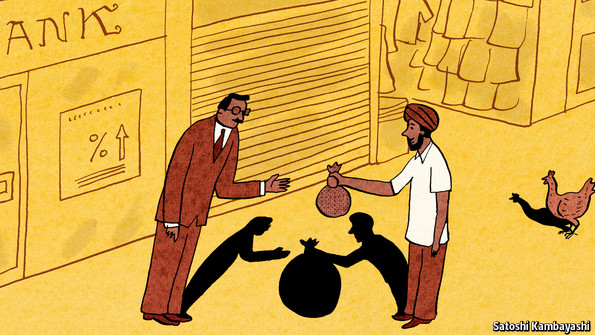
THE videos were set to the James Bond theme tune and labelled as a “shocking mega-exposé”. They were released by an investigative website called Cobrapost on March 13th, and have hit the share prices of India’s biggest private-sector banks. The sting consisted of a journalist with a secret camera walking into bank branches, where he claimed to be linked to an unnamed politician whose house could no longer contain his cash. Staff in many branches were only too willing to help launder the money, usually by fiddling the rules for setting up accounts and insurance policies. “Yes, yes, don’t worry, sir, all people do this,” replied one bank official.

The lenders and their regulator are looking into the allegations. Even if they are bogus, they tap into a well of mistrust. A 2009 e-mail claimed that Indians held more money in Swiss banks than people from all other countries combined. It was a hoax, but still went viral.

Gauging the scale of the problem is hard. A 2010 World Bank study of 151 countries concluded that India’s shadow economy, defined as legal activity concealed from the authorities, was equivalent to a fifth of official GDP (confusing matters, it is unclear to what extent India’s official GDP already captures the black economy). That is roughly double the level of the best rich countries, but below the global average and most other emerging nations. The last vaguely official study was in 1985 and had a similar answer—19-21% of official GDP. Read more of this post

Eaton Vance Files to Start Active ETFs Using New Model that wouldn’t disclose their holdings daily

Eaton Vance Files to Start Active ETFs Using New Model

Eaton Vance Corp. (EV) asked U.S. regulators for permission to start a series of actively managed exchange-traded funds that wouldn’t disclose their holdings daily. Eaton Vance filed with the U.S. Securities and Exchange Commission to open what it calls exchange-traded managed funds, or ETMFs, the Boston-based company said today in a statement. The funds would mirror existing Eaton Vance mutual funds and the firm seeks to license the model to other fund providers, according to the statement. Active ETFs typically combine the security selection of a fund manager with the intra-day trading and cost-saving characteristics of ETFs. Companies interested in that hybrid have so far been largely discouraged from opening products, especially those focused on equities, by the SEC’s requirement for daily disclosure of ETFs holdings. Active ETFs in the U.S. hold $12.3 billion, less than 1 percent of assets in the $1.4 trillion ETF industry, according to data compiled by Bloomberg. “By removing the requirement for daily portfolio transparency, ETMFs can enable investors to access a broad range of active strategies through a vehicle that provides the investor benefits of an exchange-traded fund,” Eaton Vance said in the statement. Eaton Vance, the manager best known for selling products designed to minimize taxes, managed about $248 billion in assets as of Jan. 31. Read more of this post

The Limits of China’s Market Model; An interview with James McGregor, whose book “No Ancient Wisdom, No Followers” argues that the long-term prospects for China’s economy are being hurt by state dominance and protectionism.

MARCH 27, 2013, 10:00 AM

The Limits of China’s Market Model

By DAVID BARBOZA

In his book “No Ancient Wisdom, No Followers,” the author James McGregor delivers a sharp critique of China’s recent development path, and what he calls “authoritarian capitalism.” In Mr. McGregor’s China, the government plays too large a role in the economy, and big state-owned entities dominate because of government subsidies and preferential treatment. Private entrepreneurs and multinational corporations are at a distinct disadvantage, one that he argues is likely to damage China’s prospects in the long run. With China determined to create its own global brands, he says, the government is putting rules and regulations in place that seem increasingly protectionist.  Read more of this post

China: gold before swine; Should gold traders be paying attention to Chinese pork prices?

China: gold before swine

Mar 28, 2013 8:24am by Leslie Hook

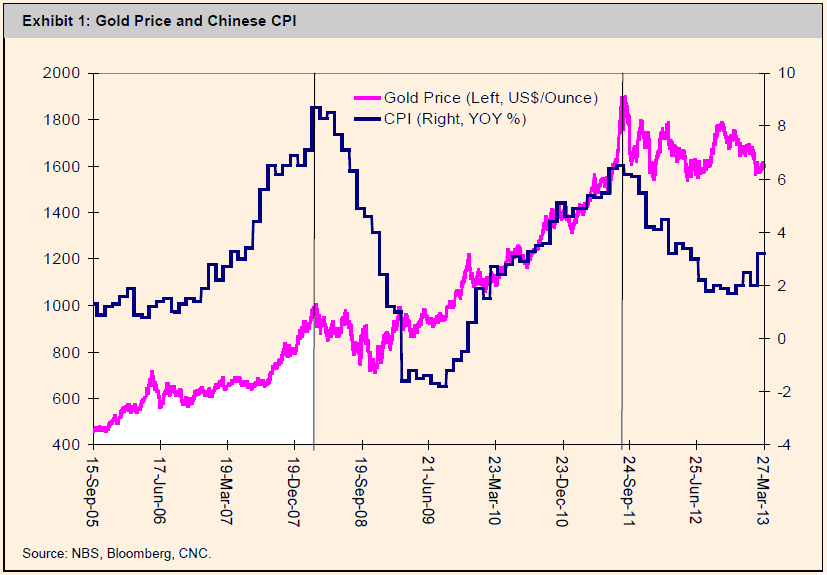
Should gold traders be paying attention to Chinese pork prices? It may sound outlandish, but new research has uncovered an interesting link between global gold prices and Chinese inflation (which in turn is often driven by pork prices). China accounts for a quarter of the world’s physical bullion demand so it’s no surprise to find it has a big role in setting global prices. But just how its influence works is not always clear, especially when weighed against other factors like crude prices, quantitative easing, or the strength of demand from India, the world’s biggest gold buyer. Now there is evidence to suggest a strong correlation between bullion prices and Chinese inflation, according to Na Liu, head of CNC Asset Management. He wrote in a recent note to clients: We have reviewed many Chinese macro indicators to detect their correlation with the gold price, and we are basically brought down to the very basics: the gold price is highly correlated to China’s inflation and real interest rate… This makes intuitive sense. Over the past few years, China’s jewellery demand shows only steady growth. The key driver for demand volatility comes from investment demand, and investment demand was driven by the need for purchasing power preservation and therefore varies as inflation expectation surges and ebbs. Last year, as China’s inflation cooled, gold demand did not increase in China at all. His chart illustrates how peaks in the gold price match peaks in Chinese inflation, while rising inflation is correlated with rising gold prices:

gold-price1

Source: CNC Asset Management

So what does this mean for gold bugs? Officials have warned that China faces inflationary pressures this year, with central bank governor Zhou Xiaochuan saying this month that China should be on “high alert” against inflation. Inflation for the first two months of this year came in at 3.2 per cent, its highest level in 10 months. The fear is that inflation could be pushed even higher by rising prices for pork, which is heavily weighted in the consumer price index because it is so widely consumed. As Rahul Jacob noted on beyondbrics, pork prices are expected to rise sharply this year, by as much as 16 per cent according to some estimates. If that happens, it could be good news for gold bugs.


Henan farmers on potentially toxic wheat: “They are all sold to you. We don’t eat them.”

Henan farmers on potentially toxic wheat: “They are all sold to you. We don’t eat them.”

Alia | March 28th, 2013 – 10:56 pm

Farmers in Xiaokuai village, Henan province, have recently been found to use unprocessed paper mill wastewater to irrigate their wheat farms. Admittedly, these wheat, if harvested, are more likely to be toxic than not. But questionable grain in China due to water and soil pollution isn’t exactly news. What surprises a lot of people in this case is the farmers’ reaction. Dongfeng Paper Mill was set up in 1982 in the village, currently with an annual production of 500 thousand tons of paper. To meet growth needs, the mill has been digging deeper and deeper wells over the past 30 years, slowly draining away local underground water. Unable to afford wells as deep, local farmers turned to a convenient source – the wastewater pipe located just a few yards from their farmlands. They cut it open and use unprocessed wastewater for irrigation directly. As a result, local farmlands are covered with a thick, grey, cardboard-feel layer, as if the wheat is growing out of concrete. When asked about whether they themselves dare to eat wheat harvested from such farmlands, one farmer thus responded…with a big smile on his face: “They are all sold to you. We don’t eat [wheat soaked in wastewater]. There are still wheat farms irrigated by [clean] water from the wells. We eat those.” This is not the first time when we observe similar “not me” effect when it comes to food safety problems in China. Every so often we hear about news exposing small food workshops or factories that use excess chemicals, toxic addictives or questionable ingredients to produce food products. For example, the countless underground gutter oil shops, and the businesses that send out the following card to purchase dead pigs. The people behind these businesses must very well know that their products may endanger people’s health or even life, but it’s “the other” people. The assumption is somehow that they themselves, or their family and friends, are not subject to the risk of toxic food. The irony is, China has way too many people in the food industry who think the same way that nobody is safe. Like a popular online saying goes: “China has become a country where pig farmers don’t eat pork, and cow farmers don’t drink milk.” And wheat farmers no longer eat wheat…Netizen 原味呼吸 asked: “When “you” think “you” have nothing to do with “us”, an era of people killing people comes. If you don’t care about others, who would care about you?” Most netizens viewed it as a lose-lose situation due to China’s at-all-cost development model. Like netizen 亚当孙今生  commented: “This is beyond a conflict of the poor and the rich. To farmers, urban residents are rich, who, at the same time, have no choice but to eat toxic rice.” Netizen 书剑2002 commented: “The cities have been exploiting the farmers. And the farmers are poisoning urban dwellers. At the end, no one survives.” When things deteriorate to this level, everyone is guilty. Like netizen 123zzq强 pointed out: “I blame the government for doing nothing. I blame the paper mill for dumping unprocessed wastewater. I blame the farmers for using wastewater for irrigation with knowledge. “ The paper mill has already been close for investigation. But the same story is probably happening somewhere else in China, right now.

“All sold to you.”

511

The end is nigh’ for global oil demand growth: Citi; global oil demand would plummet by 18%, to around 74 million barrels a day from the current 90 million

Citi: ‘The End Is Nigh’ For Oil

Rob Wile | Mar. 26, 2013, 11:21 AM | 5,312 | 10

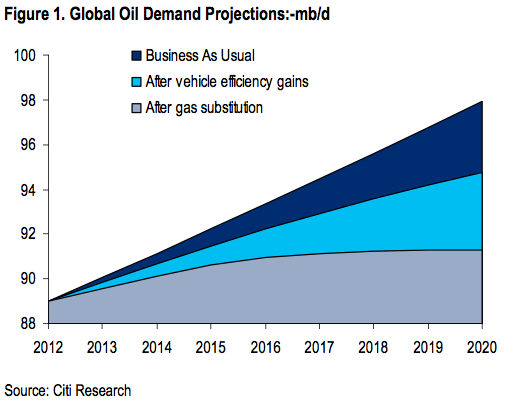
Citi‘s Seth Kleinman has a pretty sweeping note today, titled “The End Is Nigh,” in which he argues crude oil demand — and with it, prices — are is set to fall dramatically in the coming decade thanks to the rise of natural gas and more advanced fuel economies.  And the trend is worldwide. Kleinman on gas: One of the many unforeseen ripple effects of the US shale revolution is a push to substitute natural gas for oil. This is set to accelerate with LNG already challenging diesel’s 13 mb/d heavy duty truck use globally but especially in China, bunker’s 3.7 mb/d seaborne market, and CNG and propane set for exponential growth not only in markets such as Brazil, Egypt, Iran and India, but in Russia and the US as well. Oil-based power generation is increasingly being replaced by gas-fired generation. As much as 2 mb/d of power generation demand in the Middle East in total could be switched to natural gas by the end of the decade, and the increasing availability of LNG towards end-decade could back out other oil for power generation needs in India and Latin America amongst others. And on fuel economy: Higher prices, the removal of many fuel subsidies and rising fuel economy mandates have dramatically improved the outlook for fuel efficiency in global automotive and truck fleets. Citi’s automobiles team estimates that new car fuel efficiency is now improving by 3-4% p.a., with trucks managing 1-2%. As cars make up ≈60% of the total global road fleet we conservatively estimate that new vehicles (cars and trucks combined) fuel economy increases by 2.5% p.a. Here’s the key chart showing global demand forecasts.

demand projections

Kleinman concludes that the oil price spikes of the late ’00s were basically a fluke: The structural bull market of the previous decade was a result of surging global oil demand and consistently disappointing non-OPEC supply growth, compounded by a collapse in Iraqi and Venezuelan production. The outlook for each of these factors has now reversed, reinforcing Citi Research’s long term view that by the end of the decade Brent prices are likely to hover within a range of $80-90/bbl. The shale boom’s effects are still rippling across the globe.  Read more of this post

China’s Crackdown On $2.1 Trillion Of Wealth Management Products

screen shot 2013-03-28 at 7.34.05 pm

Driving the Asian Century Beyond Clans, Cliques, Clones in Indonesia

Driving the Asian Century Beyond Clans, Cliques, Clones in Indonesia
Michael L. Bak | March 27, 2013

Dynamic Asia. Amazing Asia. Rising Asia. Wherever you turn, wherever you read, wherever you tweet, facebook or youtube, nothing could be as clear; Asia is where it’s at.  Action. Growth. Change. If Asia is the future, then welcome to the mothership: Indonesia.

China is dominating the world’s headlines and cover pages; are we now witnessing the fall of the West and the rise of the rest, or as The Economist most recently put it: “is America ready to be Number 2”? We’d be forgiven for instantly gazing China-ward. Even the OECD says China will become the number one economy in 2016; but there’s a whole lot of Asia out there that’s not the Middle Kingdom. It’s the Asian Century after all, and Indonesia is leading the charge.

Indonesia’s democratic credentials bolster its confidence in regional security and economic matters, from Myanmar’s transition to a more engaged and engaging Association of Southeast Asian Nations. Growing economically by leaps and bounds — many predict the land of the mystic Garuda will outpace China and India in 2013, barreling along at 6.3 percent this year. But the story of the Asian Century goes well beyond markets, per capitas, and growing middle classes.

Crucial to our story, Indonesia brings a seriously democratic (if not messy) government, fiercely independent (and wildly free) press, one of the world’s most diverse countries (in so many aspects), and a super-active civil society (masters of multi-platform activism). Malaysia may have staked a claim to “Truly Asia,” but Indonesia definitely gets the Oscar for animating the Asian Century.

With Indonesia’s colorful democracy leading, the Asian Century will tell the story of Southeast Asia breaking the bonds of socio-economic imperialism, ditching patronage and growing through enlightened governance.  Read more of this post

As the Pace of China’s Junk Bond Sales Grows, So Do Worries. Chinese junk bonds also have a unique structure, which could leave investors vulnerable. Chinese bonds are issued through offshore holding companies and tend not to be backed by the actual businesses and underlying assets in mainland China. That means foreign bondholders may have little legal recourse if a company defaults on its debt

MARCH 28, 2013, 2:53 PM

As the Pace of China’s Junk Bond Sales Grows, So Do Worries

By NEIL GOUGH

HONG KONG — It has an all-too-familiar ring. Investors in search of better interest rates rush to risky, high-yield bonds, raising worries that the market is overheated. But the concerns — which have already been voiced about the $120 billion of European and American junk bonds issued this year — are now being applied to the fledgling Chinese market. While American and European companies have been selling high-yield debt for decades, Chinese businesses only recently started to tap into the junk bond market in earnest. It’s a sign that Chinese companies are growing up. As the country’s economy continues to open up, private sector businesses have looked to foreign investment to finance their expansion efforts, rather than relying on hard-to-get loans from the state-controlled banks. The junk bond market in China took off this year. Although the deals still account for a small share of the global total, Chinese companies have sold $8 billion of high-yield bonds to overseas investors since January. That’s up from $2.3 billion during the same period a year earlier, according to figures from Dealogic. “Bond markets are booming because companies have had difficulty getting the level of debt they want out of banks onshore or offshore, and in tapping equity markets,” said Nick Gronow, a senior managing director atFTI Consulting in Hong Kong and an expert in Chinese bankruptcies. “So bonds have really taken up the slack.”

But the pace of growth is troubling to some analysts. As investors have plowed into junk bonds across the globe, yields have plummeted. In the United States, rates on junk bonds have dipped below 6 percent, compared with historical payouts of roughly 10 percent or more. The trend is similar in China. Country Garden, a builder based in the southern city of Guangzhou, raised $750 million in January by selling 10-year bonds that paid 7.5 percent a year. In 2011, the company sold $900 million of seven-year bonds at a much higher 11.125 percent. The borrowing costs for Kaisa Group Holdings, a commercial real estate company in the southern city of Shenzhen, have also dropped rapidly. In September, it sold $250 million of five-year bonds at 12.875 percent. By January, it was able to sell $500 million of bonds at 10.25 percent. This month, it issued new bonds at 8.875 percent. “Chinese real estate issuance is happening for structural reasons: 50 percent of the population needs to be urbanized and housed, traditional funding from banks may be more restricted now, and global appetite for yield is on the rise,” said Gregorio Saichin, the London-based head of emerging markets and high-yield, fixed-income portfolio management at Pioneer Investments. “When you combine all the above factors with a massive refinancing exercise by Chinese property developers, you get this type of outcome.” But it’s a slim difference in yields for such disparate markets. Chinese high-yield bonds have many of the same characteristics — and risks — as American debt. They tend to be sold by companies looking to finance ventures in new or untested areas or businesses that compete in industries where earnings are subject to volatile swings.

But the Chinese market has its own set of potential problems, and some analysts worry that investors aren’t being properly compensated for the added layer of risks. For one, the bulk of the high-yield bonds in Asia this year — roughly half — come from Chinese real estate companies. The fear is that the housing market, which has been booming, is a bubble that will eventually burst. The industry is especially uncertain, given the periodic government intervention. On March 1, Beijing announced new measures to curb excess in the market, including the strict enforcement of a 20 percent capital gains tax on the sale of preowned homes. “With the new leadership in China, people are still not sure which way things will go in terms of property policies,” said Suanjin Tan, an Asia fixed-income portfolio manager based in Singapore at BlackRock. “That also adds to the desire among these guys to remain cashed up, so they can take advantage of any wobbles in the market to pick up land on the cheap.”

Chinese junk bonds also have a unique structure, which could leave investors vulnerable. Mainland China’s domestic bond market remains largely off limits to foreign buyers. So most investors buy offshore Chinese bonds, which are issued through holding companies headquartered in places like the Cayman Islands. The bonds tend not to be backed by the actual businesses and underlying assets in mainland China. That means foreign bondholders may have little legal recourse if a company defaults on its debt, especially if local banks or other Chinese creditors make claims. Bondholders are now facing such difficulties with the bankruptcy of Suntech Power.

Read more of this post
Buchheit On Cyprus: “The Situation Is Spiralling Down”, And Why A Second Bailout May Be Needed

Buchheit On Cyprus: “The Situation Is Spiralling Down”, And Why A Second Bailout May Be Needed

Tyler Durden on 03/28/2013 17:05 -0400

When the world’s leading expert on Sovereign debt restructurings believes that the endgame for Cyprus might be another round of restructuring, adding that “I’m not sure this is over,” it is important to listen. With the calmness in Cyprus today more reflective of paralysis than confidence,  Lee Buchheit senses that the parameters of how much money will be needed to recapitalize the banks have changed. He tells Bloomberg TV’s Lee Pacchia in this brief clip, “the situation is spiraling down… they’ll need more money because the economy is worse, tax collections less, deposits will flow out when they can flow out.” As for which European nation will be next in need of assistance with its sovereign debt burdens? Buchheit agrees with us that while many are looking to Slovenia, he sees real economic and political problems in both Italy and Spain remaining especially since the EU “have certainly changed the rules of the game.”

Read more of this post

Food Fraud Hits New Low: Dog Meat In British Curry

Food Fraud Hits New Low: Dog Meat In British Curry

03/28/2013 15:34 -0400

Submitted by Michael Krieger of Liberty Blitzkrieg blog,

The food fraud story has now progressed from somewhat humorous with the undersized Subway footlong subs, to the highly disturbing with the revelations of horse meat and fake tuna, to the really creepy with the now potential emergence of dog meat in UK lamb curry.  No you can’t print lamb folks, which is exactly why many humans are now eating worse than their pets in the Western world.

A mystery meat, which has defied the best efforts of scientists to identify it, has been found in a lamb curry as part of an investigation into food fraud. The discovery raises new questions about just what is going into the nation’s takeaways and processed foods. The meat in a Beef in Black Bean Sauce dish turned out to contain high levels of chicken material including blood, while a burger contained no beef at all, other than blood and heart. However, most alarming of all was a curry. A spokesman for the programme said: ‘Just when we thought things couldn’t get any worse, the results came in for an Indian Lamb Curry. ‘It did contain meat, but that meat was not lamb, not pork, nor was it chicken or beef. Not horse, and not goat either. All of the many tests to date by the lab used by the programme have failed to identify exactly which animal was the source of the meat. The revelation raises many grim possibilities. There is evidence from Spain, for example, of meat from dog carcasses being processed for use in pet food. At the same time, a meat cutting plant in Wales has been accused of supplying horsemeat from an abattoir in Yorkshire to companies making kebabs and burgers for hundreds of independent take-aways. Read more of this post