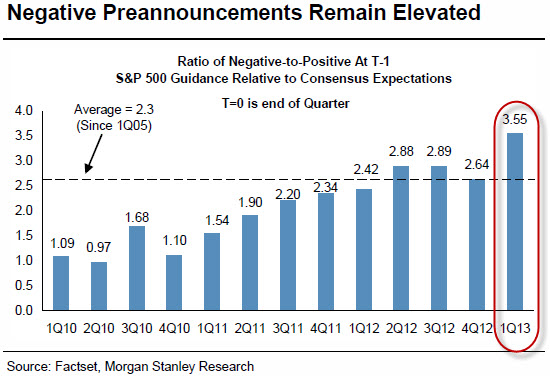
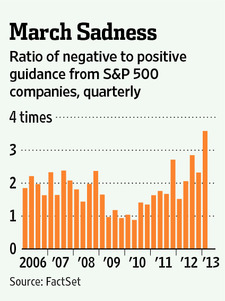
Chart of the Day: Ratio of Negative to Positive Earnings Guidance stands at a record high; At 3.5 negative updates for every positive one, that is by far the highest ratio since FactSet began tracking such data in 2006.

Updated April 1, 2013, 9:06 p.m. ET

Investors Ignore Negativity at Their Peril
By SPENCER JAKAB

20130401_MS1

Recent months have offered yet more proof that markets love to climb a wall of worry. Hand-wringing, whether from retail investors or professional pundits, often precedes heady gains. But some people’s anxiety counts for more than others. While last week the S&P 500 finally erased all its bear-market losses and strategists are falling over one another to raise their year-end targets, the only people in the market with legal inside information are surprisingly cautious. As the first quarter drew to a close, 86 companies in the S&P 500 issued negative guidance for what they expect to report in earnings for that period. Just 24 issued positive guidance. At 3.58 negative updates for every positive one, that is by far the highest ratio since FactSet began tracking such data in 2006.
MI-BV062_AOT_NS_20130401172402 Read more of this post

The last of the metal-bashers; In odd corners of the country British industry clings on

Manufacturing towns

The last of the metal-bashers; In odd corners of the country British industry clings on

Mar 30th 2013 | BARROW-IN-FURNESS, CORBY AND PENDLE |From the print edition

20130330_BRC350

TO WALK into Devonshire Dock Hall, in Barrow-in-Furness, a town of 70,000 in England’s north-west, is to walk into the heart of a community. Some 260 metres long, this cathedral of industry houses three part-built grey and black nuclear submarines. Workers in blue overalls and hard hats are busy assembling the vast machines. Among them are “fourth- or even fifth-generation shipbuilders”, says Alan Dunn, the operations director at the plant. “When people here go to the pub, they talk about submarines. The yard dominates everything we do.”

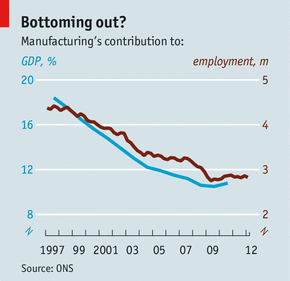
In most parts of Britain, manufacturing has all but disappeared in the past half-century. In 1997 about 4.4m people worked making things; now, just 2.8m do. North of Birmingham the urban landscape is characterised by redundant factories and the glitzy regeneration schemes intended to replace them. And yet in a few places, such as Barrow-in-Furness in Cumbria, or Pendle in Lancashire by the Yorkshire Dales, manufacturing and engineering continue to thrive. If there ever is a new “march of the makers”, as George Osborne, the chancellor of the exchequer, hopes, these places will be where they head for. Read more of this post

Canada’s economy on thinning ice; Disappointing exports, stalled investment and fiscal austerity leave the overstretched consumer as Canada’s only hope for growth

Canada’s economy on thinning ice

Disappointing exports, stalled investment and fiscal austerity leave the overstretched consumer as Canada’s only hope for growth

Mar 30th 2013 | OTTAWA |From the print edition

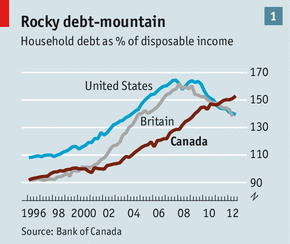
WHEN the world financial system collapsed in 2007, triggering a global recession, Canada recovered faster than any of the other members of the G7 group of large developed countries. Its banks remained solid, while low interest rates encouraged consumers to borrow and spend. But five years on, consumers are showing signs of flagging. The economy is set to expand by a paltry 1.6% this year. So the authorities are casting around for another source of growth. The trouble is they cannot seem to find one. Government, both federal and provincial, is trying to curb deficits swollen by stimulus spending. Companies are restrained by uncertainty prompted by Europe’s woes and the stand-off over fiscal policy in the United States, Canada’s main trading partner. Exports have still not returned to their pre-recession peak. As for consumers, after 11 consecutive years in which household spending has exceeded disposable income, they are deeply in hock. Just over a year ago, Craig Alexander, chief economist at Toronto-Dominion Bank, predicted the debt build-up “is going to end in tears”. The ratio of household debt to disposable income has continued to edge up (see chart 1). An increase in unemployment (from 7% at the moment) or a rise in interest rates could push some households into bankruptcy and puncture a housing bubble inflating in several Canadian cities.

20130330_AMC22820130330_AMD001 Read more of this post

An industrious Spanish bed maker has come up with a novel take on money-hoarding: a mattress with a built-in safe.

March 27, 2013, 11:52 AM

The Mattress Safe: Cushion Your Pain In Spain

By Matthew Walter

An industrious Spanish bed maker has come up with a novel take on money-hoarding: a mattress with a built-in safe.

Read more of this post

10 things financial advisers won’t say

April 1, 2013, 7:38 p.m. EDT

10 things financial advisers won’t say

Pros will tell you where to put your money, but often at a steep price

By Ian Salisbury

MW-BA868_sm10th_20130328165556_MG
1. “We’re your biggest advocate, except when we’re not.” Read more of this post

Diseased pork eaten in Shanghai for years, says farmer; “You Shanghai people have no idea how many diseased pigs you have eaten over the years”; many local farmers regularly sell their dead pigs at a discount price of around 1 yuan (US$0.16) per kilogram to recover their losses. New bird flu strand could be linked to dead pigs in Shanghai river: expert

Diseased pork eaten in Shanghai for years, says farmer

Staff Reporter 2013-04-02

The thousands of dead pigs fished out of Shanghai’s Huangpu river last month have lifted the lid on the formerly hush-hush practice of selling diseased pig carcasses for human consumption, reports Hong Kong’s Wen Wei Po.

More than 10,000 pigs have been retrieved from the river since early March, according to official figures, though internet users believe the real figure may be far higher.

Local media has reported that the dead pigs are likely to have originated from Jiaxing, a prefecture-level city in neighboring Zhejiang province about 100 kilometers southwest of Shanghai. Public pressure has reportedly now forced farmers to stash their dead pigs in more centralized locations rather than simply dumping them by the side of the road, where they were often collected by organized scavengers that resold the pigs — usually infected with disease — to butchers and meat processing companies that prepare the meat for human consumption.

“You Shanghai people have no idea how many diseased pigs you have eaten over the years,” a restaurant owner near Jiaxing told Wen Wei Po. The newspaper found that many local farmers regularly sell their dead pigs at a discount price of around 1 yuan (US$0.16) per kilogram to recover their losses. Read more of this post

CHART OF THE DAY: The Insane Parabolic Rise Of Bitcoin

CHART OF THE DAY: The Insane Parabolic Rise Of Bitcoin

Matthew Boesler | Apr. 1, 2013, 4:55 PM | 3,475 | 5

The parabolic rise of Bitcoin has caught a lot of people off guard this year and is generating a ton of investor interest. Nick Colas at ConvergEx Group, the only Wall Street strategist we know of so far who has written about the Bitcoin market, says all of his clients think the virtual currency is in a bubble. When one looks at a chart, going all the way back to 2010, it’s easy to see why the word “bubble” is being tossed around among investors. Whether it continues to go up is anyone’s guess, but Colas thinks there are five broad themes converging to create a “perfect storm” behind the current rise of Bitcoin.

bitcoin-chart

Bitcoin Is The Perfect Asset Bubble — Prices Could Go Vastly Higher From Here

Henry Blodget | Apr. 1, 2013, 11:29 AM | 6,594 | 36 Read more of this post

Air Pollution Linked to 1.2 Million Premature Deaths in China

April 1, 2013

Air Pollution Linked to 1.2 Million Premature Deaths in China

By EDWARD WONG

BEIJING — Outdoor air pollution contributed to 1.2 million premature deaths in China in 2010, nearly 40 percent of the global total, according to a new summary of data from a scientific study on leading causes of death worldwide.

Figured another way, the researchers said, China’s toll from pollution was the loss of 25 million healthy years of life from the population. Read more of this post

The Continuing Evolution of “Starbucks with Chinese Characteristics

The Continuing Evolution of “Starbucks with Chinese Characteristics”

By Robert O’Brien on March 27, 2013 at 10:00 AM 0 Comments

Last year was a big year for Starbucks in China. The company continued to open cafes at a rapid rate, began offering breakfast to Chinese consumers for the first time, was accused of “cultural invasion” for the second time in five years, and took a huge step toward establishing Yunnan Province as a major producer of coffee beans. All of these developments, and the rapid evolution of the company’s China strategy in general, led us to launch a special series –“Starbucks in China” – last December. In contrast, 2013 started off quietly on the Starbucks China front. That is, until last week, when the publication of a China Daily article and the company’s annual shareholder’s meeting shed fresh light on what new plans the popular coffee purveyor is brewing in China. Read more of this post

Receivables of China’s Moutai, the world’s second largest distiller by market value, increased 7X; top five are distributors accounting for 88% of receivables; 茅台应收账款激增7倍 欠款前五均为经销商

茅台应收账款激增7倍 欠款前五均为经销商

http://www.nbd.com.cn 2013-04-02 01:09

核心提示: 记者翻阅贵州茅台2012年报发现,应收账款金额前五名单位均为经销商,占应收账款总额的87.98%。

每经记者 曹晟源 发自成都

尽管贵州茅台(600519,SH)日前公布的2012年年报成绩不错,净利润同比增速仍在50%以上,但其激增7倍的应收账款却引发关注。《每日经济新闻》记者注意到,应收账款前五名均为本应该早已打款的经销商。

在 “塑化剂事件”、“三公消费”瘦身、反垄断等冲击下,白酒行业已进入调整期。而此时经销商和酒企之间的关系变得异常敏感,出现应收账款的大幅增长,似乎预示着经销商和白酒企业之间此前的关系或将发生改变。 Read more of this post

Cash Cow: Of the 50 Largest US Companies, Who has the Cash? Who has the Debt? The concept of “sideline cash” as widely believed and highly touted by mainstream media is mathematically impossible

Cash Cow: Of the 50 Largest US Companies, Who has the Cash? Who has the Debt?

Posted: 01 Apr 2013 08:37 AM PDT

Mike “Mish” Shedlock

Here’s the question of the day: How much actual cash is on hand at corporations? Fed by glowing reports from sell-side analysts, most investors are unaware that except for a handful of companies, there is no cash, only debt. Even counting short-term investments there is surprisingly little cash on hand. Courtesy of Mike Klaczynski at Tableau Software please consider the latest update to my periodic “Cash Cow” interactive report.

Cash Read more of this post

No progress in bankrupt Thai-listed California WOW fitness club case; “The proceedings have been slow and cannot catch up with fraud, deception and swindles of business operators.”

No progress in CAWOW case

Published: 1 Apr 2013 at 11.54

487484

A group of 639 members of the bankrupt California WOW (CAWOW) health club gathered on Sunday to decide on their next move, complaining that authorities have made no progress in helping settle their grievances. Read more of this post

Cracks appear in China; Triple threat of high leverage, slow economic growth and soaring property prices could spell trouble for world’s second biggest economy; In short, investors should not allow the size of China’s balance sheet to blind them to concerns over the underlying structural risks, given that no economy is too big to fail.

Cracks appear in China

Triple threat of high leverage, slow economic growth and soaring property prices could spell trouble for world’s second biggest economy, some analysts warn.

Published: 1 Apr 2013 at 11.17

487464

Over the past three decades, China has undergone the greatest economic boom in world history, but now it faces a major challenge to sustain its rise. As the European crisis drags on and the US recovery remains slow, a new leadership team in China is struggling to arrest slowing growth.

Opinions vary about whether the world’s second largest economy can achieve a soft landing, or whether it faces a hard landing or even a financial crisis. In any case, some economists have warned that the remaining years of annual economic growth in the high single digits can now be counted on the fingers of one hand.

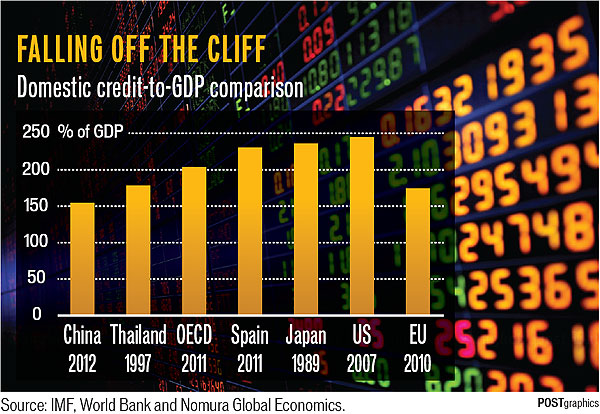
According to two economists from Nomura, the same three warning signs that preceded severe downturns in Japan, the United States and parts of Europe are now flashing over China. As a result, the government has limited time to contain the growing risks and keep the country out of trouble.

“Those signs include a rapid buildup of leverage, a decline in potential economic growth and skyrocketing property prices. The government needs to take urgent action to contain such risks,” wrote Nomura economists Zhiwei Zhang and Wendy Chen.

“We believe the true extent of financial risks in China is not fully appreciated by investors but tightening its monetary policy will be the way to avoid the crisis.” Read more of this post

China has become one of the largest producers of bibles in the world; Unofficial headcounts say that China has more Christians than members of the Communist Party (about 82m people)

Exporting bibles

In the beginning was the ideogram

China has become one of the largest producers of bibles in the world

Mar 30th 2013 | NANJING |From the print edition

LU GENGSHENG remembers growing up in rural Anhui province in the 1980s, where his father was pastor of a house church, an illegal congregation that refused to join with official churches it believed to be stooges of the Communist Party. His family owned the area’s only bible, and other believers would bring notebooks to copy passages of scripture to take home.

Today, Christians make up 5% of the population, some 67m people, according to the Pew Research Center, a think-tank. Unofficial headcounts say that China has more Christians than members of the Communist Party (about 82m people). Read more of this post

‘Airpocalypse’ drives expats out of Beijing

April 1, 2013 3:53 pm

‘Airpocalypse’ drives expats out of Beijing

By Jamil Anderlini in Beijing

Air pollution is driving expatriates out of Beijing and making it harder for companies to recruit international talent, according to anecdotal accounts from diplomats, senior executives and businesses.

No official figures are available on how many people are planning to leave after three months of the worst air pollution on record in the Chinese capital. But companies that mainly serve foreign residents are bracing for an exodus around the middle of the year when the school term ends.

“We’re anticipating this summer will be a very big season [of moves out of Beijing] for us,” said Chad Forrest, North China general manager for Santa Fe Relocations, a global service. “It seems a lot of people, particularly families with small children who have been here a few years, are reconsidering the cost-benefit equation and deciding to leave for health reasons.”

Doctors at private hospitals that mostly treat expat patients tell a similar story. Read more of this post

Hong Kong Businesses Vanish as Rents Soar: Real Estate

Hong Kong Businesses Vanish as Rents Soar: Real Estate

Over the past decade, car-repair shop owner Benny Chan has seen more than 70 percent of his small-business peers disappear as his Hong Kong neighborhood fills up with high-end Western bars and Japanese restaurants.

“Rents here are going up multiple times,” said Chan, who’s been in business since 1985 in the Tai Hang area, just east of the ritzy Causeway Bay shopping district. “We’ll all be out of here in the next four to five years.”

Rents are climbing in neighborhoods near Causeway Bay and Hong Kong’s other prime shopping districts, known for luxury stores that attract free-spending tourists from mainland China. That’s squeezing out mom-and-pop shops, congee and noodle vendors and other small businesses like Chan’s as developers and landlords seek to profit from the trend. Read more of this post

Five-Car Families Seen Deterring Thai Rate Cuts: Southeast Asia

Five-Car Families Seen Deterring Thai Rate Cuts: Southeast Asia

Chitwalai Srisaengchai bought a car last year to take advantage of a Thai tax rebate and now spends 70 percent of her salary on the loan. She’s also giving the central bank another reason to resist monetary easing.

Prime Minister Yingluck Shinawatra’s stimulus measures have stoked spending and contributed to rising household debt, prompting the Bank of Thailand to say it will monitor “persistently high” credit growth. About 1.25 million Thais have taken up the car-buying incentive the government introduced to boost domestic consumption after the 2011 floods, helping drive local car sales to a record last year.

“It was a very tempting offer,” said Chitwalai, a 27- year-old English teacher in Bangkok who will receive a 100,000- baht ($3,400) rebate on a black Mazda 2 sedan she bought for 705,000 baht, adding to her family’s four cars. “Something like this may not happen ever again, so I had to do it.”

Chitwalai’s purchase highlights why Thailand’s central bank may resist government pressure to cut interest rates tomorrow as Yingluck seeks to sustain growth. Lower borrowing costs may spur demand for personal loans that jumped 22 percent in 2012, the biggest increase in seven years, adding debt risks that threaten to heighten the economy’s vulnerability to a slowdown. Read more of this post

Are Floating Pigs Behind China’s Avian Flu? The immediate cause of floating pigs appears to be a government crackdown on the well-established, highly lucrative and totally disgusting underground trade in dead and diseased pigs for human consumption

Are Floating Pigs Behind China’s Avian Flu?

News that a new form of deadly bird flu recently killed two Shanghai residents arrived in the morning’s papers, along with some expert suggestions on how to avoid catching the unwelcome disease.

“Wash your hands, and cover your nose and mouth when coughing or sneezing,” was the advice published in the Oriental Morning Post, Shanghai’s most popular newspaper (and repeated in others). “And avoid eating or contact with dead and diseased livestock.”

That last directive might be a little tricky to fulfill. Since early March, Shanghai’s waterways have been clogged by dead pigs — officially at least 11,000 of them but likely a lot more. Many of those pigs have found their way into tributaries that feed directly into the municipal water supply. Thus, in theory, every Shanghai resident who comes into contact with the city’s water is potentially compromised.

Or are they? So far, at least, nobody from any level of government — local to national — has revealed what, precisely, may have caused a massive pork die-off so close to the city of Shanghai. Was it a virus? Or perhaps a play for livestock insurance? Both rumors (and others) have been floated in Chinese social and traditional media, but without official confirmation.

The reason for the mass water burial, however, is a different matter. According to numerous reports in Chinese and foreign media (though also without government confirmation), the immediate cause appears to be a government crackdown on the well-established, highly lucrative and totally disgusting underground trade in dead and diseased pigs for human consumption. Read more of this post

Vanguard’s founder JACK BOGLE WARNS: Prepare For Two Massive 50% Market Declines In The Next Decade

JACK BOGLE WARNS: Prepare For Two Massive Market Declines In The Next Decade

Matthew Boesler | Apr. 1, 2013, 5:38 PM | 5,977 | 17

Jack Bogle is the founder and chairman of mutual-fund giant Vanguard Group and is widely credited for popularizing index funds, a staple for buy-and-hold investors. Today, he was on CNBC, and he had a bit of a startling prediction. CNBC anchor Scott Wapner put the question to Bogle: “You say, ‘prepare for at least two declines of 25-30 percent, maybe even 50 percent, in the coming decade.’ For a buy-and-hold guy, that’s a little concerning, don’t you think?”

Bogle replied: 

Not at all. They come and go. The market goes up, and the market goes down. It’s never failed to recover from one of those 50 percent declines. I went through one in 1973-1974, I went through one in 2001, 2002, 2003; I went through another one 2008-2009. They’re kind of scary – often terrifying – but it’s typical. Why it doesn’t bother me is if you hang on through the cycle, that’s the only way to invest. Trying to guess when it’s going to go way up or way down is simply not a productive way to put your money to work. Bogle’s comments don’t represent any sort of shift in his philosophy – he remains as big a proponent of buy-and-hold investing as ever. Of course, if Bogle is right about two 50-percent declines in the next decade, it’s going to be a trying experience for the buy-and-hold crowd.

Exuberant “Reach For Yield” In Spain Leaves Retail With Up To 96% Losses; All they saw were fail-safe investments with high returns. Clients infamously included Alzheimer’s sufferers and at least one customer who signed by dipping a finger in ink

Exuberant “Reach For Yield” In Spain Leaves Retail With Up To 96% Losses

Tyler Durden on 04/01/2013 11:46 -0400

The ‘relative’ innocence of the depositors in Cyprus who saw their savings crushed by the hammer-blow of Germany’s reality last week is, it seems, not the only hardship that the European people are suffering. In Spain, thanks to their FROB restructuring, shareholders and bondholders (includinghundreds of thousands of unsophisticated ‘retail’ investors who were sold ‘fail-safe’ and ‘high-return’ investments) face losses (haircuts) from 96% (equity) to 36% (subordinated debt) and 61% (preference shares) following the ‘bailout’ of Spain’s dodgiest cajas (or savings banks).

As The Economist notes, clients infamously included Alzheimer’s sufferers and at least one customer who signed by dipping a finger in ink; shareholders should know the risks but the vast number of Spaniards who bought preference shares and complex subordinated debt from their cajas often did not. For example, a Madrid court is investigating whether Bankia misled investors: many of the 350,000 retail customers who bought Bankia shares in its €3.1 billion flotation in 2011 have already seen their money go up in smoke. Read more of this post

In China, anger grows over abuse of street vendors; “They are no different than bandits”, the fruit vendor whose detention along with her 2-year-old daughter this month sparked much outrage

In China, anger grows over abuse of street vendors

By William Wan, Monday, April 1, 3:38 AM

2013020713626168786591965605463

BEIJING — In a country infamous for heavy-handed officials, the government employees who harass and sometimes beat and extort money from street vendors are among the most despised.

Their official name is “chengguan,” which means city management, but the word has become slang for someone who uses excessive force to solve life’s problems.

In recent weeks, anger against the officials has reached a fever pitch as several cases of apparent abuse have been widely reported in Chinese microblogs, sparking a flood of online comments.

In a video posted online last week, witnesses say chengguan officers beat up a blind man, shown sitting in a pool of water, then took his cane, his begging cup and the change inside.

In another recent case, photos posted online show a swarm of officers roughing up and handcuffing a fruit vendor as her 2-year-old daughter cries inconsolably in the background. Read more of this post

The U.S. economy is in a bubble inflated by “phony money” from the Federal Reserve and will burst within a few years, warned David Stockman, who was budget director for President Ronald Reagan

Stockman Warns of Crash Of Fed-Fueled Bubble Economy

The U.S. economy is in a bubble inflated by “phony money” from the Federal Reserve and will burst within a few years, warned David Stockman, who was budget director for President Ronald Reagan.

In an essay published yesterday in the New York Times (NYT), Stockman wrote that the Fed’s quantitative easing policies in the aftermath of the credit crisis have flooded stock markets with cash even while the “Main Street economy” remains weak. The combination, he wrote, is “unsustainable.”

“When it bursts, there will be no new round of bailouts like the ones the banks got in 2008,” wrote Stockman, a former senior managing director at Blackstone Group LP (BX) and a former Republican congressman from Michigan. “Instead, America will descend into an era of zero-sum austerity and virulent political conflict, extinguishing even today’s feeble remnants of economic growth.”

Stockman, 66, is the author of “The Great Deformation: The Corruption of Capitalism in America,” which will be published April 2. Read more of this post

Indonesia’s Yudhoyono Party Stumbles as Corruption Charges Undermine Support

Yudhoyono Party Stumbles as Corruption Charges Undermine Support

Indonesia’s ruling Democrat Party chose the country’s president, Susilo Bambang Yudhoyono, as chairman ahead of national elections next year amid jockeying among possible replacements that could stall spending on roads and ports. Yudhoyono was elected March 30 at an extraordinary congress in Bali to succeed Anas Urbaningrum, who resigned after becoming at least the third senior party official linked to corruption allegations in less than two years. Read more of this post

How to Be a Successful Luxury Brand; If You’ve Got a Story, Tell It

HOW TO BE A SUCCESSFUL LUXURY BRAND

ARTICLE | 26 MARCH, 2013 10:10 AM | BY JEREMY HAZLEHURST

The spread of luxury is the story of the early 21st century. Take this fact: Louis Vuitton, which started life as a trunk-making business in Paris in 1854, will soon open a swanky new store in Kazakhstan. This follows the opening of a massive new store in Shanghai, right at the heart of what was once a hardline Communist state. Luxury goods are the quintessentially modern products, charting the spread of wealth and aspiration to the most unlikely places. Campden looks at five things that luxury brands have to do if they are to flourish in this strange new world.

1: IF YOU’VE GOT A STORY, TELL IT
Human beings love stories, so brands that have good tales are wise to use them as much as possible. “Naturally, it is easier to sell your story if it starts with depuis 1833” says Anastasia Kourovskai of Millward Brown, a brand research agency. “Such brands as Chanel, Dior and Yves St Laurent have real stories behind the brand,” she says. Other newer ones, however, have created their brand stories.

Look at Tiffany’s, whose name is forever linked to Audrey Hepburn’s classic chic through the film Breakfast at Tiffany’s. Or Ralph Lauren, founded by a chap named Ralph Lifshitz from The Bronx, the son of immigrants from Belarus, but which has brilliantly used advertising and store design to link the brand with the WASPish pursuit of polo.

Mark Henderson, chairman of Savile Row tailor Gieves & Hawkes (founded in 1771) agrees that the stories matter. “I think that is why tradition and family heritage are such an important part of the brand,” he says. Read more of this post

Time is ripe for smartwatches; 2013 may be the year for the smartwatch because “the components have gotten small enough and cheap enough” and a large number of consumers now have smartphones that can connect to a wearable device

Time is ripe for smartwatches, analysts say

2013-03-31 07:44:30 GMT2013-03-31 15:44:30(Beijing Time)  SINA.com

Amid much speculation on the future of the “smartwatch,” the consensus is growing: the time is right.

In recent weeks, reports have surfaced about plans for smartwatches from tech giants Apple, Samsung and Google, with launches possible later this year.

“I think we have reached a tipping point,” said Avi Greengart, analyst on consumer devices at the research firm Current Analysis.

Greengart said 2013 may be the year for the smartwatch because “the components have gotten small enough and cheap enough” and a large number of consumers now have smartphones that can connect to a wearable device.

The idea of the connected watch has been around for at least a decade: Microsoft had one in 2003. And some devices are already on the market including from Sony, the crowdfunded maker Pebble and Italian-based firm i’m. Read more of this post

Insight: China’s losing battle against state-backed polluters

Insight: China’s losing battle against state-backed polluters

1:41am EDT

By David Stanway

SHANGHANG COUNTY, China (Reuters) – When Zijin Mining Group threatened to move its headquarters some 270 kms from its home county of Shanghang to Xiamen on China’s southeast coast, a local Communist Party boss rushed to confront the company’s chairman Chen Jinghe.

“If you want to move, you’ll have to move the Zijin Mountain to Xiamen as well,” the official told Chen, referring to a vast local mine that has helped transform the firm into China’s top gold producer and second-biggest copper miner. The exchange, recited with some pride by local residents, reflects the anxieties felt by regional governments as they consider the prospect of losing their biggest cash-cows. It also highlights the challenges facing Beijing as it tries to take on entrenched local bureaucracies and the powerful state-owned polluters they sponsor and protect, with the central government desperate to address decades of chronic environmental damage and force growth-addicted provinces to raise standards. Read more of this post

Angang Steel gets bourse warning following losses; China’s largest shipping conglomerate COSCO suspended after loss of 9.56b yuan; Three years of deficits could see the shipping firm removed from market

Angang gets bourse warning following losses

Updated: 2013-03-29 11:22

By Wang Ying in Shanghai ( China Daily) Read more of this post

Guangdong Publicly Says It Has “huge” Hidden Debts in Pension Fund; About half of China’s 31 provinces are unable to pay their retiree costs and rely instead on financial transfer from the central government

Guangdong Publicly Says It Has “huge” Hidden Debts in Pension Fund

03-29 15:15 Caijing

It says debts were cumulated for one critical reason: a large number of retirees who were entitled to a pension without contributions when China first launches its pension system.

The government of Guangdong has expressed concerns about its pension liabilities, saying the provincial government’s pension fund is running up “huge” hidden debts, opening a peephole into the patchy pension system in the world’s second-biggest economy. The government will seek to solve the many problems in the pension fund by raising financial subsidies and exploring ways to invest the money, government officials said in an official report on Thursday. About half of China’s 31 provinces are unable to pay their retiree costs and rely instead on financial transfer from the central government. Pension shortfalls could reach 18.3 trillion yuan in 2013, and 68.2 trillion by 2033, according to a recent report by economists at Deutsche Bank and the Bank of China. What makes things even worse is that China is facing a timebomb of aging population, with a sharp rise in those over age 65, the proportion of which stands at 8.2 percent now, and is expected to rise to 30 percent by 2064. The government report of Guangdong, a southern province topping total GDP rankings in among all provinces, did not reveal the amount of its deficit and reasons making the debts non-explicit. It says debts were cumulated for one critical reason: a large number of retirees who were entitled to a pension without contributions when China first launches its pension system. Without financial transfer from governments, the retirees are actually supported by young Chinese employees, it said. Pension revenue was close 250 billion yuan in Guangdong in 2012, compared with an expenditure of just below 150 billion. China’s pension system was designed as a combination of an inclusive welfare system supported by state subsidies and individual mandatory savings by both employees and employers whose contributions vary in regions. Budget expenditures in social network totaled 98.24 billion yuan in Guangdong in 2011, the report shows, tripling those in 2006. Its portion to general budget also hiked to 14.64 percent in 2011 from 12.53 percent five years ago. The government entrusted the country’s national security fund to “invest and manage” its pension fundin early 2012, as an alternative to state fiscal support to “retain and grow” value, the first and the single case in the country as local governments are loath to hand over their cash. Government officials did not disclose income of the investment in the report, but pledged the government will ensure the money is safe in following up management.

If a Fund Turns on a Dime, Watch Your Dollars; The demise of the Willow Fund offers two lessons in investment risk

March 30, 2013

If a Fund Turns on a Dime, Watch Your Dollars

By GRETCHEN MORGENSON

LAST October, shareholders in the Willow Fund, a closed-end investment fund sponsored and sold by UBS, received some disturbing news: the fund, which had assets of almost $500 million in 2006, was being liquidated.

With a portfolio that specialized in distressed debt instruments, the Willow Fund had suffered losses of almost 80 percent in the first three quarters of 2012 after its longtime manager switched gears: he had abandoned the corporate debt markets he was familiar with and piled into some colossally bad derivatives trades. The investors, some of whom hadn’t realized they were holding a portfolio filled with risky bets against the debt of European nations, were stunned.

What happened to the Willow Fund is a cautionary tale for any investor who entrusts his or her money to an investment fund. Its demise highlights the dangers when a portfolio manager makes a big change in investment strategy. It also raises questions about how assiduously this fund’s independent directors watched over the manager as he ramped up his portfolio’s risk levels. Both are problems that investors cannot be complacent about. Read more of this post

Era of Fed Stimulus Wanes

March 31, 2013, 12:08 p.m. ET

Era of Fed Stimulus Wanes

By CYNTHIA LIN

Between U.S. stocks reaching highs and Treasury TWE.AU -0.35% yields holding near all-time lows, one of these two contrary markets will eventually have to give.

At the moment, the Federal Reserve’s easy-money policy makes it so that there is enough to go around, bolstering risky and haven assets alike. But the more the U.S. economy improves, the closer investors get to a financial marketplace with less Fed support that can sap the strength from one of these markets.

Entering the second quarter with a fresh batch of key economic data on deck, investors will get evidence as to whether the U.S. recovery this year can defy the downturn suffered in each of the past two springs. Hand in hand with that will be whether and how the Fed reacts by adjusting its $85 billion monthly bond-buying program.

“We are getting closer to the end,” John Brynjolfsson, managing director of global macro hedge fund Armored Wolf LLC, said of the Fed’s stimulus efforts. “Discussion of tapering helps to make the exit less of a digital on-off decision, and should allow the Fed to more gradually wean the markets off its support.”

Mr. Brynjolfsson owns put options on the Standard & Poor’s 500-stock index to hedge against a sharp drop in equities, while also positioning for a fall in Treasurys prices against German bund prices. Read more of this post