Small companies struggling to repay loans in Italy and Spain signal bigger problems on the horizon for the euro zone after the dust has settled on Cyprus’s last-ditch bailout

Small businesses spell big problems for Italy and Spain

2:10am EDT

By Silvia Aloisi and Sarah White

MILAN/MADRID (Reuters) – Small companies struggling to repay loans in Italy and Spain signal bigger problems on the horizon for the euro zone after the dust has settled on Cyprus’s last-ditch bailout this week.

Defaults by small and medium-sized enterprises (SMEs), easily the biggest employers in Spain and Italy, are rising at a worrying clip, spelling trouble for the banks and two countries at the heart of Europe’s debt crisis.

“You can be sure that if these companies’ bad debts rise, you’re going to see more bad loans to families, and credit card bills that won’t be paid,” said Javier Santoma, finance professor at Spain’s IESE business school.

The ability of Italy and Spain, which account for 28 percent of the euro zone economy compared with Cyprus’s 0.2 percent, to pull themselves out of crisis and avoid full-blown bailouts depends on the health of their banks; weak banks conserve capital rather than lend to get the economy moving. Read more of this post
Student loan write-offs hit $3 billion in first two months of year as many graduates remain jobless, underemployed or cash-strapped in a slow U.S. economic recovery

Student loan write-offs hit $3 billion in first two months of year

By Elvina Nawaguna | Reuters – Mon, Mar 25, 2013

By Elvina Nawaguna

WASHINGTON (Reuters) – Banks wrote off $3 billion of student loan debt in the first two months of 2013, up more than 36 percent from the year-ago period, as many graduates remain jobless, underemployed or cash-strapped in a slow U.S. economic recovery, an Equifax study showed. Read more of this post

Missing Tycoon Mars Overseas Push of China’s Private Businesses; Liu’s rise to riches and sudden disappearance aren’t just the makings of a made-for-Hollywood potboiler. They’re a warning of the risks investors take when dealing with opaque private businesses in China, where fortunes depend on political ties and the favors of state entities, and even the wealthiest entrepreneurs can vanish if they lose the patronage of powerful government allies

Missing Tycoon Mars Overseas Push of China’s Private Businesses

Even by the standards of China’s rough and tumble breed of entrepreneurs, billionaire Liu Han’s brushes with death mark him out.

After dodging a hitman’s bullets in 1997, which led to the execution of a rival tycoon and two of his relatives almost a decade later, Liu, 47, finds himself ensnared in more killings. This time, his own brother is the suspect, and the Sichuan Hanlong Group founder is being held by police for helping him evade capture over a 2009 triple murder, state media reported.

The arrest throws into jeopardy Hanlong’s planned mining investments, casting doubt on the future of Sundance Resources Ltd. (SDL)’s $4.7 billion iron-ore project in West Africa and General Moly Inc. (GMO)’s Mt. Hope, Nevada, molybdenum mine. His detention still hasn’t been confirmed by authorities and there has been no official indication of who is now running Liu’s empire, which spans energy, real estate, chemicals and technology.

Liu’s rise to riches and sudden disappearance aren’t just the makings of a made-for-Hollywood potboiler. They’re a warning of the risks investors take when dealing with opaque private businesses in China, where fortunes depend on political ties and the favors of state entities, and even the wealthiest entrepreneurs can vanish if they lose the patronage of powerful government allies. Read more of this post

Emerging Stocks Head for Worst First Quarter Since 2008

Emerging Stocks Head for Worst First Quarter Since 2008

Emerging stocks fell, extending the biggest first-quarter slump since 2008, as China’s banking regulator tightened rules on wealth-management products and the cabinet called for new measures to deregulate interest rates. Read more of this post

Hunt Brothers Becomes Billionaire on Bakken Oil After Bankruptcy from Silver Manipulation 33 Years Ago

Hunt Becomes Billionaire on Bakken Oil After Bankruptcy

William Herbert Hunt was once one of the wealthiest men on Earth. With his brother, Nelson Bunker Hunt, the billionaire bought more than 195 million ounces of silver — 60 percent of the U.S. market — in the 1970s. By early 1980, their stake was valued at more than $9 billion.

The Hunts’ position imploded when silver prices plummeted 80 percent over the course of a few weeks in March 1980, culminating 33 years ago this week on what traders called Silver Thursday. The crash rattled Wall Street and sent the Texas brothers into bankruptcy.

Hunt is once again a billionaire, this time with oil. In October, he sold 43 percent of the North Dakota petroleum assets owned by his closely held Petro-Hunt LLC for $1.45 billion to Houston-based Halcon Resources Corp. (HK) The cash and stock deal made Hunt Halcon’s largest shareholder and boosted his net worth to $4.2 billion, according to the Bloomberg Billionaires Index. Read more of this post

Aberdeen, Manulife Seek More Independent Boards: Southeast Asia

Aberdeen, Manulife Seek More Independent Boards: Southeast Asia

Southeast Asia’s companies need to add more independent directors to their boards and boost diversity to attract foreign investors including Aberdeen Asset Management Plc (ADN) and Manulife Asset Management.

One of the biggest obstacles is strengthening the roles of independent directors because many publicly traded companies in the region are family-owned, Stephen Schuster, a financial sector specialist at the Asian Development Bank, said in an interview yesterday from Manila. Other challenges include disclosure and cross-border dispute resolution, he said. Read more of this post

Hong Kong Drops New Law Restricting Access to Directors’ Details

Hong Kong Drops New Law Restricting Access to Directors’ Details

Hong Kong’s government dropped legislation that would restrict public access to the personal details of company directors, following opposition from unions, small businesses and journalists.

The Financial Services and Treasury Bureau removed provisions obscuring company directors’ residential addresses and full identification numbers from an overhaul of the city’s companies ordinance, according to a legislative briefing document sent by e-mail from Shirley Wong, the department’s spokeswoman.

Opponents of the change said it would protect bosses from scrutiny and erode the city’s reputation by making it easier to launder money and cheat on taxes. Trade unions have used the database to track down runaway employers who owed wages, and small businesses use the information to conduct background checks on trading partners. Read more of this post

Zoomlion, China’s second-biggest construction equipment maker, Misses Estimates on Finance Costs, Demand Weakness; The stock has slumped 21 percent since Ming Pao reported on Jan. 8 that it had received an unsigned letter alleging that Zoomlion’s sales are exaggerated

Zoomlion Net Misses Estimates on Finance Costs, Demand Weakness

Zoomlion Heavy Industry Science and Technology Co., China’s second-biggest construction equipment maker, posted profit that missed analyst estimates as government measures to cool the property market damped demand while finance costs and provision for bad debts increased.

Net income in 2012 fell 9.1 percent to 7.33 billion yuan ($1.18 billion) from 8.07 billion yuan in the prior year, according to a filing to the Hong Kong stock exchange today. That compares with the 8.49 billion yuan average of 26 analysts’ estimates compiled by Bloomberg. Sales climbed 3.8 percent to 48 billion yuan.

Zoomlion, based in Changsha, Hunan province, and bigger rival Sany Heavy Industry Co. face a drop in orders as slowing economic growth and government curbs on the property market sap demand. Zoomlion is also seeking to boost investor confidence after its shares slumped following a January report in Hong Kong’s Ming Pao newspaper that the company’s sales may have been exaggerated.

“Economic growth in China remained slackened with low investment in infrastructure,” the company said in today’s statement, “The construction machinery industry was also under severe challenges brought by the sluggish growth of production and sales and the increase in credit risks.”

Shares (1157) of Zoomlion rose 0.9 percent to HK$9.37 at the close in Hong Kong trading, before the earnings were released. The stock has slumped 21 percent since Ming Pao reported on Jan. 8 that it had received an unsigned letter alleging that Zoomlion’s sales are exaggerated. Read more of this post

When Will Deposit Haircuts Take Place In Other European Countries?

When Will Deposit Haircuts Take Place In Other European Countries?

Tyler Durden on 03/28/2013 11:55 -0400

When all is said and done, what happened in Cyprus over the past two weeks, is nothing but the culmination of re-marking the “assets” in the country’s financial system (which as noted previously, were a preponderance of worthless Greek bonds and countless other non-performing loans), long priced at assorted “myth” levels, to a long overdue reality. As a result of delaying resolving the mismatch between non-performing assets and liabilities for years, the resolution was one which saw some €16 billion of the total asset base impaired, which in turn necessitated the impairment of billions of deposits: the primary liability funding the Cypriot financial system. Furthermore, as a result of the “Freudian Slip” by the Eurogroup’s new head earlier this week, we know that Cyprus will be the template for all future bank resolutions, which seek to avoid a democratic popular vote of depositor self-impairment (a vote which is now known will never actually pass) and proceed to restructuring the banking sector a la carte, by liquidating bad banks and impairing liabilities to the point where the balance sheet is once again viable (however briefly).

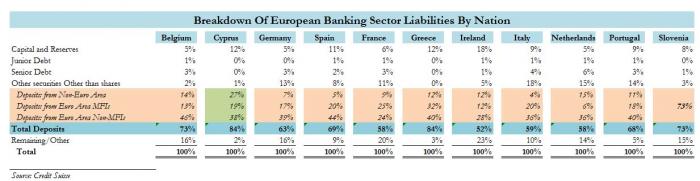
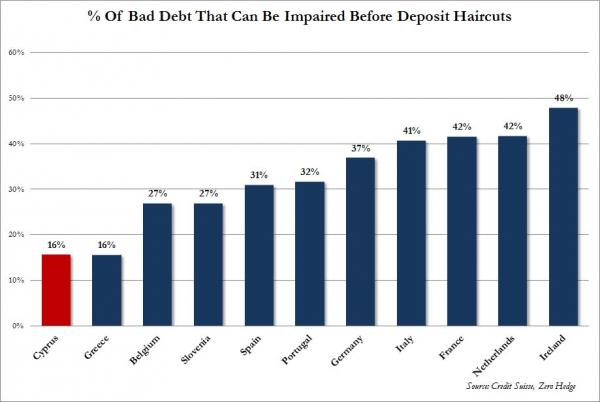
The bottom line is that at its core, it is all simply a bad-debt problem, and the more the bad debt, the greater the ultimate liability impairments become, including deposits. Which means that the real question in Europe is: how much impairment capacity is there in the various European nations before deposits have to be haircut? Thanks to Credit Suisse we now know the answer. The chart below shows the liability breakdown for various Eurozone nations, of which the key line item is the Total Deposits, and which in Europe comprises the bulk of bank funding. It becomes obvious why Cyprus had no choice but to crush depositors: they make up a whopping 84% of all liabilities (the highest in Europe and matched only by Greece), so assuming all other liabilities are liquidated, there still would be impairments if the total bad assets (assuming all bank assets are loans which in Europe, unlike the US, is more or less the case) pushed above 16% which in Cyprus they did. So applying some simple balance sheet equality math, one can quickly calculate how much of a “Bad-Debt Impairment” assorted European financial systems can withstand before they too have no choice but to follow in Cyprus’ footsteps and begin crushing depositors, who in bankruptcy court are known by a different, less friendly term: General Unsecured Claims.

Euro Financial Liabilities_2_0

Bad Debt Capacity_0 Read more of this post

Chart of the day: Euro area M3 growth vs Bank lending to euro area private sector

M3 Credit February Europe_0

How Multilatinas Are Taking Over the World

How Multilatinas Are Taking Over the World

25 MAR 2013 – JONATHAN KANDELL

HERE’S A TEST OF YOUR GLOBAL BUSINESS IQ. Where would you find each of the following: the world’s largest baker, the leading iron miner and the second most valuable airline by market capitalization?

Answer: Latin America. Mexico’s Grupo Bimbo has built the world’s largest bakery products company through a string of acquisitions, Brazil’s Vale is the biggest producer of iron ore, and Latam Airlines Group, a Chilean-controlled company that combines Chile’s LAN and Brazil’s TAM airlines, is the continent’s dominant carrier, with a stock market value of $11.4 billion, second only to Delta Air Lines.

These companies are far from alone. Latin America’s economic renaissance over the past two decades has fostered the emergence of a new generation of corporate champions with regional, and sometimes global, ambitions. Read more of this post

Layoffs trigger panic among Chinese multinational employees; Last year, many multinational employees became eager to change jobs due to worries of being laid off, which was very rare in the past

Layoffs trigger panic among Chinese multinational employees

SHANGHAI, March 28 (Xinhua) — Chinese employees of multinationals are finding their jobs no longer secure and enviable as a massive round of layoffs has hit such companies. Read more of this post

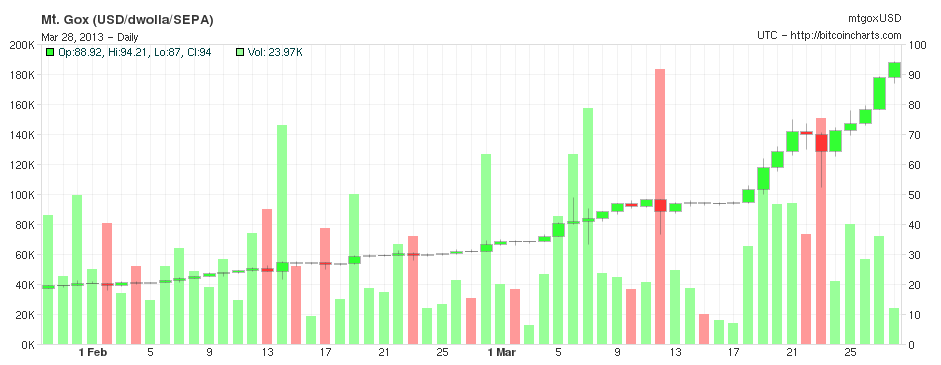
Bitcoin Prices Have Gone Utterly Nuclear In The Last Two Days; Back in February, one Bitcoin was trading at around $20. Today? $95

Bitcoin Prices Have Gone Utterly Nuclear In The Last Two Days

Joe Weisenthal | Mar. 28, 2013, 5:30 AM | 4,438 | 18

The price of a Bitcoin, the digital money that’s become the new obsession of gold and silver-types, continues its dizzying assent. Here’s a short term chart. Back in February, one Bitcoin was trading at around $20. Today? $95, having had two huge moves over the last two days.

screen shot 2013-03-28 at 5.24.53 am


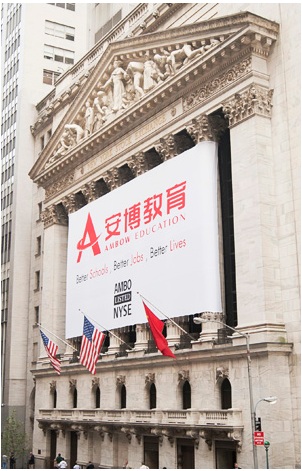
The Ambow Massacre — Baring Private Equity Fails in Its Take Private Plan

The Ambow Massacre — Baring Private Equity Fails in Its Take Private Plan

March 27th, 2013

Peter Fuhrman is Chairman, Founder & CEO at China First Capital, (中国首创)a leading China-focused specialist international investment bank and advisory firm for private capital markets and M&A transactions.

ambowbaringchart

In the last two years, more than 40 US-listed Chinese companies have announced plans to delist in “take private” deals.  About half the deals have a PE firm at the center of things, providing some of the capital and most of the intellectual and strategic firepower. The PE firms argue that the US stock market has badly misunderstood, and so deeply undervalued these Chinese companies. The PE firms confidently boast they are buying into great businesses at fire sale prices.

The PE firm teams up with the company’s owner to buy out public shareholders, with the plan being at some future point to either sell the business or relist it outside the US. At the moment, PE firms are involved in take private deals worth about $5 billion. Some of the bigger names include Focus Media, 7 Days Inn, Simcere Pharmaceutical.

The ranks of “take private” deals fell by one yesterday. PE firm Baring Private Equityannounced it is dropping its plan to take private a Chinese company called Ambow Education Holding listed on the New York Stock Exchange. Baring, which is among the larger Asia-headquartered private equity firms, with over $5 billion under management,  first announced its intention to take Ambow private on March 15. Within eleven days, Baring was forced to scrap the whole plan. Read more of this post

Looming property taxes in China spark owner panic; South China’s Guangdong Province was first to detail its implementation of the measures on Tuesday

Looming property taxes spark owner panic

English.news.cn   2013-03-27

BEIJING, March 27 (Xinhua) — Pre-opening queues have snaked around Chinese property trading centers in the past few days, with those in line vexed by the uncertain roll-out date of stricter market regulations.

They have been joined by Chinese netizens in feverish discussion of the March 1 announcement by central government that homeowners who sell will face income tax as high as 20 percent of the profit they make on the transaction. With no firm timeline set for the imposition of the measure, which is designed to cool the red-hot property sector, many are racing to sell.

Consequently, property agencies throughout the country have been inundated by sellers and buyers in a dilemma over the future heavier taxes.

Prior to the new rules, income tax was 1 percent to 2 percent of sale price.

South China’s Guangdong Province was first to detail its implementation of the measures on Tuesday. Read more of this post

Dutch Co-Founder of Tudou.com: Why I’m leaving China

Why I’m leaving China – opinion

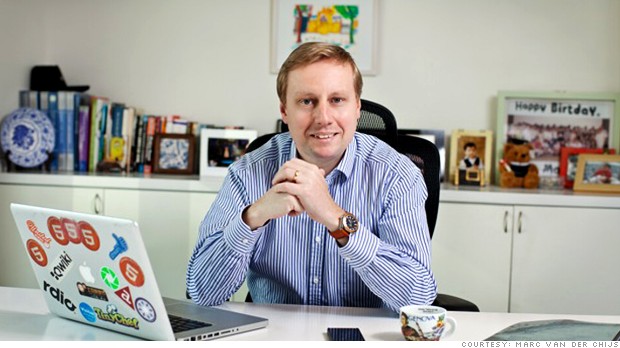
By Marc van der Chijs @CNNMoney March 27, 2013: 10:08 AM ET

130319015856-marc-van-der-chijs-620xa

After doing business in China for more than a decade, Marc van der Chijs is moving to Vancouver.

When I first came to China as an expatriate in early 2000 to work for Daimler, I had no plans to stay.

But I fell in love with this country and ended up making China my home for more than 13 years. I stayed for the business opportunities, as well as the entrepreneurial vibe that runs through cities like Shanghai and Beijing.

While living in China I was able to co-found several companies, including online video site Tudou.com, the Asian operations of Dutch online game company Spil Games and online fashion site UnitedStyles.com. I also invested in many Chinese Internet and tech startups and helped them to grow.

However, about two years ago I realized that my love for China was slowly changing, and I first started thinking about moving to a different place.

Over the years, doing business had become more and more difficult for a non-Chinese. Although many areas have opened up for foreign investment, outsiders are not always able to do business on equal terms with Chinese entrepreneurs.

For example, foreigners need more capital to set up a business. Once you have a business up and running, it will be more closely scrutinized than Chinese firms. There are still tons of business opportunities available in China, but I generally felt less welcome in recent years as a foreign entrepreneur.

Much more important than this, however, was the fact that air pollution and food quality were getting worse in my adopted home. Read more of this post

Tiny Dolls Get Big Personalities in Hopes of Boosting Sales; Fisher-Price is revamping its Little People line of preschool dolls with an older appearance, personality traits and back stories. Will the move bring licensing riches?

March 27, 2013, 7:17 p.m. ET

Tiny Dolls Get Big Personalities in Hopes of Boosting Sales

By ANN ZIMMERMAN

PJ-BN405_DOLLS_F_20130327175214

The redesigned Little People dolls, on sale this summer, will have distinct personalities. From left to right: artistic Sofie, energetic Eddie, shy Mia, silly Kobe and twirly Tessa.

Little People dolls, a staple of the toddler playroom for more than half a century, have a problem: No one remembers their names.

Their maker, Fisher-Price Inc., is trying to change that. It hopes more memorable names lead to add-on riches like television shows and songs.

The visual changes in the figures—their first in 15 years—might seem subtle. They will be a tad taller (about 2½ inches high), thinner and less babyish looking. The dolls will wear updated clothing and hairstyles. No longer holding pets or playthings or snack food, their arms will be set in more expressive poses.

Most important, says the company, the painted plastic figures will have full-blown, identifiable personalities: Eddie is active and athletic. Mia is the shy, feminine one. Tessa loves to twirl like a ballerina. Read more of this post

China Tightens Regulations on Wealth Management

Updated March 27, 2013, 11:08 a.m. ET

China Tightens Regulations on Wealth Management

By DINNY MCMAHON And AARON BACK

‘Shadow banking’ in China was worth $3.7 trillion in 2012 according to Standard & Poor’s estimates. Qiang Liao of the S&P tells the WSJ’s Jake Lee why these risky investments are being sold across the country.

BEIJING—China moved to rein in wildly popular but opaque investment products that form a key plank of the nation’s shadow-banking system, after the high-profile failure of one product offered a glimpse of the risk they pose to the financial system.

The rules issued Wednesday by China’s banking regulator came as China’s four biggest state-run banks said they had more than 3 trillion yuan ($467 billion) worth of such products outstanding at the end of last year, their fullest disclosure yet of their exposure to the products and a move signaling their own caution toward their proliferation.

They are called wealth-management products, which some Chinese regulators have said are sold with limited oversight or disclosure of what they contain. They are typically short-term investments that banks market as a high-yield alternative to bank deposit rates, which are kept low by the government. About half are invested in low-risk assets such as government and corporate bonds and money-market products, according to research firm Cnbenefit. But many others are backed by everything from loans to developers to accounts receivable to valuables such as gold and jewels. Read more of this post

BRICS “Big Five” find it hard to run as a herd

Published: Thursday March 28, 2013 MYT 8:39:00 AM

BRICS “Big Five” find it hard to run as a herd

DURBAN: At a summit in South Africa on Wednesday, Vladimir Putin likened the BRICS nations – Brazil, Russia, India, China and South Africa – to Africa’s “Big Five” game beasts of trophy hunting lore – the lion, elephant, buffalo, leopard and rhinoceros.

The Russian president’s comparison captures the dilemma of these muscular emerging global powers, which together present a formidable potential economic and political counterweight to the developed West, but individually could hardly be more different.

The question is whether the BRICS five can run as a herd or hunt as a pack on the global stage, transforming their diverse but collective strength into real institutions and coordinating structures to project their voice in the world. Read more of this post

Drugs for Indian Poor Spark Pfizer Anger at Lost Patents; The dispute illustrates how emerging markets are turning out be less lucrative than drugmakers expected

Drugs for Indian Poor Spark Pfizer Anger at Lost Patents

In trying to get sophisticated medicines to its neediest citizens, India is increasingly pitting its generic-pharmaceutical industry against international drugmakers, threatening their growth in emerging markets.

An Indian regulatory board this month upheld a ruling that allows Natco Pharma Ltd. (NTCPH) to make a low-priced copy of Bayer AG (BAYN)’s Nexavar cancer treatment. The drug is one of at least four that have had their patents weakened, revoked or rejected in India in the past year. The country also has refused a patent for Novartis AG’s (NOVN) Gleevec leukemia medicine, and the Supreme Court will rule April 1 on the company’s appeal of the decision.

Those steps are needed to put modern medicines into the hands of Indians, according to aid groups and doctors. Western drugmakers including New York-based Pfizer Inc. (PFE) say the country, which has a $30 billion drug market that’s growing 13 percent a year, is abusing international law and allowing domestic companies to profit from products discovered at Big Pharma’s expense.

The dispute illustrates how emerging markets are turning out be less lucrative than drugmakers expected. London-based GlaxoSmithKline Plc (GSK) has warned that so-called compulsory licensing of patented products may hurt profit growth. One advocacy group now is pushing stricken Western countries such as Greece to follow India’s lead, raising the prospect of further pressure on drug prices. Read more of this post

Helene Rey made a side trip on her way to the hospital to give birth to her daughter in September 2006: She stopped off at the main office of London Business School, where she teaches economics, to turn in a report on a doctoral defense. “If I hadn’t, the student couldn’t have graduated,” she said.

Proving Greenspan Wrong Shows Why Rey Became Worthy to Bernanke

Helene Rey made a side trip on her way to the hospital to give birth to her daughter in September 2006: She stopped off at the main office of London Business School, where she teaches economics, to turn in a report on a doctoral defense.

“If I hadn’t, the student couldn’t have graduated,” she said.

Rey’s dedication has led to teaching posts at Harvard University, the University of California at Berkeley, the London School of Economics and Princeton University. The department chairman who hired her there, Ben S. Bernanke, is now chairman of the Federal Reserve. Just yesterday, she became the first woman to win the Yrjo Jahnsson Prize, for a European economist under age 45 whose research is significant to Europe.

It was at Princeton that France-born Rey co-authored a paper showing how the U.S. position at the center of global finance gives it an edge to borrow cheaply and safely in the short term and make high-return, riskier investments. The study addressed concerns about the nation’s ballooning current-account deficit: By 2004, then-Fed Chairman Alan Greenspan was warning that foreigners might be unwilling to keep buying dollars.

The research caught the attention of economists at the Fed and the International Monetary Fund, and spread through academia. Read more of this post

Three small Spanish banks post multi-billion euro losses

Three small Spanish banks post multi-billion euro losses

Wed, Mar 27 2013

MADRID (Reuters) – Three small Spanish banks reported multi-billion euro losses on Wednesday, showing the scale of the country’s problems with its property market.

The three banks – Banco CEISS, BMN and Caja 3 – which have all been rescued by the government, had to take big write-downs on bad property loans and assets.

Spain has forced its banks to recognize their property losses to try to clean up the sector after the country’s property boom collapsed in 2008.

Banks without a strong enough capital base, such as CEISS, BMN and Caja 3, turned to the state for support, forcing Spain to take 41 billion euros in European aid for its banking sector. Read more of this post

Analysis: Southeast Asia ready to build, but will investors come?

Analysis: Southeast Asia ready to build, but will investors come?

Wed, Mar 27 2013

By Stuart Grudgings and Neil Chatterjee

KUALA LUMPUR/JAKARTA (Reuters) – Indonesia is seeking European investors for $9 billion worth of water, road, air and seaport projects in what will be a litmus test of Southeast Asian countries’ ability to seize on ripe financial conditions to upgrade decrepit infrastructure.

Easy global liquidity and investors’ eagerness to tap one of the world’s few fast-growing regions should create a sweet spot for the region to fill the $600 billion in infrastructure needs the Asian Development Bank identifies over the next decade.

But infrastructure experts say a shortage of projects offering compelling returns, coupled with stifling bureaucracy and regulatory uncertainty, threatens to undermine the ambitious plans of Indonesia, Thailand and the Philippines. Read more of this post

South Koreans in Farm U-Turn as Chaebol Era’s Rapid Growth Ends

South Koreans in Farm U-Turn as Chaebol Era’s Rapid Growth Ends

Lee Geun Hong is a rare example of wealth in South Korea’s countryside, known for its shrinking population and decades-long farming slump. Driving a Mercedes rather than a Hyundai, the former Samsung Heavy Industries Co. executive says that may soon change.

“The future for farmers is very bright,” the 60-year-old Lee said while pruning trees in a greenhouse at his farm in Sangju, overlooking the Nakdong River about 160 kilometers (100 miles) southeast of Seoul. “But those who stick to conventional ways will remain poor.”

Lee moved to Sangju from Seoul in 2007 after 18 years at the world’s second-biggest shipbuilder and a stint running his own cafeteria. He earns about $180,000 a year, more than six times the average rural income, selling blueberries online to cut out the middleman, and grows organically to appeal to Korean consumers he calls “the pickiest in the world.”

The number of people leaving cities for rural areas is at a record high in South Korea, as government subsidies to boost agricultural production coincide with slowing economic growth. The most successful bring investment and skills that are boosting margins — the number of farmers and agricultural associations earning at least 100 million won ($90,000) rose for a fourth year to 17,291 in 2012, the farm ministry said.

“The trend may help the national economy by re-channeling surplus labor to rejuvenate farming areas,” said Jun Kwang Hee, a professor of sociology at Chungnam National University. “We now live in an era where the economy is growing without creating many jobs. Your career at companies ends at 50, but you are very young at 50 and even at 60 in the countryside.” Read more of this post

Saudi Riches Don’t Reach Entrepreneurs as Bankers Shun Startups

Saudi Riches Don’t Reach Entrepreneurs as Bankers Shun Startups

When Saleh Al-Zaid decided it was time to expand Twitmail.com, the Saudi Arabian entrepreneur figured it wasn’t even worth trying to get a bank loan.

“Saudi banks don’t want to take the risk with early stage startups,” Al-Zaid said over coffee and donuts in Riyadh. Instead, the 28-year-old obtained 1 million riyals ($267,000) from an investor in local venture-capital group Oqal, financing a trip to Silicon Valley for training. He left his part-time job, and now his website, which helps Twitter users share e- mails, has 400,000 visitors on a busy day.

The banking blind-spot may be an obstacle for King Abdullah’s efforts to create jobs and diversify the economy away from oil, which brings 90 percent of government revenue. The kingdom, the world’s biggest crude exporter, is investing $500 billion on industry, transportation and housing, a program Abdullah expanded after watching revolts sweep across other high-unemployment Arab countries two years ago.

The Saudi plan is for private business to take over the growth baton from government spending. Smaller companies may struggle to play their part so long as they’re constrained by a lack of financing. Just 2 percent of Saudi bank loans go to small and medium-sized businesses, compared with an 8 percent Middle East average that’s itself low by global standards, according to the International Finance Corp., the World Bank’s private lending arm.

“In a country like Saudi Arabia, where relationship banking is very important, there has been a tendency for banks to focus on big corporates,” said James Reeve, an economist at Samba Financial (SAMBA) Group in Riyadh. “Some observers feel the needs of small and medium-sized businesses have been overlooked.” Read more of this post

China Says Elected Hong Kong Leader Cannot Oppose Beijing Rule

China Says Elected Hong Kong Leader Cannot Oppose Beijing Rule

China won’t allow Hong Kong to choose a chief executive who opposes Chinese government rule, as some lawmakers in the former British colony demand universal suffrage earlier than planned in 2017.

The leader of Hong Kong “can’t plot to overthrow the rule of the Chinese Communist Party,” Qiao Xiaoyang, chairman of the law committee of the National People’s Congress, said in a March 24 speech, according to a transcript posted online today. “Opposition isn’t defined to mean criticizing Beijing. If it’s for the good for the country, any sort of criticism is allowed.” Read more of this post

SHILLER: ‘We’re Living In A Totally Artificial Real Estate Economy’; Shiller thinks a full housing recovery is a long way off. He thinks it could take 40 years before home prices rise to pre-2007 levels

SHILLER: ‘We’re Living In A Totally Artificial Real Estate Economy’

Drew Sandholm, CNBC | Mar. 26, 2013, 7:51 PM | 11,479 | 27

Housing data released Tuesday was mixed, showing home prices jumped while new home sales dropped, prompting renowned economist Robert Shiller to call the housing recovery positive in the short-term, but not without many headwinds. There might even be a bubble, he said.

“One thing that makes it very hard to forecast home prices right now is that we’re living in a totally artificial real estate economy,” said Shiller, co-creator of the Standard & Poor’s/Case-Shiller Index, a widely followed measure of housing prices.

Shiller pointed to the Federal Reserve, which last week reaffirmed its policies on bond purchases and record-low interest rates. In September, the Fed launched a third round of quantitative easing (QE), in which it has bought $40 billion of mortgage-backed securities per month, primarily in mortgage-backed bonds.

Meanwhile, Fannie Mae and Freddie Mac, the two largest U.S. home funding sources, remain in government conservatorship as Congress looks for ways to raise new tax revenues, Shiller noted.

“All of these things are weighing on the futures of housing,” Shiller said on CNBC‘s “Futures Now,” adding the recovery might even be a bubble. “One thing you learn from history is that bubbles can occur at any time.” Read more of this post

Panera extends pay-what-you-want idea to menu item at all St. Louis-area cafes; “People do the right thing and are willing to take care of each other.”

Panera extends pay-what-you-want idea to menu item at all St. Louis-area cafes

By Associated Press, Updated: Wednesday, March 27, 1:08 PM

Panera Pay What You Want.JPEG-0675f

ST. LOUIS — Order a bowl of turkey chili at a St. Louis-area Panera Bread cafe and it’ll cost you a penny. Or $5. Or $100. In other words, whatever you decide.

Three years after launching the first of five pay-what-you-want cafes, the suburban St. Louis-based chain on Wednesday quietly began its latest charitable venture that takes the concept on a trial run to all 48 cafes in the St. Louis region.

The new idea experiments with a single menu item, Turkey Chili in a Bread Bowl, available at each St. Louis-area store for whatever the customer chooses to pay. The new chili uses all-natural, antibiotic-free turkey mixed with vegetables and beans in a sourdough bread bowl. The suggested $5.89 price (tax included) is only a guideline. All other menu items are sold for the posted price.

Panera calls it the Meal of Shared Responsibility, and says the potential benefit is twofold: Above-the-cost proceeds go to cover meals for customers who cannot pay the full amount and to St. Louis-area hunger initiatives; and for those in need, the 850-calorie meal provides nearly a day’s worth of nutrition at whatever price they can afford. Read more of this post

Global pool of triple A status shrinks 60%, forcing investors and financial regulators to rethink definitions of “safe” assets.

March 26, 2013 7:34 pm

Global pool of triple A status shrinks 60%

By Ralph Atkins and Keith Fray in London

The global pool of government bonds with triple A status from the three main rating agencies, the bedrock of the financial ­system, has shrunk more than 60 per cent since the financial crisis triggered a wave of downgrades across the advanced economies.

The expulsion of the US, the UK and France from the “nine-As” club has led to the contraction in the stock of ­government bonds deemed the safest by Fitch, Moody’s and Standard & Poor’s, from almost $11tn at the start of 2007 to just $4tn now, according to Financial Times analysis.

The shrinkage, largely a result of US’s downgrade by S&P in August 2011, is part of a dramatic redrawing of the world credit ratings map, which is encouraging investment flows into emerging markets and forcing investors and financial regulators to rethink definitions of “safe” assets. Read more of this post

BOE Says U.K. Banks Have a Capital Shortfall of $38 Billion; Banks need to set aside more money to cover bigger potential losses on commercial real estate and from the euro area, possible fines for mis-selling and stricter risk models

BOE Says U.K. Banks Have a Capital Shortfall of $38 Billion

By Ben Moshinsky and Jennifer Ryan – Mar 27, 2013

U.K. lenders were told by the Bank of England to raise 25 billion pounds ($38 billion) of additional capital, less than analyst estimates.

Banks need to set aside more money to cover bigger potential losses on commercial real estate and from the euro area, possible fines for mis-selling and stricter risk models, the Bank of England said following a report by the Financial Services Authority. The BOE didn’t identify or quantify the number of lenders that need to bolster capital and it said plans already announced by banks should cover about half the shortage.

“It’s a bit of a damp squib,” said Simon Maughan, an analyst at Olivetree Securities Ltd. in London. “The banks are going to have until the end of 2013, at least, to do it and there was no change to the message that they won’t need to raise fresh capital or restrict dividend payments.”

The BOE is pushing banks to increase resilience so they can boost lending and fund an economic recovery. The bank’s focus on loan losses could still hit Royal Bank of Scotland Group Plc and Lloyds Banking Group Plc (LLOY) the most because of their commercial real-estate holdings, while Barclays Plc (BARC), with its investment banking unit, would be most affected by the changes to risk weights, Maughan said. RBS and Lloyds have announced asset sales this year to bolster capital, and Barclays plans to sell contingent convertible notes. Read more of this post