S. Korea’s debt-to-GDP ratio rises to record high in 2012; the rate of combined debts to the nominal GDP was 283 percent in 2012, higher than the 227 percent for the 1998-99 Asian foreign exchange crisis and the 278 percent in 2009 when the global financial crisis peaked

S. Korea’s debt-to-GDP ratio rises to record high in 2012

English.news.cn   2013-03-27

SEOUL, March 27 (Xinhua) — The ratio of South Korea‘s total debt to gross domestic product (GDP) rose to a record high last year, boosting concerns over lack of capabilities to repay massive debts, central bank data showed Wednesday. Combined debts of households, companies and the government were 3,607.3 trillion won (3.25 trillion U.S. dollars) as of the end of 2012, according to the Bank of Korea (BOK) data. The rate of combined debts to the nominal GDP was 283 percent in 2012, the highest since the related data began to be compiled. The figure was higher than the 227 percent for the 1998-99 Asian foreign exchange crisis and the 278 percent in 2009 when the global financial crisis peaked. The ratio continued to rise from 221 percent in 2003, 236 percent in 2006 and 274 percent in 2008. The rapid rise was attributed to a faster growth in debts than economic output, boosting concerns that the Asia’s No.4 economy may fail to pay back debts amid slowing economic growth and its consequent low income gain.

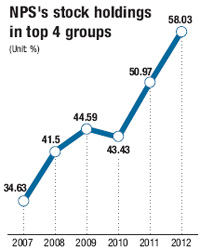
Korea’s National Pension Service (NPS) has increased its securities investment in the country’s top four conglomerates ― Samsung, Hyundai Motor, SK and LG ― by about four times over the past five years; he four firms accounted for as much as 58 percent of the NPS’s combined stock investment in 2012, compared with 34.6 percent in 2007

2013-03-26 17:54

NPS exposure to risk increasing

By Na Jeong-ju

130326_p10_NPS

The National Pension Service (NPS) has increased its securities investment in the country’s top four conglomerates ― Samsung, Hyundai Motor, SK and LG ― by about four times over the past five years. This is another indication that the state pension fund is making little effort to diversify its investment portfolio ― the No. 1 rule for risk-hedging. That also means the NPS is betting bigger money from pensioners on the four firms ― if they falter, people’s money will be at risk. According to the NPS, Tuesday, its investment in stocks and bonds issued by the four business groups and their affiliates totaled 51.7 trillion won ($46.6 billion) as of the end of 2012. That’s about 3.7 times larger than 13.5 trillion won in 2007. The four firms accounted for as much as 58 percent of the NPS’s combined stock investment in 2012, compared with 34.6 percent in 2007. Read more of this post

Red Flag, the secret supermarket in the walled grounds of Zhongnanhai, China’s Krelim and well-guarded headquarters of China’s central party and government leaders, has closed

Zhongnanhai’s Secret Supermarket

2013-03-26 18:44

Translated by Li Jing and Pang Lei

1364294542308
Update: Cao Shiru (曹世如), the chairwoman of the Red Flag supermarket, revealed onher Sina Weibo account yesterday afternoon that the Zhongnanhai supermarket closed way back in 2003, not long after it opened.

One of the top stories floating around China’s internet today was about a Sichuan supermarket chain that managed to open up a store within the walled grounds of Zhongnanhai, the well-guarded headquarters of China’s central party and government leaders.

Sometimes referred to as China\’s Kremlin, Zhongnanhai was once part of the Forbidden City with its lakes – Zhongnanhai (中南海) literally translates as the Central and Southern Seas – were part of the former imperial gardens.

Reports said that the Red Flag supermarket chain’s (红旗连锁超市) outlet within the walled compound has now closed, though no-one seems to be really sure when it happened. The store was reportedly opened in December 2003. Read more of this post

China’s “black clinics” flourish as government debates health reform

China’s “black clinics” flourish as government debates health reform

12:31am EDT

By Hui Li and Ben Blanchard

BEIJING (Reuters) – A one-room shack with a single, bare light bulb on a non-descript Beijing side street is 29-year-old Chinese migrant worker Zhang Xuefang’s best recourse to medical care.

Not recognized as a Beijing resident, she does not qualify for cheaper healthcare at government hospitals, and her hometown is too far away to take advantage of medical subsidizes there.

Like millions of other migrant workers, Zhang, on whose labor China’s economic boom depends, is forced into a seedy and unregulated world of back ally “black clinics” if she falls ill.

The issue highlights the two-tier nature of China’s overburdened health care system and goes to the heart of a heated debate about how to reform the contentious “hukou” system of household registration, a cornerstone of government policy for decades which essentially legalizes discrimination between urban and rural residents. Read more of this post

Outsourced Chief Investment Offices Gain Traction with Institutional Investors

MARCH 25, 2013

Outsourced Chief Investment Offices Gain Traction with Institutional Investors

Everyone from former endowment CIOs to asset managers is hanging out a shingle as an outsourced chief investment office. As endowments, pension funds and other institutions take advantage of OCIO services, this growing market will consolidate, experts say.
By Frances Denmark

This January, Matthew Wright joined a growing trend by walking out of his office at Vanderbilt University. He didn’t walk far. The former vice chancellor of investments founded Disciplina Group, an outsourced chief investment office, or OCIO, in Nashville.

Wright’s exit is part of a stream of high-profile talent from endowments that began in 2004, when former University of Virginia CIO Alice Handy founded Charlottesville, Virginia–based Investure. Mark Yusko left the University of North Carolina to launch Chapel Hill, North Carolina–­based Morgan Creek Capital Management, and Scott Wise departed Rice University to set up financial services firm TIAA-CREF’s Covariance Capital Management. When these people leave their posts, there’s no guarantee that they take their former institution with them.

As the OCIO business stakes out its turf, there seems to be an insatiable demand for veteran endowment investors to step in and manage endowment assets. But not everyone is convinced. “It’s an incredibly overcrowded space right now,” says Kevin Quirk, a founding partner of investment management consulting firm Casey, Quirk & Associates, in Darien, Connecticut. Read more of this post

China’s officials go underground to defeat moves to curb their lavish feasting

Officials go underground to defeat moves to curb their lavish feasting

Wednesday, 27 March, 2013, 12:00am

Keith Zhai and Minnie Chan

Officials dodge Xi Jinping’s curbs on luxury by turning canteens into five-star restaurants and meeting businessmen away from public gaze

Xi Jinping’s call for officials to cut down on extravagance and feasting appears to have hit a snag at the local level.

Officials from four different regions have told the South China Morning Post that the banquets have merely gone underground, where they are now being held in much more lavish style.

Two officials in Fujian province said many canteens in government departments had been renovated and had hired chefs from the region’s finest restaurants after outside banquets were banned as part of the Communist Party leadership’s anti-corruption and austerity drive.

“Such renovation is not only happening in Fujian, but in many provinces around the country,” one of the officials said. “There are plenty of ways at the local level for cities to get around rules from the top.”

There are plenty of ways at the local level for cities to get around rules from the top. Read more of this post

Eurozone’s bully boys will come to regret penalising tiny Cyprus

Eurozone’s bully boys will come to regret penalising tiny Cyprus

Europe’s monetary union was meant to be about solidarity among the many and prosperity for all.

An immediate collapse of 10pc to 20pc in national income is in prospect, with unemployment soaring to more than a quarter of the population Photo: EPA

By Jeremy Warner

8:17PM GMT 25 Mar 2013

In practice, it’s turning out to be a doomsday machine for the fringe economies that once so enthusiastically lined up to join.

If even Wolfgang Schaeuble, the German finance minister, is prepared to admit that Monday’s bail-out is a bitter pill for Cypriots to swallow, then it must indeed have been merciless. Nicholas Papadopolous, chairman of the Cypriot parliament’s finance committee, had a rather blunter way of putting it: “We are heading for a deep recession, high unemployment. They wanted to send a message that the Cypriot economy ought to be destroyed, and they’ve succeeded. They’ve destroyed our banking sector.”

The terms of this latest bail-out are scarcely any better than the ones so comprehensively rejected by MPs only last week. The offshore banking model on which so much of the island’s recent prosperity has been built is being broken beyond repair. Small wonder the latest package is structured in a way that doesn’t require another parliamentary vote. Democracy is once again being suspended for the supposed sake of the single currency. Read more of this post

Big Players Cash Out of Hong Kong Property

March 26, 2013, 3:00 p.m. ET

Big Players Cash Out of Hong Kong Property

By ISABELLA STEGER

HONG KONG—With the government growing confident that it has halted the meteoric rise in property prices, some of this city’s biggest real-estate investors are getting out.

Several of Hong Kong’s wealthiest families are planning initial public offerings of hotels, offices and other real-estate assets in coming months, while others are lowering prices on luxury apartments to entice buyers.

“Developers are selling assets at the very top of the market, when appetite is big, and interest rates are low,” said Christopher Wong, senior investment manager at Aberdeen Asset Management ADN.LN +4.03% in Singapore. Read more of this post

Europe’s financial crisis costing lives, suicides and infectious diseases on the rise

Published: Wednesday March 27, 2013 MYT 8:49:00 AM

Europe’s financial crisis costing lives, suicides and infectious diseases on the rise

LONDON: Europe’s financial crisis is costing lives, with suicides and infectious diseases on the rise, yet politicians are not addressing the problem, health experts said on Wednesday.

Deep budget cuts and growing unemployment are tipping more people into depression, and falling incomes mean fewer people can see their doctors or afford to buy medicines.

The result has been a reversal since 2007 of a long-term decline in suicide rates, coupled with worrying outbreaks of diseases including HIV – and even malaria – in Greece, according to an major analysis of European health in The Lancet journal.

Countering these threats requires strong social protection schemes, researchers argue. But the austerity measures imposed after a string of crises in southern Europe – most recently in Cyprus – has shredded such safety nets. Read more of this post

Abandoned gold loans are India’s “jingle mail”

Abandoned gold loans are India’s “jingle mail”

MARCH 25, 2013

By Andy Mukherjee

The author is a Reuters Breakingviews columnist. The opinions expressed are his own.

The myth that Indians’ love for gold is driven by tradition rather than financial self-interest has been dashed. Falling prices have prompted borrowers who took out loans secured against the yellow metal to break a cultural taboo and abandon their collateral. It’s the Indian equivalent of American homeowners who walked away from their underwater mortgages by mailing the keys to their homes to the bank.

India’s version of the “jingle mail” came to light when Manappuram Finance, a lender against gold, recently warned that defaulting borrowers would force it to report a quarterly loss. The lender’s Mumbai-listed shares tanked 31 percent over just three days. The precipitous fall was partly due to concerns the company had selectively leaked its guidance — a charge Manappuram denies. But clearly the lender, which was forecasting a profit as recently as February, had underestimated the borrowers’ response. Read more of this post

India Plans New Rules for Companies Pawning Shares to Borrow after uneven disclosures resulted in some small companies plunging 80 percent last month.

India Plans New Rules for Companies Pawning Shares to Borrow

By Pradipta Mukherjee and Santanu Chakraborty – Mar 26, 2013

India’s capital market regulator will frame stricter rules for companies and owners pledging shares as collateral to borrow funds after uneven disclosures resulted in some small companies plunging 80 percent last month. The Securities & Exchange Board of India is also planning to overhaul regulations for insider trading, as well as share repurchases, Chairman U.K. Sinha said in Kolkata today. The regulator set up a panel on March 5 to review insider trading rules. Indian companies had pledged as much as 1.5 trillion rupees ($28 billion) of shares to lenders as of Dec. 31, Morgan Stanley said in a report on Feb. 21.

“People have come out with creative solutions with some instruments through which they are pledging shares and they are not informing the stock exchange,” Chairman U.K. Sinha said today in Kolkata, without elaborating. “Very soon we will take measures to ensure that all kinds of encumbrances are reported well in time so the market knows about it.”

Sinha is reviewing regulations to raise corporate governance standards in the $1.2 trillion market. A dozen companies on the S&P BSE500 index plunged last month amid speculation the shares pledged by company’s founders in return for loans have been sold. Core Education & Technologies Ltd. (CETL) crashed 80 percent, Gravita India Ltd. (GRAV) 38 percent and ABG Shipyard Ltd. (ABGS) 17 percent in the period. Founders who have pledged a large chunk of their shares risk losing control of their companies should a drop in equity prices erode the value of the collateral, according to CNI Research Ltd. (CNIR) Borrowing costs in the $1.8 trillion economy are among the highest in Asia. Read more of this post

Shadow Loans Hard to Squelch in China City Hit by Suicide

Shadow Loans Hard to Squelch in China City Hit by Suicide

Zhou Xiang is playing with his mobile phone in a room just big enough for a desk and chairs at the year-old Wenzhou Private Lending Registration Center. Not a single prospective customer has shown up for hours.

As a government-sanctioned loan broker seeking to match cash-strapped business owners with private investors, Zhou is one of the few people who can even be found inside the two-story building in a high-end residential district of Wenzhou, a city of 9 million people in China’s southeastern Zhejiang province. Rows of airport-like seats are empty.

“Only those who are really out of options would come here for loans,” says Zhou, a manager at Sudaibang, one of five independent brokers operating out of the center. “Most of the time, you would find these firms so weak financially that they can be literally crushed by a straw. The volume of lending is so low that we ourselves won’t be here long without expanding into some other businesses.”

One year after China’s leaders picked Wenzhou to start a pilot program designed to curb and regulate the city’s informal shadow-lending networks, it’s clear, based on a recent trip to the country’s epicenter of private lending, that the plan isn’t working. Small firms it intended to benefit still can’t access loans because they lack collateral and are struggling to stay afloat. At least one broker, Beijing-based CreditEase, has given up, citing a gap between the center and targeted borrowers. Read more of this post

Foxconn Plant in Peanut Field Shows Labor Eroding China’s Edge; “China’s advantage in low-cost manufacturing will end much sooner than expected, I believe within five years,”

Foxconn Plant in Peanut Field Shows Labor Eroding China’s Edge

Standing on a street corner near Foxconn Technology Group’s (2038) plant in central China that makes iPhone 5 handsets, employee Wang Ke says he’ll quit if his wage doesn’t double.

“I don’t have high expectations, I know I’m a migrant worker,” said Wang, 22, who earned 1,600 yuan ($258) in December, after deductions for lodging. “But I want to make 3,500 yuan a month, net. That’s a fair price.”

Wang’s attitude springs from a labor-market squeeze across the country after China’s pool of young workers shrank by almost 33 million in five years at the same time as industry added 30 million jobs. The resulting wage pressure means Foxconn, Apple Inc.’s (AAPL) biggest supplier, pays the same basic salary at the Zhengzhou plant it built in 2010 among the corn and peanut fields of Henan province, as it does in Shenzhen, the southern city that spawned the nation’s industrial boom.

“China’s advantage in low-cost manufacturing will end much sooner than expected, I believe within five years,” said Shen Jianguang, Hong Kong-based chief economist at Mizuho Securities Asia Ltd. “Wages are rising faster inland than on the coast. More companies will consider moving to countries such as Vietnam, Indonesia and the Philippines.” Read more of this post

Malaysian PM Najib Uses Public Humiliation With Graft Gallery: Southeast Asia

Najib Uses Public Humiliation With Graft Gallery: Southeast Asia

Malaysia’s government is using public humiliation in its war on graft as Prime Minister Najib Razak seeks to show voters that he’s getting tough on corruption ahead of an election that may be held within weeks.

An online gallery shows the names and photographs of more than 1,000 convicted offenders, including former Selangor state Chief Minister Mohamad Khir Toyo, who was sentenced to a year in jail in 2011.

Najib is trying to bolster his graft-fighting credentials to counter criticism from the opposition that companies from power producers to toll-road operators have unfairly benefited from their ties to a government that has ruled Malaysia since independence from Britain in 1957.

“The opposition will use corruption and financial irregularities in government spending to try and help win the election,” Ibrahim Suffian, a political analyst at Merdeka Center for Opinion Research, said by phone on March 15. “They will present a picture of pervasive corruption in government, including trying to link Najib himself.” Read more of this post

Reforming MediShield to be truly national; “Cancer treatment can be very, very expensive. This is something our health system will have to deal with. It is not surprising if some patients have to sell their house.”

Reforming MediShield to be truly national

Every now and then, Singaporeans come across a media report of a medical bill in the hundreds of thousands of dollars, and everyone seems to know someone struggling financially after a prolonged illness.

Jeremy Lim has held senior executive positions in both the public and private healthcare sectors. He is writing a book on the Singapore health system.

4 HOURS 51 MIN AGO

Every now and then, Singaporeans come across a media report of a medical bill in the hundreds of thousands of dollars, and everyone seems to know someone struggling financially after a prolonged illness.

In fact, the late Dr Balaji Sadasivan, previously a junior minister in the Health Ministry, while undergoing treatment for cancer commented: “Cancer treatment can be very, very expensive. This is something our health system will have to deal with. It is not surprising if some patients have to sell their house (sic).”

In dealing with the financials of catastrophic illness, Singaporeans are likely most concerned about two issues: The uncertainty of illness severity with an attendant massive hospital bill, and their share of the bill. Read more of this post

How Stiglitz weakens change in S’pore; From an outsider’s standpoint, the “model” Singapore pitch is perhaps meant as praise. People who care about Singapore should reject this cheap thrill.

How Stiglitz weakens change in S’pore

Mr Joseph Stiglitz’s commentary, “Singapore’s lessons for an unequal America” (March 20), does disservice to both Singaporeans and Americans.

FROM TEO YOU YENN –

4 HOURS 34 MIN AGO

Mr Joseph Stiglitz’s commentary, “Singapore’s lessons for an unequal America” (March 20), does disservice to both Singaporeans and Americans. Graduate student Kirsten Han points out in news publication Quartz that Singapore’s Gini coefficient is the second-highest among developed countries; that exploitable migrant labour has allowed employers to suppress wages; that workers’ rights to collective action are curtailed. Mr Stiglitz mistakes these realities and overlooks the cost of inequality on social well-being here. More importantly, because he is a Nobel economist, a position of legitimacy, his claim that Singapore is a model for dealing with inequality diminishes Singaporeans’ calls on the state to reform the welfare regime, address inequalities and ensure social inclusion. In praising, for example, the Central Provident Fund (CPF) system for compelling individuals to save, he affirms the Singapore state’s claim that individuals should ultimately be responsible for themselves. As various civil society members have pointed out in recent years, this individualised view of solutions leaves many needs unresolved and generates inequalities across groups. The healthcare system, heavily dependent on individuals’ “responsibility” in ensuring lifelong employment and hence on their CPF savings, disadvantages those who are unable to have continuous, full employment. As the CPF is tied to an individual’s income, wage differentials translate into unequal access. The Association of Women for Action and Research has been particularly concerned that women doing unpaid domestic and care labour have greater difficulty accessing this basic need. Like Mr Stiglitz, various civil society groups, scholars and citizens are interested in drawing comparative lessons from cases. We have come to different conclusions about “the Singaporean model”. We have pointed out differences from the Nordic countries, in principles and outcomes. For example, the Singapore model is premised on women being responsible for fertility decisions and child support; men have limited rights to be carers. In education, while Singaporean children do test well, this has come about at significant cost for certain classes of parents; that enrichment and tuition centres are thriving signals the large private investments going into education. In considering reform, Americans would be better served by looking at social policies in Scandinavia that generate greater equality across class or gender, as various scholars do in books such as Gender Equality: Transforming Family Divisions of Labor.

From an outsider’s standpoint, the “model” Singapore pitch is perhaps meant as praise. Given that Singaporeans often read about chewing gum and caning as if these define our nation, reading a positive piece can evoke some feel-good sentiments. Yet, the failings of the piece are harmful. People who care about Singapore should reject this cheap thrill. Americans who care about reform in their case should not be thrown off by the use of a case that is closer to theirs than to genuinely desirable alternatives. Given ongoing debates regarding the future we want, and given that tensions in world views exist between state and society and within society, the rush to declare Singapore as a coherent, stable model for others undermines the very project to reform.

ABOUT THE WRITER:

Teo You Yenn is a board member at the Association of Women for Action and Research, assistant professor in sociology at the Nanyang Technological University and author of the book, Neoliberal morality in Singapore: How Family Policies Make State and Society.

CalPERS is weighing taking its massive $255 billion assets under management and moving it to an all-passive portfolio

A Gigantic Pension Fund Is Reportedly Considering A Change That Should Make Investment Managers Freak Out

Julia La Roche | Mar. 25, 2013, 2:13 PM | 7,432 | 13

Investment News reports that California CalPERS, the second biggest U.S. public pension fund, is weighing taking its massive $255 billion assets under management and moving it to an all-passive portfolio. Why would this matter? Well, it would matter a lot for active managers who receive management fees from CalPERS, Josh Brown, who runs the popular financial blog the Reformed Broker, points out on Twitter. The California Public Employees’ Retirement System already has more than half of its investible assets in passive strategies. CalPERS is expected to make the decision in about five months, the report said.

Passive investing: If it’s good enough for CalPERS …

Giant pension plan’s possible full-on switch to index funds speaks volumes

Mar 24, 2013 @ 12:01 am (Updated 2:24 pm) EST

Passive investing has reached a watershed moment. The second-largest pension fund in the United States is considering a move to an all-passive portfolio while at the same time, the largest brokerage firms are falling over themselves to push passively managed exchange-traded funds.

Read more of this post

Ravi Jaipuria: India’s Pepsi Bottler-Billionaire

Ravi Jaipuria: India’s Bottler-Billionaire

by Naazneen Karmali | Mar 26, 2013

images (3)

PepsiCo bottler Ravi Jaipuria’s insatiable thirst for growth earned him a fortune

I like to be near water,” says Ravi Jaipuria, seated in his office on the top floor of a building that bears his initials and is situated in Gurgaon, a bustling township adjacent to Delhi. The ocean is nowhere close so the chairman of the privately held RJ Corp—revenues in excess of $1 billion—has to make do with an artificial waterfall in the terrace adjoining his office.

Water of the flavoured kind has made Jaipuria, 58, a fortune: PepsiCo’s largest franchise bottler in India. He claims to be among the multinational giant’s top three globally—is among India’s new crop of billionaires, with a fortune estimated at $1.4 billion.

Jaipuria gets a chunk of that wealth from bottling unit Varun Beverages, which accounts for over half of RJ Corp’s revenues. Named after his son, who works with him, Varun Beverages has 10 bottling plants in India plus an international footprint that includes Sri Lanka, Nepal, Morocco, Mozambique and Zambia. It claims to have close to a third of Pepsi’s business in India. A PepsiCo India spokesman says that half of its beverage volume is from seven franchise bottlers, of which Varun Beverages is the biggest. Read more of this post

Pakistan’s Army of Overseas Workers Keeps Economy From Collapse; Almost 10 million Pakistanis work overseas and the sum they’ve sent home has doubled in the four years through June, to a record $13 billion.

Pakistan’s Army of Overseas Workers Keeps Economy From Collapse

Living in poverty in a mud shack in Pakistan, Mazhar Ali dropped out of school, sold the family’s two buffalo and bought a visa to work in Dubai. The money he sends home is paying for a new house.

“We’re going to build three rooms with bricks and cement, plus a courtyard and a washroom,” said his younger brother Azhar in Larkana, home town of the ruling People’s Party about 300 kilometers north of Karachi. “We will then start marrying one by one, starting with Mazhar sometime this year.”

The family’s change in fortunes reflects a rising trend of rich nations with aging workers tapping poorer ones for labor — total remittances to developing economies will rise 7.9 percent this year, and reach $534 billion by 2015, the World Bank says. For Pakistan, the income offers a source of stability, with the country poised for its first civilian handover of government in May even amid power shortages, bombings and a Taliban insurgency.

“This is our savior for keeping Pakistan out of the oxygen tent,” Farooq Sattar, former Minister for Overseas Pakistanis said in an interview in Karachi last month before his party quit the government alliance. “It has kept us from a complete economic collapse.”

Almost 10 million Pakistanis work overseas and the sum they’ve sent home has doubled in the four years through June, to a record $13 billion. Read more of this post

Mortimer Zuckerman: The Great Recession Has Been Followed by the Grand Illusion; Don’t be fooled by the latest jobs numbers. The unemployment situation in the U.S. is still dire

March 25, 2013, 7:07 p.m. ET

Mortimer Zuckerman: The Great Recession Has Been Followed by the Grand Illusion

Don’t be fooled by the latest jobs numbers. The unemployment situation in the U.S. is still dire.

By MORTIMER ZUCKERMAN

The Great Recession is an apt name for America’s current stagnation, but the present phase might also be called the Grand Illusion—because the happy talk and statistics that go with it, especially regarding jobs, give a rosier picture than the facts justify.

The country isn’t really advancing. By comparison with earlier recessions, it is going backward. Despite the most stimulative fiscal policy in American history and a trillion-dollar expansion to the money supply, the economy over the last three years has been declining. After 2.4% annual growth rates in gross domestic product in 2010 and 2011, the economy slowed to 1.5% growth in 2012. Cumulative growth for the past 12 quarters was just 6.3%, the slowest of all 11 recessions since World War II. Read more of this post

For One Chinese Student, a Tough Job Hunt; Grateful son and “Iron Chicken” Gao Yueqing is set to graduate this June with a degree in accounting, the most practical major he and his father could agree upon. But the younger Mr. Gao, like many Chinese college students, is finding it hard to nail a job

March 25, 2013, 10:33 p.m. ET

For One Chinese Student, a Tough Job Hunt

By BOB DAVIS

SHIJIAONAO, China—Four years ago, Gao Shangming was convinced that his son Yueqing needed to remain in the family’s one-room apartment and help harvest corn rather than go to college. “Our financial situation wasn’t good,” the 50-year-old peasant farmer says.

But Gao Yueqing was determined to escape the dusty north China mountain village of 200 households where nearly all young people either become farmers or migrate to nearby cities to work in restaurants. His father’s relatives talked up young Gao’s case, as did a respected high-school teacher who told the elder Gao how hardworking his son was.

The clincher: “He told me, ‘If I let him get a college degree, he’d make more money,'” the elder Gao recalls.

So the father put in extra hours in nearby coal mines to pay his son’s 10,000 yuan ($1,600) annual tuition and expenses at Shanxi University’s business school in Taiyuan, in the heart of China’s coal country. His grateful son was so frugal that his roommates nicknamed him “Iron Chicken,” because it was as hard to separate him from a yuan as it would be to pluck a feather from an iron fowl.

Gao Yueqing is set to graduate this June with a degree in accounting, the most practical major he and his father could agree upon. But the younger Mr. Gao, like many Chinese college students, is finding it hard to nail a job, especially one that pays decently. Read more of this post

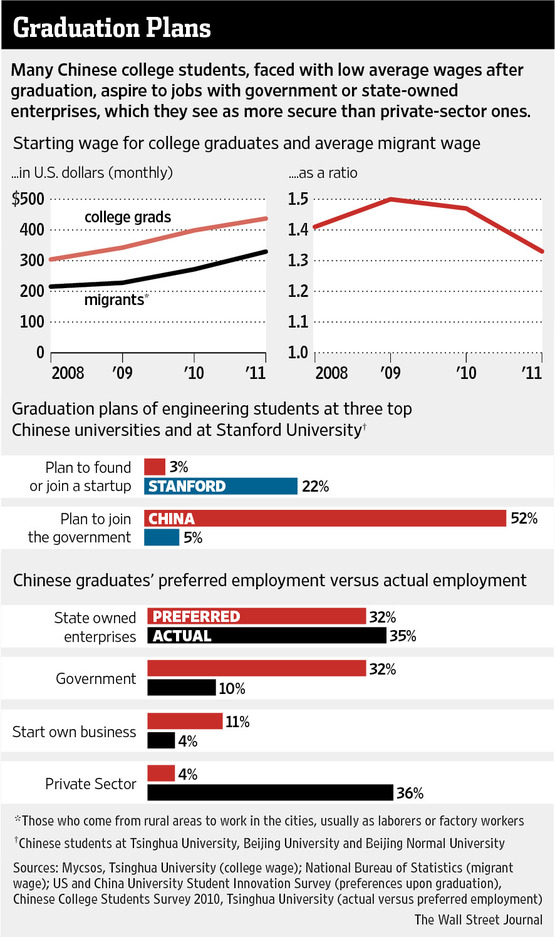
Chinese College Graduates Play It Safe and Lose Out; Chinese college graduates say they want to work for the government or big state-owned firms, which are seen as recession-proof, rather than the private companies that have powered China’s economic climb

March 25, 2013, 10:32 p.m. ET

Chinese College Graduates Play It Safe and Lose Out

By BOB DAVIS

BEIJING—Xie Chaobo figures he has the credentials to land a job at one of China’s big state-owned firms. He is a graduate student at Tsinghua University, one of China’s best. His field of study is environmental engineering, one of China’s priorities. And he is experimenting with new techniques for identifying water pollutants, which should make him a valuable catch. But he has applied to 30 companies so far and scored just four interviews, none of which has led to a job. Although Mr. Xie’s parents are entrepreneurs who have built companies that make glasses, shoes and now water pumps, he has no interest in working at a private startup. Chinese students “have been told since we were children to focus on stability instead of risk,” the 24-year-old engineering student says.

Over the past decade, the number of new graduates from Chinese universities has increased sixfold to more than six million a year, creating an epic glut that is depressing wages, leaving many recent college graduates without jobs and making students fearful about their future. Two-thirds of Chinese graduates say they want to work either in the government or big state-owned firms, which are seen as recession-proof, rather than at the private companies that have powered China’s remarkable economic climb, surveys indicate. Few college students today, according to the surveys, are ready to leave the safe shores of government work and “jump into the sea,” as the Chinese expression goes, to join startups or go into business for themselves, although many of their parents did just that in the 1990s.

Chinese economists worry that waning entrepreneurial zeal could hobble China’s ability to remake its economy and reach the ranks of wealthy nations. “The current education system does not produce people who are innovative,” says Li Hongbin, a Tsinghua University economist who specializes in education and conducted some of the surveys. “That makes it harder for the country to reach its long-term goal of building an innovative society.”

P1-BK828_CCOLLE_NS_20130325175703

P1-BK829_CCOLLE_G_20130325183608 Read more of this post

Apple pursuit lures 20,000 students into high-interest loans with annual interest rates of up to 47%

Apple pursuit lures 20,000 students into high-interest loans

By Xinhua in Wuhan (China Daily), 2013-03-22

More than 20,000 college students have taken high-interest loans to buy fancy electronic products, mostly Apple devices, in Wuhan, the capital of Hubei province.

From the start of January 2012 to the end of February 2013, the students applied for loans with a total value of 160 million yuan ($25.7 million) from Home Credit China (HC China), a subsidiary of international investment business PPF Group.

“We have lost touch with about 100 of them, getting no response to calls or letters reminding them about delayed payments,” said Liu Mingwei, Wuhan regional manager of HC China.

With around 1 million students in Wuhan, it means about one in 50 of them is shouldering HC China’s heavy annual interest rates of up to 47.12 percent on a 12-month-term loan. Read more of this post

Chinese officials earned almost US$5 trillion (30 trillion yuan) reselling land, says economist

Chinese officials earned 30 trillion yuan reselling land, says economist

Monday, 25 March, 2013, 2:49pm

News›China

Agence France-Presse in Beijing

Chinese authorities have earned almost US$5 trillion (HK$38.8 trillion) in profit by selling land obtained from farmers to developers over the years, a top economist said according to state media.

As the country undergoes a huge urbanisation process rural land confiscations have led to numerous protests, worrying the ruling Communist Party, which sees corruption and social unrest as threats to its power.

By law, officials may provide compensation worth up to 30 times the value of the land’s output, but in practice they have skimped on payments or foregone them altogether – then sold the land to developers at much higher rates. Read more of this post

Exclusive: ‘Princeling’ firm holds secret stake in giant fund house Cinda, including a private equity fund co-founded by the grandson of China’s former state head Jiang Zemin

Exclusive: ‘Princeling’ firm holds secret stake in giant fund house Cinda

Tuesday, 26 March, 2013, 12:00am

Business›Companies

George Chen george.chen@scmp.com

As jostling starts over the stock market float of Cinda Asset Management, details have come to light of two previously unknown stakeholders

With the giant state-owned fund house Cinda Asset Management planning to go public in Hong Kong this year, two behind-the-scenes investors in the company, including a private equity fund co-founded by the grandson of China’s former state head Jiang Zemin, have been pushed into the spotlight. Read more of this post

Analysis: Sitting on too much money, Norway risks going off course

Analysis: Sitting on too much money, Norway risks going off course

Sun, Mar 24 2013

By Balazs Koranyi and Victoria Klesty

OSLO (Reuters) – Middle East-style oil wealth combined with a generous Nordic welfare model is slowly throttling big chunks of Norway’s economy, threatening western Europe’s biggest success story.

On the surface, Norway is the envy of the world: growth is strong, per capita GDP has exceeded $100,000 and the nation sits on a $700 billion rainy day cash reserve, or $140,000 per man, woman and child.

But it may just be too much money as Norwegians, more keen on leisure and family life are working less and less.

Immigration is not filling the gap in the skilled part of the workforce, so productivity is stagnating, wages are surging and firms are pricing themselves out of their own market.

“Oil is a metaphor for winning the lottery,” said Ivar Froeness, a sociology professor at the University of Oslo. “Affluence has slowly crept into society… people just don’t really notice it because it’s been so gradual.”

“These days more people leave Oslo on Thursday afternoon than on Friday, taking long weekends,” he said. “We may take for granted that we have a house and a cabin in the mountain, and maybe another house on the beach.” Read more of this post

Saving Cyprus Means Nobody Safe as Europe Breaks More Taboos

Saving Cyprus Means Nobody Safe as Europe Breaks More Taboos

By Simon Kennedy – Mar 25, 2013

The devil lies in the detail of Cyprus’s salvation.

The island nation’s rescue sets precedents for the euro zone that may stick in the memory of depositors and bondholders alike as investors debate who will next fall victim to the debt crisis. Under the terms of the agreement struck early this morning in Brussels, senior Cypriot bank bond holders will take losses and uninsured depositors will be largely wiped out.

The message that stakeholders of all stripes can be coerced into helping a cash-strapped nation may make investors more skittish they’ll be targeted should Slovenia, Italy, Spain or even Greece again be next in line to need help. The risk is that bank runs and bond market selloffs become more likely the moment a country applies for a new rescue, said economists and academics from Nicosia to New York.

“We now have a new type of rule and everyone within the euro zone has to sit down and see what that implies for their own finances,” Nobel laureate Christopher Pissarides, an adviser to the Cypriot government, told “The Pulse” on Bloomberg Television. Read more of this post

IT’S OFFICIAL: Banks In Europe May Now Seize Deposits To Cover Their Gambling Losses; CITI: Cyprus Set A Bad Precedent, And Is Long-Term Negative For The Euro

IT’S OFFICIAL: Banks In Europe May Now Seize Deposits To Cover Their Gambling Losses

Henry Blodget | Mar. 25, 2013, 4:38 AM | 1,761 | 12

As expected, Cyprus and the EU reached a new late-night bailout deal last night that will reduce the chance that Cyprus’s financial system and economy will completely implode. The new deal is better than the last deal in one key respect: Deposits under 100,000 euros will be protected. That’s very important. Those deposits were ostensibly “insured.” To seize them, the way the last bailout deal would have, would have been grossly unfair and would have set a truly alarming precedent. Now, small depositors in European banks can breathe more easily. At least in this case of gross malpractice on the part of reckless bank managers, their life savings have been preserved. Alas, the good news ends there.

Although deposits under 100,000 euros will be spared, deposits over 100,000 euros will be seized and subjected to an as-yet undetermined haircut–with the confiscated money going to bail out the gambling losses of the aforementioned reckless idiots who run some of Cyprus’s banks. This seizure, needless to say, will dampen the enthusiasm of rich depositors for keeping money in banks that get themselves into financial trouble. And because many, many banks in Europe have gotten themselves into financial trouble, this will create a general state of unease among rich depositors throughout the Eurozone. And it should wig out some bank lenders, as well. After all, never before in the history of this global financial crisis has a major banking system allowed depositors to lose money, no matter how reckless and stupid and greedy their bank managers have been. And only rarely have bank lenders–those who hold bank bonds–been asked to pony up. In this case, however, the depositors will lose money. Perhaps a lot of money. And if there had been big bank debtholders in Cyprus, they probably would have been socked with losses, too.

It’s possible that everyone will just laugh off Cyprus, viewing it as an exceptional one-off. After all, the Cyprus banking system was notorious for being the offshore money-laundering arm of many Russian oligarchs, so many folks will likely view this asset seizure as a case of “just desserts.”  But this optimistic view of the Cyprus horrorshow overlooks one key fact: The main reason that Cyprus depositors will lose their cash is because it has become politically difficult (impossible?) for leaders in Germany and other rich European countries to bail out their brethren in the “periphery” without taking many pounds of flesh. And it is that precedent, in addition to the fate of big depositors in Cyprus, that should spook Europe’s big bank depositors and lenders. If Germany is done bailing out countries and banks without having those countries and banks cover some of the cost, it’s not clear why Germany will relent next time Spain, Italy, Greece, and other countries in near-desperately bad financial shape come rushing to the EU with their hands out. Read more of this post

One lump or two? Indonesian “sugar samurai” serve foreigners sparingly

Published: Monday March 25, 2013 MYT 11:19:00 AM

One lump or two? Indonesian “sugar samurai” serve foreigners sparingly

JAKARTA: White sugar prices hit a record in Indonesia last summer and further spikes are expected this year even though the world is awash with the sweetener. The main cause, say critics, is a small group of traders known in the industry as sugar samurai.

There is no evidence the samurai are doing anything illegal but they buy most of the crop through an auction system that works in their favor, say the critics, who include industry officials, government advisers and other traders. Some of the purported samurai firms deny the auctions are unfair.

The system, which some samurai helped establish, gives them the right to buy sugar at the expense of other traders under certain conditions. The samurai also run most distribution and retail networks, giving them almost total control over the market and the retail price of sugar, the critics add.

That has made it virtually impossible for foreign commodity firms or other local players to enter one of Southeast Asia’s largest white sugar markets, said Indonesia’s commission for the supervision of business competition, an independent body that looks into unfair and monopolistic business practices. Read more of this post

Mango Mirroring Zara Challenges Europe’s Wealthiest Man; Mango’s revenue hit 1.41 billion euros in 2011; Isak Andic is the founder, chairman, and owner of almost 100 percent of Mango

Mango Mirroring Zara Challenges Europe’s Wealthiest Man

Two years ago, Spanish retailer Mango could barely convince its employees to wear its dresses, skirts, and blouses, which many workers — and customers — thought were too formal.

Today, Mango has ditched the glitz in favor of more casual attire like that from Spanish rival Inditex SA (ITX), the world’s biggest seller of apparel and owner of the Zara brand. The change has helped Mango outpace Inditex in Spain’s 16.2 billion- euro ($21 billion) clothing market.

“We had gone way too far with our focus on clothes for parties and events,” said Enric Casi, general manager of the Barcelona-based retailer. “Not even our employees wore Mango.”

The casual push wasn’t the only lesson Mango took from Arteixo, Spain-based Inditex as it sought to address a decline in profit of almost 60 percent in the two years through 2011. That year, Isak Andic, the founder, chairman, and owner of almost 100 percent of the company, stepped back into a stronger day-to-day management role to help reformulate strategy.

Since then, Mango says, the chain has cut prices by about 20 percent across the board, bringing them closer to Zara’s. And the company has stepped up expansion outside of crisis-weary Spain and placed more emphasis on the fast-fashion model that has helped Inditex prosper. Read more of this post