China’s swap market is signaling interest-rate increases for the first time since 2011 after inflation accelerated to a 10-month high and the housing market defied government cooling efforts.

Zhou on High Alert Prompts Swaps PBOC Rise Signal

China’s swap market is signaling interest-rate increases for the first time since 2011 after inflation accelerated to a 10-month high and the housing market defied government cooling efforts.

Two-year contracts that exchange the People’s Bank of China’s 3 percent savings benchmark for a fixed payment rose eight basis points this month to 3.03 percent, data compiled by Bloomberg show. The swap had been lower than the one-year PBOC deposit rate for 16 months. Of the 27 economists surveyed this month by Bloomberg, 13 predicted higher rates in 2013, with Credit Agricole CIB, Daiwa Capital Markets and Nomura Holdings Inc. forecasting two increases.

PBOC Governor Zhou Xiaochuan said on March 13 the government should be on “high alert” after consumer prices jumped a more-than-forecast 3.2 percent in February. Data last week showed new home prices last month posted the broadest advance since December 2011. China’s 10-year bond yield is 38 basis points higher than inflation, compared with a similar U.S. real yield of minus 8 basis points.

“The rising inflation trend and upward pressure on home prices will continue, forcing the central bank to tighten,” said Dariusz Kowalczyk, senior economist and strategist with Credit Agricole in Hong Kong. “Main lending rates will be hiked to reduce inflation expectations.”

Inflation will probably quicken to 4 percent in the second half, a level that will “really concern” the central bank, said Kowalczyk, who accurately predicted the February consumer- price gain. He forecasts two deposit rate increases after June to 3.5 percent to protect returns on savings. Read more of this post
Free Tires for Malaysian Cabs Expose Budget Risk Before Vote; “It’s not in a proper way, it’s like rasuah,” Ramachandran said, using the Malay word for bribery. “I want to change the government and see what happens for the next five years.”

Free Tires for Malaysian Cabs Expose Budget Risk as Vote Looms

Malaysians like cab driver Ramakrishnan Ramachandran are getting used to handouts from the government as the next election looms. The budget deficit is set to show the strain regardless of who wins the vote.

From rebates for smartphones to household subsidies for electricity and higher wages for civil servants, Prime Minister Najib Razak has gone on a spending binge to woo voters ahead of polls that must be held by late June. In 2012, he announced a 35 million ringgit ($11 million) voucher program to help taxi drivers pay for new tires.

“The government simply throws the money,” Ramachandran, 54, said as he waited for passengers outside a Kuala Lumpur shopping mall, adding that the 520 ringgit he received for the wheels won’t deter him from voting for the opposition for the first time. “Whatever the government gives, I take.”

The opposition, attempting to break the ruling coalition’s hold of more than five decades on power, is also prepared to be generous as it promises free university education, lower fuel prices and the elimination of toll fees. Any fiscal deterioration from persistent largesse could raise the risk of capital outflows should the U.S. shift to tightening monetary policy, triggering a reversal in the flood of cash into emerging markets in recent years.

“No one will be overly alarmed by whether Malaysia can pay for its spending now but its fiscal trajectory is not a pretty thing,” said Vishnu Varathan, a Singapore-based Mizuho Corporate Bank Ltd. economist who has covered Malaysia for seven years. “Should investors start pulling money out of emerging markets, Malaysia is not at the top of the hit list but the sustainability of the fiscal situation is a concern for longer- term investors.” Read more of this post

Norway Becomes Petro-State as Investors Balk at Hidden AAA Risks

Norway Becomes Petro-State as Investors Balk at Hidden AAA Risks

Norway, home to the world’s biggest sovereign wealth fund, is betting it can afford to ignore investor outrage.

After shocking global credit markets in 2011 by pulling support from the once AAA and now junk-rated lender Eksportfinans ASA, the government unveiled plans in January to cut tariffs on gas transport by 90 percent, sapping income for those funding the venture by as much as $7 billion.

Investors are now asking themselves how much risk they’re willing to accept to gain access to western Europe’s biggest oil and gas reserves. And while Norway boasts a stable AAA rating and the world’s smallest default risk, the government’s decision to ride roughshod over investors is starting to resemble actions seen in less stable democracies such as Venezuela and Russia.

The planned tariff cut “undermines Norway’s reputation as a stable and predictable country for investments,” Solveig Gas Norway AS and Silex Gas Norway AS, two of the companies backing the pipeline network that charges the tariffs, Gassled, said in a March 15 letter. It “represents an unauthorized intervention in the infrastructure owners’ legally protected rights and expectations,” they said. Read more of this post

Hong Kong’s Real-Estate Brokers Feel the Chill; Hong Kong is home to more than 6,000 real estate offices, whose numbers eclipse even that of the city’s 7-Elevens and McDonald’s

March 25, 2013, 6:24 AM

Hong Kong’s Real-Estate Brokers Feel the Chill

The armies of young real-estate agents that flood Hong Kong’s shopping malls on weekends could see their ranks thinning out in the coming months, the chief analyst at Hong Kong’s largest listed real-estate broker says.

Thanks to the government’s latest round of cooling measures, transactions across the city have dropped dramatically, Midland Realty’s Buggle Lau said Thursday. Since late February, when the government doubled the stamp duty on most property purchases, transactions on the secondary market at the city’s 10 most popular housing estates have plummeted to as few as four or five on recent weekends, Mr. Lau said. By contrast, a year ago, there were closer to 100 transactions per weekend, he said.

As property prices have ballooned by 120% in recent years, Hong Kong’s real-estate offices have become even more common a sight than the city’s 7-Elevens and McDonalds, as thousands of salesmen have jumped in on the bonanza. There are more than 6,000 such offices in Hong Kong, with 300 of them opening their doors in just the past year. Read more of this post

Singapore’s ex-HDB CEO: During my time, HDB flats were 3X median annual salary

ex-HDB CEO: During my time, HDB flats were 3X median annual salary

March 24th, 2013 |  Author: Editorial

ex-HDB CEO, Dr Liu Thai Ker

At a lecture on the Singapore Public Housing Story, organised by the Centre for Liveable Cities on 20 Mar, Dr Liu Thai Ker, who was the ex-CEO of HDB and URA, made the call for Public Housing to return to the basics. Dr Liu said the end goal should be affordability. Dr Liu’s call was also backed by former Senior Minister of State and HDB Chairman Aline Wong, who reiterated that the purpose of public housing is to “provide a shelter over everybody’s heads”. Dr Aline Wong said, “The asset part comes along because … property appreciates over a long time. But that is not our primary objective. People make money, accumulate savings … but we cannot promise that they will not lose (value in their property), depending on the property cycle.” Dr Liu said, “Maybe we should go back to the basics in the sense that we should not, say, emulate condominiums — that require more expensive materials, extra this, extra that … go back to basics, keep housing prices affordable, let residents embellish the houses, embellish the interiors.” He reiterated that the “core mission” of the HDB is to “provide affordable housing”. “And in the process of providing that, we try to use whatever budget available to create the biggest possible floor area for the people and with minimum frills, minimum decorations and so on. By minimum decorations, it doesn’t mean that the buildings are not beautiful … if the buildings are well-proportioned, they are beautiful.”

Dr Liu added, “When I was CEO, we looked at the per capita GDP (gross domestic product) growth, the sector of people eligible for public housing, their income … and then matching that to our selling price and to our flat sizes. It was really a very detailed study.” Dr Liu noted that in those days, flats typically cost about three years of an owner’s annual salary. Read more of this post

Prices of Chinese medicine in Yunnan province have increased over 10-fold after four years of persistent drought

High heat and speculation set Chinese medicine prices ablaze

Staff Reporter  2013-03-24

Prices of Chinese medicine in Yunnan province have increased over 10-fold after four years of persistent drought, which has severely limited the scale of Chinese herb and tea production. Increasing demand for the disappearing herbs has only added upward pressure.

Low rainfall, high temperatures and strong wind in the spring have affected the production output of multiple tea-producing cities, especially Pu’er and Dali. Prices of green tea, pu’er tea and dianhong black tea have surged by 10%, 20% and 30% respectively since last spring, according to Chinese-language Henan Economic News.

The droughts have also driven up the prices of Chinese medicines such as dong quai, pseudo ginseng and other plants that belong to the genus panax. Dong quai fetched a market price of 34 yuan (US$5.4) a kg in Aug. 2012 but now goes for 90 yuan (US$14). The pseudo ginseng also doubled from 300-400 yuan (US$48-64) a kg in 2012 to 700-800 yuan (US$112-128) this year. Other panax plants have increased by 40% to around 400 yuan (US$64) a kg.

Chinese medicine businesses said speculators in recent years have caused herb prices to fluctuate and are using some medicines as their investments tools. Some Chinese medicines practitioners said the value of a prescription has gone up from a dozen yuan a few years ago to up to 400-500 yuan (US$64-80) now. Read more of this post

Former PetroChina chairman detained for corruption: Boxun

Former PetroChina chairman detained for corruption: Boxun

Staff Reporter 2013-03-24

Jiang Jiemin, the former chairman of PetroChina, China’s biggest oil producer, has been detained by central discipline authorities for corruption, reports Boxun, a citizen journalism website that often makes claims that are difficult to prove.

According to Boxun, a “reliable source” inside the Commission for Discipline Inspection claims that Jiang, who was also the former general manager of PetroChina’s state-owned parent China National Petroleum Corporation and a former vice governor of Qinghai province, was placed under “double regulation” shortly after stepping down as PetroChina chairman last week.

Under the Communist Party’s investigation ordinance, double regulation is one of several strategies disciplinary authorities may employ when conducting an investigation into a government official, and requires that the subject appear at a specified time and location to answer allegations of misconduct.

The source added that the chairman of state-owned oil and gas giant Sinopec, Fu Chengyu, and the company’s general manager, Wang Tianpu, are also being targeted by authorities for corruption. Read more of this post

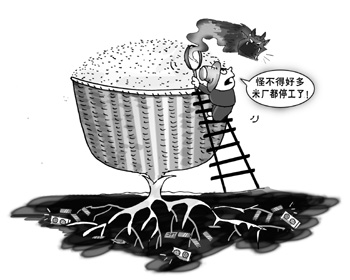
“Poison rice incidents” have led to surge in closures of 70% of rice mills in China’s Hunan province; “毒大米”事件引发湖南米厂停工潮

“毒大米”事件引发湖南米厂停工潮

担忧后期卖粮难,部分农民考虑弃种

2013-03-25   作者:记者 周勉 白田田/长沙 北京报道  来源:经济参考报

xin_27031025042107902961

全国最大的水稻主产区湖南省正遭受“毒大米”事件影响。《经济参考报》记者近日调查了解到,受不久前关于湖南上万吨大米重金属镉含量超标的事件影响,湖南省米厂出现“停工潮”,在湖南最大的米市“兰溪米市”,当地企业反映已有70%的米厂停工。 Read more of this post

The Index Liquidity Riddle: More Is Less

Updated March 22, 2013, 1:27 p.m. ET

The Index Liquidity Riddle: More Is Less

By JUSTIN LAHART

BF-AE637_INDEXH_G_20130322172406

You would think that the whole point of a stock index is to be, well, an index of the stock market’s performance.

But thanks to the popularity of exchange-traded funds, or ETFs, stock indexes have in recent years been doing double duty as investment vehicles. At the same time, there have been subtle but important changes in the way indexes are constructed.

Bottom line: The indexes aren’t measuring exactly what they used to.

It is a lot easier to manage an ETF if the stocks that underlie it are easily traded. If, instead, the stocks are illiquid, there is a risk their prices will get artificially inflated when money flows into the ETF. The opposite can happen when money flows out. Read more of this post

While many business people see the economy as badly performing and badly managed, our econocrats see it as having performed quite well and better than could have been expected. Why such radically different perspectives on the same economy?

State of economy all comes down to perspective, really

March 23, 2013

Ross Gittins

While many business people see the economy as badly performing and badly managed, our econocrats see it as having performed quite well and better than could have been expected. Why such radically different perspectives on the same economy?

Partly because business people – particularly those from small businesses – view the economy from their own circumstances out: If I’m doing it tough the economy must be stuffed. By contrast, macro economists are trained to ignore anecdotes and view the economy from a helicopter, so to speak, using economy-wide statistical indicators.

A bigger difference, however, is that business people are comparing what we’ve got with what we had, whereas the economic managers are comparing what we’ve got with what we might have got, which was a lot worse.

Business people know everything was going swimmingly in the years leading up to the global financial crisis of 2008-09, but in the years since many industries – manufacturing, tourism, overseas education, retailing, wholesaling – have been travelling through very rough waters.

The econocrats, however, have a quite different perspective: whereas the rest of us love a good boom, those responsible for managing the economy view them with trepidation. Why? Because they know they almost always end in tears and recriminations. Read more of this post

Malaysia’s Mahathir steps out of the shadows

Malaysia’s Mahathir steps out of the shadows
Posted: 24 March 2013 1109 hrs

KUALA LUMPUR: Four years after leading a charge to oust Malaysia’s previous prime minister, ex-leader Mahathir Mohamad is making his sizeable influence felt again as a close election looms.

Mahathir, who towered over Malaysia for 22 years with his grand development projects and hard-nosed politics, is 87 but has peeled back the years to step from the shadows and whip up support for the long-ruling regime he moulded.

Through his blog and visits to key constituencies, Mahathir has sounded off in typically blunt style, warning that a loss by the 56-year-old government would bring chaos.

In shades of four years ago, he told AFP that Prime Minister Najib Razak could face a ruling-party leadership putsch like his predecessor if he does not improve on a 2008 polls setback that shocked the Barisan Nasional ruling coalition. Read more of this post

Lockheed Martin Says This Desalination Technology Is An Industry Game-Changer; The problem is that current filters use plastic polymers that require an immense amount of energy (800 to 1,000 pounds per square inch of pressure) to push water through. Lockheed has developed a special material (graphene) that doesn’t need as much energy to drag water through the filter.

Lockheed Martin Says This Desalination Technology Is An Industry Game-Changer

Dina Spector | Mar. 22, 2013, 12:45 PM | 9,777 | 33

The latest technology for removing salt from seawater, developed by Lockheed Martin, will be a game-changer for the industry, according to Ray O. Johnson, senior vice president and chief technology officer of the jet and weapons manufacturer.

Desalination technology is used in regions of the world, particularly developing countries, where fresh water is not available. Water from oceans or rivers is diverted into treatment plants where the salt is removed and clean drinking water is produced through a process called reverse osmosis.

Imagine a tank with seawater on one side and pure water on the other, separated by a filter with billions of tiny holes. Lots of pressure on the salty side pushes water through faster than the salt, so fresh water comes out the other end.

The problem is that current filters use plastic polymers that require an immense amount of energy (800 to 1,000 pounds per square inch of pressure) to push water through.

Lockheed has developed a special material that doesn’t need as much energy to drag water through the filter.

Graphene is a substance made of pure carbon. Carbon atoms are arranged in a regular hexagonal or honeycomb pattern in a one-atom thick sheet. Read more of this post

Low-Quality Stocks Have Zoomed. Time to Shift Gears?

March 22, 2013, 6:22 p.m. ET

Low-Quality Stocks Have Zoomed. Time to Shift Gears?

By MARK HULBERT

BF-AE633_HULBER_G_20130322160304

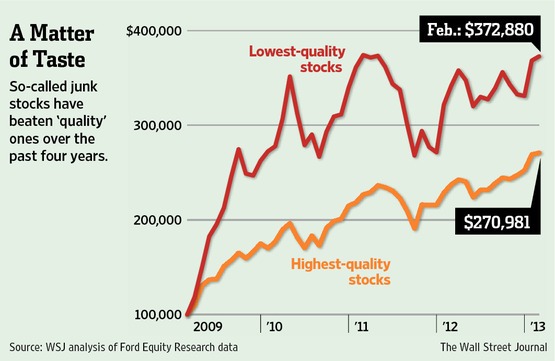
“Junk” continues to beat “quality” on Wall Street. Nearly four years after the end of the recession of 2007-09, it should be the other way around.

The Federal Reserve’s monetary stimulus is a big reason for this unexpected outcome.

Because the Fed’s easy-money policies won’t continue indefinitely, however, investors might want to begin reducing their holdings of low-quality stocks—which will be among the biggest casualties when the Fed turns off the spigot. Read more of this post

Volvo Says Chinese Dealers Inflated Sales to receive cash incentives

March 22, 2013, 9:07 a.m. ET

Volvo Says Chinese Dealers Inflated Sales

By ANNA MOLIN and COLUM MURPHY

STOCKHOLM—Volvo Car Corp. said Friday some of its Chinese dealers inflated sales figures to receive cash incentives in 2011 skewing annual comparisons that led the company to disclose it lost ground in China last year when it had actually increased sales in the key market.

The struggling Swedish auto maker launched an internal investigation last year and found that dealers reported more retail sales than they conducted during 2011, Volvo Cars spokesman Per-Åke Fröberg said on Friday. To make the books match, the dealers didn’t report the sales executed in 2012 that were falsely booked in 2011. Read more of this post

Here Comes the Slow-Stock Movement; Global investors will meet to discuss whether companies should offer special shares to reward long-term holders in a short-term world

March 22, 2013, 6:00 p.m. ET

Here Comes the Slow-Stock Movement

By JASON ZWEIG

When you are loyal to a drugstore, airline or credit card, you get points, miles, cash back and other rewards. Should investors also get a bonus for being loyal to a stock?

Next week in London, two dozen global investors will meet to discuss whether companies should offer special shares to reward long-term holders in a short-term world.

Investors who hold a stock continuously for years might earn a higher dividend or receive “warrants” entitling them to purchase more shares.

“It’s a way of rewarding long-term behavior and taxing short-term behavior,” says Patrick Bolton, an economist at Columbia Business School who has spent several years developing the idea.

Patience is a rare virtue in today’s high-speed markets. Read more of this post

Beijing, We Have A Problem: Warehoused Asian Copper Hits Record High

Beijing, We Have A Problem: Warehoused Asian Copper Hits Record High

Tyler Durden on 03/22/2013 11:18 -0400

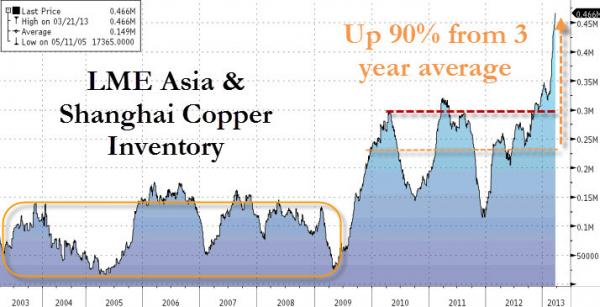
A rather well-known problem for those who have tracked the warehousing woes of assorted industrial medals in China as an indication of the true state of the Chinese economy: as of right now, the stocks of copper in Asia (as determined by deliverable LME CLS and Shanghai copper) are at an all time high and up 90% from the previous three year average.

20130322_copperall_0

AustralianSuper begins testing its new internal investment-management systems this month to manage its first money in house from zero to $40 billion in 4 years

Inhouse target: zero to $40 billion in 4 years

Posted By SIMON HOYLE On 22/03/2013 @ 3:16 pm In INVESTOR PROFILE

If everything continues on schedule, the $60-billion AustralianSuper will begin testing its new internal investment-management systems this month, with a view to managing its first money in house in the third quarter of 2013.

Within four years the fund expects to manage as much as $40 billion in house, funded primarily from cash flow, and to have built an investment management capability the equal of any in the world. Read more of this post

China’s Poison Air Is Becoming Its Leading Export

China’s Poison Air Is Becoming Its Leading Export

Sitting on a Tokyo runway last week, the captain announced that our flight would be delayed for reasons few of us could believe: sandstorms.

Chuckles filled the aircraft. The woman next to me quipped: “What, are we in Egypt?” As we all craned our necks to look out the windows, it really did feel as if we were taxiing in Cairo or Marrakesh, not the capital of a Group of Seven nation.

The sand is compliments of China’s boom. Thanks to deforestation and overgrazing, more and more of the Gobi Desert’s grit, along with industrial pollution, is being carried by prevailing winds to Japan. In recent weeks, people in Japan have been Googling “PM2.5,” or fine airborne particulates that cause disease and premature death in high concentrations. They also are loading up on air purifiers as China’s environmental crisis becomes Japan’s.

The geopolitics of pollution has the potential to turn toxic. If you thought Asia’s territorial disputes were a barrier to peace and cooperation, just wait until blackened skies dominate summit meetings. And they will, as nationalists in Japan, South Korea and Taiwan use pollution as a rallying point to gin up anti-China sentiment; business leaders in Hong Kong express anger about having trouble recruiting foreign talent; China lashes out at independent reports on health risks; and the world points fingers at the Communist Party as climate change accelerates. Read more of this post

Russian Gynecologist Becomes Billionaire in Cyprus Entity

Russian Gynecologist Becomes Billionaire in Cyprus Entity

Mark Kurtser, a 59-year-old Russian gynecologist, has become a billionaire after shares of his MD Medical Group Investment Plc, Russia’s largest private provider of women’s and children’s health care, surged 42 percent in five months.

Kurtser, MD Medical’s chairman, controls 68 percent of the operation through Cyprus-based investment entity MD Medical Holding. The company sold shares in a London initial public offering in October, raising $154 million for expansion. The billionaire collected another $135 million from the IPO.

“I did not imagine it when I was starting this business,” Kurtser, who is worth $1 billion, according to the Bloomberg Billionaires Index, said in a telephone interview. “I am a doctor first.”

Kurtser founded the company as a private Moscow hospital in 2006. Today, MD Medical runs 13 medical centers in Russia and Ukraine, offering childbirth, gynecological and in vitro fertilization services. It generated 3.5 billion rubles ($117 million) in revenue in the 12 months ended June 30, 2012, up 48.6 percent in a year. The company’s net income doubled to 1.2 billion rubles in three years. Read more of this post

US Begins Regulating BitCoin, Will Apply “Money Laundering” Rules To Virtual Transactions

US Begins Regulating BitCoin, Will Apply “Money Laundering” Rules To Virtual Transactions

Tyler Durden on 03/21/2013 21:22 -0400

Last November, in an act of sheer monetary desperation, the ECB issued an exhaustive, and quite ridiculous, pamphlet titled “Virtual Currency Schemes” in which it mocked and warned about the “ponziness” of such electronic currencies as BitCoin. Why a central bank would stoop so “low” to even acknowledge what no “self-respecting” (sic) PhD-clad economist would even discuss, drunk and slurring, at cocktail parties, remains a mystery to this day. However, that it did so over fears the official artificial currency of the insolvent continent, the EUR, may be becoming even more “ponzi” than the BitCoins the ECB was warning about, was clear to everyone involved who saw right through the cheap propaganda attempt. Feel free to ask any Cypriot if they would now rather have their money in locked up Euros, or in “ponzi” yet freely transferable, unregulated BitCoins.

For the answer, we present the chart showing the price of BitCoin in EUR terms since the issuance of the ECB’s paper:

BitCoin Nov Now_0 Read more of this post

Migrants living in containers in Shanghai urged to leave; landlord charges a rent of 500 yuan ($80) per month for each container

Migrants living in containers in Shanghai urged to leave

2013-03-22 00:02:41 GMT2013-03-22 08:02:41(Beijing Time)  SINA.com

U47P5029T2D574094F32DT20130322080241U47P5029T2D574094F36DT20130322080241 Read more of this post

Australia is expensive even for a billionaire. Michael Hintze says coming home from London is not as cheap as it used to be.

Even billionaires get the currency blues

PUBLISHED: 20 HOURS 21 MINUTES AGO | UPDATE: 6 HOURS 56 MINUTES AGO

2812eba4-925f-11e2-afbe-028d898b7af7__US_0330-2--646x363

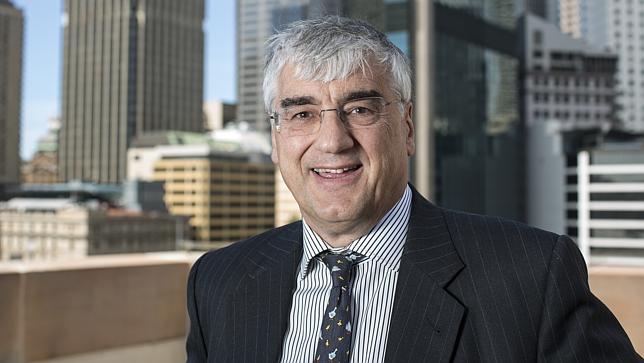
“The days when there was an arbitrage in saying, ‘Don’t worry I’ll buy you a meal when I come to Australia and you buy me one when you come to London.’ It’s gone the other way around,” says billionaire Michael Hintze.  Photo: Angus Mordant

JONATHAN SHAPIRO, PETER WELLS AND PHILIP BAKER

Australia is expensive even for a billionaire. Michael Hintze, Australia’s wealthiest and most successful financial markets export with an estimated personal fortune of $US1.6 billion, says coming home from his hedge fund’s London base is not as cheap as it used to be.

“The days when there was an arbitrage in saying, ‘Don’t worry I’ll buy you a meal when I come to Australia and you buy me one when you come to London.’ It’s gone the other way around,” says Hintze, the founder of the $US11.5 billion hedge fund CQS and a well known donor to the UK’s Conservative Party.

With the British pound at a 28-year low against the Australian dollar, British tourists and returning hedge fund titans are clearly feeling the pinch. “The Australian dollar certainly feels fully valued,” says Hintze, who owns farmland in Australia. “I wish the dollar were lower as it would be easier in farming.” Read more of this post

World With More Phones Than Toilets Shows Water Challenge

World With More Phones Than Toilets Shows Water Challenge

There are more mobile phones on Earth than clean toilets, one of the most vexing challenges facing governments on the 20th anniversary of the United Nations’ World Water Day.

Solving that developmental dilemma has so far confounded leaders, some of whom will meet today in The Hague to discuss water cooperation. There are 6 billion mobile phones, according to the International Telecommunication Union, while 1.2 billion of the planet’s 7 billion people lack clean drinking water and 2.4 billion aren’t connected to wastewater systems. Read more of this post

Hong Kong Homes Face 20% Price Drop as Banks Raise Rates; Midland, the city’s biggest publicly traded realtor, predicted as many as a third of real estate agent branches in Hong Kong will close. Cheung Kong Says Hong Kong Property to Slow on Mortgage Costs

Hong Kong Homes Face 20% Price Drop as Banks Raise Rates

By Stephanie Tong and Kelvin Wong – Mar 22, 2013

Hong Kong officials, who have struggled in vain for three years to slow the growth in home prices, are about to get their wish as the city’s biggest banks raise mortgage rates.

Prices could fall as much as 20 percent over the next two years, according to Deutsche Bank AG, after lenders including HSBC Holdings Plc, Hong Kong’s biggest by assets, and Standard Chartered Plc raise their home loan rates by 25 basis points in response to tighter risk rules.

Hong Kong dollar’s peg to the U.S. currency has kept interest rates in the city at near record lows, underpinning a more than 110 percent gain in home prices since the beginning of 2009 to the most expensive among major global cities. Low mortgage costs, coupled with a property buying spree driven by Chinese from the mainland, have seen home prices shrug off repeated attempts by the government since 2010 to stymie escalating housing values amid an outcry over affordability.

“You have this pile of measures plus higher interest rates; this will be a big challenge for the market,” said Buggle Lau, chief analyst at Midland Holdings Ltd. (1200), the city’s biggest publicly traded realtor, which predicted as many as a third of real estate agent branches in Hong Kong will close. Read more of this post

Exorbitant property prices reported in Beijing university district at a record 100,000 yuan (US$16,000) per square metre; neighbourhood labeled as “the centre of the universe”.

Exorbitant property prices reported in Beijing university district

Thursday, 21 March, 2013, 5:24pm

Ernest Kao ernest.kao@scmp.com

Property prices in Beijing’s secondary market have come under scrutiny once again after a tiny apartment in a university district recently listed a sell price of 3.5 million yuan (HK$4.4 million) – close to the very high levels in Hong Kong.

The price of the 37-square-metre (400 sq ft), one-bedroom flat located in the city’s northwest Wudaokou neighbourhood, hit a record 100,000 yuan per square metre, Xinhua reported [1] on Wednesday. Read more of this post

First Financial News looks at the the “empty city” that is Tianjin’s Xiang Luo Wan Central Business District in Binhai New Area 房企主动停工?天津响螺湾暂成“空城”

房企主动停工?天津响螺湾暂成“空城”

作者 蔡胤

来源 第一财经日报

时间 : 2013-03-22 01:39

9600259cfbe22a8938a303ddb12d23bfimages (2)

这一区域长期来看还是能发展起来的,只是浦东当时的发展用了多久,这里也需要多久,关键看当地政府的决心。 Read more of this post

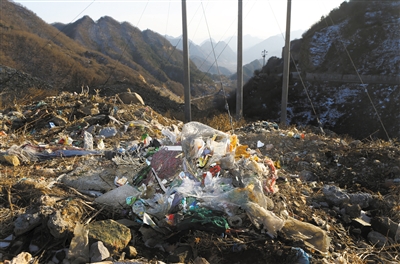
Hebei “trash mountain” that threatens part of Beijing’s water supply 河北兴隆20年堆出2.3万米平垃圾山 威胁北京水源

河北兴隆20年堆出2.3万米平垃圾山 威胁北京水源(图)

2013年03月22日 02:29
来源:新京报

7d2b5a4f2a7b4197ad673e6322045b44

2月21日,河北兴隆县青松岭上的垃圾山,虽然被黄土掩埋,仍可见大片生活垃圾。新京报记者尹亚飞摄 Read more of this post

L’Oreal Eats Into P&G’s China Lead With Mushroom Lotions

L’Oreal Eats Into P&G’s China Lead With Mushroom Lotions

At L’Oreal SA (OR) (OR)’s Shanghai research center, more than 260 scientists working with skin cells and test tubes tailor products from lipsticks to shampoos for Chinese shoppers.

This year’s offerings: a cosmetic balm for Chinese men looking to mask face blemishes, and skin serums made from white fungus, ginseng, and cordyceps — a type of parasitic mushroom widely used as a herbal remedy.

The world’s largest cosmetics maker is launching the new products to whittle away at Procter & Gamble Co (PG).’s lead in China’s market for beauty and personal care products, estimated to reach $34 billion this year by Euromonitor. To gain an edge over its Cincinatti competitor, L’Oreal is counting on lotions using traditional medical ingredients and offerings targeted at Chinese men, among the fastest growing sections of the market.

The strategy will help the Paris-based firm boost China sales more than 10 percent in 2013 from 12.05 billion yuan ($1.9 billion) last year, China Chief Executive Officer Alexis Perakis-Valat, predicted in an interview. The new products will be unveiled later this year.

“L’Oreal has become a formidable competitor for Procter & Gamble (PG) in skin care,” Oru Mohiuddin, a senior analyst in London at researcher Euromonitor International, said in an e-mail. “Not just has L’Oreal approached China from various angles, including pricing and retail coverage, it also strived to make the brands more customized and effective.” Read more of this post

Lies, Damned Lies, and Chinese Statistics; Who’s cooking Beijing’s books? Ingrained belief that boosting morale through exaggerated claims was more important than reporting reality

Lies, Damned Lies, and Chinese Statistics

Who’s cooking Beijing’s books?

BY TOM ORLIK | MARCH 20, 2013

On Wednesday, U.S. Treasury Secretary Jack Lew met with China’s Premier Li Keqiang, a crucial first meeting between new representatives of the world’s two biggest economic powers. Lew’s interlocutor sits at the top of the world’s second-largest economy — a country whose GDP reachedapproximately $8.3 trillion in 2012. But how accurate are the statistics that illuminate China’s growth? Even Li himself has said (as quoted in a U.S. State Department cable published by WikiLeaks) that China’s GDP figures are “man-made” and therefore unreliable. In this excerpt from his book, Understanding China’s Economic Indicators, Wall Street Journal China reporter Tom Orlik explains how to get to grips with China’s data. Read more of this post

What Should China Do with 18 Mln Pigs Carcasses Every Year?

03.21.2013 19:40

Closer Look: What Should China Do with 18 Mln Pigs Carcasses Every Year?

The appearance of thousands of carcasses in a Shanghai river shows how much work the government has to do on a major public health issue

By staff reporter Gong Jing

More than 10,000 dead pigs have been pulled out of a Shanghai river that provides drinking water to 23 million people over two weeks, raising health concerns. Even worse, there have been reports that many dead pigs were processed and sent to people’s dining tables.

Behind all of this is the issue of disposing of pigs that dies from disease, an area that regulators have long neglected.

Yu Kangzhen, an expert from the Ministry of Agriculture, said that an investigation has not found an epidemic at farms in Jiaxing, a city in Zhejiang Province believed to be the source of the animals found in Shanghai’s Huangpu River.

Information from other sources backs Yu. There has been no significant rise in pig deaths in Jiaxing this year. As a major pig farming city, Jiaxing raised about 4 million of the animals every year. If a normal death rate from disease is used, about 3 percent, this means the city has to handle about 120,000 dead pigs per year.

China raises more pigs than any other country in the world. Rough statistics show that it had nearly 700 million pigs in 2012. That means, about 18 million pigs died of disease every year.

How does China handle such a large number? The ministry says pigs that die from disease are usually buried or burned. But in reality, many farmers illegally sell them or simply dump the carcasses. Read more of this post