China’s Tallest Tower Builder Assures Quality Amid Sand Scandal

China’s Tallest Tower Builder Assures Quality Amid Sand Scandal

China State Construction Engineering Corp. (601668), which is building the country’s tallest tower, said materials used in all its projects meet quality standard as the southern city of Shenzhen conducted inspections on builders.

Samples from buildings, including the 660-meter Ping An Finance Center due to be completed in 2015, were tested, according to Shenzhen’s Housing and Construction Bureau. The industrywide inspection in the city last week followed a China Central Television newscast on March 14 that investigated the use of substandard concrete by some developers in Shenzhen that used low-quality sea sand instead of river sand. Read more of this post

Singapore’s property trusts, the second-best performers in Asia in the past year, may have to diversify funding sources as they aren’t prepared for an “interest rate shock,” according to Fitch Ratings.

Singapore REITs to Vary Funds on Interest Rates: Southeast Asia

Singapore’s property trusts, the second-best performers in Asia in the past year, may have to diversify funding sources as they aren’t prepared for an “interest rate shock,” according to Fitch Ratings.

The city’s real estate investment trusts or REITs have been increasing short-term debt with record-low interest rates, according to Johann Kenny, director of corporates at Fitch. They face refinancing risks when borrowing costs rise, and may be pushed to sell assets or shares to boost their funding, he said.

“Singapore REITs are not really well equipped to withstand an interest rate shock,” Kenny said in a phone interview from Sydney yesterday. “When a rating agency looks at a company, we look at the long-run average through the cycle of the interest rate environment and we don’t see the current low interest rates as a sustainable model from a macro-economic perspective.”

Singapore REITs, the biggest fundraisers in the city’s initial public offering market in the past year, had relied on short-term debt to reflect the length of commercial leases, Kenny said. Their funding costs in the past six years don’t reflect the challenges in a “normalized” interest rate scenario, he said. Read more of this post

Indian gold funds are shrinking as investors in the biggest bullion- consuming nation follow billionaire George Soros in pulling money from products backed by the precious metal.

India Gold ETF Sales Mimic Soros as Goldman More Bearish

Indian gold funds are shrinking for the first time since June as investors in the biggest bullion- consuming nation follow billionaire George Soros in pulling money from products backed by the precious metal.

Exchange-traded funds in gold saw outflows of 80 million rupees ($1.5 million), data from the Association of Mutual Funds in India show. Investments in sovereign-debt funds rose by 4.46 billion rupees, the sixth straight month of inflows. Gold prices in India have slid 4.3 percent this year, while rupee bonds returned 2.7 percent, the second-highest gains in Asia.

“Globally we are seeing a decelerating gold trend, and overweight investors will be adjusting asset allocations,” Lakshmi Iyer, Mumbai-based head of fixed income and products at Kotak Mahindra Asset Management Co., which oversees about $6 billion of assets, said in a March 14 telephone interview. “We should see some interest-rate easing over the next two or three quarters,” encouraging people to seek capital gains in bonds, she added.

Soros cut his holdings in SPDR Gold Trust, the largest exchange-traded gold product, by 55 percent last quarter, and Goldman Sachs Group Inc. predicts the metal’s 12-year rally will end as a U.S. economic recovery gathers momentum. The Reserve Bank of India will lower its benchmark repurchase rate to 7.50 percent from 7.75 percent today, according to 30 of 35 economists in a Bloomberg survey. Five predict no change. Read more of this post

Drug-Resistant Tuberculosis Spreads as $1.6 Billion Needed

Drug-Resistant Tuberculosis Spreads as $1.6 Billion Needed

Low and middle-income countries need an additional $1.6 billion a year to fight tuberculosis, threatening progress made against the world’s second-deadliest infectious disease, health officials said.

About $3.2 billion will be spent annually through 2016 combating the disease in 118 such nations and $4.8 billion is needed, the World Health Organization and the Global Fund to Fight AIDS, Tuberculosis and Malaria said in a joint statement today. The additional funds may enable treatment for 17 million people and save 6 million lives from 2014 to 2016, they said.

Tuberculosis killed 1.4 million people in 2011, the two Geneva-based organizations said. Among infectious diseases, only AIDS killed more. While TB can be cured with antibiotics, strains of the bacterium that resist most drugs afflict about 630,000 people globally, threatening to undermine a target of halving the TB death rate between 1990 and 2015.

“If we don’t act now, our costs could skyrocket,” Mark Dybul, the Global Fund’s executive director, said in the statement. “It is invest now or pay forever.” Read more of this post

Delhi needs to sell the idea of the market; Indians say their country ‘grows at night while the government sleeps’, writes Gurcharan Das

March 18, 2013 7:01 pm

Delhi needs to sell the idea of the market

By Gurcharan Das

Indians say their country ‘grows at night while the government sleeps’, writes Gurcharan Das

When the Indian government presented its budget last month, the people were expecting giveaways, subsidies and bribes for votes. But it turned out to be a surprisingly responsible settlement that capped the fiscal deficit at 4.8 per cent of economic output. It was a sensible budget, but it will not get India growing again.

Meanwhile, the day before the budget, Sugata Mitra, a researcher at Newcastle University, won the TED (Technology, Entertainment and Design conference) prize of $1m to run Schools in the Cloud from India. The scheme aims to empower teachers and parents towards self-directed learning by children.

To Indians, the contrast between the budget and the prize confirms their perception of the country’s “bottom-up” success, driven by people, in contrast to China’s “top-down” success, induced by state investment. Prosperity is spreading, despite appalling governance in the world’s biggest democracy. Read more of this post

As Crop Prices Surge, Investment Firms and Farmers Vie for Land

March 18, 2013

As Crop Prices Surge, Investment Firms and Farmers Vie for Land

By JULIE CRESWELL

From the potato fields of Michigan to the high prairies of Kansas, farmers are receiving record prices for their land — but economists and banking regulators warn that this boom, like so many before it, could end badly.

Across the American heartland, farmland prices are soaring. In places like Waco, Neb., and Chickasaw County, Iowa, where the boom-and-bust cycle of farming reaches deep into the psyche, some families are selling the land that they have worked for generations, to cash in while they can.

Behind the rush is the age-old driver of farm booms: high crop prices. Corn, in particular, has been soaring, reflecting demand overseas and, domestically, for ethanol. High prices mean good profits for farmers, and many are using their growing incomes to bid for land. Sensing opportunity, investment firms are buying, too. David Taylor, of Oskaloosa, Kan., said he was saddened to sell his family’s farm but that the prices were too good to resist. Four generations had planted corn and soybeans on the 146-acre spread. But after living through the Midwest farm crisis of the 1980s, when land values plunged, and realizing that his children would not follow in his footsteps, he sold the farm at auction in December.

“I bawled like a baby,” Mr. Taylor, 59, said. His crop-producing fields sold for $10,100 an acre. Read more of this post

Economists: China Mirrors U.S. on Eve of Financial Crisis

March 18, 2013, 5:20 PM

Economists: China Mirrors U.S. on Eve of Financial Crisis

The same three warning lights that preceded America’s real estate crash and financial crisis are now flashing over China, two economists say, leaving the government limited time to get out of trouble.

In a research note published on Saturday, Nomura economists Zhiwei Zhang and Wendy Chen outline the way that elevated property prices, a rapid build-up of leverage and a slide in the country’s potential growth rate could lead to a systemic crisis.

House prices in the U.S. racked up an 84% rise between 2001 and 2006, Mr. Zhang and Ms. Chen say, citing the Case-Shiller housing price index. The Nomura economists have their doubts about China’s official index, which shows a “rather benign” 113% rise in the major cities from 2004 to 2012. They argue that it is too broad, including older, lower-quality property across the nation. By contrast, a recent academic paper taking into account these quality differentials found prices climbed 250% from 2004 to 2009, they say.

“The government obviously recognizes the risks in the property sector,” Mr. Zhang and Ms. Chen write. “It has introduced a series of progressively tighter policies to contain property prices over the past several years… The pattern has been for house prices to initially dip after tightening policies are introduced, then to rebound, which suggests that the risks have not been mitigated.” Read more of this post

Magazine-Cover Curse Takes on New Meaning in Asia

Magazine-Cover Curse Takes on New Meaning in Asia

Will Shinzo Abe’s plan to revive Japan suffer the magazine-cover curse? Might Benigno Aquino meet the same fate in the Philippines?

What both leaders have in common is everyone slapping the “-nomics” suffix onto their growth strategies. “Abenomics” has excited investors, not to mention the pundit class, with its aim of ending 15 years of deflation. The same is true of “Aquinomics” in a country long deemed the sick man of Asia, now an investment darling.

Such bouts of euphoria often end in tears: “Reaganomics,” “Rubinomics” and “Bushonomics” in the U.S.; “Thatchernomics” in the U.K.; “Berlusconomics” in Italy; and “Thaksinomics” in Thailand. Sometimes the reckoning comes in short order; other times it takes decades. The track records of all too many of these supposedly new formulas for prosperity are questionable.

The problem is hype versus real change. Having one of these splashy appendages added to your ideas tends to have the same reverse karma payoff as being on the cover of a large- circulation magazine. By the time a trend or ideology is popular enough to warrant such a tribute, the game is already up. So, is the buzz about the Japanese and Philippine economies overdone? It will be if leaders put too much stock in their own press. Read more of this post

Pimco’s Kiesel Says Corporate Bondholders ‘Wake Up’ to Risks

Pimco’s Kiesel Says Corporate Bondholders ‘Wake Up’ to Risks

Investors are “finally” acknowledging the risks of holding corporate bonds with yields hovering at about record lows as the Federal Reserve holds benchmark interest rates at close to zero for a fifth year, according to Pacific Investment Management Co.

“Bondholders are finally starting to wake up to the fact that easy monetary policy for an extended period can also have adverse consequences,” Mark Kiesel, global head of corporate bond portfolios at the manager of the world’s biggest bond fund, wrote today on the firm’s website. “This trend has helped reignite shareholder activism and corporate animal spirits.” Read more of this post

Ex-Calpers CEO Buenrostro Indicted Over Apollo Investment

Ex-Calpers CEO Buenrostro Indicted Over Apollo Investment

Ex-California Public Employees’ Retirement System Chief Executive Officer Federico Buenrostro was charged with conspiring to trick the pension fund into paying millions of dollars in fees for a $3 billion investment into funds managed by Apollo Global Management LLC. (APO) Read more of this post

Iceland’s Lost Billionaires Unmourned as Riches Draw Ire; “Greed can’t again lead the way,” said Prime Minister Johanna Sigurdardottir. “We’ve taken that route before with terrible consequences for this nation and its people.”

Iceland’s Lost Billionaires Unmourned as Riches Draw Ire

Iceland, a country with a $13 billion economy, had six dollar billionaires before the financial crisis struck in 2008. Now it has none.

Five of the men — including former West Ham soccer team owner Bjorgolfur Gudmundsson and Baugur Group hf founder Jon Asgeir Johannesson — have lost all, or most of, their fortunes after building empires on loans from banks that used the island’s investment bubble to stretch their assets to 10 times the size of gross domestic product.

At least three of Iceland’s ex-billionaires are, or have been, the subject of financial misconduct probes. Johannesson, who once flew around in a pin-striped private jet and owned luxury apartments in New York and London, received a suspended one-year jail sentence in February for violations including accounting fraud. He and Gudmundsson, who filed for bankruptcy in 2009, personified the boom-to-bust cycle that dragged Iceland away from fishing and tourism and turned it into a center for high finance.

“Greed can’t again lead the way,” said Prime Minister Johanna Sigurdardottir, 70, whose Social Democrat-led government took over from the coalition that led Iceland into the crisis just over four years ago. “We’ve taken that route before with terrible consequences for this nation and its people.” Read more of this post

Traders Short Junk-Bond ETFs as Gains Top 100%: Credit Markets

Traders Short Junk-Bond ETFs as Gains Top 100%: Credit Markets

Wall Street’s biggest credit brokers are for the first time using exchange-traded funds as a way to wager that junk bonds are overvalued.

Bank of America Corp. (BAC) traders who helped dealers move $1.5 trillion of credit-default swaps index contracts last year began offering clients the ability to trade blocks of bond ETF (HYG) shares in February, according to three people familiar with the trading and an e-mail sent to customers. Shares borrowed to make bearish bets on State Street Corp. (STT)’s $12 billion speculative-grade bond ETF soared to a record 11.5 percent of the total outstanding on March 1, up from 4 percent at year-end. Read more of this post

Sweden Laments ‘Crazy’ Devaluations Amid Krona Strength

Sweden Laments ‘Crazy’ Devaluations Amid Krona Strength

Sweden took another step to distance itself from policies targeting competitive devaluations as exporters were told a strong krona provides opportunities to make their businesses more efficient.

“It’s good for companies that they need to understand that they have to compete with real tools rather than the imaginary tool that the exchange rate is,” Financial Markets Minister Peter Norman said in a March 15 interview in the Swedish town of Karlstad, where his Moderate Party laid out the foundations for its 2014 election campaign.

While Swedish exporters have warned that continued krona appreciation will force them to cut jobs, the government and central bank have repeatedly rejected talk of boosting trade competitiveness through the exchange rate. And while policy makers from France to Japan argue in favor of weaker currencies, the Swedes have praised their krona’s strength. Central bank governor Stefan Ingves in an interview last month said he was “happy” with the currency’s gains.

Sweden didn’t always have such a hands-off approach. Between 1976 and 1981, when the krona was linked to the Deutschmark and later to a basket of currencies dominated by the U.S. dollar, it was devalued four times. In 1982, its value was again cut, by 16 percent. After the Riksbank was unable to defend the fixed exchange rate inside the European Exchange Rate Mechanism — even resorting to a 500 percent marginal interest rate in 1992 — the peg was scrapped and a free float was introduced. Read more of this post

China’s Largest Mass Merchant Auchan/RT-Mart Turns to Its Own Brands for Growth

China’s Largest Mass Merchant Turns to Its Own Brands for Growth

Sun Art Retail Group Ltd. (6808), China’s largest operator of big-box stores, will boost its own brand offerings and add higher-margin items to increase sales after opening new stores helped raise 2012 profit by half.

The company’s RT-Mart and Auchan chains will add at least 700 more own-label products including stationary and cutlery this year and reduce local brands in favor of higher-end lines, Peter Huang, executive director, said in an interview. The retailer plans to boost own-brand sales to 10 percent of revenue in two years from 8 percent now, he said.

Huang’s shift to higher-end products is intended to help the Shanghai-based venture between Taiwan’s RT-Mart and France’s Groupe Auchan SA maintain its lead over Wal Mart Stores Inc. (WMT) and Carrefour SA (CA), its biggest rivals. Retailers can earn gross profit margins of between 10 percent to 25 percent on own branded non-food items, said Nice Wang, an analyst with Yuanta Securities HK Co. Read more of this post

Big Mac Fights Subway Shrimp in Russia Fast-Food Fracas

Big Mac Fights Subway Shrimp in Russia Fast-Food Fracas

More than two decades after McDonald’s Corp. (MCD)’s outlet on Moscow’s Pushkin Square began offering a golden-arched alternative to grey communist eateries, the fast-food pioneer is on the defensive.

McDonald’s, which virtually created the market for burgers and fries in the country and convinced Russians it’s okay to eat with their hands, must fend off a growing challenge from rivals Burger King Worldwide Inc. (BKW), Subway Restaurants, Yum! Brands Inc. (YUM) and Wendy’s Co. (WEN)

“A huge number of Subways have appeared in Moscow in recent years, I pass about five of them on my way home,” said Dmitry Mikhailov, a 30-year-old consultant. McDonald’s “is crowded — it’s just for pigging out quickly and running away.” Read more of this post

Malls must move beyond shopping to survive in Internet era; Malls must become more like full-service community centers to survive in the face of a growing list of failed retailers like HMV and Blockbuster

Malls must move beyond shopping to survive in Internet era

10:13am EDT

By Tom Bill

CANNES, France (Reuters) – As growing numbers of shoppers move online, European mall owners are looking to pull in customers by including services that can’t be replicated on the Web like hospital care and government offices.

Malls must become more like full-service community centers to survive in the face of a growing list of failed retailers like HMV and Blockbuster, property experts at the annual MIPIM trade fair in Cannes, France, told Reuters.

On the flip side of that retail revolution, the experts see big gains in warehousing as more goods are sent and returned via post.

“The days of the stand-alone mall are numbered,” said David Roberts, the chief executive of architect Aedas, one of the five largest practices in the world. The company has been involved in city masterplan projects in Asia, Europe and the Middle East.

“In 20 years time you will find stores that sell books and DVDs replaced by sites that give people a reason to go the mall … art galleries, education centers and health and spa treatments.” Read more of this post

Moody’s Investor Services said China’s local-government financing vehicles face greater risk of default, as regulators warn 20 percent of their loans are risky.

Moody’s Sees Defaults as PBOC Warns on Local Risks

Moody’s Investor Services said China’s local-government financing vehicles face greater risk of default, as regulators warn 20 percent of their loans are risky.

A rally in LGFV bonds may reverse, particularly should delinqencies emerge, Christine Kuo, a Moody’s analyst, wrote in an e-mailed response to questions on March 8. The average yield may rise to 7 percent by June from 6 percent now, according to Shenyin & Wanguo Securities Co., the first brokerage incorporated in China and ranked the nation’s most influential research provider by New Fortune magazine in 2010.

“I see increased risk of LGFV defaults because the financial profiles of many remain weak and heavy refinancing is needed,” Hong Kong-based Kuo said. “Regulators have asked banks to control their LGFV exposures. Some of the projects could default unless other sources of funds are found.”

People’s Bank of China Governor Zhou Xiaochuan said in a March 13 press briefing that about one-fifth of loans to the financing arms of local governments are risky. Net debt issuance by these entities surged 179 percent in 2012 to 1.132 trillion yuan ($182 billion), accounting for 50 percent of corporate bond sales, according to Bank of America Corp. data. Read more of this post

Where ‘Channel-Stuffed’ German Cars Go To Die

Where ‘Channel-Stuffed’ German Cars Go To Die

Tyler Durden on 03/17/2013 21:57 -0400

With the collapse of Europe’s auto market, and the channel-stuffing that is rife in every car manufacturer in the world, it is no surprise that at the end of their brief lease periods, European cars (Audi in this case) are being led to this ‘graveyard’ in Germany (70 miles north of Munich). This car park of chaos is full of nearly-new cars meant for destruction so as never to enter the car market as a cheap alternative and to maintain a high-priced spare parts market. It seems the Keynesian profligacy or digging a hole to fill it in has progressed in the 21st century to building a car and crushing that car as the engine of growth for our economies. The site can be found here…

20130317_audi_0

Chinese Kids Who Ignore Confucius Face State Backlash

Chinese Kids Who Ignore Confucius Face State Backlash

By Bloomberg News – Mar 17, 2013

In 10 years as head of an elder- care center in Confucius’s hometown of Qufu, Yang Youling has seen the Chinese philosopher’s exhortation of filial piety turned on its head.

Many children never visit their aged parents in the 50-bed home in eastern China’s Shandong province to avoid being criticized for not taking care of them at home, said Yang, 47. “The children are ashamed of being seen,” she said.

They may soon have no choice. From July 1, parents in China can sue their kids who don’t visit often enough, under a broadened law mandating children take better care of the aged. With China’s elderly population forecast to more than double to 487 million in the next 40 years, the government needs to try and limit the cost of caring for seniors.

“China’s aging problem is at a scale and speed not comparable with anywhere else in the world,” said Yuan Xin, director of Nankai University’s Aging Development Strategy Research Center in Tianjin, and a member of an advisory committee on the new rule. “My concern is how we can have sustainable economic development” while maintaining Confucian values such as respect and care for one’s parents, he said.

Traditionally, children lived with their parents and looked after them in accordance with Confucian beliefs. The ancient Chinese philosopher emphasized filial piety as the foundation of all values and placed great importance on harmony and a proper order of social relationships especially within families. Read more of this post

Twitter Just Crushed Wall Street After The Cyprus Bailout

Twitter Just Crushed Wall Street After The Cyprus Bailout

Joe Weisenthal | Mar. 17, 2013, 3:32 PM | 20,602 | 24

twitter-8

This process has been happening for a long time, but for those in finance, the value of Twitter is increasingly equaling or surpassing the value of traditional sell-side research from Wall Street analysts.

This weekend’s surprise bailout of Cyprus (surprise, because of the fact that depositors in Cypriot banks are seeing a ‘one-off’ tax) is a major moment in the evolution of financial information.

Because the news was so surprising, and because there’s so little time between when the bailout was announced early Saturday morning, and when trading begins Sunday evening, there’s been an aggressive thirst for information and analysis on what it all means.

But the sell-side has been fairly slow, and the Twittersphere has come to the rescue. Read more of this post

Burmese startups have both foreign competitors and local cronies to contend with

Burmese startups have both foreign competitors and local cronies to contend with

By Sam Petulla — 7 hours ago

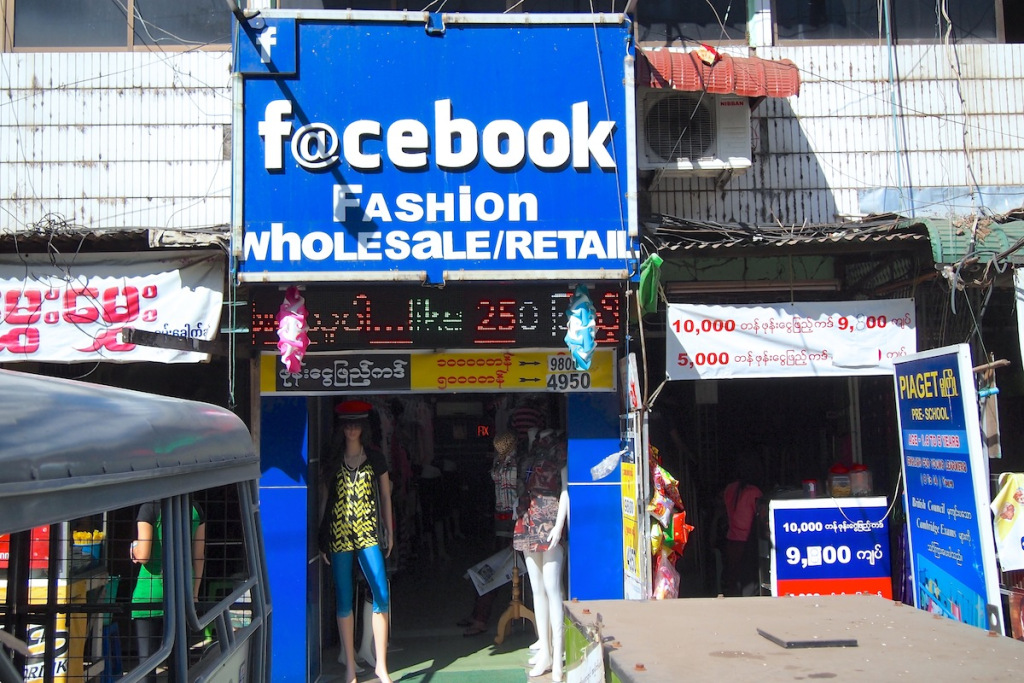
facebook-shop-myanmar

Doesn’t matter what it sells—just call it Facebook.Sam Petulla

YANGON— To hear him talk, Thiha Aye Kyaw sounds pretty much like an ambitious young entrepreneur anywhere on the planet. The 20-year-old computer science student has already built an app that makes him about as much money as a full-time software engineer. Businesses seek him out, and he no plans to join a large IT company after he graduates. He and his friends “don’t want to get the salary and work under other people.”

Except that Thiha lives in Myanmar, which makes realizing his entrepreneurial dreams a little more complicated.

With Google’s chairman, Eric Schmidt, visiting Myanmar this week, there’s a lot of attention on the country’s untapped potential for investment, especially in technology and communications. Myanmar is implementing a new foreign investment law and plans to dramatically increase internet and mobile connectivity from its current levels of less than 10%. In January it hosted Barcamp Yangon, the country’s largest tech conference, attended by an estimated 6,000 people, where Thiha rubbed shoulders with entrepreneurs and digital activists from all over the planet; there were also a few of Schmidt’s colleagues from Google.

But Burmese startups have to contend both with foreign companies that are much better financed and more experienced, and with powerful local businessmen with ties to the regime. Read more of this post

There are fresh allegations that some of the money that went missing from a Chinese company once listed on the Nasdaq may have been laundered through slot machines in Las Vegas casinos

More on the Chinese missing millions that may have been laundered through Las Vegas

By Naomi Rovnick — 2 hours ago

There are fresh allegations that some of the money that went missing from a Chinese company once listed on the Nasdaq may have been laundered through slot machines in Las Vegas casinos.

As we reported in December, medical equipment maker China Medical Technologies was listed on the Nasdaq from 2005 until February last year, and had the bluest of blue-chip advisers, underwriters, investors and creditors. It was wound up last July after missing interest payments. According to court filings since our last report, the company’s liquidators now claim that $670 million of cash the company raised in its 2005 IPO and subsequent equity and bond sales cannot be located, upping their estimate from a previous $400 million. Read more of this post

‘Wash Trades’ Scrutinized; U.S. regulators are investigating whether high-frequency traders are routinely distorting stock and futures markets by illegally acting as buyer and seller in the same transactions

Updated March 17, 2013, 9:42 p.m. ET

‘Wash Trades’ Scrutinized

Issue Is Whether High-Speed Firms Illegally Buy, Sell Futures in Same Deals

By SCOTT PATTERSON, JENNY STRASBURG and JAMILA TRINDLE

MI-BU744B_WASHT_G_20130317201803

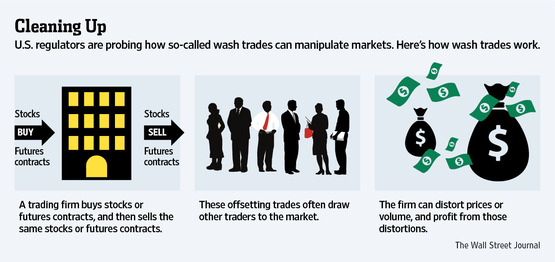
U.S. regulators are investigating whether high-frequency traders are routinely distorting stock and futures markets by illegally acting as buyer and seller in the same transactions, according to people familiar with the probes.

Such transactions, known as wash trades, are banned by U.S. law because they can feed false information into the market and be used to manipulate prices. Intentionally taking both sides of a trade can minimize financial risk for the trading firm while potentially creating a false impression of higher volume in the market.

The Commodity Futures Trading Commission is focused on suspected wash trades by high-speed firms in futures contracts tied to the value of crude oil, precious metals, agricultural commodities and the Standard & Poor’s 500-stock index, among other underlying instruments, the people said.

The agency is looking at potential wash trades by multiple high-speed firms, although it isn’t known which ones investigators are scrutinizing. Firms found guilty of intentionally distorting the market through wash trades could face hefty fines. Read more of this post

Philippines Bets Big on Casinos; Manila Wants to Be as Big as Vegas

Updated March 17, 2013, 6:27 p.m. ET

Philippines Bets Big on Casinos

New $1.2 Billion Solaire Resort Opens, Raising Asian Pressure on U.S. Gambling Industry

By KATE O’KEEFFE

MANILA—The Philippines this weekend launched its bid to become Asia’s third gambling hub with the opening of a $1.2 billion casino, as the region battles the U.S. for supremacy in the global gambling market.

In China, Macau’s $38 billion gambling industry already generates six times the revenue of the Las Vegas Strip. In Southeast Asia, Singapore’s gambling revenue matched that of the U.S. casino capital within a year of the island opening its first resorts in 2010. Now Manila is gunning for Vegas, too. Read more of this post

Canberra Wasn’t Built in a Day; Australia’s capital city celebrated its 100th anniversary this week

Canberra Wasn’t Built in a Day
Catriona Richards | March 17, 2013

20130317110418156

A couple admires the National Library of Australia, lit with colorful light projections as part of the Enlighten festival to celebrate Canberra\’s 100th anniversary. (JG Photo/Catriona Richards)

On the site of a former sheep station not so far from here, Australia’s capital city celebrated its 100th anniversary this week.

Canberra, the seat of Australia’s parliament and home to more than 370,000 people, is one of a handful of cities around the world that was built with the express purpose of serving as a nation’s administrative capital.

Before there was Naypyidaw in Myanmar or Putrajaya in Malaysia, the newly federated nation of Australia began to lay foundations for the city it believed would not only house its parliament, but also express the character of its people.

One hundred years on and deriding the sparsely populated, bureaucratic city has become a national sport — so much so that the phrase “Canberra bashing” entered Oxford’s Australian National Dictionary just weeks ahead of the city’s centenary celebrations.

Indonesia has long toyed with the idea of relocating its administrative capital away from the crowds and infrastructure problems of Jakarta.

The issue most recently came to the fore when floodwaters inundated the central business district in January, killing dozens of people and spilling embarrassingly into the grounds of the presidential palace.

But the experience of Indonesia’s neighbor to the south shows that building a capital city from scratch and finding acceptance from the people it seeks to represent is no easy feat.  Read more of this post

Thailand: The government’s rice pledging scheme appears to have created a new worry for consumers. Many people now wonder if is it safe to eat rice that has been kept in warehouses for years; Doctor warns against eating mouldy grains

How safe is our rice?

Doctor warns against eating mouldy grains

The government’s rice pledging scheme appears to have created a new worry for consumers.

Besides concerns over whether the government can manage its huge rice stockpile to prevent any severe impact on the country’s budget, many people now wonder if is it safe to eat rice that has been kept in warehouses for years.

Their worries will likely increase after Dr Banchob Junhasavasdikul questioned the quality of rice and whether it had become rotten and mouldy.

In an interview with Isranews, the founder of the Balavi Natural Medicine Center said he believes many consumers are eating fungal or mouldy rice that can be poisonous and increase the risk of cancer.

The pledging scheme has reduced the competitiveness of Thai rice exports, so the government is selling the grain locally at cheap prices, he said. Read more of this post

Pension and Investment Research Consultants, global independent research provider, disclosed that the British sizable banks have undisclosed losses of up to 31.8 bn pounds; HSBC tops list with 10.4 bn pounds in undisclosed losses

(5) HSBC:
Pension and Investment Research Consultants, global independent research provider, disclosed that the British sizable banks have undisclosed losses of up to 31.8 bn pounds. In particular, HSBC HOLDINGS (00005.HK) accounted for 10.4 bn pounds, topping the list
(5 HK) @ HK$130.9: market cap. US$200,315.1m, daily liquidity US$526.8m. Broker forecasts: 12 buys, 13 holds, 8 sells, 95.8x current year P/E, 0.7% yield.

British banks may have £30bn hidden losses

British banks may be harbouring a black hole of as much as £50bn in undeclared losses that do not show up in their accounts but hamper their efforts to lend, a shareholder group has warned.

By Louise Armitstead, Chief Business Correspondent

6:20AM GMT 12 Mar 2013

PIRC has calculated the amount of bad debts the banks may have to write off in coming years but have yet to subtract from profits, together with other items such as deferred bonuses not booked.

HSBC, which is the biggest bank by assets, was shown to have £10.4bn of hidden losses, the Royal Bank of Scotland has £9.4bn, and Barclays has £7.3bn. Lloyds Banking Group has £2.5bn and Standard Chartered £2.2bn. Together the undeclared losses total £31.8bn.

The research shows the distorting impact the accounting rules, which allow bad loans to remain hidden, have on bank results. PIRC applied old-style UK GAAP accounting rules, which applied for 100 years until 2005, to the figures released in the 2012 banks’ accounts. Read more of this post

Could The “Cyprus Fiasco” Occur In The United States? The bottom line is that the Rubicon has been crossed and deposits have now been forcefully confiscated

Could The “Cyprus Fiasco” Occur In The United States?

Tyler Durden on 03/17/2013 12:37 -0400

global write offs_0US Deposits_0

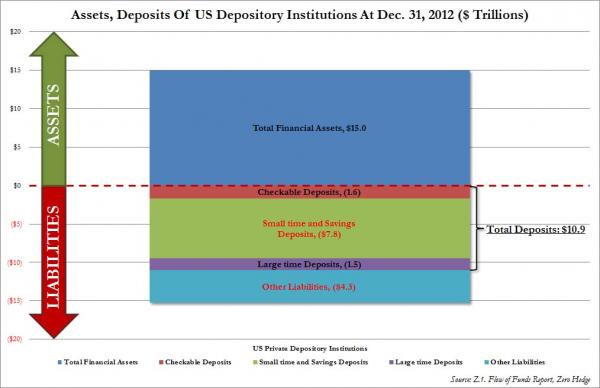
As has been assiduously explained by members of the European statist oligarchy, the reason for the deposit tax levy, in addition to the broader unsecured debt “bail-in” bailout of Cyprus, was due to the unique funding structure of Cypriot banks, in which the bulk of funding was in the form of deposits (whether Russian or domestic), leaving a tiny €2 billion in the form of junior bonds. Since the bailout would require realigning the balance sheet to a new, sustainable “fresh start” in which assets were remarked to a realistic value, it would mean impairing liabilities all the way down the capital structure. Naturally, politics played a big part in the decision to impair what Germany primarily saw as a Russian money-laundering haven, while local depositors were merely “collateral damage.”

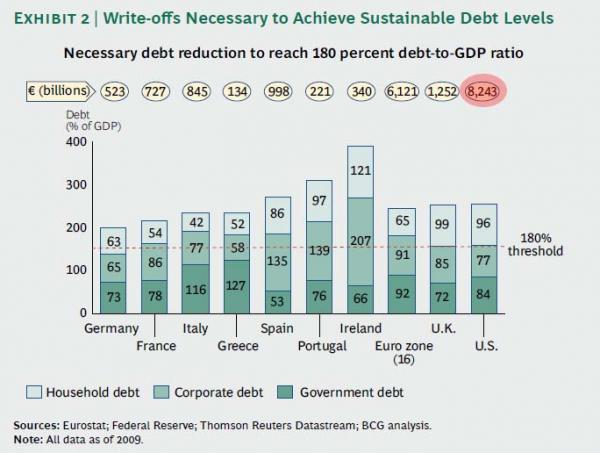
Politics aside, the bottom line is that the Rubicon has been crossed, and deposits have now been forcefully confiscated in what Europe promises to be a standalone case. What is certain, is that nobody will wait to find out how long it takes before Europe’s class of increasingly more desperate and ill-meaning despots is found to be have lied once more (as it has about everything else since the start of the European crisis). And while the mainstream media will be focused primarily on Europe in the coming days, as BCG and we have warned, the topic of “wealth taxation” is now front and center, and it stars not only Europe, but the US as well. Read more of this post

Europe Braces for Renewed Turmoil as Cyprus Deposit Levy at Risk; “Cyprus will turn into Libya”; The levy is “a worrying precedent with potentially systemic consequences if depositors in other periphery countries fear a similar treatment in the future”

Europe Braces for Renewed Turmoil as Cyprus Deposit Levy at Risk

Europe braced for renewed turmoil as outrage in Cyprus over an unprecedented levy on bank deposits threatened to derail the nation’s bailout and spark a new round in the debt crisis.

Cypriot President Nicos Anastasiades, who bowed to demands by euro-area finance ministers to raise 5.8 billion euros ($7.6 billion) by taking a piece of every bank account in Cyprus, delayed a parliamentary vote to pass the measure by a day. The European Central Bank pushed for a vote today, according to two people with knowledge of the discussions. Anastasiades plans to address the nation later today.

The levy is “a worrying precedent with potentially systemic consequences if depositors in other periphery countries fear a similar treatment in the future,” Joachim Fels, chief economist at Morgan Stanley in London, wrote in a note to clients.

Scenes of Cypriots lining up at cash machines raised the specter of capital flight elsewhere and threatened to disrupt a market calm that settled over the 17-member bloc since the ECB’s pledge in September to backstop troubled nations’ debt. With no government in Italy, Spain in the throes of a political scandal and Greece struggling to meet the terms of its own bailout, more turmoil could hamper efforts to end the crisis.

Anticipating gains in haven markets, Bill Gross, who runs the world’s biggest bond fund at Pacific Investment Management Co. in Newport Beach, California, said on Twitter that the concern in Cyprus “moves risk-on trade to backseat.”

“Sell euro as well,” he wrote. Read more of this post

Coffee’s Economics, Rewritten by Farmers; Some coffee farmers are taking control of more of the supply chain, roasting and marketing their own beans for greater profit

March 16, 2013

Coffee’s Economics, Rewritten by Farmers

By NICOLE LaPORTE

IN 2005, Kenneth Lander, a lawyer in Monroe, Ga., moved with his wife, stepdaughter and the youngest three of his seven children to a coffee farm in San Rafael de Abangares, Costa Rica. He always “had a heart,” he said, for Latin America, and after a vacation to the lush cloud forests near Monteverde in 2004, he was determined to return on a more permanent basis.

He was also looking for more balance in his work-driven life. And so, after buying a coffee farm from a farmer he’d met on his earlier trip, he packed up his life and moved.

“It was like Swiss Family Robinson,” Mr. Lander jokes. “We just left.”

In Costa Rica, Mr. Lander, who is now 46, didn’t have to worry about making money. He had received a cash windfall from selling a portion of a residential subdivision he had helped develop in Georgia; the plan was to keep selling more lots and live off the proceeds. So he grew coffee for fun.

Then, in 2008, the financial crisis hit. The value of his subdivision plummeted. Suddenly, he had to support himself as a coffee farmer. Very quickly, he realized how difficult that was going to be. He had just 12 acres that produced 6,000 pounds of specialty-grade coffee beans a year.

He belonged to a “fair trade” co-op, which guarantees farmers a minimum price, but was making only $1.30 a pound on coffee that retailed in the United States for $12 a pound. His net profit was so low that at one point he was down to $120 that had to last two weeks.

“I was at the register debating whether or not to buy shampoo or a bag of rice,” Mr. Lander recalls.

Why wasn’t he seeing more of that final price?

That question has been asked by farmers throughout history, particularly in developing countries, where growers of commodity crops like coffee and cocoa often live in poverty. Over the last few decades, a worldwide movement under the broad banner of fair trade has tried to rectify that imbalance.

In exchange for receiving “fair” prices for their products, fair trade farmers must adhere to environmental and labor standards set by certification groups, the largest of which is Fairtrade International, a nonprofit organization based in Bonn, Germany. It represents 1.24 million farmers and workers in industries including coffee, bananas and honey.

But Mr. Lander started to think that he might improve on the idea. He began to experiment. Using a roaster he had bought in better times, he started roasting his beans and selling them on Facebook to friends in the United States. He also opened a coffee shop, called the Common Cup, in Monteverde, and sold his coffee to tourists.

When he ran out of beans, he teamed up with two other area coffee farmers, Jorge Fonseca and Alejandro Garcia — who also had a coffee shop, the Colibri — and began shipping greater volumes. Suddenly, he was making money. Read more of this post