IMF Says EU Banks Face Further Losses

March 15, 2013, 12:18 p.m. ET

IMF Says EU Banks Face Further Losses

By PAUL HANNON

With anemic economic growth likely to lead to more losses on loans, risks to the financial stability of the European Union remain “elevated,” and urgent action is needed to adequately capitalize the bloc’s banks and establish a shared system for closing down or restructuring failing institutions, the International Monetary Fund said Friday.

In its first-ever review of the health of the financial system across all 27 EU members, the IMF said the bloc has made some progress in addressing the weaknesses that have exacerbated its fiscal crisis and stalled its economic recovery.

But it said much work remains to be done, with banks likely to face higher losses on loans to households and businesses to add to the losses they have suffered on their holdings of government bonds. The Fund added that low economic growth and low interest rates may also weaken insurance companies and pension funds.

“Risks remain elevated, especially in a context of low growth and fiscal retrenchment,” the IMF’s board of directors said. “Regulatory and policy uncertainty, and gaps in policy frameworks also continue to pose vulnerabilities. Further ambitious steps are thus necessary to rebuild confidence and achieve long-lasting financial stability in the region.” Read more of this post
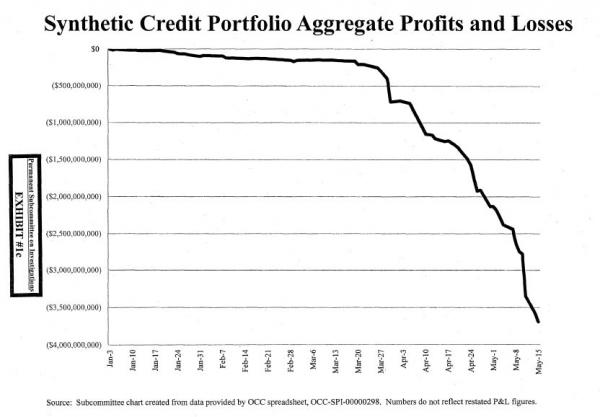
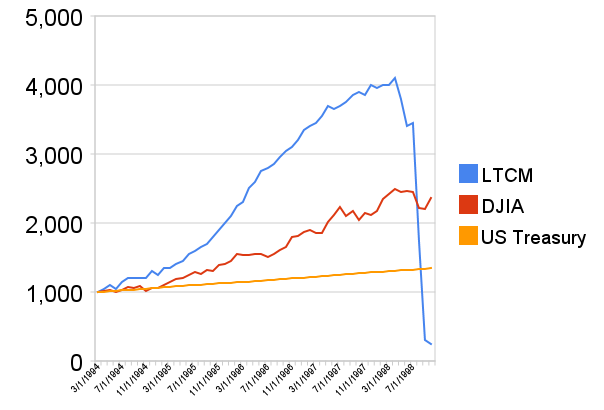
JPMorgan… Or Long-Term Capital Management?

JPMorgan… Or Long-Term Capital Management?

Tyler Durden on 03/15/2013 10:57 -0400

Compare and contrast to the performance of LTCM just before it had to be bailed out, ushering in the modern era of of Too Big To Fail.

CIO P&L_0LTCM P&L

Europe Does It Again: Cyprus Depositor Haircut “Bailout” Turns Into Saver “Panic”, Frozen Assets, Bank Runs, Broken ATMs, Bulldozer Parks Outside Bank; After Cyprus, Who Is Next?

Europe Does It Again: Cyprus Depositor Haircut “Bailout” Turns Into Saver “Panic”, Frozen Assets, Bank Runs, Broken ATMs

Tyler Durden on 03/16/2013 10:33 -0400

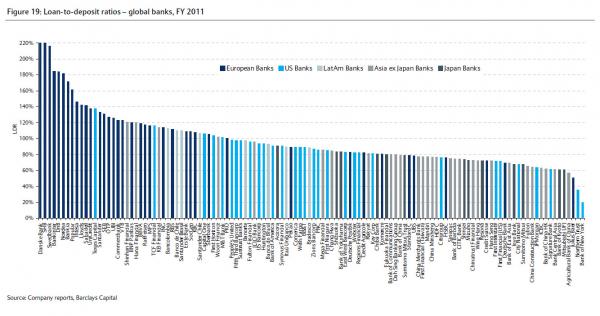
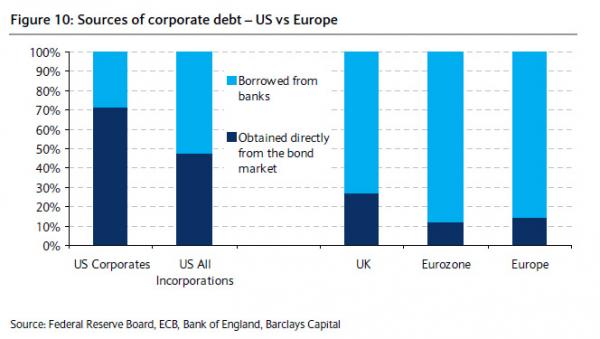
Loan to Deposit ratio_0Euro Banks Loans vs Total vs US_0

Europe has done it again.

Late last night, after markets closed for the weekend, following an extended discussion the European finance ministers announced their “bailout” solution for Russian oligarch depositor-haven Cyprus: a €13 billion bailout (Europe’s fifth) with a huge twist: the implementation of what has been the biggest taboo in European bailouts to date – the  impairment of depositors, and a fresh, full blown escalation in the status quo’s war against savers everywhere.

Specifically, Cyprus will impose a levy of 6.75% on deposits of less than €100,000 – the ceiling for European Union account insurance, which is now effectively gone following this case study – and 9.9% above that. The measures will raise €5.8 billion, Dutch Finance Minister Jeroen Dijsselbloem, who leads the group of euro-area ministers, said. Read more of this post

Private Equity’s $36 Billion Retail Bet Not Going So Well

Private Equity’s $36 Billion Retail Bet Not Going So Well

In the years before the recession, private-equity firms put so much faith in the future of U.S. brick-and-mortar retailers that they spent $36 billion on them.

That hasn’t worked out so well, especially for the era’s biggest spender, Bain Capital LLC. The firm started by Mitt Romney inked four deals valued at $17 billion from 2004 to 2007 and still owns all of the purchases. The largest of the bunch was Toys “R” Us Inc., which posted a drop in sales during the holidays, followed by Chief Executive Officer Gerald Storch stepping down.

The private-equity model — load up an acquisition with debt, cut costs and take it public — hasn’t gone according to the usual script with most of Bain’s retail acquisitions. That’s largely because the firm, which has $67 billion in assets under management, doubled down on specialty retailers just as they were about to be pummeled by the likes of Amazon.com Inc. (AMZN)

“There isn’t anything special about specialty anymore,” said Leon Nicholas, an analyst for Kantar Retail in Boston. Their advantages on product assortment, expertise and price have disappeared, he said. Read more of this post

China firms desert US stock markets amid scrutiny by US regulators and short-sellers

China firms desert US stock markets

More than two dozen US-listed Chinese companies have retreated from the US stock market in the past 15 months, amid scrutiny by US regulators and short-sellers. -China Daily/ANN
Michael Barris

Sat, Mar 16, 2013
China Daily/Asia News Network

NEW YORK – When 7 Days Group Holdings Ltd announced in September that it had received a buyout proposal to be taken private, the Chinese budget hotel operator’s US-listed shares soared to a four-month high.

Prior to the announcement, the shares, which trade on the New York Stock Exchange, had tumbled 23 per cent in 12 months, amid investor worries over corporate governance that hurt valuations of Chinese companies.

Last week, 7 Days became the latest US-traded Chinese company to go dark, after a group that included Washington-based private equity firm Carlyle Group LP and the company’s co-chairmen sweetened its offer to $688 million (S$854.7 million).

More than two dozen US-listed Chinese companies have retreated from the US stock market in the past 15 months, amid scrutiny by US regulators and short-sellers and shrinking advantages from US listings. Read more of this post

Why some think China is approaching a political tipping point

The old regime and the revolution

Why some think China is approaching a political tipping point

Mar 16th 2013 |From the print edition

20130316_CND000_0

FOR some of China’s more than 500m internet users the big news story of the week has not been the long-scheduled one that their country has a new president, Xi Jinping, who already has more important jobs running the Communist Party and chairing its military commission. Rather it was the unscheduled, unwelcome and unexplained arrival down a river into Shanghai of the putrescent carcasses of thousands of dead pigs, apparently dumped there by farmers upstream. The latest in an endless series of public-health, pollution and corruption scandals, it is hard to think of a more potent (and disgusting) symbol of the view, common among internet users, that, for all its astonishing economic advance, there is something rotten in the state of China, and that change will have to come.

Many think it will. According to Andrew Nathan, an American scholar, “the consensus is stronger than at any time since the 1989 Tiananmen crisis that the resilience of the authoritarian regime in…China is approaching its limits.” Mr Nathan, who a decade ago coined the term “authoritarian resilience” to describe the Chinese Communist Party’s ability to adapt and survive, was contributing, in the Journal of Democracy, an American academic quarterly, to a collection of essays with the titillating title: “China at the tipping point?” Read more of this post

China’s ‘new farmer:’ an investor, manager and & decision maker; mass exodus from the countryside has left China asking, “Who will till the farmlands and feed 1.4 billion Chinese people?”

China’s ‘new farmer:’ an investor, manager and & decision maker

  • Xinhua

2013-03-15

China is going to great lengths to foster a “new type” of professional farmer to inhabit the empty farmhouses across its vast rural areas and entice more migrant workers to return home to till fields and feed the world’s largest population.

If it succeeds, China will solve a major problem that cropped up after its urbanization process resulted in a population split 50:50 between rural and urban areas. Decades ago, nine in 10 people lived in rural areas, where their lives were not as good as that of their urban peers.

As large numbers of farmers, especially young farmers, have flocked to cities and towns, they have left the countryside largely inhabited by the elderly, women and children.

This mass exodus from the countryside has left China asking, “Who will till the farmlands and feed 1.4 billion Chinese people?” Read more of this post

Crisis bodes grim for Dutch housing market

Crisis bodes grim for Dutch housing market

by Christien van den Brink

English.news.cn   2013-03-15 21:36:28

THE HAGUE, Mar. 15 (Xinhua) — The happily married young couple Petra and Bert live in a suburban area of the fourth biggest city of the Netherlands, Utrecht.

Bert has just signed a long term contract at the ministry of Infrastructure, while Petra holds a part time job. They would be in the perfect position to buy their dream house, and yet, they rent it.

“Jobwise, it is really difficult to predict where we will be in 3, 4 years. We could be sent to other regions by our employers. Or we could even lose our job. This makes it hard to chose a location for our future house. We don’t want to commit to something until we are more financially stable,” Petra said.

Petra and Bert are not the only ones who have opted for renting in the Netherlands. According to figures published by CBS on Friday, 2.9 million dwellings of the 7.1 million households are rented apartments and houses.

Due to a growing incertainty at the job market, flexibility has become the main argument for renting. Renting offers the ability to pick up and leave if you have to take a job in an other region of the Netherlands. Read more of this post

The man who once saved New York City from bankruptcy explains why Detroit may go under; “We couldn’t do this today,” says Felix Rohatyn. “The various stakeholders are no longer around the same table.”

The man who once saved New York City from bankruptcy explains why Detroit may go under

By Tim Fernholz — 10 hours ago

The US city of Detroit is in deep financial trouble. Years of fiscal mismanagement and a shrinking population have left it with $14 billion in debt and a $300-million deficit last year, the auto capital of the country is headed toward bankruptcy. Michigan Governor Rick Snyder just appointed Kevyn Orr, a Washington bankruptcy attorney, to be the city’s “emergency manager,” a role with the power to implement budget measures without the consent of local officials.

Orr led the 2010 restructuring of Chrysler, the US automaker based in Detroit, during the the American government’s rescue of the auto industry. But his current challenge is what he calls “the Olympics of restructuring.” It might very well be: If the city doesn’t get back on its feet soon, it will become the largest municipal default in US history.

Felix Rohatyn faced similar problems in 1975, when he chaired a commission that extricated New York City from its financial crisis, a similar $14 billion debt load and an astounding $2.2-billion operating deficit (pdf). Rohatyn and a deputy were referred to as the “Batman and Robin of New York.” The legendary Lazard bankertalked to Quartz about his worries that the same tools he used might not be available in Detroit.

“We couldn’t do this today,” says Rohatyn. “The various stakeholders are no longer around the same table.” Read more of this post

Former Thai deputy premier Supachai Panitchpakdi warned that there were signs of a “bubble” in the Thai economy, with massive fund inflows heading mostly to the property sector.

Supachai sees signs of a bubble

March 16, 2013 1:00 am

Unctad chief urges officials to monitor property prices and bank lending

Former deputy premier Supachai Panitchpakdi warned yesterday that there were signs of a “bubble” in the Thai economy, with massive fund inflows heading mostly to the property sector.

Supachai, secretary-general of the UN Conference on Trade and Development (Unctad), expressed concern over a bubble in Thailand’s property sector, which he said could expand and create problems for the economy in the future. 

He called on the responsible agencies to pay attention to property prices, such as for condominiums, and to closely monitor bank lending. Expressing concern over overheated lending by banks, he said asset prices in some sectors are likely to exceed reasonable levels. Read more of this post

Is China’s ‘Real’ Economy Crashing?

Is China’s ‘Real’ Economy Crashing?

Tyler Durden on 03/15/2013 09:55 -0400

20130314_ChinElec_0

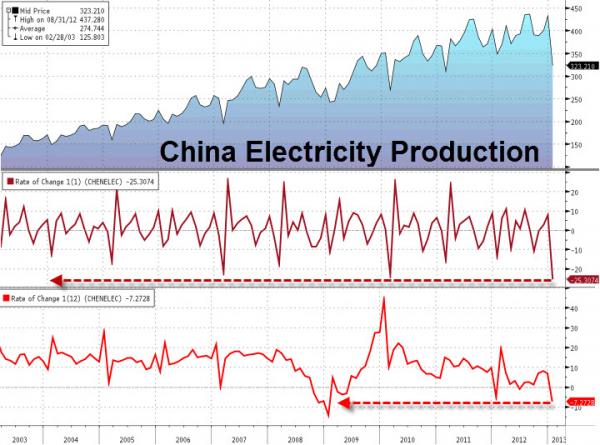
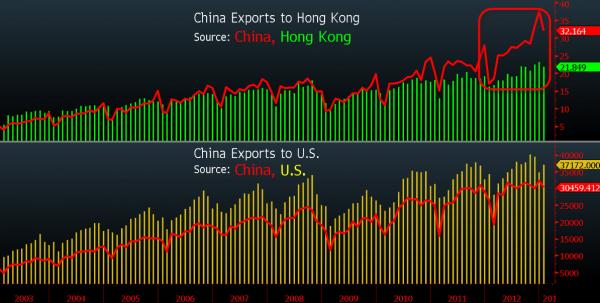
As Marc Faber noted, we hardly expect China to report GDP growth rates that do not perfectly fit the goal-seeked solution for utopian society, but under the covers, there appears to be some considerably more ugly real data. One of the hardest to manipulate, manage, or mitigate for a centrally planned economy is Electricity production. The year-over-year drop in China’s electricity production is the largest since the slump in Q1 2009; and the seasonal drop (associated with the New Year) is the largest on record at 25.3%! So on one hand China is discussing tightening monetary policy amid inflation anxiety and a potential real estate bubble – thanks to the rest of the world pumping free money – and on the other hand Chinese officials are faced with the reality of a drastically slowing ‘real’ economy. At the same time, we note that it appearsChina’s export-import data appears overstated. Rock meet hard place. Biggest seasonal drop ever in China electricity production and worst YoY drop since the crash in 2009… And as Bloomberg notes today: Widening differences in bilateral trade data reported by China and Hong Kong suggest export-import activity is being overstated by the mainland as companies report inflated figures, according to Mizuho Securities Asia Ltd. The chart below compares China’s data on monthly exports to Hong Kong the past two years, with counterpart figures from the city on imports.  

20130314_ChinElec1_0

China’s numbers were 47 percent higher than Hong Kong’s in January, compared with a 13 percent difference two years earlier. The lower panel shows reports during the same period for China’s overseas shipments to the U.S., using each nation’s official statistics, where the differential has remained more consistent. Exaggerated trade figures would mean that China’s new leaders, who take over the government at the National People’s Congress this week, are failing to get the boost from global demand that the data indicate as they try to sustain a rebound in the world’s second-biggest economy. Hong Kong passed the U.S. in November to become the biggest export market in China data. Exports to Hong Kong from China rose 60.9 percent in the first two months of 2013 from a year earlier, compared with last year’s 20.7 percent gain for the full year. “This seems inconsistent with the pictures of the final demand in both Hong Kong and the countries for Hong Kong re-exporting,”  Read more of this post

Men’s Nail Polish Joins the Cosmetics Market; Former Ultimate Fighting Championship star Chuck Liddell famously sported dainty pink fingernail polish in fights

Men’s Nail Polish Joins the Cosmetics Market

By Joel Stein on March 14, 2013

A few years ago, Josh Espley, a former marketing exec for a sex toy company called Fleshlight, noticed that his kickboxing friends were wearing polish to cover their banged-up nails. The practice was becoming popular, he noted, with the mixed martial arts crowd: Former Ultimate Fighting Championship star Chuck Liddell famously sported dainty pink fingernail polish in fights. Espley occasionally reads Us Weekly—to help him chat up women, he says—and saw polish on male celebrities such as Zac Efron, Jared Leto, Dave Navarro, and Johnny Depp. So in 2009, as a way to supplement his income, he created Blakk Cosmetics. Its first product was Alpha Nail paint, which the company sold in $12 pens in colors like “cocaine” (creamy white), “burnin’ rubber” (dark navy), and “gasoline” (charcoal gray). Read more of this post

BRICs Abandoned by Locals With Fund Outflows Highest Since 1996

BRICs Abandoned by Locals With Fund Outflows Highest Since 1996

The 2.5 million rupees ($45,984) Nirav Vora had in the Indian stock market six years ago have plunged by 72 percent. Now the 39-year-old father of two in Mumbai, who depends on investment income for his livelihood, is plowing money into government bonds.

“The confidence of small investors is rock bottom,” Vora said by phone on Feb. 26. “They have no faith in the markets.”

Vora’s exit from equities is being repeated across the biggest emerging markets as disappointing profits and growing state intervention cause stocks to trail global shares for a fourth year. Trading by Brazilian individuals has dropped to the lowest level since 1999, exchange data show. Russian mutual funds posted 16 straight months of outflows, the most since at least 1996, and withdrawals in India are the biggest in more than two years. Chinese investors emptied more than 2 million stock accounts in the past 12 months.

After amassing unprecedented wealth during 14 years of world-beating economic expansion, citizens of the so-called BRIC countries are losing their appetite for shares even as U.S. households return to stocks. While the Dow Jones Industrial Average (INDU) is trading at an all-time high, the MSCI BRIC Index remains 37 percent below its 2007 peak as economic growth disappoints investors and policy makers do little to improve the treatment of minority shareholders. Read more of this post

Hedge-Fund Liquidations Jumped in 2012 on European Crisis

Hedge-Fund Liquidations Jumped in 2012 on European Crisis

Hedge-fund liquidations rose to a three-year high in 2012 as the European debt crisis and concerns about global economic growth hurt performance for the $2.3 trillion industry, according to Hedge Fund Research Inc.

The number of firms shut jumped to 873, the most since 2009, the Chicago-based data provider said in a statement today. Still, the net number of hedge funds increased after money managers started 1,108 firms last year, it said.

Smaller hedge funds have been hardest hit by the global financial turmoil that has made it more difficult to raise money from investors since the collapse of Lehman Brothers Holdings Inc. in 2008. Hedge funds managing more than $5 billion got 65 percent of the $3.4 billion of assets that flowed into the industry in last year’s fourth quarter while firms with less than $1 billion reaped 8.7 percent, Hedge Fund Research said.

“The capital-raising environment continued to be challenging for emerging managers, including both small and mid- sized funds, as well as newly launched funds,” Kenneth Heinz, Hedge Fund Research’s president, said in the statement. “To raise new investor capital, hedge funds must not only demonstrate both superior performance and an innovative strategy, but also increased organizational efficiencies.” Read more of this post

In China, owning an oversized dog is the newest form of political dissent

In China, owning an oversized dog is the newest form of political dissent

By Damien Ma — March 14, 2013

Damien Ma is a fellow at The Paulson Institute, focused on investment and policy programs. Previously, he was a lead China analyst at Eurasia Group, a political risk research and advisory firm.

chinadog

Most Americans will likely have a preconceived notion of the Chinese relationship with dogs. When a developing country can barely take care of all its own people, animal rights tend to sit very low on the totem pole. But the reality is much more complicated, especially with a burgeoning dog culture associated with the rise of young urban elites with disposable income.

That complex reality is being captured in a soon-to-be-released documentary on China and dogs. The film, Oversized Dogs: Chinese Dog Laws and the People Who Break Them,is ostensibly about what the title suggests. It follows several Beijing residents who own dogs that are technically illegal because they are above the size limit stipulated in an antiquated Beijing law. It’s not just the Chinese capital — these size limitation rules have popped up in other parts of China, yet Chinese dog owners seem to be flouting them with impunity. Beyond the legal issue, dog ownership in China turns out to be an interesting examination of evolving attitudes in Chinese society today. In particular, it indirectly reflects the rise of rights consciousness among the growing legion of Chinese who count themselves among the middle class. Read more of this post

China’s Billionaire Bubble Stands in Xi Jinping’s Way

China’s Billionaire Bubble Stands in Xi Jinping’s Way

Now that Xi Jinping officially holds the reins in Beijing, the world is asking this question: Can China’s new leader revamp an economy that may become the world’s largest during his 10-year term? Here’s an even better one: Will Beijing let him? Much is being made of how quickly Xi is replacing Hu Jintao in China’s fastest formal transfer of power in more than a generation. Although it took Hu almost two years to get all top three positions — president, Communist Party head and chairman of the military commission — Xi has them right out of the gate. The sense is that Xi has been empowered to rebalance an economy that’s producing a dangerous gap between rich and poor. That would sound more plausible if not for China’s billionaire bubble. The real big money in China isn’t in the private sector, but the public one. A March 7 Bloomberg News story dramatized the point: The ranks of the ultra-wealthy in China’s legislature swelled 20 percent this year. The list of China’s 1,000 richest people published by the Shanghai-based Hurun Report contains 90 members of the National People’s Congress. That, Bloomberg calculates, is up from 75 in 2012. It’s worth noting that everyone on the Hurun list had a fortune of at least 1.8 billion yuan ($289.4 million), more than former Republican presidential candidate Mitt Romney.

Chinese politics is proving to be a bit too lucrative for the nation’s own good. Corruption, of course, doesn’t taint every member of Beijing’s inner circle. Yet the vast financial empires being amassed by some and the lack of transparency about wealth among politicians require attention and, where needed, legal action. Xi must break this cycle. As more and more politicians get rich through questionable land grabs, insider trading and old- fashioned rent seeking, there is less incentive to retool the economy. Political will shrinks as overseas bank accounts swell. All that money sloshing around conspires to widen China’s rich- poor divide. But can Xi do it? The plot thickens when you consider Bloomberg’s June story on how Xi’s extended family accumulated a fortune estimated at $376 million. Only time will tell if history remembers Xi as China’s great reformer or the great enricher of a party that’s become communist in name only.

(William Pesek is a Bloomberg View columnist. Follow him on Twitter.)

Buffett’s BYD Threatened by Prius in China Hybrid Shift

Buffett’s BYD Threatened by Prius in China Hybrid Shift

Toyota Motor Corp. (7203)’s Prius hybrid is emerging as the likeliest winner from China’s faltering attempt to dictate the future of world motoring.

Policies favoring Warren Buffett-backed BYD Co. (1211) and other electric-vehicle makers were meant to help China vie for global leadership in a technology the government expected to replace clunkers that run on gasoline. Except, as Chairman Mao Zedong put it, “seek truth from facts,” and the fact is: EVs flopped.

Consumer appetite failed to materialize even with financial incentives that halved the price tag of a BYD e6. The 27,800 EVs on Chinese roads are fewer than 6 percent of the government’s 2015 target — and 0.02 percent of the total civilian fleet. For now, China needs to promote other technologies to cut the tailpipe fumes choking its cities, says one minister.

“We’re very anxious” about worsening air pollution, Miao Wei, industry minister and a three-decade veteran of China’s auto industry, said during last week’s annual National People’s Congress in Beijing. “I’ve never believed that you can gain global leadership in one leap.” Read more of this post

China WMPs raise liquidity, transparency worries; Banks are reportedly now required to finish examining and – where needed – make changes to their capital-pool WMPs before April.

China WMPs raise liquidity, transparency worries

By Elva Muk | 15 March 2013 (2 hours ago)
As the China Banking Regulatory Commission sets out requirements for wealth-management product providers, analysts highlight issues around WMPs.

As China’s banking regulator seeks to limit the risk of wealth management products (WMPs) in the banking sector, some market participants are looking to clarify what they see as the major issues: chiefly liquidity and transparency.

Banks are reportedly now required to finish examining and – where needed – make changes to their capital-pool WMPs before April. If they don’t satisfy the China Banking Regulatory Commission (CBRC), it might consider halting the firm’s WMP business. Read more of this post

Turkey’s $580,000 Taxi Plates Drive Free-Wheeling Market

Turkey’s $580,000 Taxi Plates Drive Free-Wheeling Market

Beyond the polished Fiats and Fords parked at the Oto Center in a remote working class district of Istanbul, traders tout an investment vehicle that has tripled in value over the last nine years: license plates for taxis that fetch about 1.05 million liras ($580,000).

Prices quoted inside stores that act as a private bourse have risen about 10 percent from 885,000 liras a year ago, with the number of permits issued by Istanbul’s government unchanged for two decades even as the population in Turkey’s commercial capital grew, according to the taksiplakasi.com website. The 4,600 liras a month paid by drivers to rent plates add another 5 percentage points of investment income, the website shows.

Slices of permits called plates, wheels and nuts trade like bonds and lure investors wishing to comply with Islam’s ban on earning interest in a country where almost all of the 80 million population is Muslim. The licenses are an alternative to real estate and resemble investments created by bankers in Islamic finance, such as rent certificates.

The market has become so liquid that “one can sell in half an hour and get the cash in less than a week, not much different from the Istanbul Stock Exchange,” Gursoy Atli, sales manager at Kale Ticaret, one of a handful of closely-held companies that trade licenses, said in a phone interview Feb. 19. There is little regulation and no guarantees. Read more of this post

Private Equity Squeezes Out Cash Long After Its Exit

MARCH 13, 2013, 6:26 PM

Private Equity Squeezes Out Cash Long After Its Exit

By LYNNLEY BROWNING

When the Berry Plastics Group, a container and packaging company, went public last October, it generated up to $350 million in tax savings. But the company won’t collect the bulk of the benefits. Rather, Berry Plastics will hand over 85 percent of the savings, in cash, to its former private equity owners.

The obscure tax strategy is the latest technique that private equity firms are using to extract money from their companies, in this case long after the initial public offering.

In a typical buyout, the owners make money by sprucing up the operations and selling the business to another company or public investors. Private equity firms have also found ways to profit before the so-called exit with special one-time dividends and annual management fees.

Now, buyout specialists are increasingly collecting continuing payouts from their former portfolio companies. The strategy, known as an income tax receivable agreement, has been quietly employed in dozens of recent private equity-backed offerings, including those involving PBF Energy, Vantiv and Dynavox. Read more of this post

Teenager Dies of Food Poisoning After Jakarta Hospitals Deny Treatment — the latest in a series of deaths after hospitals rejected sick poor people.

Teenager Dies of Food Poisoning After Jakarta Hospitals Deny Treatment
Lenny Tristia Tambun & SP/Deti Mega | March 12, 2013

20130301132411104

Indonesian baby girl Dara Nur Anggraini, whose twin sister, Dera, died on Feb. 16. Jakarta’s hospitals were ill-prepared for governor Joko Widodo’s granting of free medical care to a larger number of the city’s poor. (AFP Photo).

A teenager on Saturday died of a severe intestinal infection after several Jakarta hospitals denied her treatment — the latest in a series of deaths after hospitals rejected sick people.  Read more of this post

Angry Birds Cartoons Head for Indonesian TV Screen

Angry Birds Cartoons Head for Indonesian TV Screen
March 13, 2013

Reuters

Helsinki, Finland. The makers of Angry Birds are launching a cartoon series this weekend, expanding further beyond its highly addictive games in a bid to expand entertainment and merchandising. Rovio, the company behind the popular mobile app game Angry Birds, said the cartoons will feature adventures of birds that appear in its games. Angry Birds Toons can be downloaded through on-demand services, and will also air on television channels such as FOX8 in Australia, ANTV in Indonesia, Cartoon Network in India, and MTV3 Juniori and MTV3 in Finland, it said. Rovio has expanded into merchandising and licensing in the past few years and its colorful, round bird characters are sold as stuffed animals and appear on everything from T-shirts to soda cans. It announced in December that it hired Hollywood executive David Maisel as executive producer of a 3D animated film planned for release in 2016.


Indonesia: Buyers and Sellers Blame Govt for Skyrocketing Price of Garlic and Shallots

Buyers and Sellers Blame Govt for Skyrocketing Price of Garlic and Shallots
Jakarta Globe | March 13, 2013

The cost of shallots and garlic has skyrocketed in the past week, causing complaints from buyers and sellers who blame government policy for the increased prices.

Detik.com reported on Wednesday the price of garlic has hit Rp 75,000 per kilogram in some places — more than five times the usual price of Rp 13,000 per kilogram— while the current price of shallots has hit Rp 48,000 per kilogram from the usual Rp 12,000 per kilogram.

In an effort to bring the price down, the Trade Ministry on Thursday announced it would import 29,136 tons of garlic from China and India. Srie Agustina, director general of domestic trade at the Trade Ministry, told Investor Daily over the weekend that the imported garlic would arrive in Jakarta in the next two weeks.

A housewife named Agnes said she’s going to avoid buying shallots and garlic until the price returns to normal.

“Shallot and garlic prices are so high. I usually buy them for Rp 14,000 per kilogram but now it’s Rp 40,000 per kilogram. It’s better if we don’t consume it for a while,” she told beritasatu.com at the Kramat Jati Market on Tuesday. Read more of this post

Former World’s Biggest Solar Panel Maker Suntech Seen Not Getting Bailout From Chinese Government; Wall Street May Lose in $541 Million Suntech Bond Default

Suntech Seen Not Getting Bailout From Chinese Government

China won’t rescue Suntech Power Holdings Co. (STP) from its creditors because the former biggest solar-panel maker needs to retrench along with the rest of the industry, two advisers to government agencies said. Officials in Beijing want to pare excess manufacturing capacity and consolidate the $25 billion global industry that’s led by China, said Li Junfeng, director of the climate-change strategic research division at the government’s National Development and Reform Commission. “The government won’t intervene and shouldn’t,” Li said in an interview. Meng Xiangan, vice chairman of the China Renewable Energy Society, a liaison between the industry and the state, said Suntech should “not rely on government assistance.”

The comments from advisers with knowledge of the Chinese government’s thinking cast doubt on whether Suntech, the largest solar panel manufacturer in 2011, can avoid bankruptcy. The company March 11 said it obtained an agreement from more than 60 percent of bond holders to delay repayment for two months on $541 million of notes due tomorrow. The national government wants to avoid a default, which would be the first for a bond issued by a company based in mainland China. Restructuring the solar industry is one of the first issues confronting Premier Li Keqiang as his administration takes over from Wen Jiabao this month. Read more of this post

Lego Builds New Billionaires as Toymaker Topples Mattel; Lego is valued at $14.6 billion vs Mattel’s $14.4bn and Hasbro’s $5.4bn

Lego Builds New Billionaires as Toymaker Topples Mattel

Lego A/S, the Billund, Denmark- based toymaker famous for its colorful building bricks, has minted three new billionaires as the company’s revenue soared 25 percent last year.

The children of Kjeld Kirk Kristiansen, Denmark’s richest man — Sofie Kirk Kiaer Kristiansen, Thomas Kirk Kristiansen, and Agnete Kirk Thinggaard — hold a combined 37 percent economic interest in the company valued at more than $5.3 billion, according to the Bloomberg Billionaires Index. None have appeared individually on an international wealth ranking.

The closely held company’s sales climbed to 23.4 billion Danish kroner ($4.04 billion) in 2012, according to the company’s annual report, helping the 81-year-old operation pass Mattel Inc. to become the world’s most-valuable toy manufacturer.

“Lego is on fire,” Gerrick Johnson, an analyst with BMO Capital Markets in New York, said in an e-mail. “It’s the world’s biggest toymaker in terms of net income, operating income and Ebitda. It had a 71 percent gross margin in its latest results and is posting strong sales growth.”

Lego is valued at $14.6 billion, based on the average enterprise value-to-earnings before interest, tax, depreciation and amortization, enterprise value-to-sales and price-to- earnings multiples of competitors Mattel (MAT) and Hasbro Inc. (HAS), according to data compiled by Bloomberg. Enterprise value is defined as market capitalization plus total debt minus cash. Read more of this post

Daewoo Shipbuilding to Construct Jackup Rigs to Challenge Keppel

Daewoo Shipbuilding to Construct Jackup Rigs to Challenge Keppel

Daewoo Shipbuilding & Marine Engineering Co. (042660), the world’s second-largest shipbuilder, is bidding to build jackup rigs for the first time in three decades to tap more orders from offshore oil discoveries.

Demand for bigger, more sophisticated rigs that can work under harsher conditions is increasing in the North Sea and other regions, Lee Jae Ha, chief marketing officer at the Seoul- based company, said in an interview. Each unit could be worth as much as $600 million, he said.

Oil discoveries, including in the North Sea, have boosted spending by companies for exploration and production. Daewoo is making a comeback since its last delivery in 1983 into a segment that has been dominated by Keppel Corp. (KEP) and Sembcorp Marine Ltd. (SMM)

“We expect demand for these high-specification heavy-duty rigs to increase this year,” Lee said on March 12. “We have a lot of experience building complex drilling units and that will give us a competitive edge over the Singapore yards.”

Keppel and Sembcorp Marine have a combined 70 percent share of the global market for jackup rigs, which are used in shallow waters with extendable legs that allow them to stand on the ocean floor. Read more of this post

Taiwan Shrinks Wealth Gap as Xi’s Communists Struggle in China; “It’s a wonderful system. Without it, we’d probably have to sell our apartment or get a loan.”

Taiwan Shrinks Wealth Gap as Xi’s Communists Struggle in China

More than six decades after Mao Zedong’s Communists chased Chiang Kai Shek’s Kuomintang off the mainland pledging an egalitarian society, it’s the KMT on Taiwan that has crafted a more balanced wealth distribution.

As incoming Chinese President Xi Jinping completes his nation’s leadership succession this week, Taiwan may offer a model for his campaign to bridge a wealth gap that threatens to undermine Communist Party legitimacy. Taiwan’s Gini coefficient, a measure of inequality, was 0.342 in 2011 compared with China’s 0.477 and the 0.4 level used as a predictor for social unrest.

Taiwan moved to introduce a national health-insurance program and greater political accountability as growth slowed to less than 10 percent two decades ago. China, which has similar gross domestic product per person to Taiwan in the late 1980s, is seeking to address grievances over land grabs and access to public services in a nation where 90 legislators have wealth of at least 1.8 billion yuan ($290 million).

“In Taiwan you had the slow and steady development of a wider social security system,” said Rana Mitter, a professor of modern Chinese history at Oxford University. “Taiwan and the mainland of China have gone in two different directions.”

Low-income households in Taiwan, an island of 23 million people, have had access to free or subsidized health care since the country enacted the National Health Insurance act in 1995. The program provides care financed via a payroll premium paid by companies and employees as well as by government subsidies.

‘Wonderful System’

“It’s a wonderful system,” said Peggy Lo, 34, as she left Taipei’s Cathay General Hospital after giving birth to her daughter prematurely 10 days before. Lo was carrying a receipt that showed she had paid the equivalent of $152 for 10 days of treatment in the neonatal intensive-care unit for her daughter. “Without it, we’d probably have to sell our apartment or get a loan,” Lo said. Read more of this post

China to Free Currency in 5 Years, Says Hong Kong Exchanges’ Li; central bank Governor Zhou Xiaochuan said yesterday in Beijing that the nation should be on “high alert” over inflation and reiterated gradual reform for the yuan’s convertibility

China to Free Currency in 5 Years, Says Hong Kong Exchanges’ Li

China, the world’s second-largest economy, will open its markets and allow its currency to float within five years, said Charles Li, chief executive officer of Hong Kong Exchanges & Clearing Ltd.

“China has to reform its interest-rate system,” Li said yesterday during a panel discussion at the Futures Industry Association conference in Boca Raton, Florida. The value of the Chinese currency is limited by the government and is only allowed to rise or fall within a narrow range. Li said that system can’t last forever.

Yuan forwards advanced for a seventh day on optimism China will embark on further currency reforms. The yuan traded near a 19-year high against the dollar as central bank Governor Zhou Xiaochuan said yesterday in Beijing that the nation should be on “high alert” over inflation and reiterated gradual reform for the yuan’s convertibility. Read more of this post

HSBC Boosts Mortgage Rates for the first time in 18 months as Hong Kong Cools Property Market

HSBC Boosts Mortgage Rates as Hong Kong Cools Property Market

HSBC Holdings Plc (5) increased Hong Kong mortgage rates for the first time in 18 months after the city’s banking regulator tightened risk rules on concern a property bubble may undermine financial stability.

Home loans priced at the best lending rate will rise to a range of 2.85 percent to 3.15 percent, from 2.6 percent to 2.9 percent, starting tomorrow, according to an e-mailed statement from the bank. The increase is the first since September 2011, Yvonne Chuang, a Hong Kong-based spokeswoman for the second- largest mortgage lender in the city, said by telephone.

The Hong Kong Monetary Authority on Feb. 22 told banks to set the risk weighting for new residential mortgages at 15 percent or more, to ensure lenders’ capital cushions are deep enough. Standard Chartered Plc last week said the measure will increase its home loan funding cost by a range of 20 basis points to 25 basis points, indicating banks may need to boost mortgage rates.

Since taking office in July, Hong Kong Chief Executive Leung Chun-ying has added property taxes, favored local permanent residents over foreigners, tightened mortgage rules and increased supply after home prices doubled in the past four years.

HSBC ranked second in the city’s home loan market last month with a 17 percent share, while Standard Chartered was in fourth position with 13 percent, according to Hong Kong-based mReferral Mortgage Brokerage Services. Read more of this post

Stranded Hotel in Australia Emblem of Mining Bust: Commodities

Stranded Hotel in Australia Emblem of Mining Bust: Commodities

A prefabricated six-story hotel, once destined to house BHP Billiton Ltd. (BHP) workers, is sitting in 126 boxes stranded on the Melbourne city docks. The stalled project is a sign of the deepening global slowdown in mining.

The contents were to have been assembled 1,990 miles away at Port Hedland, where BHP planned to use the hotel as temporary housing for its estimated $22 billion harbor expansion to export more iron ore. That was before the world’s biggest mining company scrapped its plan, and the hotel developer went bust.

Global capital spending by mining companies is set to drop by a third next year to $96 billion, from a record $141 billion last year, according to UBS AG estimates. Producers have slowed expansions and delayed projects on expectations that commodities prices have passed their highs, after economic growth began slowing in China, the biggest buyer of metals.

“Clearly the rate of new approvals has almost dried up” for mining projects, Michael Elliott, sector leader for Ernst & Young’s global mining practice, said in an interview from Sydney. “A lot of that has been rethinking what rates of return companies now require from these new investments.” Read more of this post