In the battle for China’s beer drinkers, the $0.32 brew is still king; 85% of the domestic beer market is comprised of low-end domestic beer brands

In the battle for China’s beer drinkers, the $0.32 brew is still king

By Lily Kuo — March 4, 2013

Earlier today, Denmark’s Carlsberg said it is attempting a partial takeover of China’s Chongqing Brewery Company in a bid worth 2.65 billion Danish crowns ($461 million).

Carlsberg’s is the latest attempt by a foreign brewery to tap into what is now theworld’s largest beer market by volume as sales in more traditional markets slump. (China’s per capita beer consumption is about half of America’s.) And while a lot of attention is paid to China’s emerging affluent and middle class, it’s the low-end of Chinese tipple that still matters most.

Market analysts have been saying that China’s beer industry is about to come of age; Nomura has forecast that industry profits would rise from $1 billion in 2012 to $9 billion in 2021. Still, for China’s newly affluent, beer doesn’t have the same status as high-end liquor or wine. It’s mainly seen as an accompaniment to dinner (it should be light, with a low alcohol content, and go well with spicy food).

It’s no surprise then that 85% of the domestic beer market (pdf, p. 3) is comprised of low-end domestic beer brands, according to a 2012 report by the consulting company Accenture. In Beijing, a 330-milliliter bottle of Tsingtao sells for about 2 yuan (about $0.32), compared to a bottle of Budweiser that would cost about three times as much. Read more of this post

China’s Richest Man Says Capital Markets ‘Suck’ in China; Investors Rattled by China Stock Market Swing

March 5, 2013, 8:22 PM

China’s Richest Man Says Capital Markets ‘Suck’

China’s richest man has a strong statement for those looking to invest: “The capital markets suck in China.”

Zong Qinghou climbed his way to the top of the list of China’s wealthiest by amassing a fortune of $12.6 billion through his privately listed beverage empire Hangzhou Wahaha Group Co. On Tuesday, he made clear he didn’t gain his wealth through the country’s stock market.

“When the ordinary people invest in it, the market should reward them with some benefits. But it does not,” Mr. Zong said on the sidelines of China’s annual parliamentary session, taking aim at speculators he says ruin the stock market for others. “The speculation has totally ordinary investors of any benefits.” Read more of this post

Dow Average Surpasses Previous Record High Set in 2007

The Last Time The Dow Was Here…

Tyler Durden on 03/05/2013 09:36 -0500

“Mission Accomplished” – With CNBC now lost for countdown-able targets (though 20,000 is so close), we leave it to none other than Jim Cramer to sum up where we stand (oh and the following list of remarkable then-and-now macro, micro, and market variables):  “we all know it’s going to end badly, but in the meantime we can make some money” – ZH translation: “just make sure to sell ahead of everyone else.”

  • Dow Jones Industrial Average: Then 14164.5; Now 14164.5
  • Regular Gas Price: Then $2.75; Now $3.73
  • GDP Growth: Then +2.5%; Now +1.6%
  • Americans Unemployed (in Labor Force): Then 6.7 million; Now 13.2 million
  • Americans On Food Stamps: Then 26.9 million; Now 47.69 million
  • Size of Fed’s Balance Sheet: Then $0.89 trillion; Now $3.01 trillion
  • US Debt as a Percentage of GDP: Then ~38%; Now 74.2%
  • US Deficit (LTM): Then $97 billion; Now $975.6 billion
  • Total US Debt Oustanding: Then $9.008 trillion; Now $16.43 trillion
  • US Household Debt: Then $13.5 trillion; Now 12.87 trillion
  • Labor Force Particpation Rate: Then 65.8%; Now 63.6%
  • Consumer Confidence: Then 99.5; Now 69.6
  • S&P Rating of the US: Then AAA; Now AA+
  • VIX: Then 17.5%; Now 14%
  • 10 Year Treasury Yield: Then 4.64%; Now 1.89%
  • EURUSD: Then 1.4145; Now 1.3050
  • Gold: Then $748; Now $1583
  • NYSE Average LTM Volume (per day): Then 1.3 billion shares; Now 545 million shares

March 5, 2013

Dow Average Surpasses Record High as Market Opens

By PETER EAVIS

Despite everything, the stock market is back at a record high.

The Dow Jones industrial average, which measures the performance of 30 blue-chip companies, rose more than 80 points at the start of trading on Tuesday, to 14,207.94. That surpasses its previous record close of 14,164.53, which it achieved nearly five and a half years ago, as well as its record intraday high, set around the same time, of 14,198.10. Read more of this post

CJ rises as beacon of Korean food, shopping, pop culture

CJ rises as beacon of Korean food, shopping, pop culture

20130305.101204_khera_cj

CJ Group expands bio pharma, entertainment, home shopping, logistics businesses abroad. -Korea Herald/ANN

Kim So-hyun
Tue, Mar 05, 2013
The Korea Herald/Asia News Network

SOUTH KOREA – When CheilJedang spun off from Samsung Group in 1993, not many expected the food company would grow into a major conglomerate encompassing retail and entertainment businesses as well. With food and food service; biopharmaceuticals; entertainment and media; home shopping and logistics as its four core businesses, CJ Group has shown remarkable growth and change over the past 20 years. In addition to keeping the No. 1 spot in the food and bio businesses, CJ acquired Korea Express, the nation’s largest logistics firm, in 2011, and is leading the country’s entertainment and media industries.

The history of CheilJedang, now called CJ, dates back to when its founder Lee Byung-chull built a sugar mill in Busan amid the devastation of the Korean War. It succeeded in domestic sugar production in November 1953, lessening the country’s dependence on expensive sugar imports. Soon met with fierce competition in sugar refining, CheilJedang completed a flour mill using its own technologies and Korean-made machinery in 1958 and began production. The company entered the artificial seasoning product market in 1963, with its Mipoong vying against then-bestseller Miwon of Daesang. CJ developed mass-production techniques for a seasoning product it called “Dashida” in 1975 and nucleic acid for the first time in Korea two years later, which became a stepping stone for the seasoning industry. Dashida, which came in beef, fish and anchovy flavors, was a gustatory delight for ordinary Koreans who weren’t well off. In the 1980s, CJ expanded to processed food items such as beverages and frozen foods, and entered the pharmaceutical business based on new advanced technologies.

Read more of this post

Jim Rogers Bullish on Japan Equities on Abe’s Catalyst; “Japan is one of the few places in the world where I own shares,”

Jim Rogers Bullish on Japan Equities on Abe’s Catalyst

Jim Rogers, who co-founded the Quantum Fund with George Soros in the 1970s, said he increased his holdings of Japanese shares and plans to buy more because Prime Minister Shinzo Abe will boost the economy.

“Japan is one of the few places in the world where I own shares,” Rogers, chairman of Rogers Holdings, said at a Daiwa Securities Group Inc. (8601) equity conference in Tokyo today. “I have no plans to sell and plan to accumulate more when I can. Abe has been a catalyst and this will continue for several years.” Read more of this post

India Rewarded Ineligible Farmers With $9.5 Billion Debt Waiver

India Rewarded Ineligible Farmers With $9.5 Billion Debt Waiver

Almost a tenth of Indian farmers whose debts were written off by the government were not eligible for relief, according to an audit of a $9.5 billion plan that helped the ruling Congress party win a second term in power.

There were errors in nearly 25 percent of the cases where debt assistance was offered from 2008, the Comptroller and Auditor General of India said in a review submitted to parliament. About 13 percent of farmers the government considered qualified for help were denied funding by banks, the auditor said.

Lapses and errors “raised serious concerns about the implementation of the scheme,” it said in its report. Read more of this post

China’s high local economic growth targets questioned by political advisors

China’s high local economic growth targets questioned by political advisors

  • Xinhua 

2013-03-05

As developed nations search desperately for faster growth to escape the mire of their troubled economies, more people in China, the world’s second-largest economy, are demanding the opposite. Read more of this post

Beautician Challenges Billionaire Over New Hong Kong Privacy Law

Beautician Challenges Billionaire Over New Hong Kong Privacy Law

Late last year, staff at a shuttered Hong Kong beauty salon turned to company filings to track down the boss they say vanished owing them HK$900,000 ($116,000).

Man Lee, 32, said she and five colleagues got some money back after protesting at another office they linked to their former employer.

Now, Hong Kong’s government wants to restrict public access to records of corporate directors. The move may make it harder for workers like Man to track down runaway bosses — and erode the city’s reputation by making it easier to launder money and cheat on taxes, according to lawyers, corporate transparency advocates and the former head of the Companies Registry.

“The less transparent a corporate entity is, then the greater the scope for criminal malpractice,” said Gordon Jones, Hong Kong’s registrar of companies from 1993 to 2007. “The free flow of information is Hong Kong’s big competitive advantage.”

Hong Kong, a part of China with its own legal system and currency, has Asia’s second-largest stock market by value, data compiled by Bloomberg show. It’s also the top destination for cash outflows from the mainland, totaling $525.6 billion by the end of 2011, according to official trade data. Greater secrecy increases the temptation for companies to launder assets through the former British colony, according to Jones.

Small businesses, due diligence firms and journalists are among those opposing the legal change to be put before lawmakers in May. The proposal will prevent the public accessing directors’ full identification numbers and home addresses. Read more of this post

Mutual fund investors are often their own worst enemies, prone to poor timing

Mutual fund investors are often their own worst enemies, prone to poor timing

Article by: MARK JEWELL , Associated Press

  • Updated: February 21, 2013 – 12:15 PM

BOSTON – The recipe for successful investing sounds pretty simple: have reasonably good timing over the long haul and avoid big mistakes. That’s what helps professionals build a worthy track record. For average investors, it’s advisable to set the bar lower. Construct a balanced portfolio of low-cost mutual funds, make regular contributions to invested savings, and stick with it until it’s time to retire.

The problem is that many investors seem to think they’re better than that and can beat the stock market. Yet research consistently shows that it’s a fool’s game.

The latest findings are from Morningstar Inc., which compared the performance numbers that mutual funds posted with the returns that the investors in those funds actually obtained over multiple years. It’s typical to see gaps between the figures. That’s because investors move cash in and out as markets rise and fall, and consequently don’t experience the same results as the funds they invest in. Read more of this post

Angry Swiss Aren’t Done Slimming the Fat Cats

Angry Swiss Aren’t Done Slimming the Fat Cats

The Swiss have approved a “fat-cat referendum” to limit executive pay by a crushing 68 percent to 32 percent, no great surprise perhaps given the current mood on bankers and other superrich around the globe. Yet this is Switzerland, not Greece, Italy or Spain and the vote isn’t the end of it. Switzerland is unhappy, and it is changing.

The referendum was the brainchild of Thomas Minder. The independent legislator began his struggle to give shareholders in Swiss-listed companies the right to control the pay of executives and board members in 2006. The anger that turned him into the man many Swiss see as an avenging angel was sparked as long ago as 2001, when Swissair, the national airline, went bankrupt.

Minder’s company, which supplied toothpaste to Swissair, was almost driven to the wall because its invoices initially went unpaid. Mario Corti, the chief executive officer of Swissair’s parent Sair Group, left the company after a few months, pocketing 12 million Swiss francs (then $7.5 million) in an advance payment he didn’t have to return.

Minder’s “yes” campaign in the referendum received a huge boost on Feb. 15, when it emerged that Daniel Vasella, the outgoing CEO of pharmaceuticals company Novartis AG, was to be given a $78 million payoff over six years in exchange for not working for any of the company’s competitors. Vasella renounced the payoff once the story broke, but it was too late.

On the face of it, with low unemployment and one of the best standards of living on the planet, ordinary Swiss have little to complain about. Still, they are worried about how long they can fend off the crisis that has engulfed the rest of Europe, and dissatisfied with a feeling of being ripped off by their elites. Read more of this post

Scooters Rule as E-Commerce Grows in China; Couriers at office buildings in China’s large cities can earn several times more than factory workers

Updated March 4, 2013, 11:37 p.m. ET

Scooters Rule as E-Commerce Grows in China

By PAUL MOZUR

Couriers at office buildings in China’s large cities can earn several times more than factory workers. Above, a deliveryman in Shanghai

BEIJING—David Li possesses a can-do work ethic and a willingness to zip around Beijing’s harrowing traffic on an electric scooter. That makes him highly valuable to a multibillion-dollar Chinese electronic-commerce industry struggling with how to deliver goods to demanding customers.

In 2011 Mr. Li left behind a wife, infant son and a job teaching middle-school math in the eastern city of Handan to became a courier for Chinese Internet retailer Beijing Jingdong Century Trading Co., which runs the 360buy.com shopping site.

Delivery companies say couriers who work the most profitable office buildings in large cities—where order flow is high and delivery is quick and easy—can earn more than $950 a month, well above the $200 to $650 brought in by factory workers.

Booming internet sales in China have the world’s largest manufacturing country racing to create new infrastructure systems to deliver goods to its own population. WSJ’s Paul Mozur reports via #WorldStream.

“It’s hard, but I’m ambitious,” Mr. Li says of the separation from his family. Early last year, after only five months on the job, he was promoted to manager of a distribution center that has 20 deliverymen.

E-commerce has exploded here in recent years as increasingly affluent consumers have learned to love online deals. China’s total online sales are expected to eclipse those of the U.S. in coming years, rising to $356.1 billion in 2016 from $169.4 billion last year, according to Forrester Research. U.S. online retail sales are forecast to reach $327 billion from $226 billion over the same period. That leaves Internet retailers and logistics companies attempting to build from scratch a complex distribution system to send goods purchased online to the distant corners of China. Read more of this post

China Moves to Temper Growth; Property Bubble Is a Key Concern; The realization that leaders are retightening screws surprised market

Updated March 4, 2013, 7:49 p.m. ET

China Moves to Temper Growth

Property Bubble Is a Key Concern

By TOM ORLIK and ESTHER FUNG

AI-BZ444_CPROP_G_20130304122703

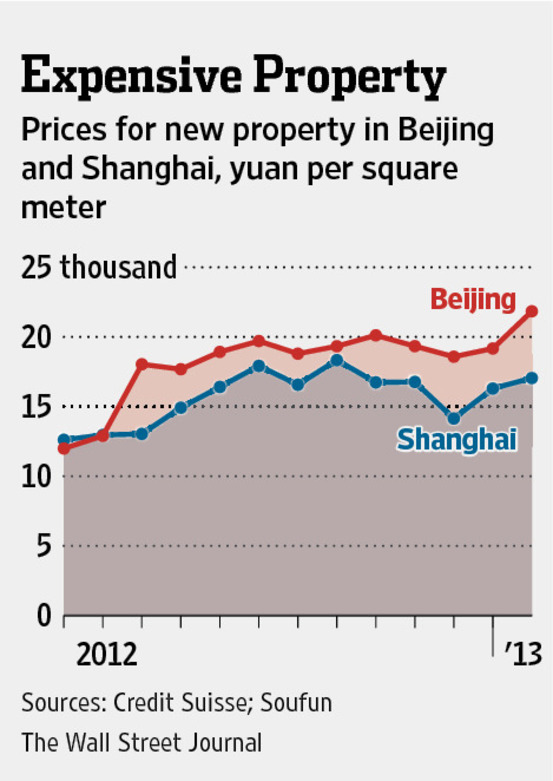
BEIJING—China set a growth target of around 7.5% for this year as it kicked off a meeting to finalize its leadership transition, reflecting how Beijing is turning away from breakneck growth based on exports in favor of a broader economy driven by spending at home. China’s ambitions for more moderate growth come after decades of double-digit increases and are a centerpiece of new leaders’ plans to be detailed during the annual National People’s Congress, which began Tuesday. Beijing’s broader goal is to shift the economy away from reliance on investment and exports, with a stronger role for domestic consumption, as it kick starts painful reforms to rebalance the country’s economic model. In the days leading up to the legislative meeting, China’s government aggressively struck at once-again-surging housing prices, showing leaders’ determination not to let a property bubble push the economy off track or breed dissatisfaction with the government just as a new guard is taking over. The growth target maintains the goal for stable growth set out last year and isn’t a forecast—China routinely exceeds its targets. Last year’s growth was 7.8%. During the National People’s Congress, eyes are on the new leadership under Xi Jinping, the Communist Party chief to be named president during the meeting, to see whether it will go beyond rhetoric to make the difficult changes required to raise household income and boost consumption spending.

A bubbly property sector has been a key feature of China’s unbalanced growth. Rising house prices drove overinvestment in real estate, and also crimped consumption by forcing households to scrimp and save to get their foot on the housing ladder. Leaders have worried about social frictions caused by housing that is out of reach for average earners. The renewed controls to tame the property sector, a major contributor to growth, suggest the government is prepared to safeguard the gains from three years of attempts to make buying a home more affordable for the middle class—even if it dents the growth outlook. The realization that leaders are retightening screws surprised markets, which like many property buyers had concluded that leaders were satisfied with the results of repeated tightening and willing to tolerate a gradual return to rising prices and sales. Read more of this post

IPO Troubles in Trust-Heavy Singapore

March 4, 2013, 5:31 PM

IPO Troubles in Trust-Heavy Singapore

By Chun Han Wong and P.R. Venkat

AM-AX445_ASIADEAL

Singapore’s listings scene is roaring back to life with a $1.3 billion initial public offering by a China-focused real-estate investment trust. But nontrust-related IPOs continue to elude the city-state, even as neighboring bourses are gearing up for a range of billion-dollar deals.

Elsewhere in Southeast Asia, companies from retailers to infrastructure firms are poised to cash in on rapid economic growth by launching large IPOs and secondary share sales. Singapore, despite its push to rival Hong Kong as an Asian listing hub, has a one-dimensional listings scene: It hasn’t hosted any major nontrust IPOs since 2010.

Its largest listing in two years—set for a Thursday debut—is a $1.3 billion China-focused REIT IPO by Mapletree Investments Pte. Ltd., the real-estate arm of Singaporean state investor Temasek Holdings Pte. Ltd.

“The supply of IPOs is relatively low as the global economy is still weak…Competition [for IPOs] will intensify with other countries given that they are growing faster,” said Ken Ang, an investment analyst at Philip Securities. Read more of this post

Asia’s Taste for Robusta Coffee Transforms Market

Asia’s Taste for Robusta Coffee Transforms Market
Sarah McFarlane & Lewa Pardomuan | March 04, 2013

London/Singapore. Asia’s thirst for coffee is changing the shape of the market as demand for cheaper robusta beans dramatically outpaces that of arabica, tightening the price difference between the two varieties. Arabica coffee beans, which dominate gourmet blends, have long traded at substantial premiums to the hardier, more caffeine-rich robusta varieties, which are widely used in soluble or instant coffee. But surging coffee demand from Asia, the region where most of the world’s robusta is grown, is narrowing this premium. Most arabica coffee is grown in South America.

“In traditional markets consumption is flat, but in emerging markets and exporting countries it’s growing fast,” said Roberio Silva, executive director of the International Coffee Organization (ICO). “These trends suggest that future demand will generally be stronger for robusta coffee as emerging markets and exporting countries tend to prefer soluble coffee.” Read more of this post

Buffett is worried about Fed policy; “There are an awful lot of people who want to get out of a lot of assets if the Fed is going to tighten. Who knows how it will play out.”

Buffett is worried about Fed policy

By Chris Isidore @CNNMoneyInvest March 4, 2013: 9:09 AM ET

NEW YORK (CNNMoney)

Investor Warren Buffett said his biggest worry about the Federal Reserve’s policy of buying assets is how the markets will react once the central bank starts selling its holdings.

In an appearance on CNBC Monday, the chairman of Berkshire Hathaway (BRKA,Fortune 500) pointed to the sell-off in stocks a couple of weeks ago after the Fed’s minutes suggested some members supported slowing asset purchases from their current pace. He said that was just a small preview of what could be extreme market reaction once the Fed actually does start selling the trillions in Treasuries and mortgages it now holds. The Fed is buying $45 billion of Treasuries and $40 billion of mortgages each month through a policy known as quantitative easing.

“All over the world everybody that manages money is waiting to catch the signal that the Fed is going to reverse course,” he said. “I think they’re on a hair trigger. There are an awful lot of people who want to get out of a lot of assets if the Fed is going to tighten. Who knows how it will play out.” Read more of this post

Gucci-Owner PPR Said to Consider Changing Its Name to Kering which is supposed to evoke the idea of caring and signal a new chapter in the company’s development

Gucci-Owner PPR Said to Consider Changing Its Name to Kering

PPR SA (PP), the French owner of Gucci and Puma, is considering changing its name to Kering to cap its transformation into a luxury and sporting-goods specialist, according to people with knowledge of the plan.

The re-branding of Paris-based PPR may be announced this month, said the people, who asked not to be identified because the information is confidential. The name, which would be the company’s fifth since listing on the Paris stock exchange in 1988, is supposed to evoke the idea of caring and signal a new chapter in the company’s development, one of the people said. Read more of this post

The $7 billion superannuation fund CareSuper has fired its last hedge fund manager, Fauchier Partners, as the industry prepares to move towards simpler, low-cost investments ahead of July 1 MySuper reforms

CareSuper axes last hedge fund manager

PUBLISHED: 1 HOUR 3 MINUTES AGO | UPDATE: 0 HOUR 41 MINUTES AGO

Exclusive | The $7 billion superannuation fund CareSuper has fired its last hedge fund manager, Fauchier Partners, as the industry prepares to move towards simpler, low-cost investments ahead of July 1 MySuper reforms.

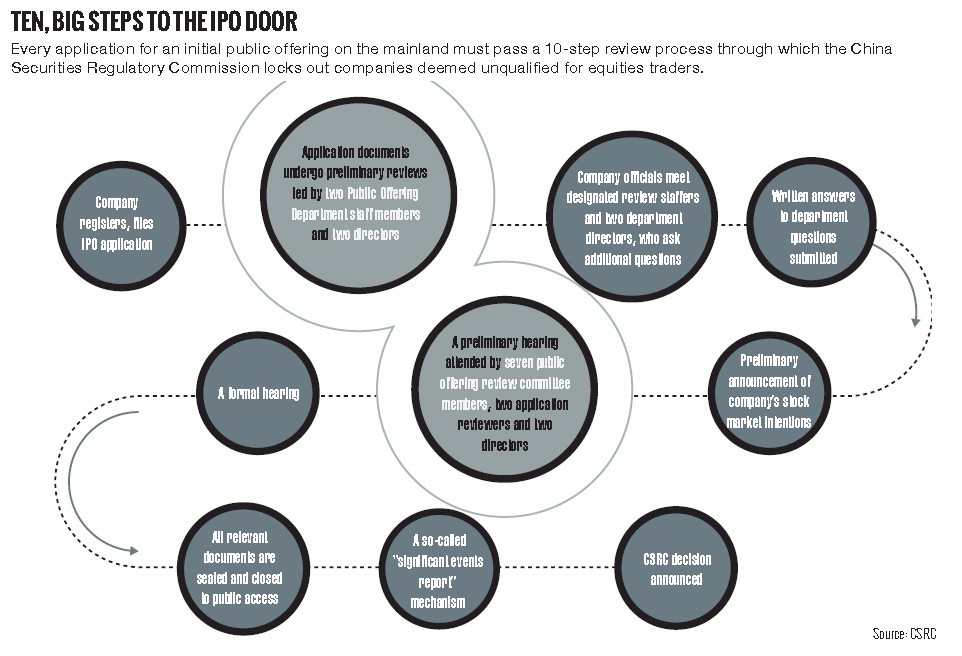
Finding IPO Alley; Permission to list on a stock exchange is often granted to companies that play an opaque and graft-poisoned game

03.04.2013 11:53

Finding IPO Alley

Permission to list on a stock exchange is often granted to companies that play an opaque and graft-poisoned game

1362369019965518

By staff reporter Lu Yuan

China’s IPO action has been locked in ice since October by China Securities Regulatory Commission (CSRC) officials intent on boosting investor confidence and improving scrutiny of stock market hopefuls.

Yet the heat is on for aspiring executives at more than 800 companies who, despite the freeze, have continued lobbying CSRC for permission to launch initial public offerings on the Shanghai and Shenzhen exchanges.

No one knows when CSRC might thaw the market for new listings. So executives have been busy door-knocking deep inside the commission at its dual “public offering departments” – one that reviews IPO applications for the Shenzhen Stock Exchange’s ChiNext growth board, the other for the Shanghai Stock Exchange A-share market.

They’ve also been busy wining, dining and warming up to members of CSRC’s elite Public Offering Review Committee (PORC), which ultimately decides the fate of every IPO application that’s survives the commission’s lengthy company review process.

In pursuit of warm relations, Caixin has learned, some IPO-hungry company executives have played along with rent-seeking CSRC officials. They’ve also paid intermediaries who charge enormous fees for access to key CSRC officials. Tens of millions of yuan may have traded hands in recent years. Read more of this post

China’s next inner circle

Monday March 4, 2013

China’s next inner circle

HONG KONG: Even as Xi Jinping gets ready to assume the presidency of China this month, jockeying has begun for 2017 when rising stars of the ruling Communist Party move into top leadership posts.

China’s first and second generation Communist Party leaders, such as Mao Zedong and Deng Xiaoping, ruled as single paramount leaders. But over the past two decades, Chinese leaders have tried to institutionalise governance with an emphasis on collective leadership – except when it comes to choosing leaders.

The process is highly secretive and influenced by faction leaders who jockey to get their allies on the 25-member Politburo and its apex body, the seven-member Politburo Standing Committee.

“In certain areas the rules and the norms of institutionalisation continue, but in certain areas they are subject to manipulation, in particular with regard to the selection of the Politburo,” said Cheng Li, director of research at the John L. Thornton China Center in the Foreign Policy program at the Brookings Institution. Read more of this post

Malaysia Regime Ouster Hinges on Borneo as Radio Aids Opposition

Malaysia Regime Ouster Hinges on Borneo as Radio Aids Opposition

At 7 p.m. on the Malaysian side of Borneo island, Luang Entiyang turns the dial on a transistor radio in search of an anti-government talk show as about a dozen villagers sit cross-legged on the floor waiting to listen.

Similar meetings occur daily across the jungles of Sarawak, Malaysia’s biggest state and one that has underpinned the ruling Barisan Nasional alliance’s 55-year hold on national power. The two-hour broadcast by U.K.-based Radio Free Sarawak, in which villagers call in to tell stories of land-grabs by palm oil companies, aided by local officials, has helped to pry loose Entiyang and other lifelong BN backers since it began in 2010.

“It makes a great difference because we are listening and learning,” Entiyang, 61, said Feb. 15 at his home in Melikin, a hillside village about a two-hour drive from Kuching, Sarawak’s capital. “If BN wins the election, the natives will have nothing. They will take all the land. Once they betray us, we say goodbye.”

Opposition inroads in Borneo rain forests that hold a quarter of Malaysia’s parliamentary seats pose the biggest threat to Prime Minister Najib Razak’s tenure as he prepares to call an election in the coming weeks. The prospect of a loss has unsettled investors, who have made the FTSE Bursa Malaysia KLCI Index the worst-performing benchmark in Asia this year on concern the country will undergo its first transfer of power since gaining independence from Britain in 1957. Read more of this post

China’s graft-fighting Xi tells party future is on the line; the Chinese leader peppered his latest speech with references to aphorisms from virtuous officials and philosophers such as Mencius and Zhuge Liang

China’s graft-fighting Xi tells party future is on the line

Xi, who will take over the reins of state power from outgoing President Hu Jintao this month, has made fighting pervasive graft a central theme since assuming the top job. -Reuters

Sun, Mar 03, 2013
Reuters

BEIJING – China’s ruling Communist Party will only be able to mark its 100th birthday in eight years time if officials can learn from the selfless sages of the past, party chief Xi Jinping said in remarks published on Sunday, taking another swipe at corruption.

Xi, who will take over the reins of state power from outgoing President Hu Jintao at this month’s annual full session of parliament, has made fighting pervasive graft a central theme since assuming the top job in the party and military in November.

The Communist Party marks the 100th anniversary of its founding in 2021, one year before the second of Xi’s two five-year term ends and he steps down as party chief.

“Only if the capabilities of all party members unceasingly continue to strengthen, can the goal of ‘two 100 years’ and ‘the dream’ of the great rejuvenation of the Chinese people be realised,” Xi said in a speech marking the 80th anniversary of the Central Party School, which trains rising officials.

“Two 100 years” refers to both the party and the People’s Republic of China lasting at least a century each. Read more of this post

Think New York Property Is Costly? In New Delhi, Seedy Goes for 8 Figures

March 2, 2013

Think New York Is Costly? In New Delhi, Seedy Goes for 8 Figures

By JIM YARDLEY

NEW DELHI — The fading bungalow at 38 Amrita Shergil Marg does not immediately shout real estate bling. There is no tennis court, no infinity pool, no Sub-Zero refrigerator or walk-in closet. The paint is chipped, the bathrooms are musty and the ceilings have water stains. The house may ultimately be torn down. Yet when it went up for public auction, the winning bid was almost $29 million. And many neighbors consider that a bargain. One block away, a gracious if not quite Rockefeller-ready residence once leased by the Mexican ambassador is now reportedly on the market for more than $100 million. Other nearby houses are going for $40 million to $70 million. “The price of the Mexican residence is $110 million,” said Jorge Roza de Oliveira, Portugal’s ambassador to India. “You can buy a home in New York and Miami and Lisbon and London and keep a lot of change for that much.” Real estate prices in the heart of New Delhi, especially for the bungalows built nearly a century ago during the British Raj, are among the highest in the world.

Read more of this post

Druckenmiller Sees Storm Worse Than ’08 as Seniors Steal

Druckenmiller Sees Storm Worse Than ’08 as Seniors Steal

Stan Druckenmiller, one of the best- performing hedge fund managers of the past three decades, has a warning for the youth of America: Don’t let your grandparents steal your money.

Druckenmiller, 59, said the mushrooming costs of Social Security, Medicare and Medicaid, with unfunded liabilities as high as $211 trillion, will bankrupt the nation’s youth and pose a much greater danger than the country’s $16 trillion of debt currently being debated in Congress.

“While everybody is focusing on the here and now, there’s a much, much bigger storm that’s about to hit,” Druckenmiller said in an hour-long interview with Stephanie Ruhle on Bloomberg Television’s Market Makers. “I am not against seniors. What I am against is current seniors stealing from future seniors.” Read more of this post

Smartphone sales in India may suffer from a higher tax on handsets costing more than $37

Chidambaram Eyes IPhone, Z10 to Plug Budget Gap: Corporate India

Smartphone sales in India may suffer from a higher tax on handsets costing more than $37 just as Apple Inc. (AAPL) steps up efforts to tap demand for data services in the world’s second-largest mobile-phone market.

Finance Minister Palaniappan Chidambaram yesterday said he would raise the excise tax on high-end phones to 6 percent from 1 percent to help finance welfare programs for the country’s poor and fund the widest budget deficit among the largest emerging economies. Samsung Electronics Co. (005930), which sells the Galaxy range of smartphones, said the move “won’t have a positive impact” on the mobile-phone industry and will force customers to pay more.

India’s government, after attempting to squeeze wireless operators including Vodafone Group Plc (VOD) and Bharti Airtel Ltd. (BHARTI) with higher license fees and airwave tariffs, is now targeting handsets for revenue from an industry that has boomed since Prime Minister Manmohan Singh opened the economy more than two decades ago. Chidambaram also increased tax on high earners, luxury cars and yachts. Read more of this post

Treasury Wine Estates Ltd. (TWE), Australia’s largest winemaker, plans to boost Chinese gift sales with trophy products similar to its $168,000 bottle of 2004 Penfolds Cabernet Sauvignon

Treasury Wine Readies China Gifts Modeled on $168,000 Ampul

Treasury Wine Estates Ltd. (TWE), Australia’s largest winemaker, plans to boost Chinese gift sales with trophy products similar to its $168,000 bottle of 2004 Penfolds Cabernet Sauvignon released last year. The Cabernet, contained in a glass ampul mounted inside a wooden cabinet, is “the sort of gifting that we really want to go out there” in Asia, David Dearie, chief executive officer, said in an interview yesterday. Treasury rose to a record today in Sydney trading. The company spent several hundred thousand dollars last year researching China’s wine-buyers, said Dearie. Treasury is using its findings to tailor products to Chinese consumers after success targeting Hispanic drinkers with Beringer’s Los Hermanos label in the U.S., he said. Read more of this post

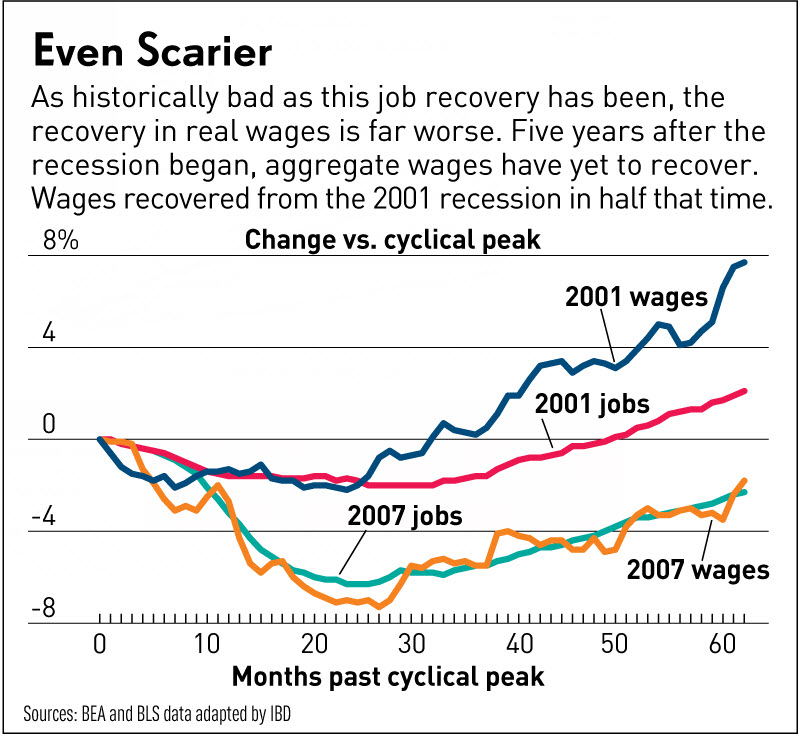
Wage Recession Hits 5 Years; Worse Than Jobs Drought

Wage Recession Hits 5 Years; Worse Than Jobs Drought

By JED GRAHAM , INVESTOR’S BUSINESS DAILY
Posted 02/28/2013 08:05 AM ET

IBD Wages

As bad as the current job recovery has been — and it’s by far the weakest since World War II — the recovery in wages has been far worse.

Five years after the recession began in December 2007, total wages in the economy have yet to fully recover in real terms, Commerce Department data show. In other words, the wage recession continues. Read more of this post

How State-owned Shipper Sailed into Stormy Seas; Analysts blame a shortsighted strategy, a bad bet on a financial derivative and poor management for COSCO Holdings’ woes

03.01.2013 12:23

How State-owned Shipper Sailed into Stormy Seas

Analysts blame a shortsighted strategy, a bad bet on a financial derivative and poor management for COSCO Holdings’ woes

By staff reporters Liu Ran and Wu Jing

(Beijing) – One of the country’s most prominent liner shipping operators, China COSCO Holdings Co. Ltd., is struggling to avoid being kicked out of the Shanghai Stock Exchange five years after its debut. It lost 6.5 billion yuan in the first three quarters of 2012 after a 10.4 billion yuan loss the previous year. Analysts expect it to post a loss of under 10 billion yuan for all of 2012. If it is in the red again in 2013, it will be forced to temporarily suspend trading until a profit can be turned. If losses continue for a fourth straight year, it will be delisted. However, the chances it can turn the tide this year seem to be long. Analysts say management is more incompetent than it cares to admit. Problems have arisen because of strategic miscalculations and bungled investments with hedging tools. Read more of this post

Chinese companies are struggling to translate their economic might into a worldwide reputation, according to a study released by Fortune magazine

Chinese firms still short of ‘global admiration’: Poll

Updated: 2013-03-02 02:42

By HE WEI ( China Daily)

Chinese companies are struggling to translate their economic might into a worldwide reputation,

according to a study released by Fortune magazine. Not a single Chinese company was ranked in the top 50 in its annual

“World’s Most Admired Companies List” for 2013, widely considered among the most definitive report cards on global corporate reputation.

Read more of this post

Heavy tax to dampen speculation; China’s cabinet ordered on Friday that a 20 percent individual income tax be levied on capital gains by home sellers

Heavy tax to dampen speculation

Updated: 2013-03-02 02:45

By Hu Yuanyuan ( China Daily)

20% levy on capital gains by sellers to rein in housing prices

In one of its sternest measures to hold back the rise of housing prices in major cities, the State Council, or China’s cabinet, on Friday ordered that

a 20 percent individual income tax be levied on capital gains by home sellers. This is the latest regulation following

the cabinet’s meeting on Feb 20 about the urban residential housing market. Currently, only a 1 percent individual income tax

is levied on the sale price, much lower than the 20 percent tax on the difference between the sale and purchase prices.

“The measure will definitely lead to a sharp drop in property transactions and change people’s expectations,”

said Ji Gang, a senior director in the investment department of real estate service provider Savills Property Services (Beijing) Co.

Read more of this post

World Bank calls Malaysia a regional leader in corporate governance, but there’s more to be done

Saturday March 2, 2013

World Bank calls Malaysia a regional leader in corporate governance, but there’s more to be done

By ERROL OH

malaysia-assessment-averages-chart-b03

IT’S like a report card you can proudly bring home to show mum and dad. On Tuesday, the World Bank released the findings of its assessment of corporate governance in Malaysia, and the numbers indicate that we have done well. Read more of this post