China’s Households “Massively” Exposed To Housing Bubble “That Has To Burst”

China’s Households “Massively” Exposed To Housing Bubble “That Has To Burst”

Tyler Durden on 01/28/2014 14:51 -0500

The topic of China’s real estate bubble, its ghost cities, and its emerging middle class – who now have enough money to invest and have piled into houses not stocks – and have been dubbed “fang nu” or housing slaves (a reference to the lifetime of work needed to pay off their debts); is not a new one here but, as Bloomberg reports, the latest report from economist Gan Li shows China’s households are massively exposed to an oversupplied property market. Read more of this post

China is biggest risk to emerging markets

January 28, 2014 8:21 am

China is biggest risk to emerging markets

By Henny Sender

Tight credit and slowing growth create ripple effect across EMs

Suddenly the prospects for emerging markets have dimmed further.

On Wall Street, wary traders speculate on which countries and securities will be under the greatest selling pressure, doubtless to get ahead of the anticipated wave of selling. Read more of this post

Why Harvey Norman has run out of steam

Why Harvey Norman has run out of steam

January 24, 2014

Nathan Bell

Hold your stones. What I’m about to write may sound like value investing heresy. I’m about to recommend you sell Harvey Norman – largely because it has a strong balance sheet and an owner manager.

We typically love these characteristics. They help companies maintain a long-term perspective, providing shelter to ride out short-term storms. But when a storm turns out to be a tsunami, then shelter may not do you much good; it would be better if you were a little less comfortable and were forced to seek higher ground. Read more of this post

Dee Hsu’s husband, Mike Hsu, and father-in-law charged with insider trading in Top Pot bakery case

Dee Hsu’s husband, Mike Hsu, and father-in-law charged with insider trading in Top Pot bakery case

image003-6

Wednesday, January 29, 2014 – 14:16

The China Post/Asia News Network

TAIPEI – The Taipei District Prosecutors’ Office concluded its investigation over the case of Top Pot Bakery, which involved alleged deceptive advertising and insider trading, and indicted four people including businessman Mike Hsu, the husband of talk show host Dee Hsu, on Tuesday. Read more of this post

Overheard In A Gold Vault In Singapore: “We Need Additional Capacity”, China’s Appetite Is “Insatiable”

Overheard In A Gold Vault In Singapore: “We Need Additional Capacity”, China’s Appetite Is “Insatiable”

Tyler Durden on 01/28/2014 15:21 -0500

Yesterday we covered the supply side of the gold market from the perspective of global mints, which were kind enough to advise that they “can’t meet the demand, even if we work overtime.” Today, courtesy of Bloomberg, we take a closer look at the demand aspect of the physical gold market, which as most know by now can be described with just one word: China. Read more of this post

Turkey tightens: implications of its aggressive rate rise

January 29, 2014 9:54 am

Turkey tightens: implications of its aggressive rate rise

By Daniel Dombey in Istanbul

In a moment of drama at midnight on Tuesday, Turkey’s central bank performed a volte face, increasing interest rates across the board where it had previously been reluctant to raise them. It more than doubled one key rate.

It was a striking move, given the political and financial backdrop: prime minister Recep Tayyip Erdogan has long made clear his opposition to high interest rates, while investors had become worried about Turkey and other emerging markets. Read more of this post

The rich stay rich while the poor struggle; Thanks to globalisation the centres of major cities now appear similar

January 28, 2014 4:59 pm

The world’s rich stay rich while the poor struggle to prosper

By John Kay

Thanks to globalisation the centres of major cities now appear similar

Dear Bill Gates,

We have never met, but your annual letter (coinciding with your Davos speech) seemed to be addressed directly to me. Your aim is to critique books with titles such as “how rich countries got rich and why poor countries stay poor”, and I did write a book with almost exactly that subtitle. You go on to say “thankfully these are not bestsellers because the basic premise is false”. I am afraid you are right to say my book is not a bestseller, but wrong to say its premise is false. Read more of this post

The challenges of a post-crisis world; Nations must nurture recovery and promote reform. Co-operation and communication should be the order of the day

January 28, 2014 7:19 pm

The challenges of a post-crisis world

By Martin Wolf

Nations must nurture recovery and promote reform. Co-operation and communication should be the order of the day

The consensus view of the world economy has become more optimistic, for good reason. The high-income economies seem at last to be taking off; this is particularly true for the US and UK. But significant challenges lie ahead, notably for the eurozone. For emerging countries, stronger growth in high-income countries brings benefits, but also costs. If euphoria is among the dangers to stability, 2014 should not see too much of it. Read more of this post

SEC Fights Turf War Over Asset Managers

SEC Fights Turf War Over Asset Managers

ANDREW ACKERMAN and RYAN TRACY

Updated Jan. 28, 2014 8:04 p.m. ET

image001-9

WASHINGTON—Senior U.S. officials are clashing over whether the asset-management industry poses risks to the financial system, setting up a fight over whether the industry should face tougher oversight. Read more of this post

Next-shoring: A CEO’s guide; Proximity to demand and innovative supply ecosystems will trump labor costs as technology transforms operations in the years ahead

McKinsey Quarterly

Next-shoring: A CEO’s guide

Proximity to demand and innovative supply ecosystems will trump labor costs as technology transforms operations in the years ahead.

January 2014 | byKaty George, Sree Ramaswamy, and Lou Rassey

When offshoring entered the popular lexicon, in the 1990s, it became shorthand for efforts to arbitrage labor costs by using lower-wage workers in developing nations. But savvy manufacturing leaders saw it as more: a decisive change in globalization, made possible by a wave of liberalization in countries such as China and India, a steady improvement in the capabilities of emerging-market suppliers and workers, a growing ability to transfer proven management processes to new locales, and increasingly favorable transportation and communications economics. Read more of this post

Marc Faber Warns “Insiders Are Selling Like Crazy… Short US Stocks, Buy Treasuries & Gold”

Marc Faber Warns “Insiders Are Selling Like Crazy… Short US Stocks, Buy Treasuries & Gold”

Tyler Durden on 01/28/2014 18:43 -0500

Beginning by disavowing Mario Gabelli of any belief that rising stock prices help ‘most’ people (“Fed data suggests half the US population has seen a 40% drop in wealth since 2007“), Marc Faber discusses his increasingly imminent fears of the markets in this recent Barron’s interview. Read more of this post

Fed Can’t Avoid Emerging-Markets Blame

Fed Can’t Avoid Emerging-Markets Blame

SPENCER JAKAB

Jan. 28, 2014 5:13 p.m. ET

Ben Bernanke just can’t catch a break.

image001-8

Three years ago he was forced to defend the Federal Reserve from accusations its bond buying somehow had triggered the Arab Spring, which was just getting under way at the time. Now, with the era of aggressive monetary policy waning, a slump in emerging markets is seen as a dangerous side effect of stimulus being withdrawn. Read more of this post

Charts of the day: Creative destruction in the S&P500 index

Wednesday, January 29, 2014

Charts of the day: Creative destruction in the S&P500 index

Mark J. Perry | January 26, 2014, 10:10 pm

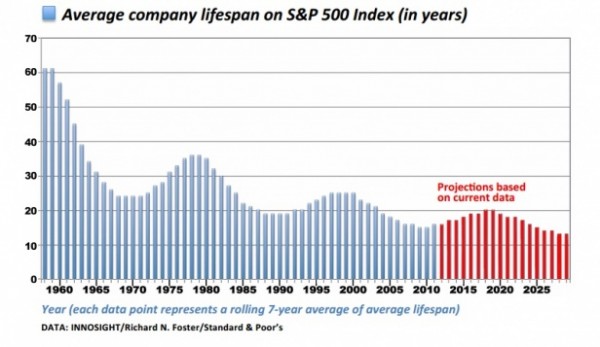
image001-7image002-2A 2012 article by Richard Foster (“Creative Destruction Whips through Corporate America“) provides a great example of “creative destruction” in the US economy and stock market – the accelerating turnover in the S&P500 Index based on almost 100 years of data. Here are some key findings: Read more of this post

Cash menagerie: Inside the bitcoin confab

Cash menagerie: Inside the bitcoin confab

January 28, 2014: 1:06 PM ET

The largest-ever bitcoin conference brought hustlers, dreamers, sharks, and technocrats to Miami.

By David Z. Morris

FORTUNE — Last weekend, Jan. 26 and 27, the North American Bitcoin Conference (NABC) in Miami drew a diverse, energized gathering of the most important figures of the emerging bitcoin sphere — a group that could still be considered remarkably small. There, they discussed obstacles facing the digital currency and payments network, oohed and aahed over the rushing stream of new bitcoin- and cryptocurrency-related services and products, and enthusiastically drank their way through Miami Beach’s most iconic dens of neon hedonism. Read more of this post

‘Fragile Five’ Is the Latest Club of Emerging Nations in Turmoil

‘Fragile Five’ Is the Latest Club of Emerging Nations in Turmoil

By LANDON THOMAS Jr.JAN. 28, 2014

The long-running boom in emerging markets came to be identified, if not propped up, by wide acceptance of the term BRICs, shorthand for the fast-growing countries Brazil, Russia, India and China. Recent turmoil in these and similar markets has produced a rival expression: the Fragile Five. Read more of this post

Japanese boardrooms learn to love English

January 29, 2014 5:10 am

Japanese boardrooms learn to love English

By Jennifer Thompson in Tokyo

English, the lingua franca of boardrooms and even, in some cases, factory floors from Paris to Nairobi, remains a distinctly foreign tongue for much of Japanese business.

Read more of this post

How postmen, and their wives, may help set India’s monetary policy

How postmen, and their wives, may help set India’s monetary policy

By Reuters | 28 Jan, 2014, 04.14PM IST

NEW DELHI: Global investors may well be putting their faith in postmen like Phanin Deka when they decide to buy or sell Indian assets in the future.
He is one of about a thousand post workers collecting data that determines the level of India’s consumer price index, which is likely to become the central bank’s most important tool for setting monetary policy.

Read more of this post

Emerging markets as vulnerable to contagion as ever

Emerging markets as vulnerable to contagion as ever

Mon, Jan 27 2014

By Sujata RaoDaniel Bases and Vidya Ranganathan

LONDON/NEW YORK/SINGAPORE (Reuters) – Emerging markets may be unrecognizable from the small and fragile economies that fell like dominoes 15 years ago, but they are just as vulnerable today to the same sort of indiscriminate selling when investor panic sets in.

Read more of this post

Thailand’s unanswered question: where is Thaksin?

January 28, 2014 6:17 am

Thailand’s unanswered question: where is Thaksin?

By Michael Peel in Bangkok

He hasn’t posted on his official Facebook or Twitter accounts for over a month and was last sighted on Webstagram posing with his daughters at the end of the trans-Siberian railway in December. Yet, nine years since Thaksin Shinawatra last won a contested election in Thailand and more than five years since he set foot in the country, his is still the name on many people’s lips in the run-up to fresh polls on Sunday – if they go ahead.

For his enemies, the self-exiled billionaire telecoms magnate is the dark corrupting hand behind all the administration of his younger sister, Yingluck, has done before and during a political crisis that erupted in November and led to violent clashes in Bangkok at the weekend.

To his core supporters – many of whom are due to rally nationwide on Wednesday – this scion of a political family in his north Thai heartland is a king across the water, still commanding fierce loyalty seven years after his ousting by the military.

“That coup of 2006 is the cause of all the problems in Thailand,” declared Attakorn Kantachai, a north Thailand radio presenter and pro-government activist, whose business card carries a picture of him with Mr Thaksin in Cambodia. “Thaksin’s policies benefited the people.”

The February 2 poll that Ms Yingluck’s ruling Puea Thai party has sworn to hold and the opposition to sabotageare in part about her absent brother and his legacy. Uprooting the “Thaksin regime” from southeast Asia’s second-largest economy is the main aim of the People’s Democratic Reform Committee activists who have been blockading roads in Bangkok since January 13.

Skirmishes are part of a battle that has raged since Mr Thaksin was removed from power, after notching landmark landslide election victories in 2001 and 2005 by wooing rural voters with subsidised healthcare and cheap loans.

Convicted of corruption in 2008 in a case he says is politically motivated, Mr Thaksin has since remained in a peripatetic exile centred on the Gulf emirate of Dubai, leaving both friends and foes to watch closely for signs of him shaping events at home before an eventual return.

Mr Thaksin has kept a pretty low profile by his standards since an abortive attempt by the Yingluck government to pass an amnesty law to whitewash politicians on both sides, including himself, accused of serious crimes.

He has said little about Thai politics other than a December Facebook post deploring its cruelty. Interviewed briefly by the Financial Times at a Dubai mall in November, he said he didn’t want to come home if he was “part of the problem”.

Yet, for all that apparent reticence, there is no secret about his influence on the government of his sister 18 years his junior, whom he once described as his “clone” and who campaigned for the 2011 election using the slogan “Thaksin thinks, Puea Thai does”. Mr Thaksin has traditionally set policies – such as the massive rice subsidy that is wildly popular with farmers but is unravelling amid cash shortages and allegations of corruption – and talked regularly to officials.

Noppadon Pattama, Mr Thaksin’s legal adviser, says it is natural the former premier speaks to Ms Yingluck: “they are brother and sister”. But he denies Mr Thaksin is orchestrating remotely the crisis strategy of a government that has often seemed a step slow in responding to events.

“Sometimes people do call him for advice, I won’t deny that,” Mr Noppadon said. “But the major part of the task has been carried out by those in Thailand.”

The latest reminder of how Mr Thaksin remains everywhere and nowhere in Thailand will come via the rallies planned this week of the “red shirts” who first sprang up to protest against his defenestration by the army in 2006.

It’s also a measure of his divisiveness that the red shirt leader, Thida Tawornseth, is still passionate about the ex-premier’s groundbreaking embrace of elections in Thailand’s coup-plagued politics – but more equivocal about the dynasty he has carved out for his Shinawatra clan in the process.

“For me, I don’t care about the family,” Ms Thida said. “But I care about the principle of democracy.”


Growth and globalisation cannot cure all the world’s ills; New forms of political conflict have emerged that are resistant to traditional prescriptions

January 27, 2014 7:33 pm

Growth and globalisation cannot cure all the world’s ills

By Gideon Rachman

New forms of political conflict have emerged that are resistant to traditional prescriptions

Faced with a dangerous political threat, governments the world over tend to place their faith in the same magic medicine – economic growth. When world leaders try to address the roots of terrorism, for example, they instinctively assume that prosperity and jobs must be the long-term answer. And when a regional conflict threatens to get out of control – in east Asia or the Middle East – the standard political response is to call for greater economic integration. From Europe to China, governments place their faith in economic growth as the key to political and social stability.

But just as doctors fear the emergence of superbugs that will not respond to existing drugs, so world leaders are beginning to witness the emergence of new forms of political conflict that are resistant to their traditional prescriptions – more trade and more investment, washed down with a good dose of structural reform.

Three political superbugs are causing special concern. The first is the spread of conflict in the Middle East. The second is the growing rivalry between China and Japan. The third is rising inequality in the western world – and the threat of social conflict that goes with it.

Delegates at the World Economic Forum in Davos, which ended last week, are the classic believers that capitalism and globalisation are the best antidotes to conflict. This belief is so deeply ingrained that it no longer even needs to be articulated. You can just see it in the way in which a Davos audience responds to political leaders.

This year it was President Hassan Rouhani of Iran who was received with great enthusiasm, largely because he seemed more interested in trade and investment than in nuclear weapons. Mr Rouhani did not shift Iran’s position on the difficult political issues – such as Syria, Israel or nuclear weapons – in any important way. But he sent a significant signal by beginning his speech with a statement of his ambition for Iran to become one of the 10 largest economies in the world. The Iranian leader also stressed the need to improve his nation’s relations with the rest of the world in order to achieve that goal. This emphasis on economics suggested to those in the audience that President Rouhani is literally a man you could do business with.

As a result, Mr Rouhani is in the novel position, for an Iranian leader, of being regarded as a voice of reason in the Middle East. But the president’s elevated status in the eyes of the Davos crowd is also a sign of how bleak things look elsewhere in the region.

No appeal to economic rationality is likely to end the war in Syria – where both sides are fighting for survival. It is also clear that the jihadists who are flourishing in Syria, Iraq and elsewhere are unmoved by the fruits of globalisation. Unless something goes seriously wrong, they will not be showing up in Davos any time soon.

Many still hope that an improvement in the economic situation of the Middle East will assuage the economic despair on which militant Islam is assumed to flourish. Yet not all jihadists hail from poor countries or impoverished backgrounds. Some of the militants showing up in Syria have travelled from Europe. Others have come from Saudi Arabia or the Gulf states. Jihadism is a disease that does not respond well to the traditional economic drugs.

The rise in tensions between China and Japan is an even more graphic illustration of the fact that economic self-interest is not a cure-all for political problems. China is now Japan’s largest trading partner and the biggest recipient of Japanese foreign investment – facts that many analysts still hope will make conflict between the two nations significantly less likely. Yet in some respects, China’s growing prosperity is actually driving the increase in international tensions in Asia. That is because the rise of China has altered the balance of power between Beijing and Tokyo and – combined with the bitter history between the two countries – that explains why relations are getting worse.

In Europe and North America it is the threat of political and social tensions within nations, rather than international rivalries, that are worrying the global plutocracy. A central element of the Davos creed is the faith that globalisation is good for both the western world and for emerging powers.

However, it is now almost conventional wisdom that the globalisation medicine has had an unpleasant side-effect. Even if it raises overall growth levels it has also powerfully contributed to wage stagnation and increasing inequality in the west. As a result, European politicians are worrying about a possible resurgence of the nationalist right and the radical left. And the Americans are increasingly worried about the gap between the richest 1 per cent and the rest – and the political consequences should the gulf keep widening.

It is easy to mock the global plutocracy – fretting about war and inequality – as they sip fine wines, behind a security perimeter high in the Swiss mountains. Yet global bankers and business people are, at least, largely immune to the viruses of xenophobia and nationalism. Their unofficial slogan is “make money, not war”. And they treat foreigners as potential customers rather than potential enemies.

In that sense, the idea that capitalism and globalisation are the best antidotes to political conflict – for all its flaws – retains a lot of attraction. Even if the old economic treatments for political conflict are losing some of their potency, they are still the best we have.


Finance: In search of a better bailout; Proposals to overhaul sovereign debt restructuring are raising fears of unintended consequences

Finance: In search of a better bailout

By Robin Wigglesworth

Proposals to overhaul sovereign debt restructuring are raising fears of unintended consequences

For two years Petros Christodoulou had one of the world’s toughest jobs. As head of Greece’s debt office his first task was convincing increasingly sceptical investors to lend to Athens. Then he had to orchestrate the biggest government debt restructuring in history amid a cacophony of protest from bankers, politicians, hedge funds and European leaders.

Mr Christodoulou, who had spent years as a trader at JPMorgan and Goldman Sachs, held his nerve but the pressure was too much for some of his staff, who quit. Once the restructuring was complete, he too left Greece’s debt management office. “It was a tremendously strenuous situation,” he admits. “When Armageddon hits you’re always less prepared than you think.”

Still, Mr Christodoulou feels there are valuable lessons to be learnt from Greece’s bruising experience with sovereign debt restructuring. “The system needs to be fixed,” he says. “We should have a predictable framework for restructurings that ensures that other countries do not have to go through what Greece did.”
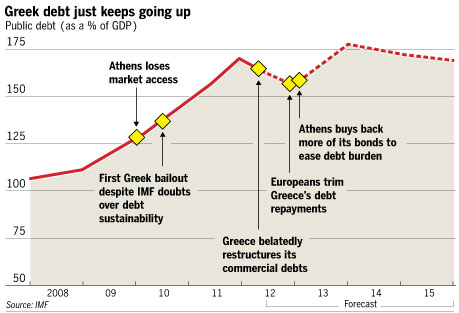
image001-6

He is not alone in thinking that the bankruptcy process for countries should be overhauled. The eurozone crisis has triggered a boisterous discussion among policy makers, investors, economists and academics about the merits and pitfalls of the framework for sovereign restructurings, or rather, the lack of one.

Even the Canadian and UK central banks have weighed in with opinions on how to improve the system.

The debate has grown more heated since Elliott Management, a US hedge fund known for extracting money from defaulting countries, scored a legal victory in 2012 over Argentina in a protracted courtroom battle. Although Elliott has yet to extract a peso from Buenos Aires, many experts fear that its initial success has handed a potent weapon to creditors that will further complicate future sovereign restructurings.

This is not merely an arcane discussion over what went wrong with Greece but a politically fraught debate that could still have a seismic impact on the global financial system. The eurozone crisis has abated but many fear that the fundamental problem it highlighted – high levels of government debt across much of the world – remains a danger.

Philip Wood of Allen & Overy, the law firm that advised Greece’s creditors, says: “I hope Greece was a one-off but I am not sure it was. If you look at all the debt out there it is hard to conclude that there isn’t a problem. State bankruptcies have not gone away. In fact they are likely to get worse.”

Last year, the fund decided to throw its weight behind those who felt the current system was riddled with problems. In a far-ranging paper released in April, it floated a series of proposals that thrilled many proponents of an overhaul and horrified opponents.

The IMF’s primary argument was that countries tend to restructure too late, and when they do the debt relief they obtain is too modest. That means that any bailout loans provided by the fund, or other official sector lenders such as development banks or neighbouring countries, in effect go to pay off private creditors and merely add to a daunting debt burden.

The IMF therefore plans to explore ways to get creditors to “voluntarily” reschedule a distressed country’s debt repayments when it cannot say for certain whether the government is facing a temporary downturn or a full-blown solvency crisis. Only after that stage would the fund step in with a rescue programme.

The IMF is also seeking ways to address the threat posed by the Argentine litigation. Stripping away the euphemisms it means the fund would require countries to default on their debts and creditors to swallow a loss – albeit mild – if a country is forced into its arms. Yet Hugh Bredenkamp, deputy director of the IMF’s policy department, argues this is necessary to avoid a repeat of cases such as the Greek crisis.

“Recent experience shows that debt restructurings have often been too little, too late, thereby impeding economic recovery, deterring investment and creating opportunities for private creditors to cash out in a run up to the restructuring, leaving the official creditors – that is the taxpayers – to bear the burden,” he says.

I hope Greece was a one-off but I am not sure it was. If you look at all the debt out there it is hard to conclude that there isn’t a problem

– Philip Wood of law firm Allen & Overy

The IMF is now engaged in a protracted consultation with economists, academics, investors, bankers and officials over its proposals. It hopes to present refined proposals to the fund board for approval in June.

Even after that the IMF expects more discussions will be necessary. “We are proceeding carefully, and without any urgent deadlines or imminent needs in mind,” Mr Bredenkamp stresses.

Some experts think the IMF is not going far enough. They want a comprehensive framework for state bankruptcies akin to a proposal it floated a decade ago. The initiative, known as the Sovereign Debt Restructuring Mechanism, mimics aspects of corporate bankruptcies, with the fund playing the pivotal role as judge. But the initiative foundered after the US withdrew its support.

The IMF is at pains to stress that it is not seeking a “statutory” solution to the problems it identified. It is primarily exploring changes to its lending policies and modest improvements in the restructuring process through bond contract tweaks.

These could include beefing up “collective action clauses”. They rose from the ashes of the mechanism and allow a supermajority of bondholders to vote on a restructuring that binds everyone. They are now common in bond markets, and limit the chances that minority creditors such as hedge funds such as Elliott can undermine a deal. But they are far from universal, or a panacea, which is why the fund wants to sharpen them.

“The fund is looking for something that will make the system work a little bit better,” says Anne Krueger, who was the leading champion of the SDRM as first deputy managing director of the IMF in 2001-06. “Obviously it would help to have a statutory mechanism in place but the question is whether it is feasible within the political constraints.”

. . .

Yet the Committee on International Economic Policy and Reform, an influential think-tank, has backed the IMF and urged it to go even further in some areas. In a paper called “Revisiting Sovereign Bankruptcy” published in October, the think-tank advocated a statutory system for the eurozone, sweeping bond contract reform and the creation of a “sovereign debt adjustment facility” under the aegis of the IMF. This would combine fund lending with debt restructuring under clearly defined ex ante criteria.

Lee Buchheit, a partner at Cleary Gottlieb, legal counsel of choice for distressed countries and co-author of the CIEPR paper, concedes that resistance to the proposals is fierce. Yet he is confident that the debate will bear fruit. “It’s just so hard to come up with good policy arguments against it,” he says.

Nonetheless, there are plenty of officials, lawyers, academics and investors who have lined up to criticise even the IMF’s more modest proposals. They warn that if implemented, the plan would have severe unintended consequences that could in extremis have systemic implications.

Mr Wood argues that despite concerns over the impact of the Argentine litigation, the current system “seems to work quite well”. He points out even Greece’s mammoth, politically fraught restructuring only took months. “There is a legal vacuum in sovereign restructuring but that doesn’t mean there is anarchy.”

While the fund reckons restructurings are often late and inadequate, investors worry that it will now veer too forcefully in the opposite direction, with action triggered by facile debt thresholds, for example. IMF officials stress it is seeking only judicious, gentle “rescheduling” when it cannot say for certain that the debts are sustainable, but many money managers are sceptical.

Some fund managers predict that this would raise the borrowing costs of countries and make crises more frequent and more painful. As soon as investors get a whiff of a possible IMF programme the country involved would be frozen out of debt markets. Money could even start gushing out of the domestic banking sector, swiftly escalating mild concerns into a full-blown financial crisis.

It is not only self-interested investors who are worried. Moody’s, the rating agency, has warned that the proposed IMF “policies may improve the resolution of sovereign debt crises but they will probably increase the likelihood, move forward the timing and increase the severity of debt restructurings”.

. . .

Some experts argue that the fund needs to stiffen its political backbone, not its policies. After all, the IMF initially endorsed the restructuring-free bailout of Greece following intense pressure from its European shareholders. If the fund is sceptical that a country’s debts are sustainable, it can in theory use its position as a lender of last resort to force a country to restructure its debts.

“There’s nothing missing in the IMF toolkit except political will,” says Anna Gelpern, a law professor at Georgetown and co-author of the CIEPR paper.

Most crucially, some of the IMF’s own shareholders seem to be harbouring doubts. The US Treasury is concerned by the emboldening impact that Elliott’s victories over Argentina could have on other hedge funds. But the Treasury favours a pragmatic, case-by-case approach rather than adopting what it feels will be a policy of presumptive restructurings. Even European governments that supported the SDRM initiative are concerned that the proposals could scare investors away and reignite the eurozone crisis.

Despite the opposition, some of the IMF’s proposals are likely to survive. For example, less contentious measures, such as beefing up Collective Action Clauses to allow restructuring votes across a country’s debts rather than just bond-by-bond, could be implemented. These will, in time, ameliorate the danger of Argentine-style litigation.

The very fact that the IMF is re-examining its lending policies could also have an impact. It is clearly trying to signal that creditors should not expect to emerge from all future IMF programmes unscathed.

Irrespective of what the fund board and government shareholders eventually decide, Mr Buchheit argues its staff will get one thing they want: “A message to markets that the assumptions of full bailouts in all cases are unfounded, and to troubled debtors of the future that they should expect to have to restructure.”

Even some old foes of IMF over-reach support that view. John Taylor, an economics professor at Stanford, was a leading opponent of the SDRM as US Treasury undersecretary for international affairs in 2001-05, but agrees the sovereign restructuring process now needs fixing.

He still favours a contractual approach but argues the fund should have a restructuring policy as automatic, clear and credible as possible. “We have to get away from this bailout mentality,” he adds.

——————————————-

An alternative fix for the faultlines

The International Monetary Fund is not the only powerful institution to support a reworking of the sovereign debt restructuring process.

In November the UK and Canadian central banks jointly presented their own solution to the “faultlines” in the present regime revealed by the eurozone crisis.

The jointly authored paper proposed that governments start issuing “contingent convertible” bonds, and bonds where the returns are linked to economic growth. So-called “sovereign cocos” would automatically extend repayment times when countries receive a bailout. Growth-linked bonds would pay out according to a country’s economic output, rather than a fixed amount, irrespective of the conditions of state finances.

These would help resolve future debt crises and reduce moral hazard and the demands on the public purse, the central banks argued.

There have been several similar proposals in the past but Mitu Gulati, a law professor at Duke University, points out that the two central banks enjoy some clout in policy making circles. “The Bank of England does not have a habit of wasting its time, and they’re really pushing this idea with the Bank of Canada,” he says.

The paper recognised that there could be resistance to its ideas and notes the dearth of sovereign cocos and gross domestic product-linked debt, despite the apparent economic logic. But the authors highlight how international backing ensured that “collective action clauses” – which allow a majority of creditors to vote on a restructuring that binds all – have become ubiquitous.

This experience suggests that it would be possible to implement the two types of state-contingent bonds proposed, the paper argues.

Crucially, the central banks’ proposals would be a “contractual” approach to tweaking the sovereign debt restructuring process, which the IMF now says it favours, as opposed to a more heavy-handed “statutory” fix.

However, that means that even if the ideas are championed by policy makers and countries begin issuing bonds with these provisions, it will take many years before most government bonds in circulation include the clauses.

 

Don’t Write Off the (Western) Focused Firm Yet

Don’t Write Off the (Western) Focused Firm Yet

by Herman Vantrappen and Daniel Deneffe  |   11:00 AM January 27, 2014

The rise of Tata in India, Koç Holding in Turkey, and Grupo Carso in Mexico have some management thinkers contending that the conglomerate is back at the expense of the focused firm. In his article “Why Conglomerates Thrive (Outside the U.S.)” in the December 2013 issue of the Harvard Business Review, J. Ramachandran concludes from a study of the performance of listed Indian business groups that the conglomerate is a winning organizational structure, even if isn’t popular in North America yet. In its January 11th issue, The Economist also argues that conglomerates are spreading their wings again. Often the debate turns ideological, arguing that the (emerging-world) conglomerate is an intrinsically better construct than the (Western) focused firm.

In our opinion, which of the two is the more successful depends on the context in which the business operates. Specifically, focused firms fare better in countries where society expects and gets public accountability of both firms and governments, while conglomerates succeed in nations with high public accountability deficits.

Simple micro-economics sheds light on the issue. Imagine you are starting a new business. What will make it successful is your ability to induce customers to buy from you rather than from someone else. As long as the revenues you obtain from those customers exceed your costs, you will turn a profit. You would consider first whether you could offer a distinct product to each individual customer that perfectly matches his or her unique preferences. Of course more often than not you would find out that such extreme customization is not profitable. As a consequence, you would begin to lump similar customers together into segments to which you offer a “compromise” product. While you no longer extract maximum value from each customer, you are still better off as a result of economies of scale and scope.

As this phenomenon repeats itself, the diversified firm is born. You add product families first, followed by business lines, each time addressing extra customer segments. As long as the extra revenues justify extra costs, and economies of scale and scope outweigh the cost of increased complexity, it makes sense to continue diversifying.

The nature of these economies of scale and scope change as you diversify more and more. Initially these savings are mainly physical, as you stretch the use of tangible assets such as plants, networks and systems. Subsequently they become more knowledge-based, as you share technologies, brands and customer intelligence. Finally, when you are at the conglomerate stage, they relate to social capital, as you move talent across internal boundaries and leverage personal relations with politicians, government officials, investors and other external parties who can greatly facilitate or obstruct your plans–not necessarily with the greater good in mind.

Given the still-prevailing “conglomerate discount” Western firms are subject to (i.e., the conglomerate share price is less than the sum of the values of its constituent businesses), we would argue that the economies from leveraging personal relations with external parties are non-existent in these firms. The forces of lawmaking, jurisprudence and, yes, ethics bring about sufficient transparency, market efficiency and fair business behavior for the conglomerate not to be worth its salt.

In the emerging world, however, these forces may be underdeveloped. In such cases officials, investors and other parties put extraordinary trust in the people they know at the helm of the successful conglomerate, for example to realize their pet projects, invest their funds or set up a joint venture – and are willing to pay a premium for it. For example, the local connectedness of emerging market conglomerates is one of the main reasons why many Western firms, in industries as diverse as electrical power and insurance, set up joint ventures with them. In addition to serving customers – which stays the very raison d’être of a firm – the conglomerate thus serves also as a conduit for initiatives that the external parties otherwise might find too risky to pursue. For example, investing in a partially listed subsidiary of a conglomerate that has been around for more than 100 years in a volatile emerging market gives a greater sense of comfort than going it alone.

Take a tobacco company in the U.S. It may spend fortunes on lobbying, but it is all about promoting its one business activity, i.e. tobacco. It doesn’t get into, say, cereals, because it realizes that knowing this one Congressman won’t make it as successful in cereals as a focused cereals manufacturer. There is no “scope effect.” But if this tobacco company wants to enter, say, India, it could establish a joint venture with a local conglomerate that has all the right connections, be it with a governor for land, another firm for electrical power, etc. It doesn’t matter that this conglomerate isn’t in tobacco yet. It just leverages its connections, and will somehow ask a premium for that know-who from its U.S. JV partner, for example by getting a higher stake in the JV than it otherwise would deserve.

We don’t expect this phenomenon to re-emerge in the Western world, and thus the conglomerate to regain a foothold. Quite to the contrary.

Consider PPG Industries. The US-based company used to be a diversified industrial group, with activities in all types of glass, chemicals, paints, optical materials and biomedical systems. Through a raft of acquisitions and divestments since the early 1990s, it has transformed into a focused world-leading coatings manufacturer with $15 billion sales. In 1995, glass and coatings each accounted for about 40% of sales. By 2012 as the firm became more focused, this split had evolved to 85% coatings and 7% glass. In that same period PPG’s share price has risen by a compound average rate of 6.6%, compared to 5.1% for the S&P 500 Industrials. Quite a respectable performance for a company operating in a fairly mature industry. It may well reflect the power of focus.

At the same time, we’re not arguing that conglomerates aren’t effective in emerging markets. One statistic that, unfortunately, may point to the lasting importance of local connectedness is the Corruption Perceptions Index published annually by Transparency International. It uses a scale from 0 (highly corrupt) to 10 (very clean). Since 1995 the index has remained stable at around level 3 in India and level 7.5 in the U.S., to take these two countries as an example. Until such public accountability deficits can be addressed, the economies of scope related to social capital (“this-person-I-know-and-trust-in-an-otherwise-untrustworthy-environment”) will sustain the conglomerate phenomenon in the emerging world.

The conglomerate is a “necessary evil” in many emerging markets: without it, things might not work. But it is a symptom of a deficit that has a high societal cost. That’s something to think through before heralding its return. In the meantime, (Western) consumers, investors, and society at large should be delighted with the focused firm.


China trust deal raises thorny questions

January 28, 2014 2:21 am

China trust deal raises thorny questions

By Simon Rabinovitch in Shanghai

A wealthy pensioner in a southern Chinese city deciding to lend money to a troubled coal miner in the country’s north about which she knew next to nothing might seem a dangerous gamble.

But Ms Wang did not see it that way – at least not until a few weeks ago. As a VIP customer at a Shenzhen branch of Industrial and Commercial Bank of China, the country’s largest bank by assets, she was offered a special investment product in 2011. For a minimum commitment of Rmb3m ($500,000), she was promised an annual return of 10 per cent for three years. And, she says, the ICBC client manager assured her that the trust product was safe.

“It was my first time buying a trust product. I had never bought any stocks or mutual funds before. Having seen the Lehman Brothers troubles, I was very careful in reviewing the product, and I only put my money into it as it didn’t look to be risky,” she told the Financial Times. Like many other investors, she wrongly assumed the trust was “backed by the biggest bank in China”.

But like the 700 other investors who took up the offer, Ms Wang sorely underestimated the risks. Last week ICBC warned investors they might not get their money back – and that contrary to a belief held by many, the bank had never guaranteed the trust product.

The trust product she bought – “Credit Equals Gold No. 1” – came within days of a default that would have wiped out almost all of the cash she had invested.

For global markets, the troubled product became emblematic of the risks that have built up in China’s burgeoning shadow banking sector. Non-bank institutions such as trusts now play a crucial role in providing funds to companies deemed too risky by regulators to borrow from the country’s banks. Financing outside the formal banking system accounted for more than a third of the Rmb17tn total new credit issued in 2013.

With roughly Rmb4tn ($661bn) in trusts maturing this year amid tight monetary conditions, many expect more repayment problems. “The market already perceives a higher risk and is in the process of pricing higher risk,” says Wang Tao, an economist with UBS.

In the case of Credit Equals Gold No. 1, ICBC clients invested a total of Rmb3bn in a product sold by China Credit Trust, one of the country’s biggest “shadow banks”. The product – a mere sliver of China’s $1.2tn trust market – was underpinned entirely by loans to and equity in coal miner Shanxi Zhenfu Energy Group. It was a rotten investment: the price of coal plummeted and Zhenfu collapsed under the weight of heavy debts.

Nevertheless, on Monday, four days before the product matured, ICBC told investors a deal had been reached that would allow them to recoup their full principal, although they would miss out on about a quarter of the interest they had expected to earn.

There was little detail about where the money came from, but Chinese media have reported in recent days that a bailout was likely to involve ICBC, China Credit and the local government.

Some investors are vowing to fight for the additional interest. “This is a war of attrition. We have gained the biggest mountain and now we must attack and seize the smaller hills,” says one Shanghai-based investor who declined to give his name.

The last-minute rescue raises a thorny question for the future of the Chinese economy. Has the deal confirmed the widespread belief that the government will do whatever it can to stave off trouble, hence fuelling more risk-taking? Or has the near-default taught investors that high yields come with high risks?

“This is something that policy makers are struggling with. The final solution has probably reinforced people’s perception that trust products bought through banks will be bailed out,” says Shen Jianguang, an analyst with Mizuho Securities. “But this case has also showed many people that it’s not risk-free.”

The optimistic scenario is that the government will now use the extra time bought by the apparent bailout to bring its shadow banking system to heel. Beijing has drafted a series of regulations since late last year to limit off-balance-sheet lending by banks. “This will help regulators push through these rules. It teaches everyone a lesson about the expansion of shadow banking,” Mr Shen says.

The pessimistic take is that it is simply too late – that as money runs short, investors in failed trust products will face far bigger losses than Ms Wang did, creating turmoil for the whole financial system.

“We believe recent trust troubles in China are only the tip of the iceberg,” says Kevin Lai, an analyst with Daiwa Capital Markets.


China’s debt-fuelled boom is in danger of turning to bust; The longer a credit hot streak lasts, the more likely it is to end abruptly, writes Ruchir Sharma

January 27, 2014 7:36 pm

China’s debt-fuelled boom is in danger of turning to bust

By Ruchir Sharma

The longer a credit hot streak lasts, the more likely it is to end abruptly, writes Ruchir Sharma

Forget Argentina. The big story of 2014 in the emerging world is the black cloud ofdebt hanging over China.

Debate rages over how this tale will end. Most analysts believe that the Chinese economy will once again expand by more than 7 per cent this year, despite ballooning private sector debts. But the pessimistic minority has history on its side. Only five developing countries have had a credit boom nearly as big as China’s. All of them went on to suffer a credit crisis and a major economic slowdown.

These are powerful precedents. Recent studies have isolated the most reliable signal of a looming financial crisis and it is the “credit gap”, or the increase in private sector credit as a proportion of economic output over the most recent five-year period. In China, that gap has risen since 2008 by a stunning 71 percentage points, taking total debt to about 230 per cent of gross domestic product.

A credit boom of this scale is not likely to end well. Looking back over the past 50 years and focusing on the most extreme credit booms – the top 0.5 per cent – turns up 33 cases, with a minimum credit gap of 42 percentage points.

Of these nations, 22 suffered a credit crisis in the subsequent five years and all suffered an economic slowdown. On average, the annual economic growth rate fell from 5.2 per cent to 1.8 per cent. Not one country got away without facing either a crisis or a major economic slowdown. Thailand, Malaysia, Chile, Zimbabwe and Latvia have had a gap higher than 60 points. All those binges ended in a severe credit crisis.

Although there have been no exceptions to this rule, most economists still believe China will prove exceptional. For 30 years it has defied sceptics, maintaining a growth rate that has averaged 10 per cent, and has not fallen below 7 per cent since 1990.

China has hit its ambitious growth targets so consistently that many analysts can no longer imagine a miss. The consensus forecast is for growth of 7.5 per cent this year, right on target. Growth is widely expected to continue at an average rate of 6-7 per cent for the next five years. It is hard to find a prominent economist who forecasts a significant slowdown, much less a credit crisis.

The unravelling of the 33 most extreme credit binges before China’s suggests that it faces a serious risk of at least a major slowdown

History foretells a different story. In the 33 cases in which countries built up extreme credit gaps, the pace of GDP growth more than halved subsequently. If China follows that path, its growth rate over the next five years would average between 4 per cent and 5 per cent.

The key to foretelling credit trouble is not the size but the pace of growth in debt, because during rapid credit booms more and more loans go to wasteful endeavours. That is China today. Five years ago it took just over $1 of debt to generate $1 of economic growth in China. In 2013 it took nearly $4 – and one-third of the new debt now goes to pay off old debt.

Those who trust in China’s exceptionalism say it has special defences. It has a war chest of foreign exchange reserves and a current account surplus, reducing its dependence on foreign capital flows. Its banks are supported by large domestic savings, and enjoy low loan-to-deposit ratios. History, however, shows that although these factors can help ward off some kinds of trouble – a currency or balance-of-payments crisis – they offer no guarantee against a domestic credit crisis.

These defences have failed before. Taiwan suffered a banking crisis in 1995, despite having foreign exchange reserves that totalled 45 per cent of GDP, a slightly higher level than China has today. Taiwan’s banks also enjoyed low loan-to-deposit ratios, but that did not avert a credit crunch. Banking crises also hit Japan in the 1970s and Malaysia in the 1990s, even though these countries had savings rates of about 40 per cent of GDP. Furthermore, there is no strong link between the state of the current account and the outbreak of credit crises.

The unravelling of the 33 most extreme credit binges before China’s suggests that it faces a serious risk of at least a major slowdown. Such an outcome may yet be avoided. But it is a long shot, even for an exceptional country such as China.

The writer is head of emerging markets and global macro at Morgan Stanley Investment Management and author of ‘Breakout Nations’

Murdoch outfoxes fund managers; Fund managers are scrambling to gain a reprieve from mandates that restrict them from owning companies without an Australian listing so they can retain their holdings in Rupert Murdoch’s 21st Century

Murdoch outfoxes fund managers

January 28, 2014

Elizabeth Knight

image003-4

Fund managers are scrambling to gain a reprieve from mandates that restrict them from owning companies without an Australian listing so they can retain their holdings in Rupert Murdoch’s 21st Century Fox, which has said it will quit its Australian listing.

Many Australian funds are not able to hold offshore-only listed companies and are attempting to get permission from trustees to allow them to hold the US-based pay TV and film business for another year to 18 months. This would allow them to undertake an orderly sell-down rather than dump the stock over the next six months before delisting.

The decision to delist 21st Century Fox in Australia is a big blow to the funds that have had enormous gains from the stock since its demerger from print operations. Local shareholders also have gained thanks to the devaluation of the dollar over the past year.

While there have been calls from smaller retail investors to have a selective buyback of 21st Century shares owned by Australians, it is likely to fall on deaf ears.

Australian fund managers say there was no suggestion at the time the demerger was being marketed that 21st Century might be delisted in Australia. But it beggars belief that the question was not broached by large local investors.

Murdoch’s history of treating his minority shareholders with disregard is legendary. It includes moving the old News Corp domicile to Delaware and creating two classes of shareholders – voting and non-voting – and loading up the family with voting stock.

Australian investors in 21st Century Fox want to retain their exposure to the growth engine within the Murdoch empire and are less inclined to retain the print operations that are structurally challenged. But given that Murdoch’s family has the biggest voting block in both companies there is little chance of the delisting of 21st Century Fox being defeated. 21st Century Fox defended the move, saying that because it had only limited operations in Australia it believed consolidating the trading in its stock in the world’s largest equity market (the US) would create efficiencies and improve liquidity.

The decision leaves many Australian institutional shareholders marooned – a group that (together with local retail investors) holds 26 per cent of 21st Century’s voting stock. Meanwhile, 21st Century Fox is getting on with the business of pursuing its growth ambitions – the chatter being that it will revisit its attempt to take out the minorities in BSkyB, a move that was thwarted a few years ago when the phone hacking scandal reached fever pitch.

The poor behaviour of the British newspapers was behind a move against the old News Corp being considered unsuitable to buy additional control of the UK pay TV assets. But the newspaper assets are now divorced from 21st Century Fox. While Murdoch controls both, there is no smoking gun that connects Murdoch to the decisions made at News of the World to tap the phones or message banks of British citizens.

At this point, Murdoch’s underlings – and in particular Rebekah Brooks – are the subject of police investigations and court action. If she does not implicate the Murdoch family, then 21st Century Fox could get the green light to take out the minorities in BSkyB.

Ringing in change

It has been speculated that one of 21st Century Fox’s rivals for ownership of BSkyB could be Vodafone. Given Murdoch’s company owns almost 40 per cent of BSkyB, the chat is fairly idle. But it does bring into sharp focus what the shareholders of Vodafone Australia intend for the future of this loss-making operation.

Bill Morrow is about to leave the management ranks – he is renowned as one of the company’s best international fix-it operatives. His replacement has been drawn from the Vodafone international family, rather than a world search of telco operatives.

Morrow had notched some success in improving the Australian company’s poor status as third in the three-horse local market. But his initiatives have not yet fed through to improved subscriber numbers or profits.

His replacement is Inaki Berroeta, who previously ran Vodafone’s Romanian operations. This suggests Morrow’s strategic plan will continue. But it raises questions about whether the telco’s owners will continue to pump money into this market given the losses sustained.

There has been plenty of chat around whether Optus and Vodafone’s owners have the stomach to fight Telstra in the Australian market. A price war would be enormously damaging to all players, which appear to be more amenable to fighting the battle on service.

Asia’s new leaders face fracturing coalitions

Asia’s new leaders face fracturing coalitions

Monday, January 27, 2014 – 09:00

Pankaj Mishra

The Straits Times

Asia’S urban migration is bringing about an “explosive transformation”, the Pakistani novelist Mohsin Hamid writes in How To Get Filthy Rich In Rising Asia, with “the supportive, stifling, stabilising bonds of extended relationships weakening and giving way, leaving in their wake insecurity, anxiety, productivity and potential”.

The political potential of this transformation is immense across the region – first underscored three decades ago by Iran’s Islamic revolutionaries, who built a loyal constituency out of the peasantry uprooted by Shah Reza Pahlavi’s grandiose attempts at double-quick urbanisation.

More recently, demographic shifts in Turkey brought to power, and then for a decade made nearly unassailable, Mr Recep Tayyip Erdogan’s Justice and Development Party (AKP).

Telecoms billionaire Thaksin Shinawatra made himself central to Thai politics by mobilising Bangkok’s urban poor in conjunction with the previously unrepresented rural masses of northern Thailand.

Urban areas have more recently spurred the emergence of a new kind of charismatic politician – Jakarta’s Governor Joko Widodo in Indonesia and Delhi’s new Chief Minister Arvind Kejriwal in India – whose unconventional backgrounds make them attractive to voters disillusioned with professional politicians.

That popularity allows them to bypass old networks of patronage and vote- gathering based on caste, religion and region.

Across Asia, the authority of older political, economic and military elites is being challenged, and often overthrown.

Fresh social networks, NGO-style activism and refurbished media-friendly symbols – such as the Gandhi cap worn by Mr Kejriwal – are defining an alternative way of doing politics.

The urban working classes as well as members of the professional middle classes have managed to disrupt the balance of power among established politicians and power brokers and businessmen.

But most accounts of this Asiawide phenomenon, which hail the triumph of “participatory democracy” or the advent of the “common man” in a post-ideological age, avoid mentioning another “potential” of this explosive transformation: explosive conflict, which a broad economic slowdown makes more rather than less likely.

The revolt of the masses, for instance, has triggered a counter- revolt of the elites, who were always unlikely to go gently into the night. Middle class anger over Thaksin’s remote-control dominance of Thai politics has paralysed the country and damaged its economy.

Mr Erdogan, who once enjoyed near-Ottoman suzerainty over Turkey, confronts a coalition – of the urban middle class and business, military and bureaucratic elites – not dissimilar to the one that that drove Thaksin into exile.

Mr Kejriwal’s unexpected electoral gains in Delhi were secured by a combination of middle class and urban poor voters.

But this coalition – in which the middle class desire for transparent and efficient governance fused with the underprivileged demand for basic social welfare – is unlikely to last Mr Kejriwal’s stint in his office, and his welfare programmes are aimed at the numerically superior poor.

The ongoing protests against Thaksin’s sister in Bangkok show that a country can be paralysed by a clash between what Thai sociologist Anek Laothamatas calls “two democracies”: one built around formerly rural masses who favour politicians who shower them with subsidies, welfare programmes and business opportunities; and the other revolving around the existing urban middle class, which hates such populism, fears the assertiveness of freshly politicised social classes, and tries to bring down what it perceives as venal and inefficient governments.

In India, of course, political loyalties are fragmented further by caste solidarities, and other forms of identity and patronage politics.

These can be superseded in a place like Delhi by local issues of corruption and governance. And so Mr Kejriwal, promising the equal rights of citizenship to all, does not need to avidly court traditional power brokers among different caste communities just yet.

Still, it is only a matter of time before ideological discord erupts among his left-leaning colleagues, middle class volunteer-activists and lower class voters.

Mr Kejriwal’s decision last week to cancel the previous government’s decision to allow foreign direct investment in multibrand retail is likely to be supported by small shop owners and traders, if not the more affluent residents who voted for him, or the corporations that have suddenly begun to take a close interest in his political prospects.

Establishment politicians and commentators baffled and disconcerted by his rise are already demanding clear statements by him on many divisive issues, such as the role of the army in India-ruled Kashmir. Cutting short the customary honeymoon period for elected politicians, mainstream parties have started to attack him for his apparently populist decisions.

For now, Mr Kejriwal may seem the beneficiary of an age in which there are no left-wing parties or movements capable of nationally deploying social antagonisms and political conflicts to their advantage, and even radical politicians prefer to present themselves as ideologically neutral to all. Pitting the ruled against the rulers, he offers an attractively simple political programme.

Certainly, vagueness – or appearing to be all things to all men – is an undeniable asset in politics. But he will have to reckon with, even in Delhi let alone the rest of India, a polarised landscape – one where increasingly, the rural poor, urbanised villagers and the urban middle classes live in tense proximity, amid the inescapable and mounting contradictions and conflicts of class as well as caste.


Why millions are gung-ho for this gaming company; With Puzzle & Dragons, GungHo Online Entertainment has a monster Japanese hit

Why millions are gung-ho for this gaming company

By JP Mangalindan, Writer January 27, 2014: 5:00 AM ET

With Puzzle & Dragons, GungHo Online Entertainment has a monster Japanese hit.

FORTUNE — Few know about it stateside, but in Japan, you’d be hard-pressed to find someone who hasn’t heard of Puzzle & Dragons.

Part puzzler, part dungeon crawler, part monster-collecting adventure, GungHo Online Entertainment launched the mobile game in 2012, and it now claims over 20 million users — roughly 1/6 of the Japanese population — who have downloaded the free-to-play game and bought into its ecosystem of virtual goods. Puzzle & Dragons‘ success has, in turn, sent GungHo’s own fortunes soaring: The company has generated $700 million-plus in profit on revenues of over $1.2 billion so far during its fiscal year, ending this month. Its stock spiked a whopping 775% in 2013.

Gamers have CEO Kazuki Morishita largely to thank. Before GungHo, Morishita worked as a manzai artist, a comedian specializing in a traditional style of Japanese stand-up comedy, for little over two years. “I genuinely enjoy entertaining people — I get a thrill out of it,” explains Morishita, who argues being a comedian actually bears some commonalities with developing games. “Game companies should entertain their fans and users. It can never just be about the business-to-business aspects of the industry.”

When he joined GungHo in 2002, it was still an Internet auction software developer. But Morishita, who grew up pouring hours into traditional console games like Super Mario Bros., saw more business potential in online gaming even then, before contemporary broadband speeds were common in his country. He helped draft a 10-year company plan, which included developing games like Ragnarok Online. The Norse mythology-inspired multiplayer role-playing game, released for the PC in 2002, has 80 million registered users in 70 countries, and spawned several successful sequels.

Still, it’s Puzzle & Dragons’ virtual overnight success that has made GungHo the veritable Rovio of Japan. Puzzle & Dragons Z, a spin-off for Nintendo’s 3DS handheld, topped Japanese software sales charts during its first two weeks on sale after it launched in December, selling 800,000-plus copies. According to Morishita, GungHo has at least 10 more games in development, although he declined to give specifics. Says Morishita simply: “Whatever they [gamers] experience the first time they pick up a GungHo game will leave a lasting impression.”


The CEO of BitInstant, a Bitcoin exchange, has been arrested at JFK airport and charged with money laundering

CEO OF BITCOIN EXCHANGE ARRESTED

ROB WILE

JAN. 27, 2014, 11:13 AM 130,062 111

The CEO of BitInstant, a Bitcoin exchange, has been arrested at JFK airport and charged with money laundering.

Charlie Shrem, along with a co-conspirator, is accused of selling over $1 million in bitcoins to Silk Road users, who would then use them to buy drugs and other illicit items.

According to the criminal complaint, Shrem himself bought drugs on Silk Road.

“Hiding behind their computers, both defendants are charged with knowingly contributing to and facilitating anonymous drug sales, earning substantial profits along the way,” DEA agent James Hunt said in a release.

Shrem is a vice chairman at the Bitcoin Foundation. He is listed as a speaker at a Bitcoin conference in Miami that ended Sunday.

Shrem is believed to own a substantial amount of bitcoins.

BitInstant, which is backed by the Winklevoss twins, is currently offline. It was recently the subject of a class-action suit alleging misrepresentation of its services.

The arrest comes on the eve of a two-day state hearing about the future of Bitcoin in New York.

Here’s the full release from the Justice Department. An embed of the full criminal complaint follows.

Manhattan U.S. Attorney Announces Charges Against Bitcoin Exchangers, Including Ceo Of Bitcoin Exchange Company, For Scheme To Sell And Launder Over $1 Million In Bitcoins Related To Silk Road Drug Trafficking

FOR IMMEDIATE RELEASE

Monday, January 27, 2014

Defendants Sold Bitcoins to be Used to Buy and Sell Illegal Drugs Anonymously on the Silk Road Drug Trafficking Website

Preet Bharara, the United States Attorney for the Southern District of New York, James J. Hunt, the Acting Special-Agent-in-Charge of the New York Field Division of the Drug Enforcement Administration (“DEA”), and Toni Weirauch, the Special Agent-in-Charge of the New York Field Office of the Internal Revenue Service, Criminal Investigation (“IRS-CI”), announced the unsealing of criminal charges in Manhattan federal court against ROBERT M. FAIELLA, a/k/a “BTCKing,” an underground Bitcoin exchanger, and CHARLIE SHREM, the Chief Executive Officer and Compliance Officer of a Bitcoin exchange company, for engaging in a scheme to sell over $1 million in Bitcoins to users of “Silk Road,” the underground website that enabled its users to buy and sell illegal drugs anonymously and beyond the reach of law enforcement. Each defendant is charged with conspiring to commit money laundering, and operating an unlicensed money transmitting business. SHREM is also charged with willfully failing to file any suspicious activity report regarding FAIELLA’s illegal transactions through the Company, in violation of the Bank Secrecy Act. SCHREM was arrested yesterday at John F. Kennedy International Airport in New York, and is expected to be presented in Manhattan federal court later today before U.S. Magistrate Judge Henry Pitman. FAIELLA was arrested today at his residence in Cape Coral, Florida, and is expected to be presented in federal court in the Middle District of Florida.

Manhattan U.S. Attorney Preet Bharara said: “As alleged, Robert Faiella and Charlie Shrem schemed to sell over $1 million in Bitcoins to criminals bent on trafficking narcotics on the dark web drug site, Silk Road. Truly innovative business models don’t need to resort to old-fashioned law-breaking, and when Bitcoins, like any traditional currency, are laundered and used to fuel criminal activity, law enforcement has no choice but to act. We will aggressively pursue those who would coopt new forms of currency for illicit purposes.”

DEA Acting Special-Agent-in-Charge James J. Hunt said: “The charges announced today depict law enforcement’s commitment to identifying those who promote the sale of illegal drugs throughout the world. Hiding behind their computers, both defendants are charged with knowingly contributing to and facilitating anonymous drug sales, earning substantial profits along the way. Drug law enforcement’s job is to investigate and identify those who abet the illicit drug trade at all levels of production and distribution including those lining their own pockets by feigning ignorance of any wrong doing and turning a blind eye.”

IRS Special-Agent-in-Charge Toni Weirauch said: “The government has been successful in swiftly identifying those responsible for the design and operation of the ‘Silk Road’ website, as well as those who helped ‘Silk Road’ customers conduct their illegal transactions by facilitating the conversion of their dollars into Bitcoins. This is yet another example of the New York Organized Crime Drug Enforcement Strike Force’s proficiency in applying financial investigative resources to the fight against illegal drugs.”

According to the allegations contained in the Criminal Complaint unsealed today in Manhattan federal court:

From about December 2011 to October 2013, FAIELLA ran an underground Bitcoin exchange on the Silk Road website, a website that served as a sprawling and anonymous black market bazaar where illegal drugs of virtually every variety were bought and sold regularly by the site’s users. Operating under the username “BTCKing,” FAIELLA sold Bitcoins – the only form of payment accepted on Silk Road – to users seeking to buy illegal drugs on the site. Upon receiving orders for Bitcoins from Silk Road users, he filled the orders through a company based in New York, New York (the “Company”). The Company was designed to enable customers to exchange cash for Bitcoins anonymously, that is, without providing any personal identifying information, and it charged a fee for its service. FAIELLA obtained Bitcoins with the Company’s assistance, and then sold the Bitcoins to Silk Road users at a markup.

SHREM is the Chief Executive Officer of the Company, and from about August 2011 until about July 2013, when the Company ceased operating, he was also its Compliance Officer, in charge of ensuring the Company’s compliance with federal and other anti-money laundering (“AML”) laws. SHREM is also the Vice Chairman of a foundation dedicated to promoting the Bitcoin virtual currency system.

SHREM, who personally bought drugs on Silk Road, was fully aware that Silk Road was a drug-trafficking website, and through his communications with FAIELLA, SHREM also knew that FAIELLA was operating a Bitcoin exchange service for Silk Road users. Nevertheless, SHREM knowingly facilitated FAIELLA’s business with the Company in order to maintain FAIELLA’s business as a lucrative source of Company revenue. SHREM knowingly allowed FAIELLA to use the Company’s services to buy Bitcoins for his Silk Road customers; personally processed FAIELLA’s orders; gave FAIELLA discounts on his high-volume transactions; failed to file a single suspicious activity report with the United States Treasury Department about FAIELLA’s illicit activity, as he was otherwise required to do in his role as the Company’s Compliance Officer; and deliberately helped FAIELLA circumvent the Company’s AML restrictions, even though it was SHREM’s job to enforce them and even though the Company had registered with the Treasury Department as a money services business.

Working together, SHREM and FAIELLA exchanged over $1 million in cash for Bitcoins for the benefit of Silk Road users, so that the users could, in turn, make illegal purchases on Silk Road.

In late 2012, when the Company stopped accepting cash payments, FAIELLA ceased doing business with the Company and temporarily shut down his illegal Bitcoin exchange service on Silk Road. FAIELLA resumed operating on Silk Road in April 2013 without the Company’s assistance, and continued to exchange tens of thousands of dollars a week in Bitcoins until the Silk Road website was shut down by law enforcement in October 2013.

*                      *                      *

FAIELLA, 52, of Cape Coral, Florida, and SHREM, 24, of New York, New York, are each charged with one count of conspiracy to commit money laundering, which carries a maximum sentence of 20 years in prison, and one count of operating an unlicensed money transmitting business, which carries a maximum sentence of five years in prison. SHREM is also charged with one count of willful failure to file a suspicious activity report, which carries a maximum sentence of five years in prison.

Mr. Bharara praised the outstanding investigative work of the DEA’s New York Organized Crime Drug Enforcement Strike Force, which is comprised of agents and officers of the U. S. Drug Enforcement Administration, the New York City Police Department, Immigration and Customs Enforcement – Homeland Security Investigations, the New York State Police, the U. S. Internal Revenue Service Criminal Investigation Division, the Federal Bureau of Investigation, the Bureau of Alcohol, Tobacco, Firearms and Explosives, U.S. Secret Service, the U.S. Marshal Service, New York National Guard, Office of Foreign Assets Control and the New York Department of Taxation and Finance. Mr. Bharara also thanked the FBI’s New York Field Office.

Mr. Bharara also noted that the investigation remains ongoing.

The prosecution of this case is being handled by the Office’s Complex Frauds Unit. Assistant United States Attorney Serrin Turner is in charge of the prosecution, and Assistant United States Attorney Andrew Adams of the Asset Forfeiture Unit is in charge of the forfeiture aspects of the case.

The charges contained in the Complaint are merely accusations, and the defendants are presumed innocent unless and until proven guilty.

Read more: http://www.businessinsider.com/report-ceo-of-major-bitcoin-exchange-arrested-2014-1#ixzz2rfT4W2MX

Deciders vs. Describers: Economics professors might accuse a CEO of excessive risk-taking. But in the real world, some industries truly are winner-take-all

Deciders vs. Describers

David A. Shaywitz

Updated Jan. 27, 2014 11:12 p.m. ET

Decades of elegantly constructed experiments have helped us to understand just how we think and decide—quite imperfectly, it would appear. We are convinced that we know more, control more and make better predictions than we have any right to believe.

Decision research has revealed a litany of cognitive biases and inspired a library of books to explain what they mean. One of the best, Phil Rosenzweig’s “The Halo Effect” (2007), demonstrated how these biases find their way into studies of business performance, leading us to lionize the most successful companies. The result: tidy narratives—”feel-good fables,” in the words of the author—that offer little guidance.

Mr. Rosenzweig’s latest effort, “Left Brain, Right Stuff,” starts by acknowledging the enormous influence of decision research in domains from finance to public policy. Britain even has an official “Nudge Unit” tasked with using behavioral science to steer citizens toward better choices.

But corporate leaders, Mr. Rosenzweig observed, haven’t rushed to embrace the lessons of decision research, and he wondered why. The answer came to him as he talked to seasoned leaders in an executive-education program and realized that, while decision research “experiments have been very effective to isolate the processes of judgment and choice,” they occur in a context far removed from “the realities that strategic decision makers face,” leading to advice that can be difficult to apply.

For instance, executives are frequently counseled
to avoid overconfidence, one of the most pervasive cognitive biases detected by behavioral researchers. But Mr. Rosenzweig, a professor at Switzerland’s IMD business school, discovers that the term is almost always invoked after the fact to explain a failure; in the context of success, the same quality is described differently. Entering a fight, boxer Manny Pacquiao’s face is “filled with confidence,” but after he loses he says “I just got overconfident.” A distinction defined by outcome offers little help to executives seeking to calibrate their enthusiasm.

Besides, Mr. Rosenzweig says, are we sure that overconfidence is all that bad? Golfers, for instance, sink nearly twice as many putts in a hole surrounded by an optical illusion that makes is appear bigger. Accurate critical appraisal makes sense when we are deliberating, he notes, “but when it’s up to us to make something happen—such as knocking a ball into a hole—the story changes.” Leaders must somehow balance dispassionate analysis (traditionally if imprecisely associated with the left side of the brain) and inspirational execution involving risk and a competitive spirit—the “right stuff.” The optimal amount of confidence depends on the task at hand.

Others lessons from behavioral science can be equally difficult for executives to apply. Think of deliberate practice—the idea that through a process of action, feedback and adjustment, skills will dramatically improve. This technique works well for free-throw shooting, memory games and playing a musical instrument, but in the business world? Once again, it depends.

Kaizen—a system of continual improvement common in manufacturing—is a clear application of the principles of deliberate practice and can be very successful, as it has been at Toyota. Presentation skills, too, can be honed through repetition and critique. Like free throws, these tasks tend to be discrete, the feedback immediate.

But “executive decisions aren’t like shooting baskets,” Mr. Rosenzweig writes. It can take years to see the impact of a major decision, and by that time it can be hard to connect cause and effect. “The more important the decision, the less opportunity there is for deliberate practice,” concludes Mr. Rosenzweig.

Most business decisions are also complicated by the dynamics of competition, which can lead to just the sort of behavior that decision researchers warn against—extreme risk taking, for example. Consider a winner-take-all scenario like a college stock-market competition (a neat microcosm of certain business contests). To win, Mr. Rosenzweig notes, you need to take on a lot of risk; a conservative strategy that keeps you in the middle of the pack nets you nothing. “In a competitive game with skewed payoffs,” he writes—the semiconductor industry comes to mind—”only those who are willing to defy the odds will be in a position to win.” Under such conditions, the irrational becomes rational and essential.

As Mr. Rosenzweig steps through example after example, reminding us of changing variables and unquantifiable unknowns, he reveals the complexity of business decisions. He also shows why executives might look at decision research skeptically: Their lived experience is messier than the conditions of experimental science.

After spending 11 chapters convincing us that strategic decisions can be unfathomably complicated, it’s a bit unsettling when in his final chapter Mr. Rosenzweig wheels around and offers guidance to executives, suggesting the questions they should ask themselves: e.g., “Am I making a decision as an individual or as a leader in a social situation?” The attempt seems halfhearted and unlikely to take a busy CEO very far.

While “Left Brain, Right Stuff” may be framed as an advice book, it reads like a call to action for social-science researchers, imploring them to expand their scope and refine their methodology so that their conclusions will be more pertinent to the thorny choices faced by corporate leaders. Surely Mr. Rosenzweig is onto something here: Researchers need to venture outside the lab and observe the real-world expression of the phenomena they are dissecting.

Dr. Shaywitz is co-author, with Lisa Suennen, of 
“Tech Tonics: Can Passionate Entrepreneurs Heal Healthcare With Technology?” and is a strategist at a San Francisco-based biopharmaceutical company.


An exclusive investigation reveals the corrupt and dangerous underworld growing beneath the nation’s construction industry

Bribery, dirty deals rife in building industry

January 28, 2014

Nick McKenzie, Richard Baker, Ben Schneiders

An exclusive investigation reveals the corrupt and dangerous underworld growing beneath the nation’s construction industry.

Officials from Australia’s powerful building unions are being bribed by corrupt companies that need their support to win multimillion-dollar contracts.

The construction industry rackets involve labour hire, traffic management, scaffolding, crane and building companies, several of which are connected to bikies and organised crime figures.

An investigation by Fairfax Media and the ABC’s 7.30 program has identified several influential Construction, Forestry, Mining and Energy Union officials, organisers and shop stewards in NSW and Victoria who have been given bribes and other inducements by the companies.

image001-4

The union figures in return use their influence to ensure the companies get the CFMEU’s backing, including specific enterprise bargaining agreements, to win contracts on parts of big private and government projects, among them Victoria’s desalination plant and Sydney’s Barangaroo development.

The corruption has flourished because policing agencies have failed to take action. Both the CFMEU and the federal government’s building watchdog have called for far greater law enforcement against corruption and other crime in the construction industry.

Union endorsement is all but essential for labour hire, traffic management, scaffolding and crane companies to be engaged on large projects by major building companies and developers.

In one case, a labour hire company run by Sydney and Melbourne crime figures has won CFMEU endorsement in Victoria and NSW, despite it owing union members more than $1 million in unpaid wages and entitlements.

Evidence includes leaked covertly recorded conversations, bank records, police files and witnesses’ testimony. At least six people from the Victorian CFMEU branch, including senior officials and shop stewards, have received kickbacks.

On Monday, Victorian CFMEU organiser Danny Berardi resigned after Fairfax revealed at least two building companies helped renovate his properties for free in an apparent breach of secret-commission laws, which carry jail penalties of up to 10 years. Mr Berardi helped these companies to get work on Melbourne construction sites.

Victorian branch secretary John Setka said: ”Last week I received specific information about an organiser, and after an immediate investigation he is no longer employed by the union.”Every branch of the union had adopted strict rules for conflicts of interest and declaring outside income last year, he said. ”There is no place for officials who engage in criminal or corrupt behaviour in this union or any other.”

Several covert recordings reveal a Melbourne building industry figure telling colleagues about how his company paid kickbacks or a “cash bribe” to several figures “in the hierarchy of the union”.

Union figures have also been given premium tickets to sporting events worth several thousand dollars and money to gamble at casinos by the owners of companies seeking their support. Relatives of criminals and associates of CFMEU figures have also been employed by labour hire and traffic management companies in return for union support to win contracts.

The CFMEU’s national executive has launched an internal investigation into allegations surrounding labour-hire companies run by Sydney businessman George Alex.

The probe was sparked after a CFMEU whistleblower, believed to be a senior NSW official, wrote to national secretary Michael O’Connor to describe how some influential NSW union officials gave “unwarranted favourable treatment” to Mr Alex.

Mr Alex, who has links to drug dealers and bikies, has made deals with union figures in NSW and Victoria to win enterprise bargaining agreements for his labour hire firms, Active Labour and United. His union support comes despite his labour hire companies having ripped off union members who work for them.

Late last year, Mr Alex’s companies owed more than $1 million in workers’ benefits and unpaid taxes in NSW and Victoria. The NSW CFMEU recently recovered $250,000 from him.

One of Mr Alex’s companies has won a lucrative contract related to Sydney’s Barangaroo site after being promoted by an influential NSW CFMEU figure. Another senior NSW union figure asked Mr Alex to employ his son after he was released from jail having served a long sentence for murder.

In Victoria, Mr Alex’s agreement with the CFMEU involved him paying Melbourne underworld figure Mick Gatto tens of thousands of dollars to help broker the deal and run Mr Alex’s operations. Gatto has also been engaged by other construction-industry companies seeking the CFMEU’s support.

A condition of Mr Alex’s Victorian CFMEU deal involved his company, United, hiring union firebrand Craig Johnston, who in 2004 served a nine-month jail term after being convicted of affray, assault and damaging property over an infamous ”run-through” at two Melbourne companies.

Mr Alex, whose Victorian operation was overseen by Comanchero bikie Amin Fakhri, paid Mr Johnston an inflated wage of at least $2000 a week. Union shop steward Andrew Roussis also helped Mr Alex’s United win work on Multiplex’s Upper West Side site in Melbourne’s CBD.

Leaked records and covertly recorded conversations reveal Mr Roussis and two of his more senior union associates have taken kickbacks from building firms in return for getting them work. It is also understood Mr Roussis recently told one subcontractor: “I will look after you if you look after me.”

In statements on Monday, CFMEU construction division national secretary Dave Noonan, NSW secretary Brian Parker and Victorian secretary Mr Setka said they took corruption claims seriously and called on police and corporate regulators to investigate companies and individuals involved in criminal conduct.

”We have consistently called on them [police and corporate regulator ASIC] to do their job,” Mr Noonan said.

The director of the Fairwork Building and Construction agency, Nigel Hadgkiss, has told Fairfax Media that law enforcement agencies have recently obtained evidence about “the payment of bribes to senior union officials” in Victoria.

Mr Hadgkiss called on police to get serious about investigating crime in the construction sector.He said years of police unwillingness to act on evidence and intelligence had allowed a ”hell of a lot” of criminal activity to occur in the industry.

The Fairfax/7.30 investigation uncovered a 2010 intelligence report prepared by Victoria Police and the Australian Crime Commission that alleged Mick Gatto and his crane company business partner, Matt Tomas, were involved in “criminal activity in the building industry and narcotics” and had connections to “the Hells Angels, the CFMEU and drug importers”.

Around the time of the report, Mr Gatto’s company Elite Cranes and a Hells Angels East County chapter crane company both won contracts on Victoria’s desalination plant through corrupt dealings.Victoria’s biggest labour hire firm, MC Labour, is also embroiled in the construction industry rackets. MC Labour, which has sponsored AFL clubs Carlton and Collingwood, gave kickbacks to CFMEU organiser Danny Berardi, including free labour to help renovate his house in Melbourne’s north-east.

MC Labour also employed Mr Berardi’s wife. At least one other building company gave him kickbacks. In return, companies paying the kickbacks expected Mr Berardi to use his union influence on building sites to help get them contracts.

Another labour hire and traffic management firm, KPI, which is run by a convicted criminal and former union shop steward, has regularly hired relatives and associates of union officials as a means of winning work and paid kickbacks to several union officials.

A KPI staff list sent to a major contractor at the Victorian government-funded Springvale Road level crossing project reveals it is employing relatives of CFMEU officials, two outlaw bikie figures and several of Gatto’s relatives.

Under the law, a person who “corruptly receives or solicits any valuable consideration” to favour someone’s business can be jailed. Industry, union and policing sources all say policing and regulatory agencies have an abysmal record in probing and prosecuting building companies who pay bribes, form illegal cartels and run ”phoenix” companies to avoid paying debts.