Samsung’s struggles in China: Record sales don’t mean record revenue

Samsung’s struggles in China: Record sales don’t mean record revenue

By Kaylene Hong, 3 hours ago, 06:59am

Over the weekend, Yonhap News reported that Samsung is struggling in the Chinese market. Yes, struggling. Despite optimistic figures from analyst firms showing record-breaking unit sales of Samsung smartphones in China — Strategy Analytics pinned Samsung’s Q2 2013 sales number at 15.3 million while Canalys had it at 15.5 million — it seems like the number of phones Samsung sold has not translated into robust amounts of revenue. According to the Yonhap News report, Samsung’s net sales stood at KRW77.2 trillion ($69.4 billion) in the first half of this year. Out of that, China accounted for KRW12.6 trillion ($11.3 billion) or a 16.4 percent share — down from the 20.4 percent share recorded in the Korean company’s annual net sales last year. Read more of this post

QR code-based Price Comparison App Wochacha Now Has 140 million Users in China

QR code-based Price Comparison App Wochacha Now Has 140 million Users

By Tracey Xiang on August 16, 2013

wochacha1

During 2013 Spring Festival earlier this year, many Chinese people who traveled back home from first-tier cities found their parents and friends in second- or – lower -tier cities were using Wochacha. Starting as a price comparison app, now it enables users to buy some goods directly. If you order goods from Wochacah’s partner supermarkets, deliverymen will send goods to your door. Brands or merchants can set up a channel on Wochacha selling goods or engage users. The QR code scanner now becomes more useful too that can track your parcels or download digital content. In addition it provides users with deals or coupons, price indexes, quality reports, etc. Read more of this post

Taobao’s Online Education Market Launched; Teachers, education organizations or agencies, or third-party online education services can set up Taobao stores to sell live broadcasts, recorded videos, offline courses or events

Taobao’s Online Education Market Launched

By Tracey Xiang on August 19, 2013

Taobao Classmates (not official translation) , an online course market, was launched recently. Teachers, education organizations or agencies, or third-party online education services can set up Taobao stores to sell live broadcasts, recorded videos, offline courses or events, or courses on third-party sites (including Tmall) — in short,  anyone is allowed to set up a store selling online educational content or related physical goods such as offline event tickets. Just the same with buying physical goods on Taobao, consumers need to log into Taobao and pay with Alipay — not a problem to the majority of Chinese. There is, of course, no delivery fee unless a store charges you for delivering physical tickets and the like. Some well-known online education services have joined in offering courses ranging from language learning to makeup. Actually a large number of online course or service providers already set up Taobao stores to sell their offerings. What more Taobao Classmates can provide is having consumers watch video courses without leaving Taobao. On its introduction page, Taobao Classmates estimates the unique visits will reach 500 thousand by the end of September. Dao Zhengone, director of the Alibaba Local Life BU which build the marketplace, estimated that transactions on the platform could possibly reach one billion yuan in a year.

Missed call has become part of daily life in India as a proxy for a pre-decided short message like “thinking of you” or “call me back” and often morph into modern-day Morse codes

Mobile advertising in India: Marketing a missed call

Aug 17th 2013, 8:30 by A.A.K. | MUMBAI

A TELEVISION advertisement in India for a mobile-phone operator opens with four friends staring forlornly at their car’s smashed windshield. “Call the police,” mutters one. His friend whips out a phone, dials for help and promptly hangs up after one ring. Others look at him quizzically. “I’ve given them a missed call,” he says sheepishly. “They’ll call back.” Everyone, incredulous, rolls their eyes in his direction, as the voiceover encourages viewers to switch to the operator’s dirt-cheap call rates.

The ad, in good humour, portrays how the missed call has become part of daily life in India. According to one estimate, 65% of India’s 860m mobile subscribers prefer it to a quick call. It is a proxy for a pre-decided short message like “thinking of you” or “call me back”. Missed calls often morph into modern-day Morse codes too. Roadside tea vendors routinely accept dropped calls from nearby mom-and-pop stores as a nudge for service; newspapers use it to urge customers to renew subscriptions; and bank balances can be requested the same way. Read more of this post

Older S. Koreans flock to smartphones

Older S. Koreans flock to smartphones

Weon Yo-hwan/ Sohn Yoo-ri

South Korea’s ‘Silver Mobilian’ is making headway in maneuvering smart devices. ‘Silver Mobilian’ is the newly-coined term that combines ‘silver’ with ‘mobilian’ referring to those changing their way of living with mobile devices. It means financially well-off older generation who utilizes mobile devices and social networking service (SNS) in active manners. Smart devices including smartphones and tablet PCs are no longer excusive tools for young generation. The rate of wireless internet usage among those in their 50s grew a startling 35.2 percent compared to a year ago, according to the Korea Internet & Security Agency (KISA)’s report released earlier this year. The growth among those in their 50 was steeper than among those in their 20s (5.3 percent) or 30s (19.6 percent).  Read more of this post

The maker of the popular Beats by Dr. Dre headphones is looking to buy out its Asian partner and bring in a new investor that can provide it with fresh funds for growth; HTC’s shares have lost nearly 90% of their value since April 2011, when HTC was second only to Apple in U.S. smartphone sales

Updated August 18, 2013, 6:50 p.m. ET

Beats By Dre Looks to Drop HTC

Headphones Maker Is in Talks With Investor for Debt Financing, Minority Stake

SERENA NGEVA DOU and HANNAH KARP

MK-CF638_BEATS_G_20130818180339

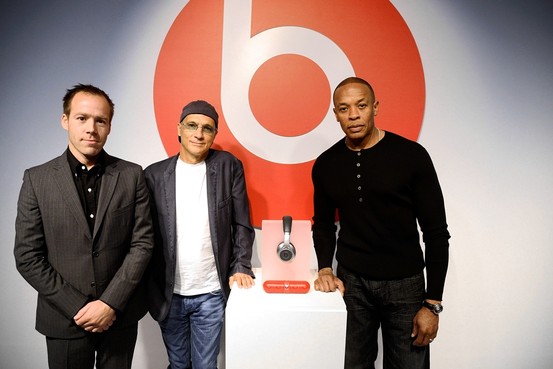
Luke Wood, left, the president of Beats Electronics, with co-founders Jimmy Iovine and Dr. Dre in 2012.

The maker of the popular Beats by Dr. Dre headphones is looking to buy out its Asian partner and bring in a new investor that can provide it with fresh funds for growth, people familiar with the matter said. The moves come as the founders of Beats Electronics LLC—music mogul Jimmy Iovine and American hip-hop producer and artist Andre Young, better known as Dr. Dre—are broadening the company’s business from headphones to include speakers, audio systems in cars and consumer electronics and a soon-to-be-launched online streaming music service. It also comes only a couple of months after the company shelved a separate deal that would have raised hundreds of millions of dollars in cash for acquisitions and investments, as well as allowing the founders to be paid a dividend without giving up their controlling interest in Beats Electronics.

Read more of this post

Disruptions: Texting Your Feelings, Symbol by Symbol

AUGUST 18, 2013, 10:58 AM

Disruptions: Texting Your Feelings, Symbol by Symbol

By NICK BILTON

10-BITS-tmagArticle

A colorful symbol alphabet that contains nearly a thousand images of cute animals, food items and expressive smiley faces can sometimes convey what words cannot.

I recently had to sit my friend down for a modern-day digital intervention. It wasn’t that he was using his phone at dinner, or that he was hitting “reply all” on e-mail threads, or leaving unnecessary voice mail messages. No, this was much worse. A few weeks ago my friend, Michael Galpert, who is 30-year-old and is founder of SuperCalendar, a personal assistant Web site, lives in New York City and was visiting the West Coast for work. I set him up on a date with a friend who lives in Los Angeles. The first date went well and the two decided to see each other again. Read more of this post

Next Out of the Printer, Living Tissue

August 18, 2013

Next Out of the Printer, Living Tissue

By HENRY FOUNTAIN

20PRIN-articleLarge

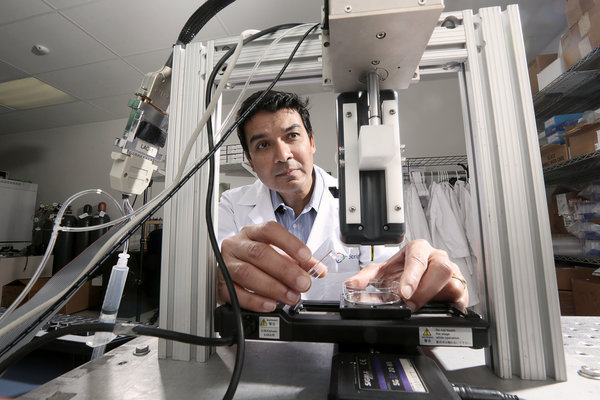
Darryl D’Lima, an orthopedic specialist, worked with a bioprinter in his research on cartilage at Scripps Clinic in San Diego.

SAN DIEGO — Someday, perhaps, printers will revolutionize the world of medicine, churning out hearts, livers and other organs to ease transplantation shortages. For now, though, Darryl D’Lima would settle for a little bit of knee cartilage.

Dr. D’Lima, who heads an orthopedic research lab at the Scripps Clinic here, has already made bioartificial cartilage in cow tissue, modifying an old inkjet printer to put down layer after layer of a gel containing living cells. He has also printed cartilage in tissue removed from patients who have undergone knee replacement surgery. Read more of this post

Inside the Phone-Plan Pricing Puzzle; complex plans make comparison shopping nearly impossible, a tool that discourages customers from jumping ship

July 31, 2013, 7:52 p.m. ET

Inside the Phone-Plan Pricing Puzzle

An Analysis of Some 700 Wireless Options Underscore the Complexity and Confusion in the Market

THOMAS GRYTA

To understand how confusing wireless plans have become, just walk into an AT&TInc. T -0.49% store. The second largest U.S. carrier offers far more plans than its rivals—nearly 30 combinations alone for individuals, and many of its packages contradict one another. For example, customers can sign up for 900 minutes of talk, unlimited texts and 300 megabytes of data for $100 a month. But a “mobile share” plan that is $30 cheaper offers unlimited talk and texts and the same amount of data. The muddled pricing isn’t unique to AT&T. The four major carriers offer a total of nearly 700 combinations of smartphone plans—a family of five alone would have more than 250 options to choose from, according to a Wall Street Journal analysis of smartphone plans offered by the four biggest U.S. carriers. “It is always a cumbersome, somewhat root canalish experience,” said Erin Riordan, of Naperville, Ill., who has five children and manages an account with six lines from AT&T that produces a $495 monthly bill. She has considered switching carriers, but has been overwhelmed by the detailed service contracts, network coverage, the multiple plan options and whether moving will actually save her any money. “I consider myself to be pretty educated but it makes me want to stick a fork in my eye,” Mrs. Riordan said. Confusing plans are as old as the cellphones themselves, although there is some hope that the structures may simplify as competition in the industry heats up. Read more of this post

How LinkedIn Became A Wall Street Juggernaut

How LinkedIn Became A Wall Street Juggernaut

GLENN SOLOMON

Saturday, August 17th, 2013

Glenn Solomon is a Partner with GGV Capital. Some of his recent investments include Pandora, Successfactors, Isilon, Domo, Square, Zendesk, Quinstreet and Nimble Storage. His personal blog, focused on growth stage entrepreneurs who are thinking big; can be found at here. Follow him on Twitter@glennsolomon.

In 2010, had you suggested to the smartest Silicon Valley entrepreneurs and investors that LinkedIn would have a larger market value in 2013 than Groupon, Zynga or Twitter, you would have been laughed at. Had you hypothesized that LinkedIn would be worth more than Groupon, Zynga and Twitter combined and worth nearly one-third the value of Facebook, no one would have believed you.  LinkedIn just wasn’t as exciting as the internet darlings of the day, and, as a result, there were many LinkedIn doubters at that time, myself included. Read more of this post

Graphene: A new miracle in the material world; It is lighter than a feather, stronger than steel, yet incredibly flexible and more conductive than copper

Graphene: A new miracle in the material world

Britain is investing £60m in developing graphene. But are our businesses already falling behind in the race to exploit it, asks Rebecca Clancy.

Graphene is a planar sheet of carbon atoms arranged in a hexagonal pattern. Stacked graphene sheets form graphite, used in pencils.

By Rebecca Clancy

9:23PM BST 18 Aug 2013

It is lighter than a feather, stronger than steel, yet incredibly flexible and more conductive than copper. It has been hailed as “the miracle material”, its possible uses apparently almost endless. The material is graphene, a single layer of carbon atoms forming a regular hexagonal pattern, extracted from graphite, with astonishing properties and impressive potential. Unbreakable, foldable touch screens for mobile phones; a revolution in how drugs are administered; protective coating for everything from food packaging to wind turbines, faster computer chips and broadband; batteries of infinitely higher capacity than today’s – these are just a few of graphene’s possibilities. Read more of this post

Dash Is Turning Cars Into Futuristic, Data-Collecting Machines With An App And A Cheap Plastic Dongle

Dash Is Turning Cars Into Futuristic, Data-Collecting Machines With An App And A Cheap Plastic Dongle

ALYSON SHONTELL AUG. 17, 2013, 12:42 PM 3,728 7

photo 4-11

Dash is made possible by this dongle which fits in a car’s OBD port. Dash can tell you why your check engine light is on and what needs to be replaced in your car.

Jamyn Edis is the CEO and co-founder of Dash, a platform that tracks 300 real-time data points in cars to make them smart vehicles.

A few months ago, just as the weather was starting to warm, a green Mini Cooper convertible rolled to a stop in front of Business Insider’s New York City headquarters. The door popped open and Jamyn Edis greeted me with a beaming smile and a pair of aviators. We were ready to take a Dash around Manhattan. Jamyn Edis and Brian Langel have been creating smart technology products for more than two decades combined. Last year, as HBO’s VP of Emerging Technology and Research Development, Edis entered the New York startup scene and advised founders going through a competitive accelerator program called TechStars. Now, the mentor has become the mentee. Edis and Langel recently founded a company called Dash, which was selected to be one of 11 startups in the 2013 TechStars New York class. Dash’s goal is to turn all vehicles into talking, data-collecting smart cars using nothing but a plastic dongle and a mobile app.  Read more of this post

“Sync is the new save”; Dropbox’s ambitious bid to “replace the hard drive” by making it easy for users to sign into Dropbox from many other apps

August 18, 2013 3:50 pm

Dropbox hopes to exploit tech rivalries

By Tim Bradshaw in San Francisco

“Sync is the new save,” declared Drew Houston, chief executive of Dropbox, at the cloud storage company’s first developer conference in San Francisco last month,writes Tim Bradshaw.

Mr Houston made an ambitious bid to “replace the hard drive” by making it easy for users to sign into Dropbox from many other apps. His hope is that this will make users more likely to pay for extra storage and, crucially, make them less prone to switch to Apple or Google’s rival products. Read more of this post

Beauty boxes by The Lilac Box sells like hot cakes in Malaysia

Beauty boxes by The Lilac Box sells like hot cakes in Malaysia

By Jacky Yap 19, Aug 2013

Malaysia-based The Lilac Box’s beauty boxes are a hit with consumers, selling out fast for each edition.

Earlier this year, there was a lot of hype around the beauty box subscription business. In January, we saw Australia-based bellabox closing an A$1.3 million (US$1.2 million) Series A round. Indonesia’s Lolabox was also launched by former Rocket Internet executives, with the backing of GRUPARA, one of Indonesia’s most active private equity fund.

Around the same time, Taiwan’s online beauty industry has also seen some activities. Japanese venture capital firm CyberAgent Ventures has put their skin in the game by investing in Taiwan based Fashionguide, a beauty and cosmetics social networking platform. Beauty sampling platform VanityTrove also commenced its consolidation in the Southeast Asia market with itsacquisition of Rocket Internet’s Glossybox in Taiwan. Read more of this post

Viacom to let Sony stream its programs, bypassing traditional pay TV providers

Viacom to let Sony stream its programs

BLOOMBERG

AUG 16, 2013

SAN FRANCISCO – Sony Corp. has reached a preliminary accord to stream cable television programming from Viacom Inc. over the Internet to TVs, game consoles and Blu-ray players, a source said.

Under the deal, Sony would use the Web to deliver shows such as “SpongeBob SquarePants” and “Teen Wolf” to homes with those products, bypassing traditional pay TV providers, said the source. The service also would sell Viacom shows and movies on demand. Read more of this post

Captive Audience: The Telecom Industry and Monopoly Power in the New Gilded Age

Captive Audience: The Telecom Industry and Monopoly Power in the New Gilded Age [Hardcover]

Susan P. Crawford J.D. (Author)

Book Description

Publication Date: January 8, 2013

Ten years ago, the United States stood at the forefront of the Internet revolution. With some of the fastest speeds and lowest prices in the world for high-speed Internet access, the nation was poised to be the global leader in the new knowledge-based economy. Today that global competitive advantage has all but vanished because of a series of government decisions and resulting monopolies that have allowed dozens of countries, including Japan and South Korea, to pass us in both speed and price of broadband. This steady slide backward not only deprives consumers of vital services needed in a competitive employment and business market—it also threatens the economic future of the nation. This important book by leading telecommunications policy expert Susan Crawford explores why Americans are now paying much more but getting much less when it comes to high-speed Internet access. Using the 2011 merger between Comcast and NBC Universal as a lens, Crawford examines how we have created the biggest monopoly since the breakup of Standard Oil a century ago. In the clearest terms, this book explores how telecommunications monopolies have affected the daily lives of consumers and America’s global economic standing. Read more of this post

What Jiu Jitsu teaches us about media companies

What Jiu Jitsu teaches us about media companies

BY BRYAN GOLDBERG 
ON AUGUST 8, 2013

For a brief period of time, I studied Brazilian Jiu Jitsu. And I wasn’t very good at it.

Nevertheless, I put in a real effort and put up with the not-so-appealing aspects of it — having some dude squash my face into the ground, gasping for breathe while a normally-stoic Korean teenager choked me, etc.

At a time when martial arts, and the UFC in particular, has grown in popularity, the very act of fighting has changed, both in reality and in the popular consciousness.

Gone are the days when 80s action stars traded punches with German terrorists. Today, we understand that fighting usually takes place on the ground, with a lot more grappling than striking. You are just as likely to win a fight by choking your opponent with your legs (i.e. a triangle choke) as you are through a good old-fashion nose break. Read more of this post

Start the Presses! It’s How You Sell Newspapers; As iconoclastic as it may sound, it’s time to stop chasing the digital ghost.

August 18, 2013, 5:32 p.m. ET

Start the Presses! It’s How You Sell Newspapers

As iconoclastic as it may sound, it’s time to stop chasing the digital ghost.

ERIC SPITZ

This month has seen a couple of successful businessmen with no newspaper experience acquire two of America’s storied media institutions. Many people are wondering why.

I cannot answer for these new owners, but I may be able to shed some light. A year ago my business partner, Aaron Kushner, and I bought Freedom Communications, which includes the Orange County Register, the nation’s 14th-largest daily newspaper. Neither Aaron nor I came from the newspaper industry, but we are both entrepreneurs inclined to question the conventional wisdom. Read more of this post

TV’s Unnatural Monopolies; The rationale for government regulation is collapsing in the face of technological change

August 18, 2013, 5:25 p.m. ET

Crovitz: TV’s Unnatural Monopolies

The rationale for government regulation is collapsing in the face of technological change.

L. GORDON CROVITZ

The big loser in the battle between Time Warner Cable TWC -0.24% and CBSCBS -0.56% is not the cable company, the network or the viewers who lost access to their favorite shows. The big loser is Washington, whose efforts to regulate what used to be called television grow more futile with every new video technology.

Lawmakers and regulators still treat broadcasters and cable operators as “natural” monopolies. That gives them a rationale to layer on bureaucratic rules setting out how the industry should be run. Read more of this post

Book-publishing giant Penguin Random House is trying its hand at television, expanding a media diversification that began a few years ago when Bertelsmann’s Random House started a movie unit to spur sales of its titles

August 18, 2013, 7:51 p.m. ET

Publisher Makes TV Play

JEFFREY A. TRACHTENBERG

Book-publishing giant Penguin Random House is trying its hand at television, expanding a media diversification that began a few years ago when Random House started a movie unit to spur sales of its titles.

Penguin Random House’s first TV co-production, “Heartland Table,” will make its debut Sept. 14 on the Food Network, starring little-known chef Amy Thielen. Ten days later, Ms. Thielen’s first cookbook, “The New Midwestern Table,” will be published by Clarkson Potter, a Penguin Random House imprint. Read more of this post

Master’s Degree Is New Frontier of Study Online; The master’s degree offered by the Georgia Institute of Technology through massive open online courses has the potential to disrupt higher education

August 17, 2013

Master’s Degree Is New Frontier of Study Online

By TAMAR LEWIN

Next January, the Georgia Institute of Technology plans to offer a master’s degree in computer science through massive open online courses for a fraction of the on-campus cost, a first for an elite institution. If it even approaches its goal of drawing thousands of students, it could signal a change to the landscape of higher education.

From their start two years ago, when a free artificial intelligence course from Stanford enrolled 170,000 students, free massive open online courses, or MOOCs, have drawn millions and yielded results like the perfect scores of Battushig, a 15-year-old Mongolian boy, in a tough electronics course offered by the Massachusetts Institute of Technology. Read more of this post

Suddenly everyone wants New Yorker style in-depth article content. Only one catch: Who is going to write it? “We need to do what so few publications have done for recent years: Teach.”

Suddenly everyone wants New Yorker style content. Only one catch: Who is going to write it?

BY SARAH LACY 
ON OCTOBER 12, 2012

One of our most popular stories all week has been David Holmes’s report about how Tumblr wants topay for journalism. And not just cat pictures, re-written press releases, or 300 word snark-fests by junior reporters paid $12 a post. This isn’t another content farm. They want real, actual New Yorker-style long form journalism.

This is great news….mostly.

For a long time, I’ve said that I thought the reason journalism was reeling was its own fault. Daily papers had a de facto monopoly — on news, classifieds, movie listing, stock quotes, sports scores, and all types of content. And yes, the Internet destroyed it. But if daily newspapers in aggregate, had been good stewards of that role in the community, people would still have read them. Most daily papers, instead, were like the one from my hometown: more daily than a newspaper. Like paying with the cable company, no one particularly loved reading it, but there wasn’t another option for getting all those things I describe above delivered to you daily. Read more of this post

Slow media: Google announced that it will start integrating links to in-depth articles into its search results; This Is What Happens When Publishers Invest In Long Stories

A small but significant victory for slow media

BY HAMISH MCKENZIE 
ON AUGUST 6, 2013

Google announced today that it will start integrating links to in-depth articles into its search results. So, if you search for “censorship,” says Google’s Pandu Nayak, “you’ll find a thought-provoking article by Salman Rushdie in The New Yorker, a piece by our very own Eric Schmidt and Jared Cohen in the Guardian, and another great article about Iran.” That means longform journalism will be treated almost the same as news, which is already featured in many search results courtesy of Google News. This is good news for people who care about “slow media” – the type of journalistic content that is not tied to a specific moment, that resists the eroding forces of faddism, and that favors quality over quantity. Not only does it unlock the power of the archive, but it sends a message that this sort of content, usually more nourishing than the “first draft of history” or slap-dash blog posts (such as this one!), deserves a pedestal that is different from, but equal to, that given to more time-sensitive information. Now that we live in an age of Twitter, we are vulnearble to automatically placing a higher value on content that gets to us the fastest. Because of its ability to instantly satisfy this thirst for “newness,” Twitter emphasizes the now while eschewing the timeless. Until now, Google’s default settings have pretty much done the same. Type “Obama” into a Google search box right now and you’ll be delivered links to his Wikipedia entry, White House bio, and then three news articles relevant to today. Nowhere on that first page is there a link to, say, Dave Remnick’s biography of the President, or Michael Lewis’s inside look at the Presidency, published by Vanity Fair.

google-indepth

An example of Google’s results for “in-depth articles.” Read more of this post

The Next Web sheds key staff amid shift in editorial strategy to one that depends less on breaking news and more on reviews and analysis; Waywire CEO Nathan Richardson Departs As Company Shifts Focus From Content Creation To Curation

The Next Web sheds key staff amid shift in editorial priorities

BY HAMISH MCKENZIE
ON AUGUST 15, 2013

The Next Web, a leading tech blog, has fired or farewelled five of its top editorial staff in recent weeks as it shifts its editorial strategy to one that depends less on breaking news and more on reviews and analysis. In the last month, deputy managing editor Alex Wilhelm left to join TechCrunch, European editor and former TechCrunch writer Robin Wauters was laid off, and both features editor Harrison Weberand news editor Matthew Panzarino have left the company. Brad McCarty, who variously held positions as managing editor, director of business development, and head of TNW Academy, has also parted ways with the company. (Update: McCarty has since been in touch via Twitter to clarify that his departure was not related to the other personnel changes; the timing was coincidental.) Read more of this post

If it’s not broke, break it: How David Marcus is dismantling PayPal to save it

If it’s not broke, break it: How David Marcus is dismantling PayPal to save it

BY SARAH LACY 
ON AUGUST 12, 2013

david_inside

These days, if you go up and down the elevator at PayPal’s headquarters, get out on each floor and look around. You’ll see the perfect metaphor for PayPal’s past, present, and future.

On the third floor, PayPal President David Marcus shows me a sea of high-walled beige and grey hexagonal cubicles. The kind you stared at for 16 hours a day if you worked at a Peninsula-based, late-1990s tech company. They look identical to Yahoo’s except no purple and yellow. The walls block out most of the natural light in the room and any sign of coworkers. Even “Cubicle Guy” would have to stretch to prairie dog over them. Marcus can’t hide his contempt looking at them. Read more of this post

Disney’s fairydust continues to work magic at the box office; media giant constantly reanimates itself to survive

Disney’s fairydust continues to work magic at the box office

Katherine Rushton visits the media giant that constantly reanimates itself to survive .

disney_2646207b

Disney is investing in a theme park and resort in Shanghai, worth $4.4bn Photo: Disney

By Katherine Rushton

4:02PM BST 17 Aug 2013

“I always liked Tinkerbell,” says Bob Iger, Disney’s chairman and chief executive. “She had a real attitude. I kind of like that. And being able to spread fairydust around? That’s kind of what I do for a living.” He’s not wildly off. Few companies in the world can claim to have pervaded Western culture over the past century to quite the same degree as Disney. Coca-Cola, perhaps, or Ford or McDonald’s – but however recognisable those juggernauts have become, they have not played the same role in shaping popular culture. It would take an unusual existence for a child to grow up without clapping eyes on Mickey Mouse, for example, or watching one of Disney’s other animations. Snow White did for one generation of children what The Jungle BookAriel the Little Mermaid and Aladdin have done for successive others. In many cases, Disney’s renditions of these tales have eclipsed the originals in people’s minds. Their popularity has helped Disney to become a commercial machine, with a market capitalisation of $112.3bn (£72bn), annual revenues of $42.3bn and $5.7bn of profits. But it is also a machine that can go awry if it loses the creative spark at its heart. Read more of this post

Expecting the Unexpected From Jeff Bezos

August 17, 2013

Expecting the Unexpected From Jeff Bezos

By DAVID STREITFELD and CHRISTINE HAUGHNEY

EARLY employees of Amazon still remember the day the company took away their aspirin. It was late 1999. After years of heady excess, the Internet boom was beginning to falter. Amazon, among the most celebrated of the dot-coms, was burdened with debt and spiraling losses. Jeff Bezos, its founder and chief impresario, had to impress Wall Street that he was serious about cutting costs. But how? Amazon had never indulged employees with Silicon Valley perks like massages or sushi chefs. Just about the only thing that workers received free was aspirin. So the aspirin went. Read more of this post

Known for its wildly popular telenovelas, or prime-time romantic melodramas, spanish-language media power Univision beat bigger English-language rivals ABC, CBS, NBC, and Fox as the most watched in the month of July by the most coveted 18-49-year-old viewers

SATURDAY, AUGUST 17, 2013

A Terrific Story of Its Own

By SANDRA WARD | MORE ARTICLES BY AUTHOR

Grupo Televisa, a global power in Spanish-language TV melodramas, offers a lot to investors, including a big stake in Univision.

For the first time, the television network most watched in the month of July by the most coveted viewers — 18-to-49-year-olds — was the Spanish-language broadcaster, Univision Communications. ¡Que!

Known for its wildly popular telenovelas, or prime-time romantic melodramas, and its variety shows and sports programs, upstart Univision beat bigger English-language rivals ABC, CBS, NBC, and Fox. Univision and its original programming benefited from those broadcasters’ heavy reliance on summer reruns, and the absence of regular NFL games, which won’t resume until September. Still, the fifth-ranked broadcaster in terms of overall viewers is making inroads. It’s the only major broadcaster attracting new viewers — and for the first time ever in any first quarter, Univision was No. 4 among the 18-to-34 set, ahead of NBC. Read more of this post

Samsung to pip Apple to the post in race to launch a smartwatch

Last updated: August 16, 2013 10:51 pm

Samsung to pip Apple to the post in race to launch a smartwatch

By Tim Bradshaw in San Francisco and Simon Mundy in Seoul

Samsung is set to pip Apple to the post in the race to bring a new wearable device to market, as the Korean electronics company prepares to launch a smartwatch early next month. According to several people familiar with its plans, Samsung will launch the “Galaxy Gear” smartwatch in early September, ahead of the IFA trade show in Berlin. Samsung declined to comment. Apple, meanwhile, has been hiring aggressively for the iWatch in recent months but is not expected to reveal the device until next year. Read more of this post

Is Big Data an Economic Big Dud?

August 17, 2013

Is Big Data an Economic Big Dud?

By JAMES GLANZ

IF pencil marks on some colossal doorjamb could measure the growth of the Internet, they would probably be tracking the amount of data sloshing through the public network that spans the planet. Christened by the World Economic Forum as “the new oil” and “a new asset class,” these vast loads of data have been likened to transformative innovations like the steam locomotive, electricity grids, steel, air-conditioning and the radio. Read more of this post