When You Can’t Tell Web Suffixes Without a Scorecard; Plans to expand the number of top-level Internet domains beyond familiar ones like .com and .net have generated a rush of activity — as well as opposition

August 17, 2013

When You Can’t Tell Web Suffixes Without a Scorecard

By NATASHA SINGER

ON the Web, there’s no place like .home.

But there soon may be, along with hundreds of other new Internet address suffixes like .bible, .blog, .family, .game, .gay and .pizza.

Since last summer, the Internet Corporation for Assigned Names and Numbersor Icann, a nonprofit entity that coordinates the Internet address system, has vetted and initially approved 1,574 applications for new “top-level domains” — the letters to the right of the dot. The premise is to give companies and consumers seeking secondary-level domain names — the janedoe in janedoe.com — options beyond the 22 top-level generic suffixes like .com and .biz that are currently available. Read more of this post

Epic launches, Politico goes deeper: Why longform journalism is the new necessity

Epic launches, Politico goes deeper: Why longform is the new necessity

BY HAMISH MCKENZIE 
ON AUGUST 12, 2013

In the last 24 hours, there have been two major updates to the list of media companies investing in longform journalism. Last night, the New York Times’ David Carr broke the news that writers Joshuah Bearman and Joshua Davis have launched a new site for longform reporting that might appeal to movie studios looking to turn articles into motion pictures. The site, called Epic, is backed by Medium, although the Times was vague on the exact nature of the relationship. (We’ve requested an interview with Epic’s founders to find out more, but that won’t be happening until next week). Read more of this post

Singapore to try out driverless shuttle on public roads

Singapore to try out driverless shuttle on public roads

By Ben Coxworth

August 16, 2013

navia

Singapore’s Nanyang Technological University will be running a Navia autonomous shuttle to the nearby JTC Corporation’s CleanTech Park (Photo: NTU)

Should you be at Singapore’s Nanyang Technological University (NTU) sometime soon, and wish to take the shuttle bus to JTC Corporation’s CleanTech Park, you might find yourself in a vehicle that drives itself. Plans call for just such an autonomous shuttle to start running the 2-km (1.2-mile) route, as a real-world test of driverless public transportation. The electric 8-passenger vehicle is a model already being made by France’s Induct Technology, and is known as the Navia. Passengers get on board at a designated stop, and select their destination stop on a touchscreen display of the route. The vehicle then heads out onto public roads at a maximum speed of 12.5 mph (20 km/h). It uses four LIDAR (LIght Detection And Ranging) units, along with stereoscopic optical cameras, to generate a real-time 3D depth map of its surroundings. This allows it to avoid obstacles, stay in its lane, and generally keep from getting into trouble. Once it’s completed its route, the shuttle automatically heads to its wireless fast charging station. It doesn’t require any rails, overhead lines, or other changes to the roads. The project partners (NTU, JTC and Induct) hope that the Navia or something like it could be an effective form of last-mile transportation, ferrying commuters between transit hubs such as train stations, and their homes or workplaces. The Navia can be seen in use in the video below.

Fox Invests In Vice, A Media Company That Makes Money Being Terrible And Brilliant; Billion-dollar-plus Vice is the new patron saint of content companies

Fox Invests In Vice, A Media Company That Makes Money Being Terrible And Brilliant

ANTHONY HA

posted yesterday

21st Century Fox has invested $70 million in youth-focused media company Vice Media, giving Fox a 5 percent stake in the company and valuing Vice at $1.4 billion, according to a report in the Financial Times. I emailed a company spokesperson to confirm the funding but they have not responded. Still, the news has been widely reported enough that it seems pretty solid. Although Vice started out as a print publication, most of its recent success has been online, especially in video (which led to a show on HBO). A recent profile in The New Yorker said that in 2012, the company brought in $175 million in revenue, more than 80 percent of it from the web. Read more of this post

The Global Dominance of ESPN; Why hasn’t anybody figured out how to beat “the worldwide leader in sports”?

The Global Dominance of ESPN

WHY HASN’T ANYBODY FIGURED OUT HOW TO BEAT “THE WORLDWIDE LEADER IN SPORTS”?

By Derek Thompson

This is the chart I was talking about. This is powerful.”

Artie Bulgrin, ESPN’s director of research, is hunched over an iPad in a wood-paneled conference room at the network’s New York City headquarters, on West 66th Street, swooshing through the slides of a presentation he’s prepared annually since 1998. Every year, in the second week of September, the company asks hundreds of random subjects for three “must have” TV networks. And every year, ESPN relearns just how much America loves ESPN. Read more of this post

China’s Tencent Faces Obstacles Marketing WeChat Abroad; Provenance Could Put Off Users Who Fear Reach of Beijing’s Censors

August 16, 2013, 4:30 a.m. ET

China’s Tencent Faces Obstacles Marketing WeChat Abroad

Provenance Could Put Off Users Who Fear Reach of Beijing’s Censors

AARON BACK

BF-AF573_CHINAH_G_20130816180914

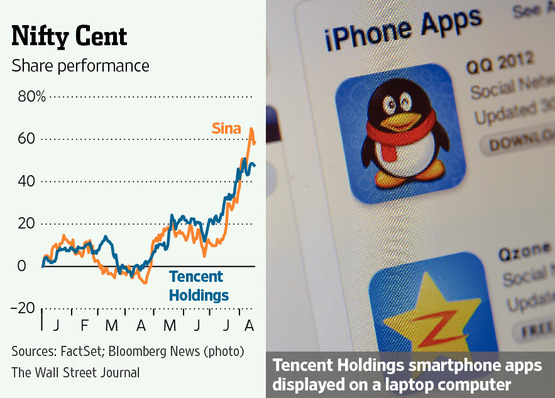
China’s Internet is a world unto itself, where foreign players are kept out by censors and a few large domestic companies wrestle for control. Now giant Tencent HoldingsTCEHY +0.86% is trying to expand abroad. Tencent plans to spend up to $200 million this year to advertise its mobile messaging service WeChat in emerging markets like Southeast Asia and Latin America. The company claims a total of 235.8 million monthly active users globally and says it already has more than 100 million registered users outside China, though it doesn’t disclose the number of active users overseas. Read more of this post

Web entrepreneurs are moving closer to duplicating the real-world feel of a mall, where shoppers can pop in and out of multiple stores, and browse with the advice of friends

August 16, 2013

Hanging Out at the E-Mall

By JENNA WORTHAM

Shopping online is easier than shopping in a mall — as long as you know exactly what you want to buy. The problem comes when you don’t know what you want. The Web has yet to duplicate the real-world feel of a mall, where shoppers can pop in and out of multiple stores, easily browsing racks of clothing, display cases of jewelry and shelves of housewares. And online, friends can’t join you in a dressing room to help you avoid buying fashion faux pas. But now, many entrepreneurs have their sights set on better replicating those experiences online, creating a category of e-commerce loosely known as social shopping. Venture capitalists are opening their pocketbooks for these new start-ups, and even some of the biggest players in e-commerce, like Amazon and eBay, have introduced their own social features. Read more of this post

Trying to Make Google Glass Fashionable; While people who own Google Glass love the glasses for their technological prowess, they feel incredibly self-conscious when wearing them in public

AUGUST 16, 2013, 4:34 PM

Trying to Make Google Glass Fashionable

By NICK BILTON

In the 2006 movie “The Devil Wears Prada,” with a high-end fashion magazine’s office as its backdrop, there’s a memorable scene when the character Miranda Priestly, played by Meryl Streep, is picking between two belts for a photo shoot that look almost identical. As she surveys them in her hand, her assistant, Andy Sachs, played by Anne Hathaway, starts to laugh quietly. Read more of this post

The world’s richest football league is embracing big data

The world’s richest football league is embracing big data

Aug 17th 2013 |From the print edition

WHEN Liverpool Football Club open the new season against Stoke on August 17th, it is not the 45,000 supporters at Anfield stadium who will be watching most closely. Nor will the band of armchair English Premier League (EPL) fans, spread across 800m homes in 212 countries, have the most detailed view of the game. The EPL has a new breed of observer: sophisticated data firms that meticulously track every movement, using statistics to discover the best way to win. Read more of this post

RFID company Savi Technology seeking to move beyond hardware into more complex software, data analytics; shift reflects the need for technology companies to continually reinvent themselves as their products mature

Newly independent, Savi pursues commercial work

By Marjorie Censer, Saturday, August 17, 10:21 AM

After cutting its teeth manufacturing special tags to track military equipment, Alexandria-based Savi Technology is moving beyond hardware and embracing data analytics, particularly hoping to attract more commercial work. The shift reflects the need for technology companies to continually reinvent themselves as their products mature. In Savi’s case, the 24-year-old company was one of the pioneers in selling radio-frequency identification, or RFID, tags to the military, which has relied on them to help manage supplies around the world. Read more of this post

Media companies took a battering from the internet. Cash from digital sources is at last repairing some of the damage

Media companies took a battering from the internet. Cash from digital sources is at last repairing some of the damage

Aug 17th 2013 |From the print edition

20130817_WBC210

THIS summer a made-for-TV movie about a tornado carrying man-eating sharks was a surprise hit in America. The preposterous plot of “Sharknado” may strike a chord with media bosses who have watched the internet ravage their business over the past decade. Newspapers have lost readers and advertising to the internet. Book and music shops have closed for good. Sales of DVDs and CDs have plummeted. The television industry has so far resisted big disruption but that has not stopped doomsayers predicting a flight of advertising and viewers. In 2008 Jeff Zucker, then the president of NBCUniversal, a big entertainment group, lamented the trend of “trading analogue dollars for digital pennies”. But those pennies are starting to add up. And even Mr Zucker, now boss of CNN Worldwide, a TV news channel, has changed his tune. Old media is “well, well beyond digital pennies,” he says. Read more of this post

With Gmail Overhaul, Not All Mail Is Equal; Google Funnels Offers Into ‘Promotions’ Folder, Tops Them With Its Own Ads; Kate Spade, Groupon and Gap Want Out

August 15, 2013, 7:24 p.m. ET

With Gmail Overhaul, Not All Mail Is Equal

Google Funnels Offers Into ‘Promotions’ Folder, Tops Them With Its Own Ads; Kate Spade, Groupon and Gap Want Out

DREW FITZGERALD

For some retailers that rely on emailed promotions, Google Inc. GOOG -1.17% is adding insult to injury. When the search giant overhauled its free email service three months ago, it set up algorithms to automatically siphon the flow of airfare offers and spa deals away from users’ main inboxes and into an easily bypassed “Promotions” folder. But there is another wrinkle: For Gmail users that do visit those Promotions folders, the first items they see will often be ads sold by Google. The ads are different from those that already appear inside users’ opened messages. Instead, they look like emails sitting in an inbox but are shaded yellow and feature informational “i” icons explaining their purpose. Marketers still complain that the ads threaten to draw attention away from the coupons and pitch emails they want their targets to read first. Read more of this post

With 400,000 subscribers, Birchbox expands from beauty-in-a-box to lifestyle products

With 400,000 subscribers, Birchbox expands from beauty-in-a-box to lifestyle products

BY ERIN GRIFFITH 
ON AUGUST 15, 2013

At the earliest stages of venture capital investing, VCs prefer companies stay lean and spend their capital very carefully. But once they know they’ve got a winner, they want to fuel as much growth as they can, as fast as they can. Witness the CEO Supper Club conversation between Lerer Ventures partner Ben Lerer, and Birchbox CEO Katia Beauchamp. (Lerer Ventures is a Birchbox investor as well as a PandoDaily investor.) Lerer scolds Beauchamp for not being aggressive enough. When Beauchamp says that Birchbox’s product is beholden to the whims of its suppliers, Lerer tells her she should start making and branding her own products and control her supply. It doesn’t sound like the first time they’ve had this conversation. Read more of this post

Watch: A Welding Robot That’s Learning to Create Art Forgeries

Watch: A Welding Robot That’s Learning to Create Art Forgeries

BY KYLE VANHEMERT

08.15.13

DAVIDDDD

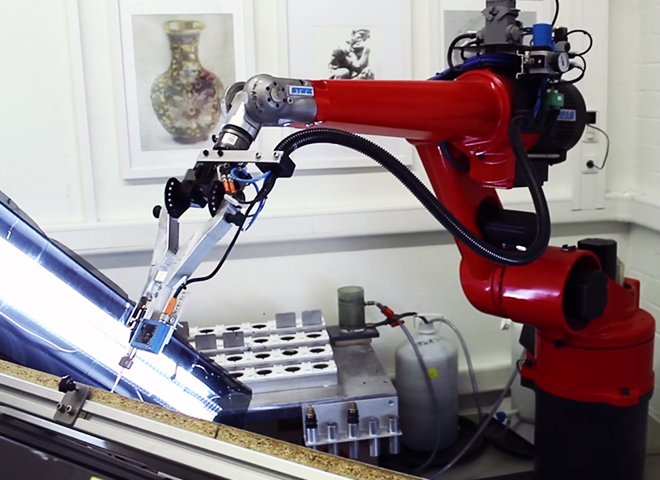
e-David is a welding robot that’s learning to create perfect copies of paintings. Image: Universität Konstanz

The collision of art and technology takes many forms. One recurring, especially straightforward one is a robot with a paintbrush. It’s easy to see the fascination; there’s something poetic about the idea of imbuing a machine with the soul of an artist. But while many of these projects involve some sort of effort to approximate human creativity in mechanical form, with e-David, the goal is a bit different. Its creators are simply trying to build a machine that can paint perfect copies of other paintings–a flawless mechanical forger. In other words, instead of giving their robot an artist’s soul, they’re trying to lend it a painter’s eye. Read more of this post

Videogames About Alcoholism, Depression and Cancer; Developers are exploring deeply personal and wrenching stories

August 15, 2013, 6:30 p.m. ET

Videogames About Alcoholism, Depression and Cancer

Developers are exploring deeply personal and wrenching stories

CONOR DOUGHERTY

AR-AD342_EMOGAM_G_20130814174200

A scene from ‘Papo & Yo,’ about an alcoholic father. ‘That Dragon, Cancer’ is an autobiographical story that puts players in the role of a father whose son is dying of cancer. A new breed of highly personal videogames on topics including depression, autism and cancer are changing what it means to play videogames. WSJ’s Conor Dougherty and game creator Ryan Green join Lunch Break. Photo: That Dragon Cancer.

Among the many videogames at a recent arts and games festival in Baltimore, none was more difficult to navigate than “That Dragon, Cancer.” The challenge: Getting through it without crying. The game is about war, but not the bullet-blazing variety normally associated with gaming. It’s an autobiographical story that puts players in the role of a father whose 4-year-old son is dying of cancer. As Hannah Armbruster sampled the game, using a mouse to move a pixelated dad around its hospital-room setting, her face showed none of the excited contortions that might accompany “Call of Duty.” She took gulps of sadness and at one point rubbed her forehead in disbelief. When the game was over, she said, “Whoo,” removed her headphones and left the computer. Read more of this post

The Internet’s Verbal Contrarian; writer Evgeny Morozov has quickly become the most prominent critic of the utopian promises coming from Silicon Valley

August 14, 2013

The Internet’s Verbal Contrarian

By NOAM COHEN

For every revolution, there is a counterrevolutionary. And so the digital one has brought us Evgeny Morozov.

A 29-year-old émigré from Belarus, Mr. Morozov has quickly become the most prominent, most multiplatformed critic of the utopian promises coming from Silicon Valley. His first book, “The Net Delusion,” looked skeptically at the belief that social networks were responsible for fomenting political change across the globe, and in the new “To Save Everything, Click Here” he has expanded that critique to question whether the Internet has improved anything. Read more of this post

Sony Grabs Lead in Race for Internet Pay TV, posing new competition for cable, satellite and phone companies which have long sold subscription TV services

Updated August 15, 2013, 7:42 p.m. ET

Sony Grabs Lead in Race for Internet Pay TV

Preliminary Deal to Carry Viacom Channels Is Content Coup for Planned Service

AMOL SHARMA And SHALINI RAMACHANDRAN

6758.TO -0.97% In the technology industry’s race to build an online version of pay television, Sony Corp. 6758.TO -0.97% just took the lead. The Japanese company has reached a preliminary deal with Viacom Inc.VIAB -1.75% to carry the media giant’s channels, such as MTV, Comedy Central and Nickelodeon, on its planned pay-TV service, people familiar with the matter said. None of the other companies vying to launch Internet-based pay TV, including Intel Corp.INTC -2.39% and Google Inc., GOOG -1.17% has reported such a major content deal. Like its technology rivals, Sony is planning to stream cable channels and on-demand programming over the Internet, posing new competition for cable, satellite and phone companies that sell subscription TV services. Read more of this post

The entertainment industry and online media: Pennies streaming from heaven; Is the internet really so different from the phonograph?

The entertainment industry and online media: Pennies streaming from heaven; Is the internet really so different from the phonograph?

Aug 17th 2013 |From the print edition

20130817_LDC231

FASTER than a speeding bit, the internet upended media and entertainment companies. Piracy soared, and sales of albums and films slid. Newspapers lost advertising and readers to websites. Stores selling books, CDs and DVDs went bust. Doomsayers predicted that consumers and advertisers would abandon pay-television en masse in favour of online alternatives. Jeff Zucker, then boss of NBCUniversal, spoke for all media moguls in 2008 when he condemned the trend of “trading analogue dollars for digital pennies”.

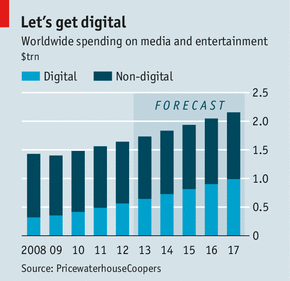
It has been a long wait, but those digital pennies are starting to pile up. The internet once destroyed jobs and companies, but it has now become an engine of growth for old media, including music, television and books (see article). In 2008 around 12% of consumer spending on media and entertainment products was devoted to digital ones; it should reach around half by 2017. Admittedly, many parts of the media industry will not recover their highs for years, if ever. The music business is about 40% below its peak of 1999. But the internet has stopped bludgeoning old media and is now boosting it. In 2012 recorded music had its first year of (very modest) growth in more than a decade. Read more of this post

Facebook is bad for you: Get a life! Using the social network seems to make people more miserable

Facebook is bad for you: Get a life! Using the social network seems to make people more miserable

Aug 17th 2013 |From the print edition

THOSE who have resisted the urge to join Facebook will surely feel vindicated when they read the latest research. A study just published by the Public Library of Science, conducted by Ethan Kross of the University of Michigan and Philippe Verduyn of Leuven University in Belgium, has shown that the more someone uses Facebook, the less satisfied he is with life. Past investigations have found that using Facebook is associated with jealousy, social tension, isolation and depression. But these studies have all been “cross-sectional”—in other words, snapshots in time. As such, they risk confusing correlation with causation: perhaps those who spend more time on social media are more prone to negative emotions in the first place. The study conducted by Dr Kross and Dr Verduyn is the first to follow Facebook users for an extended period, to track how their emotions change. Read more of this post

Cisco and the Tech That Time Forgot; Its Disappointing Outlook Underscores How Lumbering Tech Giants Can Become Too Big for Their Own Good

August 15, 2013, 2:50 p.m. ET

Cisco and the Tech That Time Forgot

Its Disappointing Outlook Underscores How Lumbering Tech Giants Can Become Too Big for Their Own Good

ROLFE WINKLER

Enterprise-technology companies should be a dynamic bunch. But investors are right to treat them like the pack of dinosaurs they have become.

Cisco Systems CSCO -7.17% is the latest to disappoint Wall Street, joiningOracleORCL -2.50% Intel,INTC -2.39% Microsoft MSFT -1.73%and International Business Machines IBM -0.93% . Though Cisco’s latest quarterly results mostly met expectations, its outlook for next quarter—calling for lighter sales than expected—has investors worried that, like the others, it just can’t be relied upon to sustain top-line growth. Read more of this post

Can an app get kids to behave in school? 15 million teachers and students are willing to give it a try

Can an app get kids to behave in school? 15 million teachers and students are willing to give it a try

BY DAVID HOLMES 
ON AUGUST 15, 2013

When Sam Chaudhary and Liam Don moved from the UK to Silicon Valley to start an ed-tech company, they soon found themselves with no place to live, no support network, and struck by the realization that the startup idea they left their homes, friends, and girlfriends for was kind of terrible. “Those were really dark emotional days,” says Chaudhary.

So Chaudhary and Don hit the pavement. They knew they still wanted to change education in some way, but their original idea, a piece of technology that helped improve group dynamics among students, was in Chaudhary’s words “a solution without a problem.” They began to learn everything they could about what was wrong with education, interviewing hundreds of teachers and surveying thousands more. What they found was that the biggest problem teachers faced wasn’t related to content or cognition. It was behavioral. “Forty percent say they spent over half the time dealing with behavior,” Chaudhary says. “You might as well send the kids home in December.” It’s also one of the most painful problems new teachers face, Chaudhary found, and the biggest reason they leave teaching. Read more of this post

3D scanners are getting cheap so fast, the age of 3D piracy could soon be upon us

3D scanners are getting cheap so fast, the age of 3D piracy could soon be upon us

By Rachel Feltman and Christopher Mims 7 hours ago

Just two weeks ago we wrote about the Fuel3D, a device for scanning 3D objects so you can replicate them on a 3D printer, with a proposed price tag of around $1,000. Now MakerBot, the leading maker of desktop 3D printers, is launching its own 3D scanner next week, and Signe Brewster at GigaOM is betting it will cost just $500.

That would make it appealing as an accessory for hobbyists who already own the MakerBot Replicator. It’s a low guess, but not unreasonable; since MakerBot today officially merged with the much larger Stratasys, which makes professional-level 3D printers for industrial prototyping, it has a lot of resources to scale the Digitizer up to cheap mass production. Read more of this post

Every night, legions of bloggers churn out descriptions and critiques of shows, episode by episode. The rise of a cottage industry

Updated August 15, 2013, 6:49 p.m. ET

The TV Recappers: From ‘Breaking Bad’ to Honey Boo Boo

The rise of a cottage industry, episode by episode

JOHN JURGENSEN

AR-AD349A_Recap_G_20130815205149AR-AD359_Recaps_G_20130815204702

When episodes of popular television shows end, the deadline pressure begins for a legion of writers whose episodic recaps of shows have become a cornerstone of the industry. WSJ’s John Jurgensen and Television Without Pity’s Daniel Manu join Lunch Break. Photo: AMC.

The biggest challenges facing most “Breaking Bad” fans during the crime drama’s final weeks are coping with cliffhangers and nervously speculating about the show’s conclusion. The stakes are higher for viewers like Donna Bowman. Every Sunday night, within a few hours of the final credits, Ms. Bowman completes a written analysis of the episode, decoding the narrative of one of the most tightly written dramas in TV history. She must anticipate questions in the minds of thousands of readers waiting to read her review online Monday morning and, if she’s on her game, get some laughs in the process. Read more of this post

News never made money, and is unlikely to

News never made money, and is unlikely to

August 15, 2013 @ 7:26 pm

By Jack Shafer

[1]Sometime in the mid-1990s, the Web began to peel from the daily American newspaper bundle its most commercial elements, essentially the editorial sections against which advertisements could be reliably sold. Coverage of sports, business and market news, entertainment and culture, gossip, shopping, and travel still ran in daily newspapers, but the audience steadily shifted to Web sources for this sort of news. Broadcasters had dented newspaper hegemony decades ago, absconding with breaking news and weather coverage, and inventing new audience pleasers, such as traffic reports and talk. But it was the Web that completed the disintegration of the newspaper bundle that dominated the news media market for more than a century. In addition to pinching the most commercial coverage from newspapers, the Web has also made off with the institution’s lucrative classified ads [2] market, simultaneously reducing its status as the premier venue for content and advertising. Read more of this post

The next big trend in South Korea’s portal industry may be mobile content platforms; “No company yet knows the key to success in the mobile platform service business”

Naver joins Kakao, Daum in mobile content platform race

Shin Ji-hye, The Korea Herald/ANN, Seoul | Business | Thu, August 15 2013, 6:12 AM

The next big trend in South Korea’s portal industry may be mobile content platforms. With Naver, the nation’s top Internet portal operator, slated to launch its mobile content platform soon, the race is shaping up to be a three-way competition between Naver, Kakao and Daum Communications. The Naver Post service is expected to provide a platform where user-created content can be shared on mobile handsets, according to industry sources on Tuesday. Currently, a closed beta test is being operated through the Android application. “No company yet knows the key to success in the mobile platform service business. However, we should continue as it is clear that user demand is growing. Whether the service will be provided for free will be decided based on the beta test,” said Lee So-young, a spokesperson for Naver. Read more of this post

For China’s Xiaomi, it’s what’s on the inside that counts

For China’s Xiaomi, it’s what’s on the inside that counts

12:50am EDT

By Paul Carsten

BEIJING (Reuters) – Two years after its high-quality, budget smartphone won over millions of Chinese fans, domestic tech firm Xiaomi Tech wants to make more money from online shopping and games than it does from selling its handsets.

Xiaomi is better known globally as China’s answer to Apple Inc, an image that billionaire Lei Jun has fostered since he founded the company in 2011 by dressing in the black tops, jeans and sneakers favored by the late Steve Jobs. Read more of this post

Chinese consumers struggle with slow 3G speed, despite paying steep rates

Chinese consumers struggle with slow 3G speed, despite paying steep rates

Staff Reporter

2013-08-11

Faster mobile internet speeds are on the priority of every company involved in the mobile internet revolution, but even though the number of users has been rising, mobile internet charges are also continuing to appreciate. The monthly 3G rate for users in mainland China is four times higher than that in the United States on an average, more than 20 times the rates charged in South Korea and over 100 times higher than in Hong Kong. The 3G internet speed, on the other hand, is slow and not even half the speed found in these areas. Read more of this post

China Mobile Exercises Sway in 4G Standards

August 15, 2013, 2:08 p.m. ET

China Mobile Exercises Sway in 4G Standards

PAUL MOZUR

MK-CF596_CMOBIL_G_20130815180610

BEIJING—When the year began, most of the world’s biggest telecommunications companies were lining up behind a single technical standard for the next generation of high-speed smartphones and other mobile gadgets. Then in March, China Mobile Ltd.0941.HK -1.01% made an unexpectedly aggressive move.

The state-owned wireless company, which has more than 740 million customers, committed to buying $7 billion of equipment this year for a mobile network based on another standard. China Mobile’s support instantly gave that standard critical mass, setting off an international race to supply the new gear. Read more of this post

Did Indonesia’s Ministry of Trade really ban e-commerce companies from getting foreign investment?

Is foreign investment a no-go for e-commerce companies in Indonesia?

By DailySocial 16, Aug 2013

Did Indonesia’s Ministry of Trade really ban e-commerce companies from getting foreign investment?

The Ministry of Trade apparently has issued a new directive which extends the negative investment list from offline businesses to online business, according to Remco Lupker, president of Ambient Digital Indonesia, on his blog post tonight. This, he says, effectively cuts off foreign investment for anything to do with direct sales to consumer. Lupker also outlined the effects it may have on the local e-commerce companies and how they can manage to comply with this new policy. Read more of this post

E-ppointments: Will patients shop around online for a doctor as tourists do for a hotel on TripAdvisor?

Online healthcare

E-ppointments

Aug 13th 2013, 22:11 by C.S.-W.

RIGHT after 8.30am is a busy time for the ill in Britain. Many medical surgeries do not allow patients to pre-book appointments with their doctors: people must call up in the morning to book an appointment later in the afternoon. Come opening time, the phone lines are jammed with hacking, spluttering sick people trying to beg an audience with their doctor. Being able to book appointments online and outside of office hours not only makes life easier for patients, but gives them more choice. Zesty, a start-up based in London, has signed up 200 dental practices across ten London boroughs since launching at the end of April. Further healthcare sectors, such as surgeries, physiotherapists and osteopaths, will be implemented into its online booking system later this month. Co-founder Lloyd Price is banking on medicine being the next sector to take advantage of e-commerce. He wagers an online interface to make appointments and to compare doctors and dentists against each other, similar to the hotel-booking and rating model perfected by TripAdvisor and Expedia, will replace the engaged-tone at surgeries up and down the land. Read more of this post