Western brands get a feel for Chinese customers’ needs on WeChat

August 14, 2013 5:32 pm

Western brands get a feel for Chinese customers’ needs on WeChat

By Sarah Mishkin in Hong Kong

It is not just Durex, owned by Reckitt Benckiser, that found WeChat’s one-to-one messaging and other features useful for reaching potential Chinese customers. Starbucks, one of the first US brands to run a campaign on WeChat, asked its followers there to tell the company what mood they were in by messaging them an emoticon. In response, the company would send them an audio track of a song that matched their mood. Asking users about their feelings made the company itself seem welcoming, said Joseph Tang, digital business director with ad agency Grey in Shanghai. Read more of this post

What “Netflix for textbook” Chegg did (and didn’t) tell prospective investors in IPO filing

Delving into Chegg’s IPO filing

By Dan Primack August 14, 2013: 4:56 PM ET

What textbook rental company Chegg did (and didn’t) tell prospective investors.

FORTUNE — Textbook rental company Chegg Inc. today filed for a $150 million IPO, with expectations that it will list next month at a premium to the $800 million valuation it received in its latter rounds of venture capital funding. Chegg plans to trade on the NYSE under ticker symbol CHGG, with J.P. Morgan (JPM) and BoA Merrill Lynch (BAC) serving as lead underwriters. Obviously there is lots of data in the company’s registration statement, but two things jumped out in particular:

1. First half growth: If you look at Chegg’s financials between 2010 and 2012, it’s fairly uninspiring. Losses expanded at a faster clip than did revenue, and EBITDA kept slipping. But then comes the first half results for 2013, and you can understand why Chegg chose to wait until now to go public. The company reports $17.96 million in EBITDA for the first half of 2013, compared to just $2.15 million for the first half of 2012. Revenue grew by 26% (up to nearly $117 million), while losses decreased by 34% ($32 million vs. $21 million). And, remember, all of this includes Q2 — typically the company’s slowest quarter, since students are rarely seeking new textbooks between April and June. Read more of this post

Weather Channel Now Also Forecasts What You’ll Buy; The company’s data helps fine-tune when and where advertisers should place their spots

August 14, 2013, 7:18 p.m. ET

Weather Channel Now Also Forecasts What You’ll Buy

Company’s Data Helps Fine-Tune When and Where Advertisers Should Place Spots

KATHERINE ROSMAN

PJ-BP965A_WEATH_G_20130814193013

The Weather Channel knows the chance for rain in St. Louis on Friday, what the heat index could reach in Santa Fe on Saturday and how humid Baltimore may get on Sunday. It also knows when you’re most likely to buy bug spray. The enterprise is transforming from a cable network viewers flip to during hurricane season into an operation that forecasts consumer behavior by analyzing when, where and how often people check the weather. Last fall the Weather Channel Cos. renamed itself the Weather Co. to reflect the growth of its digital-data business. The Atlanta-based company has amassed more than 75 years’ worth of information: temperatures, dew points, cloud-cover percentages and much more, across North America and elsewhere. The company supplies information for many major smartphone weather apps and has invested in data-crunching algorithms. It uses this analysis to appeal to advertisers who want to fine-tune their pitches to consumers. Read more of this post

The Specter Haunting Pay TV; This Year Could Mark the First-Ever Annual Decline in Pay-TV Subscriber Numbers, Deepening Cord-Cutting Fears

August 14, 2013, 2:28 p.m. ET

The Specter Haunting Pay TV

This Year Could Mark the First-Ever Annual Decline in Pay-TV Subscriber Numbers, Deepening Cord-Cutting Fears

MIRIAM GOTTFRIED

MI-BX863_CORDHE_G_20130814173610

It may once have been nothing more than a boogeyman keeping pay-TV executives awake at night. But cord cutting might now be worth losing sleep over. Amid recent declines in pay-TV subscriber additions, many analysts and investors had assumed a recovery in new-household formation would eventually turn things around. That would have shot down the idea that cord cutting—where viewers quit pay TV in favor of watching video over the Internet—was a growing phenomenon. Instead, as more consumers are priced out of the pay-TV market and alternatives such as NetflixNFLX +1.01% proliferate, such hopes don’t appear to be holding up. Read more of this post

Low growth, high return: How men’s commerce site Svbscription has thrived by taking things slow

Low growth, high return: How men’s commerce site Svbscription has thrived by taking things slow

BY ERIN GRIFFITH 
ON AUGUST 14, 2013

The tech community’s natural reaction to a company like Svbscription is one of skepticism. You want to charge guys $300 for a box of surprises? And send it on a quarterly basis? Who’s going to buy that? Plenty of people, as it turns out. A year in and Svbscription has sold out of almost every one of its parcels. The company has succeeded by taking the precise opposite approach of most ecommerce sites: make it exclusive, limited, expensive, and high quality. Sure, that technique doesn’t make for insane startup-style growth numbers. But it resonates with a core audience, following the approach of Brian Chesky of Airbnb: “It’s better to have a hundred people who love you than a million people who kinda like you.” Read more of this post

IBM to acquire Israeli data security company Trusteer for up to $1 billion; IBM’s 13th Israeli acquisition has an estimated $100 million in yearly revenues

IBM to acquire Israeli data security company for up to $1 billion

August 15, 2013 6:25am

JERUSALEM (JTA) — IBM, the American multinational technology and consulting corporation, has agreed to acquire an Israeli data security company for an undisclosed sum, believed to be up to $1 billion. Trusteer, which has locations in both Tel Aviv and Boston, develops software to help businesses protect themselves against financial fraud and security threats. Upon the official closing of the deal, Trusteer will join the IBM Security Systems organization, IMB announced Thursday. IBM is forming a cybersecurity software lab in Israel where Trusteer and IMB researchers will work on advanced software to address more complicated cyber threats. This is IBM’s largest ever acquisition in Israel, according to the Israeli business daily Globes. The purchase price is believed to be between $800 million and $1 billion. Read more of this post

Will Robots Take All Our Blue-Collar Jobs?

Will Robots Take All Our Blue-Collar Jobs?

By the Editors  Aug 13, 2013

Imagine you’re a young worker, pondering your job prospects in the economy of the future. Your grades weren’t exactly stellar, and you realize a four-year college isn’t for you. What kind of career should you look for?

Your options are narrowing. Many traditional working-class jobs — from truck driving to administrative work to retail to tending bar — are being replaced by automated technology. The trend seems likely to accelerate. How do we ensure that the kids of tomorrow can do something useful? And how do we help today’s working class transition to the economy of the future? Read more of this post

“Worthless, Impossible, And Stupid” Investing in Media Companies in Asia and Europe. Bamboo Innovator is featured in BeyondProxy.com, where value investing lives

Bamboo Innovator is featured in BeyondProxy.com, where value investing lives:

  • “Worthless, Impossible, And Stupid” Investing in Media Companies in Asia and Europe, Aug 14, 2013 (BeyondProxy)

Media

Keeping the mighty honest: A new wave of press barons should not allow newspapers to become niche products

Keeping the mighty honest: A new wave of press barons should not allow newspapers to become niche products

Aug 10th 2013 |From the print edition

20130810_USD000_0

THIS summer Lexington visited William Randolph Hearst’s castle at San Simeon. For a reporter it was a bittersweet moment: a reminder of an age when newspapers threw off profits so vast that an American press magnate could scavenge the globe for endangered treasures, prising heirlooms from Old World nobles before shipping them by the ton to his Californian lair. Today, all is stood on its head. Once-profitable journals are bleeding money and readers. America’s grandest media dynasties seem as embattled as inter-war European aristocrats, and the endangered relics being snapped up are newspapers, as 21st-century tycoons dream of playing the press baron. Read more of this post

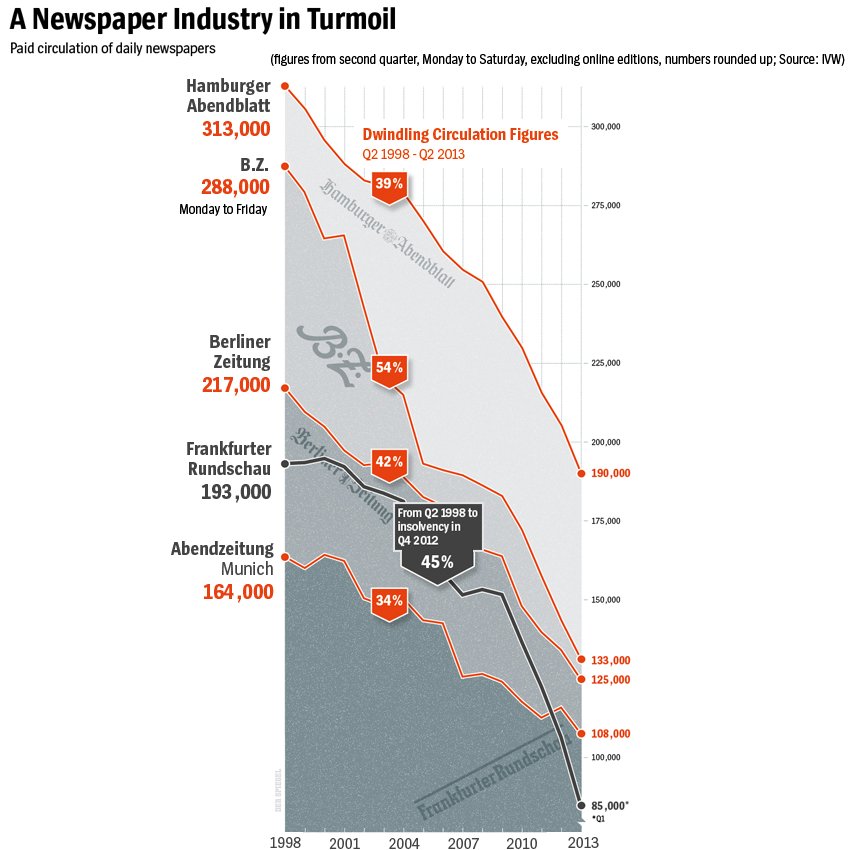
Extra, Extra! Newspaper Crisis Hits Germany; It came to Germany almost a decade later than America, but the newspaper crisis is sweeping the country, with plummeting circulations and revenues. The German news media must reinvent itself in order to retain readers.

08/13/2013 05:00 PM

Extra, Extra! Newspaper Crisis Hits Germany

By Cordt Schnibben

It came to Germany almost a decade later than America, but the newspaper crisis is sweeping the country, with plummeting circulations and revenues. The German news media must reinvent itself in order to retain readers.

image-530755-galleryV9-ayrr

Three decades ago, the editors of the Munich daily Abendzeitung produced a newspaper each day for 300,000 buyers. Fast forward 30 years and its circulation has declined to 107,634. One of of three desks in the large newsroom next to his office is now unoccupied, so when Editor in Chief Arno Makowsky uses a ballpoint pen to add a sharp upward curve into the next year on the chart in front of him, all he can do is laugh. Read more of this post

Technology: Vanity or visionary? Internet tycoons are backing futuristic ventures that may herald an era of scientific innovation

August 13, 2013 7:26 pm

Technology: Vanity or visionary?

By Richard Waters

Internet tycoons are backing futuristic ventures that may herald an era of scientific innovation, writes Richard Waters

Growing hamburgers in test tubes. Mining for precious metals on asteroids. Taking a supersonic, ground-level trip from Los Angeles to San Francisco in less than 30 minutes. The futuristic ideas that have been pouring lately from the fertile imaginations of some of the wealthiest US technology entrepreneurs – and which, in a few cases, are being funded out of their own billions – have started to sound almost outlandish. But that may be exactly the point. Testing their wits – and their fortunes – against the frontiers of technology has come to be seen as a mark of pride for the tech industry’s new super-wealthy, most of whom earned their money in the relatively low-tech environs of the consumer internet. Entrepreneurs such as Jeff Bezos ofAmazon; Elon Musk, who made his first fortune at PayPal; and Sergey Brin, co-founder of Google, have come to embody a new and ambitious era of technological ambition. Read more of this post

This Little Sticker Works Like an Anti-Mosquito Force Field; The Kite Patch is a little square sticker that emits a cloak of chemical compounds that block a mosquito’s ability to sense humans

This Little Sticker Works Like an Anti-Mosquito Force Field

BY LIZ STINSON

08.06.13

kite11

The Kite Patch is a little square sticker that emits a cloak of chemical compounds that block a mosquito’s ability to sense humans. Image: ieCrowd

Mosquitos were born to bite us, and aside from lighting worthless tiki candles, haplessly swatting them away, or resorting to spraying toxic DEET all over ourselves, there’s really not a whole lot we can do about it. Imagine then, if you could be encapsulated in an anti-mosquito bubble simply by wearing a small square sticker. Not only would it save mosquito-magnets like myself some really uncomfortable moments, it could be a major game changer in the way we prevent mosquito-borne illnesses like Malaria, Dengue Fever, and West Nile Virus. The good news is that a sticker like this is not some far away concept dreamed up by scientists in a lab–it’s actually a real thing that you’ll likely be able to find on the shelves of your local Walgreens sometime in the not-so-distant future. Read more of this post

Device Nags You to Sit Up Straight; LumoBack Sensor Vibrates Whenever You Slouch

Updated August 13, 2013, 6:09 p.m. ET

Device Nags You to Sit Up Straight

LumoBack Sensor Vibrates Whenever You Slouch

KATHERINE BOEHRET

PJ-BP905_DSOLUT_G_20130813171028

The LumoBack app tracks and scores your posture, with a stick figure. It compares straight versus slouching time, middle, and measures sitting time, right screen. The sensor and band, at right. The LumoBack from Lumo Body Tech is a $150 sensor that straps around your lower waist to track your posture, sending you a vibrating nudge whenever you start slouching. WSJ’s Katherine Boehret says it might be what some people need to straighten up.

“Sit up straight. Put your shoulders back. Don’t slouch.” Chances are good that you’ve heard nags like these from your mother more than a few times in your life. This week, I tested a gadget that might give mothers a rest. It’s a $150 sensor called LumoBack, from a company called Lumo BodyTech, that straps around your lower waist to track your posture and vibrates whenever you slouch. It also tracks steps while walking and running, standing time, sitting time, sleep positions and sleep time. Read more of this post

IPhone Fingerprint Reader Talk Boosting Biometric Stocks

IPhone Fingerprint Reader Talk Boosting Biometric Stocks

As the technology world buzzes with speculation that the next iPhone will have a fingerprint reader, makers of biometric security devices are bracing for a race among smartphone makers to adopt the technology.

Apple Inc. will unveil a new iPhone next month, according to a person familiar with the plans. ABI Research and KGI Securities Co. are among the industry watchers that say the device will include a fingerprint reader, a prediction bolstered by Apple’s $350 million purchase of fingerprint- sensor maker AuthenTec Inc. last year. Read more of this post

The Developing World Gets Unlimited Digital Storage; Telefornica announced a global partnership with Evernote, a digital archive for things like notes, photos and voice recordings.

AUGUST 13, 2013, 9:00 AM

The Developing World Gets Unlimited Digital Storage

By QUENTIN HARDY

You may have thought it was just everyone you knew. In fact, at least one company is hoping that about 200 million more people worldwide are leading digitally swamped lives, in need of organizing. On Tuesday Telefonica Digital, the London-based international business division of the Spanish telecommunications company, announced a global partnership with Evernote, an online archive for things like notes, photos, Web pages, and digitized voice recordings. In Brazil, where the business is starting, Evernote Premium accounts normally costing $45 a year will be free to customers of Telefonica’s local mobile brand, Vivo. Read more of this post

The Many Internet-Video Options for TVs

Updated August 13, 2013, 9:01 p.m. ET

The Many Internet-Video Options for TVs

Guide to Watching Online Video on a Big Screen

WALTER S. MOSSBERG

Even if you are not a cord-cutter, you most likely want to watch internet video on your TV. But there are so many options for doing it that it can be very confusing for those who are not tech-savvy. Walt Mossberg is here to help. (Photo: Panasonic)

Watching TV shows, movies and other video via the Internet on your big-screen television has become all the rage. But the proliferation of devices and methods for doing so has made the whole thing mighty confusing. Should you buy a “smart TV” to watch, say, Netflix NFLX +1.01% ? Or should you make an older TV “smart” by attaching a box that includes Netflix? Or should you buy an adapter and just beam Netflix wirelessly from your smartphone or tablet? And then, should you stream a movie or download it? Do you have to pay to get TV shows and movies from the Internet, or can you get them for free? Read more of this post

The quiet successes that drive Silicon Valley

The quiet successes that drive Silicon Valley

August 13, 2013: 11:58 AM ET

Not every successful tech entrepreneur wants the limelight.

By Jeff Richards, contributor

FORTUNE — Salesforce.com recently announced the acquisition of EdgeSpring, an emerging player in the business intelligence/analytics market. It was an amazing outcome for the company’s two founders, employees and investors (Lightspeed and Kleiner Perkins). So why didn’t you hear about it? Because the founders want it that way. They represent Quiet Success. And – despite what you may have been led to believe – it happens every day in Silicon Valley. EdgeSpring cofounders Vijay Chakravarthy and Ryan Lange are huge talents. Both have now had repeat entrepreneurial success. Both have created significant value, and will no doubt go on to work magic at Salesforce (CRM). They have a combined 27 followers on Twitter. They aren’t part of the PayPal or Facebook Mafia. They never held a launch party. They didn’t raise money from a hedge fund or a flashmob of notable angel investors and celebrities. They announced the acquisition with a simple change to their web site: Read more of this post

Web Directory Service 2345 Selling 38% Stake at A Valuation of RMB2 billion ($325 million)

Web Directory Service 2345 Selling 38% Stake at A Valuation of RMB2 billion

By Tracey Xiang on August 12, 2013

ZHEFU (SZ:002266), a Chinese hydropower equipment company,  announced to acquire a 38% stake in 2345.com, a Web directory and browser provider, for RMB760 million ($124 mn) (statement in Chinese). Thus 2345 is at a valuation of RMB 2 billion ($325mn). ZHEFU will invest in no more than RMB650 million and its biggest shareholder Sun Yi will input no less than RMB110 million, according to the statement. The stake sold will be from Pang Dongsheng, who currently owns 46.2% of 2345. As of July 2013, 2345 had 30 million users of the directory site and 10 million browser users. The company made RMB139 million in revenue and RMB 15.93 million in profit in 2012. The total revenue for the first half of this year is RMB210 million with RMB33.14 million in profit. 2345.com was once the second largest Web directory site in China, only after Hao123.com which was acquired by Baidu in 2004 for RMB 50 million cash and some Baidu shares. It is believed that Hao123 once drove about 30% of Baidu’s revenues through paid listing and the Baidu search box placed on it. Qihoo’s hao.360.cn later surpassed 2345.com. Qihoo successfully channeled users of its free security service to the browsers developed in house where hao.360.cn is set as the default landing page. Monthly active users of Qihoo 360′s browsers was 332 million and average daily unique visitors to hao.360.cn were 94 million as of March 2013, according to Qihoo’s Q113 financial report. All the revenues of Qihoo’s are generated through the browsers and the landing page. More than a few Chinese companies, such as Sogou and 2345, followed the business model.

Chinese online fashion retailer Vipshop Sinks as Citron’s Post Predicts ‘Major Decline’

Vipshop Sinks as Citron’s Post Predicts ‘Major Decline’

Vipshop Holdings Ltd. (VIPS), a Chinese online fashion retailer, tumbled in New York after Citron Research wrote in a Twitter post that the number of users on the website declined and shares may slump more than 50 percent.

Vipshop traffic “falls off a cliff,” Citron posted on Twitter today, attaching a note from Macquarie Group Ltd., which cited data from iResearch saying users fell 20 percent in June from a month earlier. “Stock should go back to 20’s easy. Scary for shareholders. Major decline,” short-seller Citron said. Read more of this post

Baidu wants in on LBS; spurned by Dianping, it has turned to Renren’s Nuomi

Baidu wants in on LBS; spurned by Dianping, it has turned to Renren’s Nuomi

August 14, 2013

by C. Custer

If you’re wondering why Renren’s stock jumped yesterday, it’s because of this. That’s a Sohu IT report written by Lin Fenglei that suggests that according to Lin’s understanding, Baidu has been in talks to acquire or invest in Renren’s Nuomigroup buying operation for the past couple of months, and that talks are now in the final stages. What’s perhaps more interesting is that Nuomi is apparently Baidu’s second choice. The company reportedly preferred to acquire Dianpoing, but when those negotiations fizzled, it turned to Nuomi, which controls around 6 percent of the daily deals market in China. It’s also hemorrhaging money and market share (in late 2012 it had 8 percent of the market) and has been an albatross around Renren’s neck, so the company would presumably be open to selling it. Baidu has certainly been on an acquisition kick lately; splashing big cash on 91 Wireless and PPS, as well as making a major investment in Kingsoft. An acquisition of Nuomi would presumably not because Baidu wants the sputtering daily deals service itself so much as it wants the service’s users, and a platform through which it can integrate its Maps platform and other LBS-friendly tools into some kind of e-commerce offering. If Baidu does buy Nuomi, I’d expect the site to look fairly different by next year. That said, this is all still a rumor as neither side as confirmed that talks are actually occurring. Baidu doesn’t comment on rumors and declined to comment for a Bloomberg article on this topic.

Mafengwo CEO Chen Gang: Online Customized Tourism Service To Upend Traditional Travelling Industry

Mafengwo CEO Chen Gang: Online Customized Tourism Service To Upend Traditional Travelling Industry

By Emma Lee on August 13, 2013

Different from mainstream tourism services of hotel reservation and ticket booking, Mafengwo.com, a travel guide service provider, aims to offer one-stop and customized products that better satisfy the needs of individual travelers, said the company’s CEO Cheng Gang at an interview held at 2013 China Internet Conference (source in Chinese).

Chen predicted that tourism industry will undergo fundamental transformation with the arrival of customized travelling service. Post-80s and post-90s who esteem individuality and familiar with Internet now constitute the major body of customers. Flight tickets and hotel reservation only will not satisfy their demands. According to data from Mafengwo, tourists who visit the Three George scenic sport in central China in groups slumped 10 percent year-on-year, signaling the customer’s demand for customized service. Read more of this post

High-stakes games: Tencent rolls the dice on mobile

High-stakes games: Tencent rolls the dice on mobile

Tue, Aug 13 2013

By Paul Carsten and Pete Sweeney

BEIJING/SHANGHAI (Reuters) – Tencent Holdings, China’s largest Internet company by revenue, is betting that one-upmanship between friends playing addictive mobile games will boost revenue from WeChat, a social messaging app used by over half of all Chinese smartphone users. The company, led by billionaire CEO and Chairman Pony Ma, last week released an update to WeChat, or Weixin, hoping the addition of games, paid-for emoticons, or stickers, and a mobile payment system will help it cash in on a client base of more than 300 million people. Tencent doesn’t charge users to download and play WeChat’s ‘freemium’ games such as Tiantian Ai Xiaochu, which is similar to “Candy Crush Saga”, the world’s top grossing app, according to Think Gaming. Instead, WeChat’s social networking features encourage friendly competition between players and their contacts by sharing scores. By paying for in-game upgrades – such as buying extra lives – users temporarily get one-up on their friends, and Tencent gets their money. Read more of this post

India’s newspapers shrug off industry woes

August 13, 2013 9:00 am

India’s newspapers shrug off industry woes

By Victor Mallet in Kolkata, India

Newspaper executives in the US or Europe can only fantasise about the problems confronting their Indian peers: how to source the extra newsprint for rising circulations and catch the eye of the millions of new readers each year.

Chennai and Kolkata are a long way from Boston and Washington, where two of the best-known US titles were sold this month – the Boston Globe for only $70m, less than a tenth of the price the paper fetched a decade ago. Read more of this post

You’ll believe a man can fly: Christchurch-based Jetpack maker Martin Aircraft is readying for an IPO blast-off. The firm had obtained full certification from the New Zealand Civil Aviation Authority for manned flight in the last two months

Jetpack maker prepares for lift-off

August 12, 2013 – 7:35PM

Tamlyn Stewart

729jetpack1-620x349

You’ll believe a man can fly: Martin Aircraft Company’s jetpack design.

Martin Aircraft Company is readying for an IPO blast-off. The Christchurch-based company said that a public listing could take place early next year as it revealed new details of its latest jetpack design. Chief executive Peter Coker said the P12 prototype was a “huge step-up” from the previous prototype. The firm had obtained full certification from the New Zealand Civil Aviation Authority for manned flight in the last two months, and had made great progress in increasing the flight time of the aircraft, Coker said. Read more of this post

3-D Printing Stirs Copyright Clash on Homemade IPhone Gear

3-D Printing Stirs Copyright Clash on Homemade IPhone Gear: Tech

Fernando Sosa had no doubt his sword-covered iPhone dock inspired by the hit TV series “Game of Thrones” would become a top seller for his small manufacturing startup. Then he heard from HBO. Defending a copyright on electronics featuring its show, HBO in February demanded Sosa halt sales on his website. He did, and gave more than a dozen customers refunds for $49.99.

Read more of this post

Facebook to buy firm specialising in voice translation

Facebook to buy firm specialising in voice translation

POSTED: 13 Aug 2013 9:44 AM
– AFP/xq

Facebook has agreed to acquire Mobile Technologies, a firm specialising in voice translation software, the two companies said Monday, without providing financial details of the transaction. NEW YORK CITY: Facebook has agreed to acquire Mobile Technologies, a firm specialising in voice translation software, the two companies said Monday, without providing financial details of the transaction. Founded in 2001, Mobile Technologies is best known for developing the Jibbigo mobile application for speech-to-speech language translation. Read more of this post

How online print and poster retailer Easyart is trying to build the ‘Athena for the internet age’.

Easyart says online art sales are the big picture

How online print and poster retailer Easyart is trying to build the ‘Athena for the internet age’.

EASYART-forweb_2641943b

Marc Lickfett, left, pictured with chairman James Bidwell, says: “Easyart can democratise art a little more. This business is the Athena of the next generation”  Photo: Easyart

By Andrew Cave

5:26PM BST 12 Aug 2013

Andy Warhol forecast that everyone would be world-famous for 15 minutes. Easyart, which has the only licence to publish the late artist’s prints in Europe, wants to be around for a lot longer than that. The company was set up as Easyart.com in 1999 as a dotcom art prints and posters retailer, attracting legal action from Stelios Haji-Ioannou’s easyGroup to prevent it using the “easy” prefix to its name. The action was withdrawn before reaching the courts and Easyart.com became the UK’s largest website for posters and art. In 2011, the company merged with King Publishing, which had been formed in the 1980s as a traditional art publisher, converting to digital printing in 2007. “We’re printing everything digitally, which makes a massive difference,” says chief executive Marc Lickfett. “It’s similar to what’s happened in music and film. We have relationships with lots of museums and lots of major artists. We take out licences, print to order on canvas or on paper and frame and dispatch within 24 hours direct from our factory.” Read more of this post

Venture capitalists weigh in on MyFitnessPal, a calorie and fitness-tracking website and mobile app. “The field’s developed and moved beyond being a fringe behaviour for Star Trekkies into something that’s really mainstream”

August 12, 2013 5:10 am

Venture capitalists weigh in on MyFitnessPal

By April Dembosky in San Francisco

Kleiner Perkins Caufield & Byers has made its largest early-stage investment, leading an $18m round of venture capital financing for MyFitnessPal, a calorie and fitness-tracking website and mobile app. John Doerr, the partner at the venture capital firm who made early bets on Googleand Amazon, said usage of health-tracking gadgets and apps had reached an “inflection point” and was no longer only for star athletes or numbers-obsessed computer geeks. “The field’s developed and moved beyond being a fringe behaviour for Star Trekkies into something that’s really mainstream,” he said. Read more of this post

Group-buying websites in China face funding crisis

Group-buying websites in China face funding crisis

Staff Reporter

2013-08-13

Group-buying websites emerged in China in March 2010 and immediately entered into cutthroat competition for market share. At the peak of the craze, 5,058 such websites were in the market, but there are only 943 left, chiefly due to a lack of funding, reports news portal Xkb.com.cn Last year, a total of 1,514 group-buying websites closed down or withdrew from the market, an average of four shutdowns per day, according to statistics from the China Electronic Commerce Research Center. Read more of this post

Adding News to the Shopping Cart; Jeff Bezos’s expertise in harnessing customer feedback could be a boon to the newspaper industry

August 11, 2013, 6:10 p.m. ET

Adding News to the Shopping Cart

Jeff Bezos’s expertise in harnessing customer feedback could be a boon to the newspaper industry.

L. GORDON CROVITZ

Journalists these days relish gallows humor, like Andy Borowitz’s satire in the New Yorker, “Amazon Founder Says He Clicked on Washington Post WPO -0.85% by Mistake.” It’s a reminder of how anxious journalists remain about their industry—a good reason to welcome Mr. Bezos as a new kind of owner. His expertise at Amazon in focusing on consumers and using data to make them happier is just what the news industry needs. Read more of this post