Dropbox used by Chinese hackers to spread malware

Dropbox used by Chinese hackers to spread malware

Paul WagenseilTechNewsDaily

July 15, 2013 at 3:36 PM ET

Popular cloud-based file-sharing service Dropbox wants to be all things to all people, with big plans to share application metadata — game saves, settings preferences and so forth — as well as raw files across devices and platforms. But when Dropbox CEO Drew Houston announced last week that Dropbox intends to “replace the hard drive,” he probably didn’t expect Chinese hackers to take him up on it so quickly. Read more of this post

Intel to IBM Feel Putin Pinch as Medvedev Loses Hold on Tech Hub

Intel to IBM Feel Putin Pinch as Medvedev Loses Hold on Tech Hub

When Russian agents stormed the downtown offices of the Skolkovo technology hub being built near Moscow on April 18, a startled Intel Corp (INTC). executive got caught up in the raid.

Dusty Robbins, head of global programs for the world’s largest chipmaker, was forced to surrender his mobile phone and was only allowed to leave the building escorted by officers after Skolkovo officials appealed to investigators, two people familiar with the matter said. Robbins flew back to the U.S. without holding a planned meeting with Skolkovo’s billionaire president, Viktor Vekselberg, said the people, who asked not to be identified because the information is confidential. Read more of this post

New apps do heavy lifting during the job search

New apps do heavy lifting during the job search

2:56pm EDT

By Natasha Baker

TORONTO (Reuters) – Finding a job is not easy but a range of smartphone and web apps are designed to customize employment searches and even provide information on the competition. Free apps such as SimplyHired, Indeed, and Monster, for iPhone and Android devices, provide job opportunities through a keyword search, and web-based apps, including TwitJobSearch and TweetMyJobs, will scour Twitter for opportunities and send job alerts through the social network. A new free iPhone app called TheLadders takes a different approach and sends a list of job opportunities to users based on their employment profile and career goals. “One of the big frustrations for job hunters is that they go online to apply for a job and they don’t hear back. It’s a black hole,” said Alex Douzet, chief executive and co-founder of TheLadders, headquartered in New York. Read more of this post

Why the price of mobile data in India is suddenly plummeting; Idea Cellular recently slashed their mobile data rates by as much as 90%

Why the price of mobile data in India is suddenly plummeting

By Nandagopal J. Nair @Njnair 6 hours ago

The price of mobile data in India is plummeting.

Some of India’s leading telecom operators—Bharti Airtel, Vodafone India, and Idea Cellular—recently slashed their mobile data rates by as much as 90%. Under the new schemes, customers can access the internet over 2G connections for as low as 1 paisa (less than 1 US cent) per 10 kilobytes. What’s driving the dramatic price war? Read more of this post

Apple in talks to buy Israel-based PrimeSense, a developer of chips that enable 3D machine vision, for $280 million

Apple in talks to buy Israel’s PrimeSense: Report

PrimeSense’s sensing technology gives digital devices the ability to observe a scene in three dimensions, -Reuters
Tue, Jul 16, 2013
Reuters

TEL AVIV – Apple is in early negotiations to buy Israel-based PrimeSense, a developer of chips that enable three-dimensional machine vision, for $280 million, the Calcalist new website said on Tuesday. A delegation of Apple engineering executives visited PrimeSense in early July, Calcalist said. Officials at PrimeSense were not immediately available for comment. PrimeSense has raised $85 million from Israel and US venture capital funds, Calcalist noted. PrimeSense’s sensing technology, which gives digital devices the ability to observe a scene in three dimensions, was used to help power Microsoft’s Xbox Kinect.

The Quiet Force Behind DreamWorks; Bill Damaschke, the chief creative officer of the film studio, is increasingly calling the artistic shots as the head of DreamWorks, Jeffrey Katzenberg, focuses on other areas

July 15, 2013

The Quiet Force Behind DreamWorks

By BROOKS BARNES

16dreamworks-damashke-popup

Chief executive of DreamWorks Animation Jeffrey Katzenberg, left, and Dreamworks chief creative officer Bill Damaschke.

GLENDALE, Calif. — Inside a modest upstairs office at DreamWorks Animation here — the one next to a framed poster reading “You’ve Got the Goods, Step Out and Show ‘Em!” — sits one of the film industry’s most important executives. His name is Bill Damaschke. Never heard of him? Neither has most of Hollywood. Mr. Damaschke, 49, is chief creative officer at DreamWorks Animation, which means that he runs the factory floor, working with directors, writers and artists to deliver hits like “Kung Fu Panda,” “How to Train Your Dragon” and the “Madagascar” movies. On Wednesday, the studio’s latest computer-animated film, “Turbo,” about a speedy garden snail, arrives in theaters. “I trust Bill’s taste more than anybody else’s, including my own,” said Jeffrey Katzenberg, DreamWorks Animation’s chief executive. Read more of this post

Billionaire Ma’s Alibaba Gets Nod to Stir Up Online Loans

Billionaire Ma’s Alibaba Gets Nod to Stir Up Loans: China Credit

China has authorized billionaire Jack Ma’s Alibaba Group to expand funding for its online loans business, designed to shake up an industry divided into heavily regulated state banks and shady financing schemes.

The Chinese Securities Regulatory Commission approved the sale of up to 5 billion yuan ($815 million) of notes backed by loans from Alibaba, according to a July 8 filing. Since starting its microloans business three years ago, Alibaba has extended more than 100 billion yuan of financing to over 320,000 small online businesses and entrepreneurs, it said in an e-mailed statement. Read more of this post

Ad scientists; Simple tests can overstate the impact of search-engine advertising

Ad scientists; Simple tests can overstate the impact of search-engine advertising

Jul 13th 2013 |From the print edition

20130713_FND000_0

SEARCH for a term like “tennis balls” using Google, Bing or Yahoo, and two types of link appear. The majority form a long list of “organic” results. Companies pay the search engines nothing for these. But those at the very top and on the right-hand side of the screen are paid links, a form of advertising that accounts for most of the revenue of search engines. These search ads appear to solve a puzzle that has preoccupied advertisers since John Wanamaker, the 19th-century founding father of marketing, reportedly declared: “Half the money I spend on advertising is wasted; the trouble is I don’t know which half.” But new research shows that the simple measures often used to assess the impact of search ads may be exaggerating their effectiveness. Read more of this post

Retailers in the rich world are suffering as people buy more things online. But they are finding ways to adapt

Retailers in the rich world are suffering as people buy more things online. But they are finding ways to adapt

Jul 13th 2013 |From the print edition

20130713_FBD001_020130713_FBC063 20130713_FBC062

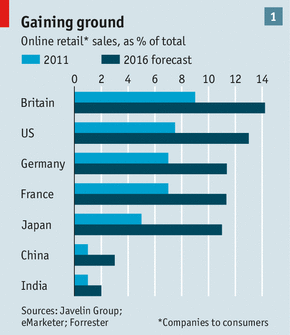
“THE staff at Jessops would like to thank you for shopping with Amazon.” With that parting shot plastered to the front door of one of its shops, a company that had been selling cameras in Britain for 78 years shut down in January. The bitter note sums up the mood of many who work on high streets and in shopping centres (malls) across Europe and America. As sales migrate to Amazon and other online vendors, shop after shop is closing down, chain after chain is cutting back. Borders, a chain of American bookshops, is gone. So is Comet, a British white-goods and electronics retailer. Virgin Megastores have vanished from France, Tower Records from America. In just two weeks in June and July, five retail chains with a total turnover of £600m ($900m) failed in Britain. Read more of this post

Bill Gates Touts Contextually-aware Computing

July 15, 2013, 8:24 PM ET

Bill Gates Touts Contextually-aware Computing

Clint Boulton

Microsoft Corp. Chairman Bill Gates touched briefly upon privacy issues Monday in a keynote speech given at Microsoft Research Faculty Summit. The bulk of his talk concerned the rise of “personal agent” technology, which uses data from sensors embedded in mobile devices, scheduling software and social connections to help users discover “deep insights.” Mr. Gates touched only briefly on data privacy, which has emerged as a hot button issue since the revelations by Edward Snowden of the extent of the National Security Agency’s efforts to gather communications data about U.S. citizens. Read more of this post

Attention, Shoppers: Store Is Tracking Your Cell

July 14, 2013

Attention, Shoppers: Store Is Tracking Your Cell

By STEPHANIE CLIFFORD and QUENTIN HARDY

Like dozens of other brick-and-mortar retailers, Nordstrom wanted to learn more about its customers — how many came through the doors, how many were repeat visitors — the kind of information that e-commerce sites like Amazon have in spades. So last fall the company started testing new technology that allowed it to track customers’ movements by following the Wi-Fi signals from their smartphones. But when Nordstrom posted a sign telling customers it was tracking them, shoppers were unnerved. Read more of this post

In Battle Over Dell, a Founder Hopes to Reclaim His Legacy

July 14, 2013

In Battle Over Dell, a Founder Hopes to Reclaim His Legacy

By QUENTIN HARDY

15Dell1-popup

Michael Dell next to a conveyor belt in 1989 at a Dell plant in Austin, Tex. He was 2

Michael S. Dell is fighting a battle over a company that many say is doomed.

Though his namesake company revolutionized the PC business, it missed the consumer shift to smartphones and tablets, and also missed the move of corporate computing to data centers and cloud-based networks. By trying to take the business private, Mr. Dell, in a sense, is trying to turn back the clock.

“Information technology moves faster than anything — even the worlds of fashion and retail don’t change as much,” said Jeffrey Sonnenfeld, a professor of management at Yale University who said he had a Dell investment. “How do you keep the revolution forever young?” Read more of this post

Why do tech-savvy Israelis remain e-commerce Luddites? Don’t blame shoppers: Business simply hasn’t invested in online selling

Why do tech-savvy Israelis remain e-commerce Luddites

Don’t blame shoppers: Business simply hasn’t invested in online selling.

By Eyal Rosen | Jul.15, 2013 | 5:57 AM

Considering the widespread use of the Internet in Israel, it is quite surprising to discover that just a half percent of gross domestic product, only NIS 5 billion, can be attributed to online transactions for goods and services. This is a considerably lower proportion than in other developed economies. In Europe, for instance, electronic commerce accounts for roughly 1.5% of GDP, three times the rate in Israel. Purchases over the web have grown 120% a year since 2003 in China and from $1.6 billion to $43 billion annually over the past decade in Latin America. The breakthrough hasn’t yet occurred in Israel even though the volume of commerce in the country resulting from online searches reached NIS 20 billion a year, or about 2% of GDP, according to a study performed by McKinsey & Co. in 2009. Read more of this post

Uber’s plans go far beyond car rides; That may be why it’s getting more attention than ever

Uber’s plans go far beyond car rides


121102034507-uber-iphone-app-monster

By Jessi Hempel, writer July 15, 2013: 2:02 PM ET

That may be why it’s getting more attention than ever.

FORTUNE — Uber is raising money again. After several weeks of speculation that the digital taxi-hailing service would raise a round large enough to value the company at well over $1 billion, CEO Travis Kalanick confirmed to the Wall Street Journal July 12 that he was talking to investors. The exact amount is TBD, but I plan to ask him about his plans next week when I interview him atFortune Brainstorm Tech, our annual tech conference which will take place at the Aspen Institute starting July 22.

It’s been three years since Kalanick and cofounder Garrett Camp launched Uber to help their friends find rides—in the form of flashy town cars—more effectively in San Francisco. (Anyone who has lived in San Francisco knows that cabs are notoriously hard to hail.) In that short time, Uber has rolled out in 35 cities including international hotspots like Amsterdam, Paris and Seoul. Kalanick has said the company is profitable in its earliest markets like San Francisco and New York, and that revenue is growing 18% each month. Read more of this post

Gazelle Killed Its Electronics Trade-In Partnership With Walmart Last Year, And Now It’s Growing Like Crazy

Gazelle Killed Its Partnership With Walmart Last Year, And Now It’s Growing Like Crazy

MEGAN ROSE DICKEY JUL. 14, 2013, 10:22 AM 4,578 2

Gazelle is one of the preeminent players in the electronics trade-in space.

It became that way in part because it walked away from a partnership with Walmart — the exact opposite tactic that most companies adopt. Gazelle lets consumers send in their old iPads, iPhones, laptops, and other electronics for cash. Since launching in 2008, Gazelle has paid out $100 million to 600,000 consumers  When Gazelle was thinking about how to grow the business, the biggest challenge was awareness among consumers that there is an easy way to trade in devices and getarket value for them. “In the early days, one of the theories was if we could partner with retailers, OEMs, carriers, and operators, that would be a match made in heaven,” Gazelle CEO Israel Ganot tells Business Insider.  Consumers typically trade in their gadgets when they upgrade to a new one. Retailers are in the business of selling things, and Gazelle is in the business of buying them back, so that theory definitely made sense.  Read more of this post

Big data can help us make sense of absence; Managers should develop ways to predict when, why and ideally where staff are most engaged

July 15, 2013 4:19 pm

Big data can help us make sense of absence

By Andrew Hill

Managers should develop ways to predict when, why and ideally where staff are most engaged

It’s hard to hide from big data. After submitting its staff records for independent analysis, one retailer discovered it was paying more than 150 employees who had called in sick years earlier – and simply disappeared from the workplace. The human resources managers responsible were so terrified of the potential backlash if they revealed the figures to their chief executive, they decided to keep the job of handling absences in-house. Read more of this post

Netflix Should Read Amazon’s Script; Building a formidable subscriber base should be a more immediate concern than raising margins

Updated July 15, 2013, 4:49 a.m. ET

Netflix Should Read Amazon’s Script

Building a formidable subscriber base should be a more immediate concern than raising margins

MIRIAM GOTTFRIED

MI-BX192A_NETFL_G_20130714210011MI-BX196_NETFLI_NS_20130714184214

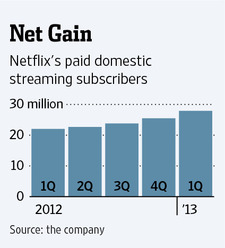
It turns out ’13 has been lucky for Netflix NFLX +0.42% . The stock has surged 178% so far, the best performance in the Standard & Poor’s 500-stock index. But to keep the odds in its favor, the video-streaming and DVD-rental company will need to be more like anAmazon.com AMZN -0.67% than an HBO. Netflix’s paid domestic streaming subscriber base has increased to nearly 28 million from 25.5 million at the start of 2013 and 22 million a year before. This puts it just below Time Warner‘sTWX -0.50% HBO. Meanwhile, Netflix’s domestic streaming margin on the basis of contribution profit, revenue less cost of sales and marketing, was 20.6% in the first quarter, up strongly from 14.3% a year earlier. But expanding margins may represent a risk for Netflix. Read more of this post

Michael Birch, the founder of Bebo, bought the website back for a mere £1m. How will he make it fashionable again?

Bebo ‘has to be different to get people hooked’, says founder Michael Birch

Last week, the founder of Bebo bought the website back for a mere £1m. How will he make it fashionable again? All the old code will be thrown away, he tells Edwin Smith .

birch_2616267b

Michael Birch believes London’s tech sector problem is that the brightest UK graduates are too easily tempted by the high starting salaries on offer in the financial sector Photo: Alamy

By Edwin Smith

9:15PM BST 13 Jul 2013

There’s a scene in the Judd Apatow-produced cult comedy Superbadwhere two high school students are accosted by a suspicious character who tries to befriend them. The audience starts to think there might be something weird about this guy because of the way he talks and the fact that he’s trying to make friends with teenagers despite being in his 30s. Then come’s the clincher: “So,” he asks. “[Are] you guys on Myspace?”. In 2005, two years after Myspace was founded, News Corp paid $580m for it. By 2007, the year in which Superbad was shown at cinemas, it was already a byword for being uncool and out of touch. Fast-forward to 2011 and the social network’s value had plummeted. It was offloaded for a mere $35m to Specific Media Group and Danny Trejo, the Hollywood actor. The lesson was clear: things move fast in social media and what is hot and what is not can swing around with alarming speed. Read more of this post

Estonia’s technology cluster

Estonia’s technology cluster

Jul 11th 2013, 15:00 by L.S. | TALLINN

IT TAKES just five minutes to register a firm in Estonia, says Mihkel Tikk, the head of the country’s online portal, a one-stop-shop for e-government services. Entrepreneurs wishing to start a firm log in with their national electronic identity-card and a few clicks later the confirmation arrives by e-mail. That service and many other equally convenient electronic offerings are a big reason why Tallinn, Estonia’s capital, is now mentioned in the same breath as Berlin, London and even Silicon Valley. According to one estimate, Estonia holds the world record in start-ups per person—a sizeable feat considering that the country has only 1.3m people.

International venture capitalists have taken notice (one, Dave McClure, created a hashtag on Twitter to describe the phenomenon: #EstonianMafia). And they are also investing. In May Transferwise, which offers a cheap way to send money across borders, announced that it raked in $6m in funding, with Peter Thiel, the co-founder of PayPal, being the lead investor. In April Fits.me, a virtual fitting room, raised £5m ($7.6m). Nearly a tenth of the firms in the portfolio of Seedcamp, a noted group of European angel investors, hails from Estonia, including Erply, a fast-growing maker of web-based retail software, which raised $2.15m in May. Read more of this post

5 Mobile Payments Data Points That Will Blow Your Mind

5 Mobile Payments Data Points That Will Blow Your Mind

JOSH LUGER JUL. 12, 2013, 2:20 PM 1,271

Consumers gravitate to convenience. That’s as true with payment technologies as it is with anything else. A prime example is the decades-old trend away from cash or checks and toward credit cards. Now, the mass adoption of smartphones and tablets has set the stage for a new move — away from fixed-point, card-based transactions and toward those completed on mobile. The old dream of the “digital wallet” is coming true in a very particular mobile-led fashion. In a recent report from BI Intelligence we explain the main types of mobile payments, analyze the state of the mobile payments race, examine the matchup between card readers and near-field communications (NFC), look at how traditional banks, credit card companies, and card processors are responding to the mobile payments threat, and detail who is furthest along in developing the all-in-one solution for merchants and consumers. Here are 5 data points that help underscore the explosion: Read more of this post

Asian Chat Giants Covet ‘Exciting’ Indonesian Mobile Market

Asian Chat Giants Covet ‘Exciting’ Mobile Market

By Hayat Indriyatno,Stephanie Hendarta& Diska Putri Pamungkas on 1:05 pm July 13, 2013.
The strong adoption of mobile social media, including chat apps,by Indonesian youths has seen major players from South Korea, Japan and China scrambling for a slice of the year ever-expanding market. Natasya Sandjojo is the quintessential Indonesian university student, constantly keeping in touch with her friends by firing off phone messages or calling them up. And like many tech-savvy Indonesian youths, she has found a way to do that virtually for free. “I prefer using a mobile chatting application over texting because it doesn’t charge me every time I send a message,” she says. “I originally decided to download KakaoTalk because a lot of my friends were using it. I can use the app to call my friends, free of charge. There’s this feature in it that lets me call using different sound effects, such as a cat’s voice. It makes calling friends a lot more fun.”

KakaoTalk is one of several mobile messaging applications that have taken Indonesia by storm over the past couple of years. Their popularity is underpinned by the fact that they allow users to send messages and make voice or even video calls over a mobile data connection or Wi-Fi network — known in industry parlance as “over the top” services because they bypass the traditional cellular phone and text messaging platforms. Read more of this post

How DailyLook grew its international revenue from 0 to 25% in one month; To incentivize its current and new members to help spread the word, DailyLook offered 1,000 “look points” for each friend that joins and makes a purchase

How DailyLook grew its international revenue from 0 to 25% in one month

BY MICHAEL CARNEY 
ON JULY 11, 2013

Less than three weeks into its international launch and Los Angeles women’s fast fashion etailer DailyLook is already seeing 25 percent of its business come from overseas. This is no small feat given its early success domestically, which saw the company generating on the order of $1 million per month in revenue, according to those close to the company, from more than 400,000 highly engaged email subscribers. So what was the key to translating this success overseas so quickly? According to CEO Brian Ree, it was a viral launch strategy. In late Spring, DailyLook posted a counter on its website tracking the progress toward 50,000 international signups, announcing that it would cut the ribbon on its international business if and when this milestone was met. The company further created an artificial deadline of June 23rd, saying that would abandon the plan if it couldn’t gather enough sign ups in time — a threat which it came within days of having to make good on.

To incentivize its current and new members to help spread the word, DailyLook offered 1,000 “look points” for each friend that joins and makes a purchase, where each 2,000 look points converts into a $20 credit on the site. The company then turned to fashion bloggers to spread the word. Needless to say, the strategy appears to have worked. Read more of this post

Online Education a New Frontier in China

July 11, 2013, 12:56 p.m. ET

Online Education a New Frontier in China

WEI GU

In a country as obsessed with education as China, it makes sense that online teaching has huge potential.

Wealthy Chinese spend hundreds of thousands of dollars to send their children abroad for what they perceive as a better education. And China’s scale means online-education companies can serve vast audiences, justifying up-front investments. There is a history of private-education companies in China, and for years the business of preparing students for exams using traditional study centers grew dramatically. About eight Chinese education companies with combined revenue of $1.5 billion last year have listed their shares in the U.S. Read more of this post

Activision’s World of Warcraft No Longer Rules in China

World of Warcraft No Longer Rules in China

By Bruce Einhorn and Ludi Wang on July 11, 2013

http://www.businessweek.com/articles/2013-07-11/world-of-warcraft-no-longer-rules-in-china

World Joyland is a Chinese theme park featuring centaurs and werewolves. It’s a weird homage to the online role-playing game World of Warcraft. Built in 2011, the park in Changzhou, several hours by high-speed train and shuttle bus from Shanghai, is filled with characters and attractions that look remarkably like those in the game developed by Activision Blizzard (ATVI)—with just enough changes that the Santa Monica (Calif.)-based software company, which hasn’t authorized the park to use them, can’t do much about it. The way things are going, World Joyland might want to look elsewhere for inspiration. Read more of this post

How Did Dropbox Scale To 175M Users? A Former Engineer Details The Early Days

How Did Dropbox Scale To 175M Users? A Former Engineer Details The Early Days

MIKE BUTCHER

posted 6 hours ago

Ladies and Gentlemen, we interrupt our normal programming about crazy entrepreneurs and even crazier VCs to bring you a little learning from the world of Engineering. Remember that? Recently Dropbox was in the news for revealingthey’d hit 175 million users, and daring to say they could replace the hard drive. Big words. But what’s the engineering back-story of how they got there? How do successful startups scale, in technical terms, to hundreds of millions of users? It turns it one of the ways it became successful was by creating a very simple and flexible platform early on. Read more of this post

IPhones Stuck to Windshields Threaten Dashboard Maps

IPhones Stuck to Windshields Threaten Dashboard Maps

Tim Nixon, chief technology officer of General Motors Co. (GM)’s OnStar service, knew something was amiss when he saw his two sons taking the “suction-cup approach” to in-car navigation. They would turn their iPhones sideways, stick them to the windshield and use a free map app to find their way.

That represented a rejection of their father’s life’s work: Convincing car buyers to pay $1,500 or more for a dashboard navigation system with an 8-inch screen and elaborate graphics. Rather than scold his young-adult sons, Nixon came up with an answer: GM (GM) now offers a $50 map application for iPhones that can play on the dashboard touchscreen of a $12,170 Chevrolet Spark. Read more of this post

Chinese chipmakers in ‘bloody’ price war

Last updated: July 10, 2013 11:41 am

Chinese chipmakers in ‘bloody’ price war

By Sarah Mishkin in Taipei

Chinese chipmakers are engaging in “bloody” competition that could accelerate production of cheap tablets, already one of the fastest-growing areas in the consumer electronics industry. Designers of the chips used in many of the inexpensive Chinese-made tablets popular in emerging markets have in recent months slashed prices by around 50 per cent, according to analysts. Read more of this post

Why isn’t LinkedIn Blocked in China? If LinkedIn remains unblocked, it should do very well in China

Why isn’t LinkedIn Blocked in China?

July 11, 2013

by Willis Wee

Among major social media sites, China blocks Twitter and Facebook (among others); heck, it even blocks Slideshare! But not LinkedIn. I might be jumping to conclusions too soon (I mean, things get blocked in China pretty rapidly) but it seems safe to assume that China knows LinkedIn has much to offer to the middle kingdom. Enough, apparently, to keep it from getting blocked. Read more of this post

In The Philippines, SMS Textbooks Are The Future Of Education

In The Philippines, SMS Textbooks Are The Future Of Education

July 10, 2013

by Phoebe Magdirila

SIM-card-and-SMS-Textbooks-in-the-Philippines-720x391

Smartphone adoption in Asia is increasing, but feature phones still dominate some areas. For example, 89 percent of the Metro Manila population are still using feature phones. Advertising agency DM9JaymeSyfu (DM9) saw that feature phones can help the education sector in the country, so it spearheaded the idea of condensing textbooks into SIM cards and executed it with the help of telco Smart Communications. The result is a campaign called Smart Txtbks. Read more of this post

Google Chromebook Under $300 Defies PC Market With Growth

Google Chromebook Under $300 Defies PC Market With Growth

Google Inc. (GOOG)’s Chromebook was dismissed as a bare-bones laptop with limited appeal when it debuted two years ago. Now it’s defying skeptics and gaining share as the rest of the personal-computer market shrinks.

Chromebooks have in just the past eight months snagged 20 percent to 25 percent of the U.S. market for laptops that cost less than $300, according to NPD Group Inc. The devices, which have a full keyboard and get regular software updates from Google, are the fastest-growing part of the PC industry based on price, NPD said. Read more of this post