Daily deals are dead, but flash sales live on: Yabblr launches DIY flash sale marketplace

Daily deals are dead, but flash sales live on: Yabblr launches DIY flash sale marketplace

BY ERIN GRIFFITH 
ON JUNE 13, 2013

The first wave of flash sale fever petered out sometime in 2011, just before daily deal fatigue set in and subscription commerce fever started to spread.

As a category, flash sales sites have experienced plenty of growing pains. Gilt Groupe went through some layoffs, belt-tightening, and amajor talent turnover. Rue La La recentlyreplaced its CEO. Totsy went belly-up. Lot18 has gone through a couple of pivots and rounds of layoffs. That hasn’t stopped new companies from trying their hand at the business model. The success of fast-growing companies like Fab, One Kings Lane and Zulilly keeps hope alive, I suppose.

Today a new one launches with a new approach. Yabblr is a flash sales platform that uses elements of a marketplace to give autonomy to independent sellers. Read more of this post


Baidu’s New Business Unit Eyes Consumer-facing Paid Services

Baidu’s New Business Unit Eyes Consumer-facing Paid Services

By Tracey Xiang on June 13, 2013

In an internal e-mail sent to Baidu employees last week, its CEO Robin Li announced a new business unit for consumer-facing paid services thus becoming the fifth of Baidu’s. The other four are focused on search, location-based services, mobile Cloud and international businesses (in Chinese).

Robin Li said at its annual event last month that the gaming-centered paid Internet services make up “a huge market” (in Chinese). Baidu Games started as an online games search engine but changed to become an online games platform in 2008 that shared revenues from users with selected third-party games providers. In 2010 the platform and revenue-sharing program opened up to all third-party providers. Now it has had over a hundred titles on the platform and claimed it had reached 100 million users. But the revenue generated there is unknown. Read more of this post

What Fred Wilson, the Godfather of New York tech, learned from the dotcom bubble

What Fred Wilson, the Godfather of New York tech, learned from the dotcom bubble

BY ERIN GRIFFITH 
ON JUNE 13, 2013

Fred Wilson of Union Square Ventures lost a lot of money in the dotcom crash. Everyone did. But not everyone spent the next three years trying to earn it back. Ultimately, by scrambling and salvaging with his portfolio companies, he managed to make more money than he lost, he told an audience at PandoMonthly in New York this evening. That, along with his massive advocacy of New York’s tech scene, is why he’s been dubbed the “godfather” of New York’s tech scene.

Many of the people he worked with had stopped returning his phone calls. Others didn’t show up for board meetings anymore. There were plenty of founders who simply walked away from their companies. Several of his biggest deals were huge disasters — he lost $25 million in famous flame-out Kosmo.com, for example. Read more of this post

For Fred Wilson, Twitter is the Beatles and Tumblr a solo act

For Fred Wilson, Twitter is the Beatles and Tumblr a solo act

BY ADAM L. PENENBERG 
ON JUNE 13, 2013

twitter_submarine

At tonight’s PandoMonthly in New York, Fred Wilson, partner at Union Square Ventures, compared two of his most successful investments by employing a musical analogy. Tumblr’s founder, David Karp, is a one-man band, while he likes to think of Twitter “as the Beatles.”

Wilson cited a well-read blog post by Marco Arment, the well-known developer who helped David Karp build Tumblr, which he published on the day of Yahoo’s billion-dollar acquisition, calling Tumblr “the one-person product.”

“Even though Tumblr was never a one-person company, it usually felt like a one-person product,” Arment wrote. “David always had a vision for where he wanted to go next. Karp would come in with concepts for product features and Arment would tell him what was feasible and what wasn’t. “The ideas were usually David’s, and the product roadmap was always David’s.” Read more of this post

IRobot’s latest product Ava 500 is designed to navigate corporate offices autonomously and facilitate videoconference calls

Meet the Ava 500, the Roomba’s Corporate Cousin

By Brad Stone on June 10, 2013

0610_irobot2_630x420

Since the founding of iRobot more than 20 years ago, the Massachusetts Institute of Technology spinout has produced robots that vacuum and mop floors, clean gutters, and patrol war zones. The Bedford (Mass.)-based company has sold more than 9 million home robots and, in the process, has done more than anyone to move the machines out of science fiction and into the real world of affordable devices.

Today, iRobot (IRBT) adds another product to its league of extraordinarily practical machines, the Ava 500. It’s a far cry from the Roomba vacuum, its corporate cousin. The Ava—short for Avatar—is a pricey, wheeled robot designed to navigate corporate offices autonomously and facilitate videoconference calls between workers and their remote colleagues. It comes with a high-definition video screen, some onboard mapping smarts, and Cisco’s TelePresence, a high-quality videoconferencing system meant to create the illusion that far-flung collaborators are sitting across a table from one another. The idea is to “turn an entire office into a high-quality videoconferencing room,” says Colin Angle, iRobot’s chief executive. Read more of this post

Innovation: Phil Dumas’s Kevo, a Tap-to-Unlock Door System

Innovation: Phil Dumas’s Kevo, a Tap-to-Unlock Door System

By John Tozzi on June 13, 2013

Innovator Phil Dumas
Age 31
Title CEO of UniKey Technologies, an 11-employee startup founded in 2010 in Winter Park, Fla.
Form and Function
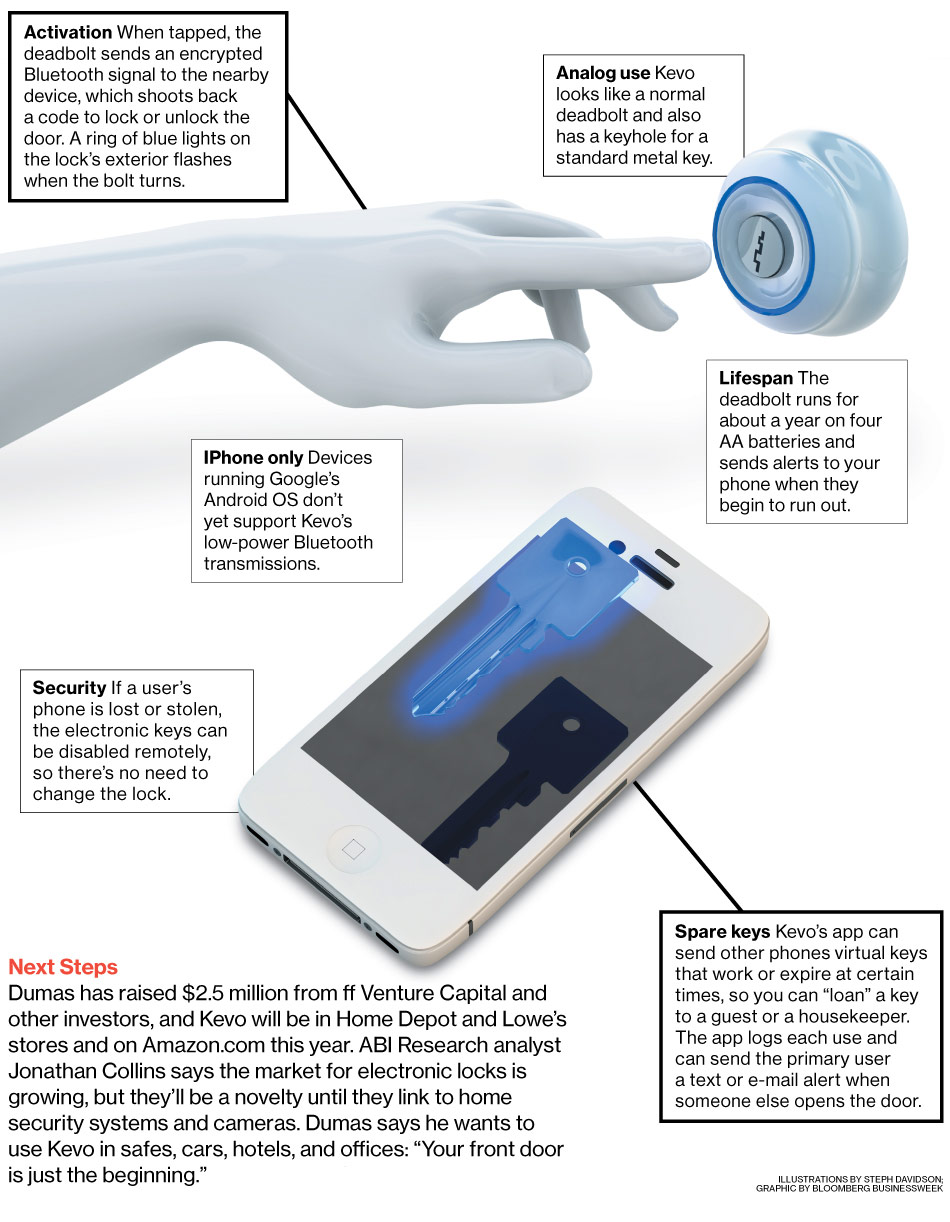
Kevo, a motorized deadbolt lock linked to your iPhone or a dedicated remote control, lets you open your door with the tap of a finger.

tech_innovator25_950


Amazon’s Kindle Worlds is looking to cash in on fan fiction by licensing popular brands. They’re paying authors 35 percent royalties

Amazon Wants to Sell Your Fan Fiction Through Kindle Worlds

By Olga Kharif on June 13, 2013

For those who can’t get enough of The Vampire Diaries or dream of further installments of Gossip Girl, Amazon.com (AMZN)may have the answer: fan fiction. The company’s Kindle Worlds e-book venture has licensed the rights to these two soapy teen drama series, as well as another called Pretty Little Liars, and is inviting amateur writers to develop novels and short stories inspired by the characters and back stories of the original works.

Amazon is trying to tap into one of publishing’s hottest trends. Fanfic websites, as they’re known, include millions of aficionado-penned stories, many dating back well over a decade. One site, FanFiction.net, offers nearly 650,000 stories about Harry Potter alone. Once a niche genre, such sites have gained commercial legitimacy since the Fifty Shades of Greyseries, which sold more than 70 million copies in print, audio, and digitally from March to December 2012. The bondage-romance series, which began as Twilight fan fiction, was a bright spot for the publishing industry last year amid slowing growth of trade e-book sales. (Sales grew 44 percent in 2012 but more than doubled in 2011, according to BookStats, which tracks U.S. publishers.) “The hope is that it could be very big,” says Les Morgenstein, president of the Warner Bros. Television Group division Alloy Entertainment, which owns rights to The Vampire DiariesGossip Girl, and Pretty Little Liars. Read more of this post

Thumbtack: A Local Services Hub to Rival Angie’s List? Companies from Angie’s List to Yelp to HomeAdvisor have tried over the past decade to crack the U.S. market for plumbing, gardening, and other local services by developing an online database for homeowners looking for reliable referrals

Thumbtack: A Local Services Hub to Rival Angie’s List?

By Brad Stone on June 13, 2013

Companies from Angie’s List (ANGI) to Yelp (YELP) to HomeAdvisor have tried over the past decade to crack the U.S. market for plumbing, gardening, and other local services by developing an online database for homeowners looking for reliable referrals. There have been limited successes but no breakout leader, partly because many of the nation’s tens of millions of local small business owners spend relatively little time on the Web and run their businesses the old-fashioned way, with a pen and pocket calendar.

Now there’s a new entrant in this crowded field, Thumbtack. The San Francisco startup has operated quietly for four years, building a database of more than 250,000 service professionals who can pay the company fees for referrals. They include home maintenance workers and a wider range of occupations, from wedding officiants to yoga instructors. Thumbtack planned to announce on June 13 that it has raised $12.5 million from a group of investors, led by Sequoia Capital, that are chasing the chance to build the next great online e-commerce hub. “The long-term vision is to build the Amazon (AMZN)for services,” says Marco Zappacosta, Thumbtack’s 27-year-old chief executive officer. “We want to build the kind of brand that the Yellow Pages had for decades.” Read more of this post

Pay for the Bus With a Phone: Mobile Wallet System Coming to China Mobile

Pay for the Bus With a Phone: Mobile Wallet System Coming to China Mobile

June 14, 2013

by C. Custer

1371087136161-315x236

Taking the bus in China isn’t that difficult if you have a transit card you can swipe to pay your fare. But soon, even the transit card may be unnecessary. The Beijing News reported yesterday that China Mobile has partnered with a number of banks (eight so far) and with China UnionPay to create a mobile payment system, and the first part of that system is coming very soon.

Right now, Beijing China Mobile customers who’d like to can visit any of six designated China Mobile shops to switch their SIM cards out for new ones that will allow them to connect their phones to their bank accounts. Soon, Beijing’s public transportation system will let them swipe those phones to pay for bus fares around the city. No transit cards required. Read more of this post

Google now takes one of every three dollars spent on digital advertising—and one of every two on mobile

Google now takes one of every three dollars spent on digital advertising—and one of every two on mobile

By Leo Mirani @lmirani 11 hours ago

Figures out today from eMarketer, a digital marketing research firm, show that Google gobbled up 31.5% of the $116.82 billion companies took in digital advertising last year. (The numbers from eMarketer are based on the total advertising revenue companies like Google earned minus the cost they have to pay affiliates for “traffic acquisition,” which is a fee paid to referrers or through programs such as Google’s AdSense.) That’s down a little from 32% in 2011. But this year Google’s share should reach one-third of expected total advertising revenues of $116.82 billion. The next biggest winner of digital ad revenue is Facebook. Its share for 2012 was a fraction of Google’s: 4.1%. Google is even more dominant in mobile advertising. Of the $8.8 billion companies pulled from mobile advertising, Google accounted for $4.6 billion, or 52.4%. Facebook went from a standing start—zero in 2011—to 5.4% ($470 million) in 2012. It is forecast to more than double its share to 13% ($2 billion) of this year’s $15.82 billion total. Not taking affiliate fees into account, advertising accounted for 95% of Google’s revenues last year.

Companies are using social media to combat online payment fraud, which cost an estimated $3.5 billion last year

Using Social Media to Stop Online Payment Fraud

By Danielle Kucera on June 13, 2013

Users of Facebook (FB), Pinterest, and Twitter share personal details every day. Now credit bureaus and payment companies Equifax (EFX), EBay’s (EBAY) PayPal, WePay, and Intuit (INTU) have begun trials to see whether social posts can help prove identities or detect whether customers are lying about their finances. “We are investing a lot in how can we use unstructured data that is sitting out there in social media that can help us understand a little more about identity,” says Rajib Roy, president of Equifax Identity and Fraud Solutions. Fraud cost U.S. online retailers $3.5 billion last year, according to payment processor CyberSource. Read more of this post

Early Waze backer maps out investment thesis

Early Waze backer maps out investment thesis

By Dan Primack June 13, 2013: 3:18 PM ET

waze-app

When venture capitalist John Malloy first invested in Waze, the company was worth just a few million dollars. Now Google is paying more than $1 billion for it. Malloy explains what he saw back in 2008, and why his bet paid off. FORTUNE — Google (GOOG) this week announced that it will buy social mapping company Waze for a reported $1.1 billion, beating out earlier suitors like Apple (AAPL) and Facebook (FB). So I spent some time on the phone with John Malloy, a general partner with BlueRun Ventures, who led the original $14 million investment in Waze. What follows is an edited transcript of our conversation.

Read more of this post

Stockholm-based Wrapp raises $15 million as social gifting matures

Wrapp raises $15 million as social gifting matures

June 13, 2013: 7:30 AM ET

Stockholm-based Wrapp is locking up more funding and moving headquarters to San Francisco.

By Kurt Wagner, reporter

130613070209-wrapp-620xa

FORTUNE — Stockholm-based Wrapp, the company known for giving away gifts, is on the receiving end of a present from Sand Hill Road this morning — $15 million in funding. Wrapp, whose app enables users to send free and paid gift cards to friends or family using a smartphone or Facebook, today announced a Series B funding round that increases the company’s total fundraising to more than $25 million. Three Series A investors, including Greylock Partners and Atomico, were joined by three new investors, including American Express (AXP), in the new round. Read more of this post

India’s Persistent Systems’ founder Anand Deshpande: My employees asked me, was it my company or our company?

Anand Deshpande: My employees asked me, was it my company or our company?

by Anand Deshpande | Jun 10, 2013

topimg_21823_anand_deshpande_600x400

Anand Deshpande is founder, CEO and managing director of Persistent Systems. Prior to setting up the Pune-based company in 1990, he worked at Hewlett-Packard Laboratories in Palo Alto, California. Every month, he spends about two weeks meeting his customers in the US. Ram Charan, Jim Collins, Clayton Christensen and CK Prahalad are among his favourite management thinkers

Anand Deshpande realised he needed to make a transition from a programmer to a sales manager in order to grow Persistent

Before I started persistent systems, i was doing research work at HP Labs in Palo Alto. When I came back to India, my ambition was to start a high-end, tech-focussed company that wouldn’t compromise my résumé in some sense. I started Persistent in 1990 and we were working on some interesting projects. The idea was to be very niche. For the first three or four years, we were doing that kind of work. I felt I achieved what I had intended to. And I was doing what I liked doing. After three or four years, some employees told me, “Fine. This is what you are doing for yourself but what about us?” In effect, their question was, “Is this your company or is this our company?”   Read more of this post

KKBOX, Taiwan’s biggest cloud-based music service provider, said Tuesday it is looking to expand further into new markets in Asia and hopes to become a leading regional subscription service brand

Music service KKBOX eyes further expansion in Asia

CNA

2013-06-13

KKBOX, Taiwan’s biggest cloud-based music service provider, said Tuesday it is looking to expand further into new markets in Asia and hopes to become a leading regional subscription service brand.

The market share leader in Taiwan and Hong Kong, KKBOX is now eyeing the Thai, Indonesian and Australian markets after successfully gaining a presence in Japan on June 1, Izero Lee, KKBOX’s CEO, was quoted as saying by local media. Read more of this post

Waze employees clinch most lucrative exit in Israeli history; Each of the company’s 100 employees will be getting an average of $1.2 million

Waze employees clinch most lucrative exit in Israeli history

Each of the company’s 100 employees will be getting an average of $1.2 million.

By Amir Teig | Jun.13, 2013 | 9:12 AM |  2

The 100 employees of the Israeli navigation app developer Waze stand to receive a total of $120 million, as a result of Google’s acquisition of the company, making this the most lucrative exit ever for employees of an Israeli startup. The global search giant confirmed on Tuesday that it had agreed to purchase Waze for $1.15 billion.

Prime Minister Benjamin Netanyahu called Waze CEO Noam Bardin on Tuesday evening to congratulate him on the sale. “We fought to keep the company in Israel,” Bardin said in response. “We’ll help you close the hole in the budget,” he added, partially in jest but also in pride.

Of the $1.15 billion that Google transferred into the account of Waze’s shareholders’ trustee, $1.03 billion will be going to the company’s owners, which include institutional investors, funds and other investors. Read more of this post

Who will be the next Waze? “Globes” selects some of Israel’s most promising start up candidates for the next big exit

Who will be the next Waze?

“Globes” selects some of Israel’s most promising start up candidates for the next big exit.

12 June 13 19:55, Roy Goldenberg

In the wake of the impressive exit by Waze Ltd., “Globes” presents ten Israeli Internet start ups which could produce the next big exit.

Wix Ltd.

Business: Easy-to-use online platform for building websites

CEO: Avishai Avrahami

Chances of sale/IPO: Last week, the company filed a draft prospectus with the US Securities and Exchange Commission (SEC) for an IPO on Wall Street

Estimated company value: $400 million

Estimated revenue in 2012: $40 million

Capital raised: $66 million

Prominent investors: Bessemer Venture PartnersBenchmark Capital, DAG, Mangrove Capital Partner, Insight Venture Partners, and private investors. Read more of this post

Amazon Expands Into Selling 3D Printer & Supplies

Amazon Expands Into Additive Manufacturing

Kyle Maxey posted on June 10, 2013 | Comment

While Amazon CEO Jeff Bezos may believe that 3D printing is still a long way from changing the way industry makes and distributes products, his online marketplace isn’t shying away from the opportunity to sell the revolutionary technology. In a recent addition to its website, Amazon has decided to add a new section to it’s “Industrial & Scientific” market category – “3D Printers & Supplies”. A quick look around the section gave me the impression that Amazon is still catering to the Maker segment of the 3D Printing community. Among the products available are the MakerBot Replicator2, the LulzBot AO-101, the Airwolf3D and a number of other models. Read more of this post

Alibaba’s Alipay App Has A Major Update Again, Wants More Control over Your Mobile Life

Alipay App Has A Major Update Again, Wants More Control over Your Mobile Life

By Tracey Xiang on June 8, 2013

AlipayWallet2

Alipay, the payments company under Alibaba Group, just released a major update of its mobile app, Alipay Wallet  – now only Android versionis available. This version touches more aspects of your mobile life. Here are some of the new features,

Managing your travel itineraries. Now you can add and manage airtickets, hotels and other travel related tickets within the app, and receive notifications of flights and other alerts. Alipay now partners with four Airlines including AirChina, airticket search service Kuxun and hotel service Buding. Read more of this post

Lakala Founder: Third-party Payments Service Are the New SPs and Banks New Telcos

Lakala Founder: Third-party Payments Service Are the New SPs and Banks New Telcos

By Charlie Sheng on June 13, 2013

Sun Taoran is a respected serial entrepreneur and a bestselling author on building startups. He started his first business back from publishing a weekly IT magazine and then shifted to the second company Bluefocus, also the first listed PR company in China. Later on he began to make mobile phones branded Hi-Tech Wealth (also named as the mobile PC), which was quite a hit at the early 00s.. He started up a total of seven companies in different fields and the most recent one is Lakala.

Now founder and chairman of Lakala, one of the biggest third-party payments services in China, Mr. Sun revealed to local media about how he came up with the idea of building such a company and his thoughts on third-party payments sector in China. Read more of this post

Real-time translation start-up Lexifone leaves much to be desired; Phone service slow, OK at business talk but garbles daily speech

Real-time translation start-up leaves much to be desired

Phone service slow, OK at business talk but garbles daily speech

BY MAX J. ROSENTHAL

AP JUN 14, 2013

JERUSALEM – An Israeli start-up says it has come up with a way to overcome language barriers when conducting international business: an automated service that provides quick translations between English and seven other languages over the telephone.

Lexifone allows people to get translations without paying hundreds of dollars for human interpreters. The service translates spoken conversations in real time, which Lexifone says is an improvement over free, Web-based services that are typically limited to typing in text. Read more of this post

Why Local-Mobile Marketing Is Exploding

Why Local-Mobile Marketing Is Exploding

JOSH LUGER JUN. 12, 2013, 2:14 PM 14,255 4

Location-based mobile marketing promises the sky: high conversion rates, surgical targeting, and rich consumer profiles. But does it deliver? According to many accounts, it does. Not surprisingly, retailers, brands, and agencies are scrambling to hone their location-based approaches. These encompass everything from “geo-aware” and “geo-fenced” ad campaigns, to hyper-local efforts keyed to Wi-Fi hotspots, and algorithmic location-based targeting of audience segments like soccer moms, bargain hunters, coffee enthusiasts, etc.

Read more of this post

Gatekeepers of Cable TV Try to Stop Intel

June 12, 2013

Gatekeepers of Cable TV Try to Stop Intel

By BRIAN STELTER

WASHINGTON — As Intel tries something audacious — the creation of a virtual cable service that would sell a bundle of television channels to subscribers over the Internet — it is running up against a multibillion-dollar barricade.

That barricade is guarded by Time Warner Cable and other cable and satellite distributors, which are trying to make it difficult — if not impossible — for Intel to go through with its plan. The distributors are using a variety of methods to pressure the owners of cable channels, with whom they have lucrative long-term contracts, not to sign contracts with upstarts like Intel, that way preserving the status quo. Read more of this post

Patchwork of data covers all of us from the cradle to the grave

June 12, 2013 8:11 pm

Patchwork of data covers all of us from the cradle to the grave

By Emily Steel in New York

Data cost

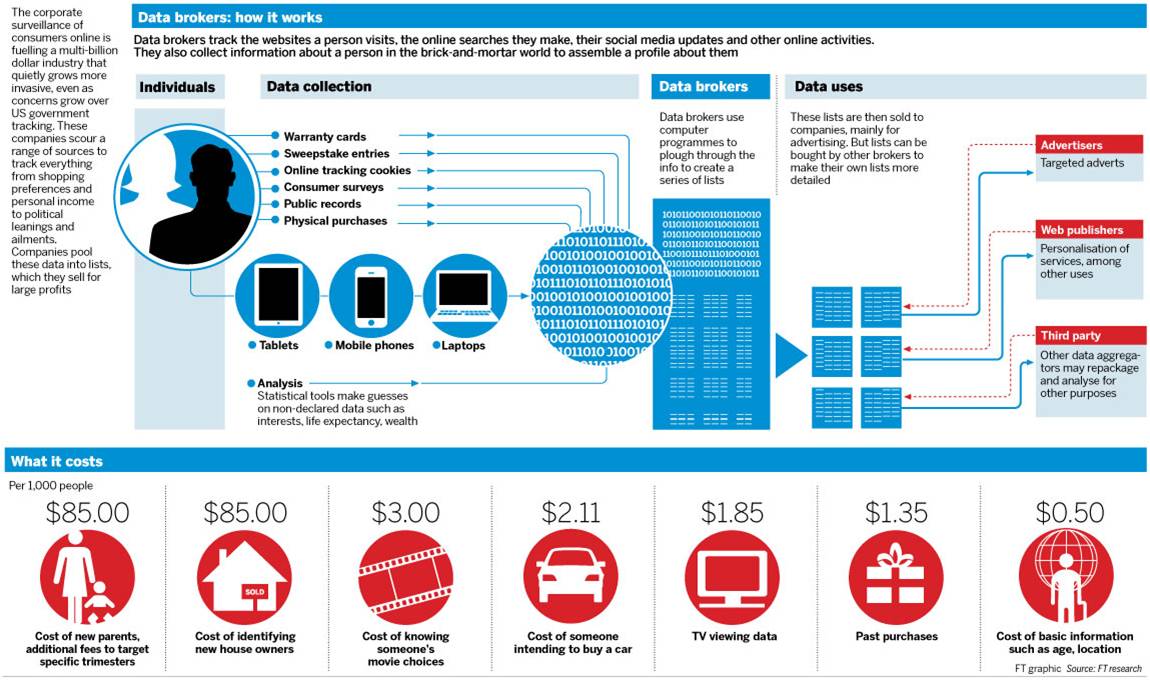
Months before Eleanor Nagle was born, details about her already had been traded for pennies in the corporate market for consumer information.

So-called data brokers scour through baby furniture and maternity store purchases, social media posts, pregnancy email subscriptions, baby registries and birth records, even purchasing details from photography companies that take in-hospital pictures of newborns. All so they can compile up-to-date, accurate lists of new parents, sorted by due date and including everything from the gender of the baby to the mother’s age and household income, to sell to marketers. Read more of this post

Big data has to show that it’s not like Big Brother

Last updated: June 12, 2013 7:15 pm

Big data has to show that it’s not like Big Brother

By John Gapper

We do not know yet what this new technology of data analysis and artificial intelligence means

Sales of George Orwell’s Nineteen Eighty-Four have risen since Edward Snowdenrevealed how the National Security Agency of the US gains access to telephone records and data from technology companies. So far, if people do not exactly love Big Brother, they are prepared to accept some invasion of their privacy in return for security.

What about “big data”? Companies that hold rapidly expanding amounts of personal information are using new kinds of data analysis and artificial intelligence to shape products and services, and to predict what customers will want. Larry Page, Google’s chief executive, describes his ideal form of technology as “a really smart assistant doing things for you so you don’t have to think about it”. Read more of this post

Banks are tripping over themselves to lend money to Box, the cloud computing start-up, in a race to get a slot on one of the next big Silicon Valley flotations

Last updated: June 12, 2013 6:21 pm

Banks prepare credit to gain edge on Box IPO

By Arash Massoudi in New York and Richard Waters in San Francisco

Banks are tripping over themselves to lend money to Box, the cloud computing start-up, in a race to get a slot on one of the next big Silicon Valley flotations.

At least five banks are in talks to give a credit line to Box, underscoring the lengths they are willing to go to to develop potentially lucrative ties with the next batch of high-profile technology companies expected to come to market. Read more of this post

ESPN Ends Game for 3-D Channel for Now

Updated June 12, 2013, 7:52 p.m. ET

ESPN Ends Game for 3-D Channel for Now

By CHRISTOPHER S. STEWART

Television viewers like to watch big screens, really big screens—and even little ones. But so far, it seems, there aren’t too many who want to watch in three dimensions.

That is a conclusion at least that can be drawn from ESPN’s decision disclosed Wednesday to pull the plug on its three-year-old ESPN 3D network, citing “low adoption of 3D in the home.” Read more of this post

In Southeast Asia, the Web Gets Tangled Amid Dissent

Updated June 12, 2013, 8:42 p.m. ET

In Southeast Asia, the Web Gets Tangled Amid Dissent

By CHUN HAN WONG

WO-AO149_ASIAWE_G_20130612185114

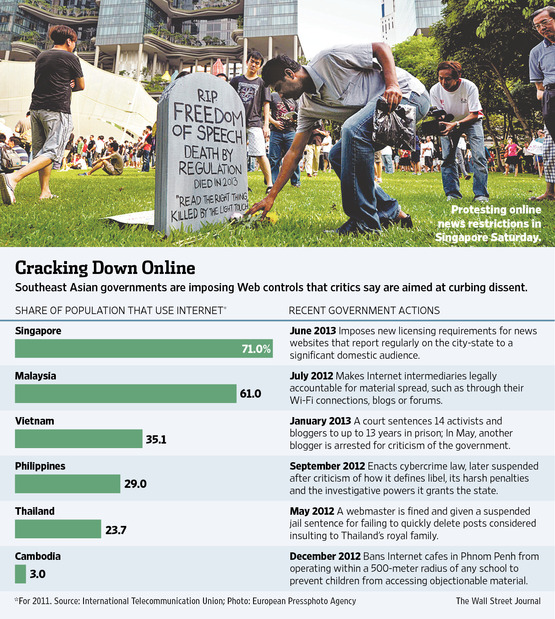
Southeast Asian governments are reaching for new legal tools and raw state powers as the Internet increasingly enables younger citizens to criticize their long-serving political leaders.

Not all these countries are as effective as China and its famed “Great Firewall,” which filters everything from microblog posts to ordinary Internet searches. But the speed with which countries such as Singapore, Malaysia, Cambodia and Vietnam are moving to impose Web controls is worrying human-rights advocates, who fear further curbs on Internet freedoms could suppress free speech and strip these economies of their vitality. Read more of this post

Danger Maps Backed by Alibaba Pinpoint Chinese Pollution; “Real-estate agents and websites who want to boost transactions won’t tell you this kind of information”

Danger Maps Backed by Alibaba Pinpoint Chinese Pollution

As pollution concerns rise in China, Liu Chunlei is boosting environmental awareness among the nation’s 564 million Internet users with help from the charitable arm of Alibaba Group Holding Ltd (ALIBABZ).

Danger Maps, a website Liu started last year, allows people to look up sites such as toxic-waste treatment facilities, oil refineries and power plants. Liu has plotted about 6,000 pollution sources based on government data and user input on Baidu Map, China’s equivalent of Google Maps.“Real-estate agents and websites who want to boost transactions won’t tell you this kind of information,” said Liu, 35, who created Danger Maps after learning that the Shanghai apartment he bought in 2007 was near a landfill — something he wasn’t informed of when negotiating the purchase. Read more of this post

Textbook rental firm Chegg selects banks for IPO; Chegg, originally called “the Netflix for textbooks,” started life as a website that allowed college students to save money on expensive text books by renting them

Exclusive: Textbook rental firm Chegg selects banks for IPO

9:26am EDT

By Olivia Oran and Alistair Barr

(Reuters) – Textbook rental company Chegg has selected two banks to lead an initial public offering, according to three sources familiar with the matter. The Santa Clara, California-based company has picked JPMorgan Chase & Co (JPM.N: QuoteProfileResearch,Stock Buzz) and Bank of America Corp (BAC.N: QuoteProfileResearchStock Buzz), the sources said. The offering could raise $200 million, one of the sources said. JPMorgan and Bank of America declined to comment. Chegg could not be reached for comment. Launched nationally in 2007, Chegg has raised more than $200 million in venture funding and debt. Its investors include Insight Venture Partners, Foundation Capital, Gabriel Venture Partners and Kleiner Perkins Caufield & Byers. The company plants a tree for every textbook it rents or sells and has planted more than 5 million trees to date, according to its website. Chegg, originally called “the Netflix for textbooks,” started life as a website that allowed college students to save money on expensive text books by renting them. Under former Yahoo! Inc (YHOO.O: QuoteProfileResearchStock Buzz) executive Dan Rosensweig, the company in recent years has built a broader online education platform that supports activities such as homework note-sharing, class planning, finding professors and tutors, and even recruiting for athletics. One question hanging over an IPO of Chegg is whether the company will be valued as a new type of education-oriented professional network, such as LinkedIn (LNKD.N: QuoteProfileResearchStock Buzz).