The 9 do-or-die questions boards should ask about technology strategy

The do-or-die questions boards should ask about technology

Board members should raise nine critical questions when discussing technology strategy with IT and business managers.

June 2013 | byPaul Willmott

An article in the fall 2012 issue of McKinsey on Business Technologydescribed how some organizations are creating new technology forums, building the expertise of corporate directors, and strengthening IT governance—all with the aim of allowing boards to guide management by asking the right questions about technology.1 But what are the right questions at a time when digital technologies are beginning to disrupt industries and mastering these technologies may be the key to long-term survival and success? The particulars of each enterprise’s situation will, of course, determine the focus of the discussion and the detailed questions to ask. However, across industries, every corporate director—IT savvy or not—will benefit from reviewing the following questions as a starting point for shaping a fruitful conversation with management about what the company needs to do to become a technology winner.

Read more of this post

Nintendo Chief Defends Console Strategy; Company Sticks to Games for Its Hardware, Resisting Lure of Mobile Devices

Updated June 11, 2013, 5:45 p.m. ET

Nintendo Chief Defends Console Strategy

Company Sticks to Games for Its Hardware, Resisting Lure of Mobile Devices

By DAISUKE WAKABAYASHI

MK-CD942_NINTEN_G_20130611190753

Nintendo President Satoru Iwata, shown with a Wii U controller, says the company will stick with a strategy of making games for its own hardware.

LOS ANGELES—Game apps for smartphones and tablet computers are selling at a rapid pace, much faster than the market for console games. But Satoru Iwata isn’t succumbing to their allure.

The president of Nintendo Co.7974.OK -1.47% is determined to stick to its three-decades-old strategy of making games only for its own hardware, despite pressures to exploit its popular software more widely.

In an interview, Mr. Iwata said the short-term benefits of going after the mobile-apps market wouldn’t be worth the potential harm to the company’s strategy of combining hardware and software in ways that make Nintendo’s offerings unique. Read more of this post

Uber Cab App Threatens Death of Taxi Dinosaurs

Uber Cab App Threatens Death of Taxi Dinosaurs

People can run into two problems when they need to find a taxi. The first is that they don’t know whether a taxi will be available. The second is that they don’t know when a taxi will be available.

Uber Technologies Inc., a San Francisco-based company, was set up to solve both problems. You can download its application, and it will find out where you are and come pick you up. It will also tell you when it is coming.

In fact, the app comes with a screen that shows exactly where the vehicle is, so you can watch as it makes its way toward you. Once a credit card is in the system, the customer doesn’t have to pay with cash or decide on a tip; everything is automatic. Read more of this post

CIA Chooses: Amazon or IBM? $600 million contract to set up a cloud-computing system shows the growing importance of intelligence-agency business for technology companies

Updated June 11, 2013, 9:47 p.m. ET

CIA Chooses: Amazon or IBM?

By SPENCER E. ANTE

MK-CD938_IBMCIA_G_20130611183613

The battle between International Business Machines Corp. IBM -0.51% andAmazon.com Inc. AMZN -2.24% over a $600 million contract to set up a cloud-computing system for the Central Intelligence Agency shows the growing importance of intelligence-agency business for technology companies.

The competition comes amid extraordinary disclosures of secret government-surveillance programs and shows that even in the rarified world of intelligence agencies, companies selling Internet-based cloud-computing services—like Amazon—are challenging the position of traditional technology vendors.

Companies like IBM have long supplied the U.S. military and intelligence services with computers, software and the know-how to operate them. Now, new contenders like Amazon are getting into the act, drawn by a fresh source of revenue as business spending on technology remains sluggish and by the imprimatur of providing services to clients that have the highest security standards. Read more of this post

An astounding 54% of online display ads weren’t seen by anyone

June 11, 2013, 10:51 a.m. ET

Web Display Ads Often Not Visible

By SUZANNE VRANICA

MK-CD933A_MISSI_G_20130611181506

The old adage in advertising—that half the money is wasted but no one knows which half—turns out to be as true for the digital world as it ever was for traditional media.

An astounding 54% of online display ads shown in “thousands” of campaigns measured by comScore Inc.SCOR -0.22% between May of 2012 and February of this year weren’t seen by anyone, according to a study completed last month.

Don’t confuse “weren’t seen” with “ignored.” These ads simply weren’t seen, the result of technical glitches, user habits and fraud.

The finding implies that billions of marketing dollars are being poured down a digital drain. Last year, $14 billion was spent on online display advertising, estimates eMarketer, 40% of all online ad spending. Read more of this post

A Revolution in the Making; Digital technology is transforming manufacturing, making it leaner and smarter—and raising the prospect of an American industrial revival

Updated June 10, 2013, 1:15 p.m. ET

A Revolution in the Making

Digital technology is transforming manufacturing, making it leaner and smarter—and raising the prospect of an American industrial revival

By JOHN KOTEN

IV-AA437A_IVCOV_D_20130610121205

On a dark and stormy night two weeks ago in Schenectady, N.Y., Ken Hislop was relaxing at home when his cellphone suddenly began buzzing in his pocket. It was an urgent text message—from the General Electric Co. GE -0.34% factory where he works.

Soon, a second message arrived. And then another, and another. The texts were being sent by tiny sensors embedded inside a series of machines, some of which look like enormous upside-down cement mixers. A violent thunderstorm passing through the area had caused something to go wrong.

“I knew right away we’d lost power at the plant,” says Mr. Hislop, a manufacturing engineer. He quickly switched on his iPad and accessed animated schematic maps that signaled everything happening at the $170 million facility, which makes massive batteries for things like cellphone towers and power plants. Though the outage had been momentary, much of the equipment at the factory had to, in effect, reboot, and any blip could mean costly lost production time. Read more of this post

How 3-D Printing Works; The process turns conventional manufacturing on its head, producing objects from the bottom up

Updated June 7, 2013, 7:02 p.m. ET

How 3-D Printing Works

The process turns conventional manufacturing on its head, producing objects from the bottom up

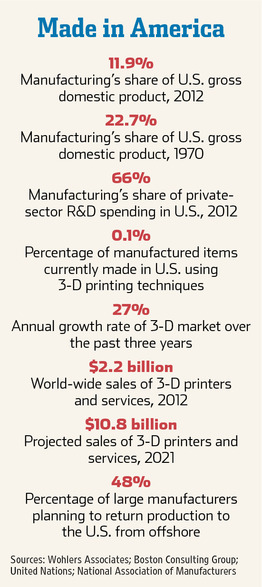
People have traditionally made things—from doorknobs to scalpels to engine cylinders—in one of two ways. They start with a solid block or sheet of metal, wood or other material and cut, stamp, drill or shave it to create a desired shape. Or they use a mold made of metal or sand, pour liquefied plastic or metal into it and let it cool to create a metal casting or molded plastic part. Now for something completely different. Three-dimensional printing and other forms of what is known as additive manufacturing use neither machining nor molds. They build an object from the bottom up by piling razor-thin layers of material on top of each other until a three-dimensional shape emerges. The computer-guided technologies enables individuals to create objects, particularly prototypes, without a shop full of metal presses, cutting lathes or plastic injection molds. There are a variety of processes for 3-D printing. Some of the most widely used rely on a printer that makes objects from powdered material. A 3-D printer bears little resemblance to a document printer in an office. It has two major parts: a “build box” that contains a smooth, thin bed of finely ground material such as pulverized stainless steel or powdered plastic; and a printing head. Depending on the type of printer, the head contains either a heat source, such as a laser or an electron beam, that melts the powdered material or jets that spray binder over the powder in a precise pattern. The binder functions as a glue for the material as an object is built. The world-wide market for 3-D printing, which includes materials, machines and service, totaled $2.2 billion last year, up 29% from 2011, according to industry estimates. But the process has some limitations. For high-volume jobs, 3-D printing can’t yet match the speed and efficiency of traditional fabrication methods and machinery. Not all materials are suitable for powder-based additive manufacturing, and not all objects, particularly those made of metal, are able to stand up to high-stress use. For manufacturers of 3-D equipment, the future of their nascent industry depends on broadening the appeal of their equipment by expanding its uses and versatility.

IV-AA436_3DPRIN_G_20130607153616

Maps That Live and Breathe With Data; largely missing from Google’s Maps is the social component; With Waze, the mob is the map, and like a mob, it can be churning with energy

June 10, 2013

Maps That Live and Breathe With Data

By VINDU GOEL

SAN FRANCISCO — Maybe real estate agents should start selling mobile phones on the side. Why? Because with phones, as with homes, location is everything. As mobile phones become all-in-one tools for living, suggesting where to eat and the fastest way to the dentist’s office, the map of where we are becomes a vital piece of data. From Facebook to Foursquare, Twitter to Travelocity, the companies that seek the attention of people on the go rely heavily on location to deliver relevant information, including advertising. Maps that are dynamic, adapting to current conditions like traffic or the time of day, are the most useful of all. The importance of such maps to mobile services helps explain why Google is deep in negotiations to buy Waze, a social mapping service used by millions of drivers around the world, for more than $1 billion. Although a final agreement has not yet been struck, people with knowledge of the discussions say that an acquisition could be announced as soon as this week. Read more of this post

Tech start-ups: Innovation hubs all over world seek to follow Silicon Valley lead

June 11, 2013 12:13 am

Tech start-ups: Innovation hubs all over world seek to follow Silicon Valley lead

By Jonathan Moules, Enterprise Correspondent

When Peter Alfred-Adekeye founded cloud-computing business Multiven in 2005, he was in the obvious place to do it – Silicon Valley. Five years later, however, he relocated his operation to Zurich, one of the least likely cities for start-ups.

Some might imagine the move away from the global entrepreneurship capital would be shocking to a serial entrepreneur such as Mr Alfred-Adekeye. Admittedly the relocation was partly forced after his US work visa was rescinded. Read more of this post

Intel, which has been using Sponsors of Tomorrow as its marketing theme since 2009, is replacing the phrase with a less ethereal entreaty: Look Inside

Intel: The inside job

New York — Intel, which has been using Sponsors of Tomorrow as its marketing theme since 2009, is replacing the phrase with a less ethereal entreaty: Look Inside. The new theme purposely echoes the Intel Inside cooperative advertising programme it has been running since 1991 with companies like Dell, which buys Intel’s chips. The idea is for each theme to reinforce the persuasive effect of the other.

BY –

5 HOURS 26 MIN AGO

New York — Intel, which has been using Sponsors of Tomorrow as its marketing theme since 2009, is replacing the phrase with a less ethereal entreaty: Look Inside. The new theme purposely echoes the Intel Inside cooperative advertising programme it has been running since 1991 with companies like Dell, which buys Intel’s chips. The idea is for each theme to reinforce the persuasive effect of the other.

Said Ms Deborah Conrad, Vice-President and Chief Marketing Officer at Intel: “Look Inside is a call to action, and Intel Inside says ‘Hey, here I am’.” The new theme also “serves all our new businesses and existing businesses”, she added, whereas Sponsors of Tomorrow was perceived, not surprisingly, as less relevant to Intel’s current products. Read more of this post

GungHo’s Popular ‘Puzzle & Dragons’ Is Upending the Industry Hierarchy, Challenging Leaders Such as Nintendo

June 9, 2013, 8:26 p.m. ET

A Smartphone Game Breathes Fire

GungHo’s Popular ‘Puzzle & Dragons’ Is Upending the Industry Hierarchy, Challenging Leaders Such as Nintendo

By MAYUMI NEGISHI

MK-CD871_JDRAGO_G_20130609184213

When told in May that mobile-game hit “Puzzle & Dragons” had catapulted his company’s market value past that of Nintendo Co., 7974.OK +1.71% the chief executive of GungHo Online Entertainment Inc. 3765.JA +14.85% didn’t feel a burst of pride.

“It made me feel lousy. I felt embarrassed,” said Kazuki Morishita about being compared with the videogame giant, whose “Super Mario Bros.” influenced his decision to create videogames. “We haven’t even reached the level of the ground Nintendo is standing on, in terms of the ability to create.”

The rise of GungHo as a possible peer to Nintendo is emblematic of how smartphone games are fomenting a revolution in the videogame sector. Increasingly, sophisticated touch screens on smartphones have given low-cost game designers as much of a chance as established and large game makers to reach millions of new players. Read more of this post

Cash Scarcity Threatening Berlin’s Thriving Startup Scene

Cash Scarcity Threatening Berlin’s Thriving Startup Scene

Naren Shaam spoke virtually no German and knew only one person in Berlin. That didn’t keep him from founding his travel planning website, GoEuro, there.

“Berlin was the right choice,” said the 30-year-old Harvard Business School graduate, who now has 20 people working for him at his offices in an old industrial building. “I would do it again here.”

Young people like Shaam have made the German capital a global hotbed for startups, drawn by a raw, artsy atmosphere that rivals Brooklyn’s as an icon of global hip. The city is home to 2,500 fledgling tech companies, employing some 30,000 people, according to the Federal Association of German Startups, which was set up in the city last year. Read more of this post

Large Companies Making the Cloud Their Own

June 9, 2013, 5:35 PM ET

Large Companies Making the Cloud Their Own

Michael Hickins

Bill Smyth, a global business manager at conglomerate 3M Co. , is in charge of developing new online products such as the 3M Visual Attention Service, which helps marketers identify the most effective elements of their websites. Not so long ago, the development of that product would have required the support of the company’s IT department, which would have had to tap 3M’s capital budget to order special servers, a time-consuming and bureaucratic process. But this time, Mr. Smyth simply rented the necessary resources on his own from Azure Microsoft Corp. ’s cloud-based computing service. That allowed him to bypass the IT department and the capital budget allocation process, and access computing power through a Microsoft website within minutes or hours instead of weeks or months. Read more of this post

Google’s growth in India is being hampered by poor technological infrastructure that is unable to keep pace with the demands of hundreds of millions of new internet users

June 9, 2013 11:29 pm

Google highlights India bandwidth threat

By James Crabtree in Mumbai

Google’s growth in India is being hampered by poor technological infrastructure that is unable to keep pace with the demands of hundreds of millions of new internet users, says the US-based search group’s Indian head. India is the world’s third most populous online nation, with 150m net users, while the country is likely to surpass the US for second place behind China during the next two years. But a combination of sluggish bandwidth and counterproductive government policy threaten to slow India’s online economy, says Rajan Anandan, Google’s managing director in India. “The single biggest constraint to the growth of the internet in India is bandwidth. It’s patchy. You don’t have a lot of speed,” Mr Anandan says. “It is very, very important that we solve the bandwidth infrastructure problems. That is priority number one, two, three and four.” Read more of this post

New stamping ground for Nike and Adidas as 3D shoes kick off

June 9, 2013 6:35 pm

New stamping ground for Nike and Adidas as 3D shoes kick off

By Barney Jopson in New York

Nike and Adidas are embracing 3D printing to speed up the shoemaking process, using the technology to make multiple prototype versions at a previously impossible speed.

While 3D printing has generated hype over potential home use – including gun making – it is becoming an important complement to the multinationals’ labour-intensive Asian factories.

3D printers lay down particles of plastic, metal or even wood in thin layers that build up into solid objects. The footwear makers are using them to print and modify prototype plastic soles with studs, or cleats, for football and running shoes. Read more of this post

Mobile gaming still eludes a troubled industry

Mobile gaming still eludes a troubled industry

7:07am EDT

By Malathi Nayak

SAN FRANCISCO (Reuters) – To get a sense of how investors view the promise of mobile gaming, one need look no further than Japan’s GungHo Online Entertainment. With just one game under its belt, its stock has risen tenfold since October and its market cap almost equals that of decades-old Nintendo.

From veterans like Electronic Arts to rising stars such as “Clash of Clans” maker Supercell, the $66 billion video game industry is scrambling to devise games and experimenting with ways to appeal to a generation of players that spends more time on mobile devices than on computers or consoles. Read more of this post

Winners and Losers in the Coming Super-Network War

SATURDAY, JUNE 8, 2013

Winners and Losers in the Coming Super-Network War

By TIERNAN RAY | MORE ARTICLES BY AUTHOR

Ciena, Cisco, Oracle, and F5 Networks could benefit as a battle looms between content and distribution.

The 17% surge in shares of networking-equipment firm Ciena (ticker: CIEN) last Thursday, following better-than-expected fiscal second-quarter earnings, was no doubt driven by some of the animal spirits lately boosting tech stocks. But the surge was not entirely adrenaline-based.

The network—the very “pipes” that carry the data, along with the software directing it, whether on the global Internet or a small corporate network—will play an increasingly pivotal role in commerce and work and play, particularly as a dramatic new age of content and services unfolds. Read more of this post

Cloud Computing and the Changing Role of the CIO

June 7, 2013, 12:44 PM ET

Cloud Computing and the Changing Role of the CIO

Irving Wladawsky-Berger

Last week I wrote about the 2013 MIT Sloan CIO Symposium which I recently attended. The Symposium included a number of talks and panels on the key issues facing CIOs, as every business is essentially becoming a digital business. Big Data and cloud were the most prominent transformative technologies discussed at the Symposium. My remarks last week were focused on Big Data. I now want to turn my attention to cloud computing, and its impact as a key driver of the changing role of the CIO.

These days, few question the importance of cloud to individuals, companies of all sizes and the economy in general. In a just published report by the McKinsey Global Institute, “Disruptive technologies: Advances that will transform life, business, and the global economy,” cloud is listed as one of 12 technologies with significant potential to drive economic impact and disruption by 2025.  The report said: Read more of this post

Cash-strapped PPTV, China’s first online TV service, at critical juncture; By 2012, PPTV had less than US$30 million left in its account, which made it hard for the company to broadcast new TV dramas from Hong Kong and South Korea

Cash-strapped PPTV at critical juncture

Staff Reporter

2013-06-08

YaoXin-120600_copy1

PPTV, China’s first online TV service, is engaged in negotiations with potential buyers to raise funds for its cash-strapped operations. The service only has enough cash to last until July, according to a report by CNTEN Technology, which cited several sources close to the company’s management.

PPTV is now seeking to raise 100 million yuan (US$16.3 million) in funds through the issue of new bonds in order to deal with its financial woes. Potential buyers are assessing its ability to pay back its growing debt. Read more of this post

Startups Tap Into Mobile-App Explosion; As the mobile business booms, an industry of little-known companies that serve app developers is growing quickly behind the scenes

Updated June 7, 2013, 5:50 p.m. ET

Startups Tap Into Mobile-App Explosion

By JESSICA E. LESSIN

As the mobile business booms, an industry of little-known companies that serve app developers is growing quickly behind the scenes.

Companies that build software for app makers to send messages to users, accept payments, track analytic information, store data and more are drawing interest from customers and investors as developers race to build more features into their applications.

Among them are upstarts like Twilio Inc., a San Francisco-based company that offers notification technology, along with other tools. Customers include the car-service Uber Inc., which uses Twilio to send riders text messages when their rides arrive, and TaskRabbit Inc., which texts people who perform on-demand tasks for the service to see it they are available to jump on new ones. Read more of this post

Credibility Crunch for Tech Companies Over Prism; People’s Locations Could Be Tracked

Updated June 7, 2013, 7:51 p.m. ET

Credibility Crunch for Tech Companies Over Prism

By AMIR EFRATISHIRA OVIDE and EVELYN M. RUSLI

NA-BW717_PRISMT_G_20130607180313

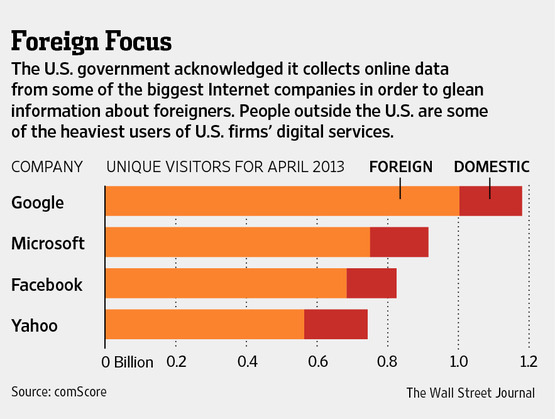
With Silicon Valley’s credibility in protecting consumer privacy on the line, many of the largest Web companies on Friday emphasized they aren’t giving the U.S. government a direct pipe into their networks as part of a secret program to monitor foreign nationals.

But the denials of involvement by Google Inc., GOOG +1.75% Microsoft Corp.MSFT +2.03% and others, which come at the same time the Obama administration confirmed the existence of such a program, raised questions about how data is ending up in the hands of the government.

The issues are especially acute for companies who make their business by collecting and processing customers’ most personal data and secrets. Read more of this post

India’s FreeCharge allows users to top-up their mobile phones for “free”, that is, reimbursed with discount coupons for top Indian food joints and retailers, equivalent to the recharge amount.

The Story of Sequoia-backed FreeCharge and its Success in India

June 7, 2013

by Stephanie Phua

Freecharge.in-Sequoia-funding

FreeCharge was founded on August 2010 by Kunal Shah and Sandeep Tandon. The service allows users to top-up their mobile phones for “free” – basically, every mobile top-up done on FreeCharge is reimbursed with discount coupons for top Indian food joints and retailers, equivalent to the recharge amount. These coupons are delivered to the user. It got $4 million in funding from Sequoia Capital in January 2012. Read more of this post

What Silicon Valley can teach Canadian businesses about ‘lean innovation’

What Silicon Valley can teach Canadian businesses about ‘lean innovation’

Mitchell Osak | 13/06/06 | Last Updated: 13/06/05 3:42 PM ET
It is commonly accepted that launching a new business or product is very challenging — so challenging, in fact, that roughly 75% of new product innovations fail to meet expectations.  Obviously, the chances of success will depend a lot on product and marketing decisions as well as customer interest.  Less attention, however, is paid to the process of commercialization or shepherding a new idea from concept to customer. Having a poor commercialization approach is guaranteed to increase failure rates, waste capital and stress the organization.  One way to improve your odds is to bring inside the “lean” start-up structure and lessons of Silicon Valley.

The typical approach to launching innovations or new businesses is to commercialize it using existing structures, processes and capabilities.  Though an internal focus can be appealing, this method has some major drawbacks.  For example, most firms and people display a bias towards the short-term and proven.  Higher risk innovation initiatives will always compete for resources, focus and capital with existing operations. When the going gets tough, innovation is often the first area to be cut. Moreover, though many companies pay lip service to breakthrough innovation, their culture, structure and management systems are often too rigid and siloed to deliver anything but modest improvements. But there is a better way. Read more of this post

AutoNavi Amap Integrates Taxi and Restaurant Reservations Services

AutoNavi Amap Integrates Taxi and Restaurant Reservations Services

By Tracey Xiang on June 8, 2013

Amp, maps service provided by AutoNavi, just updated its Android app which has integrated a plenty of location-based life services such as taxi hailing and restaurant reservations. Partering with Didi taxi service, Amap users can see taxis nearby on the map and hail one directly by clicking on a button on the top left corner(see image below). As to the restaurant reservations feature, it shows restaurants near to a user and whether group-buying or coupons are available. Reservations can be made within the app. It also added real-time bus arrival information and updated the parking spaces database.

4

YY becomes a TV partner: Another reason the US should be paying attention to China tech

YY becomes a TV partner: Another reason the US should be paying attention to China tech

BY HAMISH MCKENZIE 
ON JUNE 7, 2013

Further to the chronicles of the “yes, the US can learn from China on tech” meme, as well as the “Hey, maybe these Chinese tech IPOs aren’t so shitty after all” revelation, another Internet company from the Middle Kingdom is showing that it has ideas and execution that the West should envy.

Mass social communications platform YY – which is kind of like Google Hangout meets Facebook but on steroids – has announced a partnership with an “American Idol”-like TV show that will see it serve as a broadcasting and interactive platform throughout the duration of the popular program. Read more of this post

It’s Official? Alibaba doing more business than Amazon + eBay (Charts)

It’s Official? Alibaba doing more business than Amazon + eBay (Charts)

Jim Erickson  | Jun 07, 2013 | 03:50 PM

KChartAli_0 KChartDesk KChartDevices kChartTime

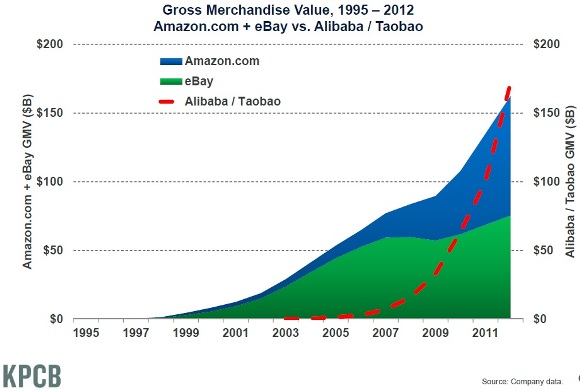
Former U.S. Vice President Al Gore gave a shout-out to Alibaba Group at the 2013 Internet Retailer Conference & Exhibition this week in Chicago, noting that China’s largest e-commerce company generated more GMV (gross merchandise value) than Amazon and eBay combined. The inventor of the Internet may have misspoke himself a tad. Gore’s syntax implied that the comparison was confined to the fourth quarter of 2012. In fact, what was being compared was total GMV for the companies for all of 2012—it was during Q4 that Alibaba’s e-commerce platforms passed the two U.S. giants for the year. Well, he got the gist right. Gore apparently sourced his material from stats offered by well-known tech pundit and KPCBpartner Mary Meeker during a “state of the Internet” talk she gave at the Wall Street Journal’s annual D: All Things Digital conference in California last week. Here’s the chart from her hard copy report, which appeared in a section entitled “Lots to Learn From China – Volume + Innovation.” Read more of this post

As Check Point nears its 20th anniversary, co-founder, CEO and chairman Gil Shwed talks about ambition and fulfillment.

“I work for the interest and the challenge”

As Check Point nears its 20th anniversary, co-founder, chairman and CEO Gil Shwed reveals his management style, and how it has changed.

6 June 13 21:01, Hagai Golan

In a month’s time, Check Point Software Technologies Ltd. (Nasdaq: CHKP) will celebrate 20 years since it was founded. The network security giant, one of the most amazing companies to have grown up in Israel, is highly relevant to some of the burning issues of the day, and this is an opportunity to ask company founder, chairman and CEO Gil Shwed if he thought that Check Point would grow to such dimensions. “Yes and no,” he says, “I thought that the Internet would be something huge. A revolution. I didn’t realize to what extent.” Read more of this post

Is Netflix model the future of e-books?

June 6, 2013, 3:17 p.m. EDT

Is Netflix model the future of e-books?

Apple’s battle over e-book prices may be overtaken by digital rentals

By Quentin Fottrell

Federal prosecutors say Apple (NASDAQ:AAPL)  conspired with book publishers to jack up e-book prices. But the court case, which began this week, may soon be a moot point, experts say, as other companies aim to make traditional prices irrelevant by offering e-book rental services akin to Spotify and Netflix.

Is Netflix the future of E-Books?

Five publishing companies have already settled with the federal government and terminated agreements made with Apple in 2010 in the weeks before the launch of the first iPad. Those publishers include HarperCollins, Lagardère’s Hachette, CBS’s (NYSE:CBS)   Simon & Schuster, Pearson’s Penguin Group and the Macmillan unit of Georg von Holtzbrinck. (HarperCollins is owned by News Corp. (NASDAQ:NWSA)  , as is The Wall Street Journal and MarketWatch.) Since then, Amazon.com (NASDAQ:AMZN)   has been steadily cutting the prices of e-books. Read more of this post

Online education platform Coursera aims to reach more Chinese

Online education platform Coursera aims to reach more Chinese

English.news.cn   2013-06-07

VANCOUVER, June 6 (Xinhua) — One of the massive online open courses (MOOCs) provider Coursera’s founders, Daphne Koller, says she is hoping to work with more Chinese universities so that they could bring more courses online and help the platform reach more people.

In a recent written interview with Xinhua, Koller said that reaching the many people in China who don’t speak English and who could benefit from free access to higher education is an important goal for Coursera. She was in Vancouver, a coastal city on the Pacific coast of Canada, recently to discuss about the impact of MOOCs on teaching and learning with teachers and students from the University of British Columbia. Read more of this post

CHART: Mobile Commerce Continues Its Massive Rise

CHART: Mobile Commerce Continues Its Massive Rise

Josh Luger | Jun. 6, 2013, 2:15 PM | 94 | 

bii_mobilecommerce_lasttry-1

As recently as late 2010, mobile commerce was only 3% of e-commerce. But, that number has steadily been on the rise. At the end of last year’s holiday shopping season, that number it had soared to 11%. That’s approximately $18.6 billion in consumer spending – and that doesn’t even include travel-related purchases. Thanks in part to a new ecosystem of retail and shopping apps, mobile-generated retail spend could rise to 15% of retail e-commerce by the end of this year.  In a new report from BI Intelligence, we examine the why mobile commerce is exploding and dig deeper into the numbers underpinning the explosive growth. We also analyze the growth and success of new mobile merchandising trends — merchandising being the art of selling people products they didn’t know they wanted — like mobile catalogs and coupons. Here’s a few reasons why the number should continue to rise dramatically: Read more of this post