East Meets West as Companies Collaborate on ‘Puzzle & Dragons’; Japan’s GungHo, Finland’s Supercell Team Up on Mobile Game

Updated June 6, 2013, 8:20 p.m. ET

Japan’s GungHo, Finland’s Supercell Team Up on Mobile Game

East Meets West as Companies Collaborate on ‘Puzzle & Dragons’

By MAYUMI NEGISHI And IAN SHERR

Two of the hottest game makers from opposite sides of the globe are teaming up.

In the hit mobile game “Puzzle & Dragons” from Japan’s GungHo Online Entertainment Inc., 3765.JA -9.83% players will soon stumble on a dungeon that features characters and themes from “Clash of Clans,” a battle and strategy game created by Finland’s Supercell Oy.

The pact between the companies is part of an effort they hope will win new users by highlighting one another’s games within their respective products. Read more of this post


Google Wallet Is Leaking Money; Google is having a hard time breaking into the $12.8 billion mobile-payment market, even with $300 million in acquisitions

Google Wallet Is Leaking Money

By Mark Milian and Ari Levy on June 06, 2013

http://www.businessweek.com/articles/2013-06-06/google-wallet-is-leaking-money

Google Wallet (GOOG), the mobile software that allows Android users to pay for purchases online and in stores with their phones, has become a money pit. The company has dedicated hundreds of developers to Wallet and spent about $300 million to acquire digital payment startups to help develop the app. But consumers aren’t sold. Wallet has been downloaded fewer than 10 million times in the two years since its launch, according to Play, Google’s app store.

For Google, the goal wasn’t to generate fee revenue from the transactions, as banks, PayPal (EBAY), and other companies do. The idea was to collect data on consumer habits and target ads to them. Google pays such high fees to the credit-card companies it works with, though, that it loses money on every transaction, says Osama Bedier, who stepped down as head of Wallet on May 20 and will shortly leave the company. Read more of this post

Google the world’s largest media owner; now boasts media revenues that are 39 per cent higher than its nearest competitor, DirectTV

Google the world’s largest media owner

By Roziana Hamsawi

Published: 2013/06/07

DESPITE the rise of digital media, the majority of media revenues are generated by traditional media and entertainment companies that create and distribute content.

According to ZenithOptimedia’s top 30 Global Media Owners report, of the 30 companies, 22 are those whose main business is to attract audiences with strong content.
Strong content remains fundamental to generating media revenues, said Jonathan Barnard, ZenithOptimedia head of forecasting. The report showed that six of the top 10 media owners are content producers, including third-placed News Corporation and fourth-placed Disney.  It also showed that Google is now the world’s largest media owner. Read more of this post

Alipay, Alibaba’s online payments service, to Release Online Mutual Funds Investment Service

Alipay to Release Online Mutual Funds Investment Service

By Charlie Sheng on June 6, 2013

Alipay, Alibaba’s online payments service announced yesterday to launch a new product “Balance Keeper” (not official translation) for investing in mutual funds on Alipay’s platform. It also supports other Alipay services including online payments and money transfer. Staff from Alipay introduced that this new service embedded the systems of mutual fund companies’ into Alipay platform. When users put money into the Balance Keeper, Alipay will automatically helps them set up mutual fund accounts. A user also can make payments for online shopping with the balance in the account. Moreover, there is no minimum investment limit. Its first currency mutual fund will be Zenglibao offered by the Tian Hong Asset Management. Alipay concluded that “The aim of the Balance Keeper is to create opportunities for adding values to users’ pocket money.” This new move has been the first attempt after Alipay got the license for third-party payments of funds in May 2012.

Five key differences between Zynga and Supercell

Five key differences between Zynga and Supercell

BY HAMISH MCKENZIE 
ON JUNE 5, 2013

Zynga is in the dumps. With its share price now hovering around $3, down from $10 at the time of its December 2011 initial public offering, and mass layoffsthat have cost it 18 percent of its workforce, it’s hard to imagine a grimmer scenario for the social gaming giant. Supercell, on the other hand, is going bananas. The small Finnish company, which so far has just two games in circulation, is Accel Partners’ fastest-growing company and is now pulling in $2.4 million a day (mind you, that figure is two months old – it could be even more now). Six-year old Zynga was built for the Facebook age. Two-and-a-half-year-old Supercell was built for the mobile age. The differences are telling. It’s easy to point to Supercell and say, “Zynga has it all wrong – it should be taking this approach.” That might turn out to be false. Supercell is young and has only two games to its name. Although it is off to a great start, it has yet to prove itself over the long term. However, it is at least interesting from an academic point of view to consider the key differences between the two companies – one tanking, the other ascendent – because it does at least give us an indication of just how much has changed in the world of gaming, and in Internet-based businesses in general. So, here we go. The five key differences between Zynga and Supercell are… Read more of this post

Google is the General Electric of the 21st century; The unnerving thing about Larry Page is that he studies history.

Last updated: June 5, 2013 6:57 pm

Google is the General Electric of the 21st century

By John Gapper

Larry Page has boundless ambition and the capacity to deliver unexpected products

Everywhere one looks, Google is doing remarkable things. It could soon overtake Apple in downloads of applications; it is developing self-driving cars; people wear its kooky augmented reality Glass spectacles; it is signing renewable power deals in South Africa and Sweden.

From being a one-product company that tapped a stream of wealth with paid internet search, Google is emerging as the dominant consumer technology company of the early 21st century, along with Amazon. Fred Wilson, a leading New York venture capitalist, accuses it of trying to control the internet, “like Microsoft tried with personal computing … Who will stop Google?” Read more of this post

Google’s X-way vision for the future

Google’s X-way vision for the future

BY CRAIG SHAMES 
ON JUNE 5, 2013

thomas_edison

Google co-founder and CEO Larry Page wants to be more like Thomas Edison than Nikola Tesla. “If you invent something, that doesn’t necessarily help anybody,” he recently told Fortune. “You’ve got to actually get it into the world; you’ve got to produce, make money doing it so you can fund it.” Edison did that with practical incandescent light, the phonograph, the movie camera, and hundreds of other inventions. Tesla had his grandiose successes, too, but a shrewd businessman he was not. “He couldn’t commercialize anything,” Page added. “He could barely fund his own research.”

With Google[x], Google’s secretive moon shot lab, Page doesn’t have to worry about that as he has the resources to bring fanciful, potentially world-changing ideas from germination to market. Some of these projects have already begun to bear fruit such as driverless cars and everyone’s favorite punching bag, Google Glass. But there’s a lot more in the development pipeline. According to reports, Google has a list of approximately 100 big ideas the company is pondering. They cover everything from levitation to even the very Tesla-like space elevator. While these ideas may seem random and far fetched they have one thing in common: the potential to help Google turn a profit either by creating ways for people to use their services or improving how the company operates. And, oh by the way, they just might change the world in the process. Read more of this post

If the giants learn how to dance, startups have less of an advantage and may stumble.

Google is hot; Apple is not. Ladies and gentlemen, we’ve entered bizarro world

BY SARAH LACY 
ON JUNE 5, 2013

rocky_google

Okay, seriously, how the fuck did Larry Page pull this off?

Google should completely be sucking right now.

In the history of the Internet, the “hot” publicly traded consumer company has about four years or so on top. See: Netscape, eBay, Yahoo, etc. Amazon was always up and down, ditto Facebook so far. But somehow Google just won’t become irrelevant. It stubbornly refuses with its surging stock price and ambitious change-the-world gambits like Google Fiber and Google Glass that just can’t help getting everyone excited. Read more of this post

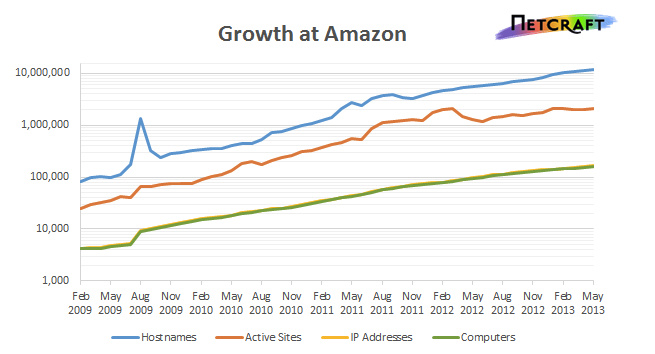
Amazon’s cloud is how big again? The number of websites hosted on these web-facing AWS workhorses soared 71 percent to 11.6 million in may from 6.8 million in September

Amazon’s cloud is how big again?

by Barb Darrow

1 DAY AGO

netcraft-aws-metricsscreen-shot-2013-06-04-at-5-34-23-pm

New numbers from Netcraft show that the number of Amazon Web Services servers has exploded over the past 9 months.

Trying to assess just how enormous Amazon Web Services is has become a sort of parlor game among techies. Counting servers is as good a way as any to get a grip on its size and the latest to take a stab at that is Netcraft, which pegs the numbers of AWS web-facing servers at 158,000, up from 118,000 such servers in September, 2012. (Hat tip to Data Center Knowledge for pointing out this interesting research.)

Netcraft also said the number of websites hosted on these web-facing AWS workhorses soared 71 percent to  11.6 million in may from 6.8 million in September. Gulp. Read more of this post

Saudi investors face hefty losses after king shuts telecoms start-up; SITC’s failure highlights the dominance of speculative retail traders in the Saudi market, who chase rising prices with little regard for fundamental valuations

Saudi investors sent reeling after king shuts telecoms start-up

3:24pm EDT

By Matt Smith

DUBAI (Reuters) – Saudi retail investors face hefty losses after a royal decree ordered the liquidation of Saudi Integrated Telecom Co (SITC), which floated its shares in an initial public offer (IPO) in 2011 but never started operations.

SITC’s failure highlights the dominance of speculative retail traders in the Saudi market, who chase rising prices with little regard for fundamental valuations.

“Investors are shocked,” said Mohammad Omran, a member of the Saudi Economic Association (SEA). “The CMA made a big mistake by allowing the IPO to go ahead.” Read more of this post

As Facebook grows up, grand ambitions get reality check

Analysis: As Facebook grows up, grand ambitions get reality check

2:58pm EDT

By Alexei Oreskovic

SAN FRANCISCO (Reuters) – Facebook, which once seemed poised to take over the Internet, is showing its limitations: a host of newer services are gaining ground among trend-setting youth; a much-hyped smartphone app has received a tepid response; and grand ambitions such as taking on Google in the search business seem ever more fanciful.

In a volatile Internet industry where companies can rise and fall almost overnight, one might even say that the nine-year-old Facebook Inc is suffering a mid-life crisis.

Yet even if the social network falls short of its goal of becoming an all-encompassing Web destination that consumers turn to for everything from messaging to shopping, experts say Facebook has likely achieved enough scale and ubiquity to assure its staying power. Read more of this post

Adobe Acrobat at 20: Successes, Second Guesses and a Few Miscues; Software and apps, readers and viewers, will come and go, but PDF files are really going to last forever.

Adobe Acrobat at 20: Successes, Second Guesses and a Few Miscues

Published: June 05, 2013 in Knowledge@Wharton

John-Warnock-and-Bob-Wulff

Twenty years ago, on June 15, 1993, Adobe Systems officially introduced the Acrobat product suite and its underlying file format, the Portable Document Format (PDF).

It’s difficult now to recall how challenging it was to exchange electronic documents before then. Plain text files worked, but failed to capture the typography, graphics and design of printed documents. Sending someone a file from a specific software program — such as a Microsoft Word .doc file — required both parties to own the program and often, to make things work correctly, the same version of the program. Even then, the fonts could change, the text might reflow and the document would repaginate.

What was needed was a universal electronic document format. That sounds straightforward enough, but the problem was deceptively complex. The format would need to be able to represent any conceivable type of document content with various fonts, graphics, images and complex page layouts. It would need to be easily viewed on any computer platform: DOS, Windows, Macintosh, UNIX and, later, mobile devices from Palm, Compaq, Apple and others. And, perhaps most challenging, it would need to be easily created by a wide range of authoring tools — word processors, page layout programs, spreadsheets and architectural design software, to name a few. Read more of this post

On Wall Street, Netflix Is a Comeback Kid — But Can It Stay on Top?

On Wall Street, Netflix Is a Comeback Kid — But Can It Stay on Top?

Published: June 05, 2013 in Knowledge@Wharton

In the first quarter of 2013, Netflix emerged as the best-performing stock in the benchmark Standard & Poor’s 500 index.

The streaming and DVD rental company was an unlikely Wall Street star, to say the least. Many observers had all but given the firm up for dead in 2011, when shares plummeted after an ill-timed and poorly received price hike in July that coincided with an announcement that Netflix would separate its streaming and DVD businesses. That plan was ultimately shelved, but the once-high-flying Netflix stock plunged as low as $53.80. Its all-time closing high was $298.73 and the record intra-day high was $304.79, both reached on July13, 2011. At the time, critics accused Netflix management of being insensitive, even arrogant. Company leadership appeared determined to squeeze every penny out of a rabidly loyal customer base that was struggling through a debilitating national recession.

Netflix was on the verge of becoming a cautionary tale. Instead, it became corporate America’s version of the comeback kid. The story of Netflix’s turnaround underscores the basic precepts of a well-run company, experts from Wharton and elsewhere say. Netflix showed patience. It learned from its mistakes, stuck to its strategy and didn’t listen to the naysayers. It didn’t give in to Wall Street’s demands that it manage for the next three-month quarter. It didn’t shift in midstream to enjoy a short-term gain at the expense of a potentially larger payoff down the road. Above all, Netflix did the most important thing that any company can ever do, at any time: Serve its customers. Read more of this post

A secretive world moves from cloak and dagger to the smartphone: Israel’s high-tech and military capabilities have nurtured a cybersecurity industry

June 5, 2013 4:19 pm

A secretive world moves from cloak and dagger to the smartphone

By John Reed

Tech threat: security start-ups have been designing tools to tackle a new era of cybercrime

In the history of the tools of warfare, from the stone age slingshot to the drones and guided weapons of today, the 21st century has produced one of the most effective: the “silent” smartphone.

Terrorists, drug barons or insurgents can pick up a networked mobile phone almost anywhere. If they avoid voice calls – which can be intercepted – and use them just for computing and instant messaging services, they can transact nefarious business with little fear of detection. Read more of this post

Tech start-ups aim to collar US $50bn pets products market

June 5, 2013 7:21 pm

Tech start-ups aim to collar US pets market

By April Dembosky and Tim Bradshaw in San Francisco and Louise Lucas in London

Thirteen years on from the collapse of Pets.com, the company that became synonymous with the bursting of the dotcom bubble, and Silicon Valley is ready to try again. A new crop of tech start-ups is reaching for a piece of the $50bn market for pet products.

Venture capitalists have invested $6m into Whistle, a San Francisco start-up that on Wednesday launched its wireless fitness tracker for dogs. Read more of this post

Countries Seek Entrepreneurs From Silicon Valley

June 5, 2013

Countries Seek Entrepreneurs From Silicon Valley

By SOMINI SENGUPTA

SAN FRANCISCO — A bold new billboard looms over U.S. 101, the highway that runs through the heart of the global technology industry. “H-1b problems?” it reads. “Pivot to Canada.”

That sassy invitation is directed at the thousands of foreigners having trouble getting temporary visas, known as H-1b’s, to work in the United States. Canada’s new so-called start-up visa offers them the prospect of permanent residency and with it, the country’s relatively low business taxes and public health insurance.

Canada is not alone in reaching out to foreign entrepreneurs. In a bid to create their own versions of Silicon Valley, Britain and Australia have dangled start-up visas like this too. Chile is even offering seed money to lure foreigners to come to Santiago and get their start-ups off the ground. Read more of this post

Accord Aims to Create Trove of Genetic Data; The goal is to put the vast collection of data on genetic variations and health into databases open to researchers and doctors all over the world

June 5, 2013

Accord Aims to Create Trove of Genetic Data

By GINA KOLATA

06gene-articleLarge

A storage robot deposits samples in the world’s largest blood and urine freezer at Biobank in Manchester, England.

More than 70 medical, research and advocacy organizations active in 41 countries and including the National Institutes of Health announced Wednesday that they had agreed to create an organized way to share genetic and clinical information. Their aim is to put the vast and growing trove of data on genetic variations and health into databases — with the consent of the study subjects — that would be open to researchers and doctors all over the world, not just to those who created them.

Millions more people are expected to get their genes decoded in coming years, and the fear is that this avalanche of genetic and clinical data about people and how they respond to treatments will be hopelessly fragmented and impede the advance of medical science. This ambitious effort hopes to standardize the data and make them widely availabl e. Read more of this post

China’s regulations are hampering taxi-hailing app providers, but leaving room for state-owned players to enter the market

Governments Move in on Taxi Apps

By Zhang Chunwei (张春蔚)
Issue 622, June 3, 2013

On June 1, Beijing began regulating software applications that allow users to hail a taxi online or by phone. Other cities like Guangzhou and Shenzhen have also recently issued new rules controlling or banning taxi-hailing apps.
An app called 1039 Yi Da Che (1039易打车)  in Beijing is likely to be one of the lucky survivors under the new regulations. Launched in April, the software is already used by more than 2,000 drivers, but the fact that the company is state-owned has made many other established taxi app players a bit uncomfortable.
1039 Yi Da Che was a late-comer to the industry and spawned from the traffic radio station FM103.9. Using the station’s resources, it’s combined information from traffic reports and taxi booking systems while increasing “interactive recommendation (互动推荐)” on its radio programs. As a result, taxi drivers have been anxious to become members. “All the drivers who installed our devices have considered membership an honor,” said Li Yang (李洋), who hosts a traffic program on the station that’s popular with taxi drivers. Read more of this post

Why eBay Failed in China? – Former eBay China Exec Wang Jianshuo

Why eBay Failed in China? – Former eBay China Exec Wang Jianshuo

By Guest Editor on June 6, 2013

Editor’s Note: This post is written by Wang Jianshuo, founder and CEO of Baixing, one of the leading classifieds sites in China, and a former eBay China exec. Mr. Wang joined eBay China in 2005 to run its classifieds ads site which was renamed Baixing in 2008. Before eBay China he was an exec at Microsoft China. You can read more of his thoughts on China’s tech industry on his blog. Let me give you some background information. Almost all US Internet companies failed in China in the last 10 years. Yahoo! entered China by acquiring 3721.com (some argued it was a keyword based search engine that dominated the space before Baidu.com came out), and turned it into nothing, before Yahoo! China was sold to Alibaba. eBay acquired EachNet.com, the largest C2C website, and spent few hundred million dollars on marketing, and successfully turned its market share from 90+% to less than 10%, and then sold it to Tom Online. Google entered China and with years’ of efforts only to turn its market share from 30% to 10%, and claimed to move China site to Hong Kong. Who else? Here is the question: Why eBay failed in China? Why Yahoo! failed in China, and why almost all US-based Internet giant failed miserably in China? Read more of this post

China Seen in Push to Gain Technology Insights

June 5, 2013

China Seen in Push to Gain Technology Insights

By EDWARD WONG and DIDI KIRSTEN TATLOW

SHENZHEN, China — A government-financed research institute in the Pearl River Delta here boasts an impressive range of specialties, from robotics to nanomedicine to magnetic resonance imaging.

But not all the cutting edge developments may be the result of indigenous innovation, according to American prosecutors, who last month charged three Chinese scientists at the New York University School of Medicine with taking bribes to share research findings with their real employers: the Shenzhen institute and a separate Shanghai medical technology company. Read more of this post

Strategies for playing at war: World of Tanks revenues have soared from €18m in 2011 to €218m last year

June 4, 2013 4:42 pm

Strategies for playing at war

By Jan Cienski

World-of-Tanks-11

Tanks for the memories: Victor Kislyi turned to the history on his Minsk doorstep for inspiration

To the dismay of wives and mothers the world over, huge numbers of men and boys adore powerful vehicles and big guns. If you put the two together, you have tanks. This insight has help­ed Victor Kislyi build one of the world’s fastest-growing computer game developers.

Mr Kislyi’s Belarus-based Wargaming.net is the creator of World of Tanks , the online game in which players get to drive a second world war-era tank and engage in team battles on an accurately depicted terrain or in city streets, using detailed and realistic maps. Read more of this post

Maverick Internet tycoon Takafumi Horie, who was jailed for accounting fraud, back in business; Horie said he had got involved in around 30 start-ups since being released from prison three months ago

Japan dotcom jailbird back in business

Horie said he had got involved in around 30 start-ups since being released from prison three months ago. -AFP
Wed, Jun 05, 2013
AFP

JAPAN-CRIME-IT-COMPANY

TOKYO – Maverick Internet tycoon Takafumi Horie, who was jailed for accounting fraud, said Wednesday Japan’s online landscape was prime territory for his aggressive style of business. Horie said he had got involved in around 30 start-ups since being released from prison three months ago, having served nearly two years for hiding losses on the balance sheets of his Internet service provider Livedoor.

Read more of this post

Chipping Away at Success: Litigation as strategy isn’t unfamiliar in the competitive high-tech world, where trampled companies turn to courts to slay the enemy

June 4, 2013, 4:47 p.m. ET

Chipping Away at Success

Litigation as strategy isn’t unfamiliar in the competitive high-tech world, where trampled companies turn to courts to slay the enemy.

By DAVID KANSAS

Hector Ruiz opens his memoir with a prologue that is intended to read like the first pages of a thriller. Mr. Ruiz, the chief executive officer of Advanced Micro Devices until 2008, brings us into a 2005 board meeting. Curt exchanges, dire threats, doubt and debate fill the air. Given that Mr. Ruiz is a sharp engineer, one would expect the argument to be about some vital aspect of technology. Instead, it’s all about suingIntelINTC +0.48% AMD’s giant market foe.

Seeing AMD as David to Intel’s Goliath, Mr. Ruiz code-named the suit “Slingshot,” the title of his book. He knew a thing or two about slingshots, having used them in his hardscrabble youth in a Mexican town on the U.S. border. Read more of this post

To revive Infosys, Murthy must revamp sales, culture

To revive Infosys, Murthy must revamp sales, culture

9:06am EDT

By Harichandan Arakali

BANGALORE (Reuters) – Narayana Murthy’s success in turning around Indian IT services firm Infosys hinges on his ability to revive its sales efforts and shake up the conservative culture he helped create.

Eleven years after Murthy stepped down as chief executive at India’s second largest computer services exporter, Infosys unexpectedly brought back the 66-year-old as executive chairman to reverse falling market share and end two years of disappointing results. Read more of this post

If Chinese IPO Booms, This Is a Bubble

If Chinese IPO Booms, This Is a Bubble

There’s something familiar about the Beijing-based online retailer LightInTheBox Holding Co., which plans to price its initial public offering this week on the New York Stock Exchange. Looking at the company’s website reminds me of an old spoof in the Onion about a Chinese factory worker who can’t believe the sheer amount of cheap junk Americans will buy. “Why the demand for so many kitchen gadgets?” the fictional worker was quoted as saying in a 2005 article for the satirical newspaper. “Where do the Americans put them? How many times will you use a taco-shell holder? ‘Oh, I really need this silverware-drawer sorter or I will have fits.’ Shut up, stupid American.” Many of the items break after a few uses, he noted. On the list of “best deals” on LightInTheBox: a “capless short bob high quality synthetic dark brown straight hair wig” for $27.99, and a “cast iron revolver design tattoo gun kit” for $109.99. Kitchen items include a “cool steamship and iceberg shaped ice tray mold” for $3.79. There’s also free shipping on many items of the 220,000 products offered (even the ice tray), but no recognizable brand names — just a lot of knockoffs.

Read more of this post

Top100, music website founded by retired NBA star Yao Ming, shuts down

Music website founded by Yao Ming shuts down

Staff Reporter

2013-06-05

CFP408376843-121846_copy1

From late April, internet users have been unable to access www.top100.cn — a Chinese music website co-founded by retired NBA star Yao Ming — as it has reportedly been shut down, reports Shanghai’s First Financial Daily. Gary Chen, the co-founder and CEO of the website, said on his microblog that the site had faced difficult choices and necessary shifts, since Google had suspended music search services in China in October. The site was officially launched in Beijing in March 2006 and provided free trial and download services, based on a catalog of millions of copyrighted music files through a collaboration with global music publishers. The website gained a good deal of attention because Google and Yao Ming, one of the biggest names in sports ever to come from China, were two of its founders. Yao and Zhang Mingji, another co-founder, had invested US$3 million as start-up capital in the site in 2005, when Yao was at the peak of his basketball career. Yao mentioned the website on many occasions and this naturally helped draw public attention to the venture. Read more of this post

Chinese Financial Social Media Snowball Announces $10 million Series B Funding

Chinese Financial Social Media Snowball Announces $10 million Series B Funding

By Tracey Xiang on June 5, 2013

Snowball Finance, a Chinese online financial service, today announced $10 million Series B round of funding from Sequoia China and Morningside Ventures. Simon Fang, founder and CEO of Snowball, said the funding will be used for product development and talent. The company owns a financial news site, iMeigu, and a financial social network, Xueqiu. iMeigu, launched in May 2010, has been focusing on U.S. stock market, while Xueqiu also covers Hong Kong stock market and China’s A-share market. Xueqiu doesn’t only has a Facebook’s Newsfeed-like platform, but also offers stock quotes, business news and analysis reports for each stock on those markets. Now being one of the most popular social networks for Chinese investors, it has attracted a large number of professionals in financial sector to contribute financial analysis reports. Xueqiu apps are available for iOS and Android. Established in 2010 by Simon Fang, former deputy editor-in-chief at NetEase’s online media, Snowball received RMB 20 million ($3.2 million) Series A funding from Sequoia China in 2011 and angel investment from Xue Manzi earlier.

Xueqiuapps

Berlin’s Network Effect Will Make It A Global Startup Center

Berlin’s Network Effect Will Make It A Global Startup Center

MATT COHLER

posted yesterday

Editor’s note: Matt Cohler is a General Partner at Benchmark and was the lead investor in Asana, Instagram and Quora among others. You can follow him on Twitter @mattcohler
Throw a dart at a map. There’s a pretty good chance it’ll hit near someplace hoping to become the “next Silicon Valley.” I’d bet on Berlin. I believe Berlin has the best shot in the Western world outside of Silicon Valley at becoming a place with a true tech startup ecosystem. I don’t just mean a place where one or two great companies are born — that can happen pretty much anywhere. I mean a place with an enduring ecosystem powered by a network effect that gets stronger over time. Like what Hollywood is for entertainment, London and New York are for big finance, Milan and Paris are for fashion, and Silicon Valley is for technology.

Recipe For A New Ecosystem

Creating an ecosystem from scratch is hard — building a network effect always is. But it can be done. I believe every enduring creative ecosystem has five key ingredients: creators, builders, the right kind of capital, the rule of law and, last but not least, the opportunity to take the starring role on the local center stage. And whether in finance, fashion, technology or the arts, you need all five: Read more of this post

Zynga Shuts Down OMGPOP One Year After Acquiring It For $200M

Zynga Shuts Down OMGPOP One Year After Acquiring It For $200M

GREG KUMPARAK

posted yesterday

As the dust begins to settle following yesterday’s massive, sweeping layoffs at Zynga, the extent of the damage is becoming more clear.

Remember when Zynga acquired OMGPOP last year for roughly $200M dollars? Yeah, OMGPOP essentially no longer exists.

According to tweets from company employees and the company’s Twitter account itself, most of the OMGPOP staff was let go, with their New York City office shuttered.

Zynga acquired OMGPOP at the height of its success, just as Draw Something — OMGPOP’s first real smash hit — was exploding onto handsets everywhere. By the time Zynga pushed an update to add their logo to the game, its popularity had already tapered. Read more of this post

Former Zynga employee takes to Reddit: ‘They rely too much on reacting to what is making money now’; micromanagement enforced by high-level executives was stifling creativity throughout the firm’s development cycle

Former Zynga employee takes to Reddit: ‘They rely too much on reacting to what is making money now’

Nick Summers

2 hours ago Updated at 12:55 CEST

A Reddit user claiming to be one of the 520 employees laid off by Zyngaearlier this week has described the company’s “terrible” business strategyand ongoing efforts to raise staff morale. The former member of staff said the video game publisher has “major issues” and an “inability to adjust to the changing market”. “They did great when Facebook gaming was on the rise, but now it’s declining and Mobile is on the rise,” the Reddit user, who is answering questions as part of an ‘Ask Me Anything’ discussion thread said. “They’re trying to change over, but employ too many of the same game development ‘best practices’ that were developed for Facebook games. These just don’t translate to the mobile market, which is why they’re suffering in that market.”

A lack of innovation

The user has kept their identity anonymous, so it’s unclear exactly which projects they worked on or their position within the company. They expressed concerns, however, with the amount of micromanagement that was being enforced by high-level executives and argued that this was stifling creativity throughout the firm’s development cycle. Read more of this post