How not to scale: Zynga edition

How not to scale: Zynga edition

BY ERIN GRIFFITH 
ON JUNE 4, 2013

The story of how Zynga grew from zero to 2,800 employees, and then back down to its current headcount of around 2,300, is not pretty. That the company laid off 18 percent of its work force yesterday was a drastic move; the realization that 18 percent of its work force is 520 freaking people is almost more shocking.

After Zynga went public in December 2011 at a valuation of $7 billion, the company had plenty of cash to throw around, even as question marks arose over whether the games could stay hot and new hits would emerge. Cracks were showing. Zynga’s symbiotic arrangement with Facebook was disintegrating, and changes to the Facebook algorithm hurt engagement. A particularly brutal quarter last summer sent shares as low as $2. Read more of this post

Amazon plans big expansion of online grocery business

Amazon plans big expansion of online grocery business – sources

2:54am IST By Alistair Barr

logo-amazonfresh-splashlanding

SAN FRANCISCO (Reuters) – Amazon.com Inc(AMZN.O: QuoteProfileResearch) is planning a major roll-out of an online grocery business that it has been quietly developing for years, targeting one of the largest retail sectors yet to be upended by e-commerce, according to two people familiar with the situation. While food is a low-margin business, Amazon could outperform similar online grocery services by delivering orders for higher-margin items like electronics at the same time. One of the people familiar with AmazonFresh’s expansion plans said new warehouses will have refrigerated areas for food, but also space nearby to store up to one million general merchandise products, in some cases. Read more of this post

Intel to Invest $100 Million in Voice, Gesture Technologies

June 4, 2013, 7:05 a.m. ET

Intel to Invest $100 Million in Voice, Gesture Technologies

By EVA DOU

TAIPEI—Intel INTC +0.48% Capital, the global investment arm of chipmaker Intel Corp., is setting up a $100 million fund to invest in “perceptual” computing technologies like voice and gesture control, company executives said. The fund will invest over the next two to three years in firms making software and applications with functions like imaging, gesture and voice control, emotion sensing and biometrics, the company said. Read more of this post

Device From Israeli Start-Up Gives the Visually Impaired a Way to Read

June 3, 2013

Device From Israeli Start-Up Gives the Visually Impaired a Way to Read

By JOHN MARKOFF

VISION-popup

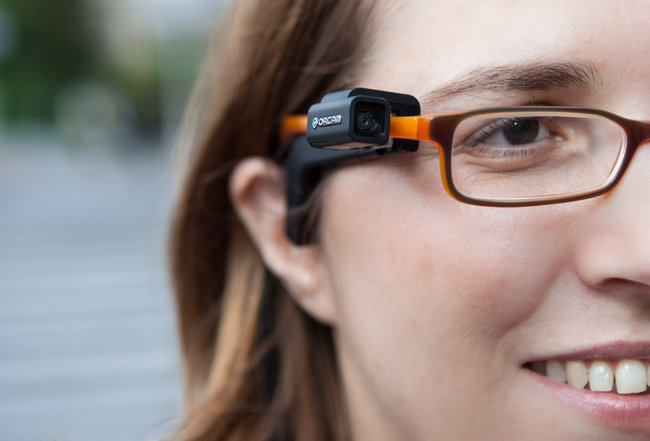
Liat Negrin, an employee at OrCam, wears a device made by the company that consists of a camera and a small computer

JERUSALEM — Liat Negrin, an Israeli who has been visually impaired since childhood, walked into a grocery store here recently, picked up a can of vegetables and easily read its label using a simple and unobtrusive camera attached to her glasses.

Ms. Negrin, who has coloboma, a birth defect that perforates a structure of the eye and afflicts about 1 in 10,000 people, is an employee at OrCam, an Israeli start-up that has developed a camera-based system intended to give the visually impaired the ability to both “read” easily and move freely. Read more of this post

New apps give users a world of languages in their pocket

New apps give users a world of languages in their pocket

10:42am EDT

By Natasha Baker

TORONTO (Reuters) – New apps are aiming to make traveling in a foreign country easier by putting translation tools in tourists’ pockets, makers of the devices said on Monday. A set of free apps for iOS devices from the language learning company Rosetta Stone give users short exercises so they can learn the basics of another language and commonly used phrases in French, Spanish, German and Italian. Read more of this post

80% of Samsung’s microchip revenue comes from arch-nemesis Apple

80% of Samsung’s microchip revenue comes from arch-nemesis Apple

By Christopher Mims @mims June 3, 2013

Here’s a stellar example of how to keep your enemies close: a multi-billion dollar division of Samsung that makes “logic integrated circuits”—basically, the brains of all mobile devices and PCs—is almost entirely propped up by business from Apple,reports Digitimes Research.

In 2012, 80% of Samsung’s business for its foundries, the specialized factories where microchips are made, came from Apple. In the same year, Samsung spent $7 billion to upgrade those foundries, one of which, in Austin, Texas, is the plant that manufactures Apple’s current latest-generation processor for iPads and the iPhone 5. That plant received at least $4 billion of investment from Samsung in 2012. Read more of this post

For Twitter, the Challenge Is to Keep It All Simple

Updated June 2, 2013, 12:44 a.m. ET

For Twitter, the Challenge Is to Keep It All Simple

TE-AB254A_SOCIA_G_20130601171204

Dick Costolo has been at the helm of Twitter Inc. since 2010. The microblogging service is one of the most popular social networks, and many are expecting an initial public offering soon. In a conversation with All Things Digital’s Kara Swisher, Mr. Costolo dodged questions about a potential IPO, but he did talk about Twitter’s current focus on TV and why he thinks simplicity is important. Read more of this post

Enterprise technology heads for the clouds in search for growth; VMware paid $1.3 billion for Nicira with revenue of $5m

June 3, 2013 2:48 pm

Enterprise technology heads for the clouds in search for growth

By Richard Waters in San Francisco

When it comes to the sky-high prices being paid for the hottest new companies in business IT, there have been few starker examples than Nicira. A specialist in a field known as software-defined networking, the Californian start-up was sold to the much larger VMware last year for nearly $1.3bn.

Yet at the time, two people familiar with its finances now say, it had generated lifetime revenues of only about $5m.

Such deals barely raise an eyebrow on the consumer internet. But they represent something new in the more staid world of so-called enterprise technology: a hunger for growth at the expense of profits, and a race for strategic advantage amid a secular change in the IT landscape. Read more of this post

The Distasteful Side of Social Media Puts Advertisers on Their Guard

June 3, 2013

The Distasteful Side of Social Media Puts Advertisers on Their Guard

By TANZINA VEGA and LESLIE KAUFMAN

As social media sites pursue advertising in a bid for new revenue, they are finding that they must simultaneously create a safe space for the advertisers they attract.

With the money, they are discovering, comes responsibility.

Facebook learned that the hard way last week. After failing to get the social network to remove pages glorifying violence against women, feminist activists waged a digital media campaign that highlighted marketers whose ads were found alongside those pages. Nissan and several smaller advertisers temporarily removed their ads from the site. Read more of this post

How Samsung Got Big

How Samsung Got Big

CHRIS VELAZCO

Saturday, June 1st, 2013

The cellphones were stacked up high in the Gumi factory yard and more were coming out every minute. Phones, TVs, fax machines, and other gear shattered as it hit the concrete and Samsung CEO Kun-hee Lee and his board cracked the screens and cases with heavy hammers. Then they lit a bonfire and threw everything in.

The 2,000 workers began to cry. And still the hardware kept coming. The CEO was disgusted by the low quality product coming out of his factories in the early 1990s and, in a blaze of anger, ordered it all destroyed.

In all, something like $50 million worth of hardware burned on one day in 1995 when Samsung hoisted its “Quality First” banner and began its slow march towards world domination in earnest. Samsung Electronics emerged from those ashes a very different company, but the road leading to that cleansing fire was a long one. Read more of this post

Short Seller Muddy Waters Seeks Silicon Valley ‘Pretenders’

June 2, 2013, 7:54 p.m. ET

Short Seller Seeks Valley ‘Pretenders’

By JULIET CHUNG

MI-BW306_BLOCK_G_20130602182403

Creative hairstyles, fake names and shoe-leather sleuthing transformed Carson Block from a no-name expatriate in China into a celebrity short seller.

But will such gambits translate elsewhere?

From an office in California at a location he won’t disclose, the 37-year-old American and his firm Muddy Waters LLC are changing their sights after wreaking havoc at Chinese companies. Last month, he told a Bellagio hotel ballroom packed with investors about his bet against the debt of U.K. bank Standard Chartered PLC.STAN.LN -1.51%

It was the first time Mr. Block had spoken out against a company based outside Asia. And his voice was heard: The cost of the debt protection Mr. Block said he was buying rose 17% in the following two trading days. Read more of this post

Banks Battle Phone Companies for Hidden Cash in Africa Townships; For millions of Africans, a simple Nokia mobile phone acts as a bank account, allowing them to transfer funds with services like M-Pesa, run by Vodacom and Safaricom

Banks Battle Phone Companies for Hidden Cash in Africa Townships

Standard Bank Group Ltd. (SBK) hired Itumeleng Heymann to persuade her neighbors that for about $6 a month, their cash would be better off with Africa’s largest lender than in its current hiding place: under the bed.

For millions of Africans, a simple Nokia mobile phone acts as a bank account, allowing them to transfer funds with services like M-Pesa, run by Vodacom Group Ltd. (VOD) and Safaricom Ltd. Now Standard Bank is turning to an army of 1,000 township residents such as Heymann as it tries to block Vodacom, South Africa’s largest wireless operator, and companies like it from muscling in on the nation’s expanding banking market as they have in Kenya, Tanzania and elsewhere. So far, the banks are winning.

“A lot of people around here don’t have accounts,” said Heymann, 27, wearing braids and a bright blue Standard Bank T-shirt as she worked the morning rush at a market in South Africa’s Tembisa township. “A lot of people don’t want to open accounts because they are scared that maybe there’s lots of fees. We explain to them why it’s better to have an account instead of putting money under your bed.” Read more of this post

The Quantitative VC

The Quantitative VC

LEENA RAO

posted yesterday

It’s no longer sufficient in venture capital for firms to wait for companies, people and trends to come to Sand Hill Road. Seeing a startup on Demo Day at Y Combinator used to be the pipeline for scouting an early deal. But these days, YC companies are raising from angels before demo days. This is a sign of the times in the venture world. To start competing for deals, VCs have to be prospecting people, companies and trends well before events like Demo Day. And how are VCs trying to do this? Through complex data mining and pattern recognition.

In the past two years, Sand Hill Road has seen a number of changes, including the explosion of angel and seed-stage investors, the agency model that Andreessen Horowitz is building, and rise of the operator VC. The latest trend is the role of the data scientist within a firm, and how a firm’s data is being used to help VCs scout better deals and entrepreneurs and eventually create better returns for their LPs. Read more of this post

Professors Are About to Get an Online Education; Georgia Tech’s new Internet master’s degree in computer science is the future

June 2, 2013, 5:54 p.m. ET

Professors Are About to Get an Online Education

Georgia Tech’s new Internet master’s degree in computer science is the future.

By ANDY KESSLER

Anyone who cares about America’s shortage of computer-science experts should cheer the recent news out of Georgia Tech. The Atlanta university is making major waves in business and higher education with its May 14 announcement that the college will offer the first online master’s degree in computer science—and that the degree can be had for a quarter of the cost of a typical on-campus degree. Many other universities are experimenting with open online courses, or MOOCs, but Georgia Tech’s move raises the bar significantly by offering full credit in a graduate program.

It comes just in time. A shortfall of computer-science graduates is a constant refrain in Silicon Valley, and by 2020 some one million high-tech job openings will remain unfilled, according to the Commerce Department. Read more of this post

ConAgra Uses Big Data in ‘Battle for Talent’

June 2, 2013, 8:42 PM ET

ConAgra Uses Big Data in ‘Battle for Talent’

Steve Rosenbush

Deputy Editor

ConAgra Foods Inc. ., the packaged foods giant known for brands such as Hunt’s and Chef Boyardee, has found that identifying, hiring and retaining top performing people is an ever-more critical task.

“In this economy, we are in a battle for talent,” says Mark Berry, vice president of people insights for the Omaha-based company, which has a global staff of 36,000.

To plumb the mysteries of who succeeds and why—and how to keep those people employed at ConAgra—the company is about to embark on a massive deployment of new analytic tools. ConAgra is one of several big companies—also including Hyatt Hotels Corp. —that are automating the HR process with software from Visier Inc., a company that just raised $15 million in Series B venture capital from Summit Partners and others. The company was launched by veterans of Business Objects, which SAPAG acquired in 2007. Read more of this post

PC Makers Fight Back Against Mobile Devices

Updated June 2, 2013, 6:47 p.m. ET

PC Makers Fight Back Against Mobile Devices

By DON CLARK and EVA DOU

MK-CD676_COMPUT_G_20130602183316

Rocked by the mobile-device movement, personal-computer makers and their partners are planning a counterattack that leans heavily on two weapons: lower prices and power consumption.

The companies, gathering for the big Computex trade show in Taiwan this week, are maneuvering to win back consumer spending that has shifted to smartphones and tablet computers by emulating more of those devices’ features and prices.

In one significant thrust, manufacturers plan to begin offering much less expensive laptop computers that have touch screens for tablet-style operation. Prices later this year are expected to drop more than 50% in some instances. Manufacturers are also expected to begin delivering thinner and less costly “two-in-one” convertibles, whose screens swivel or can be detached to operate in tablet or clamshell mode. Read more of this post

The Future of the Web is Video

The Future of the Web is Video
by  on May 28, 2013
Video is not only the future of the web—it’s the future of digital communication, and a disruptive force across platforms. This presentation follows video’s journey on the web, then focuses on where it lives today, where it’s going tomorrow, and how different players are to leverage its potential. Emerging technologies are part of this transition, but there’s a human story at the core—how we process information and how we tell stories.

Beware the Hidden Costs in Tech; Stock-based compensation is often overlooked on Wall Street, leading to understated price/earnings ratios for companies like Google, Amazon.com and Facebook

SATURDAY, JUNE 1, 2013

Beware the Hidden Costs in Tech

By ANDREW BARY | MORE ARTICLES BY AUTHOR

Stock-based compensation is often overlooked on Wall Street, leading to understated price/earnings ratios for companies like Google, Amazon.com and Facebook.

When is a profit not a profit? For tech investors, that is the question.

Many highflying tech companies encourage investors to ignore significant stock-based compensation expense when calculating earnings. Investors willingly oblige.

As a result, a range of companies, including Facebook (ticker: FB), Google (GOOG),Amazon.com (AMZN), Salesforce.com (CRM), LinkedIn (LNKD), and VMware(VMW), have higher price/earnings ratios than are apparent based on Wall Street estimates that generally exclude the often very significant cost of stock-based compensation. Read more of this post

Zapping mosquitoes, and corruption: Technology and government: How the clever use of mobile phones is helping to improve government services in Pakistan

Zapping mosquitoes, and corruption: Technology and government: How the clever use of mobile phones is helping to improve government services in Pakistan

Jun 1st 2013 |From the print edition

LIVE in a crowded South Asian city and a host of problems—smog, contagious disease, corruption—may plague you. Each winter, the air grows foul. The monsoon season brings mosquitoes, bloodsuckers capable of carrying nasties such as dengue and malaria. As cities expand and people are packed closer, they are more likely to pass on infections. Overwhelmed municipalities, especially if weakened by corruption, offer a weak response. In Lahore, Pakistan’s second-most populous city, there were 21,292 confirmed dengue patients in 2011, a particularly dire year. At least 350 of them died, victims of associated haemorrhages or shock.

The usual response is to send out fogging lorries to spray a choking mixture of insecticide (such as DDT) and kerosene to kill mosquitoes. Public officials also advise residents to drain every reservoir of water near their homes. Mosquito larvae flourish in puddles, even inside old tyres or old flower pots. But foggers sometimes spread their helpful poison too liberally, where no dengue-infected mosquitoes are present, or too rarely, perhaps neglecting poor neighbourhoods. Municipal workers skip puddle-hunting, or fail to tip chemicals into ponds to kill the larvae. Crooked workers sell their insecticides or refuse to spray without bribes from residents. Read more of this post

Desalination: A useful application may have been found for graphene: improving access to fresh water in the developing world

Desalination: A useful application may have been found for graphene: improving access to fresh water in the developing world

Jun 1st 2013 |From the print edition

ALLOTROPES of carbon—varying forms of the element in which the atoms are stuck together in different patterns—have a mixed record of practical use. Diamonds, famously, are a girl’s best friend. Graphite makes good pencil lead. But buckminsterfullerene, in which the atoms are arranged like the geodesic domes beloved of the eponymous American architect, though hailed as a wonder material, proved largely useless.

Graphene, which looks like atomic-scale chicken-wire, may be in the useful camp. At room temperature, it is the best conductor of heat yet found. It is being developed as a photoreceptor, to convert light into electricity. And now two groups of engineers, one at Lockheed Martin, an American aerospace company, the other at the Massachusetts Institute of Technology (MIT), are trying to use it to desalinate water. That could change the world. Read more of this post

Teaching old microphones new tricks with sensor technology: Microphones are designed to capture sound. But they turn out to be able to capture other sorts of information, too

Microphones as sensors

Teaching old microphones new tricks

Sensor technology: Microphones are designed to capture sound. But they turn out to be able to capture other sorts of information, too

Jun 1st 2013 |From the print edition

20130601_TQD005_0

MICROPHONES exist in many shapes and sizes, and work in many different ways. In the late 19th century, early telephones relied on carbon microphones, pioneered by Thomas Edison; today’s smartphones contain tiny microphones based on micro-electro-mechanical systems, commonly called MEMS. Specialist microphones abound in recording studios; others are used by spies. But whatever the technology, these microphones all do the same thing: they convert sound waves into an electrical signal.

It turns out, however, that with the addition of suitable software, microphones can detect more than mere audio signals. They can act as versatile sensors, capable of tuning into signals from inside the body, assessing the social environment and even tracking people’s posture and gestures. Researchers have reimagined microphones as multi-talented collectors of information. And because they are built into smartphones that can be taken anywhere, and can acquire new abilities simply by downloading an app, they are being put to a range of unusual and beneficial uses. Read more of this post

Concrete, heal thyself! Civil engineering: A building material that can perform running repairs on itself, fixing small cracks and holes, is on the horizon

Concrete, heal thyself! Civil engineering: A building material that can perform running repairs on itself, fixing small cracks and holes, is on the horizon

Jun 1st 2013 |From the print edition

IT IS useful stuff, concrete, but it does have drawbacks. One of the biggest is that it is not as weatherproof as the stone it often substitutes for. Salt and ice routinely turn microscopic fractures in its fabric into gaping holes. These let water soak in. That, in time, can cause the structure to fail. The upshot is that concrete needs constant repair by teams of workmen assigned to fill in the newly formed gaps, which is tedious and expensive. It would be better if the stuff could heal such damage by itself. And that, as he reports in Applied Materials & Interfaces, is exactly what Chan-Moon Chung of Yonsei University in South Korea hopes to get it to do.

Self-healing concrete is not a new idea. In 2009 a team at the Delft University of Technology in the Netherlands showed that it is possible to mix special bacteria, which release crack-sealing chemicals, into concrete before it is poured. These bacteria do, indeed, keep the concrete healthy—but only while they are alive. Experience shows that they last for no more than a year or so. Read more of this post

“Talent exchanges” on the web are starting to transform the world of work

Online labour exchanges

The workforce in the cloud

“Talent exchanges” on the web are starting to transform the world of work

Jun 1st 2013 | REDWOOD CITY, CALIFORNIA |From the print edition

20130601_WBD001

FOR translating a 22-minute video from English into Spanish at short notice, 7Brands Global Content, a professional-translation firm based in New York, quoted “approximately $1,500”. This fee seems in line with the local going rate for the job from a firm which boasts membership of three professional associations and clients such as Chase and Bank of America. Not so long ago, paying the local rate was the only option. Today anyone seeking to get this sort of job done is only a click away from the whole world of professionals competing to do it far cheaper. Read more of this post

For Wearable Computers, Future Looks Blurry

May 30, 2013, 7:29 p.m. ET

For Wearable Computers, Future Looks Blurry

At the D11 Confab, the Silicon Valley Elite Debate Google Glass’s Mainstream Appeal

By EVELYN M. RUSLI

RANCHO PALOS VERDES, Calif.—If you haven’t heard, the future is wearable computing. But how that future—seen through Google GOOG +0.05% Glass specs—will go mainstream is still out of focus.

At the D11: All Things Digital conference here, the tech elite buzzed about the promise of microcomputers that attach onto humans. They opined not just about fitness-tracking bands, which are already becoming ubiquitous, but also about multipurpose mobile gadgets that we can strap onto our wrists, heads or other body parts.

Tim Cook, CEO of Apple Inc., AAPL -0.41% which is reported to be working on a watch-like device, said wearable computers will likely be “another key branch” of the Apple tree. But in reference to competitor Google Inc.’s Glass headgear, Mr. Cook said high-tech eyeglasses would be “difficult” to pull off as a mainstream product. On stage, he wore a Nike+ FuelBand bracelet that tracks physical activity. Read more of this post

Killer cloud: report says Amazon Web Services threatens all IT incumbents

Killer cloud: report says Amazon Web Services threatens all IT incumbents

By Barb Darrow | GigaOM.com, Published: May 31

Amazon Web Services faces growing competition from a dozen or more legacy name-brand IT giants. But instead of taking a hit, it poses a bigger-than-ever threat to the those vendors — all of which are building their own competitive clouds, according to new Morgan Stanley research.

Oh, and the researchers project that AWS will hit $24 billion in revenue by 2022. Amazon doesn’t break out AWS revenue, but most pundits figure it passed the $2 billion-a-year mark about a year ago.

The fact that AWS has a huge lead in cloud over the rest of the world is not news to anyone who’s been watching, but these projections could be a wakeup call to investors who think tech incumbents — companies like IBM, Microsoft, HP, VMware, Red Hat, as well as every telco and hosting provider — can challenge Amazon in cloud computing.

“Applying retail economics to the delivery of technology services well positions Amazon Web Services [to be] a Top 5 vendor within the $152 TAM [total addressable market], ” according to Morgan Stanley analysts Scott Devitt, Keith Weiss and team. Read more of this post

An Economy of Microserfs: Your Facebook ‘likes’ and Twitter witticisms are making tech companies super-rich. Shouldn’t you get a cut?

May 30, 2013, 4:44 p.m. ET

An Economy of Microserfs

Your Facebook ‘likes’ and Twitter witticisms are making tech companies super-rich. Shouldn’t you get a cut? Steven Levy reviews Jaron Lanier’s “Who Owns the Future.”

By STEVEN LEVY

Critics of technology abound, but none cuts as deeply as a Geek Apostate. During the 1990s that role was held by a Berkeley astronomer named Clifford Stoll, who outsmarted a destructive hacker and wrote a book about it. Not satisfied with one best seller, Mr. Stoll staked out ground as a professional tech skeptic. He zeroed in on what he considered the ludicrously optimistic predictions of Internet enthusiasts. He failed to notice that such predictions were not fantasies but understatements. His 1995 essay in Newsweek—in which he mocked the idea that people would ever buy a book, make a restaurant reservation or look up a historical fact online—periodically goes viral on the social networks that Mr. Stoll insisted would never take off.

Jaron Lanier, our current alpha Geek Apostate, is on firmer ground. His tech credentials are impressive: At an early age he found himself in MIT artificial-intelligence guru Marvin Minsky’s circle. After a stint as a dreadlocked and dreamy game designer, he rose to prominence in the early 1990s as the father of virtual reality. (I wrote a profile of him for Rolling Stone in that period.) But something snapped. Now, despite holding a day job at Microsoft‘s MSFT +0.43% research division, he blasts the tech world he helped create. Read more of this post

Microsoft Invented A Tablet A Decade Before Apple And Totally Blew It

Microsoft Invented A Tablet A Decade Before Apple And Totally Blew It

Julie Bort | May 30, 2013, 1:38 PM | 7,181 | 34

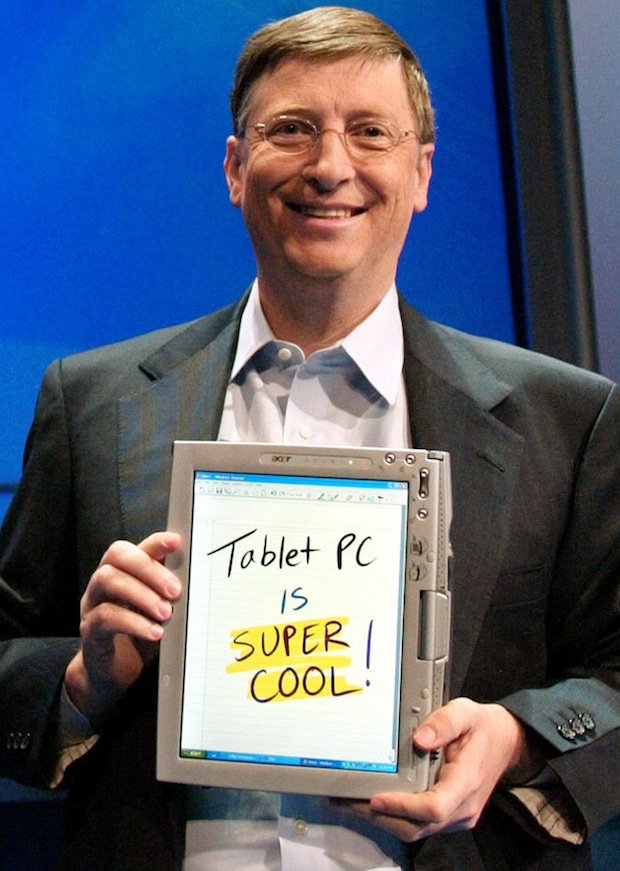
Apple’s iPad is a revolutionary product that is cratering the PC industry. But it wasn’t Steve Jobs’ idea. A full decade before Jobs launched the iPad in 2010, Bill Gates launched Microsoft’s touch input tablet computer. Here it is:

bill-gates-tablet-2000-1

Bill Gates with a Microsoft tablet in 2000

Two years later, Gates showed up with an improved model, a color tablet. It used the Windows XP Tablet operating system.

Here it is: Bill Gates in 2002

bill-gates-tablet-2002

Unlike today, Microsoft didn’t manufacture the tablet itself. Lenovo produced the tablet in 2000 and other partners, like Fujitsu, made the XP tablet in 2002. Here’s a closer look at the Fujitsu tablet. So if Microsoft was a decade ahead, why did Apple become the King of the Tablets? Last July, during an interview with Charlie RoseBill Gates explained that Jobs “did some things better than I did. His timing in terms of when it came out, the engineering work, just the package that was put together. The tablets we had done before, weren’t as thin, they weren’t as attractive.”

Writers’ platform Quill backed by Spotify investor; Quill, a former naval officer’s start-up, is attempting to build a “worldwide platform for web writers”.

Writers’ platform backed by Spotify investor

Entrepreneurs and investors behind companies including Spotify, Songkick and Mr & Mrs Smith have backed Quill, a former naval officer’s start-up which is attempting to build a “worldwide platform for web writers”.

Quill already uses 1,000 writers working in 17 countries and covers 30 languages Photo: ALAMY

By James Hurley

11:50AM BST 29 May 2013

Quill, which produces online content for large businesses, has secured £1m from a group of investors including Spotify backer Shakil Khan. Founder Ed Bussey said his business is building a network of writers around the world to produce online content in various languages for companies including retailer Shop Direct Group, insurer AXA and advertising giant WPP. Quill already uses 1,000 writers working in 17 countries and covers 30 languages, Mr Bussey said. Read more of this post

Behind the ‘Internet of Things’ Is Android—and It’s Everywhere

Behind the ‘Internet of Things’ Is Android—and It’s Everywhere

By Ashlee Vance on May 30, 2013

tech_android23__01b__630x420

Ken Oyadomari’s work space at NASA Ames Research Center in Mountain View, Calif., looks like a triage tent for smartphones. Parts from dozens of disassembled devices are strewn on workbenches. A small team of young engineers picks through the electronic carnage, carefully extracting playing card-size motherboards—the microprocessing heart of most computers—that will be repurposed as the brains of spacecraft no bigger than a softball. Satellites usually cost millions of dollars to build and launch. The price of Oyadomari’s nanosats, as they’ve become known, is around $15,000 and dropping. He expects them to be affordable for high school science classes, individual hobbyists, or anyone who wants to perform science experiments in space. A big reason nanosats are so small and cheap: They run on Google’s (GOOG) Android operating system, familiar to anyone who’s shopped for a smartphone or tablet. It’s the No. 1 mobile OS by a wide margin; Android handsets outsell Apple’s (AAPL) iPhones globally by about 4 to 1. Impressive as those numbers are, they actually understate Android’s prevalence, because increasingly it’s the operating system behind just about anything with a computer chip. Along with Oyadomari’s nanosats, three of which recently went into orbit, Android runs espresso makers, video game consoles, refrigerators, rifles that post video to Facebook (FB), and robotic harvesters for farms.

Android is becoming the standard operating system for the “Internet of things”—Silicon Valley’s voguish term for the expanding interconnectedness of smart devices, ranging from sensors in your shoe to jet engine monitors. As each of these devices hits the market, Google further outflanks Apple and Microsoft (MSFT) as the dominant software player in a connected world. Read more of this post

Jack Xu Talks about Failure in Copying Tumblr

Jack Xu Talks about Failure in Copying Tumblr

By Tracey Xiang on May 30, 2013

Jack Xu admitted that Diandian, a pixel-by-pixel Tumblr copy, was a failure and a painful experience at the Silicon Dragon Beijing 2013 yesterday. To be fair, Diandian is just one of the dozens of Tumblr copies in China and none of them really gained traction but hype.

As one of the first projects incubated by Innovation Works, Diandian was released in February 2011 — about half a year after Sina Weibo’s launch. After securing millions of dollars angel investment from Innovation Works, it raised more than USD10 million from Sequoia China and Ceyuan Ventures later that year. With the money Diandian launched massive marketing campaigns such as giving away movie tickets in order to have 10 million users by the end of that year and 100 million in the next two to three years.

But by April 2012 the number only reached 6 million — Sina Weibo announced 300 million users and $10 million in advertising revenue as of that quarter. According to some Diandian’s customers, there may be only one or two staff working on Diandian from early this year. Read more of this post