Apple Bonds: How Much Could Happen in 30 Years?

Apple Bonds: How Much Could Happen in 30 Years?

By Nick Summers on May 03, 2013

One of the more remarkable things about Apple’s (AAPL) record debt sale on April 30 was that $3 billion of it came in the form of 30-year bonds. That’s a common duration in such sectors as financials and health care—but not so much in technology, where fortunes are made and destroyed by the constant churn of innovation. Just think of all the things that the last 30 years have brought. The Macintosh. Windows. The Internet. Google (GOOG). The iPhone and iPad. The rise, fall, rise, and fall of Apple itself. Now try to envision what might change in the tech industry between now and 2043—the same year that Ali Lohan, younger sister of Lindsay, becomes eligible for membership in AARP. (Also, try to envision how investors will feel about having lent to Apple at a rate just 1 percentage point higher than virtually riskless U.S. Treasuries.) For some context, here’s a sampling of tech-related 30-year bonds that were issued 30-ish years ago:

Recognition Equipment
Issued: April 3, 1986
Which is the same month as: the Chernobyl nuclear disaster
Maturity: April 15, 2011

How’d that work out?: REI, which made optical character recognition technology, lost a big U.S. Postal Service envelope-scanning contract, and its chief executive was indicted. (The charges were dismissed.) “After the scandal, corporate raiders took over and sold” the company, according to D magazine. The bond was called in 1997.
Crazy Eddie
Issued: July 1, 1986
Which is the same month as: the first video footage of the Titanic wreckage is shot
Maturity: June 15, 2011

How’d that work out? The electronics retailer, with its iconic advertising (“his prices are insaaaaaaaane”), declared bankruptcy in 1989. Founder Eddie Antar served hard time for fraud. Read more of this post

Innovator: Dor Givon Gives Computers and Tablets 3D Powers

Innovator: Dor Givon Gives Computers and Tablets 3D Powers

By Olga Kharif on May 09, 2013

Imagine turning a smartphone into a full-body motion controller similar to the Microsoft (MSFT) Kinect or Nintendo’s (7974) Wii remote. Dor Givon, 41, has developed software that enables a device equipped with a standard 2D camera to register movement in three dimensions. “Every camera in the world today can be transformed to 3D,” says Givon, chief technology officer of Israeli startup Extreme Reality.

Givon’s software, Extreme Motion, uses a running video feed from the 2D cameras built into most laptops and tablets to map a person’s body and recognize his movements. Its algorithms calculate angles of limbs and joints to interpret the 2D images in 3D, adding depth to them frame by frame. On a camera-equipped laptop or TV, users can adjust the volume, move the cursor, and play games with a set of hand gestures the software recognizes from across the room. On a smartphone or tablet, the software lets developers add motion commands to mobile games. Read more of this post

Netflix, Reed Hastings Survive Missteps to Join Silicon Valley’s Elite

Netflix, Reed Hastings Survive Missteps to Join Silicon Valley’s Elite

By Ashlee Vance on May 09, 2013

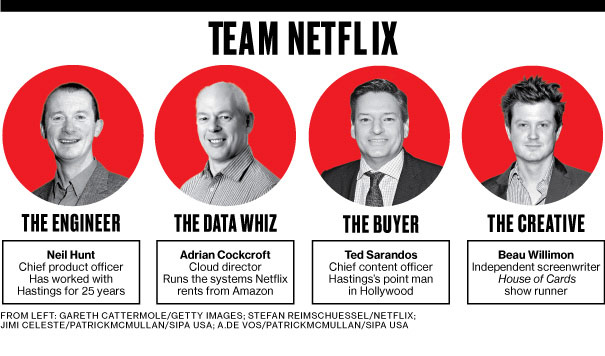
feat_netflixgraphic_605newfeature_netflix20__01__605inline

On a normal weeknight, Netflix (NFLX) accounts for almost a third of all Internet traffic entering North American homes. That’s more than YouTube, Hulu,Amazon.com (AMZN), HBO Go, iTunes, and BitTorrent combined. Traffic to Netflix usually peaks at around 10 p.m. in each time zone, at which point a chart of Internet consumption looks like a python that swallowed a cow. By midnight Pacific time, streaming volume falls off dramatically. As prime time wound down on Jan. 31, though, there was an unusual amount of tension at Netflix. That was the night the company premièred House of Cards, its political thriller set in Washington. Before midnight about 40 engineers gathered in a conference room at Netflix’s headquarters. They sat before a collection of wall-mounted monitors that displayed the status of Netflix’s computing systems. On the conference table, a few dozen laptops, tablets, smartphones, and other devices had the Netflix app loaded and ready to stream. When the clocks hit 12 a.m., the entire season of House of Cards started appearing on the devices, as well as in the recommendation lists of millions of customers chosen by an algorithm. The opening scene, a dog getting run over by an SUV, came and went. At 12:15 a.m., around the time Kevin Spacey’s character says “I’m livid,” everything was working fine. “That’s when the champagne comes,” says Yury Izrailevsky, the vice president in charge of cloud computing at Netflix, which has a history of self-inflicted catastrophes. Izrailevsky stayed until the wee hours of the morning—just in case—as thousands of customers binge-watched the show. The midnight ritual repeated itself on April 19, when Netflix premièred its werewolf horror series Hemlock Grove, and will again on May 26, when its revival of Arrested Developmentgoes live.

Netflix has more than 36 million subscribers. They watch about 4 billion hours of programs every quarter on more than 1,000 different devices. To meet this demand, the company uses specialized video servers scattered around the world. When a subscriber clicks on a movie to stream, Netflix determines within a split second which server containing that movie is closest to the user, then picks from dozens of versions of the video file, depending on the device the viewer is using. At company headquarters in Los Gatos, Calif., teams of mathematicians and designers study what people watch and build algorithms and interfaces to present them with the collection of videos that will keep them watching. Netflix is one of the world’s biggest users of cloud computing, which means running a data center on someone else’s equipment. The company rents server and storage systems by the hour, and it rents all this computing power from Amazon Web Services, the cloud division of Amazon.com, which runs its own video-streaming service that competes with Netflix. Read more of this post

Jack Ma of Chinese e-commerce giant Alibaba will officially step down today as CEO

Jack Ma to step down as Alibaba CEO today

2013-05-10 02:40:42 GMT2013-05-10 10:40:42(Beijing Time)  SINA English

Jack Ma of Chinese e-commerce giant Alibaba will officially step down today as CEO, according to Chinese media reports. He will be succeeded by his right-hand man Lu Zhaoxi. Alibaba was one of the earliest entrants into the Chinese online sector and has benefited hugely from its growth. A former English teacher, Ma set up Alibaba in 1999, convincing friends to fund him with $60,000 and picking a recognisable name with the aim of helping small firms find treasure by selling through the internet. Ma has inspired a generation of young Chinese with his open, no-nonsense and humorous personality. Both Taobao and Alibaba are owned by Alibaba Group, a private company based in the eastern city of Hangzhou. For many in China, life just wouldn’t be the same without Taobao, the country’s largest online shopping platform. In late April, Alibaba Group announced it will pay US$586 million for an 18 percent stake in Sina Corp’s Weibo microblog service.

U47P5029T2D589339F31DT20130510104042

Ten-year-old Taobao,China’s largest online shopping site, shaping Chinese lifestyles: The platform has also benefited more than 30,000 disabled, who would otherwise have more difficulty in finding a job

Ten-year-old Taobao shaping Chinese lifestyles

Updated: 2013-05-09 23:46

( Xinhua) Read more of this post

While most cable networks are off chasing the next Honey Boo Boo, Scripps Networks thrills investors by sticking close to home

Scripps Networks Interactive Staying True to its Roots

by Dorothy Pomerantz | May 10, 2013

While most cable networks are off chasing the next Honey Boo Boo, Scripps Networks thrills investors by sticking close to home

US_SAFE AS HOUSES.indd

The home of cable channels Food Network, HGTV and Travel Channel is tucked between the old Brown Squirrel Furniture Store and the Dead Horse Lake Golf Course at the foot of the Great Smoky Mountains in Knoxville, Tennessee. The building curves around a lake where, on pleasant days, employees take meetings in paddle boats. You know you’ve found the right place when you see the big mural of the squirrel. Manhattan media this ain’t, and the folks at Scripps Networks Interactive are just fine with that—as are their investors. Scripps ranks No 1,572 on our Global 2000 list, jumping up 159 spots from last year, and is the best-performing media company on the list based on long- and short-term sales growth, profitability and shareholder return. Over the past five years, revenues at Scripps Networks have increased an average 11 percent per year and net income has increased 50 percent annually. The stock is currently trading at an all-time high of $68 per share. “Food Network has a 57.7 percent cash flow margin,” says Derek Baine, senior analyst at SNL Kagan. “That’s pretty impressive for any company.”
Read more of this post

Amazon Is Developing Smartphone With 3-D Screen

Updated May 9, 2013, 7:02 p.m. ET

Amazon Is Developing Smartphone With 3-D Screen

New Gadgets, Including Audio-Only Device, Is Bid to Expand Beyond Kindle Fire

By GREG BENSINGER

MK-CD116_AMAZON_NS_20130509181504

Amazon is expanding beyond its range of Kindle devices as it aims to compete more directly with Google and Apple. Photo: Associated Press.

Amazon.com Inc. AMZN +0.57% is expanding beyond its range of Kindle devices as it aims to compete more directly with Google Inc. GOOG -0.25% and Apple Inc.AAPL -0.87%

The Seattle e-commerce giant has recently been developing a wide-ranging lineup of gadgets—including two smartphones and an audio-only streaming device—to expand its reach beyond its Kindle Fire line of tablet computers, said people familiar with the company’s plans.

One of the devices is a high-end smartphone featuring a screen that allows for three-dimensional images without glasses, these people said. Using retina-tracking technology, images on the smartphone would seem to float above the screen like a hologram and appear three-dimensional at all angles, they said. Users may be able to navigate through content using just their eyes, two of the people said. Read more of this post

Heart Patient Risk From iPad2 Found by 14-Year-Old

Heart Patient Risk From iPad2 Found by 14-Year-Old

Gianna Chien is somewhat different from all the other researchers reporting on their work today to more than 8,000 doctors at the Heart Rhythm Society meeting.

Chien is 14, and her study — which found that Apple Inc. (AAPL)’s iPad2 can, in some cases, interfere with life-saving heart devices because of the magnets inside — is based on a science-fair project that didn’t even win her first place.

The research offers a valuable warning for people with implanted defibrillators, which deliver an electric shock to restart a stopped heart, said John Day, head of heart-rhythm services at Intermountain Medical Center in Murray, Utah, and chairman of the panel that reviews scientific papers to be presented at the Denver meeting.

If a person falls asleep with the iPad2 on the chest, the magnets in the cover can “accidentally turn off” the heart device, said Chien, a high school freshman in Stockton, California, whose father is a doctor. “I definitely think people should be aware. That’s why I’m presenting the study.”

Defibrillators, as a safety precaution, are designed to be turned off by magnets. The iPad2 uses 30 magnets to hold the iPad2’s cover in place, Chien said. While the iPad2 magnets aren’t powerful enough to cause problems when a person is holding the tablet out in front of the chest, it can be risky to rest it against the body, she found. Read more of this post

Voice emotion recognition developer Beyond Verbal raises $2.8m

Voice emotion recognition developer Beyond Verbal raises $2.8m

Voice Recognition has also launched a patented technology that can extract, decode, and measure a full spectrum of human emotions from a person’s raw voice.

9 May 13 13:01, Globes’ correspondent

Voice emotion recognition developer Beyond Verbal has closed a $2.8 million financing round led by t angel investor Kenges Rakishev and new venture capital fund Genesis Angels. Following the investment Rakishev is joining Beyond Verbal’s board of directors. Voice Recognition has also launched a patented technology that can extract, decode, and measure a full spectrum of human emotions from a person’s raw voice. Read more of this post

McKinsey: Amazon’s Dominance Of Retail Comes From These 3 Factors

McKINSEY: Amazon’s Dominance Of Retail Comes From These 3 Factors

Kevin Smith | May 8, 2013, 11:52 AM | 23,829 | 2

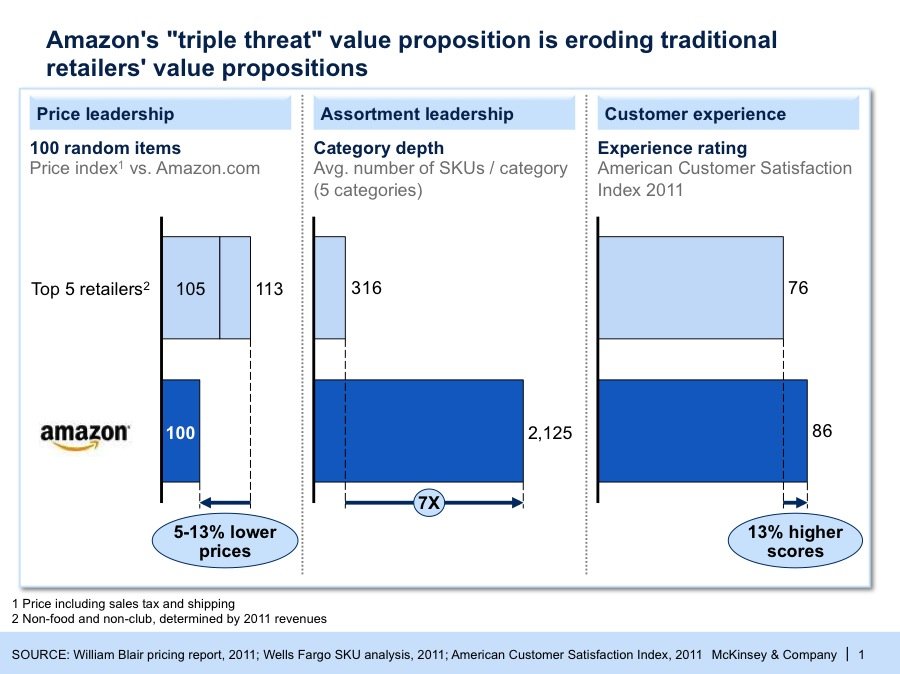
Consulting group McKinsey & Co. thinks it has figured out Amazon‘s “secret sauce.” In 2011, 13% of all U.S. online retail sales went through Amazon,McKinsey believes. The secret? Lower prices than its rivals, a greater product assortment, and better customer relations. Amazon’s domination of the retail market is bolstered by a “maniacal” tech investment strategy, according to the report. This deck shows why McKinsey believes Amazon is poised to capture even more U.S. retail market share, at the expense of its main street rivals.

jpg (15)jpg (7) Read more of this post

Galaxy’s secret sauce: Samsung components; “Samsung’s strength is this ability to in-source to itself”

May 8, 2013, 7:15 p.m. ET

Galaxy’s secret sauce: Samsung components

By ARIK HESSELDAHL

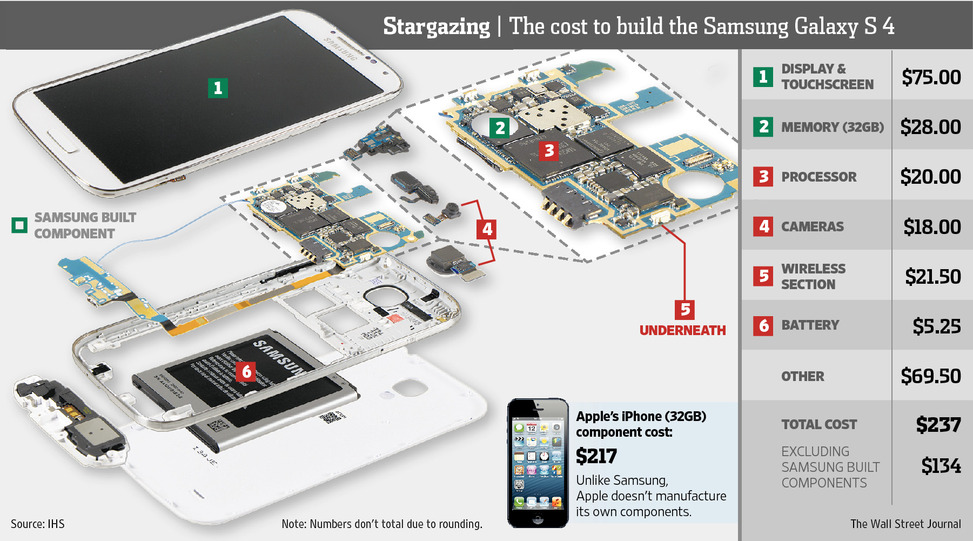
Samsung Electronics Co 005930.SE +1.01% .’s latest smartphone, the Galaxy S 4, takes advantage of the South Korean electronics company’s chip- and display-manufacturing prowess to get its material costs closer to Apple Inc AAPL +1.13% .’s costs for the iPhone 5. An analysis conducted by market-research firm IHS Inc. IHS +1.66% estimates Samsung’s cost of materials and manufacturing to produce the U.S. version of the S 4 is slightly above $237 a unit, according to a report expected to be released on Thursday. That is higher than Apple’s $217 production cost for a 32-gigabyte iPhone 5, which has a smaller and less-costly display screen. Without a two-year contract, the 16-gigabyte version of the Samsung phone sells for $639 at AT&T Inc., T +0.83%and the iPhone 5 with 32 gigabytes costs $749 at an Apple store.

MK-CD089A_GALAX_G_20130508185108 Read more of this post

Earnings Not Yet a Viral Sensation

ay 8, 2013, 7:48 p.m. ET

Earnings Not Yet a Viral Sensation

By JEAN EAGLESHAM

When Facebook Inc. FB +0.86% boss Mark Zuckerberg announced first-quarter results, he didn’t break the news with a Facebook post. He stuck with an old-fashioned news release. Across the U.S., earnings season came and went with few signs that companies are taking advantage of the Securities and Exchange Commission’s green light to tweet or post market-moving information. On April 2, the SEC announced that companies “can use social media outlets like Facebook and Twitter to announce key information…so long as investors have been alerted about which social media will be used to disseminate such information.” Since then, only about a dozen firms have said they might break news on Facebook, Twitter and the like. And few of those companies make much noise online. Read more of this post

‘Open Data’ Brings Potential And Perils for Government

May 8, 2013, 4:27 p.m. ET

‘Open Data’ Brings Potential And Perils for Government

By BEN ROONEY

Open Data: the very name is a virtuous pairing of transparency and science. No one is going to argue against openness, and data has the appeal of nonjudgmental objectivity.

Governments and public officials are rushing to embrace the concept, throwing open the vast panoply of publicly collected information for the digitally savvy to mine and exploit. The poster child of the movement is Mike Flowers, chief analytics officer for the City of New York. By mashing together all of the city’s numerous data sources, his team has more than doubled the hit rate for discovering stores selling bootlegged cigarettes and had a fivefold increase in the success rate of building inspectors looking for illegal conversions.

With that sort of track record, it is clear why Open Data is very appealing for politicians. At the last count almost 30 countries—mainly in Europe and other developed nations but also including Costa Rica, Kenya and India—plus a number of municipal areas have launched sites.

However, the use of government data throws up many issues surrounding privacy, policy-making and the uses to which the data has been put. These need to be tackled before simply opening up these digital to all comers. Read more of this post

HP and Autonomy: how to lose $8.8bn

May 8, 2013 9:29 pm

HP and Autonomy: how to lose $8.8bn

By Robert Armstrong and Stuart Kirk

Hewlett-Packard appears to be in a difficult position whatever the court rules on its disastrous purchase of the software group

AutonomyHP

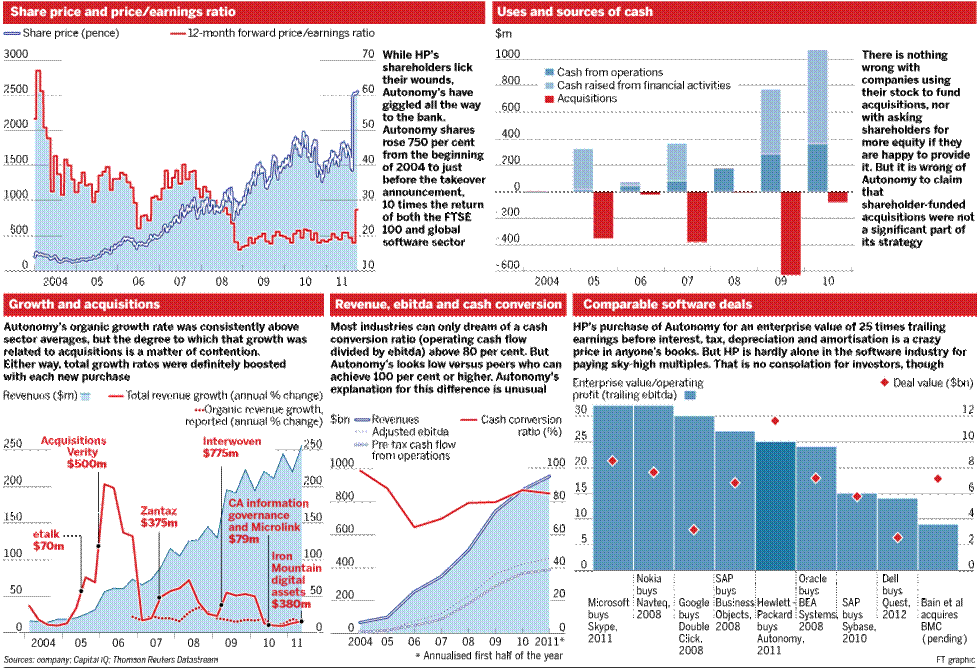
Making $8.8bn disappear is not easy.Hewlett-Packard managed it, and quickly, when it bought the information management software company Autonomyin 2011 for $11.6bn and wrote off 80 per cent of the purchase price a year later. HP’s history is rife with self-inflicted injuryand the Autonomy affair is, in part, a depressingly familiar story: a company in crisis overpaying for an acquisition it can tout as transformative. Heads have already rolled. Léo Apotheker, HP’s boss at the time of the deal, departed almost immediately afterwards and Raymond Lane, the board’s chairman at the time, and two other directors followed him last month. HP, however, attributed more than $5bn of the writedown to “accounting improprieties, disclosure failures and outright misrepresentations”. It alleges that low-margin hardware sales were disguised as high-margin software sales and that products were sold into the distribution channel when there was no buyer. Read more of this post

Jim Chanos: ‘If I Had To Pick One Short, It Would Be Seagate’; Companies like Samsung are exiting the HDD business as quickly as they can

JIM CHANOS: ‘If I Had To Pick One Short, It Would Be Seagate’

Linette Lopez | May 8, 2013, 6:03 PM | 1,556 | 1

Jim Chanos believes in the mobile revolution, and that means the death of the PC and all the businesses that exist within the PC family. At the annual Sohn Investing Conference today, he focused on one branch of that family (which he identified as value traps, of course) in a presentation called, Mobile Computing Revolution: Collateral Damage in Hard Disk Drives. “Most people have way too much storage as it is on their laptops and desktops,” he explained. “The move to the cloud is actually more efficient… The amount of storage out there still exceeds the needs as fast as data is growing.” In short, no one needs hard drives anymore. Companies like Samsung are exiting the business as quickly as they can. In fact, he pointed out, Samsung sold their disk drive business to his short pick at half of revenues in 2011 — the short pick is Seagate. He mentioned another company, Western Digital, in his presentation as well, but he particularly focused on Seagate because it’s exhibiting all the characteristics of a classic Chanos short. First off, there are, of course, accounting issues. It wouldn’t be a Chanos short if there weren’t. Seagate put about $1 billion of goodwill on the books after its Samsung acquisition, which can be great way to mask cash flow problems. Not only that, but the top 3 person in the company quit last night. And if this isn’t enough for you, Chanos put up a table that shows that the top Seagate stock holders are selling like crazy. “I think it’d probably be best if you did too,” he closed. The stock was trading at $42.32, and is now down 3.36% in after hours trading.

The Complex World of Marketing Technology

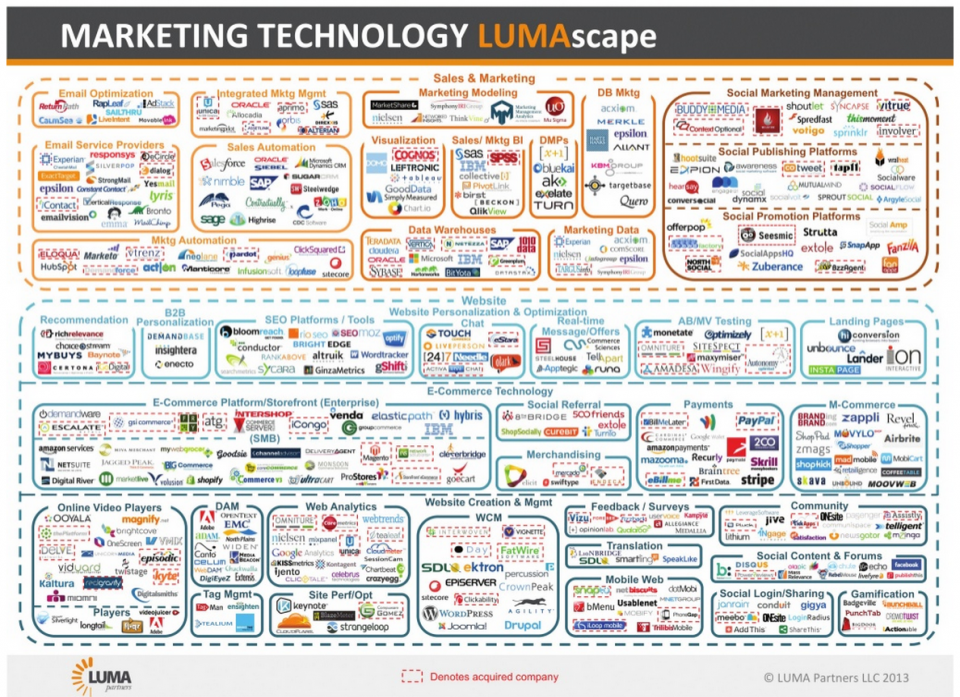
This Insane Graphic Shows How Complex Marketing Technology Is Right Now

Laura Stampler | May 8, 2013, 4:08 PM | 12,101 | 7

The marketing technology world is insanely specialized and complex. How complex? This new chart from LUMA Partners breaks down the world’s many different components, from sales and marketing to e-commerce technology to website creation and management.

screen shot 2013-05-08 at 3.56.56 pm

Once-Hot App Viddy Returns $18 Million To Investors And Prepares A Final Attempt To Turn Around

Once-Hot App Viddy Returns $18 Million To Investors And Prepares A Final Attempt To Turn Around

Alyson Shontell | May 8, 2013, 9:23 AM | 1,362 | 2

Last summer, social video app Viddy was in a much different place. It was in a battle to be the “Instagram of Video” alongside competitor SocialCam, and its number of users surged higher every day. Viddy used that momentum to raise a $30 million Series B round from investors such as Khosla VenturesNEA and Goldman Sachs. Even Shakira invested. But the traffic was temporary. Viddy grew quickly on Facebook‘s platform, but Facebook cut off the traffic hose when news broke that people were getting spammed by social video apps. Viddy’s executive team has all but left, including its CEO and its head of business development. In February, one-third of the staff was laid off. Now, Viddy is giving itself one last go. It’s returning $18 million to investors and keeping the remaining millions to try a few more product launches. “Viddy raised a substantial amount of capital last year, during different market conditions,” Viddy’s president, JJ Aguhob, told AllThingsD. “A year later, Viddy is a leaner, product-focused organization that is steadily growing its audience and will soon be releasing new products. Our late-stage investors have been very supportive, but it just makes good business sense to return capital we do not need and have a clean balance sheet in the process.” Having to return all that cash isn’t the most painful part of Viddy’s story either. Last year, Viddy reportedly turned down a $100 million buyout offer from Twitter when the app was on the upswing.

Billionaire Taizo Son Emerges With ‘Puzzle & Dragons’ App after shares of GungHo soared more than 10-fold this year. “Puzzle & Dragons” was the world’s top-grossing game app for smartphones in March

Billionaire Taizo Son Emerges With ‘Puzzle & Dragons’ App

Taizo Son, the youngest brother of SoftBank Corp. (9984) magnate Masayoshi Son, has become a billionaire after shares of his company GungHo Online Entertainment Inc. (3765) soared more than 10-fold (3765) this year. The GungHo chairman holds a 27.8 percent stake in the Tokyo-based company. The shares account for almost all of his $3.3 billion fortune, according to the Bloomberg Billionaires Index. Taizo Son has never appeared on an international wealth ranking. His older brother’s SoftBank holds a 40 percent stake and was an early GungHo investor in 2002. GungHo’s flagship app, “Puzzle & Dragons,” is the world’s best-selling game for Apple Inc (AAPL).’s iPhones and smartphones using Google Inc. (GOOG)’s Android software. The app has been downloaded more than 13 million times in Japan, or about 10 percent of the nation’s population. While free to play, the role-playing game encourages participants to buy and collect characters. It generates about $3 million a day in revenue, according to Macquarie Group Ltd. analyst David Gibson.

“It has become the ‘Angry Birds’ of Japan, the default game users download and play once they buy a smartphone,” Gibson, who has an outperform rating on the stock, wrote in an e-mail interview from Tokyo. “Puzzle & Dragons” was the world’s top-grossing game app for smartphones in March, according to the App Annie Index, which measures revenue and downloads.

Read more of this post

‘Fruit Ninja’ Will Add China Content to Narrow ‘Angry Birds’ Gap; The Brisbane, Australia-based company’s game has been downloaded 500 million times, less than a third of the 1.7 billion downloads for “Angry Birds.”

‘Fruit Ninja’ Will Add China Content to Narrow ‘Angry Birds’ Gap

Halfbrick Studios Pty, creator of the “Fruit Ninja” smartphone game, will add China-specific content to win users in the world’s most populous nation and narrow the gap with Rovio Entertainment Oy’s “Angry Birds.”

In the next three months, Halfbrick will release a China version of Fruit Ninja that will include special weapons and backgrounds designed to increase its local appeal, Phil Larsen, chief marketing officer for Halfbrick, said in an interview in Beijing yesterday. The Brisbane, Australia-based company’s game has been downloaded 500 million times, less than a third of the 1.7 billion downloads for “Angry Birds.”

Halfbrick has its work cut out to match Rovio, which has made tailoring products for China a key strategy. Espoo, Finland based Rovio built an update of its “Angry Birds Seasons” game around China’s Moon Festival, sells Angry Birds-themed mooncakes during the holiday and publishes comic books that use its bird and pig characters to tell Chinese legends, according to Chief Marketing Officer Peter Vesterbacka.

“A lot of foreign companies have this hubris that we are going to bring you this great product and you are going to love it,” said Mark Natkin, managing director of Marbridge Consulting Ltd., a market research firm in Beijing. “It’s a common mistake to think that localization means translation from English to Chinese and then you’re done.” Read more of this post

Why mobile wallets alone will fail; Smartphones are the key to revolutionizing shopping—but not in the way many think.

Why mobile wallets alone will fail

May 8, 2013: 11:18 AM ET

Smartphones are the key to revolutionizing shopping—but not in the way many think.

By Cyriac Roeding

FORTUNE — Mobile wallets as they are defined today are unfortunately a solution in search of a problem. Consumers are quite happy with their credit and debit cards…they work, they’re fast and they’re familiar. And retailers, while they may complain about credit card fees, have bigger strategic issues with online competition and showrooming than to worry about installing the next “wallet” created to replace tried and true payment systems they’ve already invested in – and successfully process millions of transactions every day. The problem with mobile payments is that payment isn’t a problem in the shopping world.

So, what is the problem? The problem is the experience of shopping. One hundred years ago, as a customer, you’d have been greeted by name when you walked into a local store. The shopkeeper would have asked you whether your kids liked the cereal he sold you last week. Nowadays no one “greets” you until you swipe your credit card because it isn’t until that point when the store finds out you are even there – that means, as you leave, when you are no longer looking for items to purchase. No one shows you something that *you* might like at the store while shopping – everything is impersonal. By scaling retail, shopping has become inhuman. Read more of this post

Google Translate For Android Can Now Interpret 16 Additional Languages By Camera, Adds Phrasebook Support

Google Translate For Android Can Now Interpret 16 Additional Languages By Camera, Adds Phrasebook Support

FREDERIC LARDINOIS

posted 7 hours ago

One of the coolest features of the Google Translate for Android app is that you can just point your camera at a text, tap the word you want to translate and get a translation back.Starting today, this feature supports 16 additional languages. Those are Bulgarian, Catalan, Danish, Estonian, Finnish, Croatian, Hungarian, Indonesian, Icelandic, Lithuanian, Latvian, Norwegian, Romanian, Slovak, Slovenian and Swedish. That’s in addition to Czech, Dutch, English, French, German, Italian, Polish, Portuguese, Russian, Spanish, and Turkish, which the app already supported in its first release. Google uses optical character recognition and its machine translation tools to make all of this work. In addition, Google is making its recently introducedphrasebook feature available in that app. The phrasebook, Google said at the time, allows “you to save the most useful phrases to you, for easy reference later on, exactly when you need them,” and revisiting them regularly should help you turn these translations “into lasting knowledge.” The phrasebook is now available in Translate’s app menu, where it replaces the app’s ‘favorite’ feature. The service will automatically sync with your Google Account (assuming you are signed in), so any changes you make on your phone will also be reflected on the Google Translate desktop site. “With your favorite phrases synced across devices,” Google writes, “we hope you’ll never be at a loss for words again.” It’s worth noting that the iOS version of the app does not currently support translate by camera.

The 20 Hottest Startups From The World’s 2nd-Biggest Startup Factory – Israel

The 20 Hottest Startups From The World’s 2nd-Biggest Startup Factory – Israel

Julie Bort | May 7, 2013, 9:32 PM | 5,273 | 1

BillGuard’s community manager Marina Boykos left the U.S. to work at an Israeli startup in Tel Aviv Israel calls itself the “startup nation.” Israelis say that technology is the country’s No. 1 export. By some counts, Israel is home to 4,800 startups today. It’s also home to least two dozen accelerator/incubator programs in the Tel Aviv area, alone, including some run by Microsoft and Google. There are more incubators in other cities, too, including a program in Jerusalem run by Jerusalem Venture Partners on a campus so big it has its own restaurant and nightclub.  All of this is to say that as a startup hub, Israel is second only to Silicon Valley. So it’s not easy to name the nation’s hottest, most exciting startups because everywhere you turn there are young companies doing really cool things. Business Insider recently spent a week exploring Israel’s super hot startup community, meeting with founders, employees and venture capitalists.

(Disclosure: Microsoft and Jerusalem Venture Partners paid some of the travel expenses for this trip.)

We asked everyone to name the nation’s coolest, hottest startups.

Waze: crowdsourced traffic reports

Waze is far and away the hottest, most talked about startup in Israel these days. It’s an internationally popular maps-and-navigation app for 30 million drivers worldwide. Drivers report their traffic problems, which is a great way to get real time traffic info. At one point, Apple was rumored to be buying Waze. That didn’t happen but the company is doing so well that co-founder Uri Levine has become an angel investor in other Israeli startups, like Pixtr, the app that makes people look gorgeous in photos. Waze has offices in Palo Alto, Calif. and New York. Read more of this post

3D printing: the new, bottom-up industrial revolution

3D printing: the new, bottom-up industrial revolution

When Joseph Schumpeter described capitalism as a process of creative destruction more than 70 years ago, he couldn’t have conceived of the miracle that is 3D printing.

By Allister Heath

4:10PM BST 07 May 2013

Yet this hair-raising technology is about to tear apart existing structures in a way that would undoubtedly have shocked even Schumpeter, a great economist struck by the free market’s revolutionary, anti-conservative tendencies.

Remarkably, 3D printing allows actual objects to be designed and created (or “printed”) surprisingly quickly with a computer connected to a printer-like device, using special material (often plastic, but increasingly almost anything) as “ink” and “paper”. With the costs of the machinery nearing mass-market levels, 3D printing is poised to take off, blurring the distinction between digital and physical realms, democratising manufacturing and turning large chunks of the global economy upside-down.

Yet the news that the first workable gun has been produced with a 3D printer will have reawakened the inner Luddite in many Britons. Surely, many will argue, such a technology is far too dangerous to be unleashed on the world: imagine what terrorists could do with it. Read more of this post

The data crunchers are invading Hollywood. Solving Equation of a Hit Film Script, With Data

May 5, 2013

Solving Equation of a Hit Film Script, With Data

By BROOKS BARNES

LOS ANGELES — Forget zombies. The data crunchers are invading Hollywood.

The same kind of numbers analysis that has reshaped areas like politics and online marketing is increasingly being used by the entertainment industry.

Netflix tells customers what to rent based on algorithms that analyze previous selections, Pandora does the same with music, and studios have started using Facebook “likes” and online trailer views to mold advertising and even films.

Now, the slicing and dicing is seeping into one of the last corners of Hollywood where creativity and old-fashioned instinct still hold sway: the screenplay. Read more of this post

Adobe’s subscription model and the future of software

Adobe’s subscription model and the future of software

By Hayley Tsukayama, Wednesday, May 8, 12:45 AM

Those waiting to grab the next Adobe Creative Suite may be disappointed — there won’t be anything for you to pick up.

Adobe announced Monday that it will no longer sell boxed versions of its software, or even the option to buy individual programs from the popular suite. And Adobe is dropping the well-known Creative Suite (most often abbreviated to CS), shifting all the programs under the “Creative Cloud” brand that it uses for Web apps, to reflect that it’s not interesting in leaving the cloud any time soon. From now on, the company said, anyone who wants to buy Photoshop, Dreamweaver, Illustrator or other parts of its Creative Suite software can subscribe to them monthly as part of a software package. The update will be available starting next month for an annual membership that breaks down to $49.99 per month for the full suite. Those who own products from CS3 through CS5.5 will get a discount on the first year of the new cloud service, for $29.99 per month. Individual app subscriptions also are available for $19.99 per month.

Plenty of software companies only distribute their software through downloads. Microsoft and Apple offer their operating systems through digital downloads. And when was the last time you took a good look at the PC gaming section of your local store? Digital downloads and hubs such as Steam or Origin have made those sections shrink — in some stores — to nothing. Read more of this post

How the iPhone conquered Japan by winning over women; The original round plastic iPhone becomes a fashion item for Japanese women who enjoyed the huge variation of cases and ease of decoration

How the iPhone conquered Japan

May 6, 2013: 12:05 PM ET

Despite its more-or-less mundane technology, Apple’s device won over women.

FORTUNE — The Japanese were using their cellphones to watch TV, navigate with GPS, download music, make movies, pay bills, and check their emails years before American consumers were doing the same. Japan also had touchscreen phones eight years earlier than iPhone — the Pioneer J-PE01. And yet it is no surprise that Apple’s iPhone was the best-selling phone in Japan last year. After over a decade of trouncing any foreign handset looks and talent-wise, Japan’s legendary ketai are been given the heave-ho in favor of foreign models. Take NEC, once one of the world’s biggest IT and telecoms firms. Its fortunes have been typical of the other seven Japanese handset makers. After two years of losses and a stock value that has fallen over 90% in a decade, it is selling off its mobile phone sales unit and cutting 10,000 mobile related jobs. Analysts say the firm can’t compete anymore with Apple (AAPL) and Korea’s Samsung.

What happened? Japanese mobile phone guru Nobuyuki Hayashi believes there are three main reasons Japan has fallen out of love with its own handset makers. First, he says, you have to understand what a colossal and unexpected hit the iPhone was with Japanese women. “The iPhone has been very strong among women from very early on. The original round plastic iPhone 3G series soon become a fashion item for Japanese women who also enjoyed the huge variation of cases and ease of decoration. Then there is the brand loyalty of Japanese women.” Read more of this post

Adobe Moves Software Out of the Box and Into the Cloud

Updated May 6, 2013, 7:44 p.m. ET

Adobe Moves Software Out of the Box and Into the Cloud

By STEVEN D. JONES

Adobe Systems Inc., ADBE -1.11% the maker of Photoshop, Illustrator and other design tools, is getting out of the packaged-software business and will sell its biggest products only as online services.

The decision announced Monday by one of the largest software publishers underscores how the industry is adjusting to changing consumer tastes. People are buying fewer boxes of software—just as they aren’t buying as many CDs, movies and books in stores—and turning to Internet-based cloud services.

Adobe, which began selling its software in stores in 1987, will no longer offer new versions of its creative software at retailers such as Staples or allow people to download digital copies to their computers. Read more of this post

Paid YouTube channels: Would you subscribe?

Paid YouTube channels: Would you subscribe?

By Hayley Tsukayama, Tuesday, May 7, 12:00 AM

YouTube has moved swiftly in the past year to produce more original content to keep regular viewers coming back to its site, rather than simply stopping by to see the latest viral cat video. Now, the Financial Times reports that the paid model could go into effect as soon as this week, with as many as 50 subscription channels starting as low as $1.99 a month. The New York Times reported that channels could include those for children’s programming, entertainment, music and other topic areas.

We’ve been here before. Chatter about paid channels has been circulating ever since Google, which owns YouTube, made its first push to release regular, original videos on its site by paying about $100 million to fund promising talent. AdAge and the Wall Street Journal reported in January that the new paid channels could launch as soon as this spring. Read more of this post

Google set to unveil subscriptions for specialist YouTube videos

May 5, 2013 2:52 pm

Google set to unveil subscriptions for specialist YouTube videos

By Matthew Garrahan in Los Angeles and Andrew Edgecliffe-Johnson in New York

Google is on the verge of unveiling an à la carte subscription service for some of YouTube’s specialist video channels, to finance a broader range of content and add a second revenue stream to the digital video market leader.

The move, which has been in the works for months, could be announced as early as this week. It will apply to as many as 50 YouTube channels, people familiar with the plan say. Viewers will be able to subscribe to each channel for as little as $1.99 a month. Read more of this post

What LinkedIn Looked Like When It Started 10 Years Ago

What LinkedIn Looked Like When It Started 10 Years Ago

Kevin Smith | May 5, 2013, 10:11 AM | 2,688 | 1

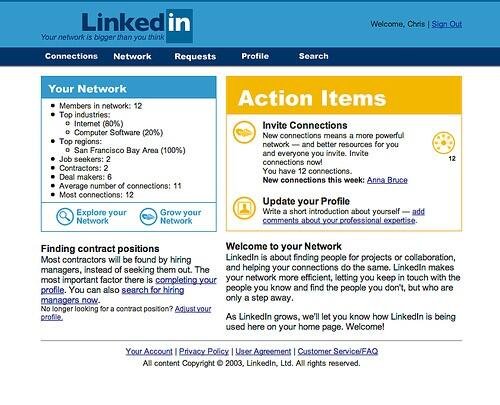
Today is LinkedIn‘s 10th birthday. The professional social network is over 200 million members strong. LinkedIn has gone through many site redesigns and added features and services to help its users connect even further. But here’s what LinkedIn’s first profiles looked like 10 years ago:

bjgpwyhciaa4l2y