LinkedIn’s Real Value: Knowing All About People in All the Right Places

May 5, 2013, 5:20 p.m. ET

LinkedIn’s Real Value: Knowing All About People in All the Right Places

By ROLFE WINKLER

Dear LinkedIn LNKD -12.93% : Please put up a few more disappointing quarters so investors who have missed the boat can pile in.

Smart types long ago realized the professional social network is more than just an improved online job board.

LinkedIn Corp.’s main product, driving 57% of first-quarter sales, is enterprise software. It charges recruiters about $8,500 annually for premium tools to find, contact and track a wide pool of desirable job candidates. Alternatively, a headhunter may charge a quarter of a new hire’s first-year salary. Fill one slot and LinkedIn pays for itself. That should help the company to steadily raise prices, especially as more members sign up and it adds new features like “endorsements” where skills listed on a profile are verified by contacts. A more modest price increase went into effect this quarter. But LinkedIn raised prices to $8,200 from $7,000 in the first quarter of 2011. Since then, the number of corporate customers has risen nearly fivefold to more than 18,000.

One reason clients didn’t seem to mind the higher price is the expanding pool of potential hires: Over the same period, the number of LinkedIn users has leapt to nearly 220 million from 90 million. Read more of this post

By allowing the use of software, rather than lawyers, to sift through legal documents in the AB InBev deal, the Justice Department is likely to spark interest in such programs

Updated May 5, 2013, 8:47 p.m. ET

Document-Review Software Gets Boost From AB InBev Deal With Grupo Modelo

By JOE PALAZZOLO

MK-CC972_PCLAWY_G_20130505174220

In the legal arena’s contest of man versus machine, the U.S. Justice Department has given a big boost to the machines.

Department officials reviewing the proposed merger of Anheuser-Busch InBev NVBUD +1.00% and Mexico’s Grupo Modelo GMODELO.MX -0.64% SAB recently approved a request to use software—rather than a horde of lawyers—to determine which documents needed to be turned over to the government.

Cases involving large companies often require legal counsel to sift through millions of electronic documents. In the past decade, that task has typically fallen on armies of contract, or temporary, lawyers who earn $25 to $40 an hour. Industry experts peg the cost for clients at more than $1 per document. Read more of this post

Disruptions: New Motto for Silicon Valley: First Security, Then Innovation. Silicon Valley to replace posters with ones that say, “Move slowly and protect your users.”

MAY 5, 2013, 11:00 AM

Disruptions: New Motto for Silicon Valley: First Security, Then Innovation

By NICK BILTON

At Facebook’s headquarters in Palo Alto, Calif., are stark white posters with bright red statements like “Done is better than perfect” and “Move fast and break things.”

These disruptive philosophies embody the spirit not just of Facebook but of Silicon Valley. Yet today, when technology companies have become the prime targets of rogue governments and hackers, the ideologies that drive these companies to provoke could end up disrupting these companies.

Conversely, the signs sitting in security research firms across the country warn, “Carelessness causes security incidents.”

Although technology companies say they take security seriously, protecting their customers seems to come second to announcing new products. Take Twitter, where people’s accounts are frequently hacked. In the last few months alone, this has happened to Burger King, BBC, NPR, The Associated Press and a slew of celebrities and users. In that time, Twitter has proudly announced updates to features on its mobile and desktop apps, introduced a music Web site and redesigned its company blog. But it still hasn’t released two-factor authentication, a security tool used by the rest of the industry to deter hackers. Read more of this post

Media Giants Chase Online Ads With Original Shows

May 5, 2013

Media Giants Chase Online Ads With Original Shows

By LESLIE KAUFMAN and TANZINA VEGA

Everyone wants to be in show biz, and these days — on the Web at least — it seems as if everyone is.

Digital and traditional media companies, including newspapers and magazines, have for years been building a video presence on the Internet. But until now the offerings have largely been low-budget, single-camera affairs featuring talking heads.

Last week, however, major media companies like Condé Nast, The Wall Street Journal and Univision presented ambitious slates of original programming to advertisers for the first time.

Companies that were already producing Web content, like Yahoo and Hulu, also announced greatly expanded offerings.

As a result, viewers are being bombarded with an array of new Internet programs — 11 from Yahoo, 14 from AOL and a whopping 30 from Condé Nast, including one that will let viewers watch a Vogue editor, Hamish Bowles, as he shops around the world. Read more of this post

Little Data Makes Big Data More Powerful

Little Data Makes Big Data More Powerful

by Mark Bonchek  |  11:00 AM May 3, 2013

You may not know this, but Big Data has a little brother. And together, Big and Little Data are far more powerful than Big Data alone.

Big Data is what organizations know about people — be they customers, citizens, employees, or voters. Data is aggregated from a large number of sources, assembled into a massive data store, and analyzed for patterns. The results are more accurate predictions, more targeted communications, and more personalized services. Big Data is what enables banks to predict credit card fraud by analyzing billions of transactions, marketers to understand customer sentiment by analyzing millions of interactions on social media, and retailers to target promotions and offers by analyzing millions of purchases.

In contrast, Little Data is what we know about ourselves. What we buy. Who we know. Where we go. How we spend our time. We’ve always had a sense for these things — after all, it’s our lives. But thanks to the combination of mobile, social, and cloud technologies, it’s easier than ever to gain insight into our own behavior. Read more of this post

Intel v ARM

Intel v ARM

Chip off the old block

May 2nd 2013, 20:29 by M.G. and P.L.| SAN FRANCISCO AND LONDON

20130504_woc556

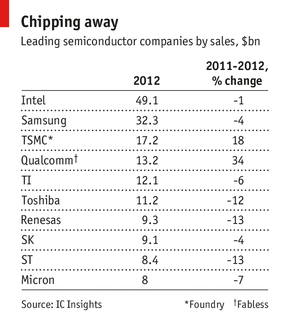
IT’S all change at the top of two of the world’s leading semiconductor companies. On May 2nd Intel, the world’s largest chip-maker, announced that Brian Krzanich (pictured above), the firm’s current chief operating officer, will become the sixth chief executive in the firm’s history. Mr Krzanich, who will take over as boss on May 16th, replaces Paul Otellini, who unexpectedly announced last November that he would be resigning as Intel’s boss.

ARM, Intel’s British rival, is also changing its leader. In March Warren East, the company’s chief executive, said he would stand down in July after 12 years in the top job. Like Intel, ARM has chosen an internal successor, Simon Segars (pictured below), who has been running the company’s intellectual-property divisions and is also the company’s president.

Mr Krzanich faces the harder challenge of the two. Intel rode to greatness on the back of the personal computer (PC). Its microprocessors are in most PCs and the server computers that are found in data centres and offices.  But PC sales have been falling sharply just as sales of smaller mobile computing devices have taken off. IDC, a research firm, reported that shipments of PCs in the first quarter of 2013 plummeted by almost 14%. Read more of this post

Online retailers may soon have to collect sales tax. Amazon, oddly, is gloating

Online retailers may soon have to collect sales tax. Amazon, oddly, is gloating

AMAZON, which became America’s biggest internet retailer by selling things more cheaply than anyone else, used to go to great lengths to avoid collecting sales tax from its customers. It issued a map showing employees which states to avoid lest they give the authorities a target for enforcement (some of the biggest states were coded red). In 2011 it shut down a warehouse in Texas after the state’s government demanded $270m in back taxes.

The taxmen are now catching up. On May 6th the Senate is expected to approve a bill requiring internet merchants to collect sales tax due in other states. The House of Representatives may follow. Politicians are heeding howls from bricks-and-mortar retailers that current law gives Amazon and its kind an unfair advantage. State governments reckon that tax avoidance by online retailers costs them roughly $11 billion a year. If the Marketplace Fairness Act passes, states will get some extra cash. Yet Amazon is unruffled. Read more of this post

Run silent, run deep: The life of new CEO Brian Krzanich at Intel

Run silent, run deep: The life of Brian Krzanich at Intel

5:57pm EDT

By Noel Randewich

SAN FRANCISCO (Reuters) – It took him 30 years, but Brian Krzanich – the understated, analytical engineer who started his career at an Intel chip factory in New Mexico – quietly worked his way up to the top. Now, the man who once prided himself on halving production times will have to act swiftly to move the company into new areas of growth.

Krzanich will take over as chief executive beginning on May 16 at the annual shareholder meeting, replacing Paul Otellini, who in November unexpectedly announced his plan to retire. Under Otellini, Intel has been sidelined in smartphones and tablets while demand for its PC processors is on the wane.

To turn around the $53 billion-a-year empire, Krzanich will have to depend on trusted lieutenants, something he shouldn’t have a problem doing, say former employees, analysts and industry executives who have worked with him.

In 2010, Krzanich was on the brink of a weighty decision: whether to break with tradition and open up Intel’s top-secret manufacturing facilities and make chips for other companies. He called a teleconference of 8-10 key people – executives from marketing, investor relations and sales among them – and began firing off questions. Read more of this post

Marc Andreessen and Peter Thiel debate whether we’re still innovating

Andreessen and Thiel debate whether we’re still innovating

BY SARAH LACY 
ON MAY 2, 2013

Marc Andreessen and Peter Thiel will pretty much debate anyone, anytime, anywhere about most anything. They’re both frighteningly good at it. It’s not fun to be on the other side of the barrage of obscure facts and rhetorical tricks both can easily employ.

So, The Milken Institute decided to sick them on one another. At an event earlier this week, the two debated whether innovation has stalled, with Thiel taking the pro and Andreessen taking the con position.

This issue is obviously a major one for the startup world, and one we’ve debated quite a bit as well. I’m typically more aligned with Andreessen’s view of the world. Yes, we could be doing more. But let’s not underestimate the impact of things like Twitter and smartphones on the world. As Andreessen says in this video, “The whole basis of civilization is communication.” It’s the catalyst for multi-cultural understanding and, ultimately, innovation itself. Massive advances in globally available free communication aren’t exactly trivial. Read more of this post

Corporate Jet Center Exposes Silicon Valley’s Class Divide

May 2, 2013

Corporate Jet Center Exposes Silicon Valley’s Class Divide

By NORIMITSU ONISHI

SAN JOSE, Calif. — The approval of a new corporate jet center at this city’s struggling airport might have been just another losing skirmish in the battle between Silicon Valley billionaires and middle-class neighborhoods worried about noise pollution. Instead, it is becoming the latest symbol for the rapidly growing gap between the region’s haves, with their private jets and untold wealth, and the have-nots, clinging to more modest lives in the dwindling number of communities they can afford.

Google, which is responsible for many of the jets that will use the new $82 million center, is helping bring badly needed cash to Mineta San Jose International Airport, just as the tech industry is creating jobs and wealth in Silicon Valley. But the tech boom is also sharpening income inequality and fueling a housing boom that is squeezing families out of many Silicon Valley communities.

Whether it is the possibility of private jets’ disturbing the sleep of San Jose homeowners, or the transformation of Palo Alto’s last mobile home park into luxury apartments, local developments throughout Silicon Valley highlight how the tech boom is leaving many behind. Local officials worry about the trend, which experts say will only accelerate, and its effects on the valley’s work force and diversity. Read more of this post

Suddenly, Google Plus Is Outpacing Twitter To Become The World’s Second Largest Social Network

Suddenly, Google Plus Is Outpacing Twitter To Become The World’s Second Largest Social Network

Thomas WatkinsAgence France Presse | May 1, 2013, 7:53 AM | 24,019 | 18

When Google launched its social networking service, Google Plus, during the summer of 2011, tens of millions of people clamoured to sign up for an account.

But within months, critics had panned the new service, pointing to user pages bereft of meaningful content and exchanges. They said the new social site just wasn’t, well, social. It seemed as though Facebook had cornered the market — Google was too late to the party.

Perhaps not. According to data released this week by Internet analytics firm GlobalWebIndex, Google Plus is racking up large numbers of new users and continues to outpace Twitter as the world’s number two social network, behind perennial titan Facebook.

The reasons behind Google Plus’s growth — it now can boast 359 million active users, up 33 percent from 269 million users at the end of June 2012, according to GlobalWebIndex — are complex and tied to Google’s effort to build a connecting layer across all its services, including search, YouTube, maps and other products. Log into one, and you’ve logged into the lot. Read more of this post

Next Time You’re About To Call A Startup ‘Stupid’ Remember These Two Stories

Next Time You’re About To Call A Startup ‘Stupid’ Remember These Two Stories

Megan Rose Dickey | May 1, 2013, 8:07 AM | 3,707 | 7

When a startup is in its early stages, it’s not always easy to determine if the product will be a hit.

Dustin Curtis, the creator of online magazine platform Svbtle, initially thought two startups that are now extremely successful were stupid when he first saw them.

“For some cruel reason, I keep finding myself in the position of being introduced to things in their infancy (often before they are even launched), dismissing them as stupid, and then watching them become unbelievably popular,” Curtis writes on Svbtle. “This has happened to me at least four times. Each time I vow never to call anything stupid again, and then, invariably, it happens again.”

It happened with Pinterest, the social bookmarking service worth around $2 billion. And then it happened again with Vine, the video app that Twitter acquired last year.

With Pinterest, Curtis wasn’t sold on the idea that middle-aged women would flock to a fashion- and design-oriented site for collecting and sharing products. Especially not one created by a twenty-something guy, Pinterest founder and CEO Ben Silbermann.

When Curtis met with Silbermann, he quickly dismissed the idea, concluding the product was stupid. Read more of this post

Sony’s First-Mover Disadvantage in Smart Watches

Sony’s First-Mover Disadvantage in Smart Watches

By Mariko YasuGrace Huang, and Olga Kharif on May 02, 2013

tech_sony1913__01__630x420

With growth slowing in the $358 billion smartphone and tablet market, Apple (AAPL) and Samsung (005930) are said to be developing digital watches that allow users to make calls, check map coordinates, or monitor physical activity. They might want to talk to Sony (SNE), whose feature-laden SmartWatch, on sale for more than a year, isn’t exactly mesmerizing the masses.

Priced at $130, Sony’s 1.3-inch touchscreen watch wirelessly connects to Android (GOOG) smartphones using Bluetooth technology. The gadget alerts users to incoming calls and allows them to reply to e-mails or texts with an array of prewritten messages. It even connects to Facebook (FB) and Twitter and controls a wearer’s phone-based music library. The SmartWatch, about the size of an iPod nano, is a slightly smaller successor to Sony’s LiveView watch. Introduced in 2010, LiveView had more limited features and was hobbled by kinks. Read more of this post

Finland’s Supercell: Mobile Games With Megaprofits

Finland’s Supercell: Mobile Games With Megaprofits

By Bernhard Warner on May 02, 2013

tech_supercell19__01__630x420tech_supercell19__01__inline405

As the gaming masses shift from consoles and big screens to smartphones and tablets, game design studios such asElectronic Arts (EA) and Zynga (ZNGA) are having a tough time pivoting resources and talent to mobile platforms, where the profit margin can border on obscene. That’s why it’s very good to be Finnish mobile games developer Supercell, a two-year-old startup familiar to few outside Helsinki. With only 95 employees, Supercell is taking in $2.5 million a day from virtual goods sold in its top-grossing games, the medieval tower-defense game Clash of Clans and crop-tending simulatorHay Day. Launched last summer, both free apps feature vivid graphics and addictive gameplay. With a combined 8.5 million registered users, the apps have stayed at the top of Apple’s (AAPL) iOS game charts since December, a rare feat for typically flash-in-the-pan mobile games. Supercell needs plenty more hits to survive over the long haul, but it’s flourishing now by charging real money for resources to buy the virtual suits of armor or sacks of seed needed to advance to higher levels within its games. The privately held company turned an operating profit of $104 million on revenue of $179 million in the quarter ended March 31, says Ilkka Paananen, its 34-year-old chief executive officer and founder.Photograph by Adriana Dobrin/Helsingin Sanomat/MVPhotos/PolarisPaananen’s two hit games have 8.5 million registered users

That 58 percent operating margin is unheard of in the console video game business, where top earners typically see margins of roughly 25 percent. In April, the game developer closed a $130 million round of financing that valued it at $780 million, creating a lot of paper millionaires. Backers led by Index Ventures, which also funded Dropbox and Path, include early Facebook (FB) investor Accel Partners and Atomico, the fund started by Skype (MSFT) co-founder Niklas Zennström. “Going from zero to $2.5 million in revenues a day, all in less than two years—we haven’t seen that kind of growth before,” says Index partner and co-founder Neil Rimer. Read more of this post

Bug-Eyed Camera With 200 Lenses Seen Improving Surgery

Bug-Eyed Camera With 200 Lenses Seen Improving Surgery

Bugs, the bane of Sunday afternoon picnics, are opening a new horizon for researchers who are mimicking some of their more extraordinary attributes in a wave of research that may save lives in the future.

A digital camera with 200 lenses that mimics the compound eyes of ants may help improve endoscopes, the tiny cameras doctors use to explore the insides of patients. A tiny robot that borrows the aerial prowess of a house fly may one day help find injured victims buried in rubble after disasters.

The two technologies, announced separately in science journals this week, are the latest advances that use biological systems as models to design materials and machines. While copying nature has long been a staple of human innovation, recent technology advances that let scientists look more closely at insects and stronger collaboration between engineers and biologists have set off a wave of new discoveries.

“The walls that divided the life sciences and the physical sciences are sort of becoming transparent, so we’re trading ideas,” said Kevin Ma, a mechanical engineering graduate student at Harvard University in Cambridge, Massachusetts, who helped design the robotic fly. “That also helps with the trend toward biologically inspired technologies, because of the cross- pollination of the fields.” Read more of this post

What’s It Like to Interview at Amazon; Retailer Says a Job Candidate’s Projects Trump School’s Name

May 1, 2013, 6:16 p.m. ET

What’s It Like to Interview at Amazon

Retailer Says a Job Candidate’s Projects Trump School’s Name

By MELISSA KORN

As Amazon.com Inc.’s AMZN -2.20% share price has soared in recent years, so has its stock with M.B.A. students. The company now ranks among the most-coveted destinations for aspiring business leaders. Last year, the Seattle-based online marketplace hit No. 6 in a Fortune survey of where M.B.A.s wanted to work. In 2007, it didn’t even crack the top 25. Amazon’s growing popularity among business-school students keeps Jennifer Boden, director of global university programs, busy. The company hires “hundreds” of M.B.A.s each year, she says, as well as hundreds of recent college graduates and others with technical backgrounds. Amazon focuses its campus recruitment on schools with analytics and entrepreneurship programs, including Carnegie Mellon University’s Tepper School of Business and the University of Michigan’s Ross School of Business. Read more of this post

Robot Aids in Therapy for Autistic Children

Updated May 1, 2013, 12:03 p.m. ET

Robot Aids in Therapy for Autistic Children

By SHIRLEY S. WANG

SAN SEBASTIÁN, Spain—A two-foot-tall robot therapist may help children with autism learn to be more social, according to intriguing findings from a study being presented this week at the annual conference of the International Society for Autism Research here.

Results from the new study of 19 children with autism—thought to be the largest trial to date of such technology—found that kids improved their conversation skills more when interacting with the robot, compared with sessions with a human therapist alone. Parents reported these children had greater improvement at home as well.

Researchers long have been interested in using technology to help treat autism, a developmental condition characterized by social deficits and repetitive behavior, because many of these children seem particularly interested in computers, iPads and other devices—often more so than they are interested in people. Read more of this post

Xero: A billion-dollar software company that had five years in stealth at the bottom of the planet – New Zealand

Xero: A billion-dollar software company that had five years in stealth at the bottom of the planet

BY HAMISH MCKENZIE 
ON MAY 1, 2013

Xero, a cloud-based accounting company that has so far raised $67 million in venture capital, had one hell of a stealth period. By spending its first five years operating only in New Zealand, the company was able to not only build up a strong product – “The Apple of accounting,” as its marketing line goes – but also test it on a sizable market of paying customers, all while evading the attention of legacy competitors. Now, as it is making a serious push in the US, Xero suddenly looks like a major threat to Intuit’s QuickBooks, the dominant player in accounting software, which is attempting to transform itself into an online business.

But that protracted “stealth” period in a quiet southern corner of the planet is not the only thing that’s unconventional about Xero. Because New Zealand’s venture capital sector is so undeveloped (read: barely existent), Xero’s founder and CEO Rod Drury had to think of creative options to raise money for the company. While the biggest venture deal possible in New Zealand at the time, 2007, was about $2 million, Drury had grand plans for Xero from day one. Fresh from selling his company AfterMail to Quest for $15 million in cash, he wanted to hire 50 people from the start and decided the company needed $15 million. He didn’t want to raise money from Silicon Valley VCs because he didn’t want to face the pressure of quickly selling the company to a large company, so he instead decided to list Xero on the New Zealand Stock Exchange. Read more of this post

The Value of Big Data Isn’t the Data. It’s the narrative.

The Value of Big Data Isn’t the Data

by Kristian J. Hammond  |  11:00 AM May 1, 2013

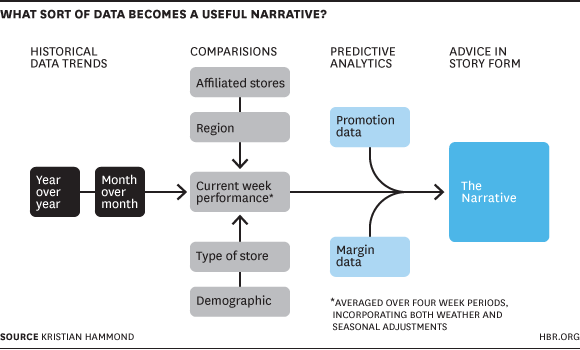
generatingnarrativesortsofdata

It is clear that a new age is upon us. Evidence-based decision-making (aka Big Data) is not just the latest fad, it’s the future of how we are going to guide and grow business. But let’s be very clear: There is a huge distinction to be made between “evidence” and “data.” The former is the end game for understanding where your business has been and where it needs to go. The latter is the instrument that lets us get to that end game. Data itself isn’t the solution. It’s just part of the path to that solution.

The confusion here is understandable. In an effort to move from the Wild West world of shoot-from-the-hip decision making to a more evidence-based model, companies realized that they would need data. As a result, organizations started metering and monitoring every aspect of their businesses. Sales, manufacturing, shipping, costs and whatever else could be captured were all tracked and turned into well-controlled (or not so well-controlled) data.

I would argue that what you want and what you need is to turn that data into a story. A story explains the data rather than just exposing it or displaying it. A narrative that gives you context to today’s numbers by exploring the trends and comparisons that you need in order to make sense of it all. The belief that Artificial Intelligence can support the generation of natural language reporting from data is what drove me to help found our company, Narrative Science. I fundamentally believe that a machine can tackle and succeed at freeing insight from data to provide the last mile in making big data useful, and this belief was the driver in building out a technology platform that makes it real. Read more of this post

Retailers Wage War Against Long Lines; Infrared Vision Helps Kroger Reduce Wait Times to 26 Seconds; Wal-Mart Experiments With Bar-Code Apps

May 1, 2013, 9:33 p.m. ET

Retailers Wage War Against Long Lines

Infrared Vision Helps Kroger Reduce Wait Times to 26 Seconds; Wal-Mart Experiments With Bar-Code Apps

By JULIE JARGON

MK-CC911_KROGER_G_20130501222305

At this Cincinnati Kroger, supervisors monitor a system that says how many lanes need to be open and how many will be needed in 30 minutes.

Supermarket giant Kroger Co. KR -0.52% is winning the war against lengthy checkout lines with a powerful weapon: infrared cameras long used by the military and law-enforcement to track people. These cameras, which detect body heat, sit at the entrances and above cash registers at most of Kroger’s roughly 2,400 stores. Paired with in-house software that determines the number of lanes that need to be open, the technology has reduced the customer’s average wait time to 26 seconds. That compares with an average of four minutes before Kroger began installing the cameras in 2010. “The technology enabled us to execute at the front of the store without that additional (labor) expense,” said Marnette Perry, senior vice president of retail operations for Kroger.”It’s remarkable that we’ve been able to improve execution as much as we have without a big price tag.” Reducing wait times is becoming a top priority for retailers, from high-end department stores to hardware chains to fast-food outlets. Battling both online rivals that offer at-home convenience and intensifying competition among fellow brick-and-mortar outlets, many companies see enhancing the shopping experience as a way to build loyalty. “Since the checkout is the last experience in a store, if it’s a bad experience, you’ll probably see that financially,” says Kurt Kendall, retail strategist with Kurt Salmon, a management consulting firm. “Retailers could speed up their service if they fully staffed their lanes, but they are trying not to staff all their checkout locations. This is the dirty little secret of this.” Read more of this post

Apple to Samsung Develop Smartwatch as Sony’s Time Passes; “Sony was ahead of its rivals to release a watch, but it takes more than an idea to create a hit product”

Apple to Samsung Develop Smartwatch as Sony’s Time Passes: Tech

With growth slowing in the $358 billion handset market, Apple Inc. (AAPL) and Samsung Electronics Co. are developing digital watches that allow users to make calls, check map coordinates, or monitor their physical activity.

They might want to talk to Tokyo-based Sony Corp. (6758), whose feature-laden SmartWatch, on sale for more than a year, isn’t mesmerizing the masses.

Priced at $130, Sony’s 1.3-inch (3.3-centimeter) touchscreen watch wirelessly connects to Android smartphones using Bluetooth technology. The gadget alerts users to calls and allows them to reply to e-mails or texts with an array of pre­written messages. It even connects to Facebook Inc. and Twitter Inc. and controls a wearer’s phone-based music library.

The SmartWatch, about the size of an iPod Nano, is a slightly smaller successor to Sony’s LiveView watch. Introduced in 2010, it had more limited features and was hobbled by kinks. The newer model is more stylish, although users can’t enter messages and it sometimes requires daily recharging and a stable connection to tell time reliably.

“Sony was ahead of its rivals to release a watch, but it takes more than an idea to create a hit product,” said Keita Wakabayashi, a Mito Securities Co. analyst in Tokyo, who rates the shares neutral plus. “It’s about bringing a product that has functionalities that people would want and marketing the product in the right way.” Read more of this post

Tensions in Korea could freeze electronics manufacturing: IHS; South Korea owns half of all DRAM, two-thirds of NAND flash and 70 per cent of tablet display production

Tensions in Korea could freeze electronics manufacturing: IHS

South Korea owns half of all DRAM, two-thirds of NAND flash and 70 per cent of tablet display production.

Adam Bender (Computerworld), 01 May, 2013 10:43

If war comes to the Korean peninsula, there will be “chaos” for the global electronics supply chain, according to an IHS analyst. “Any type of manufacturing disruption of six months would prevent the shipment of hundreds of millions of mobile phones and tens of millions of PCs and media tablets,” warned IHS analyst Mike Howard. IHS views that “such a major conflagration and disruption” is “unlikely,” but said the industry should be prepared for the worst, given escalating tensions in the region.

“South Korea now plays a more important role than ever in the global electronics business,” said Howard. Read more of this post

In Venture Capital Deals, Not Every Founder Will Be a Zuckerberg; dream can be dashed as the venture capitalists make millions in a sale, leaving the founders with nothing

APRIL 30, 2013, 4:52 PM

In Venture Capital Deals, Not Every Founder Will Be a Zuckerberg

By STEVEN M. DAVIDOFF

It’s the dream of entrepreneurs to sell their company for millions of dollars. But the dirty secret of venture capital is that the dream can be dashed as the venture capitalists make millions in a sale, leaving the founders with nothing. A recent Delaware court case arising from the 2011 sale of Bloodhound Technologies illustrates how this happens.

Bloodhound was founded in the mid-1990s by Joseph A. Carsanaro to create fraud-monitoring software for health care claims. After several years of going it alone with a handful of colleagues, Mr. Carsanaro was able to raise Bloodhound’s first venture capital round for $1.9 million in 1999, followed by a second $3.1 million round in 2000. When the Internet bubble burst, the company underwent rocky times. It was then that the venture capitalists seized control. Mr. Carsanaro was pushed out as chief executive. By 2000, he was gone from the company, as were four other members of his founding team.

For the next decade, Bloodhound recovered and slowly grew, raising seven more rounds of financing. In April 2011, the company was sold for $82.5 million. It was a time for Mr. Carsanaro and his founding team to celebrate their millionaire status. But venture capital investments are structured to ensure that the venture capitalists are paid before founders and employees. When venture capitalists invest, they typically demand preferred shares that accrue a yearly dividend of about 8 percent. The dividend goes unpaid until the company is sold. In a sale, the original amount and the interest all come due. It must be paid out before the common shares, which are typically held by the founders and other employees. Read more of this post

Craving Wi-Fi, Preferably Free and Really Fast; “If everybody flushes the toilet at the same time, you wouldn’t want the building to come down. I’m not sure why they wouldn’t design the Internet service the same way.”

April 30, 2013

Craving Wi-Fi, Preferably Free and Really Fast

By SUSAN STELLIN

TRAVELERS hitting the road with their mobile electronic devices have three questions about staying connected away from home: will there be Wi-Fi, how much will it cost and how well will it work? Increasingly, it is that last question that matters most.

Hotels, airports and airlines are struggling to keep up with customers streaming movies on their tablets and hosting online meetings on their laptops, with varying degrees of success. While hoteliers and airport authorities have been fighting the bandwidth battle for years, airlines are still installing Wi-Fi on many aircraft and are already confronting challenges. Travelers who want Wi-Fi in the air cannot always tell if a plane will have Internet service when they book their tickets. Prices for service are still evolving, and the quality of the connection does not come close to matching what most people are used to on the ground. Read more of this post

Electric car maker Coda files for bankruptcy after selling just 100 of its all-electric sedans, another example of battery-powered vehicles’ failure to break into the mass market

Electric car maker Coda files for bankruptcy

3:18am EDT

By Nichola Groom

May 1 – Green car startup Coda Holdings Inc filed for Chapter 11 bankruptcy protection on Wednesday after selling just 100 of its all-electric sedans, another example of battery-powered vehicles’ failure to break into the mass market. The filing with U.S. Bankruptcy Court in Delaware will allow the Los Angeles company to exit the auto sector and refocus on energy storage, a far less capital-intensive business. The company uses the same technology it used in cars to build systems for utilities and building operators to store power. Read more of this post

How eBay CEO John Donahoe Keeps Founders From Leaving After Acquisitions; “We need to create a culture where they can realize their visions”

How eBay CEO John Donahoe Keeps Founders From Leaving After Acquisitions

FREDERIC LARDINOIS

posted 2 hours ago

At TechCrunch Disrupt 2013 NY, eBay’s CEO John Donahoe talked to Bloomberg’s chief content editor Norm Pearlstine about how the company screens its acquisitions and how he keeps founders from leaving after the acquisition. Since becoming eBay’s CEO, Donahoe said, the company has made about 20 acquisitions. Currently, fifteen of the founders that joined eBay and PayPal after their companies were acquired are still at eBay and most of them are in executive positions. After the company acquired Zong in 2011, for example, Zong’s founder David Marcus became PayPal’s vice president for mobile. After essentially getting tested in that position, he became the President of PayPal last year. Similarly, when eBay acquired Hunch (also in 2011), its team of co-founders, including Chris Dixon, Tom Pinckney and Matt Gattis joined the company (with Dixon leaving after about a year). Today, this team is in charge of eBay’s homepage. Donahoe believes that in order to keep founders from leaving, eBay needs to give them the opportunity to grow inside the company. Because of this, he is also most interested in acquiring companies where the management team believes that they can execute their vision inside eBay. “We are always looking for companies that have a strong vision,” Donahoe said. “And then we allow them to innovate at a higher level.” The kind of founders he likes, he said, are “founders come to us and say we founded our company to do x and would like to take it to the next level.”

In his view, this strategy has been a key ingredient to eBay’s and PayPal’s success. Acquisitions, in his view, drive innovation inside a large company like eBay and bringing in founders as executives – and giving them monetary incentives to stay as well, of course – is a key part of this strategy. As for the details of these incentives, Donahoe noted that “most of the founders make money in the acquisition In some cases the acquisition price is tied to staying for a two-three year period. But yes – we provide incentives to stay. We provide good compensation, but at the end of the day, we need to create a culture where they can realize their visions.” He does, for example, regularly meet with founders to discuss the state of the company. These discussions have, for example, lead to the redesign of the eBay’s homepage. It’s that kind of impact, he believes, that keeps founders at eBay.

Technology Start-Ups Take Root in Berlin

APRIL 29, 2013, 9:06 PM

Technology Start-Ups Take Root in Berlin

By MARK SCOTT

BERLIN — Near the Rosenthaler Platz subway station here, signs of the city’s high-tech future blend seamlessly with its communist past. Decrepit breweries and stables have been converted to communal offices decked out in colorful Ikea furniture. Achingly cool coffee shops with names like Betahaus and St. Oberholz are packed with programmers in their 20s and 30s hunched over shiny new laptops. And even as the city’s unemployment broadly remains high, vintage clothing stores selling patent-leather Dr. Martens boots for 180 euros, or $235, entice technology transplants from across Europe with promotions in English. “I got sucked into Berlin,” said Henrik Berggren, a Swedish college dropout who moved here in 2011 to work on his e-book venture, ReadMill. “It became clear that this was the place to be.”

More than two decades after the fall of the Berlin Wall, the German capital has gone from a cold war relic to one of the fastest-growing start-up communities. Engineers and designers have flooded into Berlin in recent years, attracted by the underground music scene, cutting-edge art galleries, stylish bars and low rent. Read more of this post

How LinkedIn Saved Its Engineers From Marathon Late-Night Coding Sessions

How LinkedIn Saved Its Engineers From Marathon Late-Night Coding Sessions

Max Nisen | Apr. 29, 2013, 8:11 PM | 3,462 | 12

LinkedIn is a favored company among tech investors. It had a massive IPO, lived up to expectations afterwards, and continues to impress with the amount and variety of its revenue sources. That doesn’t mean there haven’t been some bumps along the way. Bloomberg Businessweek’s Ashlee Vance writes that as the company grew, “when LinkedIn would try to add a bunch of new things at once, the site would crumble into a broken mess, requiring engineers to work long into the night and fix the problems.”

Late nights are a part of Silicon Valley’s culture, they’re a right of passage and a bonding activity, but by the fall of 2011, the infrastructure problems were intolerable. So some of LinkedIn’s top engineers decided to completely stop engineering work on new features and dedicate the whole department to fixing the site’s core infrastructure. They called the effort “Project Inversion.”  It took about two whole months. But they ended up with something that was also much more efficient. Now algorithms do much of the review work humans had to do in the past, and new features can be added directly into the site. All of the company’s code is centralized and everyone can work on it continuously. There are fewer late night cram sessions and there’s more time to develop new and innovative features.  Read more of this post

Online Ads Can Now Follow You Home

April 29, 2013, 8:06 p.m. ET

Online Ads Can Now Follow You Home

Firms Are Helping Brands Like Expedia Serve Ads to Users Across PCs and Mobile Devices

By SPENCER E. ANTE

Advertisers already know what people are up to on their personal computers. But understanding their online whereabouts on smartphones or tablets has remained elusive. A number of companies are trying to better pinpoint mobile users’ online activity with new software and techniques they say could help advertisers track users across devices. By harvesting cross-screen identities, the ad industry could serve ads to mobile phones based on the interests people express when surfing the Web on their PCs. “Every retailer is trying to figure out cross-platform activities,” said Jeff Warren, vice president of mobile and online partner marketing at online travel company Expedia Inc.EXPE -4.27%

MK-CC833_mobile_G_20130429180034 Read more of this post

Iris Scans Seen Shrinking $7 Billion Medical Data Breach

Iris Scans Seen Shrinking $7 Billion Medical Data Breach

Iris scanners aren’t just for airport border-control agents and spy movies anymore.

Clinics and hospitals around the world are acquiring technology that identifies people based on physical traits to improve patient safety and stamp out fraud. HCA Holdings Inc. (HCA) hospitals in London, as well as health-care providers across the U.S., are buying so-called biometric technologies.

Biometrics makers, such as Safran SA (SAF), Fujitsu Ltd. (6702) and closely held AOptix Technologies Inc. and M2Sys Technology, say demand from health-care providers is growing. While ensuring the right person gets the right treatment is the main reason for buying biometrics, hospitals and patients see another benefit: reducing the risk of data breaches that can lead to identity theft.

“It’s a form of health-care fraud,” said Pam Dixon, executive director of the World Privacy Forum, a San Diego-based nonprofit research organization. “You can make a lot of money very quickly as a criminal with a low probability of getting caught. It’s a far easier crime to commit than robbing a bank.”

Identify theft is leaving hospitals with unpaid bills and consumers on the hook for costly treatment they didn’t receive. Data breaches, which include lost and stolen information, may cost the health-care industry in the U.S. as much as $7 billion a year, according to a survey conducted by the Ponemon Institute, a Traverse City, Michigan-based organization that studies privacy, data protection and security. Read more of this post