How smaller rivals beat Wipro and Infosys and turned India’s IT sector upside down

How smaller rivals beat Wipro and Infosys and turned India’s IT sector upside down

By Nandagopal Jayakumar Nair April 23, 2013

Nandagopal Jayakumar Nair is a Knight-Bagehot fellow in economics and business journalism at Columbia University in New York. He previously worked for CNBC-TV18 in India.

The players in India’s $108 billion information-technology industry are realigning. Finally.

While pioneers like Infosys and Wipro have been caught wrong footed, agile rivals are banking on aggression and vision to grow their businesses.

Today, shares of India’s third largest software provider Wipro fell more than 8% as the management said revenue would grow 1.3%, at best, in the next quarter. Earlier in April, India’s second largest software exporter Infosys lost more than a fifth of its value in a single trading session after it gave a disappointing annual revenue growth forecast of 6-10%. While Wipro is optimistic about a turnaround later in the year, Infosys admitted that the tough macroeconomic conditions would hamper the company’s performance. “There is uncertainty all around us. I don’t believe that this is something we can wish away,” said Infosys CEO SD Shibulal.

But how then to explain Tata Consultancy Services? TCS, as it is better known, is decidedly bullish on its near future. India’s largest software exporter is confident of beating IT industry body Nasscom’s estimate of 12-14% revenue growth for 2013-14.  “The global economic environment is providing us with many new opportunities,” said CEO N Chandrasekaran. “We are going to have a better year this year.” Read more of this post

Infosys’s boss blames the economy but the source of its troubles is internal

Infosys’s boss blames the economy but the source of its troubles is internal

Apr 20th 2013 | MUMBAI |From the print edition

THERE was something humiliating about the latest results from Infosys, long an icon of India’s technology-outsourcing industry. On April 12th it released weak figures and said that it expected sales in the year to March 2014 to grow by 6-10%, far below the level number-crunchers had hoped for. To blame, it said, was an uncertain global economy. If true, that should have hurt all firms in the industry, but investors were having none of it. Infosys’s shares fell by 21% on the day, whereas those of its main competitors were largely stable. Lo and behold, five days later, TCS, Infosys’s main Indian rival, announced yet another sparkling set of results and said all was rosy in the world.

For Infosys’s chief executive, S.D. Shibulal (pictured), it must have been a painful moment. He is the fourth, and almost certainly the last, of the company’s founders to serve as boss, having finally got the top spot in 2011, three decades after Infosys was started in a flat. Inevitably there have been whispers that he is not up to the task and that letting the firm’s creators take turns ascending to the throne has proved disastrous. That is an overstatement. Infosys has been trounced by TCS, but over the past year its shares have underperformed India’s broader IT sector by a more modest 13%. Still, the firm clearly has problems.

One is its inability to give reliable guidance on its performance. Some 90 days before this most recent announcement Mr Shibulal said he was “cautiously optimistic” about the coming quarter. It now seems clear the firm was winging it, relying to an uncomfortable degree on new business still to be won and on squeezing more from existing contracts. Rajiv Bansal, the chief financial officer, admitted there had been “confusion”. Read more of this post

Big tech is struggling with old age; Some of the world’s most well-known and powerful tech titans – IBM, Microsoft, Intel – are marked by trying to manage declining aspects of their businesses

Big tech is struggling with old age

April 23, 2013: 6:51 AM ET

Some of the world’s most well-known and powerful tech titans — IBM, Microsoft, Intel — are marked by trying to manage declining aspects of their businesses.

By Kevin Kelleher, contributor

FORTUNE — At its heart, the tech industry is about the new. Today, tech giants succeeded because of what was new yesterday. The flip side is that the new ages into the old more quickly in tech than in most other industries. And so companies that dominated tech even a decade ago can appear to be aging quickly. Such is the picture of the tech industry after a week of earnings reports that saw giants like Intel (INTC), Microsoft (MSFT), and IBM (IBM) discuss their financials in the first quarter of 2013. While the individual results and subsequent reactions among investors varied, one thread ran through all three: Each is struggling to manage older businesses in decline even as they push into promising new areas like cloud computing.

The most dramatic example was IBM, which has seen its stock decline 9.3% since it reported first-quarter earnings last week. IBM, a 101-year-old company, sold its PC business in 2004 in an effort to move into higher-margin software and IT services businesses. Its growth since then has made the stock a favorite among tech investors. Even so, IBM is still struggling with aging businesses. Revenue at the company fell 5% last quarter from the same quarter a year earlier to $23.4 billion, below analyst forecasts. Much of the disappointment centered around hardware, including servers based on x86 architecture that, like PCs, have become low-margin commodities. Some reports suggested IBM may sell its x86 server business to Lenovo (LNVGY), the company that bought its PC business years ago. Read more of this post

Can Google stop the drop in mobile advertising prices?

Can Google stop the drop in mobile advertising prices?

By JP Mangalindan, Writer April 23, 2013: 6:34 AM ET

Google’s latest quarterly earnings raise concerns about its mobile ad efforts. But things may turn out just fine for the tech giant. More than fine, in fact.

FORTUNE – For Google, the money has always been in advertising.

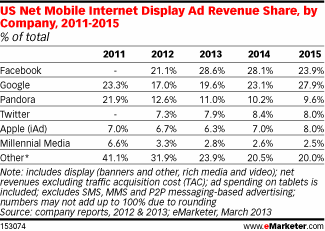
Propelled by products like AdWords, advertising generated $43.7 billion in sales last year — a whopping 95% of Google’s (GOOG) overall revenue. Its continually lucrative ad business has allowed Google to use its cash for other less-profitable ventures: Android, self-driving cars, Glass among many others. But like most of tech, Google has been challenged by the transition from desktop to mobile computing — and how to make money from users browsing the web on smartphones and tablets. One thing is for certain: The mobile market cannot be ignored. In the U.S. alone, mobile ad spending is expected to more than double from $7 billion this year to $16 billion in 2015. JMP Securities analyst Ron Josey recently estimated that mobile ads now account for 14% of Google’s overall ad sales. An important metric for Google tied to ads is called “cost-per-click.” It measures the average amount advertisers pay Google each time a user clicks on an ad. Last quarter, the company announced it would reduce the number of ads on its mobile search page to preserve the user experience and predicted a higher cost-per-click. The latter didn’t happen. Instead, Google’s cost-per-click fell 4% compared with the same time last year and marked the sixth consecutive quarterly decline. In truth, mobile ads still command lower prices than desktop ads do, the argument being that people remain less likely to click ads on their phones or tablets than desktops. (What’s more, many users may be clicking on them accidentally.) “The saying goes that ad dollars follow eyeballs, but that’s not entirely the case,” explains Clark Frederickson, vice president of New York-based digital market research firm eMarketer. Companies may be quick to tout growing mobile sales, but at the end of the day, just over 10% of e-commerce occurs on mobile. And until mobile phones and tablets become just as much a buying device as they are say, a consumption device, Frederickson says many advertisers will continue to focus their ad dollars on the desktop for the time being — even if the desktop’s days appear numbered.

154522153074 Read more of this post

Sirgoo Lee, CEO of Kakao Corporation, shared what made KakaoTalk a hit messaging platform in Korea and its rapid expansion

The Kakao story: Rising from the ashes of failure and being lean

BY JOASH WEE | APR 22, 2013 | ASIA

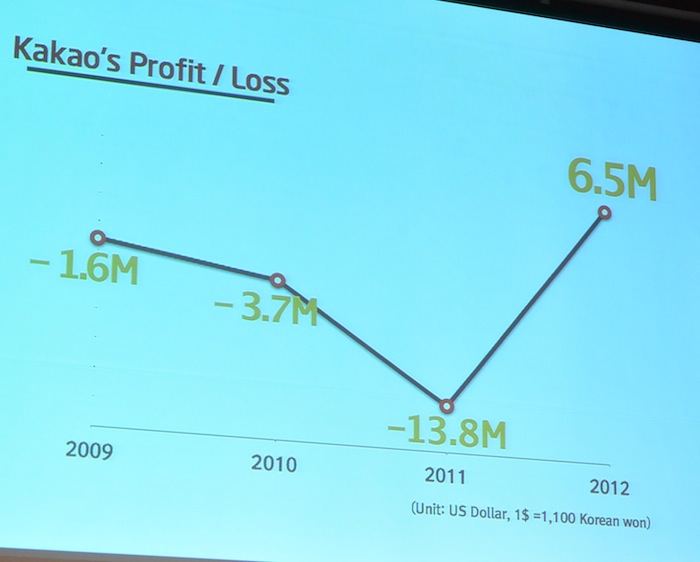
Sirgoo Lee, CEO of Kakao Corporation, shared what made KakaoTalk a hit messaging platform in Korea and its rapid expansion. Born from two failures, KakaoTalk was created by Brian Kim and his founding team as their “killer application.” Having built two web applications that have failed, Buru.com (social bookmarking serice, 2009) and Wisia.com (social ranking service, 2008), the appearance of the smartphone came at the right time for the company, then named iWILAB, to revive its efforts in the application space. According to CEO Sirgoo Lee, the team threw away all the code for the web service and decided to do something called “application service.” With just four people, KakaoTalk was created in two months. Sirgoo shared that they have since tried to keep to the “4 by 2” spirit where they aim to create something with the least amount of resources in the shortest amount of time. The reason was, when they were building web services, the team focused on creating products that had no flaws, and that is why they failed. KakaoTalk taught them to release products as quickly as possible and to continuously improve the product. KakaoTalk currently has 86 million registered users, with 70 percent of them in Korea, 29 million daily users and send 4.8 billion messages daily. In 2012, the company reported revenues of US$42 million and had its first profitable year in six years, pulling in US$6.5 million in profits.

Kakao-Revenu-BreakdownKakao-Users

Kakao-RevenuKakao-Profit Read more of this post

South Koreans, who lunch religiously between midday and 1 p.m., can now get an extra treat through a smartphone app that promises to help singles find their one true love; The app now has 800,000 subscribers

“Catch of the day” for Korea’s hungry singles with popular app

2:05am EDT

By Narae Kim

SEOUL (Reuters) – South Koreans, who lunch religiously between midday and 1 p.m., can now get an extra treat through a smartphone app that promises to help singles find their one true love. In a country with the longest working hours among rich industrialised nations, and where 8 million of its 50 million people are thought to be single, the i-um app, which means “to connect”, offers detailed profiles and photographs to help match up busy singles. Subscribers register and submit photographs and personal information. Then at exactly 12:30 p.m. each day they receive a message through a stylised “lunchbox” showing the match of the day – and if both parties click “okay”, they receive the other’s name and phone number. “At 12:30 p.m., the hour and the minute hand make a straight line. That means that both the man and the woman we connect can become one,” said Park Hee-eun, who founded the company that developed the app in 2011. The app now has 800,000 subscribers and Park says that so far, 56 people have successfully found mates. “App dating was my last-ditch effort, (I was) grabbing at straws,” said Lee Ji-sun, a 33-year-old businesswoman who last month married the man she met through the app.

Chinese in Earthquake Zone Flock to Tencent’s WeChat as Calls Fail

Chinese in Earthquake Zone Flock to WeChat as Calls Fail

Chinese in the earthquake-hit province of Sichuan resorted to instant-messaging apps including WeChat to communicate with family and friends, as overloaded voice networks prevented calls from connecting.

Yu Yuli posted a note telling friends she was safe on Tencent Holdings Ltd. (700)’s WeChat, China’s most popular instant- messaging app, after futile attempts to make calls. The quake, measured at magnitude 6.6 by the U.S. Geological Survey, killed at least 193 people and injured more than 12,000, according to the official Xinhua News Agency.

“I was really surprised to see that I was still getting messages on WeChat,” said Yu, 49, a manager at a logistics company in Chengdu, the provincial capital of Sichuan. “I was able to get in touch with friends in a very short time, so I panicked less.”

Apps from Internet companies including Tencent and Sina Corp. (SINA) have become an important tool for Chinese to locate relatives and help rescue efforts in natural disasters. Government agencies have also recognized their merit. After the April 20 quake, the Chengdu government posted a message on Sina’s Weibo, a Twitter-like service, urging people to cut down on phone calls and use WeChat, Weibo or text messages to save resources for rescue operations.

One of the first Weibo comments from the China International Search and Rescue Team, asking for first-hand accounts of damage, was reposted nearly 480,000 times as of yesterday afternoon. Read more of this post

An insider’s warning for the tech industry; Silicon Valley is being warned that it is making the same mistake as bankers

April 22, 2013 4:43 pm

An insider’s warning for the tech industry

By Ravi Mattu

Ten minutes into our conversation, Jaron Lanier has a problem. In the echoey restaurant where we are meeting, the sound of the one other diner is unnerving this pioneer of the internet world. “This space might not work . . . .” he says. “Sometimes I have trouble talking when it’s this loud.”

That Mr Lanier, a bear of a man with long dreadlocks and a scraggly beard, finds it difficult to make his voice heard in an almost empty space is surprising. In recent years the computer scientist has spent a lot of time publicly raising awkward questions of his peers and the internet-connected business world they – and he – created.

In the 1980s, Mr Lanier helped come up with the technology behind virtual reality and is often credited with coining the term. He is a serial entrepreneur and since 2006 has had a role at Microsoft Research (he does not speak on the company’s behalf). Read more of this post

Large Companies ‘Slow to Use Weibo to Respond to Bad News’

04.22.2013 18:24

Large Companies ‘Slow to Use Weibo to Respond to Bad News’

Report says central government-controlled firms are not as good as officials in responding to negative reports

By staff reporter Zhang Fan

(Beijing) – Central government-controlled companies are slow to use social media to respond to negative news, a report by an online public opinion monitoring organization says.

The report by the Peoples’ Daily Online Public Opinion Monitoring Center said ministries, commissions and local governments were more likely to use weibo, China’s version of Twitter, to interact with the public.

The businesses also seldom used spokesmen to address bad news, the report said. Read more of this post

Google Predicts Australia Tech Boom; Technology startups could contribute nearly as much to the economy as the retail and education sectors in two decades’ time

April 22, 2013, 8:32 PM

Google Predicts Australia Tech Boom

By Caroline Henshaw

Technology startups in Australia could contribute nearly as much to the economy as the retail and education sectors in two decades’ time, according to Google Inc. GOOG +0.03%

Google’s study, co-authored by PricewaterhouseCoopers, predicts Australia’s technology entrepreneurs could contribute up to 109 billion Australian dollars (US$112 billion) a year to the economy and directly employ 540,000 people by 2033.

If achieved, that would mean tech startups would make up 4% of Australia’s GDP. That’s almost on par with education and training, Australia’s third-largest exporting sector accounting for 4.2% of the economy, according to government statistics. Retail and trade contribute 4.4% of GDP. Read more of this post

How Twitter is becoming your first source of investment news

How Twitter is becoming your first source of investment news

By Barry Ritholtz, Published: April 20

On Monday afternoon at 2:56 p.m., three hours after the fastest runner of the Boston Marathon crossed the finish line, my Twitter feed lit up. Someone in the office yelled “Two explosions at the Boston Marathon, may be terrorism.” Within seconds, there were first hand reports, photos and even video circulating.

Not on CNN or Reuters or the Associated Press. On Twitter.

There was no other news reports for what seemed like a very long time. Nothing on Google News. Nothing else on the Web. It felt like a full 15 minutes before CNN reported it on cable (NPR seemed to have some early radio coverage). But in the 10 minutes after, Twitter had the only firsthand accounts of the tragedy in real time.

A quick intro: Twitter is a social-networking site where users share short texts limited to 140 characters (the cell phone text limit in the pre-smartphone days). There are now more than 200 million active users who crank out 400 million Tweets a day.

Twitter has become the “new” news wires. It has supplanted AP, Dow Jones and Bloomberg for breaking news. Even the Boston police confirmed “at least 22 injured, two dead” — by Tweeting it at 4:05 p.m. Read more of this post

How These Public School Teachers Made $4.4 Million Selling Lesson Plans Online

How These Public School Teachers Made $4.4 Million Selling Lesson Plans Online

Megan Rose Dickey | Apr. 19, 2013, 9:13 PM | 30,041 | 33

972

Teaching is by no means a very financially rewarding profession. Even though teachers are doing one of the most important jobs in society, full-time public school teachers make a mere $56,069 per year on average. That’s where Teachers Pay Teachers comes in. The online marketplace for course materials and lesson plans has attracted 1.8 million teachers, whom have collectively sold more $30 million worth of materials online. The top 10 sellers on the platform have generated more than $5 million in sales, netting around $4.4 million in total. Deanna Jump, pictured above, currently earns more than $80,000 a month. Teachers Pay Teachers features course materials for grades ranging from preschool to the collegiate level. But Teachers Pay Teachers Head of Product John Yoo says they have seen the strongest interest in the K-12 sector. On the high school level, Yoo says Tracee Orman’s material on how to integrate “The Hunger Games” into the classroom has been widely popular. “She’s not only become seen as the expert in using the Hunger Games in the classroom,” Yoo says. “She’s done what I think all good teachers do, which is marry the things that kids are interested in and turn it into really good curriculum. You know, use what they’re interested in to draw them into the classroom.” Yoo notes that not all teachers have found the same success as the top 10 sellers. In order to be successful on the platform, Yoo says they encourage teachers to leverage social media to get their name out there. “Teachers by nature need to share with each other,” Yoo says. “That’s part of what it means to be on the job. […] Whether you’re experiences or new, you need to figure out how to teach things in ways that resonate with kids.” Business Insider got in touch with many of Teachers Pay Teachers’s most successful teachers to learn more about their experiences. Read more of this post

Marc Andreessen: The World Would Be Much Better If We Had 50 More Silicon Valleys

Marc Andreessen: The World Would Be Much Better If We Had 50 More Silicon Valleys

BILLY GALLAGHER

posted 4 hours ago

Marc Andreessen, co-founder and general partner of Andreessen Horowitz, delivered a keynote speech at the she++ conference today, sharing what technology is exciting him right now, what he thinks about current startup culture, and how Sheryl Sandberg’s book, Lean In, affected his view of Silicon Valley. Andreessen described Google Glass as “potentially transformative for the entire industry. ” “You put it on and you’re like ‘Oh my God, I have the entire internet in my vision. Where have you been all my life?,’” he said. “I like to tell people that I’m beta testing the new Google Contact Lenses,” he joked to moderator Ruchi Sanghvi, VP of operations at Dropbox. He added that Facebook and Google are taking search in very different directions and opined “There’s a lot more to be done with search.” “New Facebook Graph Search capability I think is one of the coolest things I’ve ever seen…It makes me wish a little bit that I was single again,” he said to laughter. Andreessen said he switches phones every six months (between Android and iPhone) and he’ll get Facebook Home next week. Sanghvi turned the discussion to Sheryl Sandberg’s new book, Lean In. “Before Sheryl’s book, for 20 years, the answer has been, ‘Be gender blind,’” Andreessen said. “’Be gender blind.’ It’s not important; in fact, it’s not to be discussed. It certainly should not be brought into the hiring criteria and certainly should not influence how people manage. And basically have a straight meritocracy and ignore gender. Sheryl has provided a very, very provocative set of arguments that 1) That’s not actually working and 2) That managers, both female and male, actually have to take gender on squarely.” “We’ll have to completely retrain managers and executives of all kinds to be able to do this,” he continued. “[Sandberg] argues very persuasively that it’s necessary, but it’s like landmine central with the way employment law works these days.” “I think her book has been a wake up call that the current approach to solving the problem of gender imbalance— number one it’s not working, which is fairly obvious, and number two, it requires a rethink of basic communication and basic management. I think it’s a very good thing to be talking about this and debating this. I think that it’s going to take quite a while,” he said. “Startups as a general category are probably highly overrated,” he said, responding to Sanghvi’s question about Stanford students graduating and deciding between starting companies and finding jobs.

“Basically its an irrational act,” he said, explaining the right reason for starting a company. “This idea was so powerful and compelling that if I didn’t do it I’d hate myself for the rest of my life.” “I think that’s the part that’s getting lost,” he continued. “I think the cult of startups, and of course Stanford’s ground zero for this…Those startups are miserable experiences.” Andreessen argued that far too many entrepreneurs have an “incredible blind spot” to distribution, sales, and marketing in Silicon Valley right now, and shared his thoughts on immigration and innovation. Read more of this post

Specialists See Tools to Treat Pain in Video Games

April 20, 2013

Specialists See Tools to Treat Pain in Video Games

By ASHLEY SOUTHALL

therapy-1-articleLarge

Danica Zimmerman, 14, playing a game to measure her range of motion and pain triggers at Children’s National Medical Center.

WASHINGTON — Fifteen-year-old Reilly woke up one morning with a sharp, stabbing pain in his left leg that soon spread to other parts of his body. The pain, which started early last year, forced him to quit soccer, and he spent the next four months being poked, prodded and scanned by doctors.

The test results were inconclusive. “No one could tell him why he was in a ball on the floor unable to function,” said Nina, his mother, who agreed to be interviewed only on the condition that the family’s surname be withheld.

Finally, last June, Dr. Sarah Rebstock, a pediatric anesthesiologist at Children’s National Medical Center, gave Reilly a diagnosis of chronic regional pain syndrome. The nerve disorder is characterized by chronic and severe burning pain, pathological changes in bone and skin, excessive sweating, tissue swelling and extreme sensitivity to touch.

Recently, Reilly stood in a half-lighted room of the hospital’s new Pain Medicine Care Complex, playing a video game called TubeRunner as part of his physical therapy routine.

The sight of the teenager reaching in the air and shuffling from side to side as his on-screen avatar hurled down an intergalactic tube racking up rings and gems seemed unremarkable. After all, game consoles like Microsoft’s Xbox and Nintendo’s Wii have become ubiquitous in American households, and many hospitals and clinics use them to add an element of fun to physical therapy.

But TubeRunner is one of four of galaxy-themed video games created specifically for this complex, where pain specialists and game developers are piloting an approach to measuring pain. Dr. Julia Finkel hopes that using technical data from games and interactive activities to objectively identify and monitor pain can help determine how to evaluate the techniques used to treat it. Read more of this post

Companies are using Big Data analysis to help find and nurture successful employees

April 20, 2013

Big Data, Trying to Build Better Workers

By STEVE LOHR

BOSSES, as it turns out, really do matter — perhaps far more than even they realize.

In telephone call centers, for example, where hourly workers handle a steady stream of calls under demanding conditions, the communication skills and personal warmth of an employee’s supervisor are often crucial in determining the employee’s tenure and performance. In fact, recent research shows that the quality of the supervisor may be more important than the experience and individual attributes of the workers themselves.

New research calls into question other beliefs. Employers often avoid hiring candidates with a history of job-hopping or those who have been unemployed for a while. The past is prologue, companies assume. There’s one problem, though: the data show that it isn’t so. An applicant’s work history is not a good predictor of future results.

These are some of the startling findings of an emerging field called work-force science. It adds a large dose of data analysis, a k a Big Data, to the field of human resource management, which has traditionally relied heavily on gut feel and established practice to guide hiring, promotion and career planning.

Work-force science, in short, is what happens when Big Data meets H.R. Read more of this post

The Trade in the Tools of Tech Tyranny; Repressive governments around the world have been getting some help from Western technology

April 19, 2013, 8:02 p.m. ET

The Trade in the Tools of Tech Tyranny

By CHRISTOPHER RHOADS

Repressive governments around the world have been getting some help from Western technology.

Filtering devices built by Blue Coat Systems, an Internet-security company in Sunnyvale, Calif., have been used by the Syrian government to try to suppress the civil unrest engulfing the country. The company has acknowledged this happening but says it never sold the product to the Syrian government.

Amesys, a unit of French technology company BullBULL.FR +1.76% provided the Internet surveillance system deployed by Gadhafi’s regime to harass local journalists and dissidents before the Libyan government was overthrown in 2011. (The system’s workings were detailed in a 2011 series on censorship by the Journal.) In February of this year, a French judge refused to dismiss claims filed by human-rights groups that Amesys served as an accomplice to torture by selling its wares to Libya. Read more of this post

Eric Schmidt: The Dark Side of the Digital Revolution; Google’s Eric Schmidt and Jared Cohen, fresh from a visit to North Korea in January, on why the Internet is far from an unalloyed good to the citizens of dictatorships around the world

Updated April 19, 2013, 2:59 p.m. ET

The Dark Side of the Digital Revolution

Google’s Eric Schmidt and Jared Cohen, fresh from a visit to North Korea in January, on why the Internet is far from an unalloyed good to the citizens of dictatorships around the world.

By ERIC SCHMIDT and JARED COHEN

Google Chairman Eric Schmidt and Jared Cohen, director of Google Ideas, talk with WSJ’s John Bussey about what they hoped to accomplish from a visit to North Korea, and their observations about the country’s technological potential and its likelihood of embracing the Internet. Photo: Getty Images

How do you explain to people that they are a YouTube sensation, when they have never heard of YouTube or the Internet? That’s a question we faced during our January visit to North Korea, when we attempted to engage with the Pyongyang traffic police. You may have seen videos on the Web of the capital city’s “traffic cops,” whose ballerina-like street rituals, featured in government propaganda videos, have made them famous online. The men and women themselves, however—like most North Koreans—have never seen a Web page, used a desktop computer, or held a tablet or smartphone. They have never even heard of Google GOOG +4.43% (or Bing, for that matter). Read more of this post

Britain is doing more of its shopping online and not just because it’s been freezing

Britain is doing more of its shopping online and not just because it’s been freezing

By Leo Mirani @lmirani April 18, 2013

ASOS internet-sales-as-a-percentage-of-total-uk-retail-sales_chart

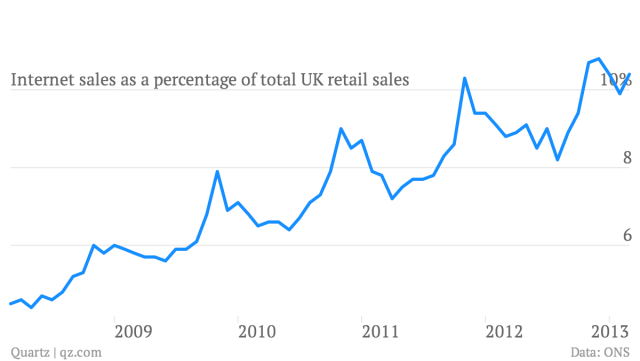
The weather gets blamed for an awful lot of depressing economic data in Britain. If it isn’t the Chancellor of the Exchequer blaming the snow, it is the venerable Office for National Statistics blaming the cold. According to the latest ONS retail sales report (pdf), “March 2013 was the second coldest on record, and this appears to have had a negative effect on sales in the non-food sector.” Retail spending dropped 0.7% from the previous month and 0.5% from the previous year, in terms of volume. Spending in terms of value was more-or-less flat. Now, admittedly, March was an astonishingly cold month in the United Kingdom, with freezing temperatures lasting well into the first week of April. Regardless, the numbers do not bode well for the UK’s economic recovery. And things look even worse if spending on automotive fuel is removed from the equation.

But the weather may also have been good for some retailers. Sales on the internet made up more than a tenth of total sales in March, a surprisingly high proportion for this time of year. Online spending tends to spike in November and remain high in December, when people to shop for Christmas but don’t want to get trampled underfoot on the high street. Shopping in general dips in the first few months of the new year, as people recover from the party season. Internet sales typically trail off as the weather gets better and people venture back outdoors. Read more of this post

Putin’s friends now own 88% of Russia’s Facebook

Putin’s friends now own 88% of Russia’s Facebook

By Simone Foxman and Gideon Lichfield 9 hours ago

Censorship or investor war? That’s a subject of debate in Russia, after a fund managed by a Russian businessman with close ties to the Kremlin acquired 48% of the country’s largest social-networking site, V Kontakte (“in touch”), which is similar to Facebook.

On Wednesday, two of the founding investors in V Kontakte sold their shares to investment fund United Capital Partners. UCP is headed by Ilya Shcherbovich, a board member at the state-owned oil giant Rosneft, which makes him an ally of Russian president Vladimir Putin.

The remaining 52% of the company is controlled Pavel Durov, the 28-year-old founder of V Kontakte. Durov actually owns only 12% of V Kontakte’s shares, but last year, online firm Mail.ru handed him control of its 40% stake of the company’s shares. Mail.ru is controlled by Alisher Usmanov, another Kremlin buddy and Russia’s richest man. It’s unclear if this agreement between Mail.ru and Durov can be reversed, though Durov says his control of the stake doesn’t expire (link in Russian). Read more of this post

SAP Software Sales Miss Estimates on Lower Demand in Asia

SAP Software Sales Miss Estimates on Lower Demand in Asia

SAP AG (SAP), the largest maker of business-management software, reported first-quarter software sales that trailed analysts’ estimates after the company failed to close contracts in the Asia-Pacific region.

Sales of new software licenses, an indicator of future revenue, rose 3 percent to 657 million euros ($859 million), Walldorf, Germany-based SAP said today. That was slower than the 9 percent growth in the previous quarter and fell short of the 726 million-euro median of estimates compiled by Bloomberg.

Operating profit adjusted for some items rose 8 percent to 901 million euros, also missing estimates. SAP joins other software makers in reporting slowing traditional license sales. Oracle Corp. on March 20 reported revenue and profit that fell short of analysts’ estimates as demand for Web-based programs hurt sales of its hardware and on-premise software. Read more of this post

How Apple’s Decision To Collect 30% Of Every iOS App Sale Could Lead To Its Downfall; OpenTable collects 1.9% of money that flows through its reservation system. eBay collects 9.9% of the revenue that flows through its site

How Apple’s Decision To Collect 30% Of Every iOS App Sale Could Lead To Its Downfall

Jay Yarow | Apr. 18, 2013, 2:45 PM | 4,419 | 13

Apple‘s decision to collect a 30% tax on every digital item sold through the App Store may lead to its undoing, according to venture capitalist Bill Gurley.

It’s an extreme, hyperbolic statement. But before you dismiss it out of hand, Gurley makes a decent point which we’ve never considered before.

In short: Apple’s 30% fee was just high enough to scare off peers who could have made iOS better. Instead, they’re working through Android to build products that undermine Apple’s core business.

Gurley did a big analysis of the “rake” e-commerce companies charge. The rake is the fee a company charges. So, OpenTable collects 1.9% of money that flows through its reservation system. eBay collects 9.9% of the revenue that flows through its site. And so on.

Apple’s rake is 30% in the App Store. If a developer sells an app for $1, Apple takes $0.30, the developer gets $0.70. Or, if a developer sells a digital good inside the app for $1, Apple takes $0.30. Read more of this post

Tech’s Rust Belt Takes Shape: Technology has long distributed its riches unequally. But the sector has seldom seemed so sharply divided between disrupters and the disrupted

Updated April 18, 2013, 8:03 p.m. ET

Tech’s Rust Belt Takes Shape

By DON CLARK and SHIRA OVIDE

MK-CC544A_TECHE_NS_20130418183603MK-CC543_MSOFT__NS_20130418182704

Technology has long distributed its riches unequally. But the sector has seldom seemed so sharply divided between disrupters and the disrupted. Computing pioneer International Business Machines Corp. IBM -1.20% on Thursday reported its revenue dropped 5% after failing to close big software and hardware deals. IBM is also in advanced talks to sell part of its server system business to Lenovo Group Ltd., 0992.HK +4.81% according to people familiar with the matter, the same company that bought IBM’s personal-computer business in 2005. Software giant Microsoft Corp.,MSFT -0.12% once known for rapid sales of PC software, reported that the business that includes its Windows operating system turned in essentially zero growth after one-time effects of software revenue deferrals. By contrast, Internet innovator Google Inc. GOOG -2.13% said Thursday revenue grew 31% in the first quarter, while profit rose 16%.

The growth disparities are just the latest repercussions of technology shifts—including the rise of mobile devices and slowing growth in personal computers, the replacement of conventional software with online versions and outsourcing corporate internal computing operations to facilities run by other companies. Tech’s turmoil bears similarities to the way old-line industrial companies in America’s Rust Belt lost sales to rivals in Asia and other regions. But the disrupters this time are mainly domestic and born since the Internet revolution took hold in the mid-1990s, often offering free or low-cost alternatives to widely used products. Read more of this post

Struggling Indian e-commerce pioneer MakeMyTrip pins its hopes on an influx of cheap smartphones

India’s MakeMyTrip Hopes for a Revival via Smartphones

By Bruce Einhorn and Kartikay Mehrotra on April 18, 2013

tech_makemytripchart17_405

For a heady moment in August 2010, a startup outside New Delhi was the pride of India. Online plane and hotel bookerMakeMyTrip (MMYT) raised $70 million in a Nasdaq offering, the first Indian company in four years with a U.S. initial public offering. Foreign investors saw the site as India’s answer to Chinese search engine Baidu (BIDU), a chance to capitalize on a giant Asian market’s growth. The day of the IPO, MakeMyTrip shares surged 89 percent. “Investors have bought into the India story,” crowed Chief Executive Officer Deep Kalra. Now, as India struggles with high inflation and low growth, the bubble has burst for MakeMyTrip investors. The stock has fallen 68 percent since its post-IPO high in September 2010, compared with a 41 percent increase for the Nasdaq Composite. In the first fiscal year after the offering, MakeMyTrip earned $4.83 million on sales of $124.7 million. In the fiscal year ended in March, revenue is forecast to drop to $88.6 million and the company posted a $2 million loss, according to analysts’ estimates compiled by Bloomberg.

India’s limited Internet infrastructure is a major problem for MakeMyTrip. The country has “a really, really sad track record” of getting Indians online, Kalra said at a March 21 tech conference in New Delhi organized by Google (GOOG). Ten percent of Indians have Web access, and only about 1 percent of the country has connections fast enough to be “truly online,” he added. Read more of this post

In The Past 48 Hours, AAPL Has Lost $35 Billion, larger than the entire market capitalization of these large-cap companies

In The Past 48 Hours, AAPL Has Lost More In Market Cap Than All Of…

Tyler Durden on 04/18/2013 15:20 -0400

In the last 48 hours, everyone’s beloved stock – AAPL – has lost around $35 billion in market capitalization. That is larger than the entire market capitalization of these large-cap companies…

20130418_aapl_0 Read more of this post

Here’s What A Physical Map Of The Internet Would Look Like

yext-tour-bi-dng-img_4535

Apple Slowdown Threatens $30 Billion Global Supplier Web

Apple Slowdown Threatens $30 Billion Global Supplier Web: Tech

Apple Inc. (AAPL)’s slowing sales are rippling through a supplier network that has long benefited from the company’s ability to churn out iPhones and iPads.

Cirrus Logic Inc. (CRUS), a maker of audio chips that gets 91 percent of its sales from Apple, this week reported an inventory glut that suggested slowing iPhone sales, and forecast fiscal first-quarter revenue below analysts’ estimates. Hon Hai Precision Industry Co. (2317), Apple’s top supplier, this month posted its biggest revenue decline in at least 13 years, indicating slower sales of smartphones, tablets and computers.

Apple’s breakneck growth to $156.5 billion in revenue last year, from $24.6 billion in 2007 when the iPhone debuted, supports an ecosystem of at least 247 suppliers across the globe. They relied on Apple to deliver $30.1 billion in orders in the latest reported quarter, according to supply-chain data compiled by Bloomberg. As a result, many are now vulnerable after building up inventory in anticipation of continued growth, according to Michael Hasler, a lecturer at the University of Texas in Austin.

“This is the downside of that really positive story of being an Apple supplier,” said Hasler, a former supply-chain executive at Applied Materials Inc. “Your fortune is directly linked to Apple. Until recently, that hasn’t been a bad thing.” Read more of this post

Can Twitter become a multimedia powerhouse?

Can Twitter become a multimedia powerhouse?

By JP Mangalindan, Writer April 17, 2013: 3:02 PM ET

153006

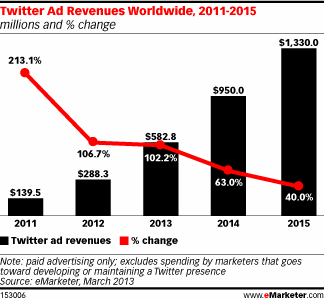
The social network might launch a music service this weekend and seek TV content deals with Viacom and others. What’s the endgame?

FORTUNE — Can a social network once entirely conceived around 140-character real-time updates transform itself into a multimedia hub? Twitter seems intent on trying.

Bloomberg reported this week that Twitter is in final negotiations with networks like Viacom (VIAB) and Comcast’s (CMCSA) NBCUniversal that could let the social network distribute TV clips and sell ads alongside them.

Over the last 12 months, Twitter has made some bold moves — acquiring startups, releasing new features, and reportedly working on TV deals, leaving small hints as to what it’s up to. Analysts agree: The social network is gunning to become a full-featured media platform.

“That’s what it’s going for long-term, but short-term, it’s a communication conduit where information flows through, kind of like a protocol of information,” explains Jeremiah Owyang, a partner with the San Mateo, Calif.-based Altimeter Group, a research and advisory firm. “They want to be more than that. They want media content to flow on top of it and to share on top of it. They want to be more than that throughway because they want to monetize that as well.” Read more of this post
Make a Note of It: Speech Recognition Apps Are Getting Better

April 17, 2013

Make a Note of It: Speech Recognition Apps Are Getting Better

By KIT EATON

Science fiction writers have long imagined a future where we simply voice-command our devices, cars or spaceships. The technology isn’t quite there yet, despite Apple’s best efforts with Siri, its digital personal assistant. But our smartphones and tablets are getting quite good at turning the spoken word into text. This app technology has the power to turn your mobile device into a powerful writing tool, without your having to lift a stylus or type on a touch screen.

Dragon Dictation, a simple speech-to-text app that is free on iOS, is probably the best known. On the left of its main page is a list of Notes you’ve previously entered; on the right is a larger section where you enter or view text inside notes. At the top of the main section is a red Record button. The app records for as long as necessary, showing the audio level of your voice as a graph at the bottom of the screen. Tapping anywhere on the screen turns off recording, or you can adjust the app to automatically detect when you’ve stopped speaking.

The app sends a digital sample of your speech over the Internet to do the speech recognition, so it requires a wireless connection. But this process is speedy, and the app soon displays your transcribed text in the main window. Naturally, it doesn’t get all the words right, perhaps because you mumbled or made some other mistake, but you may be surprised at how accurate it is over all. Read more of this post

Expenses Mount for App Launches; Some Games Cost $5 Million to Get off the Ground; Game-app makers, who once relied mostly on word-of-mouth, have been forced to ratchet up the cost and fanfare of their marketing campaignso

April 17, 2013, 7:28 p.m. ET

Expenses Mount for App Launches

Some Games Cost $5 Million to Get off the Ground; ZeptoLab Lines Up Burger King

By JESSICA E. LESSIN

MK-CC496_LAUNCH_G_20130417165908

“It’s amazing what it takes to launch a new game,” says game-app maker ZeptoLab’s CEO Misha Lyalin.

Mobile-game maker ZeptoLab UK on Thursday will release “Cut the Rope: Time Travel,” its first major title in the popular “Cut the Rope” series since 2011. The launch won’t be a quiet one. If all goes as planned, the puzzle game will go live in 125 countries and in a few dozen app stores, including those run by Apple Inc., AAPL -5.50% Google Inc.GOOG -1.36% and Amazon.com Inc. AMZN -1.81% The game will be accompanied by tie-in merchandise including T-shirts, and eventually plush toys, as well as a 10-part animated Web series that was months in the making. The company has been building buzz for the game through a six-week promotion withBurger King Worldwide Inc., BKW -1.78% which began featuring the game in its kids’ meals last month.

Overall, ZeptoLab says it will spend around $1 million launching “Cut the Rope: Time Travel,” which traces the adventures of the green monster Om Nom as he meets versions of himself in time periods like the Renaissance and the Middle Ages. On top of that sum, which includes the costs of animation, the company is counting on some free help by promoting the game inside its other titles. By contrast, the company spent almost nothing to promote the first “Cut the Rope” game when it was released in 2010. It gave the title to a third-party publisher to distribute, then sat and waited.

Now, “it’s amazing what it takes to launch a new game,” said Misha Lyalin, chief executive of U.K.-based ZeptoLab. Read more of this post
Apple Loses Throne as World’s Biggest Company

Apr 17, 2013

Apple Loses Throne as World’s Biggest Company

By Steven Russolillo

OB-XC753_AppleE_G_20130417173902

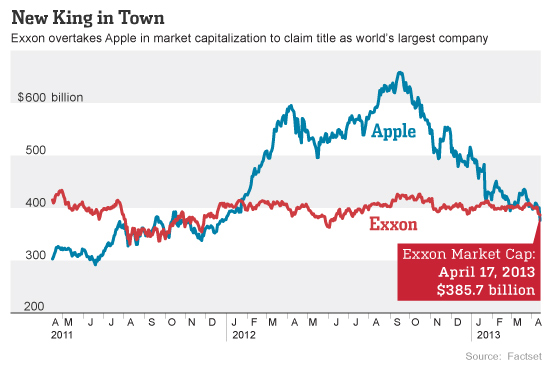
Apple’s market cap (in blue) compared to Exxon’s over the past two years

Apple Inc. AAPL -5.50% is no longer on top.

Wednesday’s steep slide in Apple’s shares has pushed the tech giant to second place on the list of the world’s most valuable companies. Oil giant Exxon Mobil Corp. XOM -0.61%has reclaimed the throne.

As the chart shows, both companies have been jockeying back and forth for the top spot for much of 2013. Prior to that, Apple had been the clear-cut king from January 2012 through this past January. And before that, Exxon had been the king dating back to 2006. Apple shares recently dropped more than 5% and briefly dipped below $400 for the first time since December 2011. Exxon shares are down less than 1%. One peculiar trend that has taken place this year: The S&P 500 has set new records without its two biggest components contributing to the rally. Apple shares are down 25% this year and Exxon Mobil shares are off 0.5% Meanwhile, the S&P 500 is up about 9%. Read more of this post