Google executive chairman Eric Schmidt predicts there will be more than 1 billion Android smartphones in use by the end of the year

Android to reach 1 billion mark this year: Schmidt

April 18, 2013 – 11:05AM

Alexei Oreskovic

Google executive chairman Eric Schmidt predicts there will be more than 1 billion Android smartphones in use by the end of the year.

The five-year-old Android software has been a huge hit for Google, giving the internet search company a strong footing with consumers who increasingly access the web from smartphones and tablets rather than PCs. Android is now the world’s No.1 mobile phone software, with more than 750 million mobile devices featuring Android in use across the world.

At the current rate, Schmidt said that Google should cross the 1 billion mark within six to nine months and will be “nearing 2 billion in a year or two”. Read more of this post

Harvard kids use 3D printing to help the blind ‘see’ paintings

Harvard kids use 3D printing to help the blind ‘see’ paintings

By VentureBeat.com, Published: April 17

For the visually impaired, the basic problem with art is that, well, they can’t see it. But with a project called “Midas Touch” a group of Harvard kids say they have a fix: Use 3D printing to help the blind ‘see’ what they cannot actually see.

“We want to bridge the gap between the visually impaired and the visual world of art,” Constantine Tarabanis, one of the brains behind the project, told me.

Basically, what Midas Touch does is take a flat image — say, of Starry Night — and use 3D printing to add layers of texture to it, creating an image that’s half painting, half relief sculpture. Essentially, Midas Touch takes the visual nature of art and translates it to a physical world that the visually impaired can understand.

In theory, anyway. The thing to keep in mind with Midas Touch is that the whole project is at this point a concept. While Tarabanis and his team have a great idea and a bunch of funding, they’re still working on creating working prototypes to prove their idea has legs. Read more of this post

Korean Supermarket Uses a Guiding Light to Point Out Discounts on Your Smartphone

Korean Supermarket Uses a Guiding Light to Point Out Discounts on Your Smartphone

April 17, 2013

by Steven Millward

“Mom, turn right for the candy – AND HURRY!” We’ve seen Korean supermarket chain Emart (KRX:139480) do some innovative stuff before, like its shadowy QR codes. But this time Emart is trying something more substantive – using smartphones and LED lights to guide shoppers around their stores and lead them to discounts. Dubbed ‘Emart Sale Navigation’, the idea is a combination of car-like GPS with a location-based discounts app. But rather than actually relying on GPS (which could be unreliable indoors), the Korean supermarket is using special LED lights on the ceiling to send information to lenses attached to shopping carts. Then, so long as you have the Emart app on your Android phone and it’s attached to the shopping cart on the special plastic arm shown in the pictures, you’ll be guided around the aisles by dedicated indoor maps. If you pass an area where there’s a discount coupon available, that’ll pop up on-screen. It’s all pretty clever and actually simpler than it sounds. For consumers it’s pretty straightforward, as all you need to do is have the app on your phone and then attach it to your cart. Emart itself sorts out the lenses and the lights, so shoppers don’t need to worry about compatibility issues. It avoids other technologies likeNFC and QR codes which tend to be either fragmented across devices or just too damn confusing for most people. So one single app in this project from Emart makes it all intelligible and fairly easy. If you’re in South Korea, grab the Emart sale navigation Android app and then head out to do some shopping; or check out the two-minute demo video (in English) here:

Goldman Traders Cede Tokyo Party Bar to Google-Apple Invasion

Goldman Traders Cede Tokyo Party Bar to Google-Apple Invasion

By Takahiko Hyuga and Terje Langeland  Apr 16, 2013

The champagne used to flow at Heartland, the bar in Tokyo’s Roppongi Hills complex that drew bankers from the Japan headquarters ofGoldman Sachs Group Inc. (GS) and Lehman Brothers Holdings Inc. upstairs.

“Every day, there was a party,” said Mai Shioya, the 39- year-old manager, who started in May 2008 before the global financial crisis that led to Lehman’s bankruptcy.

Bankers in well-cut suits would come in about 5 p.m., hand bartenders corporate credit cards and let their friends charge drinks to the tab until 2 a.m., said Michio Nakamura, 45, who’s been running events and entertainment at Heartland since its opening as part of the famed Roppongi Hills development in 2003. After the financial crisis, many disappeared, cutting revenue by 30 percent, Shioya said.

“Those customers and that age have gone,” she said.

The void is being filled by a new group of bar patrons: information-technology workers. While financial firms have cut staff in Japan, technology companies have boosted hiring, and as bankers vacated offices at Roppongi Hills, companies including Google Inc. (GOOG) andLenovo Group Ltd. (992) moved in. As early as this month, Apple Inc. (AAPL) will also make the complex its home in Japan, two people familiar with the plan said in January. Read more of this post

Tech-savvy Vietnam coffee farmers brew global takeover; Most Vietnamese coffee farmers can tell you the price of the beans, the second most traded commodity in the world after oil, in their sleep

Tech-savvy Vietnam coffee farmers brew global takeover

Most Vietnamese coffee farmers can tell you the price of the beans in their sleep. -AFP

Wed, Apr 17, 2013
AFP

Buon Ma Thuot, Vietnam – Most Vietnamese coffee farmers have never heard of a double tall skinny latte, but they could tell you the price of the beans that go into one in their sleep.

From high-tech Israeli irrigation systems to text message updates of global prices for the commodity, coffee farming in Vietnam’s Central Highlands has come a long way since the French first introduced the bean over a century ago.

“I used to carry my coffee to market by bicycle,” said 44-year-old farmer Ama Diem. “Now I check the bean price on my mobile phones” before making the trip.

By texting “CA” to the number 8288 from any Vietnamese mobile phone, farmers almost instantly receive a message with the London prices of Robusta coffee beans and the New York price of Arabica beans from a data supply firm. Read more of this post

If news makes us sick, Twitter must be a cancer; News is bad for you – and giving up reading it will make you happier

If news makes us sick, Twitter must be a cancer

BY HAMISH MCKENZIE 

ON APRIL 15, 2013

On Friday, the Guardian ran a provocative op-ed by Rolf Dobelli arguing that news is bad for our health and hinders our thinking. The much-discussed article, which the author had first written two years ago, was excerpted from the soon-to-be-released “The Art of Thinking Clearly,” a compendium of essays penned by theself-described “serial entrepreneur, thinker and writer.”*

Dolbelli’s argument is that “news is to the mind what sugar is to the body.” Not only does it distract us from wider issues, but it tells us stuff we don’t need to know, has a toxic effect on our bodies, inhibits our thinking, wastes our time, and makes us passive. Heavy stuff! Read more of this post

WhatsApp “Bigger Than Twitter” With Over 200M Monthly Active Users, 8B Inbound And 12B Outbound Messages Daily

WhatsApp “Bigger Than Twitter” With Over 200M Monthly Active Users, 8B Inbound And 12B Outbound Messages Daily

DARRELL ETHERINGTON

posted yesterday

WhatsApp CEO Jan Koum was on stage today at the AllThingsD Dive Into Mobile conference in New York City, where he said that the app is now larger than Twitter by monthly active users. He wouldn’t say exactly how many the company had, just that it was north of 200 million users.

Koum also noted that the messaging app now sees an average of 8 billion inbound, and 12 million outbound messages per day, and with less than 50 engineers, the highest ratio of active users per long-term employee today of any active tech company.

Twitter noted that it hit its own 200 million monthly active user count back in December, while WhatsApp noted in January that it had reached the 7 billion inbound messages per day milestone. To some extent, comparing the two is a bit like comparing apples and oranges, but recent evidence suggests that social networking tools like Facebook and Twitter are losing the attention of younger users, who are turning to platforms like WhatsApp instead. Read more of this post

Find Your Sister: China’s hottest mobile game; The game is currently making 5 million yuan (US$810,000) a month through the Apple App Store

Find Your Sister: China’s hottest mobile game

Staff Reporter, 2013-04-17

funship-161821_copy1

A screenshot from Find Your Sister. (Internet photo)

Find Your Sister, a free mobile phone game in China, has become a hit with over 55 million subscribers and 8 million active players daily, topping the Apple App Store in the country for downloads.

The game got off to a slow start on its release last September but improvements to its gameplay have paid off since early this year. The game has managed to attract people who have not been playing online games before, from toddlers aged 2-3 to people over the age of 60, according to China Entrepreneur magazine.

A user who plays the game regularly said the game is popular because it can be played anytime and anywhere, such as the subway commute to work, when you can take out your phone and take on one challenge after another.

One major attraction of the game is its humorous content, as well as its multiplayer feature.

The game is currently making 5 million yuan (US$810,000) a month through the Apple App Store and income from the Android platform also started to grow sharply in March. Read more of this post

Samsung accused of paying people to criticize rival HTC

Samsung accused of paying people to criticize rival

2013-04-17 06:27:58 GMT2013-04-17 14:27:58(Beijing Time)  SINA.com

Fair-trade officials in Taiwan are looking into reports that Samsung paid people to criticise rival HTC online.

Samsung is alleged to have hired students to post negative comments about phones made by Taiwan’s HTC.

Samsung, based in South Korea, said the “unfortunate incident” had gone against the company’s “fundamental principles”. Read more of this post

China’s digital advertisers need to grow up instead of just growing fast

Cost-per-billion

Wednesday, April 17, 2013

China’s digital advertisers need to grow up instead of just growing fast

Browsing one of China’s leading internet portals has been easier on the eye in recent years. By Western standards, sites such as Sina or Tencent may seem cluttered – even overwhelming. But, compared to the omnipresent floating ads, pop-ups and uncloseable boxes of years past that pestered Chinese internet users, the general demeanor of online advertising in the country has become – at least for market leaders – increasingly pleasant.

While decluttering is a good start, China has a lot of ground to cover in monetizing digital ads. Boosting the value of ads and handling large amounts of user data will be a large part of raising revenues in the months and years to come. Although digital ad revenues are expected to surpass those of TV in 2013, according to Chinese internet analysis firm iResearch, investors are waiting to see if they can keep up with the pace of the country’s quickly expanding digital universe.

Along the way, harnessing the mobile market will help – in fact, it will be essential. But this market is in its early stages and companies will be wary of running adverts on smartphones or tablets until advertisers can prove that people are looking at them. Read more of this post

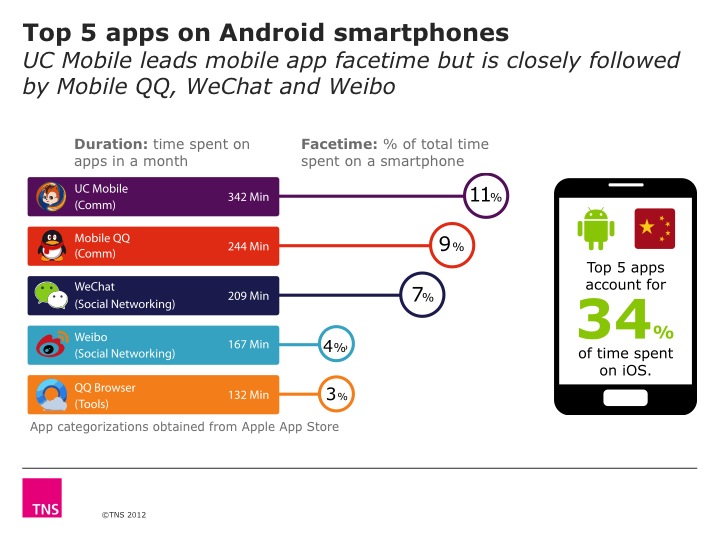
5 Mobile Apps Chinese Smartphone Users Can’t Live Without

5 Mobile Apps Chinese Smartphone Users Can’t Live Without

April 16, 2013

by Spencer Ng


top-5-ios-china top-5-android-china Read more of this post

How do you compete with a free operating system? Try paying people; Alibaba will pay handset makers a monthly fee of 1 yuan (16 cents) for every AMOS user

How do you compete with a free operating system? Try paying people

By Leo Mirani — April 16, 2013

China’s e-commerce juggernaut Alibaba has finally found some takers for its mobile operating system, known as AMOS, or the Alibaba Mobile Operating System. It announced yesterday that five handset makers—KONKA, ZOPO, Amoi, G’Five, and Little Pepper—will release devices running on AMOS. This is a big deal for the company, which has had trouble finding willing partners. Google claims Alibaba’s OS is based on but incompatible with Google’s Android software. Alibaba disputes this, saying it only uses some Android tools to give users access to third-party applications. It doesn’t matter. Google’s position means AMOS can’t be adopted by any of the firms that are part of the Open Handset Alliance, a Google-run body that coordinates Android versions. That’s basically all the biggest manufacturers except Apple and Nokia. So why would any manufacturers, Chinese or otherwise, want to use AMOS when they can get Android for free and do near whatever they want to with it? Two reasons stick out.

The first is speculation on our part. The Chinese government frets about the dominance enjoyed by Android in the country, where it enjoys a market share of 86%. (The government is not crazy about Apple either but that’s another story.) China is not the only one worried about the reliance of local firms on foreign providers—the US has its own concerns about Huawei, a Chinese manufacturer of unsexy but essential networking equipment. But unlike America, which considered banning the use of Huawei equipment, China is pushing domestic firms to compete with Google. That means AMOS probably has Beijing’s blessings.

The second reason is clearer. The best way to compete with a free product is to offer a better free product. Alternatively, you could try paying people to use your stuff. Alibaba, whose OS is too young and too small to be a serious challenger to Android, went for the second option. The company will pay handset makers a monthly fee of 1 yuan (16 cents) for every AMOS user. App-makers benefit too. Alibaba is setting up a one billion yuan fund that it will deploy as incentives for developers—though it did not say how that money would be used. In addition, Alibaba is also working on easy financing which would allow customers to buy the phone without having to pay anything upfront. Unlike some other new Chinese operating systems that rely on hype to make up for the lack of revolutionary features, Alibaba’s OS is pretty interesting. For one thing, it will do most of the heavy lifting in the cloud (on Alibaba’s servers) rather than on phones. That means no more of those constant, annoying updates. It is also important for Alibaba’s core e-commerce business—the company will want to ensure it is has a strong strategy in mobile-based shopping before its widely expected IPO in the coming months.

Facebook Charging $1 Million For New, Intrusive Video Ads; Facebook has previously claimed its logged-in audience is equivalent to three Super Bowls every day

Facebook Charging $1 Million For New, Intrusive Video Ads

Jim Edwards | Apr. 16, 2013, 8:43 AM | 2,455 | 14

Facebook wants $1 million from advertisers who want to be the first to run video ads in users’ news feeds this summer, according to Ad Age. And users won’t have a choice over whether they see them: the 15-second spots will be on “autoplay,” meaning that they’ll run like regular video ads on any other website, starting up whether users like it or not. The move was expected. Business Insider noted in December that Facebook was considering autoplay video ads. The company believes it can take a significant share of ad money currently being spent on TV by showing advertisers superior return on investment measurement. Facebook is already the second biggest server of online video, after YouTube. Facebook has previously claimed its logged-in audience is equivalent to three Super Bowls every day — making it the perfect place to launch new movie trailers. Read more of this post

China’s department stores losing out to e-commerce, higher costs; Retailing specialists said many department stores are being used purely as “fitting rooms” as shoppers have taken to trying on clothes at the store and then placing their orders online to save money

China’s department stores losing out to e-commerce, higher costs

Staff Reporter,  2013-04-17

Department stores in China have been under increasing pressure from rising rent and labor costs as well as greater competition from online retailers.

Department stores reported a total of 228.2 billion yuan (US$36.8 billion) in sales in 2012, up 8.92% from 2011, a rate far lower than the average annual growth rate of 16.5% recorded between 2006 and 2011, according to the China Commerce Association for General Merchandise.

Retailing specialists in China said local department stores were currently reporting net profits of only 2%-3% due to rising labor and rental costs. Labor costs have been increasing at a rate of over 10% annually, while rent has jumped over 10-fold during the past eight years.

Increased competition from e-commerce websites has also contributed to the slide.

Retailing specialists said many department stores are being used purely as “fitting rooms” as shoppers have taken to trying on clothes at the store and then placing their orders online to save money. Read more of this post

Snapchat processes 150 million images per day Vs Facebook’s Instagram posting 40 million photos per day

Snapchat processes 150 million images per day

By Hayley Tsukayama, Published: April 16

Snapchat, the real-time photo-sharing service has seen a three-fold increase in just four months, according to co-founder and chief executive officer Evan Spiegel.

He said Monday that the company is now processing 150 million images per day — showing a strong demand for sending photo messages that delete themselves within 10 seconds.

By comparison, the most recent statistics from Facebook’s Instagram service show users posting 40 million photos per day. Read more of this post

Turks Aim to Emulate Israel Tech as Erdogan Excoriates Netanyahu; The country “really needs to switch to higher value- added exports” and improve its education system to “compete with innovative countries like Israel,”

Turks Aim to Emulate Israel Tech as Erdogan Excoriates Netanyahu

Prime Minister Recep Tayyip Erdogan wants to catapult Turkey into the top 10 of the global economic elite over the next decade. To get there, he may need to spend more time mimicking the country he’s been feuding with.

While Turkey and Israel have both shifted to manufacturing from farming since the Jewish state was established in 1948, it’s Israel that has succeeded in building high-margin industries. The tech index on Turkey’s Borsa Istanbul has 16 members and a market value of about $790 million. Israel’s TA BlueTech-50 Index (TACT), in an economy less than one-third the size, is valued at $16.5 billion.

During Erdogan’s decade in power, which followed years of unstable and short-lived coalitions, inflation and interest rates plunged from more than 30 percent as the budget deficit and national debt shrank. The gains from that good housekeeping may be running out of steam, with economists and ministers saying Turkey needs an industrial breakthrough to achieve the next stage.

“Turkey is nearing the limits of what it can do with macroeconomic stability,” said Serdar Sayan, a professor of economics at the TOBB University of Economics and Technology in Ankara. The country “really needs to switch to higher value- added exports” and improve its education system to “compete with innovative countries like Israel,” he said. Read more of this post

Warehouses Win Investors as Unsung Internet Heroes

Warehouses Win Investors as Unsung Internet Heroes

The growth of Internet shopping in Europe is luring investors such as Axa Real Estate and Blackstone Group LP (BX) to the cinder-block world of warehouses, where yields are beating showy storefronts and sleek offices amid a space shortage.

“Net effective rents could grow by as much as 20 percent over the next four years,” Philip Dunne, president for Europe at San Francisco-based Prologis Inc. (PLD), the world’s largest warehouse owner, said of the company’s portfolio in the region. “In wider Europe, with a population bigger than the U.S., we have four-and-a-half times less modern product. That gives you some sense of the scale and opportunity for growth.”

Europe needs 25 million square meters (296 million square feet) of new distribution and storage warehouses in the next five years, about 11 percent of existing modern space, to keep up with Internet sales growth, Jones Lang LaSalle Inc. said last month. The assets generate annual income that’s 2 percentage points higher than offices and shops in Europe relative to their value and a lack of space will lift prices, said Remy Vertupier, manager of the Logistis fund run by AEW Europe, a unit of Paris- based Natixis (KN) Global Asset Management SA. Read more of this post

Big Data and numbers know a lot. But they can’t explain all the whys

April 15, 2013

What You’ll Do Next

By DAVID BROOKS

Over the past few centuries, there have been many efforts to come up with methods to help predict human behavior — what Leon Wieseltier of The New Republic calls mathematizing the subjective. The current one is the effort to understand the world by using big data.

Other efforts to predict behavior were based on models of human nature. The people using big data don’t presume to peer deeply into people’s souls. They don’t try to explain why people are doing things. They just want to observe what they are doing.

The theory of big data is to have no theory, at least about human nature. You just gather huge amounts of information, observe the patterns and estimate probabilities about how people will act in the future. Read more of this post

Infosys helped make the world flat, except its own management structure

Infosys helped make the world flat, except its own management structure

By S. Mitra Kalita — 8 hours ago

S. Mitra Kalita is Quartz’s Ideas Editor. She is the author of “My Two Indias: A Journey to the Ends of Opportunity” and has reported on India’s economy, outsourcing and globalization.

Through much of the 1990s and early 2000s, Infosys ranked up there with the Taj Mahal as part of any foreign dignitary or business luminary’s India itinerary. To drive home the software developer’s significance, the trees lining the company’s sprawling Bangalore headquarters include placards with the names of the people who planted them: Bill Gates, Michael Dell, the prime ministers of Japan and Norway, among them. Infosys represented what was possible in a liberalized Indian economy. The country’s first food court in an office setting. The first Indian company to list on the Nasdaq. Office parks modeled on a college campus (down to the Domino’s Pizza on site). Tom Friedman’s best-selling The World is Flat was inspired by former CEO Nandan Nilekani who said: “The playing field is being leveled.”

Now, Infosys is just fighting to stay in the game. On April 12, the company warned that its growth in the upcoming year will be asluggish 6-10%. Infosys shares tanked on the news, a tumble they continued today. Read more of this post

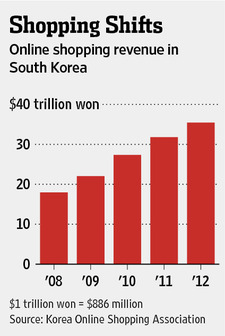
Online and TV Shopping Reshape South Korean Retailing

April 15, 2013, 1:08 p.m. ET

Online and TV Shopping Reshape South Korean Retailing

Department-Store Market, Notoriously Difficult to Crack, Starts Opening Up

By EVAN RAMSTAD

MK-CC430_SKBRAN_NS_20130415174503

SEOUL—The look of South Korean retailing, long a stranglehold of big department stores, is being reshaped partly by cable-TV shopping and smartphones.

A decade ago, it took Lee Jie-on three years to persuade South Korean biggest retailers to stock a line of children’s skin-care products from the U.S. But the product distributor, recently had an easier time persuading them to sell U.S.-made accessories online for new moms.

She introduced the Belly Bandit line of clothing and accessories on the websites of South Korea’s department stores in January after holding just one promotional event and starting a Korean-language website. Ms. Lee says she hopes the brand will develop enough of a following online to reach the shelves of physical stores.

“Penetrating the department store in Korea is very difficult,” she says. Meanwhile, she is relying on smaller retailers and baby-products exhibitions to introduce Belly Bandit to Korean shoppers. For a small company, even cracking the online offerings of a major chain here is a big change, in part reflecting South Korean department stores reacting to the growing power of home-shopping television channels and social-commerce websites. Read more of this post

How technology is slowly developing its sense of smell

How technology is slowly developing its sense of smell

By David Meyer | GigaOM.com, Published: April 15

Last week I attended what was, I think it is fair to say, the oddest conference I have been to yet. It was the first world congress of the Digital Olfaction Society (tagline: “The Smell of Digital”), the stated goal of which is to “digitize, transmit, reproduce and recapture smells, flavors and fragrances.” You know that perennial April Fool’s joke about sending odors through the internet, most recently spun up by Google? That.

The thing is, as my colleague Barb Darrow pointed out in the wake of Google’s gag this year, there really are serious efforts underway to make the digital capture and production of aromas a reality. The conference was small, but the participants spanned the disciplines of computer science, biochemistry, engineering, smart clothing design and perfume retail. The society is the brainchild of Dr. Marvin Edeas, who is also the president and founder of International Society of Antioxidants in Nutrition and Health, and Professor Takamichi Nakamoto of the Tokyo Institute of Technology’s engineering school, whose team is gradually refining its smell detection and generation systems. Read more of this post

Amazon Goes After Older Adults & Seniors With New Store

Amazon Goes After Older Adults & Seniors With New Store

SARAH PEREZ

posted 11 mins ago

50-active-healthy-living-amazon-com

Amazon has launched a new store catering to mature adults and seniors, the company announced today. But while “Amazon Seniors” would have a nice ring to it, Amazon went with a more polite, if wordy, branding: “50+ Active and Healthy Living Store.” As the name implies, the new store will be focused on a variety of “healthy living” needs, including nutritional products, wellness, exercise, fitness, medical, personal care, beauty and entertainment items and more.

The site also serves as another smart extension of one of Amazon’s lesser-known features: subscription-based ordering. Today’s its “Subscribe & Save” program allows Amazon customers to schedule automatic deliveries of household products (cleansers, paper towels, etc.) and other replenishable goods, including baby products (diapers, wipes, etc.), personal care items (deodorant, lotions, etc.), and more. Read more of this post

Ahead of the curve: but bendable screens still seek breakthrough

Ahead of the curve: but bendable screens still seek breakthrough

Sun, Apr 14 2013

By Jeremy Wagstaff and Sinead Carew

SINGAPORE/NEW YORK (Reuters) – The touted arrival this year of wearable gadgets such as computer displays strapped to wrists and in wrap-around glasses is just a step towards a bigger revolution in screens – those that can be bent, folded and rolled up.

Once freed from today’s relatively heavy, breakable and fixed glass displays, tomorrow’s devices may look very different, with screens that can be rolled out, attached to uneven surfaces, or even stretched.

But there’s still some way to go.

“It becomes a product designer’s paradise – once the technology is sorted out,” says Jonathan Melnick, who analyses display technology for Lux Research. Read more of this post

Amazon’s Letter To Shareholders Should Inspire Every Company In America

Amazon’s Letter To Shareholders Should Inspire Every Company In America

Henry Blodget | Apr. 14, 2013, 10:06 AM | 19,692 | 23

Late last week, Amazon CEO Jeff Bezos published his latest letter to shareholders.

This year’s letter, like most of Bezos’ letters, should inspire most companies to change the way they do business.

Specifically, it should inspire companies to do business the way Amazon does business — sacrificing this year’s profits to invest in long-term customer loyalty and product opportunities that will create bigger profits next year and for years thereafter.

The way most companies do business is to focus primarily on today’s bottom line: The prevailing ethos in corporate America, after all, is that companies exist to make money for their owners — and the more and the sooner the better — so every decision should be made in the context of that.

The result of this is that many (most?) companies scrimp on things like long-term investments, customer service, product quality, and employee compensation, in the interest of delivering a few more pennies to this quarter’s bottom line.

This obsession with short-term profits has helped produce the unhealthy and destabilizing situation that now afflicts the U.S. economy: Read more of this post

What Analytics And Big Data Can Learn From Lego

4/11/2013 @ 11:19AM |2,291 views

What Analytics And Big Data Can Learn From Lego

By Kurt Bilafer, APJ Regional Vice President, Analytics, SAP 

Lego recently became a hot topic of conversation with my son, a huge Star Wars Lego fan.  Lego is the fourth-largest toy company in the world, and here at SAP (and the Bilafer household), we have aspecial relationship with the brand.  In Singapore there is a Lego exhibit at theArtScience Museum where artist Nathan Sawaya uses Legos as his creative medium.  I asked around the office if anyone had been to the exhibit and one of my co-workers shared a more personal story – he lamented the fact that thousands of Lego blocks were gathering dust in his basement – the result of acquired sets for his three sons, culminating in dozens of Lego sets and completed projects.

As an analytics guy, this reminded me of Rebrickable, a Website for Lego enthusiasts.  Users input Lego set IDs and their current inventory of Lego pieces and voila!  – an analytics engine crunches the data and makes recommendations on new Lego creations they can build.  This means a second life for old, forgotten Lego sets and more importantly, saves me from having to rebuild the same sets with my son every weekend.

After the euphoria on finding this site wore off, I started to think about how this was a great example of Big Data.  Most consumers might not realize this is a real use case for big data – they simply use the Rebrickable solution to solve a problem. Read more of this post

Will Google’s Ray Kurzweil Live Forever? In 15 years, the famous inventor expects medical technology will add a year of life expectancy every year.

Updated April 12, 2013, 6:44 p.m. ET

Will Google’s Ray Kurzweil Live Forever?

In 15 years, the famous inventor expects medical technology will add a year of life expectancy every year.

By HOLMAN W. JENKINS, JR.

Ray Kurzweil must encounter his share of interviewers whose first question is: What do you hope your obituary will say?

This is a trick question. Mr. Kurzweil famously hopes an obituary won’t be necessary. And in the event of his unexpected demise, he is widely reported to have signed a deal to have himself frozen so his intelligence can be revived when technology is equipped for the job.

Mr. Kurzweil is the closest thing to a Thomas Edison of our time, an inventor known for inventing. He first came to public attention in 1965, at age 17, appearing on Steve Allen’s TV show “I’ve Got a Secret” to demonstrate a homemade computer he built to compose original music in the style of the great masters.

In the five decades since, he has invented technologies that permeate our world. To give one example, the Web would hardly be the store of human intelligence it has become without the flatbed scanner and optical character recognition, allowing printed materials from the pre-digital age to be scanned and made searchable. Read more of this post

Microsoft Can’t Keep Up in a Mobile World

Updated April 11, 2013, 3:05 p.m. ET

Microsoft Can’t Keep Up in a Mobile World

By ROLFE WINKLER

The PC ecosystem is under threat. To rescue it, Microsoft MSFT -0.50% and IntelINTC -0.69% may have to dig deeper—into their own pockets.

Global personal-computer shipments fell 14% in the first quarter, according to research firm IDC, their steepest decline ever. Microsoft’s stock duly fell 5% on Thursday, with Hewlett-Packard‘s HPQ +0.10% stock down 7% and Intel’s, 3%.

What is surprising is that investors are surprised. Not only did the two halves of the “Wintel” duopoly miss the boat with mobile, their latest attempt to regain momentum has looked ineffectual for months. New machines running Microsoft’s latest touch-enabled operating system, Windows 8, typically powered with Intel chips, are so rare as to elicit stares when seen in the wild. Read more of this post

Who says accountants are boring? How one student’s accounting-based video game took the online world by storm with over a quarter million downloads in just over two weeks

Who says accountants are boring? How one student’s accounting-based video game took the online world by storm

Caitlyn Coverly, Special to Financial Post | 13/04/12 | Last Updated:13/04/12 11:08 AM ET

2-17-13-arena-e1365723930411

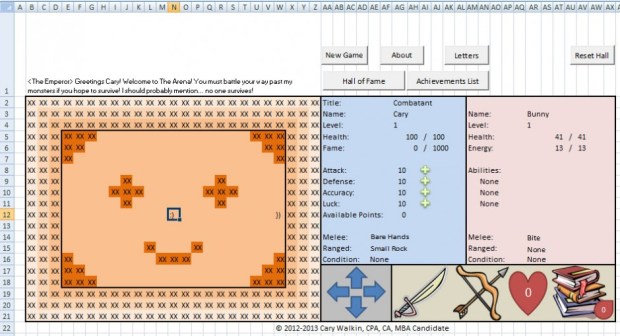
Cary WalkinA screenshot of Arena Xlsm, the Microsoft Excel-based video game created by Schulich School of Business student Cary Walkin.

When Cary Walkin went back to school to complete an MBA, his main goal was to strengthen and diversify his business acumen. Working as a chartered accountant for the past five years, Mr. Walkin was in a stable, secure profession he enjoyed. What he ended up doing, however, was realizing a childhood dream by combining his two passions, accounting and video game design, by creating a computer game based on Microsoft Excel spreadsheets and promoting it through a specialized marketing course within the Schulich School of Business MBA program.

Now set to graduate in two weeks, Mr. Walkin’s game, Arena.Xlsm, has gone viral, generating international buzz in the gaming industry and turning his accounting career upside down.

I had a party when it reached 3,000 views and then it just exploded overnight

“I was completely shocked at the attention the game received,” said Mr. Walkin. “I had a party when it reached 3,000 views and then it just exploded overnight.”

In just over two weeks, Arena.Xlsm has received over a quarter of a million downloads and has garnered media attention from GizmodoBBC News, Cnet, and the Sydney Morning Herald, to name just a few. Read more of this post

Chinese online retailers hope to challenge industry trend

Chinese online retailers hope to challenge industry trend

Online retailers have an advantage in not facing the geographical restrictions that their brick-and-mortar counterparts do. -China Daily/ANN
Fri, Apr 12, 2013
China Daily/Asia News Network

Chinese online luxury retailers have big ambitions, despite the market’s slower growth in recent years. Sun Yafei, CEO of Fifth Avenue Globe – one of the earliest online luxury retailers in China, said she plans to double her website’s turnover in 2013, as the company’s sales in 2012 already doubled from the previous year. As sales growth in China’s luxury market declined in the past year, some luxury brands said they would slow the expansion of their store networks and integrate their channels in the market in 2013. The Internet would be an effective distribution channel for the brands, Sun said. Read more of this post

Infosys, India’s second- largest software services exporter, fell the most in 10 years in Mumbai trading as it forecast annual sales will rise slower than analysts estimated. Infosys Plunge Gives Options Traders 200% Profit on Strangle Bet

Infosys Plunges as Sales Forecast Lags Behind Estimates

Infosys Ltd. (INFO), India’s second- largest software services exporter, fell the most in 10 years in Mumbai trading as it forecast annual sales will rise slower than analysts estimated.

Shares plunged as much as 20 percent, the biggest drop since April 2003, to 2,337.35 rupees as of 9:21 a.m.

The spending budgets of customers in financial services, which contributed 27 percent of Infosys’s revenue in the third quarter, will drop, the company said last month. Pricing has been under pressure since the financial crisis for most information technology services providers and remains a key concern, according to Anurag Rana, an analyst at Bloomberg Industries.

“It is a real disaster for Infosys, primarily because their low guidance along with their fourth-quarter revenue which continues to drop,” said Amar Mourya, Mumbai-based analyst with India Nivesh Ltd. ’’Their confidence seems to be shaken with such a broad forecast and visibility looks poor.’’ Read more of this post