A new device analyses brain waves to warn drivers before they nod off
April 13, 2013 Leave a comment
Good Vibrations
A new device analyses brain waves to warn drivers before they nod off
Published: 12 Apr 2013 at 00.00
R.E.S.-ilience in Value Creation 《竹经:经商经世离不得立根创新》
April 13, 2013 Leave a comment
Good Vibrations
A new device analyses brain waves to warn drivers before they nod off
Published: 12 Apr 2013 at 00.00
April 12, 2013 Leave a comment
April 11, 2013, 11:06 p.m. ET
The Age of Bite-Size Entertainment
As the world goes mobile, get ready for more movies, books and music that can be snacked on in a single sitting.
When soap operas “All My Children” and “One Life to Live” come back to life online later this month, episodes will run for 30 minutes, about half as long as the hourlong blocks that ran on broadcast television for most of the shows’ 40-year run. Why? Because they’re likely to be watched on the go. Everyone is talking about the binge-viewing craze, but as people increasingly consume TV, movies, books and music on mobile devices, briefer is better. Shorter formats “are in-betweeners, the cream in the middle of the Oreo,” says Jeffrey Katzenberg, chief executive of DreamWorks Animation. Some of the biggest forces in entertainment are rushing out bite-size portions, not just to adapt to mobile technology but to test the appetite for heartier versions. If a serialized e-book catches fire, publishers will print the novel. A short film that goes viral on YouTube can lead to a feature film or television series. A well-received EP might prompt an album. Here’s a look at efforts underway across the entertainment industry to capitalize on the new snack-size portions.

April 12, 2013 Leave a comment
IPhone Outpaced in Surging India by Less Costly Rivals
Apple Inc. (AAPL) and Samsung Electronics Co. (005930) are being beaten in the fast-growing Indian smartphone market by a couple of aggressive local competitors.
Sales growth at Bangalore-based Karbonn Mobiles India Pvt. and Micromax Informatics Ltd. is being fueled by Indians buying their first smartphone to surf the Internet, which will be accessed by more than 300 million people by 2017. Their secret: the price.
In a country where about 800 million people live on less than $2 a day, Karbonn handsets start from 3,599 rupees ($66) and Micromax’s from 3,999 rupees, less than the cheapest Apple and Samsung smartphones. The iPhone 4 is available for 26,500 rupees and Samsung’s Galaxy Y Duos Lite for 6,110 rupees.
“India is poised for a smartphone boom; just look at the Internet penetration and potential,” Deepak Mehrotra, chief executive officer of Gurgaon-based Micromax, said in an interview. “But we don’t see any point to offering a Ferrari.” Read more of this post
April 11, 2013 Leave a comment
Swedish Banks Make Money Ditching Cash as Krona Goes Virtual
If you’re looking for Swedish cash, don’t go to a Swedish bank.
Most of the country’s biggest lenders, SEB AB, Swedbank AB (SWEDA) and Nordea Bank AB (NDA), have stopped manual cash-handling services in 65 percent to 75 percent of their local branches. They say cash is out as Swedes rely on credit cards, the Internet and mobile phones to make all their payments.
The country’s bank notes, which are adorned with images of famous Swedes including botanist Carl Linnaeus and will soon also feature legendary actress Greta Garbo, are only used in about 20 percent of shop transactions, according to data from the Swedish Trade Federation. In the U.K., whose capital London is a global hub for high finance, all banks still offer cash at their branches.
“We’ve removed the manual cash handling simply because we’re seeing a change in behavior among our customers,” Swedbank spokeswoman Anna Sundblad said in an e-mailed reply to questions. “Only 5 percent of our customers make over-the- counter cash transactions.”
Customer demand for cash services at Nordea, Scandinavia’s biggest bank, is dropping by about 20 percent a year, spokesman Erik Durhan said. According to Nordea Chairman Bjoern Wahlroos, the end of cash is a natural next step in an evolutionary process that has already led to the extinction of cheque books. In this respect, Scandinavia is far ahead of the U.K. and the U.S., he said. Read more of this post
April 11, 2013 Leave a comment
Waterstones founder to launch Spotify for books
It may seem an unlikely match, but the founder of Waterstones is turning to technology to revive the lost art of the Charles Dickens-style serialised novel.
By Katherine Rushton, Media, Telecoms and Technology Editor
6:00AM BST 11 Apr 2013
Tim Waterstone is to launch a new digital books business which aims to become the literary version of Spotify, charging readers a flat rate to access as much reading matter as they like online.
The project, Read Petite, will specialise in short stories and serialisations, following in the tradition of 19th Century novelists like Dickens, creator of Oliver Twist, and Vanity Fair author Anthony Trollope, who used to publish their novels chapter by chapter in newspapers and magazines.
Short stories have traditionally been very difficult to sell in paper form, but Mr Waterstone said they would be suited to commuters and other time-pressed bibliophiles. Read more of this post
April 11, 2013 Leave a comment
April 10, 2013 5:51 pm
Television set for a revolution
By Andrew Edgecliffe-Johnson
An upstart could determine the model of the US content machine, says Andrew Edgecliffe-Johnson
Never underestimate the power of a large group of committed couch potatoes. About 90 per cent of Americans pay for television, giving them scores of channels to choose from, but four free-to-air networks they can pick up with a “rabbit ears” aerial still account for 96 of the top 100 primetime programmes.
Audience inertia and brand loyalty built over decades mean that ABC, CBS, Fox and NBC still account for 40 per cent of all primetime viewing. Their unique ability to attract mass audiences, particularly for live sport, has kept TV advertising healthy even as advertising dollars fled other media for Google and Facebook.
Broadcasters once offered signals to cable, satellite and telecoms groups for free, in exchange for perks such as prominent positions in their onscreen channel listings. In the past five years, however, their business has been transformed as they discovered they had the power to demand that distributors pay to retransmit their programming.
This has created a second revenue stream of “retrans” fees worth more than $2bn a year, which could jump to $12bn, says Rich Greenfield, a BTIG Research analyst. “It’s a good gig if you can get it,” Verizon’s Lowell McAdam remarked this week. Yet three of America’s biggest broadcasters said they might give that gig up.
Chase Carey, Rupert Murdoch’s deputy at News Corp, threatened to pull its Fox network off the air and convert the home of American Idol and The Simpsonsto a cable channel to foil the “pirating” of its content. Les Moonves, CBS chief executive, told The New York Times he had looked into taking some local stations off the air. Haim Saban, chairman of Univision, said the Spanish-language network might also switch to cable, even though Hispanic viewers rely more heavily on aerials than other Americans.
The target of their ire is the start-up, Aereo, which offers high-definition streams of broadcast channels to smartphones, tablets and laptops. For $8 a month subscribers can record shows and pause live TV using a digital video recorder in the cloud. The twist is that each customer rents a tiny remote aerial. In New York, thousands are pointed at TV masts on the Empire State Building; Aereo plans to replicate the model in 22 markets this year, from Chicago to Washington. Read more of this post
April 11, 2013 Leave a comment
Silicon Valley venture backs Google Glass
By Miguel Helft, senior writer April 10, 2013: 5:00 PM ET
Three of the Bay Area’s marquee investment firms want to capture the most interesting ideas before they’re hatched.

FORTUNE — It was classic Sergey Brin. Dressed in sports shorts, an exercise shirt and blue Crocs, the Google co-founder showed up riding an elliptical bicycle, and as he does these days, wearing Glass, Google’s futuristic wearable computer that fits on a head mounted display. Oh, and he was a few minutes late.
The occasion: An announcement that three Silicon Valley investment powerhouses are teaming up to attract entrepreneurs interested in building businesses around Glass. Never mind thatGlass is not yet available to the public or to large numbers of developers. Google Ventures, Andreessen Horowitz and Kleiner Perkins Caufield & Byers said Wednesday that they are forming the “Glass collective.” It is neither a new fund—as my colleague Dan Primack predicted—nor a commitment to co-invest in deals. Instead, it’s an agreement by the three firms to share potential seed-stage investments. If a Glass entrepreneur contacts one of the firms, all three firms will get to meet her, but will decide independently whether or not to invest in the business. Read more of this post
April 11, 2013 Leave a comment
Chinese Taxi Booking App Flags Down Funding, Alibaba Rumored to be Along For the Ride
April 11, 2013
Chinese startup Kuaidi Dache (meaning “fast taxis”) has flagged down seed funding to help the taxi-finding service grow. Centered around apps for iPhone and Android, Kuaidi Dache claims to have 300,000 users across the two cities where it operates – Shanghai and nearby Hangzhou – and covers 30,000 existing city taxi drivers. The startup sees 20,000 daily rides taken via the app.
The funding amount hasn’t been revealed, but according to Chinese tech blog 36Kr it takes the form of input from Ameba Capital’s Li Zhiguo, as well as a reported seven-digit RMB (hundreds of thousands of US dollars) investment from e-commerce company Alibaba. Read more of this post
April 11, 2013 Leave a comment
INFOGRAPHIC: The Booming Mobile Video Ecosystem Explained
Business Insider | Apr. 10, 2013, 2:40 PM | 2,254 |

Mobile video has begun to accumulate scale, and has also turned out to be one of the few types of mobile content — along with games — that monetizes reliably and drives premium ad rates.
That’s reflected in the much higher prices that mobile publishers can command for mobile video ads, compared to standard mobile formats like banners. eMarketer estimates mobile video will account for $520 million in ad spending in the U.S. this year, or 13% of the digital video ad market. Read more of this post
April 11, 2013 Leave a comment
April 10, 2013, 6:04 p.m. ET
Regulators Feeling ‘Social’ Pressure
In Age of Twitter, Decades-Old Rules That Don’t Address New Media Pose Challenge for Officials
WASHINGTON—The Securities and Exchange Commission’s move allowing companies to convey market-moving corporate news via social-media sites stems from a continuing debate at regulatory agencies: how to protect consumers, depositors and investors in the age of Facebook and Twitter.
Agencies from the SEC to the Federal Trade Commission are under increasing pressure from businesses clamoring for guidance on how they can use social media without running afoul of federal securities, advertising and other laws. Financial-advisory firms want clearer guidance from the SEC about how investment advisers can use social-media sites to court clients, while Wall Street firms want to relax rules requiring them to store every video, tweet or other piece of content their employees post on sites.
In the middle are regulators, who say they are wary of updating sometimes-decades-old rules over fears of chipping away at long-standing protections and who worry about their ability to keep up with the proliferation of social-media sites. Read more of this post
April 11, 2013 Leave a comment
Online sales reach a trillion
April 11, 2013, Michael Baker
It’s official. In 2012, business-to-consumer e-commerce passed a trillion dollars US in a single year for the first time, according to a report from US-based research firm eMarketer. Read more of this post
April 11, 2013 Leave a comment
Shodan: The scariest search engine on the Internet
By David Goldman @CNNMoneyTech April 8, 2013: 1:41 PM ET
NEW YORK (CNNMoney)
“When people don’t see stuff on Google, they think no one can find it. That’s not true.”
That’s according to John Matherly, creator of Shodan, the scariest search engine on the Internet.
Unlike Google (GOOG, Fortune 500), which crawls the Web looking for websites, Shodan navigates the Internet’s back channels. It’s a kind of “dark” Google, looking for the servers, webcams, printers, routers and all the other stuff that is connected to and makes up the Internet. (Shodan’s site was slow to load Monday following the publication of this story.)
Shodan runs 24/7 and collects information on about 500 million connected devices and services each month. Read more of this post
April 11, 2013 Leave a comment
How VCs Are Driving a Tech-valuation ‘Feeding Frenzy’
Published: April 10, 2013 in Knowledge@Wharton
Venerable retailer J.C. Penney opened its doors more than a century ago and boasts annual revenues of nearly $13 billion from its 1,100 stores. Yet a three-year-old website with an untested business model and little discernible revenue is closing in on the department store chain’s $3 billion market cap: Pinterest. The online scrapbooking site recently raised $200 million in venture capital funds to bring its implied valuation to $2.5 billion, according to a February 20 story in The Wall Street Journal. Founded by three young entrepreneurs in March 2010, the tech start-up has 48 million users as of December 2012, up from nine million in the prior year, the article noted. While Pinterest is wildly popular, its business model remains unproven. Users, including businesses, sign up for free accounts. The company is just gearing up to accept paid advertising and recently unveiled a free analytics tool for users with business-related accounts to track what has been pinned from their sites. Pinterest may be thinking hard about ways to make money, but it remains unclear whether the firm’s financial strategies can bring in enough revenue to cover costs and generate a healthy profit, which will be especially important once the company goes public. No matter. Pinterest has garnered the interest of such Silicon Valley blue-chip venture capital firms as Andreessen Horowitz (as in Netscape co-founder Marc Andreessen). For now, Pinterest has money to burn.
The company is one of at least 25 start-ups that command market caps of one billion dollars or more, according to a February 4 story in The New York Times. The billion-dollar start-ups club includes such familiar names as productivity application Evernote, travel rental site Airbnb, online questionnaire software SurveyMonkey and streaming music service Spotify. But such high valuations are bringing back concerns that the market is entering another tech bubble like the dot-com frenzy in the late 1990s that led to scores of Internet companies going belly up and investors losing vast fortunes. Read more of this post
April 11, 2013 Leave a comment
Updated April 10, 2013, 9:55 a.m. ET
Acquisitions Key to Samsung Success
To maintain its new lead over Apple Inc. AAPL +2.04% in the global smartphone market, South Korea’s Samsung Electronics Co. 005930.SE +0.33% will need to get busier buying the assets it needs to continue to innovate and expand its client base, bankers and analysts say.
Samsung, which overtook Nokia Corp. NOK1V.HE +3.25% last year as the world’s largest mobile-phone maker and surpassed Apple in smartphones, has already been buying technologies and investing in companies no one else wants, largely to differentiate itself. And with cash and cash equivalents of more than $30 billion, it is sure to keep buying, bankers say.
In a recent interview, Samsung Co-Chief Executive J.K. Shin said the company is on the lookout for acquisitions, especially “intellectual property, advanced technology, components and areas that will enable us to offer better applications on smartphones.”
Thus far, its acquisitions have been small. In the past year, its purchases have included a 5% stake in stylus maker Wacom Co. of Japan, the mobile-technology business of the U.K.’s CSR CSR.LN +3.85% PLC, and California-based storage-software pioneer NVELO. Those deals have given Samsung access to technology to develop a better stylus for its smartphones and tablets, advanced wireless connectivity, and software that enables its phones to retrieve data faster. Read more of this post
April 11, 2013 Leave a comment
PC quarterly sales plummet, sharpest drop on record
5:20pm EDT
By Bill Rigby
SEATTLE (Reuters) – Personal computer sales plunged 14 percent in the first three months of the year, the biggest decline in two decades of keeping records, as tablets continue to gain in popularity and buyers appear to be avoiding Microsoft Corp’s new Windows 8 system, according to a leading tech tracking firm. The huge drop over a year ago, the steepest since International Data Corp started publishing sales numbers in 1994, mark a new milestone in the apparent decline of the age of the PC as computing goes mobile via tablets and smartphones. Read more of this post
April 10, 2013 Leave a comment
Interviewed for a job by Sophie the robot
PUBLISHED: 18 HOURS 35 MINUTES AGO | UPDATE: 4 HOURS 53 MINUTES AGO

Professor Rajiv Khosla believes robots in the workplace can improve emotional wellbeing. Photo: Jesse Marlow
RACHEL NICKLESS
With big eyes, a feminine voice and some interesting dance moves, Sophie is rather cute but don’t let that fool you.
Sophie could soon be conducting your toughest-ever job interview, monitoring not just what you say but tiny twitches in your eyebrows that give clues about how you really feel.
Sophie and her fellow “human-like” robots Charles, Matilda, Betty and Jack plus two as yet unnamed robots are the product of a research joint venture between La Trobe University Business School in Melbourne and global electronics giant NEC Corporation in Japan.
NEC provided the robots and La Trobe is adapting them for use in recruitment, health care and as “emotionally engaging learning partners” in Australia. Rajiv Khosla, who has been driving the project since its inception, says the robots are a “world first in the area of recruitment”. Read more of this post
April 9, 2013 Leave a comment
Why Fab.com Dominates Social Media Commerce While Other Brands Struggle
Lucy Fisher, The Guardian | 17 minutes ago | 69 |
With high profile brands such as Gap, Gamestop and, in the US, JCPenney, having opened and then subsequently closed Facebook stores (presumably because they weren’t delivering ROI) it would be easy to assume that social media is not suitable for sales – too easy, perhaps.
But those who dig a little deeper may find that opportunities abound if social media is leveraged in the right way.
“We haven’t tried to use social as a sales channel at all. It doesn’t suit our demographic and we’re not a discounter,” argues Andrew Curran, chairman at luxury homewares e-tailer Amara. “Having said that, there are examples – take Fab.com – of retailers for which social is a significant proportion of what they do and drives a large percentage of their business.”
He’s not wrong. E-commerce site Fab.com, which specialises in “everyday design” items, grew sales by nearly 300% in January 2013 over January 2012. In Europe alone, 50% of its members have come from social sharing and lead to 33% of revenue in the region. Its member base grew to 11m people, up from 1.5m at the start of last year. With social networking sites and mobile apps forming a significant part of its business model, the innovative company has won a raft of awards. Read more of this post
April 9, 2013 Leave a comment
A Year Later, Instagram Hasn’t Made a Dime. Was it Worth $1 Billion?
By Victor LuckersonApril 09, 2013Add a Comment
A picture’s worth much more than a thousand words to Facebook. Last April — a year ago today, in fact — the social media giant agreed to buy the quickly growing photo-sharing social network Instagram for a cool $1 billion (the final price, a mixture of cash and stock, was $715 million because Facebook shares tumbled before the deal was finalized). The sky-high purchase price, well above Instagram’s $500 million valuation at the time, led some to wonder if Facebook was helping to fuel another tech bubble. A year later, the jury’s still out on whether Instagram will one day reap huge profits, but the company is laying groundwork to put the monetization machine in motion.
By many metrics, Instagram has had an impressive year under Facebook. The photo-sharing network had about 30 million users at the time of the buyout. Today there are more than 100 million monthly active users posting more than 40 million photos per day. The company has doubled its staff to more than 25 employees, including a new business operations director brought over from Facebook.
Despite the large growth numbers, it’s difficult to say whether Instagram has earned its price tag. The company earns no money and has not talked about monetization strategies its executives are mulling, though CEO Kevin Systrom has said that Instagram’s goal is to become a self-sustaining business. Facebook’s financial support has likely shielded Instagram from some of the financial pressures it would have faced on its own. “If there’s no revenue pressure…maybe they’ll take a wait-and-see attitude,” says Brian Blau, research director in consumer technologies at Gartner. “Their strategy today is more around building infrastructure, setting up their features and functions for the future.” Read more of this post
April 9, 2013 Leave a comment
Jim Chanos on Daily Ticker: Stay Away From U.S. Tech Firms
Posted: 08 Apr 2013 01:13 PM PDT
Mike “Mish” Shedlock
http://globaleconomicanalysis.blogspot.com
Here is an interview of Jim Chanos by Lauren Lyster from the Wine Country Conference. Chanos says Stay Away From U.S. Tech Firms
The Daily Ticker’s Lauren Lyster sat down with Chanos, also president and managing partner of Kynikos Associates, at the 2013 Wine Country Conference in support of Les Turner ALS Foundation last week. Of course we asked him: “What are your biggest shorts?” His response? U.S. technology. “I’ve been a big bear for the last year and a half, two years, in the P.C. space,” Chanos says. “I think that we are seeing a secular headwind in that business as more and more people go to mobility and tablets and the cloud. The P.C.-centric space is going to increasingly see negative surprises.” Chanos cites Hewlett-Packard (HPQ) and Dell (DELL) for problems with their accounting practices. “They spend very little on R&D and yet the companies that everyone wants to compare them to spend dramatically more on R&D thus, hurting their profitability,” he notes. Even though Dell and HP have been starting to make huge acquisitions to gain a competitive advantage, they’re doing a “very bad job” at it, Chanos argues. “I am completely mystified as to what the buyout groups at Dell are seeing here because the business from a cash flow point of view, from an accounting point of view, is deteriorating right before your eyes and yet there seems to be a number of players who think this is the greatest thing since sliced bread,” Chanos says. Chanos offers a few pointers for the average retail investor including: don’t try to trade like a hedge fund. “The deck is stacked against retail investors selling short on their own. I don’t think it is generally a good policy,” he says. “Just sell down your stocks to sleep at night.”
April 9, 2013 Leave a comment
April 8, 2013
Tiny Chiplets: A New Level of Micro Manufacturing
By JOHN MARKOFF

An enlarged view of small slivers of silicon, each no larger than a grain of sand, called chiplets. Using laser printers, Xerox’s Palo Alto Research Center may one day be able to create desktop manufacturing plants that use chiplets to “print” the circuitry for a wide array of electronic devices.
PALO ALTO, Calif. — Under a microscope, four slivers of silicon — electronic circuits called chiplets — perform an elaborate, jerky dance as if controlled by a hidden puppet master. Then on command, they all settle with pinpoint accuracy, precisely touching a pattern of circuit wires, each at just the right point of contact.
The technology, on display at Xerox’s Palo Alto Research Center, or PARC, is part of a new system for making electronics, one that takes advantage of a Xerox invention from the 1970s: the laser printer.
If perfected, it could lead to desktop manufacturing plants that “print” the circuitry for a wide array of electronic devices — flexible smartphones that won’t break when you sit on them; a supple, pressure-sensitive skin for a new breed of robot hands; smart-sensing medical bandages that could capture health data and then be thrown away. Read more of this post
April 9, 2013 Leave a comment
April 8, 2013
Teacher Knows if You’ve Done the E-Reading
SAN ANTONIO — Several Texas A&M professors know something that generations of teachers could only hope to guess: whether students are reading their textbooks.
They know when students are skipping pages, failing to highlight significant passages, not bothering to take notes — or simply not opening the book at all.
“It’s Big Brother, sort of, but with a good intent,” said Tracy Hurley, the dean of the school of business. Read more of this post
April 9, 2013 Leave a comment
Updated April 8, 2013, 9:31 p.m. ET
3-D Printing Is Ready for Surgery
Surgeons Practice With Replicas of Patients’ Organs Before Surgery
By JURO OSAWA
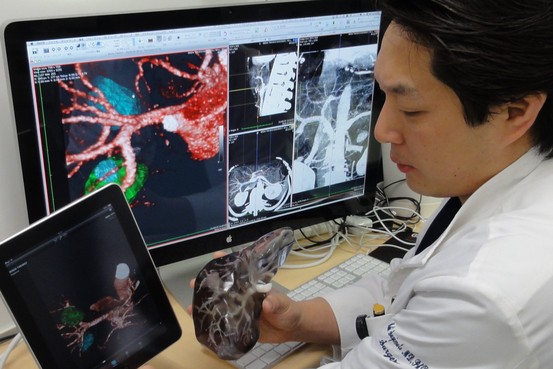
Japanese surgeon Maki Sugimoto holds a 3-D replica of a patient’s liver built by printers using acrylic resin.
Surgeons at a hospital in Japan recently faced a dilemma before transplanting a parent’s liver into a child: How exactly to trim the organ to fit the space in the child’s smaller cavity while preserving its functions.
So they took a knife to a three-dimensional replica of the donor’s liver built by a machine that resembles an office printer. The model helped the doctors figure out where to carve it, leading to a successful transplant last month.
Surgeons are finding industrial 3-D printers to be a lifesaver on the operating table. This technology, also known as additive manufacturing, has long produced prototypes of jewelry, electronics and car parts. But now these industrial printers are able to construct personalized copies of livers and kidneys, one ultrathin layer at a time. Read more of this post
April 9, 2013 Leave a comment
Luxury brands embrace DNA technology in fakes-ridden China
Staff Reporter, 2013-04-07
The world’s leading luxury brands have resorted to cutting-edge anti-counterfeiting technology to combat the rampant proliferation of fakes in the Chinese market. Counterfeit products have upped their tactics with similarly advanced technology, making it has become increasingly difficult to crack down the products.
Chanel announced recently that it has a unique coding method to control the production process for its handbags and the codes are incorporated into a fluorescent card, which accompanies every handbag on the shelf.
The anti-counterfeiting method is easy and clear for consumers but is still easy to be cracked. As a result, branded suppliers have strived to achieve breakthroughs in anti-counterfeiting technology, notably DNA-based technology, which includes DNA anti-counterfeiting ink, DNA anti-counterfeiting labels, and a DNA anti-counterfeiting chips.
“It is very difficult to crack DNA-based information, which will entail a big investment in time and costs on the part of counterfeiters,” remarks Mike Hayes, president of DNA Technologies. Read more of this post
April 9, 2013 Leave a comment
4/03/2013 @ 7:00AM |2,775 views
The Bumpy Ride for Deep Kalra’s MakeMyTrip Web Operation
By Saritha Rai

In humongous India, where snaking lines and extended waits are emblematic, instant travel reservations herald a new mobility. Deep Kalra’s MakeMyTrip Web operation, of New Delhi, pioneered the online travel field and at times has felt investor and customer delight.
But this is India, remember, and for the 43-year-old Kalra, as for many a service sector startup, the flight has been a bumpy one.
Today MakeMyTrip is fighting to stay profitable in an erratic economy and nascent e-commerce ecosystem. Kalra’s paper wealth, over $50 million, has been halved in 18 months and cut by two-thirds since a post-IPO peak. In the quarter ended in December, MakeMyTrip’s net revenues declined 5.5% and losses mounted to $2.6 million.
Even as investors pummeled the stock back to its $14 listing price, Kalra in an interview stoically takes refuge in Bollywood-speak. “Life is QSQT … quarter se quarter tak [quarter to quarter],” he says, using the popular acronym for the iconic romance film Qayamat Se Qayamat Tak (From Resurrection to Resurrection). Read more of this post
April 9, 2013 Leave a comment
Tech companies see real-life results from online translation programs
AP, APR 9, 2013
MOUNTAIN, VIEW CALIFORNIA – You might use Google Translate to read a hard-to-find manga or to decipher an obscure recipe for authentic Polish blintzes. Or, like Phillip and Niki Smith in rural Mississippi, you could use it to rescue a Chinese orphan and fall in love at the same time.
Google is now doing a record billion translations on any given day, as much text as you’d find in 1 million books for everything from understanding school lunch menus to gathering national security intelligence. It translates in 65 languages, from Afrikaans to Yiddish, and can be used on websites, with speech recognition and as an app on mobile phones even if there is no connection.
While the technology is exponentially evolving, Google’s translation guru Franz Och’s face lit up when he heard that the Smiths and their new daughter, 14-year-old Guan Ya, are settling into their lives together this month communicating almost exclusively through Google Translate.
“All day long I look at algorithms, algorithms and algorithms,” he says. “It is so rewarding to hear that it is touching lives.” Read more of this post
April 8, 2013 Leave a comment
APRIL 7, 2013, 11:00 AM
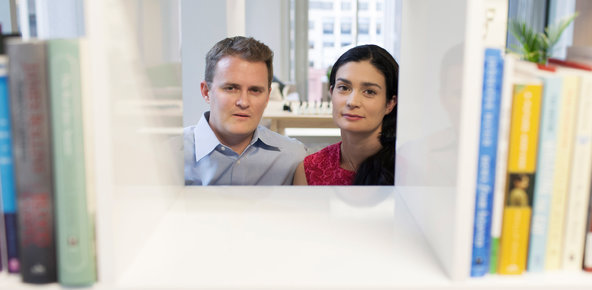 Otis Chandler and his wife, Elizabeth Khuri Chandler, the founders of Goodreads, a social media site that recently sold for a reported $150 million.
I have a vision of how suitors decide how much to offer for a start-up they want to buy. Several executives go into a conference room. Each scribbles a number on a piece of paper and places it in a hat. Then the chief executive pulls out a number, and there it is.
It might sound like a stretch, but given the seemingly random and sometimes nonsensical amounts for which start-ups with no revenue, or no users, or even no product are bought, I might not be far off.
But let’s say there is a logical way to value a company. During Bubble 1.0 there seemed to be — at least sometimes. Tech start-ups were valued by the number of eyeballs they attracted. When Broadcast.com was acquired by Yahoo for $5.9 billion in stock in April 1999, it was estimated that the company paid $10,000 per user.
Today, when eyeballs mean much less, how do start-ups with no revenue come up with a valuation? Well, it depends on a buyer’s reason for wanting the company. Read more of this post
April 8, 2013 Leave a comment
Tech upstarts threaten TV broadcast model
Sun, Apr 7 2013
By Liana B. Baker and Ronald Grover
(Reuters) – Two fledgling technologies could dramatically reshape the $60 billion-a-year television broadcast industry as they challenge the business model that has helped keep broadcasters on the lucrative end of the media spectrum.
On April 1, a U.S. appeals court rejected a petition by the major broadcasters including Comcast’s NBC, News Corp’s FOX, Disney’s ABC and CBS, to stop a service called Aereo, which offers a cut-rate TV subscription for consumers by capturing broadcast signals over thousands of antennas at one time.
It was the second time in recent months that TV broadcasters failed to block a new technology that undercuts revenue they generate for their television shows. Read more of this post
April 7, 2013 Leave a comment
These Charts Better Not Reflect The True State Of The US Economy
Tyler Durden on 04/06/2013 20:16 -0400
Lately, when it comes to obtaining an accurate sense of the true state of the US economy, it is as difficult if not more than analyzing the openly-manipulated Chinese data. On one hand, the Fed-juiced market, which has lost its discounting powers, no longer reflects the current or future economic (or corporate) fundamentals, on the other, massive seasonal aberrations, whether purposeful or accidental, have made a mockery of any data series, be it jobs, manufacturing, retail sales, or housing. On the other, the administration – still stuck in the worst economic “recovery” since the Great Depression – is desperate to telegraph an improving economy, most evident in the months leading up to the presidential election, which makes taking any data at face value problematic and naive at best. Yet even the openly-contradicting Chinese data manipulation has its Achilles heel in the form of monthly electricity consumption (and to a lesser extent, production) updates. So what is the US equivalent of Chinese electricity consumption data? We believe it may be the little-tracked, and thus not nearly as “adjusted” weekly updates from the Energy Information Administration, whose data on barrels of US product supplied of both total petroleum products and just gasoline are as indicative of the true state of the energy-hungry beating heart of the US economy as any other data set, and is likely a far more accurate representation of what is really going on between the lines.
Sadly, if that is indeed the case, then the disconnect between propaganda myth and reality is about as big as can be, since on a blended 52-week average basis, the total product supplied of motor gasoline is back to 2003 levels (black line on chart below). However, where it gets really scary is looking at the total product supplied category, which includes gasoline and all other product such as heating oil, propane, and kerosene.As the chart below shows, the US economy, whose GDP we are led to believe has never been higher, now has the same total consumption of all petroleum products (red line) as it did… back in 1997!
April 6, 2013 Leave a comment
Language Learning Startup Busuu Hits 30M Users And Launches New Kids iPad App
posted yesterday

Just this week Rosetta Stone acquired Seattle-based online language-learning communityLivemocha for $8.5 million in cash. At exit Livemocha had a 16 million member online language-learning community. It had also raised $19 million over six years. But today Busuu, a competing language-learning community based out of London, announces that it has reached 30 million users and its launched a dedicated iPad app for kids to learn Spanish.
It now reaches into 200 countries, and could lay justifiable claim to being the largest language learning community in the world. They also say they are growing at 40,000 new users a day with growth mainly coming from emerging markets like Brazil, Russia and Turkey, where clearly learning a language can help you get on. Read more of this post
April 6, 2013 Leave a comment
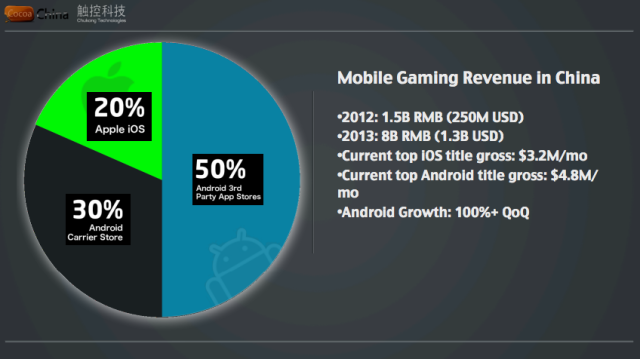
China Is Finally Becoming A Lucrative Market For App Makers
posted yesterday



咬定青山不放松,立根原在破岩中。 千磨万击还坚劲,任尔东西南北风。