Appily Ever After: A Smartphone Shrink; A few bucks and a lot of squinting into my phone: that certainly beats a $300-an-hour psychiatrist, right?

April 5, 2013

Appily Ever After: A Smartphone Shrink

By JUDITH NEWMAN

0407JP-APPI-NESS-articleLarge

When I was a kid, my favorite toy was the Magic 8 Ball. There was something immensely comforting about asking this little gizmo a question (“Will I find true love?”), shaking it and then seeing the answer that would bubble to the top of the screen: “Outlook good.”

As the world became more complicated and full of anxieties, many of us traded our Magic 8 Balls for therapists and self-help gurus. (“Will I find true love?” Answer: “First, you need to learn to love yourself.”)

But now a proliferation of psychology smartphone apps — with names like BreakkUpiStress and myinstantCOACH — purports to help us live happier, less anxious lives. As Mark McGonigle, a therapist in Kansas City, Mo., who invented the app Fix a Fight, puts it: “Electronic devices don’t have to drive us apart. They can bring us together.” Which sounds so good. A few bucks and a lot of squinting into my phone: that certainly beats a $300-an-hour psychiatrist, right? Read more of this post

9 Shocking Truths about Silicon Valley – Lessons from 100 Startup Founders

9 Shocking Truths about Silicon Valley – Lessons from 100 Startup Founders (Live Blog)

April 5, 2013 by Krish Raghav

Read more of this post

Fake Twitter Followers Becomes Multimillion-Dollar Business; The average price for 1,000 fake followers is $18

APRIL 5, 2013, 6:50 PM

Fake Twitter Followers Becomes Multimillion-Dollar Business

By NICOLE PERLROTH

Far from slowing, the market for fake Twitter followers seems to be taking off.

The fake Twitter follower phenomenon made headlines last summer after Mitt Romney’s Twitter following jumped by 100,000 in a matter of days. That news inspired a number of social media management companies like StatusPeople and SocialBakers to develop Web tools that try to determine what percent of a person’s Twitter followings are fake.

But those sites have hardly deterred people from dealing in the market for fake followers and fake retweets. The market is also becoming more sophisticated. In many cases, high-quality false  Twitter accounts are nearly impossible to discern from the real thing. Those that sell them claim that they can make up to a million dollars in one week.

Andrea Stroppa and Carlo De Micheli, two Italian security researchers, spent the last several months investigating the underground economy for Twitter followers and said they had found a thriving market.

There are now more than two dozen services that sell fake Twitter accounts, but Mr. Stroppa and Mr. De Micheli said they limited themselves to the most popular networks, forums and Web sites, which include Fiverr, SeoClerks, InterTwitter, FanMeNow, LikedSocial, SocialPresence and Viral Media Boost. Based on the number of accounts for sale through those services — and eliminating overlapping accounts — they estimate that there are now as many as 20 million fake follower accounts.

Fake followers are typically sold in batches of one thousand to one million accounts. The average price for 1,000 fake followers is $18, according to one study by Barracuda Labs. Mr. Stroppa and Mr. De Micheli said some sellers bragged that they made $2 and $30 per fake account. A conservative estimate, they said, was that fake Twitter followers offered potential for a $40 million to $360 million business. Read more of this post

Have a fancy navigation system? It’s probably running software built by QNX, a little-known but powerful Canadian company.

QNX: The little-known company that controls your car

April 5, 2013: 7:12 AM ET

Have a fancy navigation system? It’s probably running software built by QNX, a little-known but powerful Canadian company.

By Kurt Wagner, reporter

FORTUNE — Under the bright lights of the Consumer Electronics Show in Las Vegas last January, a stunning black Bentley sat with the top down on the showroom floor. The Bentley — a Continental GTC convertible starting at $191,000 — became the center of attention throughout most of the week as thousands of geeks filed through the Las Vegas Convention Center’s North Hall. But it was not for its curvaceous sheet metal that attracted them but its futuristic dashboard inside. Developed by Ottawa-based software company QNX, this dashboard boasted 3-D maps and reverse cameras, pre-touch technology that kicks the massive 17-inch screen to life as a hand approaches, and even, per Bentley’s request: video conferencing (only functional when the car is in park, of course).

For more than a decade, QNX — the same QNX that makes BlackBerry’s (BBRY) new mobile operating system known as BlackBerry 10 — has developed software specifically tailored toward the auto industry. Ask analysts what reputation QNX carries, and you’ll get phrases like “rock solid” or “a solution for things that can’t crash,” fitting considering the potential consequences of a computer failure while traveling at freeway speeds. (In a 2003 interview, one QNX customer jokingly told Fortune, “The only way to make this software malfunction is to fire a bullet into the computer running it.”) QNX has wielded this reputation to carve out an early hold on the so-called infotainment market share, shipping more than 9 million units in 2011, over 60% of all such units sold, according to Derek Kuhn, vice president of sales and marketing. Audi, Toyota (TM), BMW, Porsche, Honda (HMC), Land Rover — QNX has been in them all, and Kuhn estimates QNX software currently operates in “tens of millions” of cars around the globe. An automotive industry report from IHS pegs infotainment revenues at $6.7 billion for 2013. Read more of this post

An Introduction to the Startup Ecosystem in Indonesia, Thailand and Vietnam

The Story Of A Failed Startup And A Founder Driven To Suicide

The Story Of A Failed Startup And A Founder Driven To Suicide

Alyson Shontell | Apr. 4, 2013, 8:43 PM | 86,356 | 37

jody-sherman

A few months ago, on Sunday, January 27, an entrepreneur named Jody Sherman had plans to see a movie with a friend.

But that afternoon, the friend received a call from Jody’s wife, Kerri.

Jody had gone missing. Three hours later, Kerri notified the Las Vegas Police Department, fearing something might have happened to her husband.

At 11:12 PM, the police found Sherman’s body.

He was in his car on Witch Mountain Road, near Mount Charleston, Nevada, about 25 miles from Las Vegas. Sherman had been shot in the head.

The Clark County coroner’s office determined that Sherman had killed himself. It was five days before his 48th birthday.

News of Sherman’s suicide ripped through Twitter and the technology blogs. His death left thousands aching and confused. He left no note. His last Facebook message was written by his wife:

“This is Jody’s final post, and it isn’t coming from Jody. He’s gone. This is not a bit of his wonderful twisted humor. This is sad and real and forever. He didn’t say goodbye to anyone because he knew he couldn’t. So I’m saying it for him. If you are reading this it’s because you are connected to Jody in some way. He loved you, respected you, admired you, valued your presence in his life, or felt some combination of any or all of these things. And he would want each and every one of you to know and understand exactly that. Please post anything you have to say to or about Jody here.”

Just a few days after Sherman’s suicide, his company, Ecomom, had a board meeting in which his co-founder and the board found the startup in a startling state.

A couple of weeks later, Ecomom closed its doors. The prosaic reason: The company’s liabilities were greater than its assets.

Put more simply, Ecomom was broke. The 28-person startup — which had just raised $5 million six months earlier and more than $12 million total — ran out of cash. And no one left at the company seemed to know where it had gone. Read more of this post

Feathers Fly as New Rules Loom for Kids’ Apps; Updated federal children’s online privacy rules go into effect in July. Developers of games and other mobile software are still figuring out how to comply

April 4, 2013, 7:43 p.m. ET

Feathers Fly as New Rules Loom for Kids’ Apps

By ANTON TROIANOVSKI

MK-CC160_KIDAPP_G_20130404175704

Kids love Angry Birds, but will Angry Birds love them back?

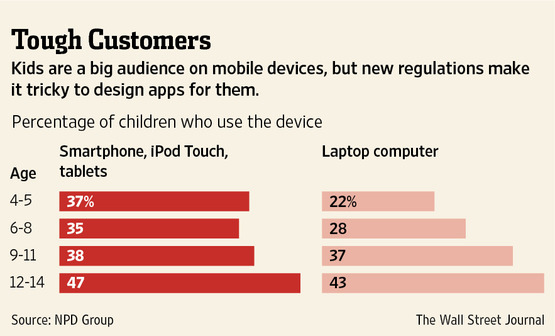
Updated federal children’s online privacy rules go into effect in July. Developers of games and other mobile software are still figuring out how to comply: They must balance their desire to tap the lucrative kids’ market and the increased regulatory headache of targeting children.

The biggest problem: data-collection practices that have become routine in the app industry could run afoul of the new rules when used in kids’ apps.

Japanese mobile games giant Gree Inc.3632.TO +3.02% and the U.K. company behind the popular kids’ website Moshi Monsters are scaling back plans to jointly build apps as they figure out how to adjust to the new rules, according to Moshi Monsters executive Rebecca Newton. Read more of this post

China’s internet: A giant cage; The internet was expected to help democratise China. Instead, it has enabled the authoritarian state to get a firmer grip. But for how long?

China’s internet: A giant cage

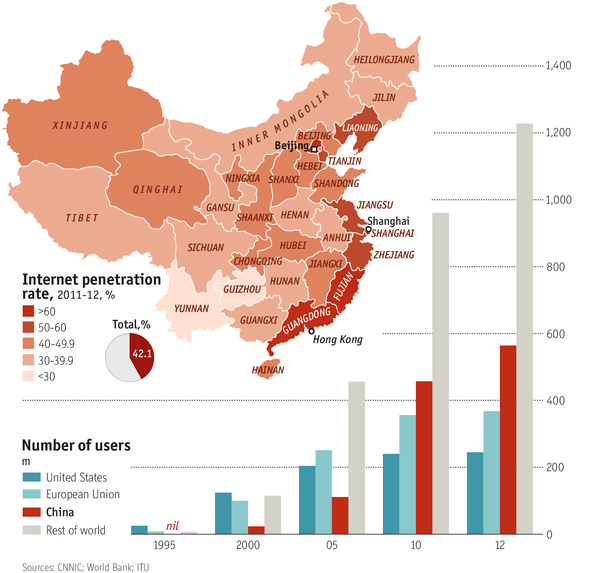
The internet was expected to help democratise China. Instead, it has enabled the authoritarian state to get a firmer grip, says Gady Epstein. But for how long?

Apr 6th 2013 |From the print edition

20130406_SRC965

THIRTEEN YEARS AGO Bill Clinton, then America’s president, said that trying to control the internet in China would be like trying to “nail Jell-O to the wall”. At the time he seemed to be stating the obvious. By its nature the web was widely dispersed, using so many channels that it could not possibly be blocked. Rather, it seemed to have the capacity to open up the world to its users even in shut-in places. Just as earlier communications technologies may have helped topple dictatorships in the past (for example, the telegraph in Russia’s Bolshevik revolutions in 1917 and short-wave radio in the break-up of the Soviet Union in 1991), the internet would surely erode China’s authoritarian state. Vastly increased access to information and the ability to communicate easily with like-minded people round the globe would endow its users with asymmetric power, diluting the might of the state and acting as a force for democracy.

Those expectations have been confounded. Not only has Chinese authoritarian rule survived the internet, but the state has shown great skill in bending the technology to its own purposes, enabling it to exercise better control of its own society and setting an example for other repressive regimes. China’s party-state has deployed an army of cyber-police, hardware engineers, software developers, web monitors and paid online propagandists to watch, filter, censor and guide Chinese internet users. Chinese private internet companies, many of them clones of Western ones, have been allowed to flourish so long as they do not deviate from the party line. Read more of this post

Samsung Electronics marketing blitz stirs debate over innovation

Samsung Electronics marketing blitz stirs debate over innovation

7:06am EDT

By Miyoung Kim

SEOUL (Reuters) – Samsung Electronics is spending more on marketing than R&D for the first time in at least three years, prompting some pundits to warn that the IT giant is sacrificing innovation at a time when the market is teeming with ever smarter gadgets.

The South Korean firm, which warned on Friday it will not post record quarterly earnings for the first time since 2011, looks set to spend big bucks on marketing upcoming mobile devices, including the Galaxy S4 smartphone, to convert more iPhone and iPad users loyal to arch rival Apple Inc.

While the new Galaxy smartphone, unveiled to much fanfare in New York last month, will boast a motion-detecting technology that stops and starts videos depending on whether someone is looking at the screen, and flip between songs and photos at the wave of a hand, industry watchers say the device would not overturn an industry that lives and dies by innovation.

“(Samsung) lagged behind in creating a new category. Apple created a new category with tablets. We are waiting to see something like that happen from Samsung,” said Rachel Lashford, an analyst at research firm Canalys in Singapore. Read more of this post

Twitter Arrives on Wall Street, Via Bloomberg

APRIL 4, 2013, 11:12 AM

Twitter Arrives on Wall Street, Via Bloomberg

By WILLIAM ALDEN

Largely blocked on Wall Street, Twitter is making its big debut on trading desks — via Bloomberg terminals.

Bloomberg L.P. announced on Thursday that it was incorporating tweets into its data service, which is widely used in the financial industry. The new feature allows traders and other professionals to monitor social media buzz and important news about companies they follow.

This arrival of Twitter comes through something of a side door. The big Wall Street banks largely ban the use of Twitter and other social media sites at work, citing regulations governing communication. Though some firms are allowing certain employees onto social media, that usage is carefully controlled.

Now, bank employees are getting a broader and more organized view of what’s being said in the Twittersphere. Some on Wall Street already use their mobile phones to monitor the site for information that could move stocks.

Bloomberg’s new service shows tweets sorted by company and topic, allowing users to search by key word and to set up alerts for when a particular company is getting an unusual amount of attention. Read more of this post

App makers say a growing group of “cloners” are mimicking their products or misappropriating their names and images to ride an original app’s success

Updated March 4, 2013, 8:05 p.m. ET

Clone Wars Roil App World

By AMIR EFRATI

In the fast-paced mobile-apps business, creating a hit app is no guarantee of success: Developers must also fend off the copycats.

App makers say a growing group of “cloners” are mimicking their products or misappropriating their names and images to ride an original app’s success.

The copycats often target top-selling apps and seek to siphon off users and potential revenue. Others carry malicious software. Despite their proliferation, app stores run by GoogleInc. GOOG -0.84% and others have been unable to weed them out.

Consider the experience of WhatsApp Inc., a Mountain View, Calif., company that makes a mobile-messaging app that has been downloaded hundreds of millions of times since its 2009 launch. After WhatsApp reached the top of the app-store rankings, WhatsApp employees noticed that other apps were hijacking its name to ride its coattails.

Today in Google’s app store, alleged WhatsApp clones include “Whatsapp Nearby,” “Whatsapp Friends,” and “Whatsapp Add Me”—none of which were made by WhatsApp but which allow users to contact each other and make new friends. Those three apps, which were made by the same developer, have been downloaded hundreds of thousands of times. The developer denies they are copycats. Read more of this post

Bond Traders Club Loses Cachet in Most Important Market; In the same way technology eroded the middleman role once played by travel agents and stock-market specialists, increased use of the direct-bidding system threatens government-bond traders

Bond Traders Club Loses Cachet in Most Important Market

Primary dealers, the select group of banks and brokers that have held a seat at the center of the U.S. government debt market since 1960, are losing influence.

More than 20 percent of the $538 billion of Treasury notes auctioned this year have been awarded to bidders who bypassed the dealers by using a website to place their orders, according to data provided by the U.S. Treasury Department. That’s almost double the 2011 level and up from 5.6 percent in 2009.

In the same way technology eroded the middleman role once played by travel agents and stock-market specialists, increased use of the direct-bidding system threatens government-bond traders at firms ranging from Bank of America Corp. to UBS AG. (UBSN) It also has eaten into profits from a business that’s among the least affected by the regulatory changes and new capital requirements reshaping the industry.

“You’ll see clients do a lot more things in a self- sufficient manner than they used to do before,” said Richard Prager, global head of trading at BlackRock Inc. (BLK), the world’s largest asset manager with $3.8 trillion. “It’s just the realities of today.” Read more of this post

Consumer Tech Finds Office Role; iPads, Dropbox, Gmail Jump Hurdles in Their Transition to Business Tool; Swiss drug maker Roche is deploying Gmail to its 80,000 employees

Updated April 3, 2013, 8:49 p.m. ET

Consumer Tech Finds Office Role

iPads, Dropbox, Gmail Jump Hurdles in Their Transition to Business Tool

By RACHAEL KING

Fueled by tight budgets, more businesses are turning to consumer technologies such as iPads, file-hosting service Dropbox and Google GOOG -0.84% productivity tools that can be easier to use and less expensive than industrial-strength counterparts.

This consumerization movement gathered steam with the launch of the iPad three years ago and its embrace by sales, media and information technology executives. Since then, Google apps have found their way onto desks at drug maker Roche Holding AG, ROG.VX +0.63% which is deploying Gmail to its 80,000 employees, one of the largest corporate Gmail rollouts to date.

In part, the financial rewards of consumer technologies are a big lure. Contract manufacturer Sanmina-SCI Corp. SANM -1.99% has saved $2 million annually since it began moving 21,000 employees to Google Apps for messaging, email and calendar in 2008, said CIO Manesh Patel. Read more of this post

Addictive animal webcams prove irresistible to business and viewers; The average person, seemingly transfixed by the cuteness, stays on the page for 18 minutes and 50 seconds

Addictive animal webcams prove irresistible to business and viewers

April 3, 2013

BRIAN STELTER

art-cat-620x349

Too cute: Animal Planet has signed a deal with Samsung to encourage viewers to watch Kitty Cam on their TVs.

The average visitor to the Kitten Cam on Animal Planet’s website has a hard time leaving. The live internet stream of felines has been watched more than 25 million times since it started last September. The average person, seemingly transfixed by the cuteness, stays on the page for 18 minutes and 50 seconds.

“That’s a longer length of time than many television shows,” said the head of Animal Planet, Marjorie Kaplan.

The channel, sensing that its visitors would like more of a good thing, will begin promoting 10 more web channels this week as “ambient entertainment” for viewers and advertisers. At a new website, APL.TV, webcams of ants, beluga whales, chicks, penguins, wild birds, and even cockroaches, will be live all the time, day and night.

The web channels — under the umbrella name “Animal Planet Live” — are designed for internet-connected TV sets, so viewers can watch the kitties and penguins on their big screens. Animal Planet already has a deal with Samsung so that the cams will appear on the manufacturer’s smart TV interface, and it says it will have a similar app for Xbox Live in coming months. The arrangement portends a future when tiny, cheap web channels can compete for viewers with 30-year-old cable TV channels.

Importantly for Animal Planet’s owner, Discovery Communications, which has withheld most of its television programming from the web, the new web channels are additive and do not use anything that already runs on the main Animal Planet channel. Read more of this post

Mobile phone turns 40, with little fanfare; Father of the mobile phone, Martin Cooper, placed the first call to a rival, Joel Engel of Bell Labs. “They thought that we were a gnat, an obstacle… we believed in competition and lots of players. And we also believed – our religion was portables, because people are mobile.”

Mobile phone turns 40, with little fanfare

April 4, 2013 – 9:11AM

bg_first_mobile_phone-20130404084241509589-620x349

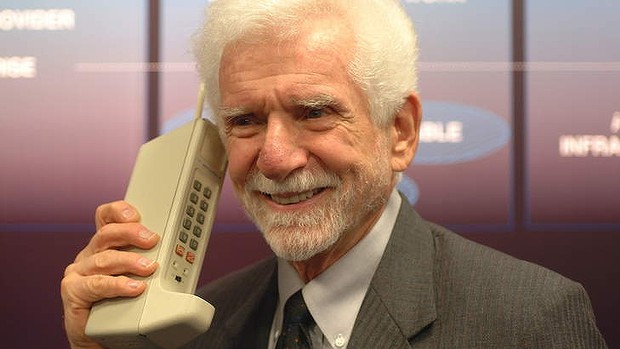
Father of the mobile phone, Martin Cooper, pictured with the first functional mobile phone.

The mobile phone turned 40 on Wednesday, with no fanfare to mark the occasion in a market which seemed focused on new smartphones like the iPhone and a possible Facebook-themed device.

The first mobile call was placed April 3, 1973, by Motorola engineer Martin Cooper, head of a team working on mobile communication technologies. Cooper made the call on Sixth Avenue in New York, before going into a press conference using a Motorola DynaTAC – a device that weighed one kilogram, and had a battery life of 20 minutes, according to Motorola. Cooper told the technology website The Verge last year that he placed the first call to a rival, Joel Engel of Bell Labs.

“To this day, he resents what Motorola did in those days,” Cooper said. “They thought that we were a gnat, an obstacle… we believed in competition and lots of players. And we also believed – our religion was portables, because people are mobile. And here they were trying to make a car telephone and a monopoly on top of that. So that battle was the reason that we built that phone.” Read more of this post

Angry Birds Maker at Pivot Point

Updated April 3, 2013, 8:59 p.m. ET

Angry Birds Maker at Pivot Point

By JUHANA ROSSI

HELSINKI—Rovio Entertainment Ltd. continued to grow at a rapid clip last year, but a top executive said maintaining momentum hinges on how well it pivots from a hot Nordic game developer into a global entertainment powerhouse.

The Finnish company, which struck gold in 2009 with the launch of its Angry Birds mobile game, said Wednesday it doubled 2012 revenue compared with the prior year and posted a steep increase in net profit. Head count more than doubled to 518 staffers and its closely watched active-monthly-user count marched past the quarter billion mark. Read more of this post

China’s Baidu developing digital eyewear similar to Google Glass

China’s Baidu developing digital eyewear similar to Google Glass

4:57am EDT

SHANGHAI (Reuters) – Baidu Inc (BIDU.O: QuoteProfile,ResearchStock Buzz), China’s largest search engine, is developing prototype digital eyewear similar to Google Inc’s (GOOG.O: QuoteProfileResearchStock Buzz) Google Glass that will leverage Baidu’s strengths in image search and facial recognition, a Baidu spokesman said on Wednesday.

Internally known as project “Baidu Eye”, the glasses are being tested internally and it is not clear whether the product will ever be commercialized, said Kaiser Kuo, Baidu’s spokesman.

Kuo said the device will be mounted on a headset with a small LCD screen and will allow users to make image and voice searches as well as conduct facial recognition matches.

“What you are doing with your camera, for example, taking a picture of a celebrity and then checking on our database to see if we have a facial image match, you could do the same thing with a wearable visual device,” Kuo said. Read more of this post

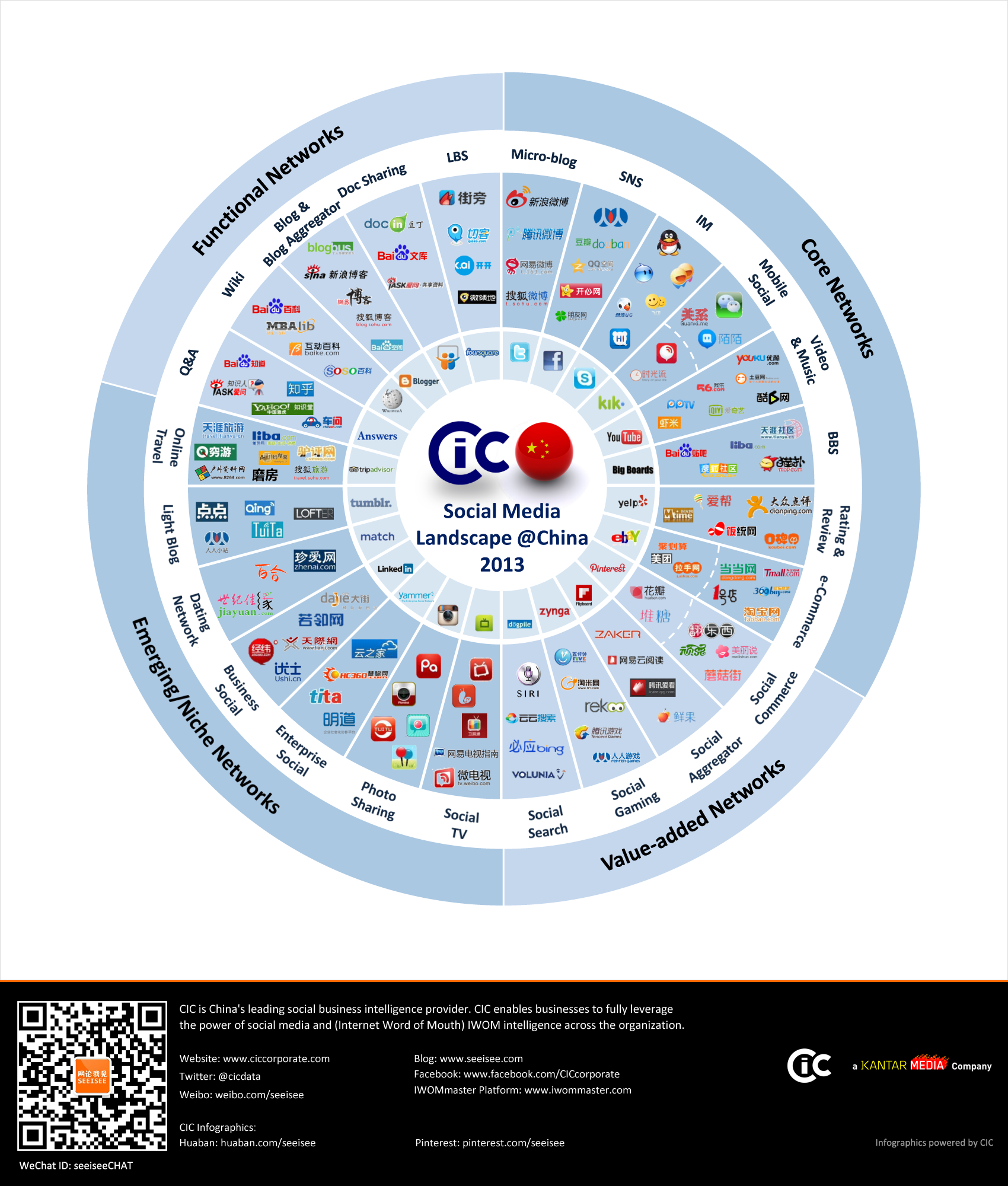
China Social Media Landscape (Infographics)

CIC-2013-中国社会化媒体格局概览图-EN-with-Watermark

SEC Approves Using Facebook, Twitter for Company Statements

SEC Approves Using Facebook, Twitter for Company Statements

Companies can use social media outlets such as Facebook Inc. and Twitter Inc. to announce key information as long as investors have been alerted where to look, the U.S. Securities and Exchange Commission said today.

The SEC clarified the disclosure guidelines in a report of an investigation involving Netflix Inc. (NFLX) Chief Executive Officer Reed Hastings, who posted monthly viewership results on his Facebook page in July even though the company didn’t report the data in a public filing or press release.

The SEC confirmed that a regulation which prohibits companies from disclosing material information to select sets of investors applies to social media and other emerging means of communication the same way it applies to company websites. Company communications made through social media channels could constitute a violation of the fair disclosure rule known as Regulation FD if investors had not been told in advance where the information would be posted, the SEC said. Read more of this post

Is it a phone, is it a bank? Safaricom widens its banking services from payments to savings and loans; 15m Kenyans use M-PESA for everything from paying electricity bills to school fees, thanks to a simple text-based menu that is accessible on even the most basic mobile phone

Mobile banking

Is it a phone, is it a bank? Safaricom widens its banking services from payments to savings and loans

Mar 30th 2013 | NAIROBI |From the print edition

20130330_FNP001_0

Loans as well as phones

SWAHILI continues to creep into the language of global finance. M-PESA, a thriving money-transfer system run by Safaricom, a Kenyan mobile-phone operator, and named after the word for “cash”, has already entered the lexicon. Having persuaded millions of Kenyans to send cash through an SMS network, Safaricom is now trying to tempt them into a savings-and-loans service called M-Shwari, after the Swahili for “cool” or “calm”.

Safaricom has nearly as many subscribers as Kenya has adults—19m people from a population of 43m. Almost 15m of them use M-PESA for everything from paying electricity bills to school fees, thanks to a simple text-based menu that is accessible on even the most basic mobile phone. The firm, which is 40%-owned by Vodafone, makes its money through transaction fees when customers withdraw or transfer cash at a network of more than 40,000 M-PESA agents throughout the country. Read more of this post

Video: Haptic-feedback shoes guide blind walkers

Video: Haptic-feedback shoes guide blind walkers

Posted by: Kate Torgovnick

April 1, 2013 at 5:51 pm EDT

The footage in this video — which shows a man, a woman and a teenager walking down paths, around curves, up stairs and across streets — may not at first viewing seem remarkable. But the people in this video are blind — and walking without a cane or guide dog. Instead, they are being guided by their shoes. These shoes, which TED Senior Fellow Anthony Vipin Das introduced us to at TED2013, use haptic feedback and GPS technology to guide the blind. Each pair contains electronic circuitry, sensors and small actuators that give the wearer feedback on their movement as they walk, vibrating to tell them when to turn or lift their feet. (See Katherine Kuchenbecker’s great TED-Ed lesson to the field of haptic technology, which debuted on TED.com just last week.) They use a voice-programmed app that reads local GPS maps and plan routes. They have sensors that note obstacles and tell the wearer to stop. The shoes can also read gestures from the walker — for example, two taps means “take me home.” These shoes are called Le Chal, which means “take me there” in Hindi. And as Vipin Das shared in this Q&A with the TED Blog, they are being tested in their first clinical study at LV Prasad Eye Institute in Hyderabad, India. Expected to be available this year, the shoes can be pre-ordered at Ducere Technology’s website. “It’s very encouraging to see the kind of response we’ve had from wearers,” Vipin Das tells the TED Blog. “They were so moved because it was probably the very first time that they had the sense of independence to move confidently — that the shoe was talking to them, telling them where to go and what to do.”

The Hidden Biases in Big Data

The Hidden Biases in Big Data

by Kate Crawford  |   2:00 PM April 1, 2013

This looks to be the year that we reach peak big data hype. From wildly popular big data conferences to columns in major newspapers, the business and science worlds are focused on how large datasets can give insight on previously intractable challenges. The hype becomes problematic when it leads to what I call “data fundamentalism,” the notion that correlation always indicates causation, and that massive data sets and predictive analytics always reflect objective truth. FormerWired editor-in-chief Chris Anderson embraced this idea in his comment, “with enough data, the numbers speak for themselves.” But can big data really deliver on that promise? Can numbers actually speak for themselves?

Sadly, they can’t. Data and data sets are not objective; they are creations of human design. We give numbers their voice, draw inferences from them, and define their meaning through our interpretations. Hidden biases in both the collection and analysis stages present considerable risks, and are as important to the big-data equation as the numbers themselves. Read more of this post

Softbank-Backed Startup SmarTots Builds Facebook for Kids

Softbank-Backed Startup SmarTots Builds Facebook for Kids

A former Nokia Oyj (NOK1V) engineer is building a private social network in China where children share art projects online with parents or grandparents. Japan’s phone and Internet giant Softbank Corp. (9984) is betting he’ll succeed.

SmarTots, Jesper Lodahl’s Beijing-based startup, began offering mobile education applications for kids from two to seven through Apple Inc. (AAPL)’s China iTunes store in June. Designed as a game center for app developers, this month it’s adding functions to allow parents to “like” or comment on projects in a layout similar to Facebook Inc. (FB)’s site, Lodahl said.

Softbank, which provided funding, and Lodahl expect growth in smartphones and tablets to drive demand for educational services. Parents’ desire to set children apart from peers is likely to drive strong demand for any service in China that can offer an edge, said Duncan Clark, Beijing-based chairman of BDA China, which advises technology companies.

“People will pay a lot for their kid’s educations,” said Clark, who doesn’t work with SmarTots. “There is a lot of spending power around educational betterment.” Read more of this post

High-Tech Means of Production Belies the Nostalgic Image of Maple Syrup; Gathering sap to boil into maple syrup, long a tradition in places like Vermont, has become a more high-tech process, with miles of plastic tubing and powerful vacuums that draw the sap out of the trees using reverse osmosis machines

March 30, 2013

High-Tech Means of Production Belies the Nostalgic Image of Maple Syrup

By JULIA SCOTT

SYRUP-1-articleLarge

Gathering sap to boil into maple syrup, long a tradition in places like Vermont, has become a more high-tech process, with miles of plastic tubing and powerful vacuums that draw the sap out of the trees.

EAST MONTPELIER, Vt. — The rich, sweet tang of sap being boiled into maple syrup greeted tourists at Burr Morse’s sugar shack here this month — along with Mr. Morse, every inch the rural maple farmer in worn baseball cap and syrup-stained jacket, stirring the steaming evaporator with an old-fashioned dipper.

“People want to have a nostalgia trip,” said Mr. Morse, 65, a seventh-generation maple syrup farmer and the patriarch of Morse Farm Maple Sugarworks. “They want to see something natural, like taking sap from a tree.”

Forty years ago, Mr. Morse would snowshoe into the forest with his father to collect sap from galvanized buckets and load them onto a tractor. The farm has not changed much since then, but the winters have. So has the maple syrup ritual itself.

Scientists say the tapping season — the narrow window of freezing nights and daytime temperatures over 40 degrees needed to convert starch to sugar and get sap flowing — is on average five days shorter than it was 50 years ago. But technology developed over the past decade and improved in recent years offers maple farmers like Mr. Morse a way to offset the effects of climate change with high-tech tactics that are far from natural.

Today, five miles of pressurized blue tubing spider webs down the hillside at Morse Farm, pulling sap from thousands of trees and spitting it into tubs like an immense, inverse IV machine. Modern vacuum pumps are powerful enough to suck the air out of a stainless steel dairy tank and implode it, and they help producers pull in twice as much sap as before.

“You can make it run when nature wouldn’t have it run,” Mr. Morse said. His greatest secret weapon is a reverse-osmosis machine that concentrates the sap by pulling it through sensitive membranes, greatly increasing the sugar content before it even hits the boiler. The $8,000 instrument with buttons and dials looks like it belongs in a Jetsons-era laboratory more than in a Vermont sugarhouse. But it saves more fuel and money than every other innovation combined. With it Mr. Morse can process sap into syrup in 30 minutes, something that used to take two hours. Read more of this post

Time is ripe for smartwatches; 2013 may be the year for the smartwatch because “the components have gotten small enough and cheap enough” and a large number of consumers now have smartphones that can connect to a wearable device

Time is ripe for smartwatches, analysts say

2013-03-31 07:44:30 GMT2013-03-31 15:44:30(Beijing Time)  SINA.com

Amid much speculation on the future of the “smartwatch,” the consensus is growing: the time is right.

In recent weeks, reports have surfaced about plans for smartwatches from tech giants Apple, Samsung and Google, with launches possible later this year.

“I think we have reached a tipping point,” said Avi Greengart, analyst on consumer devices at the research firm Current Analysis.

Greengart said 2013 may be the year for the smartwatch because “the components have gotten small enough and cheap enough” and a large number of consumers now have smartphones that can connect to a wearable device.

The idea of the connected watch has been around for at least a decade: Microsoft had one in 2003. And some devices are already on the market including from Sony, the crowdfunded maker Pebble and Italian-based firm i’m. Read more of this post

Papers Worldwide Embrace Web Subscriptions

March 31, 2013

Papers Worldwide Embrace Web Subscriptions

By ERIC PFANNER

SERRAVAL, France — Newspapers, once reluctant to try to charge readers for access to their Web sites, have begun doing so in droves.

Across many of the developed economies of America, Europe and Asia, so-called pay walls are proliferating as publishers struggle to make up for dwindling revenue on their print products. Online advertising, once seen as the great hope for the future, has begun leveling off, which is accelerating the push for new Internet business models.

“Why now?” said Douglas McCabe, an analyst at Enders Analysis in London. “The outlook for digital advertising for all but the very largest sites looks increasingly challenging. Therefore, it is critical that news services experiment with subscription models.” Read more of this post

New Disney Characters Make It Big in TV’s Preschool Playground; Nick Jr. ratings have plummeted more than 50 percent since Disney introduced Disney Junior

March 31, 2013

New Disney Characters Make It Big in TV’s Preschool Playground

By BROOKS BARNES and AMY CHOZICK

PRESCHOOL-articleLarge

LOS ANGELES — Sorry, Dora. You’ve been dethroned.

Nick Jr. has long been cable television’s No. 1 channel dedicated solely to preschool children. The service, owned by Viacom, had a smash hit in “Dora the Explorer,” which made its debut in 2000. Competition was also light: the Walt Disney Company, preoccupied with hunting for preteenagers, operated no 24-hour preschool channel.

But in the year since Disney introduced Disney Junior, a channel aimed at the tiniest of viewers, Nick Jr. ratings have plummeted more than 50 percent, according to Nielsen. On Tuesday Nielsen data for Disney Junior will be revealed for the first time; the new channel is expected to beat its rival, even though Nick Jr. is available in 75 million homes, 25 percent more than Disney Junior.

Disney now has the top three preschool cable programs, led by what appears to be a monster-size new hit, “Sofia the First,” a cartoon that stars a pint-size princess and her zany animal friends. Read more of this post

E-commerce companies that make everything from bedding to eyeglasses are trying to build premium brands at discount prices by cutting out middlemen and going directly to manufacturers

March 31, 2013

E-Commerce Companies Bypass the Middlemen

By CLAIRE CAIN MILLER and STEPHANIE CLIFFORD

When the founders of a start-up that sells eyeglasses online, Warby Parker, began investigating why designer glasses cost several hundred dollars, they discovered that everyone in the process was taking a cut: designers, manufacturers, brands, wholesalers and retailers.

But what if they left out most of those people? “I had been to the factories and knew what it costs to manufacture glasses and knew the cost didn’t warrant a $700 price tag,” said Neil Blumenthal, a founder of the company. Inspired by glasses they found in their grandparents’ attics, the founders sketched a few frames, hired the same Chinese factories that make designer glasses and started selling directly to consumers online. By doing so, they eliminated enough of the cost to charge customers just $95 a pair.

Warby Parker is part of a wave of e-commerce companies that are trying to build premium brands at discount prices by cutting out middlemen and going straight to manufacturers. They make everything from bedding (Crane and Canopy), to office supplies (Poppin), nail polish (Julep), tech accessories (Monoprice), men’s shoes (Beckett Simonon) and shaving supplies (Harry’s). The result is generally cheaper products for consumers and higher profit margins for the companies. Big retailers discovered long ago that controlling the supply chain benefited their bottom lines, which is why companies like Wal-Mart and Whole Foods sell many products under their own brands. At Macy’s and Kohl’s, such “private label” brands make up almost half of their sales. Read more of this post

eBay CEO: Same-day shipping will be everywhere; “I’ve had newspaper companies come to me and say, we have all these trucks. Can we help deliver?”

eBay CEO: Same-day shipping will be everywhere

By JP Mangalindan, Writer March 29, 2013: 1:19 PM ET

John Donahoe tells Fortune that eBay’s same-day shipping service could eventually serve everyone in the U.S.

FORTUNE — Same-day shipping is inevitable, according to eBay CEO John Donahoe.

While eBay’s (EBAY) same-day shipping program, eBay Now, may be available in just three U.S. cities — with another two coming this summer — Donahoe foresees a day when customers can get thousands of items from partners like Target (TGT), Home Depot (HD), and Urban Outfitters everywhere within an hour, from Portland to Peoria. “We’re looking at the consumer benefits and the retailer benefits,” Donahoe tells Fortune. “How it gets connected is wide open.”

That means exploring other third-party shipping and transportation systems to exploit excess capacity. Just as say, Airbnb lists available homes and rooms and Uber leverages the downtime of black car and taxi drivers, eBay Now could utilize the excess capacity of shipping services like UPS (UPS). Indeed, the company has already had early talks with two well-known shipping and transportation companies about potential partnerships that would expand eBay Now’s coverage.

“I’ve had newspaper companies come to me and say, we have all these trucks. We deliver these newspapers, and these trucks don’t get used after 8 a.m. in the morning. So we have drivers, and we have empty trucks. Can we help deliver?” says Donahoe, who readily points out there are newspaper trucks in every city in America. Read more of this post

New book shares insights from Steve Jobs’ 1st boss, Atari’s Steve Bushnell; Bushnell turned down an offer from his former employee to invest $50,000 in Apple during its formative stages, a one-third stake now worth $120 billion

New book shares insights from Steve Jobs’ 1st boss

(philstar.com) | Updated March 28, 2013 – 4:11pm
bushnell

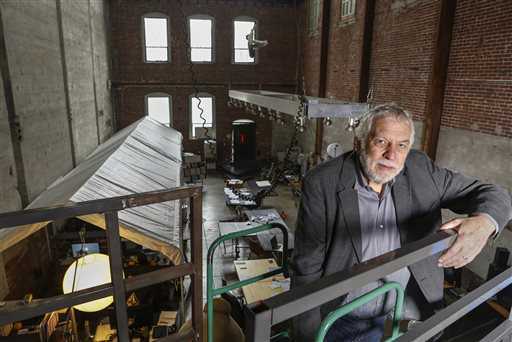
In this photo taken Wednesday, Mar. 20, 2013, Nolan Bushnell, the founder of Atari poses for a photo at “Two-Bits-Circus,” a Los Angeles idea factory focused on software, hardware and machines. Bushnell was the first guy to give Steve Jobs his first full-time job in Silicon Valley at Atari. (AP Photo/Damian Dovarganes)

SAN FRANCISCO (AP) — When Steve Jobs adopted “think different” as Apple’s mantra in the late 1990s, the company’s ads featured Albert Einstein, Bob Dylan, Amelia Earhart and a constellation of other starry-eyed oddballs who reshaped society.

Nolan Bushnell never appeared in those tributes, even though Apple was riffing on an iconoclastic philosophy he embraced while running video game pioneer Atari in the early 1970s. Atari’s refusal to be corralled by the status quo was one of the reasons Jobs went to work there in 1974 as an unkempt, contemptuous 19-year-old. Bushnell says Jobs offended some Atari employees so much that Bushnell eventually told Jobs to work nights when one else was around.

Bushnell, though, says he always saw something special in Jobs, who evidently came to appreciate his eccentric boss, too. The two remained in touch until shortly before Jobs died in October 2011 after a long battle with pancreatic cancer.

That bond inspired Bushnell to write a book about the unorthodox thinking that fosters the kinds of breakthroughs that became Jobs’ hallmark as the co-founder and CEO of Apple Inc. Apple built its first personal computers with some of the parts from Atari’s early video game machines. After Jobs and Steve Wozniak started Apple in 1976, Apple also adopted parts of an Atari culture that strived to make work seem like play. That included pizza-and-beer parties and company retreats to the beach.

“I have always been pretty proud about that connection,” Bushnell said in an interview. “I know Steve was always trying to take ideas and turn them upside down, just like I did.”

Bushnell, now 70, could have reaped even more from his relationship with Jobs if he hadn’t turned down an offer from his former employee to invest $50,000 in Apple during its formative stages. Had he seized that opportunity, Bushnell would have owned one-third of Apple, which is now worth about $425 billion — more than any other company in the world.

Bushnell’s newly released book, “Finding The Next Steve Jobs: How to Find, Hire, Keep and Nurture Creative Talent,” is the latest chapter in a diverse career that spans more than 20 different startups that he either launched on his own or groomed at Catalyst Technologies, a business incubator that he once ran. Read more of this post