Big Data Can Bring Patients to Water But It Can’t Make Them Think; Aetna can tell its members if they’re likely to develop cardiovascular disease. It does this by tracking data from lab results, pharmacy data and claims data of its 18 million members

March 20, 2013, 7:30 PM ET

Big Data Can Bring Patients to Water But It Can’t Make Them Think

Michael Hickins

As it prepares to vie for new business from some of the 30 million additional people entering health exchanges through the Affordable Care Act next year Aetna Inc. is looking to analytics as a means of lowering the cost of some coverage. According to Michael Palmer, head of innovation for the Hartford, Conn.-based insurance company, Aetna is using a new analytic platform to predict which ailments its members are likely to contract over the coming year in order to lower the odds that they will develop cardiovascular disease, one of the more expensive and endemic diseases it has to cover.

This information could help improve health outcomes for patients, dramatically lowering health care costs for themselves, their employers and Aetna itself, says Mr. Palmer. “Better outcomes also lead to better costs. It’s a virtuous cycle,” he told CIO Journal Wednesday after a presentation at the Structure: Data conference in New York. But Mr. Palmer also noted that it’s difficult to get people to act on the information they’re given, even if it’s for their own good.

For example, Aetna can tell its members if they’re likely to develop cardiovascular disease. It does this by tracking data from lab results, pharmacy data and claims data of its 18 million members, looking for data showing that a given individual suffers from three of any of five factors – high cholesterol, high blood pressure, low HDL (so-called good cholesterol), high triglyceride levels, and abdominal girth – all of which are indicative of metabolic syndrome. “We found we can predict at the individual level the probability of their getting metabolic syndrome in the coming year,” Mr. Palmer said. Read more of this post

Facebook Targeted in U.S. as Asian Chat App Line Invades

Facebook Targeted in U.S. as Asian Chat App Line Invades

Line, the Asian chat app that reached 100 million users about three times faster than Facebook Inc. (FB), is putting growth before profit to take on the U.S. social-networking giant and Twitter Inc. in their own backyard.

With 38 percent of its users in Japan, developer NHN Japan Corp. is honing plans to expand Line’s reach, setting up a U.S. marketing team and planning joint promotions and content- delivery agreements with local companies. NHN Japan is still at an investment phase as it targets as many as 1 billion customers globally, said Jun Masuda, chief strategy and marketing officer.

“This year, we want to capture North America,” Masuda said. “We’re not focused on being in the black. It isn’t time to cash in yet.”

Known for cartoon characters and other “stickers” that users can include in chat messages, Line is among several apps from Asia challenging Facebook, Twitter and Microsoft Corp.’s Skype as a way of communicating via mobile devices. South Korea’s KakaoTalk is looking to Vietnam and Indonesia to expand past 82 million users; China’s WeChat has about 300 million.

Line reached the 100 million-user mark 19 months after its June 2011 debut, compared with 49 months for Twitter and 54 months for Facebook, according to NHN Japan. Read more of this post

Alibaba’s Jack Ma outlines e-commerce vision for China

Jack Ma outlines e-commerce vision for China

The founder of Alibaba Group speaks to investors at an annual Credit Suisse conference ahead of stepping down as CEO in May.

By Anette Jönsson | 21 March 2013

In five years, e-commerce will account for 30% of total retail sales in China, Alibaba chairman and CEO Jack Ma said yesterday in a passionate speech that displayed his unwavering belief in the continuing development of the sector.

“Traditional businesses still think e-commerce is a business model. It is not, it is a lifestyle,” he told the audience at Credit Suisse’s Asian Investment Conference, adding that in 10 years nobody will talk about e-commerce as it will be a natural part of everyone’s lives, just like nobody is talking about electricity today.

The Alibaba Group, which includes Taobao, the popular consumer-to-consumer online shopping platform, and business-to-consumer sales platform Tmall.com, currently account for about 5% of total retail sales in China, said Ma, who called his 30% forecast “very conservative.”

According to Ma, e-commerce in the US is like a dessert – a supplement for traditional businesses. The infrastructure is so good in the US that it is difficult for a pure online company to grow to surpass the traditional businesses. But in China, because the infrastructure is so bad, e-commerce becomes the main course, he said. Read more of this post

Meet the next generation of Indian technology firms—and the obstacles they face

Meet the next generation of Indian technology firms—and the obstacles they face

Mar 16th 2013 | MUMBAI |From the print edition

20130316_WBT903_020130316_WBC239_0

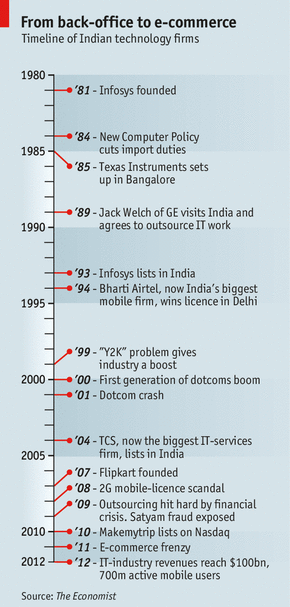
SIGNS of middle age were obvious at a recent gathering of Nasscom, the club for India’s giant IT industry, which now has sales of $100 billion and is dominated by outsourcing firms. The venue was a hotel in Mumbai, a five-star fortress of foyers and finger food. The guests of honour were politicians. Grey-haired, well-fed executives sat and talked in jargon. It was hard to spot anyone close to India’s median age of 26. Things have come a long way since 1981 when Infosys, a bellwether Indian IT firm, was founded in a flat by seven hungry engineers with $250.

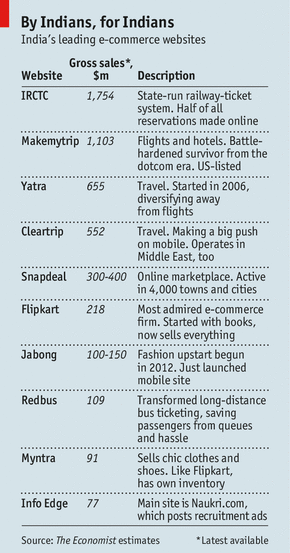
Yet if you walk to the exit of that hotel and reject the option of an expensive limousine, or of hailing a bashed-up street taxi, and instead press “Book now” on your phone screen, another Indian tech scene appears. The application links a network of taxis using satellite positioning, cheap Chinese-made smartphones, souped-up Google maps and credit cards. A 6km (4-mile) drive north in a modern car will deliver you to a snack shop, above which is the firm that runs the system. Olacabs was set up in 2010. Its co-founder, Bhavish Aggarwal, is a 26-year-old engineer who has worked for Microsoft in Seattle. He has raised a slug of venture capital, some of it American, and says business is growing at 30% a month. “When you start you are viewed as a fool,” he says. “But if you are worried about that, you’re in the wrong line of work.” His goal is to transform transport in India’s congested cities.

India needs a million Olacabs: start-ups that use technology to overcome everyday problems. The economic benefits would be huge. And in a country with a stuffy business culture, in which commercial and political dynasties are all too common, a technology revolution would be a colossal breath of fresh air. It would help unleash the energy of a generation of young people. But will it happen? Read more of this post

How Data Science Is Advancing the “Nudge” to Influence Mobile Behaviors

How Data Science Is Advancing the “Nudge” to Influence Mobile Behaviors

MARCH 19, 2013 AT 2:43 PM PT

Dr. Olly Downs is SVP of Data Sciences for Globys, a big data analytics company that specializes in contextual marketing for mobile operators.

Have you added two dollars to your grocery bill to benefit a local charity? Decreased your power usage after being shown how much your neighbors were using? Had better aim when using a urinal with the image of a fly etched into the porcelain? If you answered yes, then consider yourself “Nudged.” And yes, the urinal approach is actually being used in Amsterdam’s Schiphol Airport restrooms.

Attributed to Richard Thaler and Cass Sunstein in their best-selling book “Nudge: Improving Decisions about Health, Wealth, and Happiness,” a “Nudge” is a signal — which could be contextual or environmental versus written or verbal — that changes the behavior or decision that a human will make.

The original test of this theory was in a Chicago school district where they changed how food was laid out in the school cafeteria. This had a 35 percent positive impact in the consumption of healthier foods, without actually restricting the overall choices of foods available.

Leveraging a variety of different strategies, such as default settings, information as incentive and right context, companies have proven the ability to change someone’s behavior through a successful Nudge. Read more of this post

India’s World Startup Report Is Released And The Future Of Technology Looks Bright For The Country

India’s World Startup Report Is Released And The Future Of Technology Looks Bright For The Country

DREW OLANOFF

posted yesterday

Read more of this post

Bharti Airtel, India’s biggest wireless company, plunged after a court ordered billionaire Chairman Sunil Mittal to appear in court in a case regarding the purchase of airwaves causing the government a loss of about 8.46 billion rupees ($156 million).

Bharti Shares Plunge After Chairman Ordered to Appear in Court

Bharti Airtel Ltd. (BHARTI), India’s biggest wireless company, plunged the most in seven months after a court ordered billionaire Chairman Sunil Mittal to appear in court in a case regarding the purchase of airwaves. Shares fell 4.6 percent to 293.40 rupees in Mumbai, the most since Aug. 9. Bharti has been charged with purchasing second generation spectrum in excess of the government’s 4.4 megahertz limit, said Judge O. P. Saini at the court in New Delhi, where the company is based. “We will fight this charge sheet,” Bharti said in an e- mailed statement. The mobile-phone carrier said the charge was “an attempt to tarnish” its reputation. If the charges against Bharti are proven, the government may take away the excess airwaves, according to Harit Shah, analyst at Mumbai-based Nirmal Bang Institutional Equities. In a separate case, the company, which has seen its debt increase more than sixfold since 2010, has also been asked to pay a fine of 3.5 billion rupees ($64 million) for violating its third- generation phone services license agreement. Bharti has challenged the order in court. “This will be a disaster, not just for Bharti, but for the industry and the country,” said Shah, who recommends investors sell the stock. “Bharti has a lot of expenses coming their way and being stripped of this excess spectrum and stuck with a fine won’t help their case.” To contact the reporters on this story: Pratap Patnaik in New Delhi at ppatnaik2@bloomberg.net; Kartikay Mehrotra in New Delhi at kmehrotra2@bloomberg.net

Updated March 19, 2013, 9:53 a.m. ET
Court Summons Bharti Chairman in Telecom Case

NEW DELHI–An Indian court Tuesday asked Bharti Airtel Ltd. 532454.BY -4.74%Chairman Sunil Mittal and some former executives of a company now owned byVodafone Group VOD.LN +1.19% PLC to appear before it to face criminal charges in a case related to alleged irregularities in the allocation of telecom bandwidth in 2002.

India’s Central Bureau of Investigation had in December registered initial charges of criminal conspiracy and criminal misconduct against these companies. According to the federal agency, former Telecom Secretary Shyamal Ghosh conspired with then-Telecom Minister Pramod Mahajan to allot spectrum at lower prices to these companies, causing the government a loss of about 8.46 billion rupees ($156 million). Read more of this post

Warren East, who led ARM Holdings from start-up to near monopoly designer of smartphone chips, with its processors at the heart of Apple’s iPhone and Samsung’s Galaxy, is to step down as chief executive after 12 years. A pound invested in the company’s shares 10 years ago would be worth about 18 pounds now, and the company itself is valued at nearly 13 billion pounds ($19 billion).

ARM’s CEO Warren East to step down after 12 years

10:32am EDT

By Rosalba O‘Brien and Paul Sandle

ARM CEO East speaks during a Samsung Electronics keynote address at the CES in Las VegasARM

LONDON (Reuters) – Warren East, who led ARM Holdings from start-up to near monopoly designer of smartphone chips, with its processors at the heart of Apple’s iPhone and Samsung’s Galaxy, is to step down as chief executive after 12 years.

Group president Simon Segars will replace 51-year-old East from July, the British company said on Tuesday.

Since East, an engineer, joined in 1994, ARM has evolved from one processor product line to be the dominant player in mobile computing, providing microprocessors that run nearly all the world’s smartphones, and around a third of all consumer devices.

“After you’ve been doing it for 12 years you do get a bit tired (…) and think ‘Maybe that’s a bit of a brake on the business and somebody else should have a go’,” he told Reuters.

ARM licenses its processor designs to chipmakers including Apple, Samsung, Qualcomm and Texas Instruments. Its low-power processors have enabled it to dominate mobile computing, leaving rival Intel far behind in the sector.

In Cambridge, ARM has been at the heart of the so-called ‘Silicon Fen’, a cluster of high-tech firms at the southern tip of the English Fenland, about an hour’s drive north of London. Founded in 1990, ARM now employs 2,300 people, with 2013 revenues forecast at around $1.03 billion.

“We’ve built a global company based here in the UK, proving it can be done in technology, and I intend to do a bit more of that,” said East, who eschews the casual clothes and colorful style of California’s Silicon Valley in favor of smart suits and a sober manner.

East, whose total pay including share awards and long-term incentives was 7.6 million pounds in 2012, said it was too early to talk about his next move, but that another executive role was unlikely in the short term.

A pound invested in the company’s shares 10 years ago would be worth about 18 pounds now, and the company itself is valued at nearly 13 billion pounds ($19 billion). Read more of this post

Samsung Preparing Wristwatch as It Races Apple for Sales

Samsung Preparing Wristwatch as It Races Apple for Sales

Samsung Electronics Co. (005930) is developing a wristwatch as Asia’s biggest technology company races against Apple Inc. (AAPL) to create a new industry of wearable devices that perform similar tasks as smartphones.

“We’ve been preparing the watch product for so long,” Lee Young Hee, executive vice president of Samsung’s mobile business, said during an interview in Seoul. “We are working very hard to get ready for it. We are preparing products for the future, and the watch is definitely one of them.” Read more of this post

Chinese Operator Saw Losses in Text & Voice Businesses, Worried About Tencent’s WeChat

Chinese Operator Saw Losses in Text & Voice Businesses, Worried About WeChat

By Tracey Xiang on March 18, 2013

Last week rumors circulated that the big three Chinese operators were in talks with Tencent about WeChat’s snatching their text and voice businesses. One rumor went as far as the big three were going to charge WeChat users separately or even Tencent, WeChat’s parent company. Tencent denied the latter.

But what’s true is China Mobile, one of the three, acknowledged threat from WeChat. President of China Mobile, Li Yue, talked on a couple of occasions that their conventional telecom businesses were suffering the consequences of the rise of over-the-top services, especially WeChat. The carrier saw losses in text messages, local and international calls in terms of both usage and revenue.

Data sales cannot compensate for the loss in text messages.

China Mobile saw the annual revenue from text messages decreased by 2.2 billion yuan ($35mn) , 5%, year-over-year as of 2012, according to the the annual earnings results released last week. The ARPU reached the lowest in the past five years.

Although its mobile Internet business increased 54% with a 188% increase in data sales, it seems not enough to compensate for the loss in text messages. The company could make one hundred yuan from 1000 test messages but no more than ten yuan if those messages were sent out through WeChat, Li Yue said at the press conference after the earnings release. Read more of this post

Malls must move beyond shopping to survive in Internet era; Malls must become more like full-service community centers to survive in the face of a growing list of failed retailers like HMV and Blockbuster

Malls must move beyond shopping to survive in Internet era

10:13am EDT

By Tom Bill

CANNES, France (Reuters) – As growing numbers of shoppers move online, European mall owners are looking to pull in customers by including services that can’t be replicated on the Web like hospital care and government offices.

Malls must become more like full-service community centers to survive in the face of a growing list of failed retailers like HMV and Blockbuster, property experts at the annual MIPIM trade fair in Cannes, France, told Reuters.

On the flip side of that retail revolution, the experts see big gains in warehousing as more goods are sent and returned via post.

“The days of the stand-alone mall are numbered,” said David Roberts, the chief executive of architect Aedas, one of the five largest practices in the world. The company has been involved in city masterplan projects in Asia, Europe and the Middle East.

“In 20 years time you will find stores that sell books and DVDs replaced by sites that give people a reason to go the mall … art galleries, education centers and health and spa treatments.” Read more of this post

Twitter Just Crushed Wall Street After The Cyprus Bailout

Twitter Just Crushed Wall Street After The Cyprus Bailout

Joe Weisenthal | Mar. 17, 2013, 3:32 PM | 20,602 | 24

twitter-8

This process has been happening for a long time, but for those in finance, the value of Twitter is increasingly equaling or surpassing the value of traditional sell-side research from Wall Street analysts.

This weekend’s surprise bailout of Cyprus (surprise, because of the fact that depositors in Cypriot banks are seeing a ‘one-off’ tax) is a major moment in the evolution of financial information.

Because the news was so surprising, and because there’s so little time between when the bailout was announced early Saturday morning, and when trading begins Sunday evening, there’s been an aggressive thirst for information and analysis on what it all means.

But the sell-side has been fairly slow, and the Twittersphere has come to the rescue. Read more of this post

Apple to produce Siri-driven vehicle iMove

Apple to produce Siri-driven vehicle iMove: Yicai.com

Staff Reporter

2013-03-15

20130313imove-172039_copy1

A computer-generated image of iMove. (Internet photo)

Apple is secretly developing a vehicle incorporating its voice assistant technology Siri and map service, said China-based financial news media Yicai.com. Steve Jobs, the US technology firm’s co-founder, was said to be a car enthusiast and had planned to develop the vehicle before he died of cancer in Oct. 2011.

The development has been continued by the present Apple CEO Tim Cook after Jobs died. The vehicle, called iMove, and has a minimalist, chic design likes other Apple products. The top of its body is covered by solar panel, glass and ABS plastic, which greatly reduces its weight and energy consumption. The rest of the vehicle’s body is painted in chameleon patterns.

The vehicle is also completely electric-powered. Apple is riding the wave of alternative energy vehicles, a movement receiving considerable investment and commercialization in developed countries and China.

Read more of this post

Craig Winkler on a winner at NZ cloud-accounting software Xero which cracks the billion dollar mark in market cap

Winkler on a winner at Xero

March 16, 2013

Brian Robins

EBL-art353-craig-winkler-20130315190507269540-200x0

Craig Winkler Photo: James Davies

II is more than most of us can expect to make in a lifetime, but entrepreneur Craig Winkler’s worth has risen a stunning $20 million just over the past week alone. Mr Winkler made his first $100 million from accounting software company MYOB and then put part of his gains into Xero, a start-up New Zealand rival, when he sold. With an internet cloud-based product, it claims to have a lower cost offering than its competitors. Xero listed on the stock exchange in October. Since then its share price has nearly doubled, surging 7 per cent on Friday to hit a record $8.60, before closing up 49¢ at $8.48. It first traded on the ASX around $4.50. It listed on the New Zealand Stock Exchange in 2007. The rally in Xero’s share price has more than doubled Mr Winkler’s worth, even though the company is yet to make a dollar. He holds 16 million Xero shares after selling 2.5 million shares at $NZ6 in December, only to watch the share price surge. Part of the reason for the rally in recent weeks has been a series of product promotions in Australia, coupled with optimism about the incorporation of new product features.

But with Xero’s market valuation topping $1 billion on Friday, it seems investors are pricing in success not just in Australia, but in the US market as well, where it has established a presence. Last month Xero said monthly revenue was running at $NZ4 million ($3.2 million), up from December quarter revenue of $NZ10 million, with revenue in the year to March to double from the $NZ19 million booked last year. Xero is challenging market incumbents MYOB and Reckon in the Australian market. Since selling out of MYOB, Mr Winkler has spent most of his time working in the not-for-profit sector.

China’s Top E-Commerce Sites Saw 600% Growth in Mobile Shopping Last Year; An average of 220,000 products were sold every hour through mobile devices in 2012 on Alibaba’s Tmall and Taobao

China’s Top E-Commerce Sites Saw 600% Growth in Mobile Shopping Last Year

Mar 15, 2013 at 22:18 PM by Steven Millward, in BusinessE-commerceMobile

We know that China’s netizens love shopping online – and collectively spend about $40,000 per second on local e-commerce sites – but most of that has been happening on desktop computers and laptops. Finally that’s changing. China’s top online stores, Tmall andTaobao, have revealed that purchases made via mobile devices soared 600 percent last year on the two sites. Alibaba, the company that runs those two e-stores, says that the number of unique visitors to Taobao last year on its apps or on any mobile browser reached 300 million last year. The company’s blog says that, of those mobile visitors, 57 million (19 percent) made purchases on their phones. While that’s a sizable shift to m-commerce, mobile purchases still made up just 6.87 percent of all Taobao transactions in 2012. At least that’s way up from a mere 1.77 percent in 2011.

Indeed, as we noted previously in iResearch data for 2012 Q2, Taobao and Tmall lead the way in mobile commerce in China, punching above their general market share by accounting for 75.6 percent of mobile e-shopping buys. A few other sites also perform better than average, such as fashion e-tailers Vancl and MaiBaoBao. But quite a number of others are underrepresented on mobile, such as Amazon China. “The speed of mobile adoption has been much faster than we thought it would be,” says Alibaba’s general manager for the mobile business unit, Alex Qiu. With booming smartphone adoption in China – now accounting for 73 percent of all phones sold – there’s still a lot of market share to be won and lost in the transition to greater m-commerce. Read more of this post

History Channel’s ‘The Bible’ Is a Marketing Miracle

History Channel’s ‘The Bible’ Is a Marketing Miracle

By Bilge Ebiri on March 14, 2013

It’s a tense night in Sodom. God’s judgment has arrived, and fire rains down from the skies. The beleaguered, henpecked Lot, a nephew of Abraham, shuffles two mysterious Jedi-like figures into his home. A group of armed Sodomites soon bursts through the door and demands that the men be given up. One of the “Jedis” unsheathes two swords and swiftly dismembers the men.

The scene ends the first episode of a new, 10-part miniseries on the History Channel called The Bible, which garnered 14.1 million viewers last week—more than any other show on cable television in 2013. Produced by Mark Burnett, the reality-TV pioneer best known for SurvivorThe Apprentice, and Shark Tank, and his wife, Touched by an Angel actor Roma Downey (who also plays the Virgin Mary), the miniseries appears to have been conceived primarily for religious audiences—or at least those knowledgeable of scripture. It’s also packaged with enough bloodlust to capture channel surfers. In that regard, the series resembles Mel Gibson’s 2004 film, The Passion of the Christ, a movie bloggers called The Jesus Chainsaw Massacre—and which raked in more than $600 million at the box office. Read more of this post

HE SHOULD HAVE FINISHED HIS SMOOTHIE: How One VC Passed On A 2,500X Return; At SXSW, Brian Chesky, co-founder and CEO of Airbnb, reminisced about the difficulties of building a business.

HE SHOULD HAVE FINISHED HIS SMOOTHIE: How One VC Passed On A 2,500X Return

Megan Rose Dickey | Mar. 15, 2013, 8:51 AM | 1,908 | 1

Airbnb CEO Brian Chesky InterviewAt SXSW, Brian Chesky, co-founder and CEO of Airbnb, reminisced about the difficulties of building a business.

Airbnb, an online marketplace for renting out rooms and homes, is a $2.5 billion company, according to Bloomberg.

But in the company’s early days, Airbnb founder and CEO Brian Chesky had a hard time convincing investors to back his company.

At one point, Chesky was asking for $100,000 in exchange for a 10 percent stake in the company, Bloomberg’s Adam Satariano reports. But Chesky couldn’t seem to get anyone to bite. In fact, one investor even walked out mid-pitch, leaving his half-finished smoothie behind.

Today, that investment would be worth roughly $250 million — a 2,500x return.

Earlier this year, Wedbush Securities analyst Michael Pachter estimated that Airbnb booked 12 million to 15 million nights in 2012. He thinks that could increase to 100 million nights, whereby Airbnb could generate $1 billion a year in revenues. Read more of this post

Why Companies Like Groupon, Yelp And ReachLocal Aren’t Dominating The Local Space

3/14/2013 @ 8:19AM |1,929 views

Why Companies Like Groupon, Yelp And ReachLocal Aren’t Dominating The Local Space

The local newspaper and the yellow pages have been slowly dying for more than a decade, leaving small businesses and merchants few options for local advertising. In its place, Internet companies like Groupon, Yelp, and ReachLocal arrived on the scene to reinvent local advertising online – but none has proved to be a digital nirvana for local businesses, because these solutions do not provide a simple and scalable way to connect with consumers who have a real-time need for their services. Read more of this post

Web Video: Bigger and Less Profitable

March 14, 2013, 10:14 p.m. ET

Web Video: Bigger and Less Profitable

By SUZANNE VRANICA

MK-CB612_VIDEO__NS_20130314181828

People in the media business say that the future is online video. Just how many companies will be able to profit is the big question.

Online video-advertising rates continue to fall. Prices for ads on top-tier sites last year were down by 10% to 15% from 2011, estimates BrightRoll, a video-ad company.

That reflects two developments: the number of companies offering online video continues to rise. All kinds of traditional media companies, including those with roots in newspapers, magazines or broadcast television, want a piece of the fast-growing online video advertising market.

Consequently, the amount of online space available for ads—the inventory—is exploding. Of the 39 billion content videos viewed on the Web in December, about 23% carried video ads, up from just 14% a year earlier, according to comScore. Read more of this post

SAP as Most Valuable German Company Validates Deals Spree: Tech

SAP as Most Valuable German Company Validates Deals Spree: Tech

When SAP AG (SAP) changed leadership in 2010, the software maker had just been through its first major job cuts in 38 years, clients were upset with price increases, and analysts considered the company a takeover target.

There’s little chance of a takeover now. SAP’s stock has gained 92 percent since Bill McDermott and Jim Hagemann Snabe took over as co-chief executive officers. SAP has vaulted past Siemens AG (SIE) and Volkswagen AG (VOW) to become Germany’s most valuable company despite revenue that’s 10 percent of Volkswagen’s and one-fifth that of Siemens.

McDermott, 51, and Snabe, 47, have made key acquisitions in cloud-computing and mobile applications, invested in a database that can analyze mountains of numbers in seconds, and hastened the development of new products. That has helped SAP increase sales to clients ranging from automakers to central banks to the National Football League.

SAP “oils the engine of the economy and lends it better momentum,” said Stephan Thomas, a portfolio manager at Frankfurt Trust, which oversees about $21 billion in assets and has recently increased its holding in SAP.

With a market capitalization of $102 billion, SAP is the world’s ninth-most-valuable technology company and the only European in the top 10. SAP’s price-to-earnings ratio, a gauge of how much investors are willing pay for the stock relative to profit, is the highest of the top 10. At 27 times earnings, SAP’s P/E exceeds Google Inc. (GOOG)’s 24.5 and 16.7 for archrival Oracle Corp. (ORCL), according to data compiled by Bloomberg. Read more of this post

Samsung Needs No Steve Jobs as Low-Profile Mobile Chief JK Shin Showcases Galaxy

Samsung Needs No Steve Jobs as Low-Profile Shin Showcases Galaxy

Samsung Electronics Co. will hold a very Apple-like event to unveil its latest smartphone in New York today. The Korean company will take the wraps off the Galaxy 4S at Radio City Music Hall and stream the event live on video screens in Times Square.

Samsung has no Steve Jobs, however. Instead, the person hosting the festivities will be J.K. Shin, the company’s low- profile head of mobile.

Shin can’t compare with Jobs, the Apple Inc. (AAPL) chief executive who set the standard for product introductions, dazzling audiences with crisp presentations honed over weeks of rehearsals. The Samsung executive, who favors blue blazers and tan slacks in contrast to Jobs’s jeans and black mock turtlenecks, tends to let devices take the spotlight. Still, any lack of charisma on Shin’s part isn’t hurting Samsung, which has surged past Apple in the global smartphone market.

“Over the last four or five years, Samsung has done a great job in stealth mode without a Jobs-like figure to help them,” said Tim Bajarin, president of technology consulting firm Creative Strategies. “Without a lot of fanfare, they’ve just made great advances and taken a strong position in the market.”

Shin introduced the previous version of the flagship phone, the Galaxy S3, in London last year during a press event that featured the London Metropolitan Orchestra and soaring floor-to- ceiling video displays. Read more of this post

Networking Battles to Run the World: Cisco and VMware talked about ambitious strategies to create powerful data centers and networks, tied to millions of sensors and devices, with an eye on everything we do

MARCH 13, 2013, 6:38 PM

Networking Battles to Run the World

By QUENTIN HARDY

Cisco has a simple message: the world has bought so much of its equipment, why stop now?

Both Cisco Systems and one of its biggest competitors, VMware, talked about ambitious strategies Wednesday. The powerful data centers and networks they want to build, tied to millions of sensors and devices, promise to create all kinds of efficient systems with an eye on everything we do. Just as much, they talked about competing with each other.

Even before Cisco spoke, VMware was making its claim to a world where billions of devices were sensing the world and suggesting efficient actions. Rather than depending on legacy customers, VMware is counting on inspiring thousands of software developers, who will use computer networks as a platform for new business.

It is similar to the way Microsoft used outside developers to give it an edge on the personal computer, and Google used them on the Web. Networks are more specialized technologies, however, so it’s not clear they can attract a mass of outside talent. Cisco is hoping big companies will be better allies.

Speaking at a gathering of journalists and networking industry analysts, several Cisco executives outlined what they called a “$14 trillion opportunity” in bringing sensors, communications and data analysis to all the world’s traffic systems, hospitals, refineries, and other civil and business infrastructure.

“The first 10 years (of the commercial Internet) were really about transactions, and the last 10 were about interactions,” said Padmasree Warrior, Cisco’s chief technology and strategy officer. “The next 10 is about processes being more efficient.” Read more of this post

Angry Birds Cartoons Head for Indonesian TV Screen

Angry Birds Cartoons Head for Indonesian TV Screen
March 13, 2013

Reuters

Helsinki, Finland. The makers of Angry Birds are launching a cartoon series this weekend, expanding further beyond its highly addictive games in a bid to expand entertainment and merchandising. Rovio, the company behind the popular mobile app game Angry Birds, said the cartoons will feature adventures of birds that appear in its games. Angry Birds Toons can be downloaded through on-demand services, and will also air on television channels such as FOX8 in Australia, ANTV in Indonesia, Cartoon Network in India, and MTV3 Juniori and MTV3 in Finland, it said. Rovio has expanded into merchandising and licensing in the past few years and its colorful, round bird characters are sold as stuffed animals and appear on everything from T-shirts to soda cans. It announced in December that it hired Hollywood executive David Maisel as executive producer of a 3D animated film planned for release in 2016.


Check Out the Numbers on China’s Top 10 Social Media Sites (Infographic)

Check Out the Numbers on China’s Top 10 Social Media Sites (Infographic)

Mar 13, 2013 at 16:45 PM by Steven Millward, in Social MediaWeb

With an estimated 597 million people active on social media in China, the country’s top 10 sites actually have a staggering 3.2 billion individual accounts. Armed with the newest user numbers for these Chinese sites, the team at Go Globe has made a good-looking infographic showing how they all stand at present.

Along with those numbers, the data also shows that the largest section of China’s social media users – a full 30 percent – are aged 26 to 30. The perfect target for advertisers. As a whole, 91 percent of Chinese netizens have social accounts, which is way above the 67 percent in the US. Read more of this post

Indonesia is Social: 2.4% of World’s Twitter Posts Come From Jakarta [INFOGRAPHIC]

Indonesia is Social: 2.4% of World’s Twitter Posts Come From Jakarta [INFOGRAPHIC]

Mar 13, 2013 at 09:00 AM by Enricko Lukman, in CreativeSocial Media

Brand24.co.id, an Indonesian company that monitors social marketing online, has come out with this interesting new infographic about Indonesia’s online socializing. It shows how the country – and particularly residents of the capital, Jakarta – has taken to sites like Facebook, Twitter, Linkedin, and YouTube in huge numbers. The infographic shows Jakarta is very social, ranked second in terms of the world’s top cities on Facebook (Bangkok is first). When it comes to Twitter, Jakarta alone contributed about 2.4 percent of the 10.6 billion Twitter posts made worldwide from January to March this year. Tokyo came close, creating 2.3 percent of all tweets. The nation as a whole has 29 million Twitter users. When it comes to startups in the country, Indonesian humor site MalesBanget made it to the number one spot for the size of its local YouTube account. Besides cheering for celebrities Agnes Monica and Sherina Munaf, around 4.7 million Indonesian Twitter users read their astrology forecasts through @tweetramalan every day. Read more of this post

Visa Says Big Data Identifies Billions of Dollars in Fraud

March 11, 2013, 6:11 PM ET

Visa Says Big Data Identifies Billions of Dollars in Fraud

Steve Rosenbush, Deputy Editor

The rising controversy over China’s alleged cyber espionage against U.S. companies has dominated the recent discussion over network security. While politically motivated intrusions are doubtless a threat to many corporations around the world, those concerns may be obscuring a much bigger and more immediate threat to many businesses and their customers—and that is the mounting sophistication of criminal gangs that operate online.

“We are confronting a criminal population that continues to improve its sophistication and its attack vectors, so we can’t stand still,” says  Ellen Richey, chief enterprise risk officer at Visa Inc. “You see the criminal capability evolving on the technology side,” she said. “They are getting into the systems of [Visa] stakeholders and other companies that process payments,  and they are able to encrypt their own movements on networks, sometimes for months, and exfiltrate the data.”

No company—and certainly not Visa, the credit and debit card processing giant—can afford to “stand still,” Richey says. The company risks losing trust, and standing, with its customers – something it cannot afford to let happen in an increasingly competitive payments market. To confront the risk, Visa introduced a new analytic engine in August 2011, which she says has changed the way the company combats fraud. The analytic platform harnesses the power of Big Data—a term that refers to larger and more varied set of data, powerful algorithms, and underlying hardware and software that runs calculations faster and more cheaply than traditional databases or analytic engines.  The company estimates that the model has identified $2 billion in potential annual incremental fraud opportunities, and given it the chance to address those vulnerabilities before that money was lost. Read more of this post

How Google makes money from mobile

Read more of this post

iBamboo is an Electricity-Free iPhone Speaker Made from a Piece of Bamboo

iBamboo is an Electricity-Free iPhone Speaker Made from a Piece of Bamboo

by Mark Boyer, 04/20/12

iBamboo-speaker-lead-537x358ibamboo-urban-2-537x358

iPhone users aren’t exactly at a loss when looking for a place to dock their phones these days. But even in a market that’s flooded with a myriad docking and music amplification systems, theiBamboo Speaker by designer Anatoliy Omelchenko of Triangle Tree manages to separate itself from the pack. The simple-yet-chic design consists of a single piece of bamboo — one of the world’s greenest natural materials — with a slot cut into it where the iPhone is placed. The natural shape of the speaker amplifies the tunes, producing a pseudo-stereo effect that requires no electricity.

This isn’t the first electricity-free iPhone speaker we’ve encountered, but the iBamboo has some notable advantages over the competition. The one-foot-long bamboo tube is lightweight and durable, and because it’s made from natural material, no two speakers will be identical. Bamboo is one of the fastest-growing plants in the world, and it produces more oxygen than an equivalent mass of trees.

Earlier this year, Omelchenko told Gizmag that in response to requests for plastic versions of the iBamboo Speaker he was working on prototyping a new version of the speaker that’s made from recycled plastic. The iBamboo Urban design is shaped exactly like the natural bamboo version, and it’s reportedly even more durable. Unlike the original iBamboo speaker, which adds warmth to music and is good for listening to jazz and folk music, Omelchenko tells Gizmagthe that the Urban design has a crisper sound. According to the iBamboo website, the original iBamboo design is currently out of stock, and once it hits the market, the recycled plastic version will retail for $30.

Technology forecasting: A new “step and wait” model claims to outperform industry rules of thumb in predictive power; advances in performance are often followed by a waiting period before the next step forward

Predicting the Path of Technological Innovation: SAW Versus Moore, Bass, Gompertz, and Kryder

Ashish Sood, Gareth M. James, Gerard J. Tellis, and Ji Zhu*

Marketing Science

Abstract

Competition is intense among rival technologies and success depends on predicting their future trajectory of performance. To resolve this challenge, managers often follow popular heuristics, generalizations, or “laws” like the Moore’s Law. We propose a model, Step And Wait (SAW), for predicting the path of technological innovation and compare its performance against eight models for 25 technologies and 804 technologies-years across six markets. The estimates of the model provide four important results. First, Moore’s Law and Kryder’s law do not generalize across markets; none holds for all technologies even in a single market. Second, SAW produces superior predictions over traditional methods, such as the Bass model or Gompertz law, and can form predictions for a completely new technology, by incorporating information from other categories on time varying covariates. Third, analysis of the model parameters suggests that: i) recent technologies improve at a faster rate than old technologies; ii) as the number of competitors increases, performance improves in smaller steps and longer waits; iii) later entrants and technologies that have a number of prior steps tend to have smaller steps and shorter waits; but iv) technologies with long average wait time continue to have large steps. Fourth, technologies cluster in their performance by market.

The law and the profits

Technology forecasting: A new “step and wait” model claims to outperform industry rules of thumb in predictive power

Mar 9th 2013 |From the print edition

PREDICTING the course of technological progress can be a risky business. Scorn the latest advances and you risk being left behind, as when Sony kept investing in flat-screen versions of cathode-ray televisions in the 1990s while Samsung piled into liquid-crystal displays (LCDs), and eventually replaced Sony as market leader. Embrace new ideas too early, though, and you may be left with egg on your face, as when General Motors spent more than $1 billion developing hydrogen fuel cells a decade ago, only to see them overtaken by lithium-ion batteries as the preferred power source for electric and hybrid vehicles.

To determine when to proceed with a new technology many managers and engineers employ popular heuristics, some of which are seen as “laws”. The best known is Moore’s law, proposed in 1965 by Gordon Moore, a co-founder of Intel. At first it stated that as more transistors are crammed onto the surface of silicon chips, the devices double in performance every year. This law was later revised to two years, and chip performance is now usually reckoned to double every 18 months. Other laws use “S” curves and various other calculations to predict how technologies will evolve.

Many of these laws have become widely accepted and are now applied when drawing conclusions about a broad range of technologies. Some have become self-fulfilling. Chipmakers, for example, use Moore’s law to co-ordinate their research and development (R&D) activity and plan their capital investment. In reality, however, such laws are unreliable because progress is rarely smooth. So Ashish Sood of the Goizueta School of Business at Emory University, Atlanta, and his colleagues have come up with their own law, which is explicitly based on the tendency of technology to progress in stops and starts.

Their “step and wait” (SAW) model, recently published in Marketing Science, notes that advances in performance are often followed by a waiting period before the next step forward. The steps can be big or small, and the waiting periods long or short. The researchers also hypothesise that greater support for innovation means new technologies improve in larger and more frequent steps than old technologies did. This is the result of higher R&D spending, the existence of better tools and the fact that more countries are undertaking research. But as the number of competitors in a new field increases, both the size of the steps and the length of the wait for the next step can change. Read more of this post
Elron: The pioneer turns 50; Legendary founder Uzia Galil (“I’ve never sold a share”) and CEO Ari Bronshtein look back, but mainly forward

Elron: The pioneer turns 50

Legendary founder Uzia Galil (“I’ve never sold a share”) and CEO Ari Bronshtein look back, but mainly forward.

Elron past and present

Uzia Galil: What we did then is not the right thing to do now; CEO Ari Bronshtein: Elron is an incubator of new technologies.

10 March 13 19:25, Shlomit Lan

Uzia Galil was pleasantly surprised. The man who laid one of the cornerstones of Israeli high tech, Elron Electronic Industries Ltd. (TASE: ELRN), from which Elscint, Elbit Systems Ltd. (Nasdaq: ESLT; TASE: ESLT), and many other companies were spun off, was skeptical as he arrived for the gala meeting with Elron CEO Ari Bronshtein, to mark the company’s 50th anniversary.

“I came here,” said Galil near the end of the interview with “Globes”, “with reservations; the only thing I thought I was about to hear from him (Bronshtein) was how to make money. It’s not that that isn’t important, but I thought to myself, for heaven’s sake, every signal the company sends isn’t of a company that wants to build, but a signal that there is someone who needs money which can be taken from it. Instead, I see that he believes in innovation and in investment in new things.”

From the perspective of his 88 years and his legendary track record, Galil can allow himself to speak with complete frankness, while citing examples of his mistakes rather than his successes. Bronshtein, who is half Galil’s age, is much more calculating in his remarks and gently tries to turn the conversation in the directions he wants, without forgetting to honor Galil and explain how much contemporary Elron retains the vision of its founder.

Elron is not the high-tech powerhouse that it once was, but a mid-sized investment company with a market cap of NIS 570 million, which has put up for sale its most important portfolio company, Given Imaging Ltd. (Nasdaq: GIVN; TASE: GIVN). A sale could greatly help Elron’s parent company, IDB Holding Corp. Ltd. (TASE:IDBH) get through its current crisis.

Galil is not only Elron’s founder, but also a shareholder. “I’ve never sold an Elron share,” he says. “There were times when the share was at $50, and you know where it is now (its current share price is NIS 19.86). These are called sentimental shares. Fortunately, I have another sentimental share, Elbit Systems.” (An Elron spin-off controlled by the Federmann family, and which is doing great business and has a market cap of NIS 6 billion).

Galil not only created a high-tech industry before the term was coined, but before Israel had a real knowledge-intensive industry at all. Elron began as a laboratory in 1957, and it was established as a company in 1962. Moshe Arens introduced Galil to Dan Tolkowsky, a former Air Force commander and subsequently a VP at Discount Investment Corporation (TASE: DISI) (he would go on to become its CEO), which was owned by the Recanati family at the time. Through Michael Doron, Israel’s economic attaché in New York, Galil approached Laurance and David Rockefeller. “Between the Recanatis and Rockefellers, I raised $160,000, which was a lot of money at the time,” he laughs. Read more of this post