Turning Google Trends into sales trends; Here’s how one entrepreneur used Google Trends to predict which items were likely to sell

Turning Google Trends into sales trends

By Mohana Ravindranath, Updated: Wednesday, March 27, 6:00 PM

A year and a half ago, Matt Thier, co-founder of online-only clothing store BetaBrand, thought he noticed more people in San Francisco wearing bold, patterned socks than before.

Thier had been thinking about expanding BetaBrand’s sock line beyond the striped socks it already sold, but he wasn’t sure if there was enough interest, or if BetaBrand should continue investing in socks at all.

So Thier decided to do some market research, not by surveying shoppers, but by analyzing Internet searches.

He used Google Trends, a free service showing the volume, popularity over time, and geographic concentration of particular search terms. Google Trends is one of several search-term analysis platforms currently available, including subscription-based services like Compete, which can be a few hundred dollars a month. Read more of this post

‘Big Data’ for Cancer Care; Vast Storehouse of Patient Records Will Let Doctors Search for Effective Treatment; Some 1.6 million Americans are diagnosed with cancer every year, but in more than 95% of cases, details of their treatments are “locked up in medical records and file drawers or in electronic systems not connected to each other,”

Updated March 26, 2013, 8:46 p.m. ET

‘Big Data’ for Cancer Care

Vast Storehouse of Patient Records Will Let Doctors Search for Effective Treatment

By RON WINSLOW

A major oncology group is launching an ambitious project to collect data on the care of hundreds of thousands of cancer patients and use it to help guide treatment of other patients across the health-care system.

Cancer doctors would be able to consult the database, much like doing a GoogleGOOG +0.34% search. They would get advice on treatment strategies that might work for their patients based on how similar patients fared in practices around the U.S.

Details of the plan are being unveiled Wednesday by the American Society of Clinical Oncology, a nonprofit professional association.

It is the latest example of emerging efforts in medicine to harness the power of “Big Data” to improve care. It reflects growing expectations that information gleaned from huge clinical databases can speed learning about benefits and harms of treatments, support efforts to improve quality of care and hasten development of new medicines.

Some 1.6 million Americans are diagnosed with cancer every year, but in more than 95% of cases, details of their treatments are “locked up in medical records and file drawers or in electronic systems not connected to each other,” said Allen Lichter, chief executive office of ASCO. “There is a treasure trove of information inside those cases if we simply bring them together.” Read more of this post

A College Dropout Sophia Amoruso Turned Her eBay Page Into The Fastest-Growing Retailer with US$100M Sales

A College Dropout Turned Her eBay Page Into The Fastest-Growing Retailer

Ashley Lutz | Mar. 25, 2013, 10:28 AM | 4,167 | 3

sa

Sophia Amoruso started selling vintage clothing on her eBay page in 2006.

Seven years later, the 28-year-old runs Nasty Gal, an e-commerce site with $100 million in annual sales.

“‘People say: ‘Nasty Gal? What’s that?'” Amoruso said in an interview with Nicole Perlroth The New York Times. “I tell them, ‘It’s the fastest-growing retailer in the country.'”

Amoruso had considered going to photography school, but didn’t want to go into debt. So instead, she dropped out of community college and started buying vintage clothing at stores like the Salvation Army, selling them at a big profit.

Eventually, she moved Nasty Gal over to its own domain.

Her site caught on quickly because of her constant social media presence, according Perlroth. Amoruso used MySpace, and later Facebook, to engage with customers and market new merchandise.  Read more of this post

Computing Looks to the Eyes; Eyeballs are poised to emerge in coming years as a legitimate tool for controlling everything from handsets to games

Updated March 25, 2013, 11:38 p.m. ET

Computing Looks to the Eyes

Technology That Tracks Eye Movement Could Cut Down on Mouse Use

By SVEN GRUNDBERG

MK-CB895A_EYETR_G_20130325183604

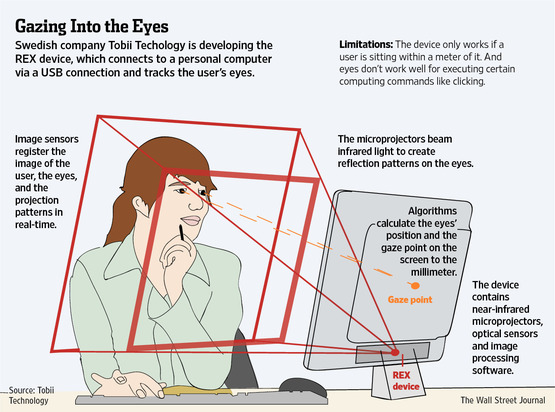
Touch screens have removed some of the need for clunky hardware extras long associated with personal computing. But the biggest technical challenge to wean computers off the age-old keyboard and mouse may rest on the two sockets in our heads.

Eyes are poised to emerge in coming years as a legitimate pointing tool for computers and mobile devices to accompany other methods of interacting with personal gadgets.

State-of-the-art eye tracking is mostly found in the health-care industry, as aids for disabled people with impaired mobility. Now the race is on to incorporate the technology into mass-market consumer electronics for games and everyday applications. Read more of this post

Teenager, who just made US$30mil, tells other teenagers ‘if you have a tech idea just do it’; At 17, App Builder Rockets to Riches From Yahoo Deal

Updated: Tuesday March 26, 2013 MYT 12:35:40 PM

Teenager, who just made US$30mil, tells other teenagers ‘if you have a tech idea just do it’

LONDON: Got a tech idea and want to make a fortune before you’re out of your teens? Just do it, is the advice of the London schoolboy who’s just sold his smartphone news app to Yahoo for a reported US$30 million.

The money is there, just waiting for clever new moves, said 17-year-old Nick D’Aloisio, who can point to a roster of early backers for his Summly app that includes Yoko Ono and Rupert Murdoch.

“If you have a good idea, or you think there’s a gap in the market, just go out and launch it because there are investors across the world right now looking for companies to invest in,” he told Reuters in a telephone interview late on Monday. Read more of this post

Wall Street worries about PayPal’s real-world expansion as it launched a push in 2011 to become a payment option in brick-and-mortar stores. The move increases PayPal’s potential market by a factor of at least 10

Published: Tuesday March 26, 2013 MYT 8:09:00 AM

Wall Street worries about PayPal’s real-world expansion

SAN FRANCISCO: Wall Street is having second thoughts about following PayPal from its online roots into the physical world.

PayPal, a leader online, launched a push in 2011 to become a payment option in brick-and-mortar stores. The move increases PayPal’s potential market by a factor of at least 10, and has been a big driver of the shares of owner eBay Inc, which surged 68 percent in 2012.

But ahead of an investor day meeting at eBay‘s Silicon Valley headquarters on Thursday, some investors and analysts are beginning to worry that the initiative will sacrifice profit margins for growth.

“Profitability of on-site payment will be dramatically lower than it is online,” said Bill Smead of Smead Capital Management, an eBay shareholder who has been bullish on the company for several years. Smead’s Seattle-based firm has trimmed its eBay position twice in the past year. Read more of this post

The internet remains the “single root” in China today to kick-start a career as a wordsmith. “There are no authors under the age of 35 who were not discovered on the internet”

Chinese online literature

Voices in the wilderness

Mar 24th 2013, 21:28 by C.S.-M. | BEIJING

FOR THE country that invented paper it is no small irony that China’s most innovative writing happens off the page. A number of authors, stifled by state censorship and a conservative publishing industry, are finding freedom online.

In the late 1990s aspiring literati began to share works online. One of these, Li Jie, started to write internet stories for no other reason than to kill time. Bored with her job serving customers in a bank, she signed up under the pen name Anni Baobei. Her depiction of a damaged, disillusioned youth hit a nerve. Aged just 25, to the horror of her parents, Ms Li gave up a secure income to write full time. The gamble paid off. She made the transition to print and is still one of China’s bestselling authors.

Internet writing has been nothing short of a revolution for Chinese literature. It has allowed myriad voices to be heard. The digital landscape and technology have changed since the first wave of authors began to write; readers in China now access novels through smartphones and tablets rather than desktops. Yet the internet remains the “single root” in China today to kick-start a career as a wordsmith, says Jo Lusby, managing director of Penguin China, a publishing house. “There are no authors under the age of 35 who were not discovered on the internet,” she adds. Read more of this post

YY Growth Fueled by Virtual Teddy Bears Lures Tiger Funds; Ni Linlin has made a career out of convincing men to send her virtual teddy bears, necklaces and blue roses

YY Growth Fueled by Virtual Teddy Bears Lures Tiger Funds: Tech

By Lulu Yilun Chen  Mar 25, 2013

Ni Linlin has made a career out of convincing men to send her virtual teddy bears, necklaces and blue roses.

Using a laptop in her 10-square-meter (110-square-foot) room in Qingdao, China, the 25-year-old entertains as many as 2,000 fans a day as a DJ and singer on YY Inc. (YY), a Chinese entertainment website with nearly half a billion users. She earns five times more than two years ago when she quit her job as an office secretary.

Part American Idol, part online hostess club, the platform allows freelance entertainers to charge fans a fee for playing games with them or earn a revenue cut from virtual gifts sold online. Racy jokes and low-slung tops are allowed, nudity is not. Guangzhou-based YY has surged 50 percent since its November listing on the Nasdaq and counts Temasek Holdings Pte. and Tiger Global Management LLC as investors.

“Very often in second- and third-tier cities and rural areas their only places for entertainment are Internet bars,” said Jenny Lee, a partner atMenlo Park, California-based GGV Capital, which has invested $17 million in the startup. Read more of this post

With Market Share Shrinking, Microsoft Bing’s China Dream is in Serious Danger

With Market Share Shrinking, Bing’s China Dream is in Serious Danger

Mar 26, 2013 at 09:00 AM by C. Custer, in BusinessWeb

Microsoft’s Bing search engine has never been a major player in China. The company itself conceded that last fall when it all but abandoned Chinese language search, opting instead to focus on what it then said was the 5 percent of searches in China that use English rather than Chinese. But six months later, it appears Bing’s strategy hasn’t worked. In an interview with Sina Tech, Microsoft VP Shen Xiangyang said that the company’s shrinking China market share — now barely above half of one percent, according to research firm CNZZ — put it in a seriously tough spot:

If you can’t see users’ search questions and choices, if you don’t have enough data to work with, then there is no way to make improvements [to the search engine]. Read more of this post

Chinese E-commerce Giant 360Buy Employees Abusing Power Over Merchants for Bribes, Free Gifts with the promise of helping them build traffic

360Buy Employees Abusing Power Over Merchants for Bribes, Free Gifts

Mar 26, 2013 at 09:30 AM by C. Custer, in E-commerceWeb

China’s e-commerce market may be gigantic and hugely profitable, but it’s also still a little bit like the wild west, as regulators are still trying to figure out the best way to oversee the industry without smothering its growth. That means that even at respectable sites, things sometimes go awry, and that’s exactly what happened at 360Buy recently according to the IT Times, which has the story of a 360Buy employee who extorted thousands of dollars and valuable goods out of merchants with the promise of helping them build traffic. Read more of this post

The next billion internet users are not going to be English-speaking, so the next big batch of new domain names will be in Arabic, Chinese or Cyrillic; Australian firm ARI Registry Services is the technology provider for four of the TLDs in the first batch to pass ICANN evaluation

First new top domains Arabic, Chinese

March 25, 2013 – 8:04PM

Trevor Chappell, AAP

The next billion internet users are not going to be English-speaking, so the next big batch of new domain names will be in Arabic, Chinese or Cyrillic.

The global governing body for domain names, the Internet Corporation for Assigned Names and Numbers (ICANN), has completed its evaluation of the first 27 of 1,898 new Top Level Domains (TLDs).

All 27 are in scripts other than Roman script, which is used for the English language.

The new TLDs are expected to join .com, .net and .au on the internet once they get approval from government advisory bodies, the applicants sign the ICANN registry contract, and the TLDs undergo technical testing.

Australian firm ARI Registry Services is the technology provider for four of the TLDs in the first batch to pass ICANN evaluation. Read more of this post

The end of Indian IT staffing as we know it; India’s IT outsourcers are promoting “mini CEOs” capable of running businesses on their own, while trimming down on the hordes of entry-level computer coders they normally hire as they try to squeeze more profits out of their staff.

Analysis: The end of Indian IT staffing as we know it

By Harichandan Arakali and Tony Munroe 5:22pm EDT

BANGALORE/MUMBAI (Reuters) – India’s IT outsourcers are promoting “mini CEOs” capable of running businesses on their own, while trimming down on the hordes of entry-level computer coders they normally hire as they try to squeeze more profits out of their staff.

The shift by Infosys Ltd and others is symptomatic of a maturing industry that wants more revenue from its own intellectual property instead of providing only labor-intensive, lower-margin information technology and back-office services.

For young graduates who see the $108 billion IT industry as a sure pathway to modern India’s growing middle class, the transformation is unsettling. Read more of this post

Warren East is leaving UK tech success story ARM and Simon Segars is taking over. “Failing on the way towards success is seen there as a credible path to success. Failing once isn’t something that dooms you forever.”

Sunday Interview: ARM’s Warren East and Simon Segars

Warren East is leaving UK tech success story ARM and Simon Segars is taking over. They speak to Andrew Cave about how the firm will stay ahead in chip design

ARM2_2518426b

Warren East (L) is stepping down as chief executive at ARM after 12 years at the helm. His replacement is to be Simon Segars (R), who is moving up from president and had been at ARM for even longer than East.

By Andrew Cave

9:30PM GMT 23 Mar 2013

Last Tuesday, staff and shareholders of ARM Holdings received a surprise. Warren East the chief executive, announced that he was stepping down after 12 years running the British technology darling whose computer chip designs are in almost all of the world’s mobile phones.

His replacement is to be Simon Segars, who is moving up from president and had been at ARM for even longer than East.

Segars was employee number 16 when he arrived just four months after the company was spun out from Acorn Computers in November 1990.

“The day I joined, my boss was soldering together a computer for me to use,” he laughs. “The company had only just been formed.” Read more of this post

Big Data Is Opening Doors, but Maybe Too Many

March 23, 2013

Big Data Is Opening Doors, but Maybe Too Many

By STEVE LOHR

IN the 1960s, mainframe computers posed a significant technological challenge to common notions of privacy. That’s when the federal government started putting tax returns into those giant machines, and consumer credit bureaus began building databases containing the personal financial information of millions of Americans. Many people feared that the new computerized databanks would be put in the service of an intrusive corporate or government Big Brother.

“It really freaked people out,” says Daniel J. Weitzner, a former senior Internet policy official in the Obama administration. “The people who cared about privacy were every bit as worried as we are now.”

Along with fueling privacy concerns, of course, the mainframes helped prompt the growth and innovation that we have come to associate with the computer age. Today, many experts predict that the next wave will be driven by technologies that fly under the banner of Big Data — data including Web pages, browsing habits, sensor signals, smartphone location trails and genomic information, combined with clever software to make sense of it all. Read more of this post

Mixing bricks with clicks: Some online retailers are venturing onto the high street

Mixing bricks with clicks

Some online retailers are venturing onto the high street

Mar 23rd 2013 |From the print edition

20130323_WBD001_020130323_WBC300

KIDDICARE wants to be as disruptive as the little monsters who use its products. Traditional sellers of baby gear, laden with too many stores and creaky technology, have all the perkiness of sleep-deprived parents. Internet-based Kiddicare should run rings around them. So it seemed odd last year when the British merchant took over ten “superstores” from Best Buy, itself an erstwhile disrupter (in electronics). Far from weighing Kiddicare down like overstuffed nappy bags, the shops will give customers “a true multichannel experience”, the retailer vowed.

“Multichannel” (or even better, “omnichannel”) is something almost every self-respecting retailer wants to be. It means letting customers shop with smartphones, tablets, laptops and even in stores as if waited upon by a single salesman with an unfailing memory and uncanny intuition about their preferences. Pure-play internet vendors are good at this. But most resist the idea that actual stores, with their rents, payrolls and security cameras, ought to be one of those channels. The thought of having the same costs as bricks-and-mortar competitors “scares the living daylights out of me,” says Charles Hunt, owner of Duvet and Pillow Warehouse, a fast-growing online retailer.

Yet Kiddicare, owned by Morrisons, a British grocer, is not the only retailer to shed its online purity. Screwfix, a British supplier to plumbers and electricians, has opened Read more of this post

The world’s greatest bazaar Alibaba, a trailblazing Chinese internet giant, will soon go public

The world’s greatest bazaar

Alibaba, a trailblazing Chinese internet giant, will soon go public

Mar 23rd 2013 | HANGZHOU AND HONG KONG |From the print edition

20130323_FBD001_0

IN 1999 Trudy Dai used to spend all night sending e-mails from her friend Jack Ma’s apartment, trying to answer queries from American customers without letting on that she was Chinese. Ms Dai was one of the first dozen employees of Alibaba, an online listings service Mr Ma, a teacher, had just started. It was already having some success connecting small Chinese manufacturers to potential customers, including the overseas ones Ms Dai was reassuring over e-mail. But the friends and students who made up the workforce were earning just 550 yuan (then $66) a month.

Mr Ma, though, already had big dreams. That year he said: “Americans are strong at hardware and systems, but on information and software, all of our brains are just as good…Yahoo’s stock will fall and eBay’s stock will rise. And maybe after eBay’s stock rises, Alibaba’s stock will rise.”

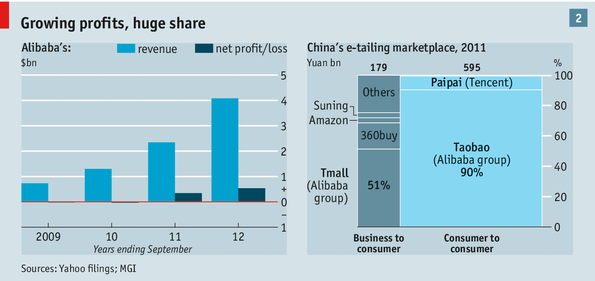
Since then, Alibaba has come to dominate internet retailing in China, which will soon be the biggest e-commerce market in the world. It has moved beyond its original remit of connecting businesses to each other to ventures that let companies sell directly to the public (Tmall) and enable members of the public to sell to each other (Taobao). Between them, Taobao and Tmall processed 1.1 trillion yuan ($170 billion) in transactions last year, more goods than passed through Amazon and eBay combined (see table 1).

20130323_FBC28020130323_FBC285

20130323_FBC284

Read more of this post

The Fall of the “Taobao Village”

The Fall of the “Taobao Village”

By Tracey Xiang on March 22, 2013

The Shanghai-based Xin Wen Chen Bao (Morning News) visited Qing Yan Liu, the village that has been referred to as “Taobao Village” since 2008 when it was crowded with thousands of Taobao sellers who were making a good living. But this time the journalist finds some store owners there having a hard time and some left. Golden times are gone.

Liu Wengao, a Qing Yan Liu villager and current deputy head of Zhejiang e-commerce merchants association, says currently only a dozen out of one hundred entrepreneurs can survive in the Taobao ecosystem. But years back almost every Taobao store set up ran by people in the village was successful.

Qing Yan Liu, with about two hundred local households, is located in Yiwu, a city in central Zhejiang province and where  has been known as one of the biggest small commodity wholesale markets in the world. For years merchants from all over the world flied into this city. There was a wholesale market next to Qing Yan Liu till 2008 when merchants doing business in the market were asked to move to a bigger and farther commercial area, leaving with rental village houses empty.

At that time several young villagers set up Taobao stores. Liu Wengao saw potential in it reasoning that most goods sold on Taobao then were what Yiwu markets could provide with at low prices.

To make their stores look fancier, Liu got designers from Yiwu Industrial & Commercial College. Later, the help of Liu and support from the school, students at Yiwu Merchant School were encouraged to run Taobao stores. They were allowed to do business at school time or move out of campus altogether to register companies for their Taobao stores. The school even provided a classroom with Internet access and inventory warehouse for those students. Even better, students can get a credit for running a Taobao store.

Those empty houses were filled in and crowded again. It is said that the Yiwu Industrial & Commercial College alone, with an accumulated two thousand students involved, have set up fifteen hundred stores since 2008.

Liu Wengao said that they created a variety of marketing approaches and got well experienced in operating online stores. Then everyone made a fortune from it.

Now  the village accommodates over eight thousand people who run a total of one thousand Taobao stores.

Even local grocery stores feel the decline in business and find the familiar faces disappeared. Read more of this post

72% Of Professors Who Teach Online Courses Don’t Think Their Students Deserve Credit

72% Of Professors Who Teach Online Courses Don’t Think Their Students Deserve Credit

GREGORY FERENSTEIN

posted 13 hours ago

This is not a good sign for online education: 72 percent of professors who have taught Massive Open Online Courses (MOOCs) don’t believe that students should get official college credit, even if they did well in the class. More importantly, these are the professors who voluntarily took time to teach online courses, which means the actual number of professors who discount the quality of MOOCs is probably much (much) higher. The survey reveals the Grand Canyon-size gap between the higher-education establishment and the coalition of tech companies and lawmakers that are mandating college credit  for online courses. Read more of this post

Watch Nokia CEO Stephen Elop Throw A Reporter’s iPhone On The Floor

Watch Nokia CEO Stephen Elop Throw A Reporter’s iPhone On The Floor

Steve Kovach | Mar. 22, 2013, 1:12 PM | 4,673 | 9

In an interview with a Finnish television reporter, Nokia CEO Stephen Elop took a moment to verbally and physically bash the iPhone. A lot of people are passing the clip around today, so we thought we’d share it with you too. The reporter asked Elop about the Lumia 928, a device that’s rumored to launch on Verizon soon. Elop refused to comment on the rumor, so the reporter pulled out his iPhone and said he’s rooting for Nokia to make a new phone.

“I don’t want to have an iPhone,” the reporter said. “Oh, how embarrassing,” Elop said when he saw the iPhone. “I can take care of that for you.”

Then he snatched the iPhone from the reporter’s hand and chucked it off camera. You can hear the iPhone make thud on the floor. The reporter, to his credit, didn’t even blink. He kept asking about the rumored Lumia 928. Elop said he’d replace the discarded iPhone with a Nokia phone.

Lockheed Martin Says This Desalination Technology Is An Industry Game-Changer; The problem is that current filters use plastic polymers that require an immense amount of energy (800 to 1,000 pounds per square inch of pressure) to push water through. Lockheed has developed a special material (graphene) that doesn’t need as much energy to drag water through the filter.

Lockheed Martin Says This Desalination Technology Is An Industry Game-Changer

Dina Spector | Mar. 22, 2013, 12:45 PM | 9,777 | 33

The latest technology for removing salt from seawater, developed by Lockheed Martinwill be a game-changer for the industry, according to Ray O. Johnson, senior vice president and chief technology officer of the jet and weapons manufacturer.

Desalination technology is used in regions of the world, particularly developing countries, where fresh water is not available. Water from oceans or rivers is diverted into treatment plants where the salt is removed and clean drinking water is produced through a process called reverse osmosis.

Imagine a tank with seawater on one side and pure water on the other, separated by a filter with billions of tiny holes. Lots of pressure on the salty side pushes water through faster than the salt, so fresh water comes out the other end.

The problem is that current filters use plastic polymers that require an immense amount of energy (800 to 1,000 pounds per square inch of pressure) to push water through.

Lockheed has developed a special material that doesn’t need as much energy to drag water through the filter.

Graphene is a substance made of pure carbon. Carbon atoms are arranged in a regular hexagonal or honeycomb pattern in a one-atom thick sheet. Read more of this post

Apple is finally making money on content

Apple is finally making money on content

By Christopher Mims — 11 hours ago

screen-shot-2013-03-22-at-3-22-2-39-55-pm-620x516

A few percent of a huge volume of transactions is a tried and true business model.Asymco

Apple has long said that it wants to run its its app and media stores at break-even, but the volume of transactions on iTunes has become so huge (check out the graph, above) that even at a tiny margin, Apple appears to be making a substantial profit on content. This data comes from mobile analyst Horace Dediu. Here’s his breakdown of Apple’s profits on bits, not atoms:

  • Apple’s iTunes revenue has quintupled in the past seven years. (Mind you, its overall revenue has quintupled in just the last four.)
  • 23 billion items were sold sold through iTunes in 2012.
  • At a hypothetical (and not unlikely) margin for Apple of 2% on apps and 1% on music, Apple could be making $150 million a year on content alone.
  • Throw in Apple’s software business (it’s easy to forget that Apple also makes its own, from Pages and OS X to Final Cut Pro) which is now sold entirely through the company’s desktop and mobile app stores, and Dediu estimates that “iTunes inclusive of Apple’s own Software generates as much as 15% operating margin on gross revenues. That’s over $2 billion a year.”

Now, next to a net income of over $40 billion in 2012, that’s still hardly game-changing. But it appears that the well-worn trope—that Apple is a hardware company that practically gives away everything else—is no longer true.

Rakuten: The biggest e-commerce site you haven’t heard of with a market cap of $13.5 billion and annual sales of over $4 billion

Rakuten: The biggest e-commerce site you haven’t heard of

March 22, 2013: 10:50 AM ET

130322100643-hiroshi-mikitani-rakuten-614xa

Rakuten CEO Hiroshi Mikitani heads one of the oldest and largest e-commerce sites in the world. He stopped by Fortune to talk about its unique model, plans for expansion and its battle with Amazon in the global market.

By Omar Akhtar, reporter

FORTUNE —  Hiroshi Mikitani, CEO of the Japanese e-commerce site Rakuten stopped by theFortune offices to promote his new book Marketplace 3.0: Rewriting The Rules Of Borderless Business, where he outlines his company’s strategy for globalization.  Founded by Mikitani in 1997, Rakuten is the largest e-commerce site in Japan and with a market cap of $13.5 billion and annual sales of over $4 billion; it is one of the biggest Internet companies in the world.  In the U.S., it bought Buy.com for $250 million and rebranded it to “Rakuten.com Shopping” earlier this year. Read more of this post

SAP to Become European Corporation to Speed Up Decisions; SAP will ask shareholders to approve a change of its legal status from an Aktiengesellschaft (AG) to a Societas Europaea, or SE

SAP to Become European Corporation to Speed Up Decisions

By Cornelius Rahn  Mar 22, 2013

SAP AG (SAP), the German business- management software maker, plans to turn itself into a European corporation to enable faster decision-making as it focuses on grabbing database customers from Oracle Corp. (ORCL)

SAP will ask shareholders to approve a change of its legal status from an Aktiengesellschaft to a Societas Europaea, or SE, at next year’s annual meeting, it said yesterday. One aim is to speed up decisions on the supervisory board, said a person familiar with the matter, who asked not to be named because the discussions are private.

The SE structure, already adopted by companies including BASF SE (BAS)Allianz SE (ALV) and Puma SE (PUM), was created by the European Commission to simplify regulatory and legal requirements for companies with subsidiaries in more than one European country. Previously, multinationals had to follow each of the EU members’ own legal system where they had a subsidiary. Read more of this post

IBM Works for Free to Build Relationships With African Cities; “We’re not just walking in and saying, ‘Throw us our money’”

IBM Works for Free to Build Relationships With African Cities

International Business Machines Corp. (IBM), which makes most of its money from high-end technology contracts, is betting that some of its growth will come from customers who don’t pay anything — yet.

The company has developed an application to track the water system in Tshwane, South Africa, where more than half the population lives in slums that often aren’t connected to plumbing. IBM is letting the community use the app for free, after it sent a team of executives to evaluate the system as part of a corporate service project in October.

The benefit to IBM is it can use the city as a testing ground for the application, while gaining favor with the local government. It also may catch the attention of other cities with similar problems. Relationships are key to building the company’s business in Africa, where it now has offices in more than 20 countries, compared with just four in 2006.

“We’re not just walking in and saying, ‘Throw us our money,’” said Perry Hartswick, an architect of IBM’s Smarter Planet program, which tries to fix civic problems with tracking technology. “We’re walking in to say we’re here to be a part of Africa. That’s a very important part of the way we approach any new geography.” Read more of this post

Price wars and the destruction of China’s e-consumer confidence

Price wars and the destruction of China’s e-consumer confidence

Staff Reporter 2013-03-22

The constant price-cutting competition between China’s online shopping sites has been the source behind a growing number of consumer complaints, the Chinese-language Economic Information Daily reports.

Some 93,600 complaints regarding online commerce were filed in 2012, with most of them being made against leading shopping sites Taobao, TMall and Dangdang. The number of complaints had not gone down significantly from 2011, according to a report recently published by the China e-Business Research Center. Major players making the list of 10 most complained-about sites in 2012 also include Amazon China, Gome, Tencent’s QQ online shopping service and Jingdong 360Buy, according to other consumer data. Over half of these complaints — 55.40% — involved online shopping, while 21.3% concerned transactions made with group-buying sites, which offer daily deals with heavy discounts. The center noted in its report that at least 10 large-scale price wars occurred in 2012 and the number of complaints often peaked during the half-month period following these cutthroat sales.

Such price wars were blindly aimed at grabbing market share, experts said, often leading to customer disputes when websites fail to stock sufficient merchandise and cancel orders placed by shoppers. The websites can cancel orders under their terms of use, which often stipulate that a contract is not established prior to confirmation of the sale transaction. Read more of this post

What You Need To Learn From Groupon’s Unprofitable Business Model

What You Need To Learn From Groupon’s Unprofitable Business Model

George RobertsOpenView Venture Partners | Mar. 21, 2013, 5:36 PM | 1,587 | 4

A little more than two years ago, Groupon was the apple of the startup community’s eye. It had turned down a $6 billion acquisition offer from Google and was headed for a remarkable IPO. Today, no one really knows what Groupon’s future holds. But it doesn’t look good.

Since its IPO in November of 2011 (the largest by a U.S. Internet company since Google raised $1.7 billion in 2004), the company’s stock has plummeted. After debuting at $20, Groupon’s stock can now be had for less than $6 a share. Adding insult to injury, Groupon’s market cap is now almost $2.5 billion less than Google’s original offer.

Now, to be fair, Groupon’s current stock price of around $5.38 is more than double what it was in November when it hit rock bottom. But I’m guessing that nice gain doesn’t quite make up for the billions that investors have watched fly out the window in the last year.

Where Did Groupon Go So Wrong?

When it comes to entrepreneur leadership lessons (which is the theme of this series of posts), the company’s management team — including its much-maligned former CEO, Andrew Mason — forgot that building a sustainable business is a marathon, not a sprint.

Ultimately, that led to a series of bad decisions, many of which Fast Company’s Noah Fleming does a great job of highlighting in a post from last October. But the business’s most damning mistake was its disproportionate focus on new customer acquisition, often at the expense of customer retention.

Groupon was obsessed with growing as fast and as big as it possibly could, which resulted in high churn and, as Slate’s Farhad Manjoo points out, a business model that is just about anything but profitable. Read more of this post

A Strange Computer Promises Great Speed

March 21, 2013

A Strange Computer Promises Great Speed

By QUENTIN HARDY

QUANTUM-articleLarge-v2

VANCOUVER, British Columbia — Our digital age is all about bits, those precise ones and zeros that are the stuff of modern computer code.

But a powerful new type of computer that is about to be commercially deployed by a major American military contractor is taking computing into the strange, subatomic realm of quantum mechanics. In that infinitesimal neighborhood, common sense logic no longer seems to apply. A one can be a one, or it can be a one and a zero and everything in between — all at the same time.

It sounds preposterous, particularly to those familiar with the yes/no world of conventional computing. But academic researchers and scientists at companies like Microsoft, I.B.M. and Hewlett-Packard have been working to develop quantum computers.

Now, Lockheed Martin — which bought an early version of such a computer from the Canadian company D-Wave Systems two years ago — is confident enough in the technology to upgrade it to commercial scale, becoming the first company to use quantum computing as part of its business. Read more of this post

Volio Aims for Videos That Simulate Conversation

Volio Aims for Videos That Simulate Conversation

By Brad Stone on March 21, 2013

tech_volio13__01__630x420

Rodney Cutler, hairstylist and grooming columnist for Esquire magazine, is giving styling advice via iPad. “I’ll be honest, curly long hair is tricky,” he says in his Australian brogue. “But we can make it work so you don’t look like a throwback from the ’80s. We’ve got to make sure you are using the right product. What are you using in your hair at the moment?”

“Head & Shoulders,” says the iPad user.

“You know, that’s why I’m here,” he grimaces. “For me, that’s not the best product for the look you are trying to achieve.” He recommends a leave-in conditioner. Except “he” isn’t Cutler at all, but a series of videos designed to simulate a conversation with him.

For years the technology world has promised the ability to speak with computers. Services like Siri and Google (GOOG)Voice Search allow people to convey specific commands and receive answers. Volio, a San Francisco startup that produced Cutler’s conversational grooming video for the new Talk to Esquire iPad app, has a more ambitious goal: creating an entirely new media format it calls participatory video. Companies will be able to use Volio’s tools to set up conversational videos of people that users can interact with, learn from, and, if they’re mischievous, try to stump. “We’re not trying to fool anybody,” says Ronald Croen, Volio’s founder and chief executive officer. “But if this is done well, we’ll create the experience of talking to a real human being.” Read more of this post

Fab.com: Winning in E-Commerce With Whimsy

Fab.com: Winning in E-Commerce With Whimsy

By Brad Stone on March 21, 2013

tech_fab13__01__304tech_fab13__04inline__605

Photograph by Jeremy Liebman for Bloomberg BusinessweekBradford Shellhammer (left) and Jason Goldberg

Products on shopping site Fab.com are often so campy and overstylized that words fail to describe them: They are … fabsurd? Colorfully described in daily e-mails to Fab’s 12 million registered customers are items such as “In the Seam Animal Pals” (pillows molded into shapes of pets) and the “Awmoo Red” (a spherical bong fashioned by designers “after years of hiding their unsightly water pipes”). In mid-March, the site’s supply of dangling, sterling silver earrings in the shape of attacking sharks, priced at $58, sold out in an hour.

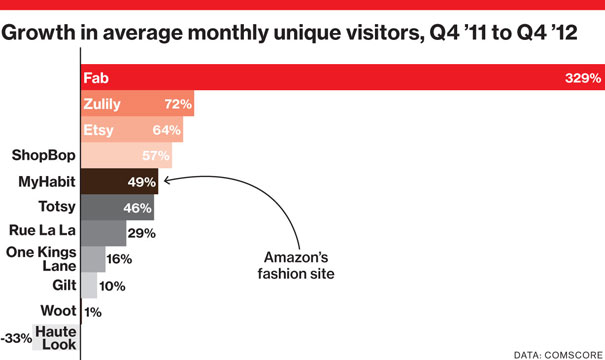
While it’s tempting to dismiss such items as hipster indulgences, Fab.com is as close as it gets to a hot new e-commerce property. The store “for everyday design” is packed with kitsch in kitchenware, furniture, fashion, and electronics. It tripled its customer base last year and now gets close to 3 million visitors a month, according to ComScore (SCOR). The 600-employee company has amassed $150 million in venture capital to build warehouses, improve shipping time, expand into Europe, and team up with manufacturers. This spring it will depart the ranks of aggregated retail and unveil lines of private-label goods, including luggage, linens, and jewelry, branded with its name and sensibility—edgy, amusing, and typically over the top. Read more of this post

How emoji conquered the world; The story of the smiley face from the man who invented it

How emoji conquered the world

The story of the smiley face from the man who invented it

By Jeff Blagdon on March 4, 2013 11:46 am Email @jeffblagdon

emoji1_1020

In 1995, sales of pagers were booming among Japan’s teenagers, and NTT Docomo’s decision to add the heart symbol to its Pocket Bell devices let high school kids across the country inject a new level of sentiment (and cuteness) into the millions of messages they were keying into telephones every day. Docomo was thriving, with a bona fide must-have gadget on its hands and market share in the neighborhood of 40 percent. But when new versions of the Pocket Bell abandoned the heart symbol in favor of more business-friendly features like kanji and Latin alphabet support, the teenagers that made up Docomo’s core customer base had no problem leaving for upstart competitor Tokyo Telemessage. By the time Docomo realized it had misjudged the demand for business-focused pagers, it was badly in need of a new killer app. What it came up with was emoji.

Shigetaka Kurita is the man who created emoji, and during his time at Docomo he saw the shift happen first-hand. He was part of the team working on i-mode — a project that was just beginning to take shape, but would be the world’s first widespread mobile internet platform, combining features like weather forecasts, entertainment reservations, news, and email. i-mode would prove so popular that it would completely engulf the country, giving Japan’s mobile internet a nearly 10-year lead internationally. Initially, though, the i-mode team needed ideas, and in order to get a look at other work already being done on mobile internet applications, Kurita and others visited San Francisco in 1998 to check out AT&T’s Pocket Net.

It was the first service in the world to provide amenities like email and weather forecasts over a cellular network, and using AT&T’s new cellular digital packet data (CDPD) service, it was capable of transfer speeds of 19.2Kbps. (In comparison, an average US LTE connection today is around 9.6Mbps, or about 500 times faster). “At the time, the specs on the devices were really poor, so they weren’t able to display images, for example,” Kurita explains. Pocket Net had weather news, but things like ‘cloudy’ and ‘sunny’ were just spelled out in text. The lack of visual cues made the service more difficult to use than it ought to be, and Kurita recognized that AT&T’s mobile experience would benefit majorly from some extra characters for contextual information. Read more of this post