Zendesk eyes Fortune 500 as it hits over 30,000 customers globally

Nassim Khadem Reporter

Zendesk eyes Fortune 500 as it hits over 30,000 customers globally

Published 26 November 2013 08:46, Updated 26 November 2013 12:12

ab4b1fe4-561a-11e3-b1c8-465f9441c1e6_morten and michael--646x363

Zendesk’s Morten Primdahl and Michael Folmer Hansen. The company takes expensive and bulky on-premise customer support software into the cloud. The founder of start-up Zendesk, a cloud-based customer service software provider, says the company is targeting Fortune 500 companies in a bid to more than double 30,000 customers within the next few years. Read more of this post

Why Snapchat is screwed

Why Snapchat is screwed

BY SHANE SNOW 
ON NOVEMBER 25, 2013

(This post originally appeared on LinkedIn Influencers. Follow Shane Snow.)

Last week, Business Insider chief Henry Blodget wrote a post titled, “EXCLUSIVE: How Snapchat Plans To Make Money.” With a juicy title like that, one couldn’t help but click. The disappearing MMS app, Snapchat, is as hot as a startup can be right now. Recent reports say its board turned down a $3 billion buyout offer from Facebook, even though Snapchat makes no money. The news has caused a flurry of speculation – what does Snapchat know that we don’t know? – and hungry social media consultants and marketers are eagerly pointing to it as evidence that you should spend money on this, guys! Read more of this post

Lenovo’s rise amid giants defies critics

Lenovo’s rise amid giants defies critics

Updated: 2013-11-25 07:50

By Alfred Romann in Hong Kong ( China Daily) Read more of this post

Clash of Clans is a big hit in China despite in-app payment disaster

Clash of Clans is a big hit in China despite in-app payment disaster

November 26, 2013

by Steven Millward

Supercell’s newest game Clash of Clans is proving to be a big hit in China right now. According to one of China’s biggest third-party Android app stores, Wandoujia, it’s the top new game in the country with over 200,000 downloads this month from just that one app store. But there’s a problem. The developers are not going to make much money from all the new Clash of Clans fans in China – though it’s not because of piracy, since it’s a free game. Instead, there’s a massive in-app payment mess-up going on whereby the new game uses only Google’s in-app billing but doesn’t have a localized solution in place for Chinese gamers. As a result, notes Wandoujia’s newest China App Index for November, the popular game tries to force Chinese users to install the Google Play store, which few in the country use. But even that won’t work. That’s because Google’s app store in China doesn’t support paid apps, so there’s literally no way for Chinese gamers to get in-app schwag in Clash of Clans [1]. Of course, not all game developers make this mistake. Many find a local publishing partner to adapt their game for tough markets like China – as exemplified by the guys who make Fruit Ninja – or find a method to take in-app payments in a way that suits local consumers. For example, the studio could form a tie-up with a telco for carrier billing, use Alipay in China (like Paypal), or implement a third-party app store billing system (ie: not Google’s). In-app purchases for Clash of Clans on iPhone work fine and very easily via Chinese iTunes accounts, so this is an Android-only issue in China.

Influx of Tech Riches Prompts a Backlash in San Francisco

November 24, 2013

Backlash by the Bay: Tech Riches Alter a City

By ERICA GOODE and CLAIRE CAIN MILLER

SAN FRANCISCO — If there was a tipping point, a moment that crystallized the anger building here toward the so-called technorati for driving up housing prices and threatening the city’s bohemian identity, it came in response to a diatribe posted online in August by a young Internet entrepreneur. The author, a start-up founder named Peter Shih, listed 10 things he hated about San Francisco. Homeless people, for example. And the “constantly PMSing” weather. And “girls who are obviously 4s and behave like they’re 9s.” Read more of this post

Malaysian billionaire Vincent Tan is considering listing his online payments company MOL Global Pte, four years after it bought social networking site Friendster

Billionaire Tan Said to Consider IPO for Friendster Owner MOL

Malaysian billionaire Vincent Tan is considering listing his online payments company MOL Global Pte, four years after it bought social networking site Friendster Inc., three people with knowledge of the matter said. Tan is holding preliminary discussions with banks for a dual listing on Kuala Lumpur’s stock exchange and either Hong Kong or Singapore, said two of the people, who asked not to be identified as the process is private. An initial public offering may raise as much as $300 million in the first half of next year, they said. Read more of this post

Signs of rapidly worsening Chinese demand for IT giants IBM and Cisco Systems Inc are starting to spook Hewlett-Packard investors

HP may have yet another problem: China

10:06am EST

By Poornima Gupta

SAN FRANCISCO (Reuters) – Signs of rapidly worsening Chinese demand for IT giants IBM and Cisco Systems Inc are starting to spook Hewlett-Packard investors. HP’s year-long stock rally sputtered last week amid fears a faster-than-anticipated slowdown in emerging markets, above all China, may dash the computing giant’s hopes for a return to growth in 2014 or beyond. Read more of this post

Intel Looks Beyond Traditional Markets; Intel’s Newly Appointed President Renée James Talks About Embracing Market Trends in Asia and Plans for the Company’s Growing Cash Pile

Intel Looks Beyond Traditional Markets

Intel’s Newly Appointed President Renée James Talks About Embracing Market Trends in Asia and Plans for the Company’s Growing Cash Pile

YUN-HEE KIM

Nov. 24, 2013 1:13 p.m. ET

Technology companies are looking beyond traditional PCs, smartphones and tablets to drive growth in the next decade, and Intel Corp. INTC -5.39% wants to be ahead of the curve. The Santa Clara, Calif.-based semiconductor maker, which initially lagged behind rivals in mobile computing, is developing chips that can be used in wearable devices and placing more emphasis on software and services to drive growth. The moves are important because Intel, which has traditionally focused on chips for personal computers, expects next year’s revenue to be flat because of weak PC sales. Read more of this post

Google’s showcased shopping found to come at a premium; Five out of every six items in the panels shown on a Google search made in America are more expensive than the same items from other merchants hidden deeper in the index

November 24, 2013 8:01 pm

Google’s showcased shopping found to come at a premium

By Richard Waters in San Francisco

Anyone in the US doing their holiday shopping from the product showcases that appear at the top of Google’s search results is almost certain to pay substantially more than if they delved deeper in the search engine. Five out of every six items in the panels shown on a Google search made in America are more expensive than the same items from other merchants hidden deeper in the index, with an average premium of 34 per cent, according to a Financial Times analysis. Read more of this post

TV Is Dying, And Here Are The Stats That Prove It

TV Is Dying, And Here Are The Stats That Prove It

JIM EDWARDS NOV. 24, 2013, 10:11 AM 566,542 116

screen shot 2013-11-18 at 5.59.42 pm screen shot 2013-11-18 at 10.49.00 am-1 screen shot 2013-11-18 at 10.36.56 am screen shot 2013-11-18 at 10.35.27 am screen shot 2013-11-18 at 5.59.54 pm slide079-4 slide030-4 screen shot 2013-11-22 at 10.34.33 am advertiser demand for tv has led to pricing growing faster than ratings have declined

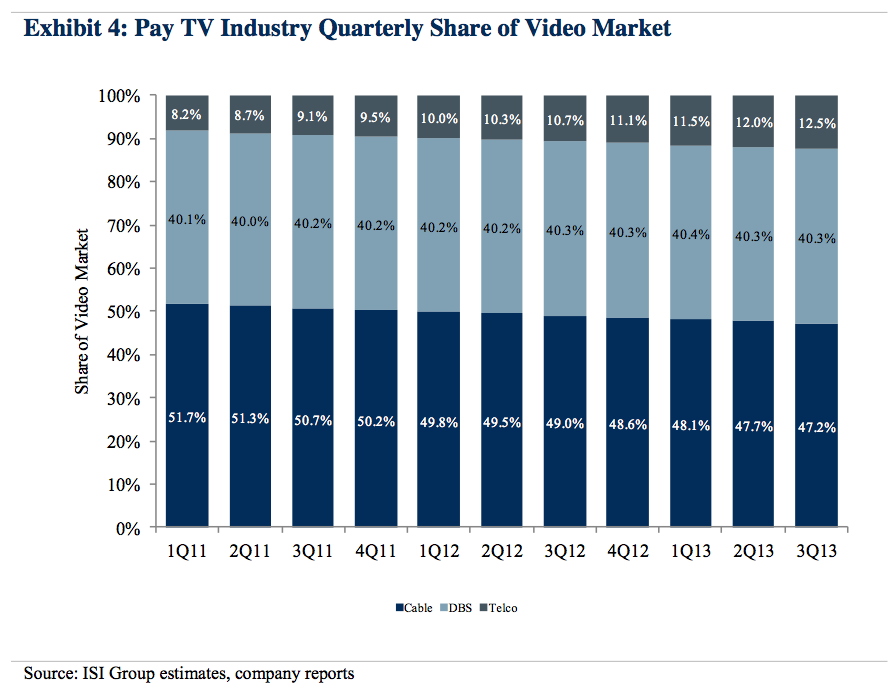
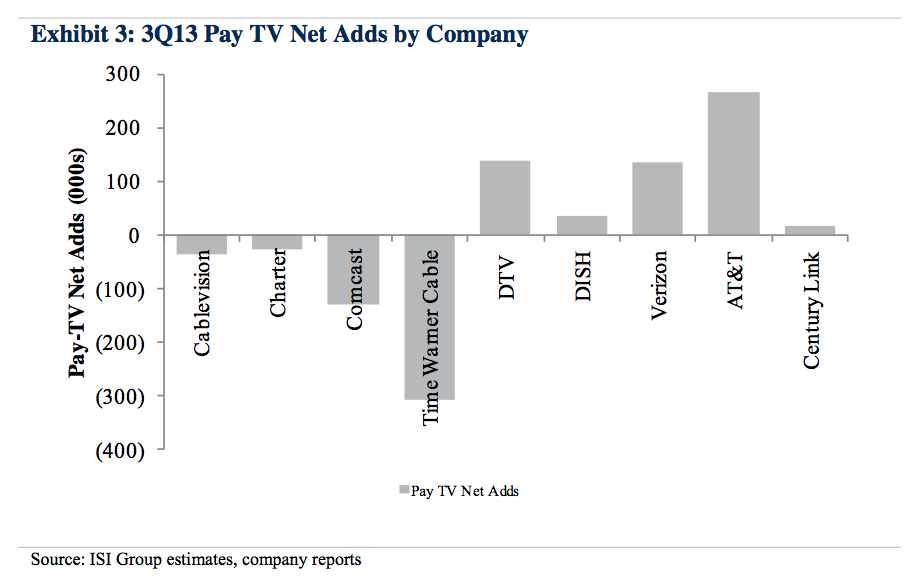
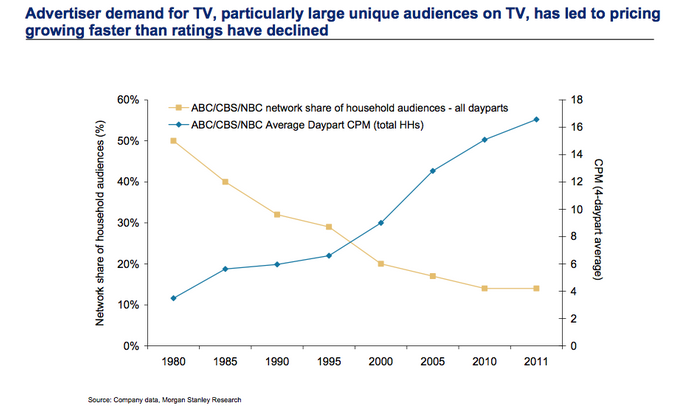
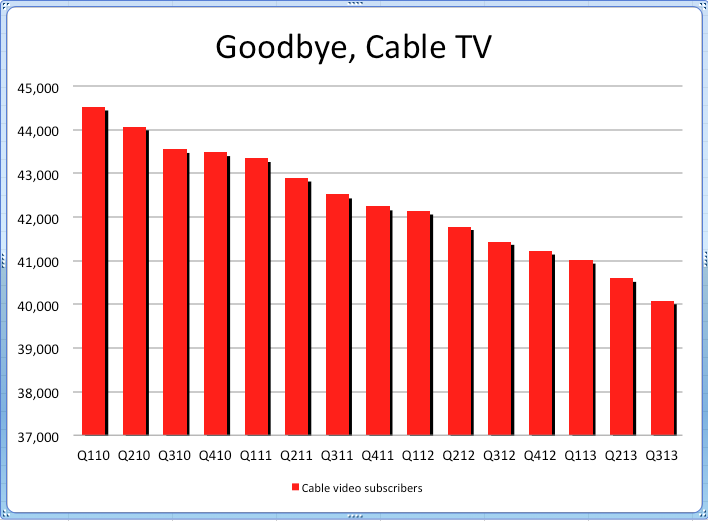
The TV business is having its worst year ever. Audience ratings have collapsed: Aside from a brief respite during the Olympics, there has been only negative ratings growth on broadcast and cable TV since September 2011, according to Citi Research. Media stock analysts Craig Moffett and Michael Nathanson recently noted, “The pay-TV industry has reported its worst 12-month stretch ever.” All the major TV providers lost a collective 113,000 subscribers in Q3 2013. That doesn’t sound like a huge deal — but it includes internet subscribers, too. Read more of this post

Some content on this page was disabled on December 14, 2020 as a result of a DMCA takedown notice from Citigroup Inc., Citigroup Global Markets Inc., Citigroup Global Markets Limited, and Citibank, N.A.. You can learn more about the DMCA here:

https://wordpress.com/support/copyright-and-the-dmca/
Some content on this page was disabled on December 14, 2020 as a result of a DMCA takedown notice from Citigroup Inc., Citigroup Global Markets Inc., Citigroup Global Markets Limited, and Citibank, N.A.. You can learn more about the DMCA here:

https://wordpress.com/support/copyright-and-the-dmca/

Qualcomm Ages Gracefully; Wireless chip-maker may be having something of a midlife crisis as it matures with the cellphone market. But it’s not about to embarrass itself—or investors

SATURDAY, NOVEMBER 23, 2013

Qualcomm Ages Gracefully

By RESHMA KAPADIA | MORE ARTICLES BY AUTHOR

Wireless chip-maker may be having something of a midlife crisis as it matures with the cellphone market. But it’s not about to embarrass itself—or investors.

In an industry that prizes youthful energy, investors have been worried about a midlife crisis at wireless chip giant Qualcomm . Ageists will miss out: Qualcomm is still fit and has the resources to stay healthy and profitable for a good long time. Qualcomm (ticker: QCOM) dominates the market for communications chips used in smartphones and wireless devices worldwide, and has an estimated three-year lead over competitors in the latest cellular technology, known as LTE. In addition to manufacturing its own chips, it licenses its technology to other chipmakers, which provides a lucrative royalty stream. Read more of this post

Moocs are no magic bullet for educating Americans; Methods of teaching make only marginal difference if content is irrelevant to the jobs market

November 24, 2013 7:08 pm

Moocs are no magic bullet for educating Americans

By Edward Luce

Methods of teaching make only marginal difference if content is irrelevant to the jobs market

Optimists have scoured the dictionary for superlatives to describe the future of internet education. But the cult of the Mooc – massive online open courses – took a blow last week when one of its leading Silicon Valley pioneers, Sebastian Thrun,described it as a “lousy product”. Students taking Mr Thrun’s online courses at Udacity performed far worse – and dropped out in far higher numbers – than those with a human instructor. Mr Thrun, who invented the self-driving car, is at least temporarily dropping out of the business. Luddites everywhere will be feeling vindicated. Read more of this post

After 32 years, BRW goes out of print; For much of its 32-year history, BRW had the highest per capita circulation in the world for a business magazine

Leo D’Angelo Fisher Columnist

After 32 years, BRW goes out of print

Published 25 November 2013 00:29, Updated 25 November 2013 11:46

For much of its 32-year history, BRW had the highest per capita circulation in the world for a business magazine. At its peak it boasted a circulation of 80,200. But a flat and rapidly fragmenting advertising market, consumer preference for digital platforms and a sluggish economy have finally caught up with one of Australia’s most respected media brands. Read more of this post

The Weinstein Company, Seeking Hits, Shift to TV; The heavy investment in the production and sale of TV series mirrors changes occurring elsewhere in Hollywood

November 24, 2013

The Weinstein Company, Seeking Hits, Shift to TV

By MICHAEL CIEPLY

LOS ANGELES — As Oscar season approaches fever pitch, Harvey Weinstein, master of the movie awards game, is talking about … television. The Weinstein Company, founded eight years ago by Mr. Weinstein and his brother, Bob, is making a surge into TV production that will soon test whether it can extend its success in film to the world of television. Read more of this post

Though Silicon Valley insists there is not a technology bubble, average investors should be cautious, especially when many highly valued companies have yet to produce earnings

NOVEMBER 24, 2013, 1:05 PM

Disruptions: If It Looks Like a Bubble and Floats Like a Bubble …

By NICK BILTON

SAN FRANCISCO — It sounds like heresy around here. But here goes: Is this another tech bubble? Back East, the Wall Street money is starting to worry that it feels like 1999 all over again. Money-losing technology companies are going public at you’ve-got-to-be-joking prices. The founders of Snapchat are getting multibillion-dollar offers — and turning them down. And the Nasdaq composite index, a visible symbol of the ’90s dot-com boom and bust, is a sneeze away from 4,000, a level it last reached just before, well, you know. Read more of this post

One Way or Another, Big TV Is Getting Bigger. Will You Care?

One Way or Another, Big TV Is Getting Bigger. Will You Care?

Published on November 22, 2013
by Peter Kafka

Can Comcast, the country’s biggest pay-TV provider, really get bigger? That’s the scenario that’s floating out today, sparked by CNBC’s report that Time Warner Cable, the country’s second-biggest cable company, might be looking to Comcast as a white knight. That’s because Charter Communications, another big cable operator, is getting ready to make an offer for Time Warner, and Time Warner either wants a different buyer or at least someone to raise the price for its eventual takeout. Read more of this post

Reincarnation at Nokia: Planning the next bounceback; After the sale of its devices division to Microsoft, what was once the world’s biggest mobile-phone maker is reinventing itself. Again

Reincarnation at Nokia: Planning the next bounceback; After the sale of its devices division to Microsoft, what was once the world’s biggest mobile-phone maker is reinventing itself. Again

Nov 23rd 2013 | HELSINKI |From the print edition

20131123_WBD001_020131123_WBC833

SAMULI SIMOJOKI knew the outcome was a formality, but he still wanted his say, “not so much as a Nokia shareholder, but as a Finn.” Mr Simojoki, a lawyer from Helsinki, was one of the 3,200 who attended the company’s extraordinary general meeting on November 19th. He voted against the only motion, the proposed sale of Nokia’s mobile-phone division to Microsoft for €3.8 billion ($5.4 billion) in cash. More than 99% of votes were cast in favour. When the deal is sealed early in 2014, Nokia, once the world’s biggest maker of mobile phones, and still its second-biggest, will be out of the business. Read more of this post

That queasy feeling when a Web rally starts losing steam

That queasy feeling when a Web rally starts losing steam

KEVIN KELLEHER 
ON NOVEMBER 24, 2013

What happened to the Great Web Rally of 2013? Until two months ago, investors were clamoring for companies in the sector so much they were willing to buy stocks with triple-digit PE ratios. They snapped up well-known names that had a track record of losses. After years of shying away from Web stocks, investors couldn’t get enough. Read more of this post

WeChat sneaking up on heavyweight Alipay

WeChat sneaking up on heavyweight Alipay

Staff Reporter

2013-11-24

With rapid growth among users using the built-in online payment mechanism, WeChat is challenging Alipay in a battle for the online payment market in China. Alipay, a third-party online payment platform established by China’s largest e-commerce operator Alibaba Group, has generated a turnover of 274.79 billion yuan (US$45 billion), accounting for 78.4% of online payments in China, according to iResearch data for the first three quarters of 2013. Read more of this post

New Threat Spurs E-Commerce Giant into Action: Tencent wants its WeChat app to dominate mobile shopping, but Alibaba has countered with a flurry of moves to get back in the game

11.22.2013 15:45

New Threat Spurs E-Commerce Giant into Action

Tencent wants its WeChat app to dominate mobile shopping, but Alibaba has countered with a flurry of moves to get back in the game

By staff reporter Zhu Yishi

1385106320377286

On November 11, which has become known as a major sales day for China’s e-commerce companies every year, Alibaba Group saw Taobao.com and Tmall.com combine for sales of 35 billion yuan. But the big day has Alibaba feeling anything but festive. The reason for this is that the company’s chairman, Jack Ma, expects competition to get fiercer as mobile Internet become more popular. Read more of this post

How Did Mobile Karaoke App Changba Gain 100 Million Users in One Year?

How Did Changba Gain 100 Million Users in One Year

By Tracey Xiang on November 20, 2013

changba

Chen Hua, founder and CEO of mobile Karaoke app Changba, shared with us at TechCrunch Shanghai how the app managed to gain 100 million users in no more than one and a half years. Mr. Chen is a serial entrepreneurs. Before developing Changba he and his team spent about one year studying how mobile services could be different from those based on PC. Of all the special traits with smartphone, including gravity sensor, flash sensor and direction sensor, Changba finally chose the combination of phone speaker and earphone. He labels Changba as an Instagram for voice. Similar to Instagram which enables ordinary users to produce beautified pictures and share with friends. Changba is for enabling the ordinary to record singing and share to social networks. Changba also offers tools to optimize your singing. Changba has had 100 million registered users and 30 million monthly active accounts in no more than one and a half years since its launch. Here are some takeaways from Changba on why the app gained traction in such a short time in China. Read more of this post

Premji Invest, the family office of one of India’s richest individuals, Azim Premji, is reportedly in discussions to lead a $50 million (€37 million) fundraiser in e-commerce fashion retailer Myntra

PREMJI FAMILY OFFICE MULLS E-COMMERCE DEAL

ARTICLE | 20 NOVEMBER, 2013 12:05 PM | BY JESSICA TASMAN-JONES

Premji Invest, the family office of one of India’s richest individuals, Azim Premji, is reportedly in discussions to lead a $50 million (€37 million) fundraiser in e-commerce fashion retailer Myntra. The website, headquartered in Bangalore, was founded in 2007 and is now India’s largest online fashion and lifestyle store, with annual revenues of $120 million. It stocks Indian fashion brands, as well international household names, such as Nike, Reebok and Adidas. Read more of this post

Why Fab.com Is Bleeding

Why Fab Is Bleeding

ANDREA HUSPENIENTREPRENEUR
NOV. 23, 2013, 12:19 AM 6,772 8

Once a media darling, lately Fab has been in the spotlight for reasons it would rather not be.

From the continuous management shuffle to layoffs and pivots, Fab has seen more shakeups than a James Bond martini. And with these restructurings, the New York City-based ecommerce site has been hemorrhaging uncontrollably. When it will stop, no one knows.

A company in turmoil.

The bleeding began this past April, when Fab announced it was changing its business strategy –moving away from its flash-site model, where it sold limited-supply items, to a more traditional, global storefront. At the time, CEO and co-founder Jason Goldberg said he wanted Fab to become “the world’s No. 1 design store” and was looking to take on Ikea and Amazon. Read more of this post

Sirius XM has a monopoly on satellite radio, a growing subscriber base, and loads of free cash

SATURDAY, NOVEMBER 23, 2013

Sirius XM’s Sweet Sound of Success

By ALEXANDER EULE | MORE ARTICLES BY AUTHOR

Sirius XM has a monopoly on satellite radio, a growing subscriber base, and loads of free cash. Why the stock could rise 50%.

BA-BD526D_SIRIU_G_20131123011210

By the end of its first decade, Sirius XM had blanketed the country with satellite radio coverage, but on Wall Street the signal was growing faint. On Feb. 11, 2009, Sirius XM shares fell as low as five cents. Years of big spending had finally caught up with the firm, and the credit crisis would be the finishing touch. Hours before filing for bankruptcy, Sirius got a lifeline from cable pioneer John Malone’s Liberty Media (ticker: LMCA). Read more of this post

Qualcomm CEO Says NSA Fallout Impacting China Business

Qualcomm CEO Says NSA Fallout Impacting China Business

Mobile Device Chipmaker Is ‘Definitely Seeing Increased Pressure,’ Paul Jacobs Says

SPENCER E. ANTE

Nov. 22, 2013 5:09 p.m. ET

Mobile device chipmaker Qualcomm Inc. QCOM +1.74% expects to continue growing in China, but Chief Executive Paul Jacobs acknowledged U.S. restrictions on Chinese companies and revelations about surveillance by the National Security Agency are impacting its business in the fast-growing country. “We are definitely seeing increased pressure,” said Mr. Jacobs in an interview with The Wall Street Journal. “All U.S. tech companies are seeing pressure.” Read more of this post

Google in Talks to Create Prescription Lenses, Designs for Google Glass; Internet Giant Exploring Ways to Put High-Tech Eyewear in Optometry Offices

Google in Talks to Create Prescription Lenses, Designs for Google Glass

Internet Giant Exploring Ways to Put High-Tech Eyewear in Optometry Offices

THEO FRANCIS and ROLFE WINKLER

Updated Nov. 22, 2013 5:52 p.m. ET

Google Inc. GOOG -0.21% ‘s new computer-powered glasses haven’t hit the shelves yet, but already efforts are afoot to keep them from becoming just a niche product for nerds. In a sign the eyeware industry and Google see a broader market for the technology, the Internet search giant is exploring ideas with at least one eyewear company to put the device in optometry offices around the country and create alternative designs. Read more of this post

For all the sophisticated algorithms involved in same-day delivery, many of the services ultimately come down to the delivery guy

November 23, 2013

In War for Same-Day Delivery, Racing Madly to Go Last Mile

By HILARY STOUT

There’s a hot new job in tech: delivery guy. As the holiday shopping season gets underway, same-day delivery has become a new battleground for e-commerce. For all the sophisticated algorithms and proprietary logistics software involved, many services come down to someone like Fermin Andujar, who finds himself racing to a store, scanning the aisles for the requested items, buying them and rushing them to the customer. Read more of this post

Beyond 3-D Printers’ Magic, Possible Legal Wrangling; two law professors warn that the rise of three-dimensional printing could set off lawsuits like those seen over music file-sharing

November 23, 2013

Beyond 3-D Printers’ Magic, Possible Legal Wrangling

By PHYLLIS KORKKI

When reports first appeared that computers could produce three-dimensional objects — from toys to auto parts to household items — it sounded like a page from a science fiction novel. But the era of 3-D printers is upon us. For a mere $1,299, plus shipping, you can even buy one from Staples to use at home. There’s still a gee-whiz aspect to the technology, but once that fades away, it’s likely to set off something else: lawsuits. That warning comes from two law professors in a paper to appear early next year in The Georgetown Law Journal. Read more of this post

Apple dives deeper into designing and inventing tech for manufacturing process

Apple dives deeper into designing and inventing tech for manufacturing process

By Adam Satariano, Saturday, November 23, 12:22 AM

Apple is putting a record $10.5 billion to work in new technology — from assembly robots to milling machines — that consumers will never see. To get a jump on rivals such as Samsung Electronics and lay the groundwork for new products, Apple is spending more on the machines that do the behind-the-scenes work of mass producing iPhones, iPads and other gadgets. That includes equipment to polish the new iPhone 5c’s colorful plastic, laser and milling machines to carve the MacBook’s aluminum body and testing gear for the iPhone and iPad camera lens, said people with knowledge of its manufacturing methods. Read more of this post

Corporate Incubators Popping Up in Europe

NOVEMBER 22, 2013, 5:09 PM

Corporate Incubators Popping Up in Europe

By MARK SCOTT

LONDON – In an Art Deco office block on a side street in central London, groups of 20-something programmers and engineers sat hunched over laptops in teams of three or four people. Surrounded by the trappings of a fast-growing start-up, including table tennis equipment and a fully stocked kitchen, the developers were tapping out computer code and planning marketing campaigns just like many other fledgling companies spread across the British capital. Yet unlike other strapped start-ups, these small tech companies already have links to the corporate world. Read more of this post