Norway Government Says Central Bank Is Winning Krone Battle

Norway Government Says Central Bank Is Winning Krone Battle

The Norwegian central bank’s efforts to tame the krone are paying off for exporters as the economy of western Europe’s largest oil producer slows, Industry Minister Monica Maeland said. “I don’t know if it’s enough but it is working,” Maeland, who took office in October, said yesterday in an interview in Oslo. “The exchange rate of the Norwegian krone is important for the export industry and the fact that it has weakened is good.” Read more of this post

Norges Bank Delays Tightening by a Year as House Prices Drop

Norges Bank Delays Tightening by a Year as House Prices Drop

Norway’s central bank left its benchmark interest rate unchanged and said it will delay tightening plans until the summer of 2015, a year later than previously signaled. The krone sank 0.4 percent against the euro to 8.3987 as of 11:32 a.m. in Oslo. Against the dollar, it dropped 0.4 percent. The bank kept the overnight deposit rate at 1.5 percent, as predicted by 11 of 12 economists in a Bloomberg survey. Read more of this post

Lessons From Europe’s Long Recession

Lessons From Europe’s Long Recession

Five years after the onset of its worst recession, the European Union’s economic recovery remains painfully slow. Has anything been learned from this dismal performance about how governments can combat severe recessions? The answer is yes — but sadly, the clearest lessons are the ones governments seem least likely to apply. Read more of this post

Job Cuts Loom at European Banks as Economy Pinches Fees

Job Cuts Loom at European Banks as Economy Pinches Fees

European banks, which eliminated more than 140,000 jobs in two years, are poised to keep shrinking. Lenders in the region probably will cut at least 5 percent of trading and advisory staff next year, according to a survey of three London-based investment-bank recruiters, and the reductions could reach 15 percent, two of them said. That would be twice the 7 percent shrinkage across the industry since 2011. Read more of this post

Jim Rogers Cautions “Be Prepared, Be Worried, And Be Careful… This Is Going To End Badly”

Jim Rogers Cautions “Be Prepared, Be Worried, And Be Careful… This Is Going To End Badly”

Tyler Durden on 12/04/2013 20:41 -0500

“Eventually, the whole world is going to collapse,” Jim Rogers chides a disquieted CBC anchor as he explains the reality that, “we in the West have staggering debts. The United States is the largest debtor nation in the history of the world,” adding that “this is going to end badly.” However, the co-founder of Soros’ Quantum fund is convinced that the commodity super-cycle is far from over, but driven by supply constraints (and cost increases) as opposed to demand from higher growth. The following interview provides more color on his commodity view as he re-iterates his bullish stance on Ag (with sugar a focus) and Natural Gas (some harsh natural realities coming), warning “don’t get too excited about fracking,” when he talks energy products. Rogers, in his inimitable way, sums up the state iof euphoria that many markets find themselves in thus, “we are all floating around on a sea of artificial liquidity right now. This is not going to last.” On the end of the commodity super-cycle: Commodities have pulled back, but I would remind you that in all bull markets there are periods of correction. In 1987 – during the great bull market in stocks – stocks went down 40 to 80 per cent around the world; again in 1989, 1990, 1994, etc. Every time people said the bull market’s over, but it wasn’t. I think that’s what’s happening with commodities now.” On the next crisis: 2008 was so much worse than 2000 because the debt was so much higher, you wait until 2014 or 2015 when the next crisis hits… debt has gone through the roof, the next one’s gonna be really bad” His final words: Be prepared, be worried, and be careful

Robert Samuelson: Is the stock market nuts?

Is the stock market nuts?

By Robert J. Samuelson, Thursday, December 5, 2:42 AM

The question about the stock market is whether the bull is a bubble. The 1990s’ “tech bubble” and the recent “housing bubble” have conditioned us to think that almost any sign of investor craziness is going to end badly — and the stock market seems a bit crazy. At the end of November, reported Wilshire Associates, stocks were up nearly 30 percent for the year, representing a gain of about $4.8 trillion. From the market’s recent low in March 9, 2009, when the economy was in a tailspin, the increase has been 180 percent, or nearly $15 trillion. If you dislike this comparison, then measure the gain since the market’s pre-recession high on Oct. 9, 2007. The increase is 21.5 percent, or $4.2 trillion. Read more of this post

Hugh Hendry Goes Stock, Bitcoin Bull Retard: “Don’t Tell Me The Valuation, It Is Trending”

Hugh Hendry Goes Stock, Bitcoin Bull Retard: “Don’t Tell Me The Valuation, It Is Trending”

Tyler Durden on 12/04/2013 16:18 -0500

Everyone knows “you never go bull retard,” but it seems Eclectica’s Hugh Hendry, the hardiest of hardy Scots, has accepted that there is only one way for this farce to end (as we predicted back in 2009). As Investment Week reports, the bear-turned-bull has bought 3D printing stocks as a play on trend-driven, QE-fuelled equity markets, and said the rise in the valuation of Bitcoin amounts to “the same thing”. Perhaps summing up the “trend-driven, QE-fueled” new normal better than anyone, Hendry added: “I say to my team ‘don’t tell me the valuations, it is trending’… This is the environment where Bitcoin could go to $1m. There is no qualitative reason, but it is trending. If I could own Bitcoin, I would. It gets worse: Hendry is now chasing the biggest momentum trend of all, that of Bitcoin, which he now “expects” to rise to $1 million! As for his “hedge”, don’t laugh, 3D printing stocks… Sigh. We suspect, as he noted previously, he will be avoiding mirrors even more now. And yes, that this whole series now reeks of an Onion viral marketing campaign, is clear to everyone. Although sadly, we fear it is all too sincere, and a sad consequence of what happens when Bernanke’s centrally-planned markets crush one after another talented asset manager and leave the E-Trade momo babies in charge. Read more of this post

Hedge Fund Legend Seth Klarman Returns Cash To Investors Due To “Lack Of Investment Opportunities”; This is only the second time in the hedge fund firm’s 31-year history that it is returning money to investors

Another Hedge Fund Legend Returns Cash To Investors Due To “Lack Of Investment Opportunities”

Tyler Durden on 12/04/2013 16:03 -0500

While hardly as spectacular as Hugh Hendry’s supernova flameout, or the far more boring, slow motion conversion of the assorted other famous and less famous bears, a legendary hedge fund titan has decided he too has no use for excess capital in this broken market. No surprise then thatInstitutional Investors’ Alpha reports that Baupost’s Seth Klarman is returning $4 billion in capital to investors for only the second time in its history due to “a lack of investment opportunities.” And watching how the epic farce that Bernanke’s wealth effect known as the Stalingrad & Poorski trades in the last 30 minutes of every day nobody can blame him. And no, Klarman is not returning cash due to some hidden underperformance: “Baupost’s many partnerships were up 13 percent, on average, through the September quarter. Its annualized return since inception is in the high teens.” This happens to push it in the top decile of all hedge funds in 2013. Yet despite the exercise of the redemption put, Baupost, which at the end of 2013 had $26.7 billion in AUM making it the 7th largest hedge fund in the world, still will have a ton of both capital and dry powder. Read more of this post

Fixing What’s Wrong With Economics 101

Fixing What’s Wrong With Economics 101

Harvard’s most popular course is Ec 10, the introductory class in economics. This fall, 760 undergraduates were enrolled — almost half the school’s freshmen. Economics is the most popular major at Harvard, Yale and Princeton. Rightly or wrongly, these students and others will have an outsized impact on policy making, so it matters how the subject is taught. Yet many, especially those who only take first-year classes, get a misleading impression of how the economy works. We can do better. Read more of this post

Brace for bumpy ride in emerging markets

December 5, 2013 12:11 pm

Brace for bumpy ride in emerging markets

By Gillian Tett

Banks and hedge funds have been stealthily creating ‘hit lists’

This week, the Indian government can breathe one tiny sigh of relief. After a year in which the rupee has gyrated dramatically, amid fears about a US “taper” and poor growth, the Indian currency hit a one-month high against the dollar of Rs61.53 on Thursday. Read more of this post

Greenspan Baffled Over Bitcoin ‘Bubble’: “To Be Worth Something, It Must Be Backed By Something”; Ron Paul: Bitcoin could ‘destroy the dollar’; Bitcoin Boom Spreads to IPhones With Mobile-Payment Apps

Greenspan Baffled Over Bitcoin ‘Bubble’: “To Be Worth Something, It Must Be Backed By Something”

Tyler Durden on 12/04/2013 19:07 -0500

“In order for currencies to be ‘exchangeable’ they have to be backed by something,” is the remarkably ironic initial comment from none other than debaser-of-the-entirely-fiat-dollar Alan Greenspan when asked about the “bubble in bitcoin,” by Bloomberg TV’s Trish Regan. Unable to “identify the intrinsic” backing of Bitcoin (or see bubbles in equity, credit, real estate, or greater fools) Greenspan is, apparently, capable of identifying Bitcoin “as a bubble,” because “there is no fundamental means of “repaying’ it by any means that is universally accepted.” The farcical double-speak continues as the Maestro does a great job of making Bitcoin (which Ron Paul earlier noted could be the “destroyer of the dollar”) look even better than the readily-printed fiat we meddle with every day. Read more of this post

How to Live In a Grey World with Black-and-White Values? Musings on the Indian Accounting Standards 18, “Willful Defaulters”, Frugal Innovations and Avalokiteśvara

The following article is extracted from the Bamboo Innovator Insight weekly column blog related to the context and thought leadership behind the stock idea generation process of Asian wide-moat businesses that are featured in the monthly entitled The Moat Report Asia. Fellow value investors get to go behind the scene to learn thought-provoking timely insights on key macro and industry trends in Asia, as well as benefit from the occasional discussion of potential red flags, misgovernance or fraud-detection trails ahead of time to enhance the critical-thinking skill about the myriad pitfalls of investing in Asia at the microstructure- and firm-level.

The weekly Bamboo Innovator Insight series brings to you:

  • How to Live In a Grey World with Black-and-White Values? Musings on the Indian Accounting Standards 18, “Willful Defaulters”, Frugal Innovations and Avalokiteśvara, Dec 2, 2013 (Moat Report AsiaBeyondProxy)

Grey World

How to Live In a Grey World with Black-and-White Values? Musings on the Indian Accounting Standards 18, “Willful Defaulters”, Frugal Innovations and Avalokiteśvara

“Mr Murthy, if we have black-and-white values like yourself, how can we live in the real world that is grey?” This brilliant question to Infosys Chairman Narayana Murthy was posed by Hemant Amin, the Singapore-based value investor who compounded his investment in Infosys by 60-folds, amongst his other concentrated portfolio holdings in his multi-million single family office. Last Thursday was the second time that the Bamboo Innovator has met over lunch with Hemant, also the head of the BRKets (www.brkets.com), after our rendezvous at the Singapore Cricket Club on 7 Nov. We also wanted to catch up before the Bamboo Innovator flies over to India on a work trip from 7 to 17 December.

The Bamboo Innovator is grateful to have the experience to have met with people from all walks of life during the past decade plus in the Asian capital jungles. They range from competent pioneering intra-preneurs such as Tong Chong Heong who nurtured Singapore’s Keppel FELS (KEP SP, MV $16.3B); gritty entrepreneurs such as Lim Hock Chee who built Singapore’s supermarket chain Sheng Siong (SSG SP, MV $672M) against the odds of competing with the Davids of state-owned FairPrice and giant Jardine Group’s Dairy Farm, China’s natural gas pipeline and equipment baron Wang Yusuo of ENN Energy (2688 HK, $7.6B) and spinoff Enric (3899 HK, MV $3.2B) and many more; kind and wise professors from the School of Accounting at Singapore Management University; to exposing the accounting frauds of billionaire imposters such as Eddy Groves of Australia’s ABC Learning and the “extractor” CEOs of S-chips and P-chips. Perhaps the Bamboo has acquired some sensitivity in differentiating between the “Compounders” and the “Extractors” in a harsh and cruel world over the years. Hence, we are always excited to meet with a super value investor or/and outstanding entrepreneur with upright values and Hemant is amongst them.

The answer by Narayana Murthy was equally brilliant and profound. “You have to be able to live with the consequences of your values system. You have to be comfortable under your own skin.” An example would be how Murthy would rather acquire plots of land to expand his business at three times the price than he would otherwise pay for if he had gone through the “grey market” of middlemen who would most probably bully and rape the rural poor residents and force them into “illegal” eviction.

Besides Infosys, another concentrated compounding bets that returned multiple-fold for Hemant include HDFC (HDFC IN, MV $20.6B) and its subsidiary spinoff GRUH Finance (GRHF IN, MV $671M). As Asia slows down, many tycoons have been considering spinoffs as part of their corporate restructuring efforts to battle sluggishness and improve managerial efficiency. As explained in our earlier articles, not all spinoffs are value-creating opportunities. Heavily-indebted firms are in deleveraging mode to dispose highly-geared businesses to investors in spinoffs. The upcoming spinoff events in Asia need to be examined carefully for their business fundamentals (whether they have a wide moat and a unique scalable business model) and their motivation. In India, one of the more useful accounting clues to separate the Compounders vs the Extractors in India has been the Indian Accounting Standards 18 (IAS 18), which we will elaborate after understanding the (hidden) debt problem in India and Asia.

Despite the entrenched problems in India, both Hemant and the Bamboo Innovator share the same investment insight that India is a unique vibrant and versatile hub for “frugal innovations”: cost-effective and affordable solutions of various varieties that cater to price-sensitive consumers. Like the three sources of wide-moat in Bamboo Innovators to separate the resilient compounders vs the extractors, India’s Frugal Innovators are those with the:

1)       Indestructible intangible know-how in proprietary know-how in the system to scale up or know-how in unique products or trust and support in the community of customers and suppliers, such as Tata Consultancy Services TCS; NBFCs such as HDFC and its subsidiary GRUH with their accumulated knowledge base in assessing the credit quality of its borrowers which cultivates and snowballs trust and support from its customer base; the “unique” products of Bosch India, Pidilite Industries, Britannia, Jyothy, Eicher, Emami;

2)       Core-periphery network with the strong touch-points and periphery network eg Asian Paints, Godrej Consumer, Mahindra & Mahindra;

3)       Open innovation in co-creating value with external partners, such as the MNCs Nestle India etc, Amara Raja vs Exide, Hero Motocorp.

One prominent Buddhist story according to Mahāyāna doctrine tells of Avalokiteśvara (Sanskrit: अवलोकितेश्वर lit. “Lord who looks down”), the bodhisattva vowing never to rest until he had freed all sentient beings from samsara. Despite strenuous effort, he realizes that still many unhappy beings were yet to be saved. After struggling to comprehend the needs of so many, his head splits into eleven pieces. Amitabha Buddha, seeing his plight, gives him eleven heads with which to hear the cries of the suffering. Upon hearing these cries and comprehending them, Avalokiteśvara attempts to reach out to all those who needed aid, but found that his two arms shattered into pieces. Once more, Amitabha Buddha comes to his aid and invests him with a thousand arms with which to aid the suffering multitudes. The Chinese name of Avalokiteśvara is Guanyin (观音菩萨), which means “Observing the Sounds or Cries of the World”. The Goddess of Mercy goes all out to hear and see the pains and sorrows and negative things to help with her thousand hands and eyes (“即发誓言,若我当来堪能利益安乐一切众生者,令我即时身千手千眼具足.” 《千手千眼观世音菩萨广大圆满无碍大悲心陀罗尼经》). In their own ways, Frugal Innovators attempt to design cost-effective, “good enough” solutions that can reach out to meet the aspirations and solve the problems of millions of consumers with the indestructible intangible asset in the form of their first-hand knowledge of the ground situation of targeted customer group. Seeking to hear and see the negative things and acknowledging sadness and failures is perhaps the first step to becoming a Bamboo Innovator and resilient compounder.

The Bamboo Innovator will be away to India on a work trip from 7 to 17 December and will resume the weekly Bamboo Innovator Insight article in the last week of December. We are grateful for your support and understanding all this while.
As Hospital Prices Soar, a Single Stitch Tops $500

December 2, 2013

As Hospital Prices Soar, a Single Stitch Tops $500

By ELISABETH ROSENTHAL

SAN FRANCISCO — With blood oozing from deep lacerations, the two patients arrived at California Pacific Medical Center’s tidy emergency room. Deepika Singh, 26, had gashed her knee at a backyard barbecue. Orla Roche, a rambunctious toddler on vacation with her family, had tumbled from a couch, splitting open her forehead on a table. Read more of this post

Diners not biting on KFC’s China revival campaign

Diners not biting on KFC’s China revival campaign

7:19am EST

By Lisa Baertlein and Adam Jourdan

NEW YORK/SHANGHAI (Reuters) – Yum Brands Inc’s KFC website in China trumpets the slogan “Trust in every bite”. That message is part of the company’s new “I Commit” campaign intended to reassure customers in its largest market, who have cut back on visits since Chinese media reports a year ago about excessive antibiotic use by a few KFC suppliers. Read more of this post

Hands-On Bavarian Count Presides Over a Pencil-Making Empire

December 3, 2013

Hands-On Bavarian Count Presides Over a Pencil-Making Empire

By JACK EWING

STEIN, Germany — Count Anton-Wolfgang von Faber-Castell has been known to hurl wooden pencils from the tower of his castle to the stone courtyard below. It is not a petty fit of pique by a mad Bavarian aristocrat. The 72-year-old count, the eighth in a long line of pencil makers, just wants to prove how durable the pencils that carry his family name are. The Faber-Castell family has been making wooden pencils by the hundreds of millions here in a storybook setting, bisected by the swift Rednitz River, which was once the main source of power here. A torrent of brightly colored pencils flows from clattering machines in a century-old factory with a tile roof and windows framed in pastel hues. Faber-Castell is the largest maker of wood-encased pencils in the world and also makes a broad range of pens, crayons and art and drawing supplies as well as accessories like erasers and sharpeners. About half the company’s German production is exported, mostly to other countries in the euro zone. That means that Faber-Castell contributes, at least in a small way, to Germany’s large and controversial trade surplus — which now rivals China’s for the world’s largest. Read more of this post

Marriages can survive the start-up pressures; Being married to an entrepreneur is not easy. Most are egotistical and obsessed by their company; very few winning entrepreneurs are unattached permanently. Like all of us, they benefit from the emotional support a soul mate can bring

December 3, 2013 4:20 pm

Marriages can survive the start-up pressures

By Luke Johnson

Being married to an entrepreneur is not easy. Most are egotistical and obsessed by their company

Virtually all entrepreneurial successes are forged by a partnership. But frequently one of the partners is a background figure, who few in the business world will know. That is because they are the spouse of the entrepreneur. Yet their importance is usually enormous. Read more of this post

An Expensive Play on China’s Bad Debts; Investors Shouldn’t Volunteer as Guinea Pigs in Beijing’s Cinda Experiment

An Expensive Play on China’s Bad Debts

Investors Shouldn’t Volunteer as Guinea Pigs in Beijing’s Cinda Experiment

AARON BACK 

Updated Dec. 3, 2013 2:21 a.m. ET

AM-BB316_CINDAH_NS_20131203020304

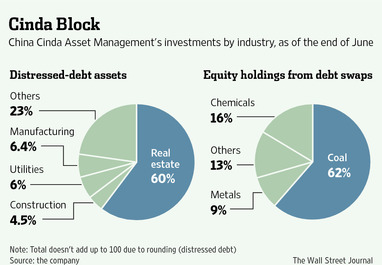
China Cinda Asset Management has essentially become a state-owned hedge fund that specializes in distressed assets. Now foreign investors are invited to bet on its success in a Hong Kong public offering. They should pass. Beijing created Cinda in 1999 to take nonperforming loans off the books of state-ownedChina Construction Bank.601939.SH -0.22% It never made money on this batch of loans, which it was forced to buy at face value and eventually had to fob off on the government. It later was able to buy more loans at deep discounts, and since 2010, take over debts that Chinese companies owe each other. These business lines have been profitable, according to pre-IPO documents. Read more of this post

China Banks Manage Debt Levels With Loan Rollovers; China’s banks are among the world’s healthiest and most profitable, based on their financial statements. But investors aren’t convinced; Hands-On Bavarian Count Presides Over a Pencil-Making Empire

China Banks Manage Debt Levels With Loan Rollovers

Regulators Discourage Banks From Rolling Over Troubled Loans

CYNTHIA KOONS

Updated Dec. 3, 2013 5:32 a.m. ET

AI-CF217_CLOANS_G_20131203051204

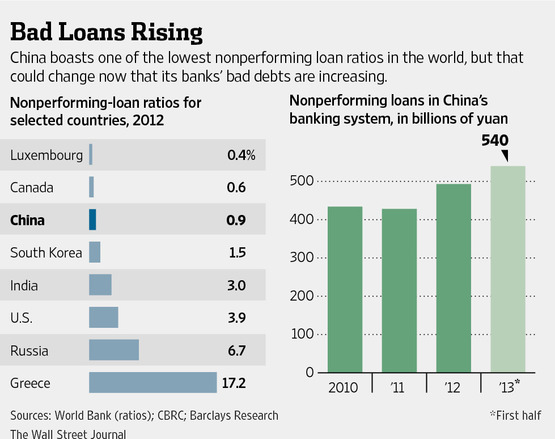
China’s banks are among the world’s healthiest and most profitable, based on their financial statements. But investors aren’t convinced. Nonperforming loans account for less than 1% of total loans, a ratio that has been falling in recent years and is now one of the lowest in the world, according to World Bank data. Despite this, price-to-book values of the country’s leading banks have been declining over the past few years, reflecting worries about deteriorating credit quality in China. Read more of this post

AQR Capital’s Cliff Asness: My Top Ten Peeves

Cliff Asness: My Top Ten Peeves

by ValueWalk StaffDecember 2, 2013

Saying I have a pet peeve, or some pet peeves, just doesn’t do it. I have a menagerie of peeves, a veritable zoo of them. Luckily for readers, I will restrict this editorial to only those related to investing (you do not want to see the more inclusive list) and to only a mere 10 at that. The following are things said or done in our industry or said about our industry that have bugged me for years. Because of the machinegun nature of this piece, these are mostly teasers. I don’t go into all the arguments for my points, and I blatantly ignore counterpoints (to which I assert without evidence that I have countercounterpoints). Some of these are simple, so perhaps the teaser suffices. But some deserve a more thorough treatment that hopefully I, or someone else, will undertake. Some are minor, truly deserving the title “peeve,” and some, more weighty. In each case, as befits an opinion piece, it’s not just my discussion of the peeve but the very prevalence of the peeve itself that is my opinion. I do not extensively cite sources for them. I contend that they are rather widespread throughout the land of financial media, pundits, advisers, and managers. Thus, citing one or two sources would be unfair, and citing them all, impossible. Therefore, please feel free to disagree not just with my discussion of the peeves but also about their very existence! Without further ado, here is a list of things held together by only three characteristics: (1) They are about investing or finance in general, (2) I believe they are commonly held and often repeated beliefs, and (3) I think they are wrong or misleading and they hurt investors.

Is a Peanut Butter Pop-Tart Innovation? Kellogg’s CEO Calls It That, but Is He Right?

Is a Peanut Butter Pop-Tart Innovation?

Kellogg’s CEO Calls It That, but Is He Right?

DENNIS K. BERMAN

Dec. 3, 2013 8:22 p.m. ET

It measures nearly three inches by five inches, and it’s made from enriched flour, corn syrup and creamy peanut butter. This is Kellogg‘s K +0.89% Gone Nutty! peanut butter Pop-Tart. If you agree with Kellogg CEO John Bryant, it’s one of the cereal company’s important products of 2013. He went so far as to call it an innovation. Listen to the chiefs of America’s biggest companies, and you’ll find the Gone Nutty! Pop-Tart has plenty of company. Most CEOs now spray the word “innovation” as if it were an air freshener. A little spritz can’t hurt. A little spritz can’t hurt. Read more of this post

The One Thing That Truly Motivates Creative Talent–And How To Foster It

THE ONE THING THAT TRULY MOTIVATES CREATIVE TALENT–AND HOW TO FOSTER IT

BY DEBORAH MORRISON

Educator and author Deborah Morrison talks inner mojo and the simple, yet critical stuff of wanting to be good. Talent. It’s the subject line of many an inbox message these days. All of us who belong to the great ecosystem of new talent development–universities, portfolio programs, thinktanks, agencies–and agency leaders, mentors, recruiters and talent managers, offer opinions about who we need now and how we train them. Even better, the discussion has evolved to the nurturing of talent over the long ride of a career. Read more of this post

(Bad) strategy is everything, in innovating

(Bad) strategy is everything, in innovating

“Business as usual” is no longer a luxury a company can afford. More and more, companies are seeing that their revenue growth cannot outpace the increase in cost, resulting in decreasing profitability year-on-year.

BY JANSON YAP –

4 HOURS 54 MIN AGO

“Business as usual” is no longer a luxury a company can afford. More and more, companies are seeing that their revenue growth cannot outpace the increase in cost, resulting in decreasing profitability year-on-year. With the fast-changing competitive ecosystem, brought about in part by technology and knowledge advancement, business leaders are recognising the urgent need to revisit their strategy. Innovation is a critical piece of that strategy — but many times, normally rational business people allow themselves to be blinded by the notion that innovation is unlike any other aspect of business and, therefore, does not follow the normal rules of corporate strategy. Read more of this post

The Secrets Inside Us: The human body is less well understood than we think

December 3, 2013

The Secrets Inside Us

By BILL HAYES

WHEN the news broke recently that a team of Belgian scientists had “discovered” a new body part — a ligament located just outside the knee — the first place my mind went was to Padua. Padua is the small city in northern Italy where the 16th-century Brussels-born scientist Andreas Vesalius taught anatomy and created his history-making masterpiece, “De Humani Corporis Fabrica” (“On the Fabric of the Human Body”), published in 1543. The old man would have been delighted by the news, I couldn’t help thinking. Read more of this post

The Science of Great Ideas – How to Train Your Creative Brain

THE SCIENCE OF GREAT IDEAS–HOW TO TRAIN YOUR CREATIVE BRAIN

CREATIVITY IS A MYSTERY RIGHT? MAYBE NOT. HERE’S A LOOK AT THE SCIENCE OF THE CREATIVE PROCESS AND HOW TO HARNESS YOUR BRAIN’S POWER TO COME UP WITH MORE GREAT IDEAS.

BY BELLE BETH COOPER

Ah, ideas. Who doesn’t want more great ideas? I know I do. I usually think about ideas as being magical and hard to produce. I expect them to just show up without me cultivating them, and I often get frustrated when they don’t show up when I need them. The good news is that it turns out cultivating ideas is a process, and one that we can practice to produce more (and hopefully better) ideas. On the other hand, often timesgreat ideas can also just come to us whilst in the shower or in another relaxing environment. Read more of this post

The Reinvention of an Industrial Titan: DuPont is again remaking itself, with a shifting R&D strategy and a pile of acquisitions and divestitures. The CFO gives his take on the transformation.

November 22, 2013

The Reinvention of an Industrial Titan

DuPont is again remaking itself, with a shifting R&D strategy and a pile of acquisitions and divestitures. The CFO gives his take on the transformation.

David McCann

The quaintly named E.I. du Pont de Nemours and Company was founded in 1802 as a gunpowder manufacturer. That remained its main product until late in that century, when it delved into dynamite and nitroglycerin. (The company later upped the explosive ante considerably by helping along The Manhattan Project and production of the first atomic bombs.) For most of the past century, DuPont remained a U.S. industrial titan even while entering and exiting a dizzying array of businesses. It’s arguable that no major American company has reinvented itself as many times as DuPont has. Read more of this post

Steve Case: Don’t let the United States turn into Detroit

Steve Case: Don’t let the United States turn into Detroit

By Matt McFarland, Updated: December 3 at 12:05 pm

AOL co-founder Steve Case stressed the need for the United States to remain innovative Tuesday at an event hosted by the Aspen Institute in Washington. “We kind of led on the digital information revolution. We need to lead in the next revolution, otherwise our economy will start stagnating and we’ll never be able to solve some of the fiscal problems,” Case said. Read more of this post

Paul Crouch dies at 79; founder of the Trinity Broadcasting Network, the world’s largest Christian television system.

Paul Crouch dies at 79; founder of the Trinity Broadcasting Network

By Elaine Woo, Tuesday, December 3, 9:02 AM

In the mid-1970s, a vision came to Paul Crouch, but it wasn’t what a man of the cloth might have expected. A map of North America appeared on his ceiling, glowing with pencil-thin beams of light that shot in every direction. “Lord,” asked Mr. Crouch, a Pentecostal minister, “what does this mean?” God, according to Mr. Crouch, had one word for him: “Satellite.” Read more of this post

Copycat biotech drugs slow to take off in Europe

Copycat biotech drugs slow to take off in Europe

1:00am EST

By Ben Hirschler

LONDON (Reuters) – Despite austerity-driven cuts across European healthcare systems, most countries have been slow to embrace a new class of medicines that could save them billions of euros – copies of biotech treatments. These cheaper versions of expensive biotech drugs, known as biosimilars, could slash the cost of treating diseases like cancer and rheumatoid arthritis in the same way that generics have curbed spending on traditional medicines. Read more of this post

Shell to GE Lured by Gas-Fueled Ships on Record Supply

Shell to GE Lured by Gas-Fueled Ships on Record Supply

Royal Dutch Shell Plc (RDSA), General Electric Co. (GE) and a company co-founded by T. Boone Pickens are planning investments in natural-gas-powered shipping as record U.S. output spurs the merchant fleet to use a new fuel. Clean Energy Fuels Corp., which Pickens helped start, will begin construction next year on the country’s first fuel station for cargo ships running on liquefied natural gas in Jacksonville, Florida. Shell said in March it’s planning LNG plants for the Great Lakes and Gulf Coast. GE, evaluating five locations, says the U.S. will need 50 to 100 small-scale plants for ships, trains, mining and trucks by 2025, each costing $50 million to $150 million. Read more of this post

OPEC Inaction Masks Looming Supply Glut in 2014: Energy Markets

OPEC Inaction Masks Looming Supply Glut in 2014: Energy Markets

Even with OPEC forecast to keep its output quota unchanged at a meeting this week, falling oil demand and prospects for increased supply from some member states mean the group’s leader, Saudi Arabia, will have to cut production anyway. The kingdom and its allies Kuwait, Qatar and the United Arab Emirates will need to produce about 2 million barrels a day less in 2014 to prevent a glut, the Centre for Global Energy Studies predicts. That’s equal to annual revenue of about $80 billion at today’s prices. The 12-nation group meets in Vienna on Dec. 4 and will reaffirm its collective limit of 30 million barrels a day, according to 22 of 24 analysts and traders surveyed by Bloomberg News. Read more of this post