Cable’s Pied Piper of Consolidation: Why Liberty Media Chairman John Malone is back in the cable business

Cable’s Pied Piper of Consolidation

Why Liberty Media Chairman John Malone is back in the cable business.

HOLMAN W. JENKINS, JR.

Dec. 3, 2013 7:11 p.m. ET

Never have so many been spurred to such frenzy by so few. By “few,” of course, we meanJohn Malone. The 72-year-old Mr. Malone, the original cable guy, has sidled back into the industry he helped create decades earlier. In March, his Liberty Media LMCA -0.91% bought a 27% stake in Charter Communications, CHTR -2.57% a midsize operator with a laggard history. Mr. Malone announced the time was ripe for consolidation. That’s all it took. Read more of this post
Govt watching home prices, will step in if needed as price levels remain high : MAS

Govt watching home prices, will step in if needed: MAS

SINGAPORE — While property measures implemented over the last few years have dampened the rising momentum in the housing market, price levels remain high and the Government will step in, if necessary, to ensure stability and sustainability, the Monetary Authority of Singapore (MAS) said yesterday.

BY LEE YEN NEE –

5 HOURS 10 MIN AGO

SINGAPORE — While property measures implemented over the last few years have dampened the rising momentum in the housing market, price levels remain high and the Government will step in, if necessary, to ensure stability and sustainability, the Monetary Authority of Singapore (MAS) said yesterday. Read more of this post

Philippines’ Aquino Races the World’s Fastest Economies

Philippines’ Aquino Races the World’s Fastest Economies

Just after midnight one sultry Friday in August 1987, Manila became a battleground as rebel troops attempted a coup against Philippine President Corazon Aquino. Two blocks from the besieged presidential palace, insurgents opened fire on a car carrying Aquino’s only son, a bespectacled and soft-spoken 27-year-old junior insurance executive nicknamed Noynoy. Read more of this post

Myanmar looks abroad for investment in healthcare

Myanmar looks abroad for investment in healthcare

Mon, Dec 2 2013

By Jared Ferrie

YANGON (Reuters) – Yangon General Hospital was once the jewel in the crown of one of Southeast Asia’s best healthcare systems. These days, hundreds of patients are forced to sleep in corridors of the hulking, colonial-era red-brick building, dogs doze on the floor of the emergency ward and garbage is piled in corners. It is a scene that Myanmar’s reformist government hopes to change as it ratchets up spending on the sector and seeks foreign investment to revive one of Asia’s sickest healthcare systems. Read more of this post

Najib Faces Conservatives in Post-Election Test: Southeast Asia

Najib Faces Conservatives in Post-Election Test: Southeast Asia

As the son of a pencil factory worker, Abdul Wahid Omar grew up in poverty in Malaysia’s southern state of Johor with 10 siblings after his family left Singapore in 1969. Good test scores won him a place in a boarding school with a bed of his own, helped also by a national policy to boost the lot of ethnic Malays and indigenous people, who are about 60 percent of the population. A government scholarship led to a British accounting degree, as Abdul Wahid went on to run Malaysia’s biggest bank and become the government minister overseeing economic planning. Read more of this post

With Top 4 US Banks Holding $217 Trillion In Derivatives, Total Number Of US Banks Drops To Record Low

With Top 4 US Banks Holding $217 Trillion In Derivatives, Total Number Of US Banks Drops To Record Low

Tyler Durden on 12/03/2013 09:49 -0500

total number banks

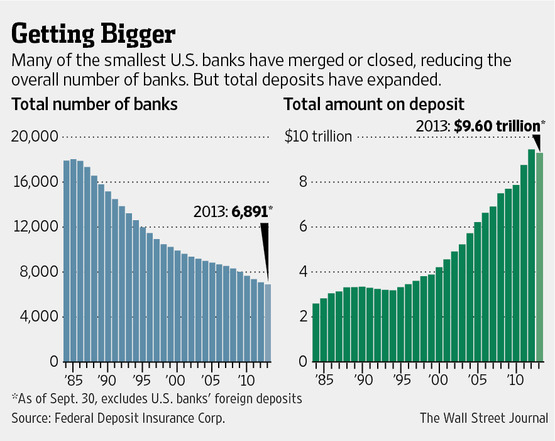
Overnight, the WSJ reported a financial factoid well-known to regular readers: namely that as a result of a broken system that ever since the LTCM bailout has encouraged banks to become take on so much risk they become systematically important (as in their failure would “end capitalism as we know it”), and thus Too Big To Fail, there has been an unprecedented roll-up of existing financial institutions especially among the top, while the smaller, less “relevant”, if far more prudent banks have been forced out of business. “The decline in bank numbers, from a peak of more than 18,000, has come almost entirely in the form of exits by banks with less than $100 million in assets, with the bulk occurring between 1984 and 2011. More than 10,000 banks left the industry during that period as a result of mergers, consolidations or failures, FDIC data show. About 17% of the banks collapsed.” Read more of this post

Unilever CEO Says Emerging Market Slowdown to Last for Years

Unilever CEO Says Emerging Market Slowdown to Last for Years

Unilever (UNA) Chief Executive Officer Paul Polman said the economic slowdown in emerging markets is here to stay as many countries need to enact structural reforms to adjust to new conditions after the boom of recent years. “They are still relatively stronger economies, but still fragile,” Polman said. “And you see that growth coming off now a little bit, obviously not being helped either by lower demand coming from Europe and the U.S. This will last a few years. And it will only be corrected if some of the reforms have been made in these places.” Read more of this post

The Coming Global Wealth Tax; Indebted governments may soon consider a big one-time levy on capital assets

Romain Hatchuel: The Coming Global Wealth Tax

Indebted governments may soon consider a big one-time levy on capital assets.

ROMAIN HATCHUEL

Dec. 3, 2013 7:15 p.m. ET

Between ObamaCare

, Iran and last quarter’s uptick in U.S. economic growth, taxpayers these days may be distracted from several dangers to come. But households from the United States to Europe and Japan may soon face fiscal shocks worse than any market crash. The White House and New York Mayor-elect Bill de Blasio aren’t the only ones calling for higher taxes (especially on the wealthy), as voices from the International Monetary Fund to billionaire investor Bill Gross increasingly make the case too. Read more of this post

Richemont Chairman Warns Global Economy Is “Very Precarious… There Will Be Tears”

Richemont Chairman Warns Global Economy Is “Very Precarious… There Will Be Tears”

Tyler Durden on 12/03/2013 10:11 -0500

While most of the world’s elites are bathing in a sea of liquidity and propagandizing the status quo to keep the dream alive, Richemont Chairman Johann Rupert has unleashed a torrent of uncomfortable truthiness this morning:

*REMGRO CHAIRMAN RUPERT ‘VERY CONCERNED’ ABOUT GLOBAL ECONOMY

*GLOBAL ECONOMY ‘VERY, VERY PRECARIOUS,’ RUPERT SAYS

*WORLD HEADING FOR ‘BIG INFLATION’ OR `BIG DEPRESSION’: RUPERT

*GLOBAL ECONOMY HEADED FOR ‘TEARS’: REMGRO, RICHEMONT CHAIRMAN

*RUPERT SAYS HIS BIGGEST CONCERN IS JOBLESS GROWTH

And while things are good now, the owner of the Cartier brand warned if the global economy doesn’t do well, Richemont is not well positioned.

Via Bloomberg,

“It is very, very precarious,” Rupert said at the annual general meeting in Cape Town of Remgro Ltd., where he is also chairman.

 “There will be tears, but we don’t know when, and we don’t know whether it’s going to be a big inflation or whether it’s going to be a depression. Just hedge your bets.”

 “The luxury goods market is very cyclical and relies on consumers discretionary spend,” Rey Wium, an analyst at Renaissance Capital in Johannesburg, said by telephone. “When times are tough, consumers will tighten their belts.”

Penny Pricing for U.S. Stocks Said to Get Scrutinized

Penny Pricing for U.S. Stocks Said to Get Scrutinized

Securities executives are trying to determine if the 12-year-old decision to narrow the price increments for American stock trading has harmed investors, according to two people with knowledge of the matter. Representatives from exchanges, brokers, mutual funds and regulatory agencies held two conference calls yesterday to discuss concerns about market structure, said the people, who requested anonymity because the discussions were private. One topic was the U.S. mandate in 2001 to trade equities in pennies rather than eighths or sixteenths of a dollar, they said. Read more of this post

Mondelez Follows Microsoft Selling Bonds in Europe as Costs Fall

Mondelez Follows Microsoft Selling Bonds in Europe as Costs Fall

U.S. food and beverage company Mondelez International Inc. (MDLZ) is following Microsoft Corp. selling bonds in Europe as borrowing costs fall. The maker of Oreo cookies is marketing 18-month floating-rate notes and fixed-rate bonds due January 2017 and January 2021, according to a person familiar with the matter. The average yield investors demand to hold corporate bonds in euros instead of government debt dropped six basis points this week to 123 basis points, the lowest since June 12, Bank of America Merrill Lynch index data show. Read more of this post

Keeping Shareholders in the Dark; The Securities and Exchange Commission is failing to put investor interests first

December 3, 2013

Keeping Shareholders in the Dark

By THE EDITORIAL BOARD

Protecting investors and ensuring proper corporate governance are the essence of the mission of the Securities and Exchange Commission. But you wouldn’t know that from the recent actions of the agency and its chairwoman, Mary Jo White. Last week, the S.E.C. unwisely removed from its regulatory agenda a plan to consider a rule to require public companies to disclose their political spending — even though the case for disclosure is undeniable. Basic investor protection requires that shareholders know how corporate executives are spending shareholder money. Good corporate governance requires that companies are transparent about their use of corporate resources. Shareholders know this and have demanded disclosure. Read more of this post

Investors invited to join forces to rein in wayward governance

December 2, 2013 10:04 pm

Investors invited to join forces to rein in wayward governance

By David Oakley, Investment Correspondent

Britain’s largest shareholders are joining forces with the world’s biggest international investors in a groundbreaking initiative to curb boardroom excesses and improve company performance. An Investor Forum, a central recommendation of economics professor John Kay’s 40,000-word report on UK equity markets last year, will be created to tighten checks on all London-listed companies over pay, auditing and strategy and to promote long-term decision-making. Read more of this post

Inflation-Linked Bonds Boom

Inflation-Linked Bonds Boom

Governments in Emerging Markets Plan New Issues

ANJANI TRIVEDI

AM-BB302_AMONEY_NS_20131203050903

Governments in emerging markets are turning to inflation-linked bonds, some for the first time, as they look to tap more avenues to raise cash and signal they’re serious about keeping a cap on price increases. An Indian trader counted money at a wholesale market in Hyderabad. A fourfold surge in the cost of onions helped push Indian inflation to a seven-month-high in September. Read more of this post

How Peugeot and France ran out of gas

How Peugeot and France ran out of gas

5:36am EST

By Sophie Sassard, Mark John and Gilles Guillaume

PARIS (Reuters) – The rush to Paris’s Charles-de-Gaulle airport for flights to China began on Friday, October 11. A first set of bankers booked onto the 10-hour overnight Air China Flight; over the next 48 hours, they were followed by top management from PSA Peugeot Citroën and the French Finance Ministry. Peugeot was ailing – and it had just started talks about selling a stake to state-owned Chinese automaker Dongfeng. Read more of this post

Gold Drops Below Cash Cost, Approaches Marginal Production Costs

Gold Drops Below Cash Cost, Approaches Marginal Production Costs

Tyler Durden on 12/02/2013 19:32 -0500

20130416_gold1 20130417_cost1_0 (1)

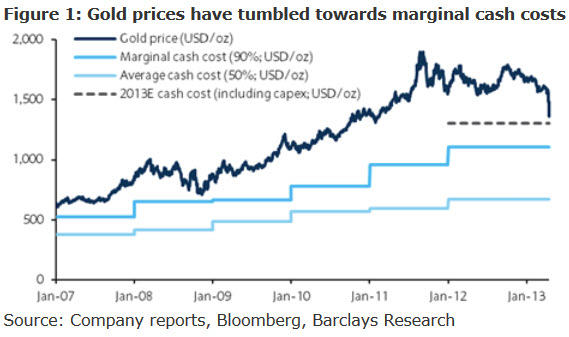
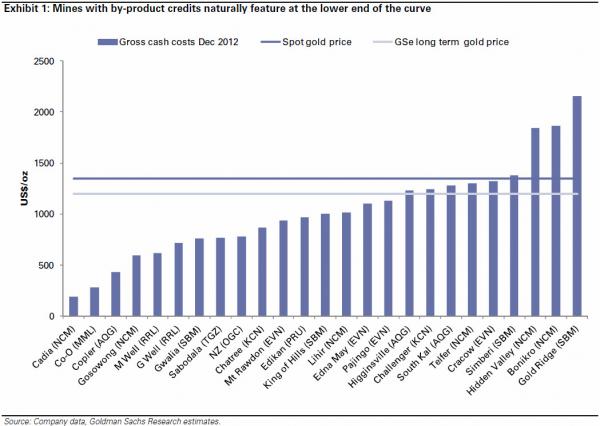
As we showed back in April, the marginal cost of production of gold (90% percentile) in 2013 was estimated at between $1250 and $1300 including capex. Which means that as of a few days ago, gold is now trading well below not only the cash cost, but is rapidly approaching the marginal cash cost of $1125… Of course, should the central banks of the world succeed in driving the price of gold to or below its costs of production (repressing yet another asset class into stocks) then we fear the repercussions will backfire from a combination of bankruptcies, unemployment, and as we have already seen in Africa – severe social unrest (especially notable as China piles FDI into that region). Read more of this post

Potter Says New Repo Tool Should Increase Fed’s Control of Rates

Potter Says New Repo Tool Should Increase Fed’s Control of Rates

Simon Potter, the Federal Reserve Bank of New York’s markets group chief, said the Fed’s reverse repurchase agreement program now being tested will probably play a central role in the eventual removal of record stimulus. Market “participants have indicated that they expect that a facility, if executed in full scale in the future, should be an effective tool for increasing the Federal Reserve’s control of short-term money market rates,” Potter said today in the text of speech in New York. He is in charge of the System Open Market Account used in implementing monetary policy. Read more of this post

Europeans Struggle to Put Out Cigarettes as Nicotine Trumps Bans

Europeans Struggle to Put Out Cigarettes as Nicotine Trumps Bans

Never mind the smoking bans, high taxes and the pictorial death warnings. Europeans still rank as the world’s heaviest smokers. About 28 percent of adults smoked in 2011 in Europe as more French picked up the habit, according to statistics released today by the World Health Organization’s regional office in Copenhagen. Tobacco-related illnesses cause 16 percent of deaths in Europe, compared with 12 percent globally, the WHO said. Read more of this post

E-Cigarettes to Fracking Rules Seen in 2014 Surge

E-Cigarettes to Fracking Rules Seen in 2014 Surge

Over the next 12 months, the Obama administration is due to issue regulations governing everything from e-cigarettes to smoke-stack emissions in what experts predict will be a second-term rush to put rules in place before leaving office. “In every administration, these things have to be wrapped up in at least the second to last year,” Cindy Skrzycki, author of “The Regulators: Anonymous Power Brokers in American Politics,” said in an interview. Skrzycki said 2014 will be an important year for agencies to get new rules under way. Read more of this post

Bitcoin’s 80-Fold Jump Unlikely to Last: Offit Capital

Bitcoin’s 80-Fold Jump Unlikely to Last: Offit Capital

Bitcoins probably won’t become a popular method of exchange as competing “crypto-currencies” crowd the market, confusing merchants and sending them back to credit cards and cash, Offit Capital said. “Why should I pay $1,000 for a Bitcoin when I can acquire a Bbqcoin for $10 or a Hobonickle for 10 cents?” Todd Petzel, chief investment officer of the New York-based private wealth-management firm, said in a report today. “They are all costless to produce, and consequently ultimately worth as much.” Bitcoins, which aren’t regulated by any country or banking authority, jumped 80-fold from a year earlier to about $1,200 last week. They traded at $1,04.98 today at 5:57 p.m. in New York on online exchange BitStamp. The currency, which exists as software in an open online system, gained credibility after law enforcement and securities agencies said at U.S. Senate hearings last month that it could be a legitimate means of exchange. Bitcoins fall short as a viable currency because there is a finite supply, Petzel said. The software that creates bitcoin dictates there can be only 21 million in circulation. “A Picasso drawing could sell for one Bitcoin and a Starbucks latte for one one millionth of a Bitcoin,” he said. “An absolute fixed quantity of currency in circulation is a recipe for extreme deflation and all the problems that come with it.”

To contact the reporter on this story: Gerrit De Vynck in Toronto at gdevynck@bloomberg.net

Bill Gross Explains What “Keeps Him Up At Night”

Bill Gross Explains What “Keeps Him Up At Night”

Tyler Durden on 12/03/2013 08:14 -0500

The choice extracts from Bill Gross’ just released latest monthly letter:

What keeps us up at night? Well I can’t speak for the others, having spoken too much already to please PIMCO’s marketing specialists, but I will give you some thoughts about what keeps Mohamed and me up at night. Mohamed, the creator of the “New Normal” characterization of our post-Lehman global economy, now focuses on the possibility of a” T junction” investment future where markets approach a time-uncertain inflection point, and then head either bubbly right or bubble-popping left due to the negative aspects of fiscal and monetary policies in a highly levered world.  Read more of this post

Buffett-Munger: Temperament is more important than IQ

Temperament is more important than IQ

by SHANE PARRISH on NOVEMBER 25, 2013

Munger

During a recent interview Warren Buffett and Charlie Munger had some interesting comments on how to outsmart people who are smarter than you.

Munger: We’ve learned how to outsmart people who are clearly smarter [than we are.]

Buffett: Temperament is more important than IQ. You need reasonable intelligence, but you absolutely have to have the right temperament. Otherwise, something will snap you.

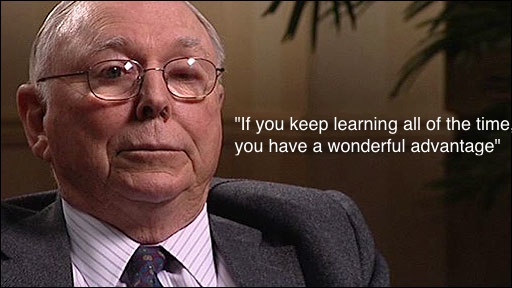
Munger: The other big secret is that we’re good at lifelong learning. Warren is better in his 70s and 80s, in many ways, than he was when he was younger. If you keep learning all the time, you have a wonderful advantage.

Buffett: And we have a wonderful group of friends, from whom we can learn a lot. Read more of this post

When the undefeated samurai Miyamoto Musashi retreated to a cave in 1643 and wrote The Book of Five Rings, he created one of the most perceptive and incisive texts on strategic thinking ever to come from Asia

The Book of Five Rings Hardcover

by Miyamoto Musashi  (Author) , Shiro Tsujimura

(Illustrator) , William Scott Wilson (Translator)

When the undefeated samurai Miyamoto Musashi retreated to a cave in 1643 and wrote The Book of Five Rings, a manifesto on swordsmanship, strategy, and winning for his students and generations of samurai to come, he created one of the most perceptive and incisive texts on strategic thinking ever to come from Asia.
Musashi gives timeless advice on defeating an adversary, throwing an opponent off-guard, creating confusion, and other techniques for overpowering an assailant that will resonate with both martial artists and everyone else interested in skillfully dealing with conflict. For Musashi, the way of the martial arts was a mastery of the mind rather than simply technical prowess—and it is this path to mastery that is the core teaching in The Book of Five Rings.
William Scott Wilson’s translation is faithful to the original seventeenth-century Japanese text while being wonderfully clear and readable. His scholarship and insight into the deep meaning of this classic are evident in his introduction and notes to the text. This edition also includes a translation of one of Musashi’s earlier writings, “The Way of Walking Alone,” and calligraphy by Japanese artist Shiro Tsujimura.   Read more of this post

How Bad Bank Cinda squares China’s debt triangles

How Cinda squares China’s debt triangles

By John Foley

NOVEMBER 27, 2013

The author is a Reuters Breakingviews columnist. The opinions expressed are his own.

CN_BDLNS1113

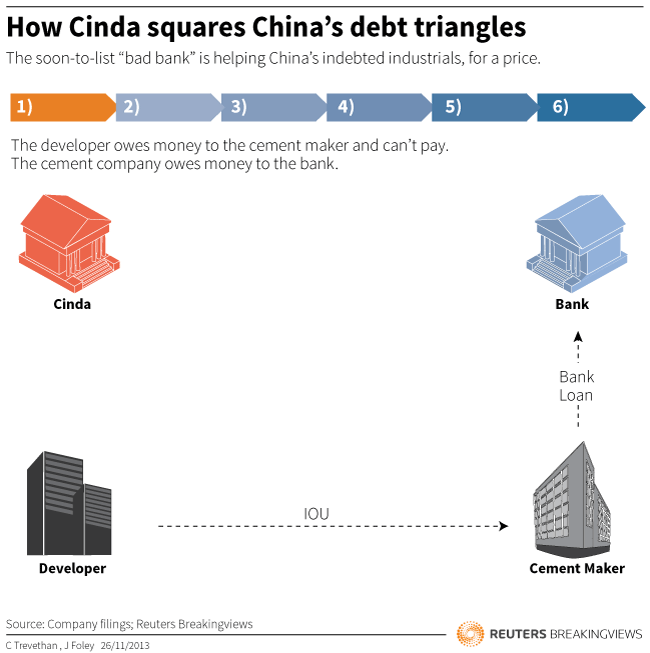
China Cinda has spotted a clever arbitrage. The Chinese “bad bank”, which is revving up for a Hong Kong initial public offering (IPO), has recently been doing brisk business by borrowing cheaply from other banks and using those funds to buy up companies’ short-term loans to each other. In doing so, it has found a way to square China’s dreaded “debt triangles”. Read more of this post

How successful people make themselves luckier

How successful people make themselves luckier

By Craig Forman November 30, 2013

The two most important days in your life are the day you are born, and the day you know why. Unfortunately for some people, that second day never occurs. For lucky people, though, the second day—the day you know why—is often described as a personal epiphany. The most successful people have a clear idea of who they are, and a conviction about where they want to end up. They then work backwards to develop the milestones they need to hit along the way. Read more of this post

Scientists May Have Found A Way To Erase Traumatic Memories

Scientists May Have Found A Way To Erase Traumatic Memories

VIRGINIA HUGHESPOPULAR SCIENCE
DEC. 1, 2013, 11:06 AM 1,039 3

Roadside bombs, childhood abuse, car accidents — they form memories that can shape (and damage) us for a lifetime. Now, a handful of studies have shown that we’re on the verge of erasing and even rewriting memories. The hope is that this research will lead to medical treatments, especially for addiction and post-traumatic stress disorder (PTSD). Researchers have known for decades that memories are unreliable. They’re particularly adjustable when actively recalled because at that point they’re pulled out of a stable molecular state. Read more of this post

Ian Rankin: ‘It took 14 years for my writing to pay’; Crime writer Ian Rankin, 53, who has sold more than 20m books, opens up on his personal finances

Ian Rankin: ‘It took 14 years for my writing to pay’

Fame & Fortune: Crime writer Ian Rankin, 53, who has sold more than 20m books, opens up on his personal finances

PD59220993_DTMP_R7_2750633b

Ian Rankin: ‘A royalty statement arrived giving a sum of six figures. Neither my wife nor I could quite believe it’  Photo: Martin Pope

By Roz Lewis

7:36AM GMT 01 Dec 2013

How did your childhood influence your work ethic and attitude to money? Greatly. I grew up in a family that was working class, which taught me to be careful with money. My father worked in a grocery store. When the grocery chain went into administration he eventually got a job in the naval dockyard in an office preparing the charts for the boats and the submarines before they headed out. Read more of this post

Our educational goal should be to help all students learn as much and as deeply as they possibly can, and to instill in them a love of learning

How I get all my students to be good at math

By Elizabeth Cleland November 30, 2013

Elizabeth Cleland has taught in Indiana, Oregon, New York, and California in public, charter, and private high schools. She also has taught in Japan and studied the Japanese educational system. As a mathematics educator for the last seven years, I can attest that most folks believe they either are or are not “math people.” And that idea of innate math ability is very harmful to both those who believe they possess it and to those who believe they don’t.  Furthermore, our new era of accountability (read test-taking) perpetuates this fallacy and clouds the message we want our students to receive in math class. Read more of this post

Why We Fail

Why We Fail

by SHANE PARRISH on NOVEMBER 28, 2013

We fail for many reasons.

In The Checklist Manifesto: How to Get Things Right Atul Gawande explains: In the 1970s, the philosophers Samuel Gorovitz and Alasdair MacIntyre published a short essay on the nature of human fallibility that I read during my surgical training and haven’t stopped pondering since. The question they sought to answer was why we fail at what we set out to do in the world. One reason, they observed, is “necessary fallibility” — some things we want to do are simply beyond our capacity. We are not omniscient or all-powerful. Even enhanced by technology, our physical and mental powers are limited. Much of the world and universe is—and will remain—outside our understanding and control. There are substantial realms, however, in which control is within our reach. We can build skyscrapers, predict snowstorms, save people from heart attacks and stab wounds. In such realms, Gorovitz and MacIntyre point out, we have just two reasons that we may nonetheless fail. Read more of this post

It’s easier than ever to get a piece of the Next Big Thing. But it’s also easier to get a piece of the Next Big Nothing. It’s easier than ever to make the leap. But also to make a big mistake

What You Need to Know to Become an Angel Investor

It’s easier than ever to make the leap. But also to make a big mistake.

SARAH E. NEEDLEMAN

December 2, 2013

SM-AA809_SMCOVE_NS_20131125125406 SM-AA814_ANGELj_G_20131125125709

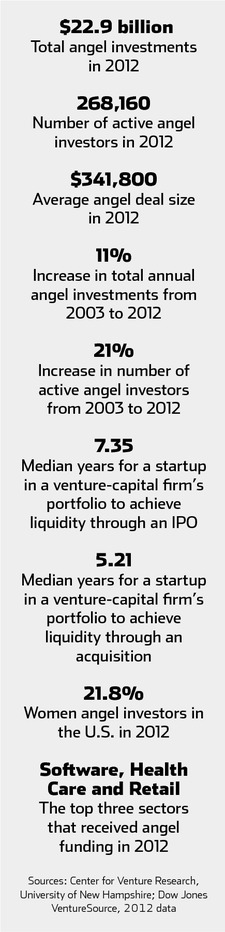
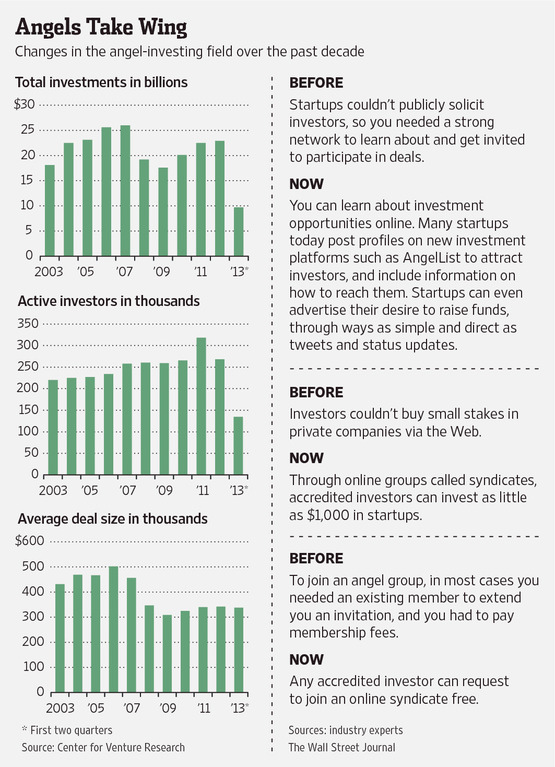
Ready to strap on some wings and become an angel investor? Investing in young companies or startups used to be just for very wealthy individuals with strong networks. But these days, you don’t need to be well connected to participate in deals. Now you only need fairly deep pockets and access to the Internet to get in on the ground floor of what could be the next Google or Facebook. Read more of this post