Vietnam’s power grid is under strain. All kinds of fuses may blow

Vietnam’s power grid is under strain. All kinds of fuses may blow

Aug 31st 2013 | HANOI |From the print edition

IN 1894 Prince Henri d’Orléans published a book of his journey through France’s then-sprawling empire. His florid account was largely upbeat. Yet it soured along the northern coastline of Vietnam, where he lamented the “dilatory attitude of a red-tape administration” when it came to exploiting the area’s coal reserves. Now red tape is again impeding foreign investment in Vietnam’s energy sector. The country’s electricity supply is fairly reliable—if compared with Myanmar and Pakistan. But daily life is punctuated by brownouts which analysts say will intensify unless officials reform a state-dominated power market and entice foreign companies to build more power plants. That also has sobering implications for the ruling Communist Party, which is trying to revive a slow economy and boost its sagging legitimacy. Read more of this post
Bank Leverage Tax? Bank Leverage Is the Defining Debate of Our Time

Bank Leverage Is the Defining Debate of Our Time

Every age has great debates on its defining questions. Sometimes these disputes are on a grand scale: capitalism versus communism. Sometimes they concern details that puzzle later generations: Summarize the main points of contention in the Thirty Years’ War, without consulting Google.

The defining conflict of our time is over what might seem to be a relatively arcane and technical detail: leverage, meaning the extent to which financial institutions should be allowed to borrow relative to their total balance sheets. The question won’t be decided on the battlefield, in the courts or by the public. The Board of Governors of the Federal Reserve System will make the call. Read more of this post

The big trade switch is on as emerging markets export less; global expansion will slow until emerging countries develop stable sources of internal demand to replace their sales abroad

The big trade switch is on as emerging markets export less

By Tim Fernholz @timfernholz September 3, 2013

trade-trends-highlight-global-growth-worries-world-trade-volume-advanced-economies-emerging-economies_chartbuilder

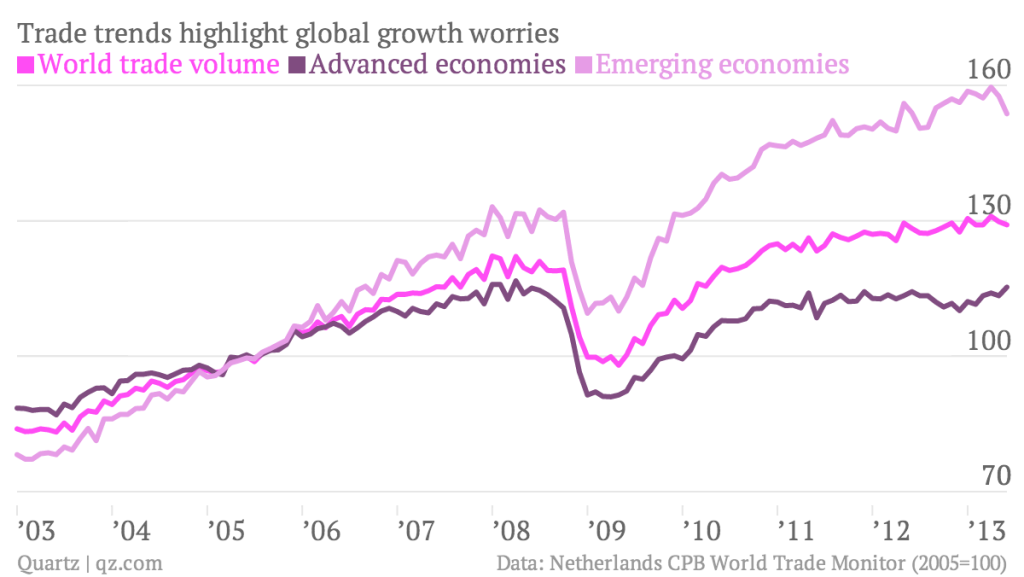
This chart shows a trend that has economists worried about the pace of economic recovery: the slowing growth of overall worldwide trade, and the drop in exports from emerging markets even as the advanced economies sell more goods abroad. The OECD released an interim forecast of global growth today, showing a continued slow recovery in the US, Japan and Germany that is being undermined by slowing growth in emerging markets, including China, Brazil and India. This is a reversal from recent years, when emerging markets drove global growth as Europe stumbled through a double-dip recession and the US slowly emerged from the wreckage of its housing bubble. But in 2013, industrial production has slowed in emerging economies even as manufacturing grows in wealthier Western nations. Another data point out today that reflects this trend: US factories reported the largest increase in orders in the last two years. This is all part of the great rebalancing, as wealthier citizens in emerging marketsseek access to more imported Western goods, while Western economies re-tool tocompete with cheaper workforces abroad. That’s all well and good, but because emerging markets make up such a huge share of worldwide economic activity, global expansion will slow until these countries develop stable sources of internal demand to replace their sales abroad.


How 37-Year-Old Teacher Imperils Pimco’s Bond Bet: Mexico Credit

How 37-Year-Old Teacher Imperils Pimco’s Bond Bet: Mexico Credit

For Pedro Hernandez, a striking elementary-school teacher from the southern state of Oaxaca, his union’s protests disrupting Mexico’s capital aren’t just about education. They’re about stopping President Enrique Pena Nieto. “We’re against all the structural reforms,” the 37-year-old said last week as he walked down Mexico City’s central boulevard as part of an organized march of 15,000. Hernandez held a sign that read, “Mexico has no president.” Read more of this post

Here’s The Key Thing You Should Know About Ronald Coase, The Great Economist Who Died Yesterday At 102

Here’s The Key Thing You Should Know About Ronald Coase, The Great Economist Who Died Yesterday At 102

JOSH BARRO SEP. 3, 2013, 4:43 AM 4,308 12

Ronald Coase, 1910-2013

Ronald Coase was one of those economists whose contributions were so significant and so longstanding that you assumed he had to be dead. But he wasn’t, until yesterday, when he died at the age of 102. Coase’s most famous contribution is the Coase Theorem, which holds that the problem of externalities—that is, me taking an action that imposes a cost on you—can be fixed without government action so long as property rights are clearly defined and transaction costs are low. My favorite example of the Coase Theorem in action relates to airline seats. A lot of people like to complain about airline passengers who recline, taking away precious knee-room. But Coase would have said there’s a simple solution to this problem: pay the person in front of you not to recline. If you value your knee space more than he values the option to lean back, the seat will stay upright where it belongs. There’s no need for the government, or the airline, to intervene to protect your knees. Read more of this post

Factoring Draws Attention of China’s Bank Regulator

September 3, 2013, 6:43 a.m. ET

Factoring Draws Attention of Bank Regulator

Regulator Seeks Better Monitoring of Innovative Lending

BEIJING—China’s banking regulator has instructed banks to better monitor a type of lending particularly popular with small firms as demand burgeons and banks relax their oversight standards. According to a document from the China Banking Regulatory Commission seen by The Wall Street Journal, loans made against companies’ accounts receivable—those sales for which a company has yet to receive payment—must be recorded as nonperforming loans if they turn bad. Banks also need to be sure that such loans are in fact backed by receivables. Read more of this post

China Arrests Bosera’s Ex-Fund Manager Ma Le on Suspected Insider Trading in front-running of fund clients

September 3, 2013, 7:04 a.m. ET

China Arrests Ex-Fund Manager on Suspected Insider Trading

Bosera Fund Management: Activities Were Ma Le’s ‘Personal Actions’

BEIJING—China has arrested a former manager with a major securities fund-management company on suspicion of insider trading, the nation’s legal supervisory body said Tuesday. Ma Le, a former fund manager at Bosera Fund Management, has been arrested on suspected front-running of fund clients, the Shenzhen People’s Procuratorate said in a statement on its website. Front-running, a form of trading on privileged information, entails purchases of securities by a broker or fund manager for resale to clients—or the fund itself—at a profit. The procuratorate is responsible for criminal investigations and prosecutions. Read more of this post

Publishing Hears Echoes of Netflix Business Model; Digital Startups Prepare to Offer E-Book Subscription Services

September 2, 2013, 6:59 p.m. ET

Publishing Hears Echoes of Netflix Business Model

Digital Startups Prepare to Offer E-Book Subscription Services

JEFFREY A. TRACHTENBERG

Offering unlimited television shows and music for a flat monthly fee has worked forNetflix Inc. NFLX +1.06% and Spotify AB. Will it work in the book industry? It is a question of intensifying debate in the publishing industry right now, as two digital startups plan launches of rival e-book subscription services this fall. If successful, the new services could pose fresh challenges for brick-and-mortar bookstores already struggling to cope with the growth of e-book sales and low prices of physical books offered online. Read more of this post

It’s all in the wrist – Who has vision to crack the “smartwatch”?

It’s all in the wrist – Who has vision to crack the “smartwatch”?

7:08am EDT

By Jeremy Wagstaff

SINGAPORE (Reuters) – The smartwatch could be as revolutionary as the smartphone – an intelligent device on our wrist that connects our bodies to data and us to the world – but only a handful of companies have the heft and vision to be able to pull it off. It’s not through lack of trying. Watchmakers and others have been adding calculators, calendars and wireless data connections to wrist-straps for at least 30 years. Read more of this post

What’s Left of Nokia? Microsoft Deal Changes Nokia’s Focus; Remaining Business Largely Focused on Network Equipment; Nokia handsets sale reveals revamped networks value

September 3, 2013, 10:15 a.m. ET

Deal Changes Nokia’s Focus

Remaining Business Largely Focused on Network Equipment

SAM SCHECHNER

What’s left of Nokia NOK1V.HE +33.94% Corp.? The Finnish company’s proposed $7 billion deal to sell its unprofitable cellphone business to Microsoft Corp MSFT -5.48% . will leave behind 56,000 employees and a collection of businesses focused mainly on making network equipment for cellphone operators. But it will also hold on to a lucrative patent portfolio and a mobile-mapping business that competes with Google Inc. GOOG +1.11% and Apple Inc. If a deal is sealed, Nokia will emerge about half the size it is today, by revenue, but profitable. Read more of this post

Nokia’s Stephen Elop: Next Microsoft CEO? Having Left the Software Giant After Running the Company’s Profitable Business Division, Elop Returns a Bit of a Hero

Updated September 3, 2013, 10:37 a.m. ET

Nokia’s Stephen Elop: Next Microsoft CEO?

Having Left the Software Giant After Running the Company’s Profitable Business Division, Elop Returns a Bit of a Hero

JOHN D. STOLL

After three years of trying to repair businesses that proved to be unfixable, Nokia Corp.NOK1V.HE +33.94% Chief Executive Stephen Elop is back at Microsoft Corp.MSFT -5.60% to help shape the legacy of the software giant’s longtime boss, and potentially take his job. Nokia on Tuesday announced the $7 billion sale of an ailing handset business to Microsoft, ending several months of discussions between Mr. Elop and Microsoft Chief Executive Steve Ballmer. The negotiations were the subject of dozens of boardroom deliberations on both sides of the Atlantic. Read more of this post

Analysts: Microsoft Bought Nokia Because Nokia Was Going To Stop Making Windows Phones

Analysts: Microsoft Bought Nokia Because Nokia Was Going To Stop Making Windows Phones

NICHOLAS CARLSON SEP. 3, 2013, 7:25 AM 9,018 8

Last night Microsoft bought the smartphone division of Nokia for ~$7 billion. Nokia will present the deal to is shareholders in November, and both companies expect the transaction to close in the first quarter of 2014. So, why did Microsoft do this deal? Two analysts, Ben Thompson of Stratechary and Benedict Evans, assume that Microsoft had to buy Nokia because Nokia was going to stop making Windows Phones very soon.

Read more of this post

South Koreans hope fortune-tellers point way to top of the class

South Koreans hope fortune-tellers point way to top of the class

Fortune teller Song Byung-chang looks at a child's fate, or Saju in Korean, at his office in Seoul

8:13am EDT

By Jane Chung

SEOUL (Reuters) – Byun Mi-kyong sat quietly with her hands in her lap as she listened closely to every word the fortune-teller said about her daughter’s chances of getting into the right university. Dealing with intensely competitive college entrance exams has driven South Korean students to despair, and sometimes to suicide, as they fight for the few places in the best programs that are seen as the key to a successful career. Anxious parents have long sought hints from fortune-tellers about how well their children will do in school. But now Byun and others are turning to divination for specific guidance on picking the most promising activities, courses and colleges. Read more of this post

China bans officials from buying mooncakes with public funds

China bans officials from buying mooncakes with public funds

8:30am EDT

BEIJING (Reuters) – China is banning officials from using public funds to buy mooncakes, pastries offered as gifts during the Mid-Autumn Festival, as part of President Xi Jinping’s fight against corruption, the government said on Tuesday. Officials cannot use public money to send mooncakes as gifts or to arrange banquets that are not related to official duties during the festival, which falls on September 19 this year, the ruling Communist Party’s Central Commission for Discipline Inspection said on its website. Read more of this post

For Rich Mainlanders, Hong Kong Loses Luxury Luster

September 3, 2013, 6:22 PM

For Rich Mainlanders, Hong Kong Loses Luxury Luster

By Jason Chow and Chester Yung

Has Hong Kong lost its perch as China’s preferred luxury hub? Mainland Chinese passport holders account for 78% of all visitors to Hong Kong, and they have an outsize presence on the city’s shopping scene. The sheer number of Chinese visitors is huge: Last year saw 34.9 million arrivals from China, equal to about five times’ Hong Kong’s population. But while mainlanders continue to arrive in the city in droves – more than 3.7 million entered the territory in July, up 15.7% from a year before – they seem to be spending less than they used to, and veering away from big-ticket items in particular, according to Hong Kong government figures released on Monday. Read more of this post

Citigroup has shed more than $6 billion in private-equity and hedge-fund assets in the past month in order to comply with new regulations limiting banks’ holdings of “alternative” investments

Updated September 2, 2013, 9:28 p.m. ET

Citigroup Dialing Back Its ‘Alternative’ Holdings

SHAYNDI RAICE

Citigroup Inc. C +2.13% has shed more than $6 billion in private-equity and hedge-fund assets in the past month, according to people familiar with the transactions, in order to comply with new regulations limiting banks’ holdings of “alternative” investments. The nation’s third-largest bank by assets last week sold a $4.3 billion private-equity fund called Citi Venture Capital International for an undisclosed price to Rohatyn Group, a private-equity fund run by Nick Rohatyn, son of financier Felix Rohatyn, said people familiar with the matter. It couldn’t be determined what price the fund fetched. On Aug. 9, Citigroup sold a $1.9 billion emerging-markets hedge fund to the fund’s managers, the people said. Read more of this post

China’s Struggle Sessions; A messy leadership transition suggests the return of ideology

September 3, 2013, 1:10 p.m. ET

China’s Struggle Sessions

A messy leadership transition suggests the return of ideology.

When the trial of Bo Xilai, the former Communist Party boss of Chongqing, ended last week, most observers assumed that Chinese politics would settle into its usual monotonous patterns. But the power plays continue. On Tuesday, Jiang Jiemin was removed as head of the State-Owned Assets Supervision and Administration Commission (SASAC), a post he had held for only a few months. Read more of this post

Buying a Frontier Market Fund? This Theater’s Got a Teeny, Tiny Exit

September 3, 2013, 10:26 A.M. ET

Buying a Frontier Market Fund? This Theater’s Got a Teeny, Tiny Exit

By Brendan Conway

It’s been a rotten year for one of yesteryear’s favorite investing categories: iShares MSCI Emerging Markets ETF (EEM) is down 13% on the year. But iShares MSCI Frontier 100 ETF(FM), which tracks stocks from tiny, less trodden markets that are too underdeveloped for EEM, is up more than 10%. If you guessed frontier markets are even less liquid than emerging markets and, thus, harder to exit in a panic, Joe Light of the Wall Street Journal has some data you should see. Namely, Vanguard Group estimates the one hour it takes to liquidate $100 million in emerging-markets expands to more than 10 days when you’re on the frontier. Being so small can have bad consequences, says Chris Philips, senior analyst at Vanguard Group, which doesn’t offer a frontier-market fund. For one thing, it can take funds a long time to move into and out of stocks. Mr. Philips calculated that a frontier-market fund would need more than 10 days to liquidate a $100 million position. Read more of this post

Europe’s Workers Flock to Norway for Better-Paying Jobs

Europe’s Workers Flock to Norway for Better-Paying Jobs

Pedro Dias cut his workday almost in half and tripled his pay after leaving his native Portugal for a job as a software developer in Oslo. The 27-year-old, who escaped 15-hour days as a researcher at New University of Lisbon and now rarely works past 5 p.m., landed his job at Metafocus AS, a producer of web-based software, at a career fair in the Portuguese capital in February. “In Portugal, with an average salary you will struggle and have to work longer hours,” he said as he looked at the waters of the Oslo Fjord from a patio outside his office in the capital. Dias says he enjoys his new job and his free time, during which he is preparing for his first half-marathon run. Read more of this post

Philippine netizens have voiced outrage over a plan to spend 7.8 million pesos (about US$177,000) to replace a flagpole at a national park in Manila, accusing the government of misusing state funds

Outrage over multi-million peso flagpole

By Christine Ong
POSTED: 04 Sep 2013 12:35 AM
Philippine netizens have voiced outrage over a plan to spend 7.8 million pesos (about US$177,000) to replace a flagpole at a national park in Manila, accusing the government of misusing state funds.

MANILA: There is uproar in some quarters of the Philippines over a plan to spend millions of pesos on replacing a flagpole in a national park. The government is allotting 7.8 million pesos (about US$177,000) to replace the current 30-metre high pole standing in front of a monument of the country’s national hero, Jose Rizal, at Rizal Park in Manila. The new flagpole to be imported from China, will be 52 metres high and will include the installation of a mechanically-assisted pulley and a new marble base. Read more of this post

Predicting Financial Markets with Google Trends and Not so Random Keywords

Predicting Financial Markets with Google Trends and Not so Random Keywords

Damien Challet Ecole Centrale Paris – Laboratory of Mathematics Applied to Systems

Ahmed Bel Hadj Ayed Ecole Centrale Paris – Laboratory of Mathematics Applied to Systems

August 14, 2013

Abstract: 
We check the claims that data from Google Trends contain enough data to predict future financial index returns. We first discuss the many subtle (and less subtle) biases that may affect the back-test of a trading strategy, particularly when based on such data. Expectedly, the choice of keywords is crucial: by using an industry-grade back-testing system, we verify that random finance-related keywords do not to contain more exploitable predictive information than random keywords related to illnesses, classic cars and arcade games. We however show that other keywords applied on suitable assets yield robustly profitable strategies, thereby confirming the intuition of Preis et al. (2013)

Mammal Virus Tally Seen Speeding Global Contagion Control

Mammal Virus Tally Seen Speeding Global Contagion Control

The mammalian world may harbor at least 320,000 viruses, scientists estimated in new research that aims to speed the control of new infectious killers. The tally, based on data collected from flying foxes in Bangladesh applied to the 5,486 known species of mammal, will help create a more systematic way of managing outbreaks, particularly those spreading from animals to humans, scientists from Columbia University and the EcoHealth Alliance wrote in a paper published today in the journal mBio. Zooneses, or diseases that transmit from vertebrate animals to humans, account for almost 70 percent of emerging infectious diseases including HIV, Ebola and severe acute respiratory syndrome, or SARS, the scientists said. “This is a real breakthrough,” said Peter Daszak, a study author and president of EcoHealth Alliance, a biodiversity conservation organization. “Instead of just sitting here and waiting for them to emerge and kill us, we want to be ahead of the curve and fight them before they even kill the first ever person.” Money spent researching disease threats would represent a fraction of the cost of fighting a contagion such as SARS, whose economic impact is estimated at $16 billion, the scientists wrote in the study. The cost of uncovering all viruses in mammals is about $6.3 billion, and expenses could be cut to $1.4 billion by limiting discovery to 85 percent of estimated viral diversity, they said, based on their extrapolation of results.

To contact the reporter on this story: Natasha Khan in Hong Kong at nkhan51@bloomberg.net

Dealers in Debt Pare Commitments Raising Risk as New Rules Bite

Dealers in Debt Pare Commitments Raising Risk as New Rules Bite

The worst losses in U.S. debt in at least 37 years are being magnified by investors exiting the market at the same time new regulations prompt Wall Street firms to cut back on trading corporate bonds. Bank of America Merrill Lynch’s U.S. Broad Market Index is on pace to drop 4.41 percent, the biggest annual loss since at least 1976. Investors pulled $123 billion from bond funds since May, according to TrimTabs Investment Research. Read more of this post

North Korea Can Launch Nuclear-Tipped Missiles, South Korea Says, contradicting the U.S. position that the country is years away from developing the technology

North Korea Can Launch Nuclear-Tipped Missiles, South Korea Says

North Korea can now deliver a nuclear warhead on a missile, the South Korean Defense Ministry said in a report, contradicting the U.S. position that the country is years away from developing the technology. “The security situation on the Korean Peninsula has now worsened as the North’s threat of nuclear missiles has become real,” according to the report, which was presented to a parliamentary committee on national security today and released by the office of lawmaker Kim Kwang Jin. The new capability may embolden North Korea toward military provocation once the U.S. relinquishes its wartime command of South Korean troops in 2015, the report said. That command was given to the U.S. during the 1950-53 Korean War. North Korea threatened first strikes against South Korea and the U.S. in March after a February nuclear test prompted tightened sanctions against the Kim Jong Un regime. The Obama administration, which has called on North Korea to renounce its nuclear program, has said the country didn’t have the ability to launch an atomic weapon on a missile. Until 2010, the North was in an experimental stage with its nuclear missiles, and the country has now come to a point where it can actually use them, the report said. The Defense Ministry didn’t explain how it reached its conclusion, and the study didn’t mention the ranges of the missiles that the North had the capability to mount weapons on.

To contact the reporter on this story: Sam Kim in Seoul at skim609@bloomberg.net

China Solar Defaults Shock Holders as $8.4 Billion Due

China Solar Defaults Shock Holders as $8.4 Billion Due

LDK Solar Co.’s delay in paying debt and Suntech Power Holdings Co.’s attempts to renegotiate obligations are prompting investors to gird for losses as $8.4 billion in renewable energy comes due by the end of next year. The 2014 securities of LDK slid to a record low of 25.6 yuan per 100 yuan face value last week after the manufacturer said a payment due Aug. 28 on the notes would be delayed. That compares with the 30 euros per 99.861 euro issue price on Bonn-based Solarworld AG. (SWV) Suntech, once the world’s biggest panel maker, said former chairwoman Susan Wang and two other directors quit amid negotiations with holders of its defaulted debt. Read more of this post

Rupiah Weakens Beyond 11,000 a Dollar for First Time Since 2009

Rupiah Weakens Beyond 11,000 a Dollar for First Time Since 2009

The rupiah weakened beyond 11,000 per dollar for the first time since April 2009 on concern Indonesia will struggle to rein in a record current-account gap. The nation’s trade shortfall was $2.3 billion in July, compared with the $393 million median estimate in a Bloomberg survey of economists. The current-account deficit will be about 4 percent of gross domestic product or more this quarter, from 4.4 percent in the previous period, Bank of America Merrill Lynch economist Hak Bin Chua wrote in a note yesterday. This is higher than the government’s target of 3 percent this quarter. Read more of this post

Japan Salaries Extend Longest Fall Since ’10 in Threat to Abe

Japan Salaries Extend Longest Fall Since ’10 in Threat to Abe

Japan salaries extended the longest slide since 2010 in July, raising the stakes for Prime Minister Shinzo Abe’s decision on whether to increase a sales tax. Regular wages excluding overtime and bonuses dropped 0.4 percent from a year earlier, marking a 14th straight month of decline, according to data released today by the Ministry of Health, Labour and Welfare. Bonus payments rose 2.1 percent, helping to lift total cash earnings 0.4 percent. Read more of this post

RBA Running Out of Room to Cut Rates, Australia’s Robb Says

RBA Running Out of Room to Cut Rates, Australia’s Robb Says

Australia’s central bank is running out of room to implement emergency stimulus measures should they be needed with interest rates now at historical lows, Shadow Finance Minister Andrew Robb said. The central bank doesn’t have “a lot of room left if there was some other unforeseen event in the world economy to make a difference,” Robb, whose Liberal-National coalition is on track to win government at the Sept. 7 election, said in an interview with Bloomberg Television today. “The Reserve Bank has been relied upon, or pressured, to do the heavy lifting in the economy for the last few years.” Read more of this post

SNB Shield Reaps Reward of Growth Defying Euro Area

SNB Shield Reaps Reward of Growth Defying Euro Area

Switzerland’s economy defied the recession that afflicted its neighbors to notch up a year of uninterrupted growth, underlining the importance of the country’s currency ceiling as it marks its second anniversary. Swiss gross domestic product rose 0.5 percent in the second quarter from three months through March, when it expanded by 0.6 percent, the Secretariat for Economic Affairs in Bern said in a statement today. That is more than a median estimate of 0.3 percent in a Bloomberg survey of 18 economists. Read more of this post

Ronald Coase, Nobel Winner Who Studied Corporations, Dies at 102

Ronald Coase, Nobel Winner Who Studied Corporations, Dies at 102

By Laurence Arnold September 02, 2013

220px-Coase

Ronald Coase, the British-born University of Chicago economist whose Nobel Prize-winning work on the role of corporations stemmed from visits in the early 1930s to American companies including Ford Motor Co. and Union Carbide, has died. He was 102. He died yesterday at St. Joseph Hospital in Chicago, according to a news release from the University of Chicago. No cause was given. The Royal Swedish Academy of Science awarded Coase the 1991 Nobel in economics “for his discovery and clarification of the significance of transaction costs and property rights for the institutional structure and functioning of the economy.” Read more of this post