How the Great Depression Spawned Literary Masterworks

How the Great Depression Spawned Literary Masterworks

The Great Depression was one of the most desperate periods in U.S. history, and one of the most important in American literature.

When the stock market crashed in October 1929 and the hectic prosperity of the 1920s gave way to mass unemployment, the crisis energized American writers. After a decade in which the literary experiments of the Modernists — Ernest Hemingway, F. Scott Fitzgerald, T.S. Eliot — dominated the scene, a new wave of writers began to look to politics and economics for inspiration. At a time when the Communist Party was presenting itself as the strongest force for progress, these writers saw capitalist America as a dying society in need of revolutionary changes. Never before or since have so many of America’s best writers focused on the lives of the poor and the working class or written with such a furious sense of political engagement. In 2008, the U.S. suffered the most severe economic crisis since 1929. This was followed by a deep recession characterized by high unemployment, financial instability and government deadlock — an echo of the problems that plagued the country during the Depression, though in much less virulent form. Read more of this post

Bursting the Neuro-Utopian Bubble; Pyschosocial problems cannot simply be solved in the neuroscientist’s lab

AUGUST 11, 2013, 9:31 PM

Bursting the Neuro-Utopian Bubble

By BENJAMIN Y. FONG

During my graduate studies in the Department of Religion at Columbia, I spent countless hours in the Burke Library of Union Theological Seminary, where I had a spectacular, cater-corner view of the construction and unveiling of the Northwest Corner Building, Columbia’s new interdisciplinary science building. Although the 14-story steel and aluminum tower was designed to complement the brick and limestone gothic tower of Union, its dominating presence on the corner of Broadway and 120th serves as a heavy-handed reminder of where we are heading. Walking from Union toward Columbia’s main campus through its doors, I often felt, passing through the overwhelmingly aseptic marble lobby, as if the building was meant to cleanse northwesterly intruders who have not been intimidated by the facade. Read more of this post

Inventor Greg Lambrecht uses the Coravin wine preservation device to serve rare, expensive Italian wines by the glass

Wine Loving Inventor Solves Red or White By Glass Battle

ii1nvaPurvdo iORcxnYQCqKM imRydKIhE7y4

Inventor Greg Lambrecht, founder of medical device company Intrinsic Therapeutics, Inc., after showing off his Coravin wine preservation system at Del Posto. The restaurant’s wine director, Jeff Porter, has been using the device to serve rare, expensive Italian wines by the glass since last November. A cartridge of Argon gas, used to keep wine fresh within the Coravin wine preservation device. A hollow needle is pushed into the cork, then a button releases argon gas into the wine. Coravin of white Burgundy 2010 Alex Gambal Meursault Clos du Cromin. The Coravin is an ingenious wine preservation system that allows you to access wine without pulling the cork and keeps the wine inside the bottle fresh for years. Photographer: Elin McCoy/Bloomberg

Hankering for a taste of 1979 Il Colle Brunello di Montalcino with your dry-aged steak? At New York’s Del Posto restaurant, a three-ounce pour is $169, six ounces, $338. The by-the-glass list includes hard-to-obtain 2000 Giacomo Conterno Barolo Monfortino for $100 and $200, and last month, rare Italian stunner 2002 Masseto. All this is thanks to a new wine preservation device, the Coravin 1000. “It’s a wine populist’s dream, giving more people access to the world’s great wines,” says Del Posto wine director Jeff Porter. He’s been offering them “alla Coravin” since last November. The ingenious $299 device went on public sale two weeks ago. Though most new wine gadgets bring out my inner skeptic, this one will revolutionize how we drink wine at restaurants — and at home. One of my pet peeves has always been the boring selection of wines at most restaurants offered by the glass. Usually it includes only current vintages, yet they frequently taste dull, cooked and lifeless, signs they’re oxidized from being open too long. Once you pull a cork, contact with air causes the wine to start deteriorating. The Coravin prevents that by allowing you to access the wine without actually pulling the cork. Really. Read more of this post

Autism’s Unexpected Link to Cancer Gene

August 11, 2013

Autism’s Unexpected Link to Cancer Gene

By GINA KOLATA

Researchers studying two seemingly unrelated conditions — autism and cancer — have unexpectedly converged on a surprising discovery. Some people with autism have mutated cancer or tumor genes that apparently caused their brain disorder. Ten percent of children with mutations in a gene called PTEN, which causes cancers of the breast, colon, thyroid and other organs, have autism. So do about half of children with gene mutations that can lead to some kinds of brain and kidney cancer and large tumors in several organs, including the brain. That is many times the rate of autism in the general population. “It’s eerie,” Evan Eichler, a professor of genome science at the University of Washington, said about the convergence. Read more of this post

U.S. Probes Use of Antipsychotic Drugs on Children

August 11, 2013, 10:39 p.m. ET

U.S. Probes Use of Antipsychotic Drugs on Children

Federal health officials are reviewing antipsychotic drug use on children in the Medicaid system

LUCETTE LAGNADO

P1-BM655A_ANTIP_G_20130811180008

Federal health officials have launched a probe into the use of antipsychotic drugs on children in the Medicaid system, amid concern that the medications are being prescribed too often to treat behavioral problems in the very young. The inspector general’s office at Department of Health and Human Services says it recently began a review of antipsychotic-drug use by Medicaid recipients age 17 and under. And various agencies within HHS are requiring officials in all 50 states to tighten oversight of prescriptions for such drugs to Medicaid-eligible young people. Read more of this post

Why Your Computer Slows Down Over Time

Why Your Computer Slows Down Over Time

KEVIN SMITH AUG. 11, 2013, 9:14 AM 31,478 37

One of the biggest computer annoyances is when your machine gets slow over time. This can start to happen years after you get a PC, but sometimes it happens in just a few short months. Since we all use our computers for different tasks and activities, there isn’t one single reason that pinpoints why this happens. The thing is, when you first get a new computer and boot it up it works lightning fast. That’s because it doesn’t have anything on it. Regardless of whether you have a PC or Mac, over time as you download files, install software, and surf the Internet, your computer gets bloated with files that hog system resources. In addition, there are many other things that contribute to a slowdown. We explored some of the major causes. We started by speaking with Rachel, a tech expert who works at New York City authorized Apple repair shop Tekserve. Rachel told us that software and hard drive corruption are two reasons why your computer may slow down over time. Corruption can be caused by a host of things but it’s mostly bugs in the operating system, corrupted RAM data, static electricity (from carpet or other fabrics), power surges, failing hardware, and for Windows users, normal operating system decomposition with age. Two other huge culprits are not having enough RAM (memory to run programs) and simply running out of hard disk space. Not having enough RAM causes your hard drive to try to compensate for a lack of memory. The computer will constantly seek more RAM taking away resources from other tasks. Another thing users fall victim to is installing unnecessary software. This will fill up your hard drive, causing you to run out of space at the price of speed. There are useful free programs that help you easily identify what is taking up space on your hard drive: For Mac users try: OmniDiskSweeper, a free program that breaks down exactly which files take up the most space. For PC users try WinDirStat, a disk usage statistics viewer and cleanup tool. But what if you don’t have a lot of apps or programs on your computer and it’s still going slow? Read more of this post

To Stay Afloat, Bookstores Turn To Web Donors

August 11, 2013

To Stay Afloat, Bookstores Turn To Web Donors

By JULIE BOSMAN

For years, independent bookstores have taken creative steps to fight off challenges from Amazon and the superstores by building in-house espresso bars, hosting members-only lunches with authors and selling birthday cards, toys and trinkets. In 2013, it has come to this: Asking their customers for donations. Crowdfunding is sweeping through the bookstore business, the latest tactic for survival in a market that is dominated by Amazon, with its rock-bottom prices, and Barnes & Noble, with its dizzying in-store selection. It’s hardly a sustainable business model; but it buys some time, and gives customers a feeling of helping a favorite cause and even preserving a civic treasure. In San Francisco, a campaign for Adobe Books successfully raised $60,000 on Indiegogo.com in March after the store faced a rent increase and nearly went out of business. In Asheville, N.C., the Spellbound Children’s Bookshop collected more than $5,000 when it appealed to customers for help moving to a new location. Read more of this post

Tiny screens are growing in importance for television viewers

August 11, 2013 1:51 pm

Tiny screens are growing in importance for television viewers

By Emily Steel in New York

Television viewers are trading the small screen for the tiny screen, with a growing proportion of smartphone owners watching full-length television programmes on mobile devices. New research shows a surge in people watching not just short clips but entire television episodes and films on tablets and smartphones. While 38 per cent ofsmartphone owners regularly watch videos on their device, about a tenth now watch full-length television programmes, according to Magid Advisors, a consulting group whose clients include large media and technology companies. “Mobile is the connected television that we all carry in our pockets,” said Amir Ashkenazi, chief executive of Adap.tv, the digital video advertising company thatAOL said it would acquire for $405m last week. Read more of this post

Technology Industry Extends a Hand to Struggling Print Media

August 11, 2013

Technology Industry Extends a Hand to Struggling Print Media

By NICK WINGFIELD

From classifieds to display ads to subscriptions, the digital age has broken the financial pillars of print journalism, leaving the industry struggling to stand on its own. But more frequently — and with a boom last week, when Jeffrey P. Bezos, the founder of Amazon.com, bought The Washington Post — the tycoons who have led the digital revolution are giving traditional print outlets a hand. Call it a sense of obligation. Or responsibility. Or maybe there is even a twinge of guilt. Helping print journalism adapt to a changed era is becoming a cause de jour among the technology elite. Read more of this post

One Hour Translation’s Patented Tech Enables Speedy And Accurate Real-Time Translation Of Online Content

One Hour Translation’s Patented Tech Enables Speedy And Accurate Real-Time Translation Of Online Content

CATHERINE SHU

posted 10 mins ago

ounded in 2008, One Hour Translation is one of the oldest and largest online translation companies, with more than 15,000 active translators in 100 countries who cover more than 75 languages. The Cyprus-based company processes 100,000 projects a month for customers ranging from large corporations (including Toyota and Shell) that need enterprise-grade multilingual content management systems to smaller companies in search of a more polished alternative to cutting-and-pasting content into Google Translate.

Over the last five years, CEO and founder Ofer Shoshan, who bootstrapped One Hour Translation, has seen an increase in demand for online translation as companies seek to diversify into global markets. Read more of this post

Monster Zombie Spider to Crush Super Mario’s China Dreams: Tech

Monster Zombie Spider to Crush Super Mario’s China Dreams: Tech

He’s pudgy, middle aged and wears dungarees. So what makes investors believe Nintendo Co. (7974)’s Super Mario can take on Tencent Holdings Ltd. (700)’s giant, undead spider Vilemaw in his Chinese lair?

Nintendo shares have risen 36 percent since state-run China Daily on Jan. 28 said the country was ready to end a 13-year ban on consoles. Meant to shelter China’s youth from the violence and perceived corrupting influence of video games, the ban instead spawned a generation of gamers grown used to a free online model and increasingly migrating to mobile devices. Read more of this post

Currency broker FxPro is set to become the latest investment platform to dive into the world of “social trading”, in a bid to lure investors who are immersed in Twitter and other forms of social media

August 11, 2013 5:09 pm

Currency broker FxPro set to enter world of social trading

By Vanessa Kortekaas

Currency broker FxPro is set to become the latest investment platform to dive into the world of “social trading”, in a bid to lure investors who are immersed in Twitter and other forms of social media . The online foreign exchange broker is planning to launch a “Super Trader” platform this autumn featuring about 200 forex traders, whose positions can be copied by other FxPro traders. “The whole concept is to give clients access to different [trading] strategies in order to diversify their risk,” said Charalambos Psimolophitis, chief executive of the Cyprus-based platform. Read more of this post

Cashing in on health scares, China online food sales boom

Cashing in on health scares, China online food sales boom

Sun, Aug 11 2013

By Dominique Patton

BEIJING (Reuters) – Chinese consumers are responding to a powerful new marketing tactic that plays to a widespread fear of food contamination – the promise of safe groceries sold online. Pledging produce direct from the farm, vendors have found food is becoming one of the fastest-growing segments of Internet retailing as they cash in on scares from cadmium-tainted rice to recycled cooking oil. The trend is adding momentum to a Chinese online retail boom driven by a rapidly expanding middle class, with companies such as COFCO Ltd and Shunfeng Express betting that a decent slice of a 1.3 billion population will pay for the peace of mind they say their services offer. Read more of this post

Tea-Maker’s Woe Signals China Fund Deficit for Entrepreneurs

Tea-Maker’s Woe Signals China Fund Deficit for Entrepreneurs

Dai Jinlian has created more than 200 jobs for villagers picking tea leaves in China’s Zhejiang province since 2008. That wasn’t enough to qualify her for a loan from the nation’s state-controlled banking system. The 65-year-old grandmother, who was denied a 40,000 yuan ($6,500) loan in 2009, relies instead on retained earnings to fund the business she started with 300,000 yuan in savings. “Banks will send you flowers when you are rich, but they won’t even look at you if you’re poor,” said Dai, who sells her “Mother Dai” tea bags through local stores. Read more of this post

Questioning China’s real achievements

Questioning China’s real achievements

Updated: 2013-08-12 02:48

By Andrew Moody ( China Daily)

Sinologist’s views unleash debate about the country’s place in the world and how farit will finally advance

eca86bd9dcd8136e9c6a04

Is China emerging as a potential globalsuperpower or just a partial one? The leadingAmerican Sinologist David Shambaugh makesthe case in his new book, China Goes Global:The Partial Power, that despite being theworld’s second-largest economy, the countryhas a long way to go before it begins to shapethe world in its own image. Read more of this post

China Urbanization to Hit Roadblocks Amid Local Opposition

China Urbanization to Hit Roadblocks Amid Local Opposition

China’s plan to encourage hundreds of millions of rural residents to settle in cities to boost growth faces opposition from local governments, according to Li Tie, an official with the nation’s top economic planning agency.

Officials, researchers and company executives highlighted challenges at an urbanization forum in Beijing on Aug. 10. They cited the strain on local-government finances, the dangers of overbuilding and the cost of scrapping the hukou, or residence permit, system that denies migrants the welfare, health and education benefits of city dwellers.

Premier Li Keqiang has championed urbanization as a “huge engine” for growth as he seeks to shift the world’s second-largest economy toward a model that relies on consumption rather than investment and exports. As policy makers draft plans for the new leadership’s reform agenda ahead of a key Communist Party meeting later this year, Li is grappling with vested interests that could stymie some of his plans. Read more of this post

China trips up retail grocery chains; “The reality is that growing a grocery store chain in Asia is very difficult – ParknShop is dominant in Hong Kong but has struggled elsewhere”

August 11, 2013 2:26 pm

China trips up retail grocery chains

By Paul J Davies in Hong Kong

If Tesco’s joint venture with China Resources is an admission of defeat for the UK supermarket group in the world’s second-largest economy, it is also a warning to potential bidders for ParknShop.

Foreign grocery store operators might be tempted to see the Hong Kong-based chain – the subject of a recently announced “strategic review” by parent Hutchison Whampoa – as a stepping stone into China, but the costs and difficulties of growing a fresh food business in such a vast country are easily underestimated. Read more of this post

China to set up more private banks to help small firms; Banks are encouraged to tolerate higher non-performing loans when they lend to smaller firms

China to set up more private banks to help small firms

1:45am EDT

BEIJING (Reuters) – China’s cabinet has unveiled plans to set up more private banks to boost financial support for cash-starved smaller firms, in the latest bid to bolster the slowing economy. “We will actively develop small-sized financial institutions and open up the channel for private capital to enter the financial sector,” the cabinet said in a set of guidelines published on the central government’s website: www.gov.cn. “We will promote trials by private capital to initiate the establishment of private banks responsible for their own risks, as well as financial leasing companies and consumer finance companies and other financial institutions.” Read more of this post

China Poised to Gain Control as Shipyard Shakeout Looms

China Poised to Gain Control as Shipyard Shakeout Looms: Freight

China grew into the world’s leading shipbuilder over the last decade as hundreds of private yards opened to compete with state-run companies. Now, the government is poised to regain control as the industry heads for consolidation.

The number of shipyards in China has swollen to 1,647, contributing to a global capacity glut. To stabilize the industry, one third to a half of the yards will probably have to disappear through acquisitions and closings, according to executives and analysts. Read more of this post

Beijing Plates Harder to Win Than Roulette Spur Loopholes

Beijing Plates Harder to Win Than Roulette Spur Loopholes: Cars

Raising the money was once the big obstacle to auto ownership in China. Now it’s getting the right license plates.

To ease congestion in the biggest cities, officials are trying to cap the number of vehicles. In Beijing, residents have a better chance of winning at roulette than in the capital’s monthly lottery for new auto licenses. In Shanghai, buying a set of plates in the city’s auction system can mean spending more than on the car itself.

Small wonder then that resourceful motorists are finding ways around the rules. An entire industry has sprung up to help them, from services that register cars in other towns, to brokers of surplus licenses to thieves and counterfeiters of plates. Read more of this post

A credit crisis in Shenmu, a bustling northwest China county that built its riches on coal, highlights urgency of economic transition

Credit crisis highlights urgency of economic transition

English.news.cn   2013-08-11

XI’AN, Aug. 11 (Xinhua) — A credit crisis in Shenmu, a bustling northwest China county that built its riches on coal, has stoked concerns regarding how quickly the country can complete its economic transition. Hundreds of underground banks that mushroomed in Shenmu during more prosperous times have failed to collect large amount of debts, as prices of coal and real estate have fallen sharply. Lured by annual earnings of 20 percent, more than 20 billion yuan (3.3 billion U.S. dollars) in private funds is believed to have swarmed into local underground banks, which previously lent to investors at annual rates of more than 30 percent, according to a local resident surnamed Meng. The borrowers could invest the funds in coal mines or real estate for higher profits, Meng said. Read more of this post

In North Asia, a Growing Crisis of Confidence in Nuclear Power

In North Asia, a Growing Crisis of Confidence in Nuclear Power

By Faith Hung & Antoni Slodkowski on 3:38 pm August 9, 2013.
Taipei/Tokyo. A nuclear power plant in Taiwan may have been leaking radioactive water for three years, the government has said, adding to a growing crisis of confidence in North Asia about nuclear safety.

Japan is struggling to contain radioactive water pouring out of the Fukushima nuclear plant that was wrecked by a 2011 tsunami. In South Korea, prosecutors are conducting a massive investigation into forged safety certificates and substandard parts at many of its reactors. Read more of this post

UGL to Spin Off Property Unit DTZ After Posting 45% Drop in Profit; Acquired DTZ (Revenue $1.1 Billion) in Dec 2011 for $120.2 Million Vs Singapore’s ERA $103 Million (Revenue $274 Million)

UGL to Spin Off Property Unit After Posting 45% Drop in Profit

UGL Ltd. (UGL), the Australian company that acquired U.K. real estate broker DTZ Holdings Plc in 2011, plans to split its operations into two listed companies by June 2015 to allow each to follow its own growth strategy.

UGL will create two companies, one focused on global property services and the other on engineering, construction and maintenance services in Australia, New Zealand and Asia, it said in a statement to the Australian stock exchange today. The company today reported underlying profit after tax in the 12 months to June 30 fell 45 percent from a year ago to A$92.1 million ($84.7 million). Read more of this post

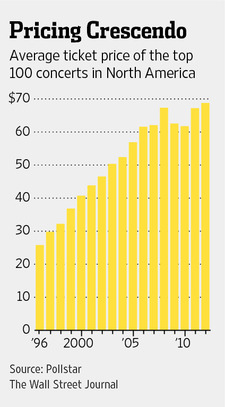
Ticketmaster Wants in on the Scalping Act; Resellers, Long the Enemy, Invited to List Tickets on New TM+ System

August 11, 2013, 6:11 p.m. ET

Ticketmaster Wants in on the Scalping Act

Resellers, Long the Enemy, Invited to List Tickets on New TM+ System

HANNAH KARP

MK-CF467B_RESAL_G_20130811175710MK-CF471_RESALE_NS_20130811183914

Live Nation Entertainment Inc. LYV -1.23% and its Ticketmaster subsidiary have a new strategy for dealing with their sworn enemies, ticket scalpers: If you can’t beat ’em, join ’em.

Heavy-metal fans looking for tickets to see Black Sabbath at the First Midwest Bank Amphitheatre near Chicago this month are getting a taste of the new approach. On Live Nation’s website, an unusual seating map lists available face-value seats right alongside pricier seats being offered for resale by others. A block of seats nine rows from the stage was recently listed for their face value of $156 each, including fees; one row back, a reseller was offering a pair for $360.80 each. Read more of this post

AmBev Weathering Brazil’s First Beer Drop-Off in Decade

AmBev Weathering Brazil’s First Beer Drop-Off in Decade

Brazilians are drinking less beer for the first time in a decade. Cia. de Bebidas das Americas, Latin America’s biggest brewer, says it can still boost profit.

AmBev, as the Anheuser-Busch InBev NV (ABI) unit is known, is promoting higher-margin premium beers and repackaging cheaper offerings to make them more affordable after a surprise volume drop, Chief Executive Officer Joao Castro Neves said last week in a conference call. It’s also expanding in Brazil’s North and Northeast, where sales aren’t slowing as in other regions.

“Even though we’re expecting volumes to be down, that’s a volume number, not a profit number,” Lauren Torres, an HSBC Holdings Plc analyst, said by telephone from New York. “They could actually still grow their company, still generate cash and pay dividends.” Read more of this post

CFTC subpoenas metals warehousing firm as inquiry heats up

CFTC subpoenas metals warehousing firm as inquiry heats up

2:03am EDT

By Josephine Mason

LONDON (Reuters) – The U.S. commodities market regulator has subpoenaed a metals warehousing firm, seeking all of its documents and communications related to the London Metal Exchange since January 2010, as an inquiry into complaints about inflated metals prices gathers steam.

The U.S. Commodity Futures Trading Commission (CFTC) sent the subpoena last week, a source with direct knowledge of the matter said, after a letter from the regulator last month ordered the warehouse firm to preserve emails, documents and instant messages from the past three years. Read more of this post

Oil Sands Industry Turns to Algae to Appease Obama

Oil Sands Industry Turns to Algae to Appease Obama

Canada’s response to President Barrack Obama’s challenge to reduce emissions of global-warming gases from the oil sands starts with sewage and algae.

The paste-like crude extracted from the oil sands is softened by heat and steam to make it flow though pipelines. Burning natural gas to process the fuel creates carbon dioxide that researchers believe can be combined with waste water and fed to algae, which can be processed into cattle feed and other useful products.

“We’re taking CO2 and making it into a valuable product,” said John Parr, vice president at Canadian Natural Resources Ltd. (CNQ), the country’s third-largest oil-sands producer by market value, in a phone interview. “There’s a business case that can be made for it.” Read more of this post

Yes Bank Loses Almost Half Its Market Value on India Crunch; Indian Banks to Drop on Record Yield Inversion

Yes Bank Loses Almost Half Its Market Value on India Rate Surge

Yes Bank Ltd. (YES), the best-performing Indian bank stock last year, has lost almost half its market value in less than a month on investors’ concern that a record surge in interest rates will erode profits and boost defaults.

The stock has tumbled 43 percent, the most in the S&P BSE Bankex Index, since the Reserve Bank of India on July 15 began taking emergency steps to tighten liquidity and bolster the rupee. Mumbai-based Yes Bank, which gets 69 percent of its funding from bulk deposits and debt, is among lenders that are most vulnerable if rates remain high, according to Espirito Santo Securities India Pvt. Read more of this post

Catalogue shopping finds new life in digital age

August 11, 2013 12:43 pm

Catalogue shopping finds new life in digital age

By Andrew Bounds

In the vast reception area of Express Gifts’ head office in Accrington, Diana, Princess of Wales, beams down from the wood panelled wall with her trademark Mona Lisa smile. The princess opened the building in June 1983, while catalogue shopping was in its heyday.

Today more than half its sales are online. But the group, part of listed conglomerateFindel, has adapted and returned to growth.

It joins NBrown, established in 1859, and the biggest of all, Shop Direct, founded as Littlewoods in 1932, in proving there is life in the oldest form of remote shopping in its northwest heartland.

NBrown, which employs 3,500 in Manchester, has become a model stock market performer, with the shares doubling in a year after five years of rising sales and dividends. It made £96.4m in pre-tax profit on revenues of £784.7m in the year to March 2.

Angela Spindler, the new chief executive, admits stepping into the retiring Alan White’s shoes will not be easy. She also cannot step into the company’s products – it caters for size 14 and above only, a growing market with little competition.

“It is a great place to be in terms of our relationship with customers. They are at best ignored and at worst actively alienated by the fashion industry,” she said.

Some 57 per cent of sales to its 6m customers are online, with 10 per cent still by post and the rest over the telephone. It sends out 70m publications a year. Ms Spindler, who arrived from the Original Factory Shop chain, said: “We are not a catalogue retailer. We are a multi-channel retailer.” But a catalogue arriving can still be a “trigger” to purchase, even if that is done online.

NBrown has launched a series of brands such as SimplyBe for women and Jacamo for men, promoted by cricketer Andrew “Freddie” Flintoff, to attract younger customers. It has learnt lessons, says Ms Spindler, chiefly that high street retail is about “location, location, location”.

Its next push could be international. It has trial sites in Germany and the US. While the rate of returned goods in Germany has been high – they “order four sizes and send three back” – Ms Spindler says in the US SimplyBe is “really resonating, we are seeing strong growth there”.

It may follow where Tesco retreated, with Ms Spindler set to unveil her strategy at the interim results announcement in October.

Express Gifts, which owns the Studio catalogue business, added 8 per cent more customers in the year to March 29. Sales were up 13.4 per cent from £231.9m to £263m and operating profit grew by 15.9 per cent from £18.8m to £21.8m.

It has two advantages. A 375,000 sq ft Accrington facility, fully automated, allows it to make money on even small items such as mop heads and can openers. It also services Kleeneze, Findel’s army of door to door salesmen.

But the main one is its ability to personalise its products by adding names or initials to everything from dolls houses to dressing gowns for “free”.

“It’s a point of difference. People are so price sensitive. You can’t go on the web and compare prices directly,” Phil Maudsley, chief executive, said. Some 40 per cent of goods are personalised, with a 48 hour turnround.

The catalogue retailers have another secret weapon: credit. Express has a 48 per cent APR, which is not atypical. Shop Direct, where 90 per cent of customers buy with credit, has hired Alex Baldock from Lombard, the asset-based lender, as chief executive to develop its offering still further.

Shop Direct, which is owned by the Barclay brothers and has merged with Great Universal Stores, its Manchester based rival, is also back on the path to profitability.

“It was like merging Liverpool and Manchester United,” Mr Baldock says of the challenge of bringing together the two biggest competitors in the market. “But it is done now.”

Mr Baldock is also talking about personalisation. But to him, it means using the vast amount of data the business has on its customers to tailor its selection of the 50,000 products it stocks, especially as more people buy through mobile devices with smaller screens.

It could suggest curtains to match a sofa bought last year, for example.

It is working with IBM to perfect the offering. “We intend to be a world class digital retailer. We have a strong foundation, a very clear strategy based on unique strength and support from our shareholders.”

He says the typical customer is an “aspirer and striver, female, aged 25-55”.

“This business has been focused on her for 80 years. We know her better than anyone else.”

India’s Path to Prosperity Doesn’t Run Through Cities

India’s Path to Prosperity Doesn’t Run Through Cities

Indian leaders often warn that they need to shift the majority of their country’s population — almost 70 percent — from rural to urban areas. “Our salvation,” Prime Minister Manmohan Singh claims, “lies in moving people out of agriculture.” Finance Minister P. Chidambaram confirms, “My vision is to get 85 percent of India into cities.”

These dedicated urbanizers claim to have history on their side: the shift from agriculture to urban industry and manufacturing is how Europe, the U.S. and, more recently, China enhanced their productivity and created capital for broader investments to modernize their economies. Read more of this post