China Metal Liquidators Sue Chairman Chun for Fraud

China Metal Liquidators Sue Chairman Chun for Fraud

The provisional liquidators of China Metal Recycling Holdings Ltd. (773) sued its founding chairman Chun Chi Wai and his wife for unspecified damages for fraud. Chun, Lai Wun-Yin and 10 companies orchestrated false trading schemes, disclosed false or misleading information to China Metal and paid dividends on inflated profits, according to a lawsuit filed on July 31 at Hong Kong’s High Court. China Metal, which called itself the nation’s biggest scrap-metal dealer, inflated the size of its business to gain a listing in Hong Kong in 2009, the Securities and Futures Commission said July 29 when it announced that it had won a court order appointing provisional liquidators for the company. The liquidators have obtained an injunction freezing more than HK$1.6 billion ($206.3 million) in assets of the defendants, a lawyer for the SFC told a court hearing today which agreed to continue their appointment. Read more of this post

‘Decoupling’ Returns to Bite Asia

August 1, 2013, 8:57 AM

‘Decoupling’ Returns to Bite Asia

By Michael S. Arnold

A few years ago economists in Asia were talking about “decoupling,” a buzzword that meant markets and economies would continue to grow on the back of regional demand despite a slowdown in the West. Now that decoupling may be coming back to bite them. Manufacturing data out Thursday shows regional economies failing to benefit from a pick-up in economic activity in the U.S., Europe and Japan. The reason? Their deepening dependence on demand in China, where growth continues to decelerate.  Read more of this post

Can something be so uncool that it’s actually cool? ‘Uncool’ Cool Japan Video Goes Viral

August 2, 2013, 8:29 AM

‘Uncool’ Cool Japan Video Goes Viral

By Joelle Metcalfe

Japan’s Ministry of Economy, Trade and Industry has never been known as a particularly hip place — even though it’s in charge of the government’s “Cool Japan” push to promote trendy industries like anime, fashion, and Japanese cuisine overseas. But a home-made Cool Japan video shot by two ministry officials and uploaded to YouTube last month has attracted so much criticism that it’s gone viral, prompting Japan’s online community to ask: Can something be so uncool that it’s actually cool? Read more of this post

P&G Shifts Marketing Dollars to Online, Mobile; World’s Largest Advertiser Says as Much as 35% of Ad Budget Going to Digital Media

Updated August 1, 2013, 8:00 p.m. ET

P&G Shifts Marketing Dollars to Online, Mobile

World’s Largest Advertiser Says as Much as 35% of Ad Budget Going to Digital Media

SERENA NG and SUZANNE VRANICA

‘We need and want to be where the consumer is,’ says A. G. Lafley, CEO of P&G, maker of basics like Tide.

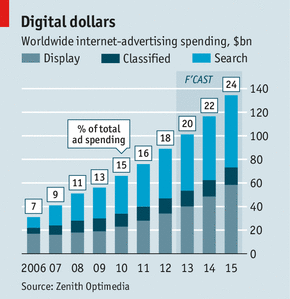
Procter & Gamble Co. is now spending more than a third of its U.S. marketing budget on digital media, an aggressive shift as Americans for the first time are expected to spend more time online this year than watching television. P&G chief executive A.G. Lafley said the consumer products giant’s digital spending on things like online ads and social media ranges from 25% to 35% of its marketing budget and is currently near the top of that range in the U.S., its biggest market. That is well beyond the estimated 20% to 25% share that digital ads typically claim of companies’ marketing budgets and highlights the threat to traditional advertising media like print. Read more of this post

Plight of Chinese hawkers highlights impact of downturn

August 1, 2013 7:45 am

Plight of Chinese hawkers highlights impact of downturn

By Jamil Anderlini in Beijing

Every year the scorching Chinese summer brings throngs of unlicensed vendors out on to the streets, hawking everything from pirated DVDs to watermelons. Given their lowly and illegal status they are often treated poorly by the authorities, but this year has been particularly bloody for this army of mobile shopkeepers. Two weeks ago, Deng Zhengjia, a 56-year-old watermelon vendor, was killed and his wife knocked unconscious after they were attacked by the local “chengguan” – an auxiliary police force tasked with keeping city streets clean and orderly. Since then there have been a dozen similar incidents reported across China in which “melon-peasants” (as they are referred to in Chinese), street hawkers, journalists and even police officers have been beaten up by locally-employed chengguan. Read more of this post

Carrefour in the trenches of the hypermarket war

Carrefour in the trenches of the hypermarket war

1:53am EDT

By Dominique Vidalon

PARIS (Reuters) – Fifty years ago, on June 15, 1963, two French families opened Europe’s first hypermarket in Sainte-Genevieve-des-Bois near Paris. Stocking 5,000 products over 2,500 square meters, it was three times the size of most grocery stores. Today, owned by retail giant Carrefour, it has tripled in size and offers 19,000 different products. The store’s growth mirrors Carrefour’s global expansion, but the format – an out-of-town warehouse offering cheese, lawn mowers and almost everything in between – is shrinking as online vendors, convenience shops and discounters bulk up. Some fear the decline could be terminal. Not Carrefour, which pioneered the stores across the globe, making it the world’s second largest retailer after Wal-Mart, but its attempts to revive the hypermarket in France have ended the tenure of a string of chief executives. Read more of this post

Gildan Reaches Record as Branded Wear Boosts Pofit

Gildan Reaches Record as Branded Wear Boosts Pofit

Gildan Activewear Inc. (GIL), the Canadian producer of cotton T-shirts to underwear, rose to a record high after reporting third-quarter earnings at the high end of the company’s guidance and analysts’ estimates. Gildan rose 4.7 percent to C$48.15 at 11:00 a.m. in Toronto. Earlier it rose 6.6 percent to C$48.86 earlier, the highest since the company went public in June 1998 and the biggest intraday jump since June 12, 2012. The shares have gained 26 percent this year through yesterday, compared with a 0.4 percent rise in the Standard and Poor’s/TSX Composite Index. Montreal-based Gildan posted earnings of $116.5 million or 95 cents per share, adjusted for certain items, compared with $80.2 million or 66 cents a year earlier. The company previously projected earnings of 92 cents to 95 cents per share. Results beat the 94-cent average of analysts’ estimates compiled by Bloomberg. “The company began shipment of its first major Gildan-branded underwear program to a national mass-market retailer,” the company said today in a statement. “Initial retailer sales of the Gildan underwear products are very strong, and consumer demand is well in excess of expectations.” Gildan acquired New Buffalo Shirt Factory Inc. manufacturing facilities on June 21, providing it with screenprinting and decorating capabilities to enhance its ability to act as a supply chain partner for larger athletic and lifestyle brands. Gildan narrowed its full year adjusted earnings expectation to $2.67 to $2.70 per share, from its previous guidance range of $2.65 to $2.70.

To contact the reporter on this story: Lauren S. Murphy in Toronto at lmurphy48@bloomberg.net

Sin-free ale: Non-alcoholic beer is taking off among Muslim consumers

Sin-free ale: Non-alcoholic beer is taking off among Muslim consumers

Aug 3rd 2013 | BEIRUT AND CAIRO |From the print edition

DEDICATED drinkers may struggle to see the point of non-alcoholic beer, but it is growing in popularity around the world. Last year 2.2 billion litres was downed, 80% more than five years earlier. In the rich world it is mainly consumed by a health-conscious minority. But in the Middle East, which now accounts for almost a third of worldwide sales, the target market is the teetotal majority. In 2012 Iranians quaffed nearly four times as much as in 2007. Consumers in Saudi Arabia, Egypt and the United Arab Emirates also have a growing taste for it (though across the region, alcoholic beer still outsells it). Read more of this post

Baidu and Sina are among Chinese Internet companies that have jointly created a website for refuting rumors, the latest step in government efforts to increase scrutiny of information spread online

China Starts Website to Refute Rumors as Scrutiny Grows

Baidu Inc. (BIDU) and Sina Corp. (SINA) are among Chinese Internet companies that have jointly created a website for refuting rumors, the latest step in government efforts to increase scrutiny of information spread online.

The website officially began operations yesterday under the oversight of the Beijing Internet Information Office and the Beijing Internet Association, the official Xinhua News Agency reported. Sohu.com Inc. (SOHU) and NetEase Inc. (NTES) also contributed to creating the site, which is hosted by Qianlong.com, a news portal controlled by the Beijing city government. Read more of this post

German employers are abandoning the country’s famous labour model

German industrial relations

Labour’s lost love

German employers are abandoning the country’s famous labour model

Aug 3rd 2013 |From the print edition

IT WORKED brilliantly in the dark days of 2008 and 2009 when exports faltered and companies might have been tempted to shed staff. German manufacturers, their workers and unions, with a little help from the government, engineered a compromise that put employees on short time and trimmed their holiday entitlements but saved their jobs. As a result, when Germany pulled out of recession in 2010 its companies had a skilled workforce in place to meet resurging demand. The pact, along with continuing wage restraint, has boosted productivity while keeping unemployment low. Read more of this post

The father of fracking: Few businesspeople have done as much to change the world as George Mitchell

The father of fracking: Few businesspeople have done as much to change the world as George Mitchell

Aug 3rd 2013 |From the print edition

20130803_WBD000_0

THE United States has of late been in a slough of despond. The mood is reflected in a spate of books with gloomy titles such as “That Used to Be Us” (Thomas Friedman and Michael Mandelbaum) and “Time to Start Thinking: America in the Age of Descent” (Edward Luce). For the first time in decades the majority of Americans think their children will be worse off than they are. Yankee can-do optimism is in danger of congealing into European nothing-can-be-done negativism.

There are good reasons for this. The political system really is “even worse than it looks”, as another doom-laden book puts it. Middle-class living standards have stagnated. The Iraq war turned into a debacle. But the pessimists are ignoring a mighty force pushing in the opposite direction: America’s extraordinary capacity to reinvent itself. No other country produces as many world-changing new companies in such a variety of industries: not just in the new economy of computers and the internet but also in the old economy of shopping, manufacturing and energy. Read more of this post

The future of oil: The world’s thirst for oil could be nearing a peak. That is bad news for producers, excellent for everyone else

The future of oil: The world’s thirst for oil could be nearing a peak. That is bad news for producers, excellent for everyone else

Aug 3rd 2013 |From the print edition

20130803_LDP002_1

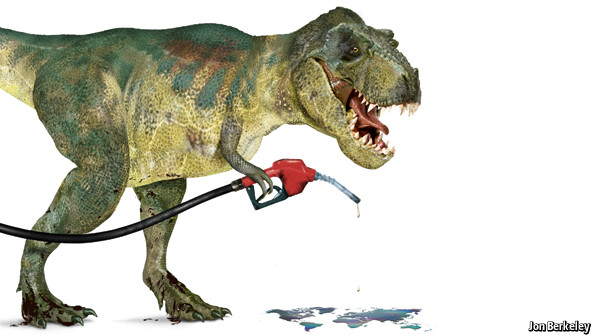
THE dawn of the oil age was fairly recent. Although the stuff was used to waterproof boats in the Middle East 6,000 years ago, extracting it in earnest began only in 1859 after an oil strike in Pennsylvania. The first barrels of crude fetched $18 (around $450 at today’s prices). It was used to make kerosene, the main fuel for artificial lighting after overfishing led to a shortage of whale blubber. Other liquids produced in the refining process, too unstable or smoky for lamplight, were burned or dumped. But the unwanted petrol and diesel did not go to waste for long, thanks to the development of the internal-combustion engine a few years later. Read more of this post

Neuromorphic computing: The machine of a new soul; Computers will help people to understand brains better. And understanding brains will help people to build better computers

Neuromorphic computing: The machine of a new soul; Computers will help people to understand brains better. And understanding brains will help people to build better computers

Aug 3rd 2013 |From the print edition

20130803_STD001_0

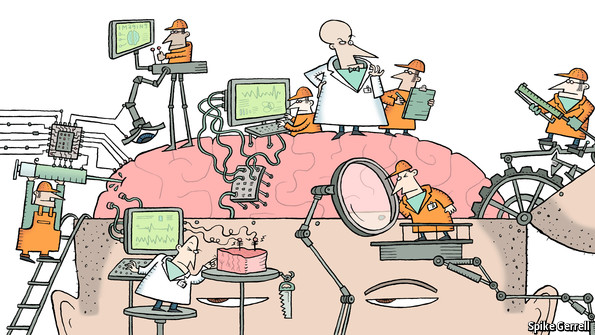
ANALOGIES change. Once, it was fashionable to describe the brain as being like the hydraulic systems employed to create pleasing fountains for 17th-century aristocrats’ gardens. As technology moved on, first the telegraph network and then the telephone exchange became the metaphor of choice. Now it is the turn of the computer. But though the brain-as-computer is, indeed, only a metaphor, one group of scientists would like to stand that metaphor on its head. Instead of thinking of brains as being like computers, they wish to make computers more like brains. This way, they believe, humanity will end up not only with a better understanding of how the brain works, but also with better, smarter computers. Read more of this post

The future of advertising agencies: Omnipotent, or omnishambles? Omnicom and Publicis are combining to try to stay on top of a rapidly changing industry, but sheer size will be no guarantee of success

The future of advertising agencies: Omnipotent, or omnishambles? Omnicom and Publicis are combining to try to stay on top of a rapidly changing industry, but sheer size will be no guarantee of success

Aug 3rd 2013 | LONDON AND NEW YORK |From the print edition

20130803_WBC166

CROSS-COUNTRY deals in the advertising industry can be painful affairs. Look what happened to Guy MacKendrick, the young executive sent by his London-based agency to oversee its acquisition of a New York rival, in “Mad Men” (yes, it is now compulsory to refer to the hit television series in all articles about the ad business). The staff throw a party to celebrate the takeover, and a drunken secretary drives a lawnmower through the office, shredding Mr MacKendrick’s foot.

On July 28th, however, there were no bizarre gardening accidents as executives of two real-life advertising firms toasted their merger with champagne in Paris. Maurice Lévy, the boss of the French Publicis Group, and John Wren, the head of its American competitor Omnicom, toasted the birth of Publicis Omnicom, which will overtake British-based WPP as the world’s largest advertising and marketing agency, with combined 2012 revenues of $23 billion and a market value of $35 billion. Read more of this post

Troubled Currencies, Troubled Regimes

Troubled Currencies, Troubled Regimes

By Steve H. Hanke on 5:04 pm August 1, 2013.
For academics, the term “troubled currency” might be a term of art. But for people who are faced with such a currency, they know a troubled currency when they see one. Today, this is the case for millions of people around the world – most notably in Iran, North Korea, Argentina, Venezuela, Egypt and Syria. A troubled currency is one in which users have lost confidence. When users no longer think a currency will retain its purchasing power, they attempt to dump it for a stable foreign currency (or commodities). As the demand for the troubled currency evaporates, its value vis-a-vis stable foreign currencies collapses, and prices for goods and services sold in the troubled currency soar. As this process develops, expectations about the currency’s ability to retain its purchasing power deteriorate, and a doom loop ensues. At the extreme, doom loops can culminate in hyperinflation – an inflation rate of over 50 percent per month. This, however, is rare. Indeed, there have only been 56 cases of hyperinflation. Read more of this post

Foreign business leaders residing in Korea say that President Park Geun-hye’s corporate policies to ensure “economic democratization” are a move in the right direction to upgrade Asia’s fourth-largest economy

2013-08-01 18:58

Foreigners like Park’s reforms

By Choi Kyong-ae
Foreign business leaders residing in Korea say that President Park Geun-hye’s corporate policies are a move in the right direction to upgrade Asia’s fourth-largest economy. They stress that her economic policies aimed at reforming chaebol and ensuring “economic democratization” will help the country’s economy become more transparent and sustainable. “The government is just enforcing the law and if you look at what the tax office is doing, it’s enforcing the law against big (companies), small (firms) and individuals. But the large companies are more sensational,” Jeffrey Jones, a lawyer at Kim & Chang, told The Korea Times in a telephone interview. Read more of this post

Korean furniture makers finally met the truth of IKEA’s longtime-wearied arrival on their turf

2013-08-01 18:50

IKEA alert: Korean furniture firms brace for dark future

By Ko Dong-hwan
Korean furniture makers finally met the truth of IKEA’s longtime-wearied arrival on their turf. On Aug. 1, Gwangmyeong City approved of an IKEA store construction work on a site of 25,759 square meters located within the KTX Gwangmyeong railway station sphere, which will be completed by late 2014. Korea’s few major furniture companies like Hanssem and Livart responded rather unstirred by the news. As to IKEA’s signature advantage over rival stores _ affordable prices _ they said they will counter with differentiated quality, design, service and wide distribution networks. “Since IKEA’s coming has been confirmed, there is nothing else for us to do but to do our best. We have had two years of preparation since the news of IKEA’s coming to Korea had surfaced.” But for small-to-medium-sized furniture companies, the news totally wrested their hearts. Unlike the major companies, these minor firms _ mostly run by family members or few part time workers _ have few selling points except cheap prices. Lee Sang-bong, president of the Gwangmyeong Furniture Distribution Business Cooperative, said, “For small furniture firms, competing against a global enterprise like IKEA is futile. We might as well hit the road before trying.” Those who are on the same page with Lee have founded a task force that bashes the arrival of IKEA in Gwangmyeong. Their message, targeted at both Gwangmyeong city and IKEA, is to provide mutual measures that don’t kill but instead embrace the small-to-medium-sized companies.

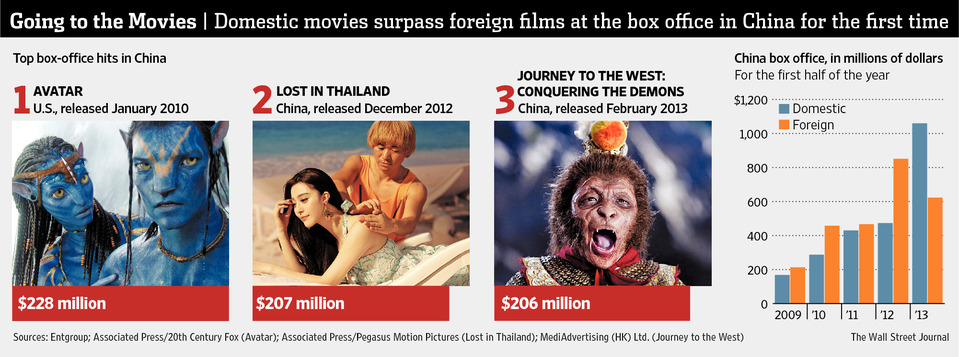
In China, where pirated movies can be bought for less than $1, people are flocking to theaters, a sign of how Chinese consumers are willing to spend more on entertainment.

August 1, 2013, 2:34 p.m. ET

Now Playing: China’s Booming Movie Market

People Are Flocking to Theaters

WEI GU

AM-AZ691_WEICOL_G_20130801052108

In China, where pirated movies can be bought for less than $1, people are flocking to theaters, a sign of how Chinese consumers are willing to spend more on entertainment. China, now the world’s second-largest film market after the U.S., is already critical for Hollywood blockbusters such as “Pacific Rim,” a giant monster-versus-robot slamfest that opened in China this week. The movie struggled in the U.S., but its glitzy special effects may be better appreciated in thousands of state-of-the-art movie theatres that have sprung up in China in the past few years. As in other industries, China has taken a “build first, and demand will follow” strategy with movies. And it has worked. The number of screens in China quadrupled from 2009 to 2012, according to entertainment consulting firm EntGroup Inc. Read more of this post

Myanmar Firms Feel Pinch From Abroad; Foreign Consumer-Goods Companies Rush in After Removal of Market Sanctions

August 1, 2013, 2:26 p.m. ET

Myanmar Firms Feel Pinch From Abroad

Foreign Consumer-Goods Companies Rush in After Removal of Market Sanctions

Drinks and other provisions on display at a tea shop in Yangon, Myanmar. Foreign consumer brands like Coca-Cola and Sprite are increasingly displacing locally-produced beverages like Star Cola, chipping away at profits of local conglomerates in the country.

SHIBANI MAHTANI

AM-AZ677_MYBUSI_G_20130731152106

YANGON, Myanmar—The world’s biggest consumer companies are flocking to Myanmar, filling the once-pariah nation and its backward economy with goods previously unavailable to its 60 million people. But not everyone is happy. Some of the country’s biggest conglomerates—plugging away at the cash-strapped market for decades and fighting hard to grow despite crippling Western sanctions—are now finding themselves drowned out by foreign competitors including Coca-Cola Co. KO +1.22% of the U.S. and Canon Inc.7751.TO +1.78% of Japan. “It is very tough for us, now that these big multinationals are here,” said Sai Sam Htun, chairman of the Loi Hein Group of Cos., one of Myanmar’s largest conglomerates. “They have easily taken over in a short time, because they are so powerful and strong.” Read more of this post

The New Explosion in Audio Books; People are buying audio books to listen to, syncing them with their Kindles, and snapping up original audio-only productions

Updated August 1, 2013, 7:41 p.m. ET

The New Explosion in Audio Books

How They Re-emerged as a Rare Bright Spot in the Publishing Business

ALEXANDRA ALTER

For a new generation of readers, the best way to devour a book may be to not read it at all. Alexandra Alter joins Lunch Break to explain the new surge in audio books

Cory Wilbur, a 25-year-old software engineer in Boston, never used to read much. He barely cracked a book in college and would read one or two a year on vacation, at most. But in the past year, he’s finished 10 books, including Dan Brown’s “Inferno,” Walter Isaacson’s biography of Steve Jobs and George R.R. Martin’s fantasy series “A Song of Ice and Fire.” He listens to audio books in snippets throughout the day on his iPhone during his morning workout, on his 20-minute commute to work, and while he’s cooking dinner or cleaning up. Before he falls asleep, he switches to an e-book of the same story on his Kindle, and starts reading right where the narrator left off. “I fly through a lot more books than I used to,” Mr. Wilbur said.

Read more of this post

Tipping point for media viewing as couch potatoes go digital; US digital media use overtakes TV viewing

Last updated: August 1, 2013 8:14 pm

Tipping point for media viewing as couch potatoes go digital

By Emily Steel in New York

The amount of time people in the US spend consuming digital media is set to overtake hours spent watching television for the first time this year, marking a significant tipping point in the shift away from traditional forms of media. The average adult will spend five hours and nine minutes a day online or consuming other types of digital media this year, an increase of 38 minutes or 16 per cent compared with 2012, according to new estimates from eMarketer. The amount of time spent watching TV is projected to fall by seven minutes to four hours and 31 minutes. Read more of this post

Asian mobile chat apps challenge western dominance; “When you use Asian mobile chat apps, you have a certain sense of joy and fun communicating with your loved ones, whereas western apps focus more on pure functionality”

August 1, 2013 1:56 pm

Asian mobile chat apps challenge western dominance

By Ben Bland in Jakarta, Nguyen Phuong Linh in Hanoi and Simon Mundy in Seoul

Nguyen Tung Lam, a 16-year-old high school student in Hanoi, uses Japanese mobile messaging service Line to chat with his girlfriend because she “likes the cute icons such as the teddy bear and bunny”. Doan Nguyen Trang, another Vietnamese teenager, prefers South Korea’s KakaoTalk app because it is promoted by a wildly popular Korean boy band. “I use KakaoTalk because Big Bang also use it and they are number one; I love them,” says the 14-year-old. KakaoTalk, Line and WeChat, a mobile messaging app developed by China’s Tencent, are spending tens of millions of dollars on television advertising, online promotions and celebrity endorsements as they fight for the attention of tech-savvy southeast Asian teenagers. Read more of this post

Andreessen-Backed Tutor Matching Service Is Working With Colleges To Upend The Tutoring Industry, Starting With Cost

Andreessen-Backed Tutor Matching Service Is Working With Colleges To Upend The Tutoring Industry, Starting With Cost

RIP EMPSON

posted 7 hours ago

Of the many ways that technology is disrupting education, one area that’s changing a lot, is rife with potential, but doesn’t get as much play as it should is tutoring. Mostly, this involves the attempt to make high-quality, local tutors accessible to a wider range of students online, without having to turn to traditional channels, like Craigslist or those pesky, expensive SAT-focused private networks. There are a million marketplaces for tutors, and many startups that have joined in the struggle to make connecting with quality tutors possible, from Tutorspree, IAC’s Tutor.com and the increasing number of services like StudyBlue to WyzAnt and Chegg. But a new startup is launching out of beta today with backing from Andreessen Horowitz and others that wants to help push the space forward by creating a tutoring marketplace that is not only affordable for students but is a sort of official “Tutor List” for universities.

Read more of this post

Upworthy Goes Viral by Optimizing Optimism; Upworthy attracted 26 million unique views in May by testing headlines and using social media to promote its content

Upworthy Goes Viral by Optimizing Optimism

By Sam Grobart on August 01, 2013

tech_upworthy32__02inline__405

Doctors gave Zach Sobiech bad news just after his 17th birthday last year: His rare bone cancer had progressed so far that he had only a year to live. In December, Sobiech posted a music video of Clouds, a song he wrote and recorded about struggling with the disease. He became the subject of a short online video documentary, which garnered tens of thousands of views after being featured on FoxNews.com (FOX) and People.com (TWX). Sobiech died on May 20. Then the editors at viral-media site Upworthy saw the documentary. They repackaged it with the headline “This Kid Just Died. What He Left Behind Is Wondtacular.” Since then more than 15 million people have watched the documentary on Upworthy, which aggregates and popularizes videos and other online content. Sobiech’s song went to No. 1 on Apple’s(AAPL) iTunes Store, and a link Upworthy put next to the video raised more than $300,000 for cancer research. “The whole Internet heard his story,” says Upworthy co-founder Peter Koechley. Read more of this post

SAP Invades Silicon Valley via Acquisitions

SAP Invades Silicon Valley via Acquisitions

By Matthew Campbell and Aaron Ricadela on August 01, 2013

German software giant SAP (SAP), the 41-year-old maker of financial and supply-chain software, has been slow to shift to cloud computing and has struggled for years to catch up to U.S. competitors such as Oracle (ORCL) and Salesforce.com(CRM). Among other things, it’s broken some of its brightest engineers into startup-like teams far from its main campuses. While waiting for them to spawn new products, the company is doubling down on plan B, for “buyout.” Read more of this post

Instead of buying expensivekaraoke equipment bundled with soon-to-be-outdated tunes, iKala reinvents karaoke via the internet so users can enjoy it on their Samsung and LG smart TVs, PCs, and mobile devices (iOS and Android)

How a Taiwanese Startup is Riding on Asia’s Karaoke Culture

August 2, 2013

by Willis Wee

Founded in 2007, Taiwan’s iKala is a cloud-based online karaoke service. Instead of buying expensivekaraoke equipment bundled with soon-to-be-outdated tunes, iKala reinvents karaoke via the internet so users can enjoy it on their Samsung and LG smart TVs, PCs, and mobile devices (iOS and Android). Today, iKala has grown to become a 36-person team, serving around 600,000 users and with about five percent of them paying NT$129 ($4.30) each month for its premium service to have full access to the song library (which includes several thousand tunes in Chinese and English). Alternatively, users can just pay $1 to sing for an entire day. On average, each user spends about 10 minutes a day singing and sharing their creations (users can also record and upload their singing). About half of them visit iKala on mobile and another half from the web.

Read more of this post

How Tiket Became Indonesia’s Biggest Ticketing Platform In Under 2 Years

How Tiket Became Indonesia’s Biggest Ticketing Platform In Under 2 Years

July 31, 2013

by Dewi Yuliani

Tiket1

Tiket is one of the biggest players in the online travel industry and has become an award winning platform for hotel, flight, and train ticket booking online in Indonesia. We just heard that June 2013 is definitely the best month for Tiket. Why? The Tiket teams reveals that it brought in more revenue last month (June) than it did in the whole of 2012. Natali Ardianto, the co-founder and CTO of Tiket was excited to say that “the growth is exponential!” and he also shared more figures with us. Read more of this post

After years of quietly building its craft beer brand in the shadow of MillerCoors, Blue Moon is fighting back against the naysayers

Blue Moon Tells Beer Snobs to Drink Up and Show Respect: Retail

MillerCoors LLC has a message for beer snobs: Blue Moon is an authentic craft brew. So show a little respect.

comp_bluemoonchart33_405

Aficionados long ago dubbed Blue Moon an impostor cooked up by a megabrewer to exploit the explosive growth of artisanal beer. In recent months, small beermakers have stepped up their attacks — calling suds like Blue Moon “crafty” for not spelling out their corporate parentage. Micro breweries have reason to be defensive: Blue Moon has grabbed what equals 15 percent of the U.S. craft market, expanded as far as Japan and spawned an Anheuser-Busch InBev NV (ABI) knockoff called Shock Top. After years of quietly building its brand in the shadow of MillerCoors, Blue Moon is fighting back against the naysayers. It’s adding more artisanal brews, including a wine hybrid. Marketing emphasizes the beer’s provenance and Belgian-trained brewmaster. Blue Moon is even taking credit for helping to popularize craft. Read more of this post

As time goes on, our Google Dashboards will tell us more and more about who we are, and who we were.

July 31, 2013, 12:37 PM

64,019 Searches: A Dark Journey Into My Google History

By Tom Gara

Corporate Intelligence is the WSJ’s business news blog. Follow it on Twitter,@WSJCorpIntel, or its editor, @tomgara

ivsLwRW

Let’s run through a little thought experiment. Imagine there’s a list somewhere that contains every single webpage you have visited in the last five years. It also has everything you have ever searched for, every address you looked up on GoogleGOOG +1.86% Maps, every email you sent, every chat message, every YouTube video you watched. Each entry is time-stamped, so it’s clear exactly, down to the minute, when all of this was done. Now imagine that list is all searchable. And imagine it’s on a clean, easy-to-use website. With all that imagined, can you think of a way a hacker, with access to this, could use it against you? And once you’ve imagined all that, go over to google.com/dashboard, and see it all become reality. Read more of this post

80 per cent of Beijing’s edible ice cubes from ‘illegal’ factoriesl Only six manufacturers have production license for edible ice in the capital in a market worth $80-130 million

80 per cent of Beijing’s edible ice cubes from ‘illegal’ factories

China Daily/ANN | Thu Aug 1 2013

Only six manufacturers have production license for edible ice in the capital.

China, August 1, 2013

As much as 80 per cent of the edible ice cubes in Beijing’s shops and restaurants come from “illegal” factories, National Business Daily reported. Only six manufacturers have production license for edible ice in the capital, making the total output valued at 100 million yuan (S$20.75 million) in the summer season. But the output of the whole market is valued at 500 to 800 million yuan, which means at least 80 per cent of the ice come from non-qualified factories, the report said. Edible ice companies must have a QS, or Quality Standard identification since 2005. And it costs at least 30,000 yuan to cover the certification besides building laboratories and hiring inspectors, according to an agency for quality certification. Ice cubes at several restaurants were found to be dirtier than toilet water, Chinese media reported last week. According to CCTV, ice cubes used by fast food giants including KFC, McDonald’s and Guangzhou-based Kungfu at their Beijing branches were tested to contain bacteria at severe levels. The KFC ice cubes contained levels of bacteria which were 20 times higher than the national limit, and 13 times higher than water samples taken from toilet bowls. “The market is in chaos,” said an employee of an ice company, “Costs are increasing and those with qualification certificates would have closed down if they didn’t rely on big buyers.”