County in Shaanxi in a Deep Hole as Mining Bubble Pops

08.01.2013 19:19

County in Shaanxi in a Deep Hole as Mining Bubble Pops

Shenmu rolled in cash when prices for its coal soared in recent years. Now private bankers are fleeing and the local government is in a bind

By staff reporter Li Yan

(Shenmu) – A financial crisis triggered by falling coal prices is brewing in Shenmu County, in the northwestern province of Shaanxi. Construction projects have been halted, universal health care has run into payment problems and many private bankers have disappeared in the last few months, all indications that another story of legendary development is now just a bubble bursting. The richest county in the province, Shenmu is blessed with abundant coal reserves. Buoyed by rising prices in the last decade, Shenmu enjoyed the birth of a vibrant mining industry. Accompanying this were rampant private lending, skyrocketing real estate prices and government largesse in social spending. The county’s 400,000 residents were the happy recipients of China’s first universal health-care scheme and free education for 15 years, six more years than the national minimum. Read more of this post

The $7 Trillion Problem That Could Sink Asia

The $7 Trillion Problem That Could Sink Asia

“It’s our currency, but it’s your problem.” This musing from Nixon-era Treasury Secretary John Connally is about to find new relevance as the White House battles Republicans over raising the U.S. debt limit.

Connally couldn’t have foreseen how right he would be 42 years on as Asia sits on almost $7 trillion in currency reserves, much of it in dollars. Asia’s central banks engaged in a kind of financial arms race after a 1997 crisis, stockpiling dollars as a defense against turmoil. That altered the financial landscape in two ways: One, Asia now has more weapons against market unrest than it knows what to do with. Two, Asia is essentially America’s banker, with China and Japan having the most at stake. Read more of this post

Indian brokers said a lack of oversight allowed the nation’s biggest spot commodity exchange to stretch settlement dates, prompting a government clampdown that triggered a 65 percent tumble in its parent’s shares.

Bourse Crash Seen Triggered by Regulator Vacuum: Corporate India

Indian brokers said a lack of oversight allowed the nation’s biggest spot commodity exchange to stretch settlement dates, prompting a government clampdown that triggered a 65 percent tumble in its parent’s shares.

The National Spot Exchange Ltd. this week suspended some contracts after the government on July 14 asked the bourse not to start new obligations until further notice. The exchange permited investors to close trades in 36 days. A settlement longer than 11 days allowed the bourse to act similar to a forward market, according to Harish Galipelli, head of commodities and currencies at JRG Wealth Management Pvt. Read more of this post

15 per cent of Singaporean Chinese older than 60 have dementia: Study

15 per cent of Chinese older than 60 have dementia: Study

Friday, Aug 02, 2013
The Straits Times
By Linette Lai

SINGAPORE – Three in 20 Chinese Singaporeans above the age of 60 suffer from cognitive impairment or dementia, according to a study conducted by the National University Health System (NUHS). Issues with poor brain function were found to increase with age, with close to half the participants over 80 years old suffering from some form of cognitive impairment. Before being diagnosed as suffering from full-blown dementia, many show symptoms that may go unrecognised and ignored, said Dr Mohammad Kamran Ikram, who co-authored the two-year study involving 1,226 participants. These symptoms include memory loss and difficulty in carrying out simple tasks like following recipes or keeping track of household bills. The study found those with diabetes, high cholesterol or high blood pressure are most at risk of developing cognitive impairment problems. But associate professor Christopher Chen, director of the NUHS Memory, Aging & Cognition Centre, debunked the idea that being at risk guarantees the development of dementia in an individual. “Many people have the idea that it’s all due to age and there’s nothing that can be done about it,” he said. “You may have forgetfulness, but you can compensate and take steps to identify if you have these risk factors and halt progression.” Two separate studies on the prevalence of dementia in the Malay and Indian communities will be conducted, with the former slated to be completed by the end of this year.

linettel@sph.com.sg


SEC Says Largest U.S. Hedge Funds’ Debt Tops $1 Trillion

SEC Says Largest U.S. Hedge Funds’ Debt Tops $1 Trillion

The nation’s largest hedge funds had $1.47 trillion in net assets and more than $1 trillion in borrowings as of the fourth quarter, according to the first report compiled on confidential data they provided to the U.S. Securities and Exchange Commission.

The SEC’s Division of Investment Management issued the report to Congress last week using figures from money managers who run private funds with gross assets of at least $150 million, including borrowed capital, and the agency broke out figures for the biggest firms. Congress ordered the SEC to collect information from private-equity and hedge-fund managers under a provision of the 2010 Dodd-Frank Act designed to help regulators monitor risk in the financial system. Read more of this post

China moves to eliminate financial scam advertisements

China moves to eliminate financial scam advertisements

Thursday, August 1, 2013 – 18:39

AFP

BEIJING – China kicked off a nationwide campaign on Thursday to do away with advertisements for financial scams promising big returns at no risk, highlighting concern over the potential for trouble as financial know-how lags behind rising personal wealth. The China Banking Regulatory Commission said the three-month “clean-up campaign” would take aim at the huge number of advertisements in China for wealth management products, no-interest loans, real estate and many other “no-risk, high-return” schemes from planting forests to breeding animals. Read more of this post

About 1.3 million Hongkongers are living in poverty, of whom 500,000 are in severe poverty, a study claims.

500,000 found suffering in severe poverty
Magdelene Cubbon
Friday, August 02, 2013

About 1.3 million Hongkongers are living in poverty, of whom 500,000 are in severe poverty, a study claims. Academics at the Hong Kong Institute of Education researched 2011 census data and found a staggering 363,275 or 41.1 percent of the elderly, aged 65 and above, are living in either poverty or severe poverty. This age group constitutes the largest proportion of the total number of those in poverty of more than 27percent. The 18.8percent of the population in poverty represents a 1.1percent increase on the Census and Statistics Department’s 2005 figure of 17.7percent. Read more of this post

Fresh grads in China face job crunch as economy slows

Fresh grads in China face job crunch as economy slows

By Kristine Lim
POSTED: 01 Aug 2013 8:50 PM
Fresh graduates in China are facing what has been described as the toughest employment season ever. The job crunch is worse in major cities.

BEIJING: Fresh graduates in China are facing what has been described as the toughest employment season ever. The job crunch is worse in major cities. Nearly seven million students graduate from college this year, the highest number since the PRC was founded in 1949. Although this is less than a three per cent increase from 2012, the situation is complicated by a lack of jobs as a result of slowing economic growth. In Beijng, government and state-owned enterprises have cut job vacancies for fresh graduates by 14 per cent compared to a year ago. Read more of this post

Asia’s richest man made a subtle but significant statement that he’s stepping back from his $120 billion empire and allowing his eldest son to emerge from his shadow

August 1, 2013, 6:48 a.m. ET

Li Ka-shing Signals Power Shift With Absence From News Conference

TE-PING CHEN

Asia’s richest man made a subtle but significant statement Thursday that he’s stepping back from his $120 billion empire and allowing his eldest son to emerge from his shadow.

In a sign of the power shift under way from father to son, Li Ka-shing, 85 years old, skipped his annual televised news conference timed to the earnings from his companies Cheung Kong Holdings0001.HK +2.39% and Hutchison Whampoa 0013.HK +0.17% . For the past 10 years, it has been one of the city’s most anticipated press events, in which the charismatic Mr. Li dazzles reporters with his star power, answering questions on subjects from education to Hong Kong’s politics. Read more of this post

HK developers turning blue as property market enters ‘ice age’

HK developers turning blue as property market enters ‘ice age’

HONG KONG – Government cooling measures to rein in Hong Kong’s property market are finally taking a toll on the city’s powerful developers and industry watchers forecast prices could drop by up to 15 per cent in the second half of this year.

42 MIN 11 SEC AGO

HONG KONG – Government cooling measures to rein in Hong Kong’s property market are finally taking a toll on the city’s powerful developers and industry watchers forecast prices could drop by up to 15 per cent in the second half of this year. Weak property sales at conglomerate Cheung Kong (Holdings), controlled by Asia’s richest man, Mr Li Ka-shing, confirmed that a series of tightening steps are weighing on companies’ bottom lines and taking the heat out of one of the world’s most expensive real estate markets. “It’s like an ice age now from an agent’s perspective,” said Mr Patrick Chau, director of residential investment at property consultant Savills. “The sales volume has dropped substantially since the implementation of a series of tightening policies.” Read more of this post

Financial-technology firms: Tech start-ups promise to transform finance, if regulators will let them

Financial-technology firms: Tech start-ups promise to transform finance, if regulators will let them

Aug 3rd 2013 |From the print edition

20130803_LDC174_0

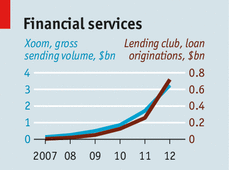
TWO millennia after the Temple was cleansed of money-changers, the Archbishop of Canterbury, Justin Welby, plans to open his churches to moneylenders. This is no capitulation in the struggle between God and Mammon. It is an effort to “compete out of existence” payday lenders that offer expensive loans by supporting not-for-profit credit unions.

The archbishop is right that more competition is needed, but old-fashioned credit unions are unlikely to be able to beat the slick systems and snappy service of online providers, like Wonga. A more effective way of pushing down rates would be lighter regulation to allow more lenders to flourish. Read more of this post

The 77 Year-Old Grandmother With Faith in Indian Stocks; “Patience is key to stock market investments”

August 1, 2013, 1:14 PM

The Grandmother With Faith in Indian Stocks

By Ashutosh Joshi

OB-YJ833_istock_G_20130801034224

At a time when individuals in India are disenchanted with the stock market, Mumbai resident Ashalata Maheshwari, 77 years old, is a rare champion for stocks. Ms. Maheshwari has been investing in Indian companies for five decades, and though many have gone bust over the years, shares in others have gained enough value to give her confidence that equities are the best investments over the long term. “Stocks have given me the best returns because I have rarely sold them,” Ms. Maheshwari told The Wall Street Journal in an interview at her Mumbai home. “Patience is key to stock market investments,” she said. Read more of this post

The Gaping Hole in China’s Corruption Fight

August 1, 2013, 3:03 PM

The Gaping Hole in China’s Corruption Fight

Top of Form

By Stanley Lubman

The ongoing campaign against corruption that forms the backbone of new Chinese president Xi Jinping’s reform platform is not nearly robust as Communist Party media would have us believe. It is directed more at symptoms than causes and is limited in scope due to fears of citizen agitation on broader issues such as press freedom and transparency. It also suffers from a glaring and an important omission: The judicial system, although it should be the appropriate institution for exposure and punishment of offenders, is itself infected by corruption that up to now has gone unmentioned. Read more of this post

New Zealand Pushes Technology to Head Off Mislabeling of Meat; Producers Work to ‘Fingerprint’ Products as Mislabeled and Tainted Food Eat Into Customer Confidence

July 31, 2013, 11:01 p.m. ET

New Zealand Pushes Technology to Head Off Mislabeling of Meat

Producers Work to ‘Fingerprint’ Products as Mislabeled and Tainted Food Eat Into Customer Confidence

LUCY CRAYMER

AI-CC640_NZMEAT_G_20130801040306

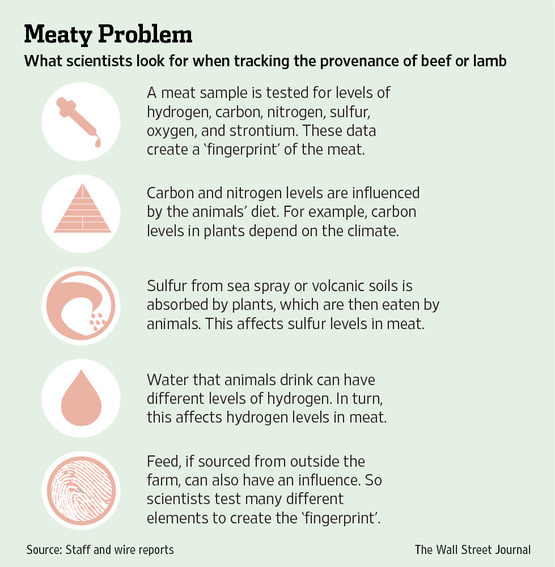
WELLINGTON, New Zealand—Beef and lamb producers are at the forefront of a global push to try to verify scientifically the provenance of the meat that people buy, as a series of scandals over mislabeled and tainted food eat into consumer confidence. Farm groups from the highlands of Scotland to the pastures of New Zealand are investing in technology that tries to “fingerprint” meat by looking for chemical traces of the soil, grass, water and air where the animals once roamed. The move shows how economies dependent on farm income are battling to retain their reputation for high quality—and their premium prices—in an increasingly complex and opaque global food chain. Read more of this post

Overcoming Cognitive Biases: A Heuristic for Making Value Investing Decisions

Overcoming Cognitive Biases: A Heuristic for Making Value Investing Decisions

Eben Otuteye University of New Brunswick – Fredericton – Faculty of Business

Mohammad Siddiquee Faculty of Business, University of New Brunswick, Saint John

April 26, 2013
Forthcoming in the Journal of Behavioral Finance

Abstract: 
Investment decisions are subject to error due to cognitive biases of the decision makers. One method for preventing cognitive biases from influencing decisions is to specify the algorithm for the decision in advance and to apply it dispassionately. Heuristics are useful practical tools for simplifying decision making in a complex environment due to uncertainty, limited information and bounded rationality. We develop a simple heuristic for making value investing decisions based on profitability, financial stability, susceptibility to bankruptcy, and margin of safety. This achieves two goals. First, it simplifies the decision making process without compromising quality and secondly it enables the decision maker to avoid potential cognitive bias problems.

Buddhism v Islam in Asia: Fears of a new religious strife; Fuelled by a dangerous brew of faith, ethnicity and politics, a tit-for-tat conflict is escalating between two of Asia’s biggest religions

Buddhism v Islam in Asia: Fears of a new religious strife; Fuelled by a dangerous brew of faith, ethnicity and politics, a tit-for-tat conflict is escalating between two of Asia’s biggest religions

Jul 27th 2013 | BANGKOK, COLOMBO, JAKARTA AND SITTWE |From the print edition

20130727_ASP003

Wirathu, Buddhism’s new face

THE total segregation of Buddhist Arakanese from Muslim Rohingyas is now a fact of life in the western Myanmar port-city of Sittwe. Until June last year both communities lived side by side in the capital of Rakhine state, but following several rounds of frenzied violence, the Buddhist majority emptied the city of its Muslim population. The Rohingya victims now scrape by in squalid refugee camps beyond the city boundaries. The best that most of them can hope for is to escape on an overloaded fishing boat to Malaysia. Many of them die trying. Read more of this post

The unkindness of strangers: A soul-searching debate rages about apathy towards those in need

The unkindness of strangers: A soul-searching debate rages about apathy towards those in need

Jul 27th 2013 | SHANGHAI |From the print edition

20130727_CND001_0

EIGHTY years ago Lu Xun, now enshrined as the father of modern Chinese literature, observed that when others needed help his countrymen seemed to be stricken by apathy. “In China,” he wrote, “especially in the cities, if someone collapses from sudden illness, or if someone is hit by a car, lots of people will gather around, some will even take delight, but very few will be willing to extend a helping hand.” Read more of this post

Gated, gilded and gaudy, they have sprung up all over China: overwrought government buildings erected at vast public expense, and in stark contrast to the shoddy state of so many homes and schools

Architectural bombast

Jul 27th 2013 |From the print edition

20130727_cnp010

GATED, gilded and gaudy, they have sprung up all over China: overwrought government buildings erected at vast public expense, and in stark contrast to the shoddy state of so many homes and schools. In style they range from modernist brutalism to Versailles kitsch. In function, they are less lofty. The four towers in the second picture are the government headquarters of Changxing, a county in Zhejiang with a population of just 620,000. In a sign the central government understands public frustration with the waste, and the whiff of corruption, associated with these projects, it has ordered a five-year “across-the-board halt” to official building projects. The ban also covers government hotels and training centres. Announcing the ban, the government acknowledged that “glitzy structures” have “tainted the image” of the Communist Party and “stirred vehement public disapproval”

Many Malaysians looking to bulletproof their vehicles following shooting incidents; can bulletproof the windows from $300

Many looking to bulletproof their vehicles

20130801_bulletproof_reuters

Thursday, August 1, 2013 – 09:35

The Star/Asia News Network

PETALING JAYA – Malaysians, who are known for pimping their ride, are now looking to bulletproof their vehicles. There have also been enquiries on making the windows of their houses bullet proof. A check showed that one can bulletproof the windows of a Perodua Kancil windows from around RM1,000 (S$389) but it can be more expensive for other models. A source from a German car company revealed that one of their flagship models, which is a fully bulletproof version, would cost around RM5mil. Meanwhile, STEC Laminates director James Thomas said enquiries for security protec-tion of cars have increased during the last week. “Our main market is not in Malaysia. We export our materials to 30 other countries. “Since the shooting incidents, enquiries have increased and we have received five calls in one week,” said Thomas. Read more of this post

Vietnam bans bloggers and social media users from sharing stories

Vietnam bans bloggers and social media users from sharing stories

Thursday, August 1, 2013 – 16:19

AFP

HANOI- Communist Vietnam is to ban bloggers and social media users from sharing news stories online, under a new decree seen as a further crackdown on online freedom. Blogs or social media sites like Facebook and Twitter — which have become hugely popular over the last few years in the heavily-censored country — should only be used “to provide and exchange personal information”, according to the decree. The document, signed by Prime Minister Nguyen Tan Dung and made public late Wednesday, stipulates that internet users should not use social networks to share or exchange information on current events. Read more of this post

Three quarters of China’s solar-grade polysilicon producers face closure as solar panel piles up and Beijing looks to overhaul a bloated and inefficient industry

As solar panels pile up, China takes axe to polysilicon producers

Wed, Jul 31 2013

By Charlie Zhu

HONG KONG (Reuters) – Three quarters of China’s solar-grade polysilicon producers face closure as Beijing looks to overhaul a bloated and inefficient industry, resulting in fewer but better companies to compete against Germany’s Wacker Chemie AG and South Korea’s OCI Co Ltd. The polysilicon sector, which has around 40 companies employing 30,000 people and has received investment of 100 billion yuan ($16 billion), suffers from low quality and chronic over-capacity as local governments poured in money to feed a fast-growing solar panel industry, for which polysilicon is a key feedstock. Read more of this post

Mortgage bond sell-offs hit U.S. banks with big losses

Mortgage bond sell-offs hit U.S. banks with big losses

12:06am EDT

By Peter Rudegeair, Carrick Mollenkamp and Cezary Podkul

(Reuters) – U.S. banks, who had little choice in recent years but to use deposits to buy super safe mortgage bonds, are now getting an unpleasant taste of the risks. On Wednesday, Tulsa, Oklahoma-based BOK Financial (BOKF.O: Quote, Profile, Research, Stock Buzz), which had nearly a third of its $27.5 billion in assets invested in mortgage bonds earlier this year, saw paper profits from the portfolio drop. It said net unrealized gains on agency mortgage bonds fell 66 percent to $70 million in the second quarter compared to the previous three month period. A BOK spokeswoman wasn’t immediately available to comment further. Read more of this post

China’s equity market has become “dysfunctional” after the regulator halted share sales and investors shifted to wealth-management products, said Anthony Neoh, a former government adviser who helped the nation open up to foreign money managers a decade ago.

China Stock Market Dysfunctional Amid IPO Freeze, Neoh Says

China’s equity market has become “dysfunctional” after the regulator halted share sales and investors shifted to wealth-management products, said Anthony Neoh, a former government adviser who helped the nation open up to foreign money managers a decade ago.

Smaller companies are losing access to capital as the China Securities Regulatory Commission extends a more than nine-month halt on initial public offerings and government-controlled banks focus on lending to state-owned enterprises, said Neoh, who helped start the Qualified Foreign Institutional Investor program as the CSRC’s chief adviser from 1999 to 2004. Many investors assume wealth-management products are guaranteed by the government, creating “tremendous moral hazard,” Neoh said. Read more of this post

India’s Financial Technologies, which controls the nation’s biggest commodity exchange, tumbled 42 percent after a subsidiary suspended trading in some contracts.

Financial Technologies Plunges Most in 15 Years: Mumbai Mover

Financial Technologies (India) Ltd. (FTECH), which controls the nation’s biggest commodity exchange, sank the most in more than 15 years after a subsidiary suspended trading in some contracts.

Financial Technologies tumbled 42 percent to 313.95 rupees at 9:57 a.m. in Mumbai, its biggest decline since December 1997. Unit National Spot Exchange Ltd. halted trading in some contracts, merged the delivery and settlement of all others and deferred them for a period of 15 days, it said in statement yesterday. Trading in its dematerialized contracts will continue, the company said. Read more of this post

Australia to increase tobacco tax by 60 pct over four years

Australia to increase tobacco tax by 60 pct over four years

Thursday, August 1, 2013 – 12:54

Reuters

SYDNEY – The Australian government said on Thursday it will increase tobacco taxes by 60 per cent over the next four years as it seeks to return the budget to a surplus in 2016/17, dealing another blow to cigarette manufacturers. The move, which the government said is also aimed at battling high rates of smoking-related cancer, follows the introduction in Australia last year of the world’s toughest cigarette plain packaging laws. Read more of this post

Europe’s plan to cut card fees will hurt banks but may not help consumers; Retailers battling banks over debit-card transaction costs may benefit from lower fees after winning a court ruling on claims they were overcharged billions of dollars under an unlawful rate set by the Fed

Europe’s plan to cut card fees will hurt banks but may not help consumers

Jul 27th 2013 |From the print edition

TO POLITICIANS, banks are both incompetent behemoths waiting for public bail-outs and conniving profiteers pulling a fast one on their customers. Just as one arm of the European Commission has been finalising new rules that will force banks to have much more capital on their balance-sheets in order to make them safer, another arm has been writing rules to stop the “unjustifiably high” fees charged whenever a credit or debit card is used. Read more of this post

Julie Taymor and other creative minds share how they start their incredibly unique works

Julie Taymor and other creative minds share how they start their incredibly unique works

Posted by: Kate Torgovnick
July 31, 2013 at 1:32 pm EDT

Julie Taymor, the director behind Frida, Across the Universe and the Broadway reimagining of The Lion King, creates productions that tickle the senses. Filled with saturated colors, offbeat imagery, stacatto movement and big sound — each of her productions shares her unique style, yet manages to be completely distinct. In today’s talk, Taymor shares with raw honesty the creative struggle that goes into each of her works, including the super-sized Broadway musical Spider-Man: Turn Off the Dark. Given just before Taymor split from the production over creative direction, she reveals what she was hoping to achieve with the play — a “comic book coming alive” in three dimensions all around the audience. But perhaps even more interestingly for any creative person, Taymordescribes in this talk how she begins each project. “I start with the notion of the ideograph,” she explains. “An ideograph is a Japanese brush painting — three strokes and you get the whole bamboo forest,” she says. “I go to the concept of The Lion King and say, ‘What is the essence of it? What is the abstraction? If I were to reduce this entire story into one image, what would it be?’ The circle. It’s so obvious.” For The Tempest, her big screen adaptation began with the image of a sandcastle, the thing we build that always fades. So much is made in the creative world of “finding your voice.” But just as hard is figuring out your process — how you work, and the way you like to begin a project. Below, read illuminating quotes from some filmmakers, writers, artists, musicians and designers who, like Taymor, have given insight into the way that they like to work. Read more of this post

Prosperous Guangzhou Nears Debt Red Line, on the verge of falling short of meeting scheduled debt repayment

07.31.2013 17:56

Guangzhou Nears Debt Red Line, Its Figures Show

Prosperous southern city’s payment obligations for year approach 20 percent of revenue, raising more worries about local government finances

By staff reporter Wang Jing

(Beijing) – One of the most affluent cities in the country has published figures that indicate it is on the verge of falling short of meeting scheduled debt repayment. This comes amid mounting concern that local governments may have trouble paying off the debts they racked up in recent years amid spending intended to stimulate the economy. Guangzhou, the capital of Guangdong Province with a GDP that ranked third last year among all Chinese cities, said on July 30 that it needs to pay loans worth almost 26.1 billion yuan this year. That is 19.37 percent of the city government’s projected income for this year. The internationally accepted red line for this ratio is 20 percent. Read more of this post

Which Chinese City Will Become the Next Detroit?

Which Chinese City Will Become the Next Detroit?

Where is China’s Detroit? A few weeks ago, the answer to that question would have been an optimistic shortlist of towns with thriving automobile industries. But since Detroit filed for bankruptcy on July 18, the question has become this: Which Chinese city will be the poster child for the country’s growing multitrillion-dollar local-government-debt problem?

In 2010, China’s National Audit Office announced that local governments had amassed a debt of $1.73 trillion, driven largely by borrowing for construction, infrastructure and debt service. Easy credit meant to avert the worst of the global financial crisis only served to worsen the problem: Local debt will grow to $2.63 trillion by the end of the year, equal to 29 percent of gross domestic product, according to Huatai Securities Co. Ltd. A 2012 audit of 36 local governments found $624.6 billion in debt — suggesting there are at least a few Chinese cities with debt equal to, or in excess of, the $18 billion that sunk Detroit. Read more of this post

Berthold Beitz, who has died at the age of 99, was one of Germany’s most influential industrialists for nearly three decades after the second world war.

July 31, 2013 8:19 pm

Influential industrialist personified Germany’s postwar recovery

By Chris Bryant and Peter Norman

images (25)

Berthold Beitz, who has died at the age of 99, was one of Germany’s most influential industrialists for nearly three decades after the second world war. He was prominent again late in life, when in 1997 and 1998 he helped initiate and guide negotiations on the merger of the Essen-based Krupp industrial group with its larger rival, Thyssen, to form Germany’s largest heavy engineering concern. Beitz was instrumental in rebuilding the Krupp industrial group from the ruins of war. He was later to survive serious financial difficulties at Krupp that were partly of his own making. He also played a key role in reopening trade and political links between the young west German republic and its deeply suspicious communist neighbours to the east.

Read more of this post