Foreign Capital Outflows Hit China in June; Net Outflow Was First Since November, Contributing to Credit Crunch

Updated July 22, 2013, 7:27 a.m. ET

Foreign Capital Outflows Hit China in June

Net Outflow Was First Since November, Contributing to Credit Crunch

BEIJING—Foreign capital flowed out of China in June as economic growth slowed and a rise in the Chinese currency stalled, contributing to a credit crunch that briefly strained the nation’s banking system. The credit crunch has eased considerably since last month as the central bank injected liquidity in the interbank market, where banks lend funds to each other, but the squeeze raised doubts about the strength of China’s banking and financial system. The net outflow of foreign capital in June was the first since November. The People’s Bank of China and financial institutions sold a net 41.2 billion yuan ($6.71 billion) worth of foreign currency in June compared with net purchases of 66.86 billion yuan in May, according to Wall Street Journal calculations based on central bank data released Monday. Read more of this post
Beijing Lending Shift May Force Banks to Raise Capital; China’s banks will need up to $100 billion in new funding over the next two years following Beijing’s move to shake up lending

July 21, 2013, 12:06 p.m. ET

Beijing Lending Shift May Force Banks to Raise Capital

Removal of Floor on Loan Rates Is Seen Hitting Smaller Lenders Hardest

LINGLING WEI

MI-BX327_CLEND_D_20130721171804

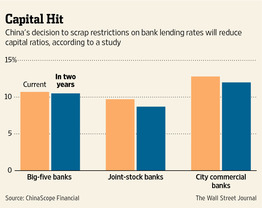
BEIJING—China’s banks will need up to $100 billion in new funding over the next two years following Beijing’s move to shake up lending, according to an analysis by a research firm, and that could spur banks to tap investors for capital even amid growing worries over the strength of their balance sheets. China’s central bank on Saturday removed a government floor on the interest rates banks can charge their clients for credit, allowing financial institutions to price loans at whatever level they want. Authorities hope the action will foster competition among banks and result in easier access to loans for businesses and individual borrowers, especially small and private manufacturers long shunned by big state-owned lenders.  Read more of this post

China’s rate reform adds to concerns for bank investors as eventual industry overhaul will deprive the banks of virtually risk-free profits

China’s rate reform adds to concerns for bank investors

12:16am EDT

By Pete Sweeney and Gabriel Wildau

SHANGHAI (Reuters) – Beijing’s move to scrap the floor on lending rates is not yet a game-changer for Chinese banks, but it may have just started the countdown to an eventual industry overhaul which will deprive the banks of virtually risk-free profits.

China bank stocks mostly fell on Monday, the first trading session following the rate reform announced late on Friday. An index of banks listed in Shanghai was down 1.7 percent in late morning trading, compared with a decline of 0.4 percent for the broader Shanghai Composite Index .SSEC.SS. Read more of this post

Senior provincial officials seek financial help from China’s finance ministry, even from provinces considered economically sound such as Guangdong

Senior provincial officials seek help from China’s finance ministry

Staff Reporter

2013-07-18

Several senior provincial-level officials have personally sought financial support from China’s Ministry of Finance, with officials from provinces considered economically sound such as Guangdong, also voicing similar demands, reports Shanghai’s National Business Daily. Amid an economic slowdown, provincial officials have made visits to the Ministry of Finance with the aim of receiving central government benefits to bolster their regions. The list includes Guo Gengmao, secretary of the CPC Henan Provincial Committee, Xie Fuzhan, the governor of Henan, Zhou Benshen, secretary of the CPC Hebei Provincial Committee, and the governor of Guangdong Zhu Xiaodan. Read more of this post

The path of bankruptcy which crippled the once booming industrial city of Detroit is now being followed by certain cities in China

Detroit clones cropping up around China

Staff Reporter

2013-07-21

The path of bankruptcy which crippled the once booming industrial city of Detroit is now being followed by certain cities in China. These cities, such as Ordos and Wenzhou, develop rapidly without considering market demand and become “ghost towns,” according to the China Securities Journal.

The difference between Detroit and ghost towns in China, said Yang Shaofong, chairman of Chinese property developer Conworld, is that the latter will never go bankrupt because Beijing will always bail them out through policy support. Many of the ghost towns are actually already bankrupt. Read more of this post

As luck would have it: Historian, China scholar and bestselling author Jonathan Spence retraces a career driven by serendipity

As luck would have it

Sunday, 21 July, 2013, 12:00am

Kate Whitehead

Historian, China scholar and bestselling author Jonathan Spence retraces a career driven by serendipity, writes Kate Whitehead.

Jonathan Spence – historian, intellectual and eminent China scholar – is not one for a snappy answer. He’s not slow to reply; just very thorough. Unhurriedly he paints a picture, sketching in plenty of detail and planting his response somewhere in the middle. Ask him when he first became interested in China and he won’t give you a hard and fast answer. He’ll talk about his childhood, about his first conscious memory, and then go on to ponder whether we can even be certain that a memory is genuine. He’ll want you to understand the context behind what he’s saying – and it will always be interesting. Perhaps that’s what sets him apart from other historians – this knack of spinning his web and drawing you in. Read more of this post

Madness and the delicate art of exercising power in negotiating

Madness and the delicate art of exercising power in negotiating

INSEAD | Business | Sat, July 20 2013, 3:46 PM

Unpredictability can be an asset in making people do what you want as a leader and a negotiator. In October, 1969, the Nixon White House indicated to the Soviets that the “madman was loose” as the US military ostentatiously flew bombers packed with thermonuclear weapons near the Soviet border for three consecutive days. It was part of the then-president’s “Madman” strategy, designed to make the leaders of other countries, especially the Soviet Union, think that the American president was quite literally emotionally unstable and disjointed. Senior U.S. officials, such as Secretary of State Henry Kissinger, not only portrayed Nixon as irrational and volatile to his Soviet counterparts, but made them think that Nixon was totally unpredictable. The sudden decision to bring the bombers home reinforced the “madman’s” unpredictable nature and baffled the Soviets. Read more of this post

Beware your heroes and heed the lesson of stargazer Galileo Galilei

Beware your heroes and heed the lesson of stargazer Galileo Galilei

BY NORIKO HAMA

SPECIAL TO THE JAPAN TIMES

JUL 21, 2013

A scene from “The Life of Galilei” seems to encapsulate the dilemma Japan faces as it gropes for new leadership. “Woe betide a nation without heroes.” “Not so. Woe betide a nation in need of heroes.” This exchange from the play by anti-establishment German playwright Bertolt Brecht is a traumatic one in which Galileo Galilei returns from his encounter with the Grand Inquisitor. (The production I saw was in Japanese. The translations are my own.) The latter has managed to convince the scientist to rescind his views on celestial dynamics and shut up about the earth moving round the sun. It turns out that even the great Galileo is susceptible to threats when they are accompanied by a display of the latest advances in torture tools. The above lament over the lack of heroes is an utterance of Master Galileo’s foremost student, who did not believe even for a moment that his great tutor would capitulate. Read more of this post

How Companies Can Get Smart About Raising Prices; Marketers too often do precisely the wrong things, alienating customers and getting little return. Here’s how they can do it right.

Updated July 21, 2013, 4:01 p.m. ET

How Companies Can Get Smart About Raising Prices

Marketers too often do precisely the wrong things, alienating customers and getting little return. Here’s how they can do it right.

KUSUM L. AILAWADI and PAUL W. FARRIS

LE-AA274B_PRICE_G_20130719125704

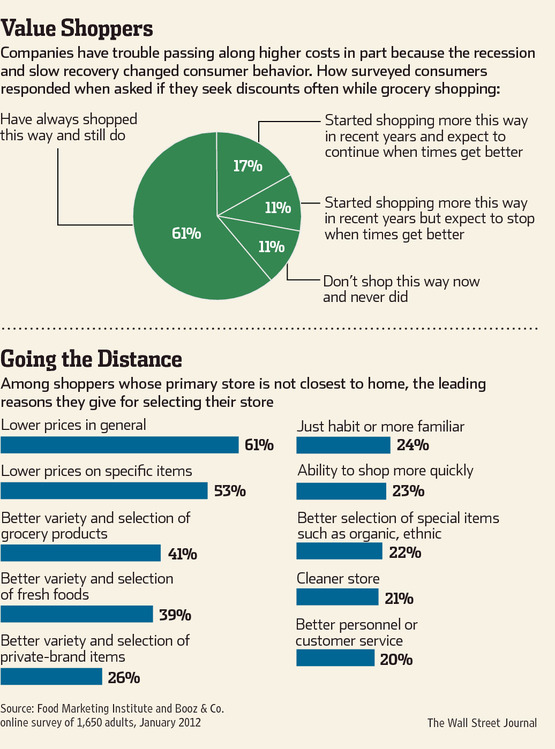
How do you get Customers to pay more for your products? It’s a question no company wants to face. Raise prices in the middle of a sluggish economy, and they risk alienating customers they can’t afford to lose and leave themselves vulnerable to competitors. Yet they have little choice but to ratchet up. The cost of making consumer goods and getting them to stores has been rising for some time. And a lot of the old strategies for shaving overhead, such as outsourcing, are getting less effective in economic terms and more unpopular in humanitarian terms. Read more of this post

Advice for CFOs: Don’t Think Fast; When chief financial officers think too fast, they can get the company into a lot of trouble. Here’s how to slow down and avoid such problems, based on insights from Nobel laureate Daniel Kahneman

July 21, 2013, 4:01 p.m. ET

When CFOs Think Fast…

…They may get the company into a lot of trouble. Here’s where they go astray—and how to avoid it.

HERSH SHEFRIN

LE-AA276_FAST_G_20130719120855

Daniel Kahneman, in his best-selling book, “Thinking, Fast and Slow,” says there are basically two modes of thinking. Fast and slow. Fast thinking is intuitive, he says. It arises from experience and broad unconscious associations between ideas. Slow thinking, in contrast, relies on reason, analysis and deliberation. Both have their time and place. But the psychology professor and Nobel laureate in economics warns about the risks of too much fast thinking when thinking slowly would lead us to better decisions. Chief financial officers would do well to heed that advice. Too often, they take mental shortcuts, trusting their instincts instead of doing the math. And the results can be damaging to their companies’ shareholders, employees and customers. Here are some of the ways fast thinking leads CFOs astray, and a few suggestions as to how such problems can be avoided. Read more of this post

How to Make an Audit Report Useful

Updated July 22, 2013, 12:00 a.m. ET

How to Make an Audit Report Useful

Auditors’ letters are boring and uninformative. In the future they may still be boring, but at least they’ll say something.

Face it: It is going to be pretty hard to ever make audit reports scintillating reading. But they definitely could be made a lot more informative. Audit reports are those tedious letters in which a company’s outside auditor attests that its financial statements are accurate. In fact, they’re so tedious, and offer so little information, that most investors can be forgiven for skipping them. But now many want to revamp the reports so they provide more information about the auditor’s findings—from potential risks that could affect the financial statements to areas of the audit that the auditor thinks are particularly important. The graphic at left (click to enlarge) is a mock-up prepared by The Wall Street Journal of what a revamped audit report might look like, drawing on ideas suggested by regulatory agencies and accounting groups around the world. There is no uniform agreement on what changes to make, and no revamp will incorporate all these ideas. U.S. audit regulators haven’t even issued a formal proposal yet indicating which ideas they will pursue. Though a revamped report would still be jargon-filled—and probably longer because of the suggested additions—investors might get more out of it. In other words, at least the tedium might be worth it.

LE-AA271_AUDITt_G_20130718123613

Ernst & Young has unwittingly rebranded itself with the same name as a Spanish soft porn magazine. “It’s marketing 101: you check who has the rights to the name.”

Rude shock as Ernst & Young rebrands

PUBLISHED: 0 HOUR 25 MINUTE AGO | UPDATE: 0 HOUR 23 MINUTE AGO

dd7eef6a-f281-11e2-af75-865935e314ff_EY_646_edited-1--646x363 0896cfe6-f27e-11e2-af75-865935e314ff_IMG (1)--236x230

Ernst & Young now shares its name with a racy Spanish magazine.

AGNES KING

Professional services giant Ernst & Young has unwittingly rebranded itself with the same name as a Spanish soft porn magazine. The London-based global accounting and advisory firm should have run a quick Google search first before re-branding itself as “EY”. It now shares a name with a racy Spanish magazine, EY! Magateen, featuring near-naked male models in homoerotic poses. As a result, a Google image search of “EY” brings up photos of strapping lads clad in low-cut briefs, with Brazilian flags covering their crown jewels, alongside the Ernst & Young logo and exterior shots of the company’s offices. “This is a definite balls-up,” marketing and brand expert Mark Ritson said. “It’s marketing 101: you check who has the rights to the name, whether it means something rude in a foreign language and who owns the digital personality.” Read more of this post

Netflix Rule as No. 1 S&P Performer But…. negative free cash flow, a surge in liabilities for new movie and TV-show content and a long-term increase in unpaid subscribers

Netflix Rule as No. 1 S&P Performer But….

Netflix Inc. (NFLX) has become the best performing U.S. stock in the Standard & Poor’s 500 Index in 2013 and the second most expensive, and therein lies a tale of disagreement.

Investors who dig into company filings can find negative free cash flow, a surge in liabilities for new movie and TV-show content and a long-term increase in unpaid subscribers. Moreover, perceived limits on customer numbers and the high price of shares have led 26 of the 37 Bloomberg-listed analysts covering the stock to advise investors to sell or hold stakes. Read more of this post

When you’re rattled by collateral, do the Fed taper talk; it seems increasingly that Taper talk was forced upon the Fed for market operational reasons rather than anything to do with economic conditions being ripe for a pullback in easing

When you’re rattled by collateral, do the Fed taper talk

Izabella Kaminska

| Jul 19 10:02 | 11 comments | Share

Tim Duy, professor of practice at the department of economics at the University of Oregon, is confusing Brad DeLong, professor of economics at Berkeley, with his observation that the Fed seems to be striving to change the mix but not the level of outright accommodation. This, at least, seems to be the motivation for taper talk. We’re less confused, and quite like what Duy is saying. Note the following (our emphasis):

Bernanke is talking as if the goal is to change the mix of monetary policy but not the level of accommodation, essentially trading some reduced accommodation from ending asset purchases for additional accommodation by extending the forward guidance on interest rates. But why? If the level of accommodation is the same, does the mix matter? That’s an interesting question – does the Fed have research saying the mix matters, and why? I can see two reasons. One is that somehow asset purchases have a more negative distortionary impact. Another is that there exists an internal bias in the FOMC against expanding the balance sheet. Arguably, some elements of both where on display in Bernanke’s testimony today: Read more of this post

At-home beauty device market grows

2013-07-21

At-home beauty device market grows

By Rachel Lee

hair_200

Laser 4X, a hair removal device made by Tria Beauty, is designed for at-home use

The country’s at-home beauty device market has been expanding gradually over, creating a new approach to beauty and skin care. Using high-tech, easy-to-use home beauty devices, consumers can now perform procedures like facial rejuvenation, cellulite and fat reduction, acne treatment and hair removal at home. Some popular at-home devices are Nu Skin’s ageLOC Galvanic Body Trio, a spa device that contours, smoothens and firms the body, and Unix Electronics’s Style Cube,  a hairstyling device. Read more of this post

Korea: Republic of Workaholics

2013-07-21

Korea: Republic of Workaholics

Long working hours make workers unhappy

By  Kim Bo-eun
130721_a01_korea2

Korea is notorious for being a country of workaholics, having one of the world’s highest numbers of annual working hours per employee. While the government and leading conglomerates have been cutting back on working hours and lengthening breaks, small- and medium-sized companies still face the miserable reality of all work and no play. Korea still has one of the lowest numbers of legally guaranteed vacation days. Even then, employees rarely use up all of their vacation days due to the workaholic culture, and when they do go on their short vacations, they are prone to be stress-ridden. Read more of this post

Malaysian-listed China firms losing lustre? “Investors just do not trust China stocks and they are quite justified in doing so”

Bursa-listed China firms losing lustre?

By Lidiana Rosli

Published: 2013/07/22

KUALA LUMPUR: China-based companies that are listed on Bursa Malaysia are having a tough time attracting investors and retaining their stock prices after being listed.

Almost all of the nine China-based companies, namely XingQuan International Sport Holdings, China Automobile Parts Holdings, HB Global Ltd, China Stationery Ltd, XiDeLang Holdings, K-Star Sports Ltd, China Ouhua Winery Ltd, Maxwell International Holdings and Multi Sports Holdings, are trading below their initial public offering (IPO) price as at July 19’s market close. An analyst told Business Times that low investor confidence and possibly “justified stigma” are the reasons for the lacklustre performance. “Frankly speaking, investors just do not trust China stocks and they are quite justified in doing so,” said the analyst, on condition of anonymity.  Read more of this post

The Bond Boom—and Beyond: Low rates drew a flood of corporate debt issues in recent years. But is the run over?

Updated July 22, 2013, 12:00 a.m. ET

The Bond Boom—and Beyond

Low rates drew a flood of corporate debt issues in recent years. But is the run over?

LE-AA279_DEBTch_G_20130719113322

The record-breaking bond market has been very, very good to corporate borrowers. Companies around the globe have been rushing to issue new debt, encouraged by the lowest interest rates since the 1950s. New bond issues set a record last year, the average yield for high-yield junk bonds in early May fell below 5% for the first time, and Apple Inc.’sAAPL -1.58% recent $17 billion offering was the largest in history. Borrowers have been taking advantage of cheap debt to refinance more expensive short-term obligations, pushing the ratio of long-term to total borrowing to record highs. Many, like Apple, are using bond proceeds to benefit shareholders through increased dividends or stock buybacks. Read more of this post

Spectre of rising household debt in Malaysia

Spectre of rising household debt in Malaysia

Monday, Jul 22, 2013

Daljit Dhesi

The Star/Asia News Network

PETALING JAYA – Although the latest measures introduced by Bank Negara to rein in household debt would ensure a sound and sustainable household sector, more is needed to prevent debt from reaching alarming levels, said economists.

The household debt in Malaysia, which stands at about 83 per cent of gross domestic product (GDP), is higher than many other countries in the region like the Philippines, Indonesia, Singapore, Hong Kong and Japan. If not prevented, it could put a damper on the country’s 5 per cent-6 per cent projected GDP growth this year. Read more of this post

Snack War: Peltz vs. Rosenfeld

July 21, 2013, 4:46 p.m. ET

Snack War: Peltz vs. Rosenfeld

Mondelez CEO Is Familiar With Investor’s Efforts to Reshape Companies

JULIE JARGON

Irene Rosenfeld can’t seem to shake activist investor Nelson Peltz. First, Mr. Peltz’s Trian Fund Management LP pushed her in 2007 to sell underperforming brands such as Post cereals while she was chief executive of Kraft Foods Inc. Then in 2010, with Ms. Rosenfeld still as CEO, Kraft made a $19.4 billion acquisition of British chocolate maker Cadbury PLC, two years after Cadbury separated its drink and candy businesses at Trian’s urging. After the Cadbury deal, Mr. Peltz and his partners used their stake in Kraft to press the company to split in two. The separation of Kraft’s North American groceries unit and international snack business occurred last year, with the snack business renamed asMondelez International Inc. MDLZ +0.36% Now, Trian’s machinations are threatening to bedevil Ms. Rosenfeld yet again. Mr. Peltz last week proposed to merge PepsiCo Inc.’s PEP -0.45% snack business with Mondelez, where Ms. Rosenfeld became chairman and CEO under the changes at Kraft.

Read more of this post

Apple acquires Locationary, a Toronto startup, to help with troubled Maps app

Apple acquires Locationary, a Toronto startup, to help with troubled Maps app

Mashoka Maimona | 13/07/19 | Last Updated: 13/07/19 3:51 PM ET
Apple has scooped up nascent Toronto-based startup Locationary in a deal that could help the tech giant fine-tune its widely-panned mobile mapping service. Launched in late 2010, Locationary aggregates accurate, up-to-date information from users to create a synchronized database of local businesses, or an encyclopedia of what venues are open in the area, along with extraneous details such as opening times. An Apple spokeswoman confirmed an earlier report of the deal to the Financial Post on Friday, but would not disclose how much it paid for the startup or any additional terms of the deal. Read more of this post

CFOs Ignore Big Data at Their Peril

Updated July 18, 2013, 12:30 p.m. ET

CFOs Ignore Big Data at Their Peril

MAXWELL MURPHY

LE-AA270_DATAch_D_20130717112405

Big data seems tailor-made for finance chiefs. So why aren’t more of them using it?

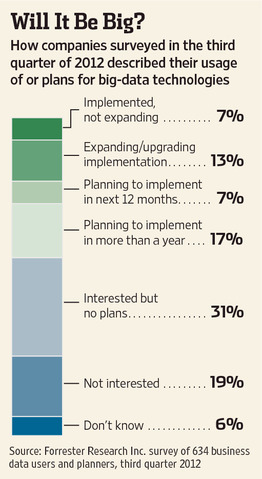
Many chief financial officers say big-data technologies—which use high-performance computing to organize and analyze impossibly large volumes of information—would make their jobs more complicated and might not be worth the extra cost. They say their existing tools, mainly sophisticated financial dashboards that can crunch an organization’s numbers in real time, are adequate for their financial-planning needs. Read more of this post

For Developing World, a Streamlined Facebook; To expand its user base, the Internet giant is developing a slimmed-down interface for those whose Internet access is generally via cheap, unsophisticated cellphones

July 21, 2013

For Developing World, a Streamlined Facebook

By VINDU GOEL

MENLO PARK, Calif. — Facebook has been quietly working for more than two years on a project that is vital to expanding its base of 1.1 billion users: getting the social network onto the billions of cheap, simple “feature phones” that have largely disappeared in America and Europe but are still the norm in developing countries like India and Brazil. Facebook soon plans to announce the first results of the initiative, which it calls Facebook for Every Phone: More than 100 million people, or roughly one out of eight of its mobile users worldwide, now regularly access the social network from more than 3,000 different models of feature phones, some costing as little as $20. Read more of this post

Netflix has given a good shaking to the settled world of television: it has provided its own series, streamed them over the Internet and made them available all at once everywhere

July 21, 2013

TV Foresees Its Future. Netflix Is There.

By DAVID CARR

Apple and Google were back making waves in the television world last week, with reports suggesting they were renewing efforts to use technology to transform the box in your living room. But Netflix already has. Netflix knows a little about transformation. It’s worth remembering that it managed to go from the largest user of the Postal Service to the largest source of download traffic on the Web in the span of months, not years. After a big stumble on pricing in 2011, Netflix recovered and then some, using its expertise in technology and algorithms to accrue over 36 million users worldwide, a number that will probably grow when it announces its earnings on Monday. Its stock has already risen more than 200 percent in the last year. Read more of this post

With Decentralized Power Comes Graft

With Decentralized Power Comes Graft

By Yeremia Sukoyo & Usmin on 9:08 am July 22, 2013.

Riau Governor Rusli Zainal, center, became the latest of nearly 300 regional heads to be arrested for graft since 1999. (JG Photo/Marcel Kataren)

Jakarta/Bengkulu. The advent of regional autonomy more than a decade ago has given rise to highly corrupt local cabals who have misappropriated Rp 2.2 trillion ($218.5 million) in public funds since 2008, watchdogs say.

Uchok Sky Khadafi, the director of investigations and advocacy at the Indonesian Forum for Budget Transparency (Fitra), said at a discussion over the weekend that the figure for the state losses was based on a report published by the Supreme Audit Agency (BPK) about regional funding from 2008 to 2012. Read more of this post

In Brazil, Dilma Rousseff’s woes prompt talk of Lula comeback

July 21, 2013 12:59 pm

In Brazil, Dilma Rousseff’s woes prompt talk of Lula comeback

By Joe Leahy in São Paulo

The interaction was classic Lula, as Brazil’s former president Luiz Inácio Lula da Silva is known.

Discussing mass protests that swept Brazil last month with university students in his working-class neighbourhood of São Paulo, Mr Lula da Silva was all rough charm, casually peppering his discourse with expletives uncommon for a politician, in public at least. Read more of this post

Investors, Analysts See End of Commodity ‘Supercycle’; Popular Bet in Global Financial Markets—That Prices Would Keep Rising—Is Unraveling

July 21, 2013, 3:42 p.m. ET

Investors, Analysts See End of Commodity ‘Supercycle’

Popular Bet in Global Financial Markets—That Prices Would Keep Rising—Is Unraveling

CHRISTIAN BERTHELSEN

MI-BX315_ABREAS_G_20130721163008

Investors are suffering mounting losses as a decadelong rise in commodity prices unravels amid slowing emerging-markets economies, rising supplies of oil and metals and the eventual end of central-bank stimulus policies that propped up prices for raw materials.

The sharp reversal in the prices of commodities, ranging from gold to copper and aluminum, is undermining one of the most popular bets in global financial markets: that prices would keep rising, fueled by strong growth in China and other developing economies and the relative scarcity of many raw materials. Read more of this post

High-End Smartphone Boom Ending as Price Drop Hits Apple

High-End Smartphone Boom Ending as Price Drop Hits Apple

By Peter Burrows – Jul 21, 2013

The smartphone has crossed the line from shiny new technology to ubiquitous commodity.

App-laden, Web-surfing phones have surged in popularity over the past half-decade and generated $293.9 billion in sales last year alone. They are now used by more than 1 billion people around the world. With more than half of mobile users in the U.S. and developed countries owning a smartphone, and consumers in emerging markets including China and India gravitating toward cheaper models, demand is slowing for high-end devices. Read more of this post

The China disconnect: analysts lose plot on financial stocks

The China disconnect: analysts lose plot on financial stocks

5:45pm EDT

By Nishant Kumar

HONG KONG (Reuters) – Seventy percent of analysts covering Chinese financial stocks rate them a buy, the highest among the world’s top 10 markets for such shares. Yet its financials are the worst performing this year in the group, Thomson Reuters StarMine data shows.

That disconnect has been on display in recent weeks, with Chinese financial stocks getting hammered on fears about a credit crunch and the country’s slowing economy. While the majority of analysts remain positive, mutual funds have dumped shares and short sellers have moved in. Read more of this post

Treasuries Not Safe Enough as Foreign Buying Slowest Since 2006

Treasuries Not Safe Enough as Foreign Buying Slowest Since 2006

Foreign investors, the bulwark of the U.S. government bond market as it more than doubled in size during the financial crisis, are adding Treasuries at the slowest pace since 2006 amid the worst rout in four years.

Holdings by non-U.S. investors rose 1.9 percent through May, down from 5.2 percent a year ago data last week show, as foreigners owned less than 50 percent of Treasuries outstanding for the first time since March 2012. Overseas central banks cut the amount of bonds held for them by the Federal Reserve during the second quarter. The Bloomberg U.S. Treasury Bond Index fell 2.4 percent, the most since 2009, after Chairman Ben S. Bernanke said he might slow asset purchases as the economy improves. Read more of this post