Tycoons Usurped by SOEs in China IPOs as Returns Tumble

Tycoons Usurped by SOEs in China IPOs as Returns Tumble

In December, China Machinery Engineering Corp., a builder of power stations, went public in Hong Kong thanks to five Chinese government-owned companies that bought almost a third of the $575 million offering. The stock has since fallen 24 percent.

China Machinery is among a growing number of state-owned enterprises forced to rely on so-called cornerstone investments by other state firms to get initial public offerings done, as wealthy individuals like Li Ka-shing stopped investing. The results haven’t been stellar. Read more of this post

China’s move to loosen interest-rate controls is insufficient to cut corporate borrowing costs in coming months as the economy expands at the slowest pace since 1990

PBOC’s Rate Rules No Company Salve to Barclays: China Overnight

China’s move to loosen interest-rate controls is insufficient to cut corporate borrowing costs in coming months as the economy expands at the slowest pace since 1990, according to Barclays Plc and UBS AG.

The People’s Bank of China scrapped the floor on the rates banks can charge customers on July 19 while keeping a cap on deposit rates. Yuan forwards rose and Chinese stocks trading in the U.S. posted the first back-to-back weekly gain since May as the change signaled policy makers’ commitment to market reforms. Read more of this post

Steel Goal Fades as $12 Billion Projects Dumped in India

Steel Goal Fades as $12 Billion Projects Dumped: Corporate India

ArcelorMittal (MT) and Posco’s decisions to scrap $12 billion of proposed steel projects in India and delays in building plants by Tata Steel Ltd. (TATA) and its peers will probably cut the nation’s 2020 capacity target by a quarter.

India may add about 50 million metric tons in the next eight years, half of an earlier plan, taking total capacity to 150 million tons, according to the average estimate of six analysts, government officials and company executives in a Bloomberg survey. Slowing demand, land acquisition delays, rising funding costs and difficulties in getting iron ore mining permits are diminishing the viability of the projects, said A.S. Firoz, the steel ministry’s chief economist. Read more of this post

Beijing Airport Bomber Highlights Threat to Social Stability

Beijing Airport Bomber Highlights Threat to Social Stability

A man who detonated a home-made bomb at Beijing Capital International Airport to gain attention for his grievances highlights the growing threat to social stability in China from frustration at perceived injustice.

The man, identified as Ji Zhongxing, a 34-year-old from Heze city in eastern Shandong province who is confined to a wheelchair, exploded the device outside the exit to the arrival hall of Terminal 3 on July 20, according to a report from the official Xinhua News Agency. Ji, who sustained injuries to his arm, was the only person hurt in the explosion, it said. Read more of this post

China Shipyards Squeezed by Low Down Payments Amid Credit Crunch

China Shipyards Squeezed by Low Down Payments Amid Credit Crunch

During the 2007 shipping boom, China’s shipyards charged down payments of as much as 60 percent of a vessel’s value. Now, shipbuilders are cutting those payments to as little as 2 percent, giving an advantage to state-owned companies that can tap the government’s cash.

With flagging demand pushing shipyards to compete by cutting down payments and China taking measures to rein in lending, the nation’s privately owned yards are getting squeezed by state-owned rivals that enjoy greater access to financing. China Rongsheng Heavy Industries Group Holdings Ltd. (1101), the largest shipbuilder outside state control by order book, said this month it’s seeking government support after failing to win any new vessel orders this year. Read more of this post

Keppel Seeks New Non-Rig Orders for Brazil Yards as competition from China pushes down rig prices

Keppel Seeks New Non-Rig Orders for Brazil Yards: Southeast Asia

Keppel Corp. (KEP), the world’s largest oil-rig maker, wants to set aside capacity to build offshore production and support vessels in Brazil as competition from China pushes down rig prices.

Keppel wants to expand its business of building offshore production and support vessels in the country, Chief Executive Officer Choo Chiau Beng said in an interview on July 19. The Singapore company, which is building a second yard in Brazil, also plans to offer more repair and conversion work. Read more of this post

Mastery by Robert Greene

China’s decision to liberalize bank lending rates has raised suspicions that it reflects official concerns over possible loan defaults and is aimed at helping out heavily indebted state firms and local governments

China’s rate reform may serve to shield indebted state firms

4:27am EDT

By Wayne Arnold

HONG KONG (Reuters) – China’s decision last week to liberalize bank lending rates, though widely applauded, has raised suspicions that it reflects official concerns over possible loan defaults and is aimed at helping out heavily indebted state firms and local governments. China’s central bank announced on Friday that banks could now lend at whatever rate they liked, enabling them to compete for new borrowers with cheaper credit at a time when the world’s second-largest economy is slowing markedly. But some investors said the move was symbolic and likely represented, in the short term at least, relief for heavily indebted state-owned enterprises (SOEs), big private-sector employers and local government financing arms. “I’m a little skeptical of the appraisals that this is a big, big reform move,” said Patrick Chovanec, managing director and chief strategist at Silvercrest Asset Management in New York and formerly a professor at Beijing’s Tsinghua University. “My concern in the short run is that what will happen is that a bunch of local government financing vehicles will get lower interest rates,” he added. Read more of this post

Amazon vs. IBM: Big Blue meets match in battle for the cloud

Amazon vs. IBM: Big Blue meets match in battle for the cloud

8:08am EDT

By Alistair Barr

SAN FRANCISCO (Reuters) – The tech industry maxim that “no one ever got fired for buying IBM” is a testament to how Big Blue has been the gold standard in computing services for decades. But IBM faces an unlikely challenger in Amazon.com Inc, the e-commerce retail giant that is becoming a force in the booming business of cloud computing, even winning backing from America’s top spy agency. Read more of this post

Poor quality and bad management: India ignored warnings in free meal program

Poor quality and bad management: India ignored warnings in free meal program

7:18am EDT

By Annie Banerji and Anurag Kotoky

GANDAMAN, India/NEW DELHI (Reuters) – The village school in India where 23 children died by poisoning last week had been providing lunch under a government-sponsored scheme without checks or monitoring by local officials to see if the food was stored carefully or cooked properly. Although it is the first such disaster in the “midday meal” project that feeds about 120 million children every day across India, a Reuters review of audit reports and research papers shows officials have long ignored warnings of the lack of oversight and accountability in the program. “You only come and do checks when you get complaints or when there are serious cases,” said Rudranarayan Ram, the local education administrator for the village of Gandaman in Bihar state, where the children died. “This was the first time.” Read more of this post

True entrepreneurs find worth in the worthless and possibility in the impossible

True entrepreneurs find worth in the worthless and possibility in the impossible

Jul 20th 2013 |From the print edition

20130720_WBD000_0

ENTREPRENEURSHIP is the modern-day philosopher’s stone: a mysterious something that supposedly holds the secret to boosting growth and creating jobs. The G20 countries hold an annual youth-entrepreneurship summit. More than 130 countries celebrate Global Entrepreneurship Week. Business schools offer hugely popular courses on how to become an entrepreneur. Business gurus produce (often contradictory) guides to entrepreneurship: David Gumpert wrote both “How to Really Create a Successful Business Plan” and “Burn Your Business Plan!”.

But what exactly is entrepreneurship (apart from a longer way of saying “enterprise”)? And how should governments encourage it? The policymakers are as confused as the gurus. They assume that it must mean new technology; so they try to create new Silicon Valleys. Or that it is about small businesses; so they focus on fostering start-ups. Both assumptions are misleading. Read more of this post

Fast Time and the Aging Mind; Is it possible that learning new things might slow our internal sense of time?

July 20, 2013

Fast Time and the Aging Mind

By RICHARD A. FRIEDMAN

AH, the languorous days of endless summer! Who among us doesn’t remember those days and wonder wistfully where they’ve gone? Why does time seem to speed up as we age? Even the summer solstice — the longest, sunniest day of the year — seems to have passed in a flash. No less than the great William James opined on the matter, thinking that the apparent speed of time’s passage was a result of adults’ experiencing fewer memorable events: “Each passing year converts some of this experience into automatic routine which we hardly note at all, the days and the weeks smooth themselves out in recollection to contentless units, and the years grow hollow and collapse.”

Don’t despair. I am happy to tell you that the apparent velocity of time is a big fat cognitive illusion and happy to say there may be a way to slow the velocity of our later lives. Read more of this post

Let’s Shake Up the Social Sciences: It is time to create new social science departments that reflect the breadth and complexity of the problems we face as well as the novelty of 21st-century science

July 19, 2013

Let’s Shake Up the Social Sciences

By NICHOLAS A. CHRISTAKIS

TWENTY-FIVE years ago, when I was a graduate student, there were departments of natural science that no longer exist today. Departments of anatomy, histology, biochemistry and physiology have disappeared, replaced by innovative departments of stem-cell biology, systems biology, neurobiology and molecular biophysics. Taking a page from Darwin, the natural sciences are evolving with the times. The perfection of cloning techniques gave rise to stem-cell biology; advances in computer science contributed to systems biology. Whole new fields of inquiry, as well as university departments and majors, owe their existence to fresh discoveries and novel tools.

In contrast, the social sciences have stagnated. They offer essentially the same set of academic departments and disciplines that they have for nearly 100 years: sociology, economics, anthropology, psychology and political science. This is not only boring but also counterproductive, constraining engagement with the scientific cutting edge and stifling the creation of new and useful knowledge. Such inertia reflects an unnecessary insecurity and conservatism, and helps explain why the social sciences don’t enjoy the same prestige as the natural sciences. Read more of this post

Glorious Misadventures: Nikolai Rezanov and the Dream of a Russian Americ

Russia’s American empire: When the tsarist empire reached California

Jul 20th 2013 |From the print edition

20130720_BKP002_0

Glorious Misadventures: Nikolai Rezanov and the Dream of a Russian America. By Owen Matthews. Bloomsbury; 320 pages; £20. To be published in America in November by Bloomsbury; $28. Buy from Amazon.com, Amazon.co.uk

HIS breath stinking from scurvy, his hair crawling with lice, and starving in his fine clothes, Nikolai Rezanov was as unlikely a suitor as he was an ambassador. His most urgent mission, when he arrived in 1806 at the tiny Spanish fort of San Francisco, was trade: tools and weapons in exchange for grain, for the hungry garrison he had left behind in Russian Alaska. Spain forbade such trade, but Rezanov (pictured here as the Japanese saw him) was not cowed by rules. Once clean and fed, he was an exotic, cosmopolitan presence in the tiny settlement. His wooing (passionate but pragmatic) of Conchita, the 15-year-old daughter of the fort’s commander, brought both a deal and a betrothal. His ship groaning with cargo, he left, promising to return and bring his bride back to the delights of St Petersburg. Read more of this post

If You’re a Bond Investor, Beware of the Seesaw; SEC has a basic reminder for investors enticed by rising interest rates on bonds: When rates climb, prices fall.

July 20, 2013

If You’re a Bond Investor, Beware of the Seesaw

By JEFF SOMMER

21stra-illo-articleLarge

THE Securities and Exchange Commission issues frequent bulletins about what it calls “investment frauds and scams” — a frightening taxonomy of plots and stratagems aimed at separating investors from their money. The agency’s alerts range from warnings of Madoff-style Ponzi schemes to “pump and dump” operations intended to temporarily inflate a stock price. They also include cautionary notes about polite offers of assistance from predators posing as government regulators. Lately, though, the S.E.C. has been giving a warning of a different sort. Bearing the general title “Interest Rate Risk,” this latest bulletin is a cry for understanding. It’s about bonds, and for most people, the subject is confounding. Read more of this post

Shoppers Drug Mart’s pharmacist associate model a hidden jewel for Loblaw

Shoppers Drug Mart’s pharmacist associate model a hidden jewel for Loblaw

Armina Ligaya | 13/07/20 | Last Updated: 13/07/19 4:46 PM ET
If Loblaw Companies Ltd. successfully buys Shoppers Drug Mart, it will not only inherit the pharmacy retailer’s vast network of stores — particularly key locations in the hearts of Canada’s urban centres — it will also benefit from the advantages afforded by the owner-operators of those stores: pharmacists.

While pure-play food and drug retailers such as Metro and Rexall appear to have the most to lose in the impending nupitals of Loblaw and Shoppers Drug Mart, Monday’s $12.4-billion deal stands to challenge a far broader swath of retail companies — from Old Navy to Sears to Sephora — as the two Canadian retail giants begin stocking their strongest brands and categories in each other’s stores. Read more of this post

After Waze, What Else Can Mobile Crowdsourcing Do?

After Waze, What Else Can Mobile Crowdsourcing Do?

Published on July 19, 2013
by Liz Gannes

WeatherMob-348x285

In the absence of good sensor data from phones, Weathermob asks users to post location-tagged weather status updates.

Google spent $1.1 billion to buy the mapping startup Waze last month, a deal that the Federal Trade Commission is still investigating. And while Google won’t be swapping out its flagship Google Maps in favor of its sassy new step-sibling Waze anytime soon, one thing is certain: The jumbo acquisition is a clear validation of mobile crowdsourcing. That’s because Waze’s mapping and traffic information are built off the contributions of 70,000 volunteer map editors and some 15 million active users, who contribute their live driving data by default, so others can benefit by seeing how fast they are going. Given the increasing number of people who carry smartphones in their pocket, it seems likely other services could be built on the back of willing users who contribute a little bit of data from wherever they are so it can be mapped and analyzed for the common good. Read more of this post

Transitioning To a Mobile Centric World

BY BILL GURLEY

Transitioning To a Mobile Centric World

July 17, 2013: “If you choose not to decide, you still have made a choice.” — Freewill, Rush

If you happen to be a sports fan (I am), one of the coolest features to emerge in our lifetime is the ability to program your DVR remotely. The game is about to start, and you forgot to record it. No problem — you can simply talk to your DVR remotely. It’s like magic. When you get home your game is there. DirecTV has supported this feature for some time, initially on the Internet via the browser and more recently via their smartphone application. Ironically, the smartphone version of this experience renders the browser-based experience antiquated, even painful. On the browser, the DirecTV user isalways required to sign-in, which is time consuming and tedious. Plus who remembers their TV provider’s login credentials? On the iPhone, the user is never required to log-in, which is a remarkable contrast. On the desktop navigating the schedule is cumbersome, slow, and deep in the feature hierarchy. On the smartphone it is quick, responsive, and right up front. When I am sitting at my desktop at work with the browser open and high-speed bandwidth at my fingertips and want to program my DVR, I pick up my iPhone. Read more of this post

TV everywhere: Pay-television executives hope to hang on to customers by letting them watch shows on their portable devices

TV everywhere: Pay-television executives hope to hang on to customers by letting them watch shows on their portable devices

Jul 20th 2013 |From the print edition

ALFRED HITCHCOCK once compared television to indoor plumbing. “It didn’t change people’s habits,” said the master of cinematic suspense. “It just kept them inside the house.” If television chained entertainment-junkies to the couch, online video has now released their shackles. Faster broadband, the rise of mobile phones and tablet devices, and services like Netflix, Hulu and YouTube that stream shows to people anywhere with an internet connection have freed viewers to watch programmes wherever they wish.

Pay-television executives have also chosen to take part in this liberation movement, by offering their subscribers “TV everywhere”. Their companies give their customers an access code that lets them watch channels streamed live—or individual shows on demand—on their mobile devices, much as they can on Netflix or Hulu. These days almost every TV operator in America, and many elsewhere in the world, offer subscribers something along these lines, says Ben Reneker of SNL Kagan, a research firm. Read more of this post

Renewable energy in Spain: Sustainable energy meets unsustainable costs

Renewable energy in Spain: Sustainable energy meets unsustainable costs

Jul 20th 2013 | MADRID |From the print edition

20130720_WBC097

ÁNGEL MIRALDA was proud of his 320 solar panels in a field near Benabarre, in northern Spain. They added 56 kilowatts of clean-energy capacity to a country that depended on oil imports. The panels cost €500,000 ($735,000): €150,000 from an early-retirement pay-off from IBM’s Barcelona office, the rest from a bank loan. The government promised a 10% annual return on such projects. That was in 2008. Five years later, after subsidies were cut on July 12th for the third time since 2012, his income is down by 40% and he is struggling to repay the loan. “There is no legal security in Spain,” he complains. Mr Miralda is the victim of a bungled, overambitious renewables programme. Governments everywhere want to turn green and create environmentally friendly jobs. But as Spain shows, good intentions are not enough. If the policies are wrong, the benefits are wasted, the jobs disappear, the costs remain—and business investors bear the brunt. Read more of this post

Lighting rural India: Villagers enjoy sunlight after dark

Lighting rural India: Villagers enjoy sunlight after dark

Jul 20th 2013 | ATRAULI, UTTAR PRADESH |From the print edition

20130720_ASP002_0

FLY by night over Uttar Pradesh in northern India, the country’s most populous state, and its cities appear as dazzling islands. In between, however, lies an inky sea. Perhaps two-thirds of Uttar Pradesh’s 200m people have no regular electricity. In India as a whole, 700m, or more than half of the population, suffer unreliable connections to the national grid, or none at all.

On paper, plans exist for linking the country’s northern and southern grids. That would help, yet nobody expects rural India to be properly plugged in for a long time yet. Meanwhile, villagers soldier on with paraffin lamps, which harm lungs and emit a dim light that is of little use for school homework. Darkness breeds danger, so women stay home after the sun goes down. A lack of electricity limits business, as markets and shops close early. Banks have been ordered to reach villages, but they need electricity. And though most Indians have mobile phones, many struggle to recharge them. Lots of India’s 400,000 mobile-phone towers are powered at least in part by diesel generators, which are noisy, dirty and costly. Power can account for two-fifths of a mobile-phone company’s operating costs. Read more of this post

Hauling New Treasure Along the Silk Road; With freight trains as their caravans, manufacturers like Hewlett-Packard are reviving an ancient way to ship products made in China to markets in Western Europe

July 20, 2013

Hauling New Treasure Along the Silk Road

By KEITH BRADSHER

AZAMAT KULYENOV, a 26-year-old train driver, slid the black-knobbed throttle forward, and the 1,800-ton express freight train, nearly a half-mile long, began rolling west across the vast, deserted grasslands of eastern Kazakhstan, leaving the Chinese border behind.

Dispatchers in the Kazakh border town of Dostyk gave this train priority over all other traffic, including passenger trains. Specially trained guards rode on board. Later in the trip, as the train traveled across desolate Eurasian steppes, guards toting AK-47 military assault rifles boarded the locomotive to keep watch for bandits who might try to drive alongside and rob the train. Sometimes, the guards would even sit on top of the steel shipping containers. Read more of this post

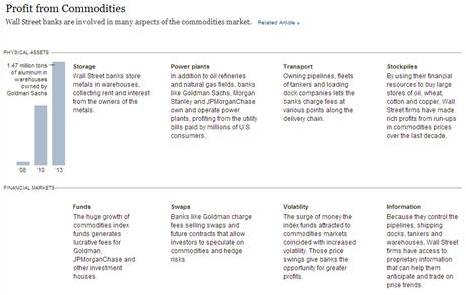
A Bizarre Goldman Sachs Aluminum Moving Scheme Has Allegedly Cost US Consumers $5 Billion In The Past 3 Years

A Bizarre Goldman Sachs Aluminum Moving Scheme Has Allegedly Cost US Consumers $5 Billion In The Past 3 Years

ADAM TAYLOR JUL. 20, 2013, 6:20 PM 5,341 24

Aluminium

The Federal Reserve is currently “reviewing” a landmark 2003 decision that first allowed regulated banks to trade in physical commodity markets. Why exactly shouldn’t banks be able to trade physical commodities? To see one argument, take a look at a big report from David Kocieniewski in today’s New York Times. According to Kocieniewski, a Goldman Sachs-owned company has been involved in an elaborate plan to move around aluminum in a way that has inflated market prices. The report states that every time an American consumer buys a product containing aluminum, they pay a price that has been affected by this maneuver. Sources told The New York Times that in total the plan has cost American consumers more than $5 billion over the last three years, Kocieniewski’s investigation centers on Metro International Trade Services, an aluminum storage company that Goldman Sachs bought three years ago. According to the Times, since Goldman bought the company the average wait time at the storage facility has gone up more than 20-fold. As the wait times are longer, the companies’ revenues for storing the aluminium are higher. This cost is reflected in the market price of aluminum. Aluminum storage facilities are not allowed to mindlessly sit on aluminum — industry standards require them to move 3,000 tons of the metal every day. However, according to the Times, Metro International gets around this law by moving the metal between its own warehouses every day. One analyst estimated that around 90% of the metal moved each day went to another Goldman-owned warehouse. The body that governs the industry has shown little interest in reforming the practice, Kocieniewski writes. This may be because the body — the London Metals Exchange — collects 1% of the rent from aluminum storage facilities. Limiting the amount of rent received would cost it millions. This all makes for a somewhat absurd working environment. Workers told the Times that they’d routinely see the same drivers making three or four round trips a day. Some warehouses reportedly sat empty 12 or more hours a day, the Times reports, despite the huge backlog. If the practice is as the Times describes it, it is very hard to see what value is given to society by the activity. A loose coalition of companies that use aluminium — including Boeing and Coca-Cola — have begun to put pressure on Goldman. However, the issue may go beyond aluminum — JP Morgan, Blackrock and Goldman have all been given approval by the SEC to buy a large amount of copper available on the market and stockpile it, Kocieniewski reports. Read more of this post

Chipotle Founder Reveals Why People Thought His Restaurant Wouldn’t Work

Chipotle Founder Reveals Why People Thought His Restaurant Wouldn’t Work

ASHLEY LUTZ JUL. 19, 2013, 3:13 PM 2,432 1

chipotle_kitchen_steve_ells

Chipotle founder and CEO Steve Ells started an empire. But Ells said that many thought his idea of making burritos and tacos from a few fresh ingredients wouldn’t work. On an earnings conference call, Ells described the biggest criticism people had with his first restaurant: “I remember 20 years ago people said, ‘Steve, a menu with burritos and tacos, I mean, you’re going to have to add new stuff pretty soon,'” Ells told investors. “But it’s the combinations of things that people can make, not only for taste but for diet and people can vary enough over the years during their visits that really keeps Chipotle fresh.” Ells opened the first Chipotle in Denver, Colorado in 1993. Today the chain has more than 1,500 locations. And while Chipotle might have few ingredients on the menu, there are a mind-boggling number of combinations to be had. Our math found that 655,360 different options were possible from Chipotle’s current ingredients.

A Buffett Fortune Fades in Brooklyn; Case of Othmer Gift to Ailing Hospital Is Cautionary Tale for Wealthy Donors; As early investors with Warren Buffett, Donald and Mildred Othmer quietly amassed a fortune that they believed would sustain their favorite charities for generations

July 19, 2013, 4:39 p.m. ET

A Buffett Fortune Fades in Brooklyn

Case of Othmer Gift to Ailing Hospital Is Cautionary Tale for Wealthy Donors

ANUPREETA DAS

As early investors with Warren Buffett, Donald and Mildred Othmer quietly amassed a fortune that they believed would sustain their favorite charities for generations. Among those organizations: Long Island College Hospital in Brooklyn, N.Y., for which the Othmers created a $135 million endowment in the 1990s, “to be held in perpetuity,” according to their wills.

OB-YG358_0719ot_DV_20130719165318

Mildred Topp Othmer and Donald Frederick Othmer cutting their wedding cake in Manhattan, November 1950. Read more of this post

It is getting easier to foresee wrongdoing and spot likely wrongdoers

Don’t even think about it

It is getting easier to foresee wrongdoing and spot likely wrongdoers

Jul 20th 2013 |From the print edition

THE meanest streets of Kent are to be found in little pink boxes. Or at least they are if you look at them through the crime-prediction software produced by an American company called PredPol. Places in the county east of London where a crime is likely on a given day show up on PredPol’s maps highlighted by pink squares 150 metres on a side. The predictions can be eerily good, according to Mark Johnson, a police analyst: “In the first box I visited we found a carving knife just lying in the road.” PredPol is one of a range of tools using better data, more finely crunched, to predict crime. They seem to promise better law-enforcement. But they also bring worries about privacy, and of justice systems run by machines not people. Read more of this post

Bruce Lee’s daughter recalls his energy as fans mark anniversary

Bruce Lee’s daughter recalls his energy as fans mark anniversary

Shannon Lee, daughter the late Kung Fu legend Bruce Lee, poses in front of a portrait of her father at the Hong Kong Heritage Museum

8:41am EDT

By Brian Yap

HONG KONG (Reuters) – The daughter of kung fu legend Bruce Lee spoke fondly on Friday of her father’s powerful presence and energy at a preview of an exhibition to mark the 40th anniversary of his death. Fans are gathering in the former British colony of Hong Kong for a series of commemorative events, including art gallery shows, exhibitions and even street graffiti. Many fans are urging the Hong Kong government to do more to honor the star of movies such as Enter The Dragon and Game Of Death. Shannon Lee was just four years old when her father died in Hong Kong from acute swelling of the brain at the age of 32, at the height of his career. Read more of this post

The latest research suggests humans are not warriors in their genes, after all

The latest research suggests humans are not warriors in their genes, after all

Jul 20th 2013 |From the print edition

EDWARD WILSON, the inventor of the field of sociobiology, once wrote that “war is embedded in our very nature”. This is a belief commonly held not just by sociobiologists but also by anthropologists and other students of human behaviour. They base it not only on the propensity of modern man to go to war with his neighbours (and, indeed, with people halfway around the world, given the chance) but also on observations of the way those who still live a pre-agricultural “hunter-gatherer” life behave. Add this to field studies of the sometimes violent behaviour of mankind’s closest living relative, the chimpanzee, and the idea that making war is somehow in humanity’s genes has seemed quite plausible. It has even been advanced as an explanation for the extreme levels of self- sacrificial altruism people sometimes display. (If a neighbouring tribe is coming to wipe yours out completely, then giving up your own life to save your fellows might actually make evolutionary sense.) Read more of this post

Make It Brew: The rise of craft breweries is less a story about business than one about taste

July 19, 2013, 3:55 p.m. ET

Make It Brew

The rise of craft breweries is less a story about business than one about taste.

MAX WATMAN

Do you remember where you were when you tasted your first Anchor Steam? If you do (and don’t worry, you’re not alone), then Tom Acitelli’s “The Audacity of Hops” is going to make you very happy. Mr. Acitelli’s exhaustive chronicle of the American beer revolution begins “on a breezy, warm day in August 1965,” when Fritz Maytag walked into the Old Spaghetti Factory “and ordered his usual beer: an Anchor Steam.” The brewery was about to close, and the next day, Fritz Maytag—inheritor of not just his great grandfather’s washing machine fortune, but his father’s blue cheese fortune, as well—bought 51% of the company, tweaked the recipe and lit a fire under the brew kettle of American beer that is still burning. For hop heads, this is a defining moment. It’s like reading about Henri Cartier-Bresson looking at Martin Munkácsi’s “Three Boys at Lake Tanganyika,” going out to a shop in Marseilles and finding a box with a curvy “L” printed on the side. Read more of this post

The 10 greatest white elephants

Thursday 18 July 2013 11.52 BST

The 10 greatest white elephants

In-Tempo-apartment-buildi-010

Benidorm’s In Tempo is the latest huge construction project to end up unused. Here are nine more examples from history

Benidorm’s In Tempo building. Photograph: intempobenidorm.com

Sometimes man’s optimism knows no bounds. In a bad way. Take yourself back to 2005, when people would’ve given themselves hernias laughing if you suggested the world was about to be plunged into a crisis that would make the Great Depression look puny. The European property market was at its frothiest, with developers throwing up luxury apartments and offices at the slightest excuse. In Spain they went a bit wilder than most. As a result, when the sun set of this fantasy in 2008, many cities found themselves lumbered with zombie projects. Read more of this post