Can Google’s Online TV Kill Cable?

Can Google’s Online TV Kill Cable?

The Internet is coming for your TV.

Google is in discussions to create an online-television service, the Wall Street Journal reports. While they face roadblocks, Google and other technology companies’ efforts to marry Internet with TV represent a telling shift in the Web’s increasing role as the backbone of our communications networks.

The idea: Let users stream live channels and on-demand shows on their TVs — just by connecting to the Internet. This combines the traditional TV packages of cable and satellite companies with the newer model of Netflix, Hulu and Amazon.com. Read more of this post

China defies IMF on mounting credit risk and need for urgent reform

China defies IMF on mounting credit risk and need for urgent reform

If you think China’s Communist Party fully understands the mess it has created by ramping credit to 200pc of GDP and running the greatest investment bubble know to man, read its shockingly complacent response to warnings from the International Monetary Fund.

By Ambrose Evans-Pritchard

8:00PM BST 17 Jul 2013

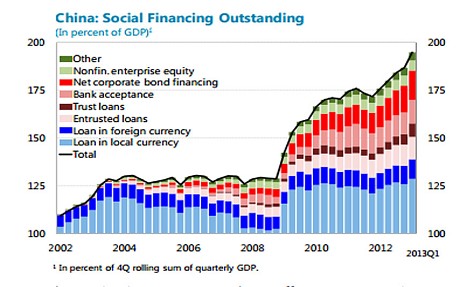
Chart1_2620453c Chart3_2620455c

The IMF’s Article IV report on China states – as clearly as the IMF dares – that excess credit has been pushed to the outer limits of sanity, and that there is a growing risk of an “adverse feedback loop” as the financial system and the economy take each other down in a mutually reinforcing spiral.

As you can see from the first chart, total credit has jumped from 129pc to 195pc of GDP since 2008, and has completely departed from its historic trend. The great mistake, plainly, was to keep the foot on the floor in 2010 and 2011, long after the Lehman crisis had subsided. Read more of this post

China’s Easy Money Flows Abroad as Credit Squeeze Hurts at Home

China’s Easy Money Flows Abroad as Credit Squeeze Hurts at Home

As China’s cash squeeze claims victims across the nation — from a bailout-seeking shipyard to a solar-panel maker missing a bond payment — there are places where Chinese money remains cheap and plentiful. Like Nigeria.

China Development Bank Corp. and Export-Import Bank of China are lending billions of yuan to some of the world’s riskiest regimes at interest rates hundreds of basis points below the cheapest commercial loans available at home. That lending in turn generates overseas contracts to build airports, roads and shopping malls for state-owned Chinese companies that are mired in debt. Read more of this post

SEC Said Near Proposal on Disclosure of CEO-to-Worker Pay Ratios

SEC Said Near Proposal on Disclosure of CEO-to-Worker Pay Ratios

Public companies would be required to disclose how much more their chief executives are paid than rank-and-file workers under a rule to be proposed next month by U.S. securities regulators, according to two people familiar with the matter.

The Securities and Exchange Commission proposal, part of the 2010 Dodd-Frank overhaul of financial markets, would require companies to calculate and disclose their CEO’s compensation as a multiple of average worker pay, said the people, who spoke on condition of anonymity because the commission’s agenda has not been made public. Read more of this post

China’s Thinning Margins Has Marubeni Betting on U.S. for Growth

China’s Thinning Margins Has Marubeni Betting on U.S. for Growth

China’s economic slowdown could be worse than official forecasts and a recovery may not come before 2014, according to the chairman of Marubeni Corp. (8002), Japan’s biggest power and agriculture trading company.

Thinning cargo volumes and trading margins suggest China’s gross domestic product may be expanding at less than the announced 7.5 percent in the second quarter, Teruo Asada said in an interview in Tokyo, making the U.S. a better prospect for the trader’s expansion. Read more of this post

Temasek Racing Exxon to Build Biggest LNG Stash: Southeast Asia

Temasek Racing Exxon to Build Biggest LNG Stash: Southeast Asia

A Temasek Holdings Pte unit is up against Exxon Mobil Corp. (XOM) and Royal Dutch Shell Plc (RDSA) in a contest to fill storage that will hold three times as much liquefied natural gas as Singapore will consume this year.

The city-state’s Energy Market Authority is seeking proposals through the end of July for stocking a 9 million metric-ton LNG terminal. The threefold expansion will allow Singapore to offer last-minute deliveries, or spot cargoes, to buyers in Asia seeking an alternative to long-term contracts linked to oil. Read more of this post

Rupee’s plunge drives up offshore debt costs for India Inc

Rupee’s plunge drives up offshore debt costs for India Inc

5:04pm EDT

By Sumeet Chatterjee

MUMBAI (Reuters) – The Indian rupee’s slide to record lows is squeezing mid-sized companies that borrowed offshore when times were good, with a slowing economy now making it even harder for them to generate the extra funds needed to cover dollar payments.

Many firms in capital-intensive industries such as infrastructure, manufacturing and metals that borrowed in offshore markets lack an overseas income stream to buffer their currency exposure, and the impact is expected to become clear in the current reporting season. Read more of this post

Designing cars in China: Can Nissan give “daqi” global appeal? “Daqi” is the hard-to-define sense of style and road “presence” that Chinese buyers look for in a vehicle.

Designing cars in China: Can Nissan give “daqi” global appeal?

5:41pm EDT

By Norihiko Shirouzu

BEIJING (Reuters) – Nissan Motor Co. plans to start selling more China-inspired cars around the world, its design chiefs said, a nod to the growing importance of China’s auto market and the country’s up-and-coming design talent. Staff at the Japanese automaker’s new design center in Beijing will attempt to export homegrown concepts like “daqi” – the hard-to-define sense of style and road “presence” that Chinese buyers look for in a vehicle.

Read more of this post

Who’s 91? Why’d Baidu Buy It? Baidu, 91 Wireless deal epitomizes mobile internet scramble

Who’s 91? Why’d Baidu Buy It?

By Tracey Xiang on July 17, 2013

$1.9 billion. It’d be, so far, the most expensive deal in China’s Internet history if Baidu successfully bought 91 Wireless. So who’s 91? Why 91?

Who’s 91?

91 started as iPhone PC Suite, an iPhone software managing tool. The developer, Xiong Jun, sold it to NetDragon for 100 thousand yuan in 2008, not long after its launch. Xiong developed 91 Assistant after joining NetDragon. Later in 2010 he left it to found Tongbu, an iOS software & content manager backed by Innovation Works. 91 Assistant got much traction as Chinese users with jailbroken iPhones could download paid apps from it for free. It reportedly had three million users in early 2010 that accounted for over 90% of jailbroken iPhones in China. It expanded to Android in 2011 by launching HiMarket, a third-party Android app market. In the same year its parent company decided to spin it off and planned to have it go IPO. Read more of this post

NHN, operator of Korea’s dominant online portal Naver, is emerging as a public enemy for destroying the cyber ecosystem by expanding its territory to non-core businesses at the expense of smaller players

2013-07-17 17:14

‘Naver the online predator’

Big portal dominates, dictates flow of information on cyberspace
By Kim Yoo-chul

aaaa-450

NHN, operator of Korea’s dominant online portal Naver, is emerging as a public enemy for destroying the cyber ecosystem by expanding its territory to non-core businesses at the expense of smaller players.
It has become a principal target of monitoring by the Park Geun-hye administration which has pursued “shared growth” to ensure a level playing field.
The Fair Trade Commission (FTC) is currently investigating NHN for abusing its bargaining power and distorting the market. Read more of this post

Woolworths’ loss-making hardware start-up, Masters, admitted a failure to understand the hardware business

Woolworths ‘failed to understand’ hardware

July 18, 2013 – 4:59PM

Eli Greenblat

art-560983698-620x349

The director of Woolworths’ loss-making hardware start-up, Masters, has defended the overly optimistic sales and earnings forecasts set down for its new business, but admitted a failure to understand the hardware business. Addressing analysts in the wake of Woolworths being forced to blow out its projected losses for Masters in its first five years, CEO Melinda Smith said the company failed to grasp the seasonality of hardware and acknowledged she didn’t know a lot about the structure of the business when it began. “We didn’t know a lot about this business when we set the budget for financial 2013,” she said. “We didn’t know a lot about the seasonal curves,” she added. “We didn’t have the right stock in some instances.” Read more of this post

The Low Volatility Anomaly in the U.S. and in India – An Evaluation in Light of Different Holding Periods and Regimes

The Low Volatility Anomaly in the U.S. and in India – An Evaluation in Light of Different Holding Periods and Regimes

Raahat Achtani Independent

June 1, 2013

Abstract: 
This study evaluates the existence and extent of the low volatility anomaly in a developed market, the U.S and in an emerging market, India from 2004-2012 for holding periods of 1, 3 and 4.5 years and for two sub-periods 2004-2007 and 2008-2012, by creating equally weighted decile portfolios. The results show that the low volatility anomaly exists in India but does not exist in the U.S, which is inconsistent with the hypothesis that it exists in both markets. The results obtained are statistically significant at the 5% significance level. The volatility effect is stronger during the volatile period of 2008-2012 in both markets, and when comparing low volatility Decile 1 and high volatility Decile 10 portfolios, the effect gets stronger when holding period is increased from 1 year to 3 years. The implications are that in India, low volatility stocks give higher returns, whereas in the U.S, the use of low volatility stocks to give higher returns may not be useful even during a period in which the market is characterized by uncertainty.

Great Expectations from Pension Fund Activism: Insights from an Emerging Market

Great Expectations from Pension Fund Activism: Insights from an Emerging Market

Agnieszka Slomka-Golebiowska Warsaw School of Economics

April 9, 2013

Abstract: 
This study examines private pension funds’ preferences for shareholder activism in Poland in closely-held firms that dominate stock exchanges in emerging markets. The results show that the major institutional investors engage in a limited spectrum of shareholder activities. Most often they seek to contact the company’s management board members as well as supervisory board members if they are dissatisfied with a portfolio company. None of the funds even considers public criticism or litigation. The form of shareholder activism selected by different funds and the sequence do not vary substantially. The reasons lie in the internal benchmark. However, the largest pension funds tend to be more active than the rest. They choose low-cost and low-risk forms of activism, but they hardly participate in any corporate governance organizations. They avoid highly visible and confrontational activities.

Can Investors in the Stock Market Generate Profit from the Analysts? – An Empirical Analysis of Analysts’ Signals Disseminated from the Bloomberg Terminal

Can Investors in the Stock Market Generate Profit from the Analysts? – An Empirical Analysis of Analysts’ Signals Disseminated from the Bloomberg Terminal

Katsuhiko Okada Kwansei Gakuin University Business School

Takahiro Azuma Independent

June 7, 2013

Abstract:      
Using a large database of Japanese analysts’ rating information over the period 2000-2010, we examine short term market reactions to the announcement. We find a significant market reaction to the information contained in the analysts’ rating. Particularly, the market reacts sensitively to the rating changes rather than the rating itself. We also examine whether investors are able to achieve a positive net return by taking advantage of the abnormal market reaction to the analysts’ signal by constructing a dynamic calendar time equity long-short portfolio. Results indicate that investors are able to capture some abnormal profit trading on such signals, however, large size investment based on the same strategy becomes implausible due to the transaction costs.

China Won’t Have Large Stimulus This Year, Finance Minister Says

China Won’t Have Large Stimulus This Year, Finance Minister Says

Chinese Finance Minister Lou Jiwei said the nation won’t use “large-scale fiscal stimulus” measures this year, adding to signals that the government will tolerate a slowdown in the economy. China will promote growth and boost employment while fine-tuning policies and keeping the fiscal deficit unchanged, and will also avoid big adjustments to short-term macroeconomic policies, Lou said in July 11 comments in meetings with U.S. officials in Washington. The remarks were posted yesterday on the Finance Ministry’s website. Premier Li Keqiang said this month that the nation should keep restructuring the economy as long as growth and employment stay above unspecified limits, even as a second-quarter slowdown in expansion increased risks that China will miss its 7.5 percent goal for the year. The government responded to the global financial crisis in 2008 with a 4 trillion yuan ($586 billion at the time) stimulus and a wave of bank lending. “From a policy perspective, China won’t roll out large-scale fiscal stimulus policies this year,” said Lou, who became finance minister in March. China “will promote economic growth and job creation and fine-tune policies, while keeping the fiscal deficit size unchanged.” Lou said in a press briefing at the Washington meetings last week that growth as low as 6.5 percent may be tolerable in the future. While the government in March set a 2013 growth goal of 7.5 percent, Lou said he’s confident 7 percent can be achieved this year. The official Xinhua News Agency later amended its English-language report on Lou to say there’s no doubt that China can achieve this year’s growth target of 7.5 percent.

To contact Bloomberg News staff for this story: Scott Lanman in Beijing at slanman@bloomberg.net

China Resources Power fell the most in more than four years after Xinhua media said the power generator and the chairman of its state-owned parent intentionally overpaid for a 2010 acquisition

China Resources Power Falls After Report of Deal Overpayment

China Resources Power Holdings Co. (836) fell the most in more than four years after the official Xinhua News Agency posted a letter on its website by one its reporters that said the power generator and the chairman of its state-owned parent intentionally overpaid for a 2010 acquisition.

The company’s shares fell as much as 11.8 percent, the biggest drop since Nov. 6, 2008, and were trading down 10.4 percent as of 2:20 p.m. in Hong Kong. The city’s benchmark Hang Seng Index was little changed. Read more of this post

Fraud widespread in New Jersey free lunch program: state official

Fraud widespread in New Jersey free lunch program: state official

11:30am EDT

By Hilary Russ

(Reuters) – New Jersey will refer 109 names to criminal investigators after a probe allegedly found pervasive fraud in the federal free and low-cost lunch program in the state’s schools, a state official said on Wednesday. The alleged fraudsters are all public employees, their spouses or members of their households, accused of lying about their income so that their children would qualify for federally subsidized reduced-price lunches, according to New Jersey Comptroller Matthew Boxer. Six of the names, which were not released, are elected school board officials. The 109 people underreported their household income by more than $13 million altogether over the three years of records and 15 school districts that Boxer’s office examined, according to his report. Read more of this post

New Technology Could Make It Possible To Fly Anywhere In The World In 4 Hours; the new “Sabre” engine system could be cooled by more than 1,000 degrees Celsius in .01 seconds, enough to fly at five times the speed of sound

New Technology Could Make It Possible To Fly Anywhere In The World In 4 Hours

ALEX DAVIES JUL. 16, 2013, 3:32 PM 25,959 44

British aerospace firm Reaction Engines is working on an aircraft it believes would be able to take passengers anywhere in the world in just four hours. The vehicle would also be able to fly in outer space. Reaction Engines says there’s only one truly new technology in the aircraft that makes those things possible: the precooler. In a new video, chief engineer Alan Bond explains that air entering the new “Sabre” engine system could be cooled by more than 1,000 degrees Celsius in .01 seconds. That ability would allow a jet engine to run at higher power than what is possible today. More power = more speed. Enough to fly at Mach 5, five times the speed of sound, “pretty easily,” Bond says. Read more of this post

Plunging ad prices underscore doubts over Yahoo turnaround plan; “This is just the beginning of the trend, of the drop in the price per ad.”

Plunging ad prices underscore doubts over Yahoo turnaround plan

Tue, Jul 16 2013

By Alexei Oreskovic

SAN FRANCISCO (Reuters) – Marissa Mayer’s plan to resuscitate Yahoo seems a simple one: get back the eyeballs, sell more ads and charge higher prices. But the chief executive’s plan seems to have run into a major snag. The price the company charges per ad slid 12 percent in the April to June period, six times the decline just a quarter ago – a fall that some say highlights how Yahoo has been caught unprepared for the industry shift to automated, programmatic ad buying. Marketers increasingly prefer to buy online advertising space through automated exchanges, where prices are significantly lower, rather than paying top-dollar for premium ads sold by a Web publisher’s salesforce. Ads offered by exchanges also allow marketers to aim ads in real time at specific audiences, such as by gender or age. Read more of this post

Carson Block’s Muddy Waters Says American Tower May Tumble 40%

Carson Block’s Muddy Waters Says American Tower May Tumble 40%

American Tower Corp. (AMT), the operator of cell-phone antennas whose stock has almost tripled since 2008, is engaged in a “value-destroying investment binge” that will knock its shares down 40 percent, according to short-seller Carson Block. “AMT has serious challenges domestically and internationally that have not been factored into the stock price,” Block’s firm, Muddy Waters Research, wrote in a report published on its website today. The Boston-based real-estate investment trust has a market value of $28.6 billion, data compiled by Bloomberg show. American Tower has overstated the value of acquisitions in the U.S. and Brazil, according to the report. The stock is worth $44.57 a share, about 40 percent below the trading price, Muddy Waters said. Shares retreated 3 percent to $72.50 at 10:22 a.m. in New York after falling as much as 4.3 percent. Matt Peterson, an American Tower spokesman, didn’t immediately respond to a message seeking comment. Read more of this post

Are Boring Businesses Resilient or Risky? Pitfalls and Opportunities in Europe and Asia. Bamboo Innovator is featured in BeyondProxy.com, where value investing lives

Bamboo Innovator is featured in BeyondProxy.com, where value investing lives:

  • Are Boring Businesses Resilient or Risky? Pitfalls and Opportunities in Europe and Asia, July 17, 2013 (BeyondProxy)

BoringBusiness

Short-Term Shareholders, Bubbles, and CEO Myopia

Short-Term Shareholders, Bubbles, and CEO Myopia

John E. Thanassoulis University of Oxford – Department of Economics

July 1, 2013

Abstract: 
This paper analyses the real economy effects of firms having some shareholders with a short investment horizon on their shareholder register. Short-term shareholders cause management to be concerned with the path of the share price as well as its ultimate value. Such shareholders in an economy lead to bubbles in the prices of key inputs, to the misallocation of firms to risky business models, and to increased costs of capital. For individual firms short-term shareholders induce the Board to reduce deferred incentives in CEO pay prompting CEO myopia and reduced investments in the long-run capabilities of the firm.

Do General Managerial Skills Spur Innovation?

Do General Managerial Skills Spur Innovation?

Claudia Custodio Arizona State University – W. P. Carey School of Business

Miguel A. Ferreira Nova School of Business and Economics; European Corporate Governance Institute (ECGI)

Pedro P. Matos University of Virginia – Darden School of Business; European Corporate Governance Institute (ECGI)

July 4, 2013

Abstract: 
We show that firms with chief executive officers (CEOs) that gather general managerial skills during their lifetime work experience produce more innovation. Firms with generalist CEOs invest more in R&D and produce more patents than those with specialist CEOs. Generalist CEOs also create more diverse and original patent portfolios. We address the potential endogenous CEO-firm matching bias using firm fixed effects and the variation on the enforceability of non-competing agreements across states and time as an instrument for general managerial skills. Our findings suggest that generalist CEOs spur innovation because they have skills that can be applied elsewhere should risky innovation projects fail. We conclude that an efficient labor market for executives can promote corporate innovation by acting as mechanism of tolerance for failure.

China’s Richest Man Considers IPO for Department Store Business

China’s Richest Man Considers IPO for Department Store Business

Zong Qinghou, China’s richest man who is worth an estimated $11.3 billion, is considering an initial public offering of his department store businesses.

There is no specific timeframe for the share sale, Zong said at a press conference in Beijing today. The billionaire controls food and beverage conglomerate Hangzhou Wahaha Group Co., which plans to have 100 malls in China in the next three to five years, according to a statement from the closely held company today. Read more of this post

Beers Of The World

Beers Of The World [MAPS]

MEGAN WILLETT JUL. 16, 2013, 3:46 PM 6,867 10

Who needs a flag when your country can be represented by its most popular brand of beer instead? At least, that’s what the geniuses at PureTravel.com thought when they put together this “World Beer Map” that features over 80 lager beers from around the world. Not all the choices are without controversy, however — we’re guessing a few German beer-ophiles won’t be too pleased that Germany is represented by Oettinger, an infamous low-budget beer.

largebeermap Read more of this post

Is being an entrepreneur really a viable option? It is essentially cultural dogma that the only viable option is to go to college, get good grades, and become a doctor, lawyer, or some other respectable professional

Is being an entrepreneur really a viable option?

BY FRANCISCO DAO 
ON JULY 16, 2013

Following last week’s post about the importance of establishing entrepreneurship as a self fulfillingcultural norm, several people asked me what I thought was the key to jump starting this process. As I thought about the belief system of entrepreneurs vs. non-entrepreneurs, I remembered a conversation I had with an old roommate that perfectly captured the difference. In 2000, I was starting a new company and trying to raise some angel money. One Saturday afternoon, my roommate “Joe” asked me what I had planned for the day and I told him I had to work on my business plan. He said to me, “I don’t understand. Why do you work on this stuff? It’s not like you get anything out of it.” For Joe, launching a business was simply not a viable possibility. In his mind, I may as well have told him I was training to be the quarterback of the 49ers or some other unattainable pipe dream. More than anything, the belief that starting a company is a viable option is what separates entrepreneurs from non-entrepreneurs. Most people simply aren’t taught to think this way and don’t have accessible role models to show them the possibilities. It is essentially cultural dogma that the only viable option is to go to college, get good grades, and become a doctor, lawyer, or some other respectable professional. How many of you have had to explain to your parents why you were leaving your viable career in order to pursue what they viewed as the nonviable path of entrepreneurship? More than a few, I’m sure. Read more of this post

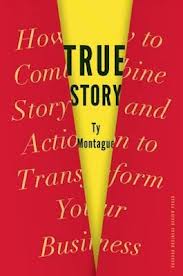
True Story: How to Combine Story and Action to Transform Your Business

True Story: How to Combine Story and Action to Transform Your Business [Hardcover]

Ty Montague (Author)

images (21)

Publication Date: July 16, 2013

Is your company a storyteller—or a storydoer?
The old way to market a business was storytelling. But in today’s world, simply communicating your brand’s story in the hope that customers will listen is no longer enough. Instead, your authentic brand must be evident in every action the organization undertakes.
Today’s most successful businesses are storydoers.
These companies create products and services that, from the very beginning, are manifestations of an authentic and meaningful story—one told primarily through action, not advertising. In True Story, creative executive Ty Montague argues that any business, regardless of size or industry, can embrace the principles of storydoing. Indeed, our best-run companies—from small start-ups to global conglomerates—organize around a coherent narrative that is then broadcast through every action they take (from product design to customer service to marketing). Montague shows why storydoing firms are nimble, more adaptive to change, and more efficiently run businesses.
Montague is a founder of the growth consultancy co:collective and the former president and CCO of J. Walter Thompson, the largest advertising agency in North America. He brings his depth of creative business experience to the book and provides a clear framework and proven process for bringing you and your customers together in the creation of your brand story.
Montague introduces five critical elements—what he calls the “the four truths and the action map”—that are the foundation of storydoing:
• the participants (your customers, partners, and employees)
• the protagonist (your company today)
• the stage (the world around your business)
• the quest (your driving ambition and contribution to the world)
• your action map (the actions that will make your story real for participants)
The book is filled with examples of how forward-thinking organizations—including Red Bull, Shaklee, Grind, TOMS Shoes, and News Corporation—are effectively using storydoing to transform their organizations and drive extraordinary results. Read more of this post
Good Companies Are Storytellers. Great Companies Are Storydoers; The story is about a larger ambition to make the world or people’s lives better

Good Companies Are Storytellers. Great Companies Are Storydoers

by Ty Montague  |   1:00 PM July 16, 2013

storydoing-6-thumb-200x399-4480 storydoing-5-thumb-200x312-4473

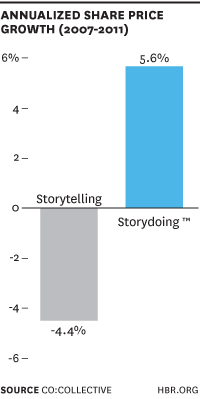
Discussions about story and storytelling are pretty fashionable in marketing circles. I have ambivalent feelings about this. On the one hand, as a lifelong advocate for the power of story in business, I find this very encouraging. For all companies, having a story and knowing that story are crucial steps to achieving success. On the other hand, I’m worried that too many marketers think that telling their story through advertising is enough. It’s not. In fact, those that think this way do so at their own risk because there is a new kind of company on the rise that uses story in a more powerful way — and they run more efficient and profitable businesses as a result. In my new book, True Story: How to Combine Story and Action to Transform Your Business, I call these new companies storydoing companies because they advance their narrative through action, not communication. Storydoing companies — Red Bull, TOMS shoes, Warby Parker, and Tory Burch, for example — emphasize the creation of compelling and useful experiences — new products, new services, and new tools that advance their narrative by lighting up the medium of people. What I mean by this is that when people encounter a storydoing company they often want to tell all their friends about it. Storydoing companies create fierce loyalty and evangelism in their customers. Their stories are told primarily via word of mouth, and are amplified by social media tools. So how do you know a storydoing company when you see one? These are the primary characteristics:

  1. They have a story
  2. The story is about a larger ambition to make the world or people’s lives better
  3. The story is understood and cared about by senior leadership outside of marketing
  4. That story is being used to drive tangible action throughout the company: product development, HR policies, compensation, etc.
  5. These actions add back up to a cohesive whole
  6. Customers and partners are motivated to engage with the story and are actively using it to advance their own stories Read more of this post

Self-Published Book Success Stories; How Writers Used Free Tools to Get Their Books Noticed

July 16, 2013, 6:50 p.m. ET

Self-Published Book Success Stories

How Writers Used Free Tools to Get Their Books Noticed

HEIDI MITCHELL

PJ-BP397_SELFPU_DV_20130716162253

Ms. Ware realized she wanted to write a book after blogging about her eight years working as a palliative caregiver.

The popular saying that everyone has a book in them has never been truer, as the much-heralded rise of self-publishing—and companies dedicated to editing, printing and promoting books—has put the power to publish at people’s fingertips. The cost of producing a paperback has gone from thousands of dollars—from editing and jacket design to printing, distribution and warehousing—to free on Amazon.comInc.’s AMZN +0.10% CreateSpace and the popular independent e-book distributor Smashwords. Readers don’t miss a traditional publishing house, says Ann McIndoo, who runs an author-coaching business. “The author or the topic or the brand drives the sale. When you go to the bookstore, you want Stephen King or a book on How To Knit. It doesn’t matter who published it.” Here are several authors and their different strategies for self-publishing their books. Read more of this post

Chaebol under fire amid South Korean scandals

July 16, 2013 6:28 am

Chaebol under fire amid South Korean scandals

By Song Jung-a in Seoul

The audio file is uncomfortable listening. Uploaded on YouTube, it captured a young salesman at Namyang Dairy Products, one of South Korea’s leading dairy companies, bullying a representative of one of the group’s distributors. At one stage he threatens to kill the distributor unless he buys more of the company’s products. The threat comes after a series of verbal insults are hurled at the buyer, who pleads that he does not have the space to store any more stock. The poisonous exchange, which has rocketed around South Korea’s vibrant social media forums since May, has become a lightning rod for mounting discontent over the dominance of the chaebol – the country’s big family-run conglomerates – which are accused of choking the development of small and medium-sized companies. The recording provided an extreme example of something many people believed had been happening up and down the country – lifting a veil on decades of abuse meted out by the chaebol. Read more of this post