Partial skull removal, used to relieve life-threatening pressure in the brain after a traumatic injury or severe stroke, raises questions about quantity versus quality of life

July 16, 2013

Skull Surgery Offers Perils and Potential

By KATIE HAFNER

16SKUL1-articleLarge

Dr. Geoffrey T. Manley of San Francisco General Hospital held a cranial prosthesis to be fitted in a patient who suffered traumatic brain injury after falling from a window.

SAN FRANCISCO — Following the crash of Asiana Airlines Flight 214 here, one of the first victims rushed to San Francisco General Hospital and Trauma Center was a teenage girl, unconscious and gravely injured. Her brain was quickly swelling, with nowhere to go but through the small opening at the base of her skull. Such an event, known as “herniation,” crushes the brainstem and can be rapidly fatal. Unable to reduce the swelling with medications, neurosurgeons decided to remove a large portion of the girl’s skull. Once they had done so, her brain bulged through the opening. The operation relieved the pressure and saved her brain, but it was not enough to save her life. The girl, whose parents asked that she not be named to protect her privacy, died of the other injuries she sustained in the crash. Read more of this post

Slapping, shoving tied to kids’ future health problems

Slapping, shoving tied to kids’ future health problems

12:17am EDT

By Genevra Pittman

NEW YORK (Reuters Health) – Children who are punished through pushing, shoving and slapping are more likely to be obese and have other health problems when they grow up, a new study suggests. “This is one study that adds to a growing area of research that all has consistent findings that physical punishment is associated with negative mental and now physical (health) outcomes,” said Tracie Afifi, who led the study at the University of Manitoba in Winnipeg, Canada. Read more of this post

U.S. Blood Supply Threatened as Donors Face Iron Losses

U.S. Blood Supply Threatened as Donors Face Iron Losses

Dennis Gastineau started giving blood regularly when he was in medical school in the 1970s. The $25 he received bought almost enough groceries for a week. Now, it just seems like the right thing to do.

It may also be bad for his health. Gastineau, who happens to be a hematologist, is among the 2.4 million donors who risk silent damage as a result of frequent giving. U.S. government research published last year found this group iron-deficient, which can lead to fatigue, compromised mental function and eventually anemia. Now, iron levels are being examined as part of an $87.2 million study the U.S. is funding on blood donation and transfusion safety. Read more of this post

Scientists find how ‘obesity gene’ makes people fat

Scientists find how ‘obesity gene’ makes people fat

2:49pm EDT

By Ben Hirschler

LONDON (Reuters) – Scientists have unraveled how a gene long associated with obesity makes people fat by triggering increased hunger, opening up potential new ways to fight a growing global health problem. A common variation in the FTO gene affects one in six of the population, making them 70 percent more likely to become obese – but until now experts did not know why. Using a series of tests, a British-led research team said they had found that people with the variation not only had higher levels of the “hunger hormone” ghrelin in their blood but also increased sensitivity to the chemical in their brains. Read more of this post

Four Drugmakers Face China Probes as Glaxo Woes Widen; GSK is test case in China’s rules laboratory

Four Drugmakers Face China Probes as Glaxo Woes Widen

GSK

China is investigating at least four multinational drugmakers as it widens its probe of GlaxoSmithKline Plc (GSK), according to a lawyer in Hong Kong whose firm advises companies on cross-border anti-corruption.

The investigations point to an increased targeting of the pharmaceutical industry in corruption probes as the world’s most populous country faces rising health-care costs and seeks to lower drug prices. While the drugmakers are being examined by local regulators, the results may draw added questions from officials in Beijing and scrutiny by the U.S. government under the Foreign Corrupt Practices Act. Read more of this post

Sting in dragon’s tail for foreign companies in China

Sting in dragon’s tail for foreign companies in China

Sun, Jul 14 2013

By Sujata Rao

LONDON (Reuters) – China’s vast market for foreign goods and services, once seen by global companies as a modern-day El Dorado, is becoming a weight around their necks as its growth slows. The rise of the Chinese economic “dragon” over the last two decades has transformed international business. But now the country is in the grip of a slowdown due to a slump in exports and banking sector excesses, as recent data has shown. That has led fund managers worldwide to re-assess their investments in companies with a focus on the world’s No.2 economy. “Anything China-sensitive is performing poorly and the trend will not go away because there is no sign of growth recovery,” said Maarten-Jan Bakkum, investment strategist at ING Investment Management, which has cut its holdings of China-exposed stocks. Read more of this post

The woeful admission by Treasury Wine Estates that inventory levels had been grossly mismanaged and overstated is going to lead to a major rethink by the market about what this company has been doing for the past couple of years

US wine stocks stain market darling

July 16, 2013

Elizabeth Knight

MK-CE757_AUSWIN_NS_20130715183604

The woeful admission by Treasury Wine Estates that inventory levels had been grossly mismanaged and overstated is going to lead to a major rethink by the market about what this company has been doing for the past couple of years.

Under chief executive David Dearie, Treasury Wine has been telling a positive story about remaking the company, focusing on the high-end brands and installing proper management disciplines – a goal made possible thanks to winning independence from Foster’s in 2011. Read more of this post

Reform agenda puts China’s economic superagency NDRC under scrutiny

Reform agenda puts China’s economic superagency under scrutiny

6:20pm EDT

By Alexandra Harney

SHANGHAI (Reuters) – Behind China’s two investigations into irregular pricing of infant formula and pharmaceuticals announced this month is one powerful institution and its struggle for relevance as Beijing attempts a transition to a more consumption-led economy.

The investigations have entangled big foreign companies including Danone SA (DANO.PA: Quote, Profile,Research, Stock Buzz), Nestle SA (NESN.VX: Quote, Profile, Research, Stock Buzz) and GlaxoSmithKline Plc (GSK.L: Quote, Profile, Research, Stock Buzz). But some analysts say there may be something deeper at work – jockeying over the direction of policy in the world’s second largest economy in the years ahead. Read more of this post

Billionaire Ma’s Alibaba Gets Nod to Stir Up Online Loans

Billionaire Ma’s Alibaba Gets Nod to Stir Up Loans: China Credit

China has authorized billionaire Jack Ma’s Alibaba Group to expand funding for its online loans business, designed to shake up an industry divided into heavily regulated state banks and shady financing schemes.

The Chinese Securities Regulatory Commission approved the sale of up to 5 billion yuan ($815 million) of notes backed by loans from Alibaba, according to a July 8 filing. Since starting its microloans business three years ago, Alibaba has extended more than 100 billion yuan of financing to over 320,000 small online businesses and entrepreneurs, it said in an e-mailed statement. Read more of this post

China Slowdown Sends Ordos to Bust as Li Grapples With Credit; “Now the economy has collapsed, they’ve all gone.”

China Slowdown Sends Ordos to Bust as Li Grapples With Credit

Posters of the Chinese character for good luck adorn shops bolted shut in the northern city of Ordos, where cranes stand silently above half-finished developments and doors on workers’ dormitories creak in the wind.

Apartment sales have come to a virtual halt in the central district, real-estate agent Zhang Wei says. With the municipality’s revenue gains diminishing, the Inner Mongolian city that saw a surge in building during China’s record credit boom is now a showcase for the speculative financing Premier Li Keqiang is trying to curb.

“In the past few years there was a lot of coal so people came from all over the country,” says Gao Wei, 30, smoking in an office that deals in second-hand construction machinery and had no clients that day. “Now the economy has collapsed, they’ve all gone.” Read more of this post

Wealth Products Threaten China Banks on Ponzi-Scheme Risk

Wealth Products Threaten China Banks on Ponzi-Scheme Risk

Zhang Defa hurried into an Industrial & Commercial Bank of China Ltd. branch in Shanghai on a sizzling July afternoon breathlessly looking for the manager.

The day before, Zhang had received a text message saying the bank was selling a 37-day wealth-management product with a 5 percent expected annualized return, principal guaranteed. He was too late. The offer, requiring a minimum of 500,000 yuan ($81,000), had sold out in less than three hours. Zhang would have netted 2,534 yuan in just five weeks.  Read more of this post

In Abe We Trust as Japan Inc. Buybacks Climb to Eight-Year High

In Abe We Trust as Japan Inc. Buybacks Climb to Eight-Year High

Eight months into the biggest equity rally in three decades, Japanese executives are gaining faith in the nation’s recovery as they reward shareholders with stock buybacks and pledge to increase capital spending.

Topix companies bought 1.78 trillion yen ($17.8 billion) of their own shares in the half ended June 30, the most since 2005, according to data compiled by Bloomberg. With companies from Orix Corp. (8591) to Toyota Motor Corp. to Nissin Foods Holdings Ltd. holding a record 115 trillion yen, plans for capital projects are rising at the fastest rate in seven years. Read more of this post

Ad scientists; Simple tests can overstate the impact of search-engine advertising

Ad scientists; Simple tests can overstate the impact of search-engine advertising

Jul 13th 2013 |From the print edition

20130713_FND000_0

SEARCH for a term like “tennis balls” using Google, Bing or Yahoo, and two types of link appear. The majority form a long list of “organic” results. Companies pay the search engines nothing for these. But those at the very top and on the right-hand side of the screen are paid links, a form of advertising that accounts for most of the revenue of search engines. These search ads appear to solve a puzzle that has preoccupied advertisers since John Wanamaker, the 19th-century founding father of marketing, reportedly declared: “Half the money I spend on advertising is wasted; the trouble is I don’t know which half.” But new research shows that the simple measures often used to assess the impact of search ads may be exaggerating their effectiveness. Read more of this post

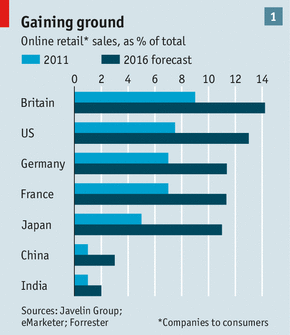
Retailers in the rich world are suffering as people buy more things online. But they are finding ways to adapt

Retailers in the rich world are suffering as people buy more things online. But they are finding ways to adapt

Jul 13th 2013 |From the print edition

20130713_FBD001_020130713_FBC063 20130713_FBC062

“THE staff at Jessops would like to thank you for shopping with Amazon.” With that parting shot plastered to the front door of one of its shops, a company that had been selling cameras in Britain for 78 years shut down in January. The bitter note sums up the mood of many who work on high streets and in shopping centres (malls) across Europe and America. As sales migrate to Amazon and other online vendors, shop after shop is closing down, chain after chain is cutting back. Borders, a chain of American bookshops, is gone. So is Comet, a British white-goods and electronics retailer. Virgin Megastores have vanished from France, Tower Records from America. In just two weeks in June and July, five retail chains with a total turnover of £600m ($900m) failed in Britain. Read more of this post

1.5 mil. expats in Korea and creative economy

2013-07-14 13:43

1.5 mil. expats in Korea and creative economy

Lee Dong-geun
The population of resident foreigners in Korea now exceeds 1.5 million. From 680,000 in 2003, the number has more than doubled in the past 10 years. This means that out of every 100 Korean residents, three are of foreign nationality. While this is of course lower than Dubai, where 90 percent of the residents are foreigners, or even Germany (8.7 percent) or Russia (7.7 percent), the number still tells of a major change in our society, especially when considering how the Korean people have always prided themselves on their homogeneity as a single-race society. Read more of this post

Testing value of the Bund: Several big-name global brands have left Shanghai’s old luxury hub

Testing value of the Bund

Updated: 2013-07-16 01:57

By XU JUNQIAN in Shanghai ( China Daily)

Several big-name global brands have left Shanghai’s old luxury hub

The summer heat is taking its toll on the crowds of tourists on Shanghai’s Bund where there arehardly any trees big enough to shade them from the merciless sun. Many seek refuge on thepavement under the shadow of the imposing old buildings that double as resting areas wheresweating tourists sit on the steps or lean against the walls outside plush fashion boutiques andjewelry stores. Nobody seems to mind. These establishments catering for the rich who made a fanfare ofvisiting the Bund a decade ago are quietly leaving one by one. Of course, they aren’t pulling out of Shanghai, which has remained a shopping paradise for richentrepreneurs. But the Bund, as the retailers see it, has fallen victim to its own historical allure. Read more of this post

Many international luxury brands are buying out their Chinese franchises to increase profits by operating the stores directly, to the latter’s ire

Luxury brands reclaiming Chinese franchises, to the latter’s ire

Staff Reporter

2013-07-15

Chinese franchisee owners and retailers told Moneyweek that “the franchise business in China is becoming tough but it is not so bad that it will vanish.” With China’s luxury market still having growth potential, many international luxury brands are buying out their Chinese franchises to increase profits by operating the stores directly. The weekly reported that when the country’s luxury market was relatively immature, franchise stores were the most effective way for high-end brands to tap into the market. The brands and the franchisees were in a mutually beneficial relationship until the franchisees were forced to surrender their control over the franchise stores. In 2010, British luxury fashion house Burberry bought out its Chinese franchises for some £100 million (US$149 million) from its franchisee partner. Although the Chinese franchisee received a large sum for the buyout, the efforts the company had put into boosting the brand’s visibility were wasted. Read more of this post

Families in China borrowed RMB8.6tn in private loans: survey

Families in China borrowed RMB8.6tn in private loans: survey

Liang Shih-huang and Staff Reporter

2013-07-14

According to the China Household Finance Survey conducted by the Southwestern University of Finance and Economics in Chengdu, some 33.5% of Chinese families have taken private loans totaling 8.6 trillion yuan (US$1.4 trillion). Half of these loans were used to buy houses, and people who made less money borrowed more in private loans. The survey was China’s first large-scale study of the financial situation in Chinese households. In 2011, the university began conducting a biennial nationwide survey, which involved household information, debts, income and expenditure. Read more of this post

Fortune 500 list reveals need for China’s structural reform

Fortune 500 list reveals need for China’s structural reform

Xinhua

2013-07-14

C709X0236H_2013資料照片_N71_copy1

Nearly 100 Chinese companies made this year’s Fortune Global 500 list. (Photo/Xinhua)

Nearly 100 Chinese companies made this year’s Fortune Global 500 list released earlier this week, but a closer look at the companies reveals problems that have long plagued the country. Ninety-five Chinese firms joined the ranks of the world’s top companies, measured by their revenues in recent fiscal years. China added 16 more companies to the list, narrowing the gap with the United States, which boasted 132 corporations this year. Chinese companies accounted for 17% of the total revenues grossed by the top 500. This compares with 28%, or US$8.6 trillion, logged by US companies. However, Chinese firms on the list are mostly focused in traditional industries such as steelmaking, power generation, energy and chemicals — sectors that are either grappling with overcapacity or are dominated by state-owned enterprises (SOE). China’s unbalanced economic structure is evident in the ranking. “Very few Chinese companies on the list come from high-end manufacturing, the service industry or the technological sector,” said Zhuang Ziyin, a professor with the Institute for Advanced Studies at Wuhan University. Read more of this post

Under the management of Yoji Sato and his younger brother, Kohei, Dynam Japan (6889) has grown from two Pachinko halls to become Japan’s second largest Pachinko operator with a network of 362 halls in 46 years

Game winners
Grace Cao
Monday, July 15, 2013

6_2013071419305402001Leader

The relationship between brothers is as close as hand and foot – so says an ancient Chinese proverb. And the Sato brothers – Yoji and Kohei – are an embodiment of this philosophy.

Under the management of Yoji Sato and his younger brother, Kohei, Dynam Japan Holdings (6889) has grown from two Pachinko halls to become Japan’s second largest Pachinko operator with a network of 362 halls in 46 years. Last year, Dynam Japan listed on the local main board – the first Japanese company to have its primary listing on the Hong Kong Exchanges and Clearing. The genesis of Dynam Japan can be traced back to their father, Yohei Sato, who founded Sawa Shoji in Tokyo in 1967. Read more of this post

Tokyo Exchange Merges With Osaka to Form World’s No. 3

Tokyo Exchange Merges With Osaka to Form World’s No. 3

The Tokyo Stock Exchange (TPX) became the world’s third-biggest bourse by listed companies today, adding 1,100 stocks from the Osaka Securities Exchange as the two merged their cash-equity trading platforms.

The TSE now has 3,423 companies after firms solely traded in Osaka moved their listings to Tokyo. TSE first-section stocks increased by 38 to 1,760, with the companies added set to join the Topix index that tracks the section in phases starting on Aug. 30. Read more of this post

Japanese gambling tycoon Kazuo Okada broke Philippine law for allegedly creating dummy firms to buy land for a Manila casino project

Japan tycoon broke Philippine fake firm law

Investigators said similar charges should be filed against 25 other individuals who helped the Japanese billionaire set up at least three firms to establish the billion dollar casino. -AFP

Mon, Jul 15, 2013
AFP

20130715.203824_reuters_kazuookada

MANILA – Philippine investigators recommended Monday that charges be filed against Japanese gambling tycoon Kazuo Okada for allegedly creating dummy firms to buy land for a Manila casino project, the Justice Department said. Investigators said similar charges should be filed against 25 other individuals who helped the Japanese billionaire set up at least three firms to establish the billion dollar casino at Manila’s bayfront Entertainment City. There was clear evidence that the firms established by Okada “were a front for Universal Entertainment, meant to circumvent or evade laws of nationalisation of certain rights, franchises and privileges”, Justice Secretary Leila de Lima said. Read more of this post

Mexican kid-free couples fuel high-end boom

Lingerie, iPads: Mexican kid-free couples fuel high-end boom

Sun, Jul 14 2013

By Alexandra Alper and Elinor Comlay

MEXICO CITY (Reuters) – While their parents may have scrimped and saved to raise small armies of children on a single paycheck, growing numbers of high-earning Mexican couples are putting the department store before the baby carriage. Couples with dual incomes but no kids, or “Dinks,” are on the rise in Mexico, nearly doubling since 2005. They are buoying a growing high-end goods market, splashing out on everything from expensive lingerie to home decor. Though just over a million in number, the couples are a gold mine for leading brands, and their spending habits are shoring up consumer demand as Mexico’s economy cools. Read more of this post

India’s Central Bank Raises Two Interest Rates to Support Rupee

India’s Central Bank Raises Two Interest Rates to Support Rupee

India’s central bank raised two interest rates as part of measures to steady the nation’s currency following a plunge in the rupee to a record low.

The Reserve Bank of India increased both the marginal standing facility and the bank rate to 10.25 percent from 8.25 percent, it said in a statement on its website late yesterday. The monetary authority said it will conduct open market sales of government bonds worth 120 billion rupees ($2 billion) on June 18, a step that would drain cash from the economy. Read more of this post

Silver Shoplifters Steal Rice as Abe Cuts Welfare to Trim Debt

Silver Shoplifters Steal Rice as Abe Cuts Welfare to Trim Debt

Fumio Kageyama was 67 when he first turned to crime, making an unsuccessful attempt to rob a drunk passenger on a train in March 2008.

Given a suspended jail sentence, Kageyama was caught two months later stealing a bowl of rice and pork from a supermarket. This time, he went to prison for two years.

Kageyama, who spent 40 years as a construction worker on projects including the Takashimaya Co. department store in Shinjuku, Tokyo, and a bicycle-racing track in Maebashi, Gunma Prefecture, is part of a growing number of silver shoplifters. After he became too old to work, he wound up on the streets and turned to petty theft. Released from detention, he was caught again in April 2011 stealing hot-dog buns and fried noodles. Read more of this post

China Falters in Effort to Boost Consumption; Growth in Urban Households’ Disposable Income Slows, Hindering Beijing’s Plan to Cut Emphasis on Unreliable Exports

Updated July 15, 2013, 8:51 p.m. ET

China Falters in Effort to Boost Consumption

Growth in Urban Households’ Disposable Income Slows, Hindering Beijing’s Plan to Cut Emphasis on Unreliable Exports

TOM ORLIK and BOB DAVIS

WO-AO563B_CECON_G_20130715174204

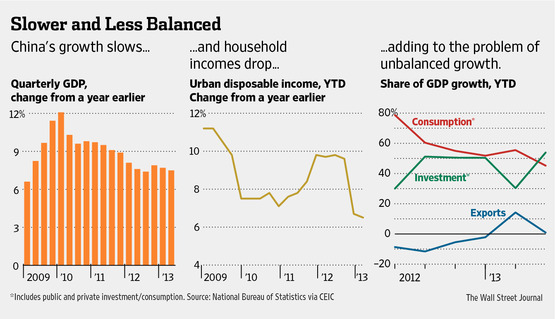
BEIJING—China’s push to get consumers to open their wallets more and refocus the economy on domestic consumption is stalling, contributing to lower growth in the second quarter and forecasts of even slower momentum ahead. A slew of data released on Monday showed that disposable income growth for urban households slowed to 6.5% in the first half compared with a year ago, down from 9.7% growth in the first half of 2012 and below the growth rate of the economy as a whole. That contributed to a slide in the share of consumption in China’s growth—the reverse of the government’s plans. Salary increases are “getting slower and slower,” said Peter Zhou, a 29-year-old manager at an information-technology company, who saw his income eke out a meager 3.7% increase to 28,000 yuan a month ($4,500) in 2013. “We used to buy consumer electronics and jewelry every month,” he said, but now he hasn’t made a big-ticket purchase for three months. Read more of this post

U.S. Shale Boom Threatens Australian Gas Projects; More than $160 billion of bets placed by international oil companies on natural gas in Australia are getting riskier

July 15, 2013, 6:02 p.m. ET

U.S. Shale Boom Threatens Australian Gas Projects

ROSS KELLY

MK-CE756_AUSLNG_NS_20130715180907

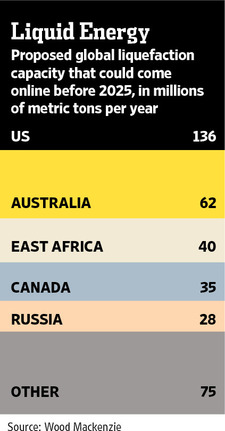
BRISBANE, Australia—More than $160 billion of bets placed by international oil companies including Chevron Corp. CVX +0.50% and Exxon Mobil Corp.XOM -0.16% on natural gas in Australia are getting riskier, as the country becomes the latest major energy producer to grapple with North America’s surging output of shale gas. Once a global hot spot for energy investment due to its political stability and large, untapped natural-gas reserves, Australia’s appeal has waned as labor shortages and a high Australian dollar have triggered cost blowouts at flagship projects. Although those problems have been around for a while, they are becoming more worrisome now that gas prices elsewhere have dropped and buyers have more options for securing energy supply. “The industry has more than US$160 billion of liquefied natural gas investments currently in flight [being built]. But upward of another US$100 billion in potential future projects could be at risk,” Chevron Australia Managing Director Roy Krzywosinski said. Read more of this post

A Jobless Recovery Is a Phony Recovery; More people have left the workforce than got a new job during the recovery by a factor of nearly three

July 15, 2013, 7:09 p.m. ET

Mort Zuckerman: A Jobless Recovery Is a Phony Recovery

More people have left the workforce than got a new job during the recovery—by a factor of nearly three.

MORTIMER ZUCKERMAN

In recent months, Americans have heard reports out of Washington and in the media that the economy is looking up—that recovery from the Great Recession is gathering steam. If only it were true. The longest and worst recession since the end of World War II has been marked by the weakest recovery from any U.S. recession in that same period. The jobless nature of the recovery is particularly unsettling. In June, the government’s Household Survey reported that since the start of the year, the number of people with jobs increased by 753,000—but there are jobs and then there are “jobs.” No fewer than 557,000 of these positions were only part-time. The survey also reported that in June full-time jobs declined by 240,000, while part-time jobs soared by 360,000 and have now reached an all-time high of 28,059,000—three million more part-time positions than when the recession began at the end of 2007. Read more of this post

Bill Gates Touts Contextually-aware Computing

July 15, 2013, 8:24 PM ET

Bill Gates Touts Contextually-aware Computing

Clint Boulton

Microsoft Corp. Chairman Bill Gates touched briefly upon privacy issues Monday in a keynote speech given at Microsoft Research Faculty Summit. The bulk of his talk concerned the rise of “personal agent” technology, which uses data from sensors embedded in mobile devices, scheduling software and social connections to help users discover “deep insights.” Mr. Gates touched only briefly on data privacy, which has emerged as a hot button issue since the revelations by Edward Snowden of the extent of the National Security Agency’s efforts to gather communications data about U.S. citizens. Read more of this post

Private-Equity Buyouts Shortchange Shareholders; Dell Deal an Example of the Upper Hand Held by Smart Financiers and Knowledgeable Insiders

July 15, 2013, 6:26 p.m. ET

Private-Equity Buyouts Shortchange Shareholders

Dell Deal an Example of the Upper Hand Held by Smart Financiers and Knowledgeable Insiders

FRANCESCO GUERRERA

MI-BX205A_GUERC_NS_20130715175403

Would Dell be better off away from the tyranny of quarterly earnings and what-have-you-done-for-me-lately shareholders? Francesco Guerrera joins the News Hub with his take. Farewell, then, DELL DELL -1.31% . After a quarter century of service, the stock ticker for Dell Inc. is likely to be consigned to the dust bin of history this week. On Thursday, to be precise, shareholders are expected to seal the sale of the computer company to the private-equity firm Silver Lake Partners and founder Michael Dell. Read more of this post