Is top-down culture to blame for Asiana crash?

2013-07-11 17:23

Is culture to blame for Asiana crash?

Experts say evidence is ‘inconclusive’ to ‘stereotypical’
By Kim Young-jin
Did culture contribute to the crash of Asiana Airlines Flight 214?
Western media speculation appears itchy to point out that Korea’s top-down hierarchal ways caused communication problems in the cockpit, leading to the fatal crash at San Francisco International Airport last Sunday.
“Despite changes, including an improved safety record, Korea’s aviation sector remains rooted in a national character that’s largely about preserving hierarchy ― and asking few questions of those in authority,” an article by CNBC said. Read more of this post

Robots on the Brain: The merging of human surgical experience with machines and computerized technologies is driving neurosurgical advancement

Robots on the Brain

09 July 2013

Garnette Sutherland is Professor of Neurosurgery in the Department of Clinical Neurosciences at the University of Calgary, Canada.

CALGARY – When Harvey Cushing and William Bovie introduced electrocautery (which uses a high-frequency current to seal blood vessels or make incisions) in 1926, their innovation transformed neurosurgery. Given the precision required to operate on an organ as delicate as the brain, the convergence of mechanical technologies with the art of surgery catalyzed progress in the field. Read more of this post

Byron Wien’s Firsthand Impressions of Asian Markets; “In past years there was a sense of optimism everywhere you went. Now you get a feeling of uncertainty touched by apprehension.”

WEDNESDAY, JULY 10, 2013

Byron Wien’s Firsthand Impressions of Asian Markets

By BYRON WIEN | MORE ARTICLES BY AUTHOR

“In past years there was a sense of optimism everywhere you went,” writes the Wall Street veteran. “Now you get a feeling of uncertainty touched by apprehension.”

I spent almost two weeks in Asia in June and in some ways it was an eye-opener. In past years there was a sense of optimism everywhere you went. Now you get a feeling of uncertainty touched by apprehension. My trip covered a great circle starting in Singapore and going on to Kuala Lumpur, Taipei, Hong Kong, Beijing, Seoul and Tokyo. Spending only one day in each city, my observations were more impressionistic than analytical. I talked with sovereign wealth fund managers and other major investors. Most concerns related to China’s outlook and whether the financial system there was overextended. As we all know, China is the engine of growth for the region and any problems there are felt everywhere else. In contrast to last year, Japan was also a major topic of interest. Read more of this post

Commodity Traders Face New Squeeze as Storage Congestion Spreads

Commodity Traders Face New Squeeze as Storage Congestion Spreads

Commodity traders are facing another supply squeeze as stockpiles concentrate in fewer cocoa depots, mirroring congestion at metals warehouses that means some buyers are paying record premiums for deliveries.

Warehouses in Antwerp, Belgium, held 61 percent of cocoa certified for delivery by the NYSE Liffe exchange on June 24, compared with 36 percent a year earlier, bourse data show. That mirrors the trend in metal stockpiles, with 73 percent of aluminum and 90 percent of copper tracked by the London Metal Exchange now held in three locations. Read more of this post

The panic that rippled through Asia’s markets in May and June might just be a prelude to a more serious capital flight when the U.S. Federal Reserve starts winding down its stimulus measures for real

Asian stress points unveiled as Fed tapering looms

5:07pm EDT

By Nachum Kaplan and Umesh Desai

Singapore (Reuters) – The panic that rippled through Asia’s markets in May and June might just be a prelude to a more serious capital flight when the U.S. Federal Reserve starts winding down its stimulus measures for real.

How quickly the U.S. Federal Reserve reduces its $85 billion a month of bond purchases, which keep interest rates low, will determine how quickly money is pulled out of Asia. Read more of this post

New-breed bosses rev up Indonesia’s state enterprises

New-breed bosses rev up Indonesia’s state enterprises

Wednesday, Jul 10, 2013

John McBeth

The Straits Times

SINGAPORE – Don’t say it too loudly because it might upset the bureaucrats, but over the past five years, go-ahead private sector executives have been changing the corporate culture and turning around the fortunes of a clutch of Indonesia’s state-owned enterprises.

Pertamina oil company president-director Karen Agustiawan, 54; Garuda Airlines chief executive officer Emirsyah Satar, 53; and Kereta Api national railway boss Ignasius Jonan, 49, have all made an impact on organisations previously known for their leaking budgets and tardy public service. Read more of this post

Trouble Looms for Japan’s Once-Mighty DPJ; Beleaguered Party Projected to Lose Last Grasp on Power in Upper House Race

Updated July 10, 2013, 1:26 p.m. ET

Trouble Looms for Japan’s Once-Mighty DPJ

Beleaguered Party Projected to Lose Last Grasp on Power in Upper House Race

TOKO SEKIGUCHI

TOKYO—Four years after its historic overthrow of the entrenched one-party rule of the Liberal Democratic Party, the Democratic Party of Japan is set to lose its last grasp on power with polls predicting a catastrophic loss for the beleaguered party in the coming upper house race.

The DPJ, led by Banri Kaieda is projected to lose half its 44 seats up for election in the July 21 race, according to surveys by Japan’s major dailies. The DPJ, which for now is the largest single voting bloc in the upper chamber, will be giving up its presence as the dominant opposition force, as the governing LDP-New Komeito coalition’s bicameral control of parliament all but eliminates the DPJ’s tactical recourse against the enactment of government-proposed bills. Read more of this post

Corporate Insiders Shift From ‘Buy’ to ‘Sell’ as Bankruptcy Nears

July 10, 2013, 11:02 p.m. ET

Corporate Insiders Shift From ‘Buy’ to ‘Sell’ as Bankruptcy Nears

SUSAN PULLIAM and ROB BARRY

P1-BM252B_Tradi_G_20130710184829

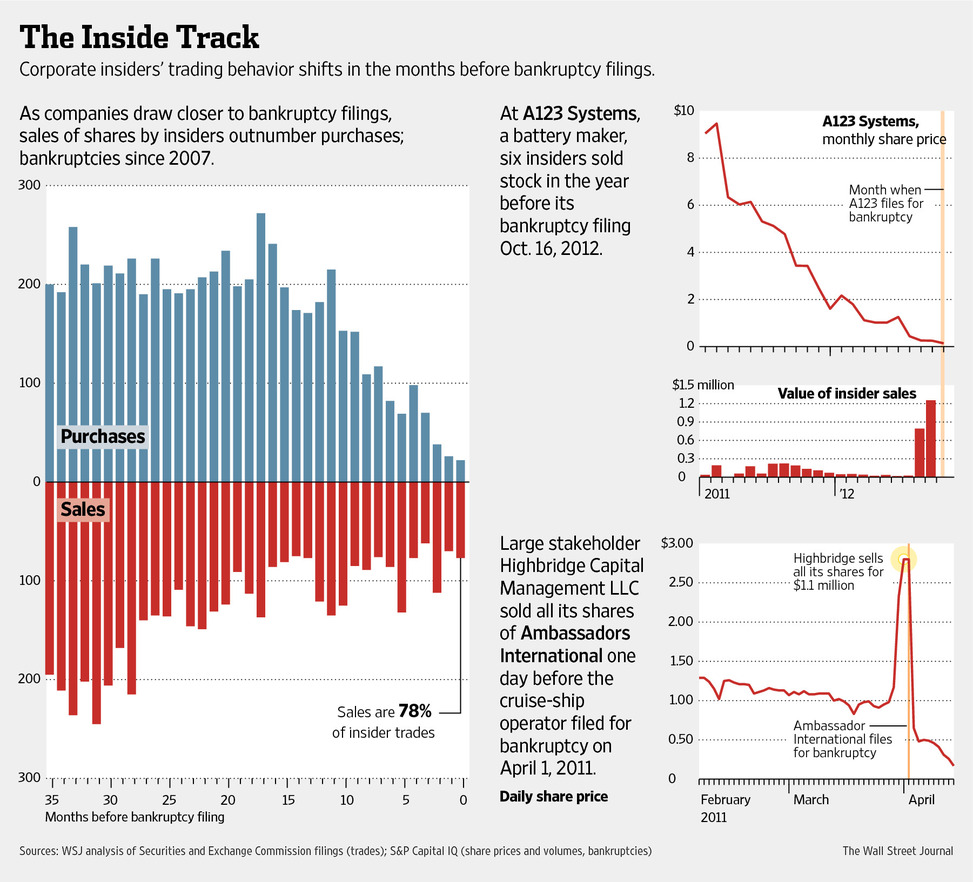
One day in September 2011, Wall Street analysts trundled into the spacious lobby at the Livonia, Mich., plant of a company called A123 Systems Inc. to view a slide presentation describing a rosy outlook for the maker of lithium batteries. “They stood up in front of investors and painted a very bullish picture,” said Andrea James, an analyst at Dougherty & Co., who took pictures of the lobby’s two-story floor-to-ceiling window. “It looked like the lobby of a company that was making money hand over fist.” Thirteen months later, it filed for bankruptcy protection. But not before insiders unloaded a total of $2.5 million of its stock. The company said the sales conformed to its policy for insider transactions. The episode suggests how corporate insiders’ trading can shift in the months before their companies file for bankruptcy. A Wall Street Journal review of thousands of trades by insiders in their own company’s stock found the trades veering heavily toward selling rather than buying as bankruptcy filings drew nearer. Read more of this post

Dividend Stock Investors Should Really Consider How CEOs Are Paid

MORGAN STANLEY: Dividend Stock Investors Should Really Consider How CEOs Are Paid

SAM RO JUL. 11, 2013, 7:39 AM 844 1

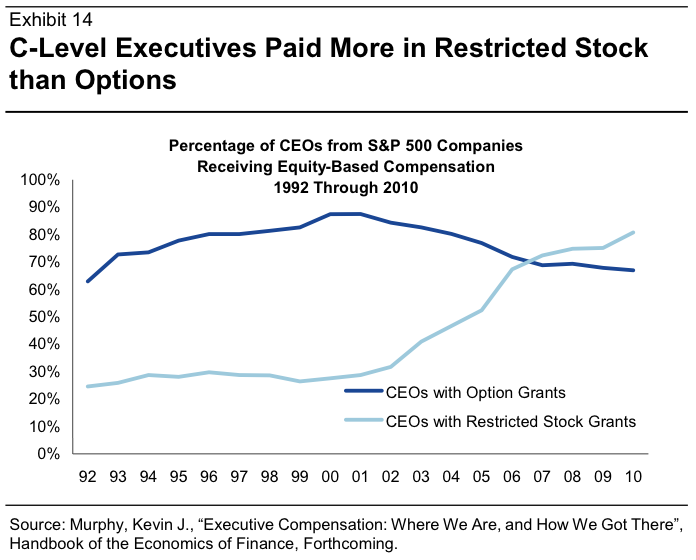
Adam Parker, Morgan Stanley’s Chief U.S. Equity Strategist, is on Bloomberg Surveillance with Tom Keene this morning. While discussing dividend paying stocks, Parker noted that we should consider executive compensation structures. Parker addressed this in a recent report to clients: Management teams are paying themselves more in restricted stock units (RSUs) than in options. In recent years, more CEOs of S&P 500 companies have received compensation in the form of restricted stock than as options (Exhibit 14). It is important that fundamental analysts understand how the senior management teams of the companies they are analyzing are variably compensated, as those with restricted stock and not options are much more likely to increase dividends. The principle? People rarely intentionally damage their own net worth. The shift toward equity-based compensation was designed to align executives’ interests with shareholders. However, we have to wonder if corporate decision-makers will pass up better uses of cash to enrich themselves in the form of dividends. Regardless, this decision to pay out an increasing dividend is crucial to investors. Since 1930, dividends have accounted for 42 percent of stock market investment returns.

screen shot 2013-03-18 at 8.41.33 pm

Chateau d’Yquem ’90 Extends Decline to Lowest Level Since 2009

Chateau d’Yquem ’90 Extends Decline to Lowest Level Since 2009

A case of 1990 Chateau d’Yquem, Bordeaux’s top-ranked Sauternes dessert wine, sold for 2,700 pounds ($4,050) on the Liv-ex market yesterday, extending a 15-month drop and taking it to its lowest level since October 2009.

The wine sold for 20 percent less than the 3,380 pounds at which it traded in March last year, having peaked at 3,400 pounds in September 2011, according to data on London-based Liv-ex’s Cellar Watch website. Read more of this post

Fittings maker Grohe attracts bid interest from rivals; Grohe, which has a 8% global market share, posted sales of 1.4bn euros, EBITDA 273m euros

Fittings maker Grohe attracts bid interest from rivals – sources

1:10pm EDT

FRANKFURT (Reuters) – German bathroom fixtures maker Grohe GROH.UL has attracted bidding interest from several rivals, which have been asked to submit tentative offers by the end of next week, three people familiar with the process told Reuters.

Grohe’s owners, investor TPG Capital TPG.UL and the private equity arm of Credit Suisse (CSGN.VX: Quote,Profile, Research, Stock Buzz), are running a so-called dual track process that may alternatively result in a stock market listing of Europe’s biggest bathroom equipment maker in the autumn. Read more of this post

Brazil Signals World’s Biggest Key Rate Increase Far From Over; Brazil Raises Rate to 8.5% as Inflation Undermines Growth

Brazil Signals World’s Biggest Key Rate Increase Far From Over

Brazil’s central bank raised the benchmark interest rate a third consecutive time and said it was giving continuity to the world’s biggest tightening cycle, signaling increases may be extended through year-end as policy makers battle inflation.

The bank’s board, led by President Alexandre Tombini, yesterday raised the benchmark Selic (BZSTSETA) rate by 50 basis points to 8.50 percent, as forecast by all 51 analysts surveyed by Bloomberg. The move led Itau Unibanco to reiterate its call for a rate increase in each of the three meetings left this year. Read more of this post

Indonesia Raises Rate More Than Forecast to 6.5% on Inflation

Indonesia Raises Rate More Than Forecast to 6.5% on Inflation

Bank Indonesia raised its key interest rate more than forecast to bolster a weakening currency and ease inflation pressures after the government increased fuel prices last month.

The central bank boosted the reference rate by 50 basis points to 6.5 percent, Governor Agus Martowardojo said in Jakarta today. The outcome was predicted by three of 19 economists surveyed by Bloomberg News, with the majority expecting a 25 basis-point increase. It also boosted the deposit facility rate to 4.75 percent from 4.25 percent. Read more of this post

How Did Dropbox Scale To 175M Users? A Former Engineer Details The Early Days

How Did Dropbox Scale To 175M Users? A Former Engineer Details The Early Days

MIKE BUTCHER

posted 6 hours ago

Ladies and Gentlemen, we interrupt our normal programming about crazy entrepreneurs and even crazier VCs to bring you a little learning from the world of Engineering. Remember that? Recently Dropbox was in the news for revealingthey’d hit 175 million users, and daring to say they could replace the hard drive. Big words. But what’s the engineering back-story of how they got there? How do successful startups scale, in technical terms, to hundreds of millions of users? It turns it one of the ways it became successful was by creating a very simple and flexible platform early on. Read more of this post

IPhones Stuck to Windshields Threaten Dashboard Maps

IPhones Stuck to Windshields Threaten Dashboard Maps

Tim Nixon, chief technology officer of General Motors Co. (GM)’s OnStar service, knew something was amiss when he saw his two sons taking the “suction-cup approach” to in-car navigation. They would turn their iPhones sideways, stick them to the windshield and use a free map app to find their way.

That represented a rejection of their father’s life’s work: Convincing car buyers to pay $1,500 or more for a dashboard navigation system with an 8-inch screen and elaborate graphics. Rather than scold his young-adult sons, Nixon came up with an answer: GM (GM) now offers a $50 map application for iPhones that can play on the dashboard touchscreen of a $12,170 Chevrolet Spark. Read more of this post

Chinese chipmakers in ‘bloody’ price war

Last updated: July 10, 2013 11:41 am

Chinese chipmakers in ‘bloody’ price war

By Sarah Mishkin in Taipei

Chinese chipmakers are engaging in “bloody” competition that could accelerate production of cheap tablets, already one of the fastest-growing areas in the consumer electronics industry. Designers of the chips used in many of the inexpensive Chinese-made tablets popular in emerging markets have in recent months slashed prices by around 50 per cent, according to analysts. Read more of this post

Why isn’t LinkedIn Blocked in China? If LinkedIn remains unblocked, it should do very well in China

Why isn’t LinkedIn Blocked in China?

July 11, 2013

by Willis Wee

Among major social media sites, China blocks Twitter and Facebook (among others); heck, it even blocks Slideshare! But not LinkedIn. I might be jumping to conclusions too soon (I mean, things get blocked in China pretty rapidly) but it seems safe to assume that China knows LinkedIn has much to offer to the middle kingdom. Enough, apparently, to keep it from getting blocked. Read more of this post

In The Philippines, SMS Textbooks Are The Future Of Education

In The Philippines, SMS Textbooks Are The Future Of Education

July 10, 2013

by Phoebe Magdirila

SIM-card-and-SMS-Textbooks-in-the-Philippines-720x391

Smartphone adoption in Asia is increasing, but feature phones still dominate some areas. For example, 89 percent of the Metro Manila population are still using feature phones. Advertising agency DM9JaymeSyfu (DM9) saw that feature phones can help the education sector in the country, so it spearheaded the idea of condensing textbooks into SIM cards and executed it with the help of telco Smart Communications. The result is a campaign called Smart Txtbks. Read more of this post

Google Chromebook Under $300 Defies PC Market With Growth

Google Chromebook Under $300 Defies PC Market With Growth

Google Inc. (GOOG)’s Chromebook was dismissed as a bare-bones laptop with limited appeal when it debuted two years ago. Now it’s defying skeptics and gaining share as the rest of the personal-computer market shrinks.

Chromebooks have in just the past eight months snagged 20 percent to 25 percent of the U.S. market for laptops that cost less than $300, according to NPD Group Inc. The devices, which have a full keyboard and get regular software updates from Google, are the fastest-growing part of the PC industry based on price, NPD said. Read more of this post

Rolls-Royce Revives Age of Sail to Beat Fuel-Cost Surge

Rolls-Royce Revives Age of Sail to Beat Fuel-Cost Surge: Freight

Rolls-Royce Holdings Plc (RR/), best known for powering planes from Concorde to the Airbus superjumbo, is working on a modern-day clipper ship as it bets on emissions curbs to jack up bunker-fuel costs and herald a new age of sail.

Cargo vessels are set for a design change embracing sleeker hulls and hybrid propulsion systems, according to London-based Rolls, which is helping to develop a ship featuring a 180-foot sail augmented by bio-methane engines and carrying 4,500 tons. Read more of this post

Emerging Markets Are Stuck on Fed’s Elevator Ride

Emerging Markets Are Stuck on Fed’s Elevator Ride

Back in the 1960s, a French finance minister called the U.S.’s ability to borrow in its own currency — thanks to the dollar’s pre-eminence and reserve-currency status — an “exorbitant privilege.” It’s an advantage that the rest of the world has to pay for, one way or another. This has lately given many emerging-market governments cause for complaint. If they had the will, one or two of them could do something about it. Maybe it’s time they did.

The issue has been highlighted in recent weeks as the Federal Reserve (FDTR) unsettled global markets by signaling its intent to start tightening monetary policy — at least, that’s what investors thought it said. There was a sell-off in global fixed-income markets, and many emerging economies saw the value of their bonds, equities and currencies drop. Read more of this post

Can 3D printing change face of Singapore’s public housing?

Can 3D printing change face of Singapore’s public housing?

As with the term “robot”, which was coined by Czech writer Karel Capek long before its first technical implementation, 3D printing entered our collective imagery by the backdoor of fiction. In the late 1960s, cult television series Star Trek presented us with two chimerical devices: The transporter and the replicator, both of which involved dematerialising matter and reconstituting it in another form elsewhere.

4 HOURS 47 MIN AGO

As with the term “robot”, which was coined by Czech writer Karel Capek long before its first technical implementation, 3D printing entered our collective imagery by the backdoor of fiction. In the late 1960s, cult television series Star Trek presented us with two chimerical devices: The transporter and the replicator, both of which involved dematerialising matter and reconstituting it in another form elsewhere. Read more of this post

Insight Private Equity on the black box of restructuring tools private equity investors use to improve the operational performance of their portfolio companies

Insight Private Equity

Andrej Gill Goethe University Frankfurt – Faculty of Economics and Business Administration

Nikolai Visnjic Goethe University Frankfurt

June 18, 2013
SAFE Working Paper No. 23

Abstract: 
We are able to shed light on the black box of restructuring tools private equity investors use to improve the operational performance of their portfolio companies. By building on previous work considering performance evaluation of PE backed companies, we analyze whether private equity improves operating efficiency and which of the typical restructuring tools are the main performance drivers. Using a set of over 300 international leveraged buyout transactions of the last thirty years, we find that while there is vast improvement in operational efficiency, these gains vary considerably. Our top performing transactions are subject to strong equity incentives, frequent asset restructuring and tight control by the investor. Furthermore, investors’ experience has a positive influence while financial leverage has no influence on operational performance.

Unethical Culture, Suspect CEOS, and Corporate Misbehavior

Unethical Culture, Suspect CEOS, and Corporate Misbehavior

Lee Biggerstaff  University of Tennessee, Knoxville – Department of Finance

David C. Cicero University of Alabama – Culverhouse College of Commerce & Business Administration

Andy Puckett University of Tennessee, Knoxville

June 2013

Abstract: 
We show that firms with CEOs who personally benefited from options backdating were more likely to engage in other forms of corporate misbehavior, suggestive of an unethical corporate culture. These firms were more likely to overstate firm profitability and to engage in less profitable acquisition strategies. The increased level of corporate misbehavior is concentrated in firms with suspect CEOs who were outside hires, consistent with adverse selection in the market for chief executives. Difference-in-differences tests confirm that the propensity to engage in these activities is significantly increased following the arrival of an outside-hire ‘suspect’ CEO, suggesting that causation flows from the top executives to the firm. Finally, while these suspect CEOs appear to have avoided market discipline when the market was optimistic, they were more likely to lose their jobs, and their firms were more likely to experience dramatic declines in value during the ensuing market correction.

Z-Score Models’ Application to Italian Companies Subject to Extraordinary Administration

Z-Score Models’ Application to Italian Companies Subject to Extraordinary Administration

Edward I. Altman New York University (NYU) – Salomon Center; New York University (NYU) – Department of Finance

Alberto Falini University of Brescia – Department of Economics

Alessandro Danovi University of Bergamo (Italy)

May 1, 2013
Bancaria No. 04-2013

Abstract: 
It is normal for companies, during their life cycle, to alternate between positive and negative phases, periods of success and failure. When a negative period shifts from temporary to structural and chronic (and thus continues over time), the company is often destined to go bankrupt. The uncertainty regarding the exact moment when this takes place has brought about a plethora of quantitative and qualitative models aimed at predicting bankruptcy. This study applies the most well-known of these models, the Z-Score, through an application to Italian companies subject to extraordinary administration between 2000 and 2010. The results confirm a good predictive effectiveness, though Italian peculiarities could require the development of ad hoc parameters.

Is the CEO’s In-House Experience Informative About Audit Risk?

Is the CEO’s In-House Experience Informative About Audit Risk?

Paul Brockman Lehigh University

Gopal V. Krishnan American University; American University – Kogod School of Business

HyeSeung Lee Lehigh University – Department of Accounting

Jesus M. Salas Lehigh University

June 19, 2013

Abstract: 
Very little is known about whether personal characteristics of senior managers convey information about audit risk. We focus on one characteristic of the CEO, the number of years the CEO has worked in the firm before becoming the CEO (CEO in-house experience). We posit that the CEO’s in-house experience mitigates audit risk due to less uncertainty and more familiarity with the auditor. Using audit fees to proxy for audit risk, we find that audit fees are decreasing in CEO’s in-house experience. On average, audit fees are lower by 10% when CEO in-house experience changes from 2 to 6 years. Further, the relation between audit fees and the CEO’s in-house experience is conditional on the overall quality of corporate governance. While the CEO’s in-house experience is insignificant in firms with good governance, it is strongly significant in firms with weak governance.

When Blockholders Leave Feet First: Do Ownership and Control Affect Firm Value?

When Blockholders Leave Feet First: Do Ownership and Control Affect Firm Value?

Bang Dang Nguyen University of Cambridge – Judge Business School

Kasper Meisner Nielsen Hong Kong University of Science & Technology – Department of Finance

June 26, 2013

Abstract: 
This study investigates the effect of ownership and control on firm value using exogenous variation resulting from stock price reactions to the sudden death of individual blockholders. Stock market reactions range from -5% to 4% for inside blockholders as ownership increases and from 0% to -2% for outside blockholders. The difference in market reactions identifies the value of ownership and control while effectively controlling for confounding effects on firm value due to liquidity or anticipated takeover activity. Overall, our results suggest that as ownership increases the beneficial effect of inside blockholders disappears while the beneficial effect of outside blockholders increases.

Departing and Incoming Auditor Incentives, and Auditor-Client Misalignment under Mandatory Auditor Rotation: Evidence from Korea

Departing and Incoming Auditor Incentives, and Auditor-Client Misalignment under Mandatory Auditor Rotation: Evidence from Korea

Gil S. Bae Korea University – Department of Accounting

Sanjay Kallapur Indian School of Business

Joon Hwa Rho Chungnam National University – College of Business

June 18, 2013

Abstract: 
In this paper we provide evidence on specific factors that could affect audit quality under mandatory rotation, using data from Korea where mandatory auditor rotation was put into effect in 2006. We find no evidence supporting the “Brillo pad effect” (the argument that departing auditors have incentives to clean up the balance sheet) or the “new broom effect” (the argument that new auditors can find problems that long-standing auditors tend to overlook). On the contrary, departing auditors spend fewer hours just before rotation, consistent with a lack of incentives to maintain quality given the impending rotation. Compared to clients in other mandatory rotations, the clients rotating away from industry specialist auditors have higher audit hours and higher absolute discretionary accruals post-rotation, suggesting there are adverse effects from breaking such auditor-client pairings. Finally we find that Big 4 auditors’ market share continues to increase after mandatory rotation is imposed. Our findings therefore fail to support mandatory rotation.

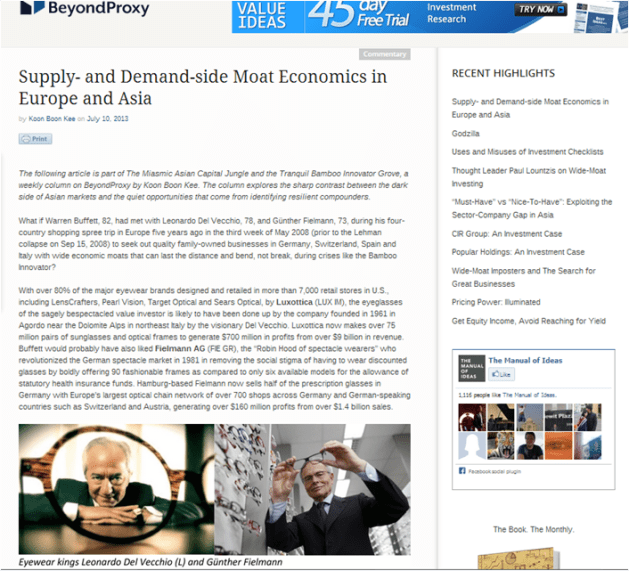
Supply- and Demand-side Moat Economics in Europe and Asia. Bamboo Innovator is featured in BeyondProxy.com, where value investing lives

Bamboo Innovator is featured in BeyondProxy.com, where value investing lives:

  • Supply- and Demand-side Moat Economics in Europe and Asia, July 10, 2013 (BeyondProxy)

Moat Economics

Worthless, Impossible and Stupid: How Contrarian Entrepreneurs Create and Capture Extraordinary Value

Worthless, Impossible and Stupid: How Contrarian Entrepreneurs Create and Capture Extraordinary Value

by Daniel Isenberg  (Author)

Isenberg

Introducing the global mind-set changing the way we do business.
In this fascinating book, global entrepreneurship expert Daniel Isenberg presents a completely novel way to approach business building—with the insights and lessons learned from a worldwide cast of entrepreneurial characters. Not bound by a western, Silicon Valley stereotype, this group of courageous and energeticdoers has created a global and diverse mix of companies destined to become tomorrow’s leading organizations. Worthless, Impossible, and Stupid is about how enterprising individuals from around the world see hidden value in situations where others do not, use that perception to develop products and services that people initially don’t think they want, and ultimately go on to realize extraordinary value for themselves, their customers, and society as a whole. What these business builders have in common is a contrarian mind-set that allows them to create opportunities and succeed where others see nothing. Amazingly, this process repeats itself in one form or another countless times a day all over the world. From Albuquerque to Islamabad, you will travel with Isenberg to discover unusual yet practical insights that you can use in your own business. Meet the founders of Grameenphone in Bangladesh, PACIV in Puerto Rico, Sea to Table in New York, Actavis in Iceland, Studio Moderna in Slovenia, Hartwell Metals in Hong Kong and Southeast Asia, Given Imaging in Israel, WildChina in China, and many others. You’ll be moved by the stories of these plucky start-ups—many of them fueled by adversity and, more often than not, by necessity. Great stories, stunning successes, crushing failures—they’re all here. What can we, in the East and West, learn from them? What can you learn—and what will these entrepreneurial stories, so compellingly told, inspire you to do? Let this book open doors for you where you once saw only walls. If you’ve ever felt the urge to turn a glimmer of an idea into something extraordinary, these stories are for you. Read more of this post