Inside Thunderbird B-school’s chronic decline

Inside Thunderbird B-school’s chronic decline

July 11, 2013: 10:55 AM ET

The school, long known for its international business focus, is selling its Arizona campus to a for-profit education company, kicking up a storm of controversy.

By Taylor Ellis

(Poets&Quants) — With its 2012 fiscal budget $4 million in the red, the Thunderbird School of Global Management has agreed to grasp a sorely needed lifeline. The school, long known for its international business focus, is selling its Arizona campus to a for-profit education company. The decision has kicked up a storm of controversy. At least two board members have resigned in protest and nearly 2,000 of the school’s alumni have signed a petition contending that its agreement with Laureate Education Inc. would “cheapen the value of the [Thunderbird] degree.” “This is the end of Thunderbird as we have known it,” wrote Merle Hinrich, a director and alumnus, in his resignation letter. “The Laureate transaction is a tragedy for Thunderbird and a total windfall for Laureate.” Thomas Greer Jr., another board member who resigned, called the decision to sell Laureate a campus built with tuition funds and donations “unconscionable.” Greer vowed to no longer contribute either his time or his money to the school. Read more of this post

‘Debt peril’ awaits 1.25m UK households if rates rise

Last updated: July 11, 2013 10:15 pm

‘Debt peril’ awaits 1.25m UK households if rates rise

By Claire Jones, Economics Reporter

Up to 650,000 more UK households face “debt peril” if mortgage rates rise unexpectedly before the economy returns to full strength, a think-tank warns.

The Resolution Foundation said on Thursday that 1.25m households would have to spend half their disposable income on repayments by 2017 if the Bank of England’s official rate rose 2 percentage points higher than forecast without a recovery in wage growth. Read more of this post

Shadow financing charted in China; At least 50% of the debt on smaller developer balance sheets would be from trust financing, funding construction at initial stages which puts the company and the trust at redemption risk

Shadow financing charted in China, and a property catch-up

David Keohane

| Jul 11 11:18 | 10 comments | Share

Part of the UP SHIBOR CREEK… SERIES

Creditsights-china-non-bank-credit-marketCreditSights-China-cities-reporting-house-price-increases-590x282

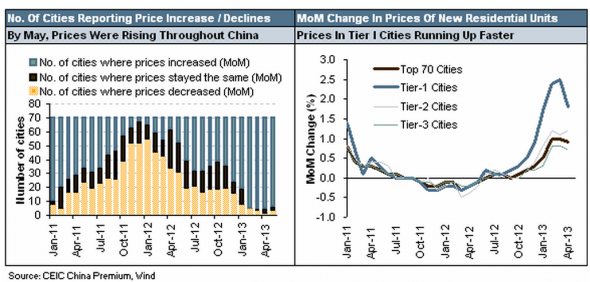
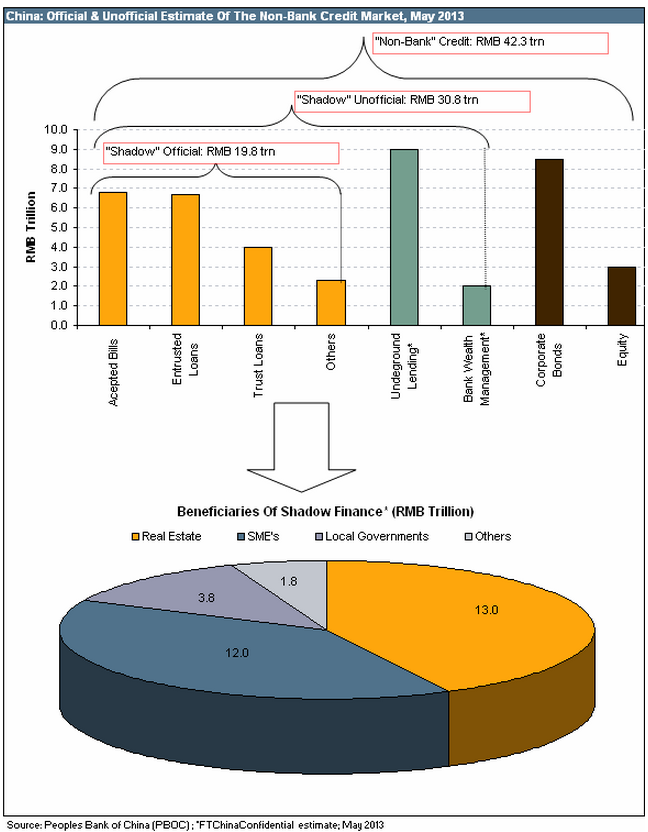
You’ll note that real estate is where a significant amount of the credit apparently flows and thus quite a bit of the risk resides — property developers, particularly the small ones, have had to go begging to trust companies and underground lenders at interest rates usually in the low to mid teens and for something like 6 months to two years. The duration mismatch is pretty obvious. Read more of this post

China exports slide raises doubts about currency policy

China exports slide raises doubts about currency policy

6:41pm EDT By Pete Sweeney

SHANGHAI (Reuters) – China’s bet that it could reap the benefits of a more powerful yuan without paying a price in competitiveness is looking increasingly risky.

An unexpected slump in exports in June marked the latest worrying sign of a slowdown in the world’s second-biggest economy and raised the prospect that regulators may be forced to drag the yuan back down after a massive rally this year. Read more of this post

Loose Lips Sink Euro Bond Markets in Crisis: Cutting Research

Loose Lips Sink Euro Bond Markets in Crisis: Cutting Research

A European Central Bank paper released last week used 25,000 news media releases between January 2009 and October 2011 to investigate how much political communications affected sovereign bond yields during the region’s fiscal crisis. The ECB study focused on public pronouncements on fiscal policy and state finances by officials. It found in the short term that certain types of commentary had a quantifiable effect on the spread between the bond yields of Greece, Ireland and Portugal over German bunds. The impact was biggest for Greece. Policy makers at the regional level communicated more positively on average by using words such as “implement.” For those at the national level, the most-used word was “fail.” Read more of this post

Venture Capital: The Art of Picking the Few from the Many

Venture Capital: The Art of Picking the Few from the Many

Published in Knowledge@Wharton

Venture capital (VC) has never been a mega-industry, but many who work in the sector seem happy with the current state of affairs. VC funds raised $20.6 billion in 2012, Thomson Reuters reported, but this amount is dwarfed by the $311 billion that was raised by the private equity industry, including venture capital, in 2012, according to research firm Prequin. The sector has also had some recent ups and downs in terms of fundraising. The latest figures show that the VC industry has shrunk since raising $25.6 billion in 2008, but is recovering from the depths of the financial crisis in 2010 when fundraising fell shy of $14 billion.

Read more of this post

How Do Private Equity Firms Create Value?

How Do Private Equity Firms Create Value?

Published in Knowledge@Wharton

In the Hollywood version of a hostile takeover, the boss would grab control of a company, throw out the slackers, move into the corner office and start barking out orders. The message is, “it’s my way or the highway!”

But what makes for good drama on the screen doesn’t necessarily work in real life. When a private equity (PE) firm buys a portfolio company, it’s much more like a romance instead of a war movie. For the new partnership to work, both parties must really believe they will be better off together instead of alone. Read more of this post

Property bubble in Indonesia

Property bubble in Indonesia?

The announcement yesterday that Indonesia is planning policies to quell rising property prices against a backdrop of rising inflation comes as concerns grow over the health and stability of the real estate market, with some suggestions that a bubble is forming.

BY KARIM RASLAN –

6 HOURS 19 SEC AGO

The announcement yesterday that Indonesia is planning policies to quell rising property prices against a backdrop of rising inflation comes as concerns grow over the health and stability of the real estate market, with some suggestions that a bubble is forming.

A small two-room apartment far from the city centre in Jakarta can cost up to US$80,000 (S$101,100) — increasingly out of reach of ordinary Indonesians, an Al Jazeera report in May highlighted. Read more of this post

Thailand Needs to Invest in People, Not Rice

Thailand Needs to Invest in People, Not Rice

The search for lessons from lost economic decades has led from Japan to the U.S. to Europe. Now the spotlight turns to Thailand (SET).

This may strike some as odd, considering Thailand’s 5.3 percent growth, its young and expanding population, and the surprising level of political stability in Bangkok. In her two years leading Thailand’s 68 million people, Yingluck Shinawatra has somehow managed to tamp down the virtual civil war that led to the ouster of her prime minister brother in 2006. Read more of this post

Radical Buddhism Threatens Myanmar’s Path to Democracy

Radical Buddhism Threatens Myanmar’s Path to Democracy

Two years into its transition from dictatorship to democracy, Myanmar is finding out how dangerous freedom can be. Since June 2012, when fighting broke out between Buddhists and Muslims in western Arakan state, attacks against Myanmar’s tiny Muslim minority have spread throughout the country. More than 200 people have been killed in Buddhist-Muslim riots, and more than 150,000 rendered homeless — most of them Muslims.

Many Burmese think that former regime figures are stoking the attacks, hoping to create an excuse for the military to reassert its influence. Perhaps. Another set of Burmese leaders, however, have quite openly fueled sectarian tensions. Monks associated with the 969 movement — named after the attributes of the Buddha and Buddhism — have promoted a boycott of Muslim businesses and a ban on interfaith marriages. Some have been accused of egging on followers as they torched Muslim homes and shops. Read more of this post

Abenomics Leaves Japan’s Hinterland Behind as Budget Cuts Bite

Abenomics Leaves Japan’s Hinterland Behind as Budget Cuts Bite

Japanese Prime Minister Shinzo Abe’s cuts to local-government subsidies are like trying to “wring water from an old rag that’s been squeezed dry,” says Kazuya Yoshida, a 27-year veteran of Shijonawate City’s municipal staff.

Abe pared payments to local authorities by 392 billion yen ($3.9 billion), or 2.3 percent, deepening decade-long cutbacks for city and prefectural budgets hurt by falling populations and dwindling revenues. While Abe has deployed fiscal stimulus at the national level to revive Japan’s economy, a drop in wages for provincial civil servants risks prolonging deflation. Read more of this post

Gaming the Float: How Managers Respond to EPS-Based Incentives

Gaming the Float: How Managers Respond to EPS-Based Incentives

Alan D. Crane Rice University – Jesse H. Jones Graduate School of Business

Andrew Koch University of Pittsburgh – Finance Group

Chishen Wei University of Texas at Austin

June 27, 2013

Abstract: 
We show that the likelihood of meeting earnings per share (EPS) forecasts is mechanically positively related to the number of shares outstanding. As a result, managers can affect the long run probability of meeting future EPS forecasts without managing earnings or affecting analysts’ forecasts. We find that firms with unpredictable earnings and firms with managers that have compensation more sensitive to EPS outcomes have more shares outstanding. To address causality, we find that an exogenous drop in the likelihood of meeting a forecast causes managers to increase shares outstanding, primarily through stock splits. Following an increase in shares, accounting and real earnings management drop, and the firm meets EPS forecasts more frequently going forward. Our results also offer a new explanation for stock splits; and provide evidence of a channel that relates EPS incentives to analysts’ forecast errors, stock liquidity, and price levels.

Sentiment, Earnings Co-Movements and Earnings Manipulation

Sentiment, Earnings Co-Movements and Earnings Manipulation

Andrew B. Jackson University of New South Wales (UNSW) – School of Accounting

Brian Rountree Rice University – Jesse H. Jones Graduate School of Business

June 11, 2013

Abstract: 
This paper provides an empirical validation of the theoretical model in Strobl [2013]. Our results are consistent with the model, which document the greater co-movement of earnings with the market the less likely a firm is to manipulate earnings. Furthermore, we find evidence that the probability of manipulation and the importance of earnings co-movements in determining that probability increase as the state of the economy improves. This means earnings management is more prevalent during expansions relative to recessions. Additionally, we provide evidence that firms which are more sensitive to market sentiment are more likely to have managed earnings with a stronger effect during the best economic times. Overall, our results are helpful in understanding the time varying nature of earnings management.

An Analysis of the Financial Schemes to Defraud People in the Garb of Sound Investment

An Analysis of the Financial Schemes to Defraud People in the Garb of Sound Investment

Sujoy Kumar Dhar Sr. Icfai Business School (IBS)

June 15, 2013

Abstract: 
Different conventional financial schemes are prevalent in the market such as bank deposits, post office schemes. Life Insurance products, Public Provident Fund, Government and Corporate Bond, equity share, mutual fund schemes, real estate, gold, bullion, derivative products, paintings and antiques which offers a certain rate of return depending on the riskiness of the scheme. Apart from these traditional players, , there are Nidhi companies, Chit fund players, Non Banking Financial Companies as well as Financial intermediaries which are alluring the layman retail investors by making a promise of offer a super normal rate of return. Due to the lack of adequate financial literacy and the greed of appropriating above average return, a major section of the retail investors are being trapped by those unscrupulous lenders. As a result, they have to lose their hard earned money and this creates a keen jerking effect to the all stakeholders of the nation. The RBI and SEBI has already conducted different financial awareness program to protect the depositors as well as investors from these ponzi schemes. The objectives of the research paper is to focus on the major threats imposed by the shadow bankers, to analyze the unholy nexus of the media business and chit fund players, to interpret the interdependence between the banks, micro finance institutions, chit fund payers. The methodology of the paper is collecting the secondary data from the different research articles of various national and international reputed journals which are available in Ebscho and Emerald. Simultaneously analysis and collection of secondary data is performed from the Annual Reports of Reserve Bank of India, Security Exchange Board of India, website of the Ministry of Finance, Government of India etc. This paper will give a new dimension in the literature of investment strategies of the Individual Investors

Bernanke May Want to Hint At July Tapering Move Now: Scotiabank

Bernanke May Want to Hint At July Tapering Move Now: Scotiabank

07/10/2013 15:32 -0400

Via Guy Haselmann of Scotiabank,

What Bernanke Might Want to Say

In past speeches, Bernanke has said that central banks should not surprise markets.  However, he has also said that central banks should not threaten action, because the threat is then counter-productive to what they are trying to achieve under current policy.  Therefore, waiting 2.25 months until the September meeting seems impractical to me and counter to earlier speeches. Bernanke can use his speech today to bring clarity to the market, while limiting market damage.  For the reasons mentioned, he may want to hint at an earlier-than-expected tapering (say at the July meeting rather than the September meeting).  At the same time, he may want to emphasize asset purchases may continue for longer than expectations.   Of course, he will also emphasize that tapering is merely a slowing of the rate of purchases (slower easing) and that a rate increase in a long way off.  Trying to extend forward guidance at the same time that he moves forward the initial timing of tapering will help limit an adverse market reaction. One reason the Treasury market priced in a Q4 2014 rate hike – moving the first hike forward by 6 months after the June FOMC – was because the FOMC central tendencies lowered the low end of its unemployment rate forecast for end-2014 to 6.5%, which is the Fed’s target for the first rate hike.  Bernanke may wish to verbally lengthen this assessment. Bernanke may wish to say something about the revised exit strategy guidance paper (from January) that is likely to be released at the July meeting.  The original paper said that QE will likely end 6 months after the first taper and rates will be hiked 6 months after QE ends.  Bernanke may wish to hint that both of these time frames are likely to be extended.   In addition, the FOMC noticed (likely with angst) the rise in mortgage rates.  Bernanke can use this opportunity to emphasize that no Fed mortgage assets will ever be sold (but rather allow to run-off).  The first paper discussed asset sales, but Bernanke said at the June FOMC press conference that the Fed does not intend to sell any mortgages.

Background, Reasoning, and Justification

Bernanke gives a speech today in Boston beginning at 4:10 PM entitled “The First 100 Years of the Federal Reserve: The Policy Record, Lessons Learned, and Prospects for the Future”.  There will be a post-speech ‘Question & Answer’ period.  This is an ideal time for him to fine-tune the Fed’s complicated message to markets.  He can use this opportunity to send up a trial balloon for next week’s semi-annual report to Congress.  I suspect Bernanke could even have his staffers leak questions to ask to those in the audience in order to frame and direct the conversation. I believe the Fed has drifted toward acceptance of tapering because of concerns about: 1) financial instability, 2) asset bubbles and 3) amassing difficulties for its exit strategies, not because economic nirvana has been reached.  The FOMC likely recognizes that economic strength is not ideally where they would like it to be, but they understand that $85 of monthly asset purchases has a greater impact on asset prices than it does on lowering the Unemployment Rate (UR).   Therefore, I believe the decision to taper at one of the next two meeting is almost a certainty.  “Data dependency” will dictate the length and pace of QE, but will no longer delay the tapering start date past the next few months. Bernanke can site “progress” as the reason for tapering.  The UR has fallen from 8.2% to 7.6% and employment has expanded by over 200k jobs per month on average over the last 6 months.  A tapering announcement would afford the FOMC the opportunity to get all members on the same, increase their flexibility going forward, and remove it as an uncertainty overhanging markets.
Avoid the Deadly Temptations that Derail Innovators

Avoid the Deadly Temptations that Derail Innovators

by Rosabeth Moss Kanter  |   9:00 AM July 11, 2013

Any promising new initiative — a stand-alone business venture or an innovation in an established organization — hits roadblocks and unexpected obstacles. Recently I’ve advised entrepreneurs and innovators about a different, seemingly better, dilemma: pop-up opportunities that look like short cuts to success. Too often, these turn out to be deadly temptations.

Consider these cases (with names disguised to protect confidentiality):

Bill’s venture capital-backed business concept was to operate a new revenue-producing service for large U.S. professional organizations. In its first year, the venture landed two almost-committed pilot sites and a prospect pipeline for a multi-billion-dollar market. But almost at the same time, Bill was offered a lucrative deal to build a similar service for an English-speaking country outside the U.S. Feeling that the money was good and the chance to show credibility to U.S. customers even better, Bill took the deal, brushing aside numerous challenging differences and departures from his model. Then he was offered an even bigger international site in a developing country eager for American know-how, in partnership with a U.S. organization that could also be a customer. His financial backers urged him to take it — it would mean more revenue, fast. Suddenly Bill was in a different, less appealing business, jeopardizing building the U.S. business. Read more of this post

NASA telescope to probe long-standing solar mystery to determine how the sun heats its atmosphere to millions of degrees, sending off rivers of particles that define the boundaries of the solar system

NASA telescope to probe long-standing solar mystery

Thu, Jun 27 2013

By Irene Klotz

CAPE CANAVERAL, Florida (Reuters) – A small NASA telescope was launched into orbit on Thursday on a mission to determine how the sun heats its atmosphere to millions of degrees, sending off rivers of particles that define the boundaries of the solar system. The study is far from academic. Solar activity directly impacts Earth’s climate and the space environment beyond the planet’s atmosphere. Solar storms can knock out power grids, disrupt radio signals and interfere with communications, navigation and other satellites in orbit. Read more of this post

Investable vs. employable: Which startup founder are you?

Investable vs. employable: Which startup founder are you?

Guest 11, Jul 2013Featured 

John Fearon is a lifelong entrepreneur. His 35 years have taken him from selling sweets as a child, to global digital marketing, to founding Dropmyemail.com, one of the fastest growing cloud companies today. Follow him on Twitter at @JohnFearon.

As a startup founder, would you consider yourself to be investable or employable? There’s a big difference in terms of being nice, consistency, passion and attitude. After going through a few rounds of raising funds with numerous startups, I’ve come to realize that investors use two universal, yet unspoken, categorization of founders pitching to them: “Investable” or “Employable”. The terms are quite self-explanatory and are antonyms of each other. That being said, it doesn’t mean that an investable founder will definitely get funded or that an employable founder cannot. I believe that the fundamental differences between these two are their characters and the different end results they get. This is especially so when investors encounter a startup is in the twilight zone – where everything (i.e., traction, revenue model, target markets, etc.) is unknown yet intriguing. At this early stage of funding, investors can’t determine anything from the data, so they base their decision on the person who is doing the pitch. Here, the investors need to feel a connection before parting with their money to the founders. Read more of this post

Unraveling the Pollinating Secrets of a Bee’s Buzz

July 11, 2013

Unraveling the Pollinating Secrets of a Bee’s Buzz

By CARL ZIMMER

Now is the time of year when bees buzz from flower to flower. And for many plants, the very survival of their species depends on that buzz. The flowers and the insects are joined together in a partnership of sound.

Bumblebees and other insects use buzzing to shake pollen out of flowers for food — and they fertilize flowers along the way. Scientists are exploring this acoustic feat to figure out how it has evolved, and how it helps sustain our own food supply. Read more of this post

Hong Kong Horse Bets Hit Record as Races Draw Young Punters

Hong Kong Horse Bets Hit Record as Races Draw Young Punters

Horse racing bets in Hong Kong reached a record HK$93.8 billion ($12.1 billion) in the past season as the race organizers poured wine and hosted concerts to attract younger punters to its events.

Revenue in the 2012/13 season rose 9 percent from a year earlier, surpassing the previous record set in the 1996/97 season, Hong Kong Jockey Club said in a statement on its website. The 83 races drew over two million attendees, according to the statement. Read more of this post

Cosco Shipping Loss Triples in Latest Sign of Weak China Profits

Cosco Shipping Loss Triples in Latest Sign of Weak China Profits

Cosco Shipping Co. (600428), a listed unit of China’s biggest shipping group, said first-half net loss tripled, the latest sign that slowing growth in the world’s second-biggest economy is eroding corporate earnings.

The shipping company’s loss in the first six months was 78 million yuan ($12.7 million), widening from 23.6 million yuan a year earlier, it said in a statement to Shanghai’s stock exchange yesterday. Gold miner Zijing Mining Group Co. (2899), sportswear maker Peak Sport Products Ltd. (1968) and winemaker Dynasty Fine Wines Group Ltd. (828) are among others to report sliding profits or losses this month. Read more of this post

Heads to roll as curbs bite HK property agents; largest property agency Centaline sent letters to a staggering 1,400 of its agents – more than one-third of the total – warning they could be fired

Heads to roll as curbs bite property agents
Karen Chiu
Thursday, July 11, 2013
Property agents may face another round of layoffs as major agencies launch fresh efforts to slash costs.

Centaline Property Agency yesterday sent letters to a staggering 1,400 of its agents – more than one-third of the total – warning they could be fired as they have made deals worth less than HK$60,000 in the past six months.  Read more of this post

Hong Kong regulators are reportedly investigating allegations of fraud against Zoomlion Heavy, China’s second-largest construction machinery maker

Probe into Zoomlion 
Thursday, July 11, 2013
Hong Kong regulators are reportedly investigating allegations of fraud against Zoomlion Heavy Industry Science and Technology (1157). Guangzhou-based Southern Metropolis Daily and Yangcheng Evening News received two documents showing Hong Kong Exchanges and Clearing (0388) and the Securities and Futures Commission accepted complaints against the Changsha-based machinery maker on June 7. They allege the firm is involved in manipulating profit and misleading investors by making false statements. The anonymous complaints also noted similar allegations against Zoomlion were presented to the China Securities Regulatory Commission on Tuesday.Both the HKEx and SFC declined to comment on the issue. Zoomlion shares fell 1.78 percent yesterday to HK$4.98. Since allegations first surfaced in January, the stock has declined 57 percent. NATALIE NGAN

Glut of shopping malls in China could create realty bubble

Glut of shopping malls in China could create realty bubble

Staff Reporter

2013-07-11

Compared with the residential market, the commercial real estate market is more likely to face bubbles, a vice chairman of a Hong Kong-listed realty firm has told Shanghai’s First Financial Daily. According to real estate services company DTZ, the total floor area for new shopping malls slated to open in Shanghai during the second half of this year will reach 2.49 million square meters. In comparison, the total floor area of retail property transactions from the year 2000 to June 2013 was pegged at 10.9 million square meters. Read more of this post

Muddy Waters: Adventures Abroad Could Hurt U.S. Companies

JULY 10, 2013, 3:06 PM

Adventures Abroad Could Hurt U.S. Companies

By CARSON C. BLOCK

Carson C. Block is the director of research for Muddy Waters, an investment firm.

Analysts across Wall Street are just beginning to warn investors about trouble brewing in emerging markets. The International Monetary Fund this month downgraded its global growth forecast for the rest of 2013 and next year, citing a big slowdown in emerging market economies because of higher interest rates, asset price volatility, weaker domestic activity and currency depreciation. Read more of this post

Financial fraud investigation into Chinese wind energy giant Sinovel after a few years of explosive growth

07.11.2013 18:48

Post-Boom Blowdown for Wind Energy’s Sinovel

A wind energy giant is in trouble with regulators, customers and investors after a few years of explosive growth

Pu Jun and Yu Ning

(Beijing) — Wei Wenyuan’s sudden resignation stunned his colleagues at Sinovel Wind Group but started making sense two weeks later when securities regulators announced a financial fraud investigation targeting the company. Wei’s departure May 13 after just two months as chairman and eight months as acting president also mirrored the turbulent atmosphere at Sinovel, one of China’s largest wind turbine manufacturers as well as a developer of wind farms locally and overseas. Read more of this post

1,000 hopeful borrowers overran a branch of China’s central bank as a rumor spread that it was handing out zero-interest loans, illustrating how Chinese financial know-how badly lags growth in banking products

China central bank office mobbed by borrowers seeking free loans

5:43am EDT

BEIJING (Reuters) – About 1,000 hopeful borrowers overran a branch of China’s central bank as a rumor spread that it was handing out zero-interest loans, media said on Thursday, illustrating how Chinese financial know-how badly lags growth in banking products.

Police were called in on Tuesday to disperse the crowd, which had gathered for days outside the central bank in Beihai in the southern province of Guangxi, the Global Times said. Read more of this post

Cash for copper in China (or whack-a-mole financing)

Cash for copper in China (or whack-a-mole financing)

FT Alphaville | Jul 10 15:06 | 13 comments | Share

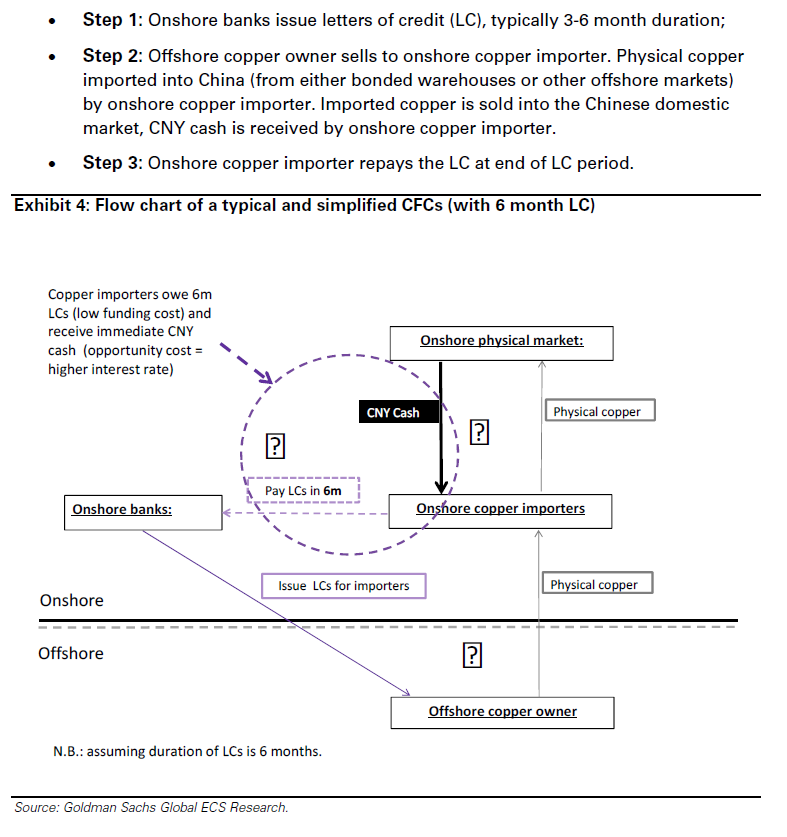
Kate’s post on the June China trade data mentions that commodities imports were the only bright spot (although it’s a somewhat dubious bright spot if it indicates a resurgence in investment). It turns out that copper imports were particularly strong, recording a 9.7 per cent year-on-year increase in June, a rather large change compared to a 14.6 per cent decline in May. Goldman point us to one compelling reason why that might be the case. It’s basically another case of whack-a-mole financing in China. Hit over-invoicing over the head and up pops ‘Cash For Copper’ (CFC) financing. This differs from more traditional Chinese Copper Financing Deals in that CFC financing involves moving physical copper from offshore to onshore; and there is no circulation of warrants. But the point of the two mechanisms is the same — getting access to CNY through cheap FX funding. A CFC financing deal looks a little something like this (click to enlarge):

Goldman-July-9-2 Goldman-July-9-1 Read more of this post

China faces tug-of-war over growth strategy; “We can’t rule out the possibility that the situation will be different from what leaders expect and that the economy will suffer a hard landing”

July 10, 2013 12:37 pm

China faces tug-of-war over growth strategy

By Simon Rabinovitch in Shanghai

Is this the end of the ‘Beijing put’? Over the past five years whenever China’s growth slipped below 8 per cent, global investors could count on the government to unleash stimulus and re-energise the world’s second-largest economy, boosting demand for everything from Audis to iron ore.

China is now sliding toward 7.5 per cent growth and likely lower. But the country’s new leaders are refusing to ride to the economy’s rescue, as they did most spectacularly in late 2008 when the global financial crisis struck. There is virtual unanimity among analysts that China has entered an era of slower growth, and that the government, far from panicking, welcomes this change, believing it will give rise to a more sustainable economic model. Read more of this post

Penang is as famous for being the nation’s jeans centre as it is for its char kway teow; and Yen Global is believed to command about 10% of the Malaysian market share for jeans

Updated: Tuesday July 9, 2013 MYT 8:39:21 AM

Sky-high demand for denim

STORY AND PHOTOS BY GRACE CHEN

doc6aucd3sbcs4num5xagq

Dynamic team: (From left) Kok Beng, Yen Global group marketing director Goh Kok Peng and Yeoh. ]

It may not be common knowledge, but Penang is as famous for being the nation’s jeans centre as it is for its char kway teow,says Goh Kok Beng, group executive chairman of Yen Global Bhd. The company manufactures and distributes the Edwin, Mustang and GA Blue brands from the company’s factory headquarters in Bayan Lepas. The genesis of the island’s denim history can be traced back to the late 1960s when a large Hong Kong-based garment factory began manufacturing jeans under license for Levi’s. “They were not big, they were huge!” recalls Goh, who was still in school then. From Goh’s vivid recollections, they had close to 1,000 skilled workers earning a base salary of RM300 a month stationed in three areas – Rifle Range, Parit Buntar and Balik Pulau in the early 1970s. The production rate was believed to number 100,000 pairs a month. Read more of this post