The Essayification of Everything: Why has the form invented by Montaigne — searching, sampling, notoriously noncommittal — become a talisman of our times?

MAY 26, 2013, 3:00 PM

The Essayification of Everything

By CHRISTY WAMPOLE

Lately, you may have noticed the spate of articles and books that take interest in the essay as a flexible and very human literary form. These include “The Wayward Essay” and Phillip Lopate’s reflections on the relationship between essay and doubt, and books such as “How to Live,” Sarah Bakewell’s elegant portrait of Montaigne, the 16th-century patriarch of the genre, and an edited volume by Carl H. Klaus and Ned Stuckey-French called “Essayists on the Essay: Montaigne to Our Time.”

It seems that, even in the proliferation of new forms of writing and communication before us, the essay has become a talisman of our times. What is behind our attraction to it? Is it the essay’s therapeutic properties? Because it brings miniature joys to its writer and its reader? Because it is small enough to fit in our pocket, portable like our own experiences? Read more of this post

Brewing fortunes are not uncommon. But few of these fortunes have been turned into such a successful family office as Quilvest

BEER MONEY

ARTICLE | 23 MAY, 2013 02:43 PM | BY JEREMY HAZLEHURST

When Otto Bemberg set up a brewery in the Argentine town of Quilmes after leaving his native Cologne in 1850, he would no doubt have been pleased that a century and a half later the business he started would produce Argentina’s biggest selling beer, with 75% of the market, that it would sponsor the national football team, and appear in trendy bars the world over. He’d also be chuffed to see a family business in its seventh generation. As a savvy businessman, he might have been even happier that, through its investment arm, the family firm would also spawn one of the world’s largest family offices.

Quilvest, which has $22 billion (€17.1 billion) under management, including $4 billion in the private equity arm, almost 400 employees and 13 offices globally, started life in 1917 in Paris to look after the family’s wealth. These days, Quilvest is divided into two. One side is a multi family office with around 4,000 clients – around 100 of them use it as a one-stop-shop family office, while most of the others use it for individual investments. The other is a private equity house, which has been investing since 1972. And interestingly, the family, which now consists of around 150 members, is still intimately involved with all aspects of Quilvest. Read more of this post

Why People Hate The Google Bus

Why People Hate The Google Bus

Rory Carroll, The Guardian | May 26, 2013, 8:54 AM | 20,507 | 57

google-bus-7

Every morning and every evening the fleet glides through the city, hundreds of white buses with tinted windows navigating San Francisco’s rush hour. From the pavement you can see your reflection in the windows, but you can’t see in. The buses have no markings or logos, no advertised destinations or stops.

It doesn’t matter. Everyone knows what they are. “Transport for a breed apart. For a community that is separate but not equal,” said Diamond Dave Whitaker, a self-professed beat poet and rabble-rouser.

The buses ferry workers to and from Apple, Facebook, Google and other companies in Silicon Valley, an hour’s drive south. They hum with air-conditioning and Wi-Fi. They are for the tech elite, and only the tech elite. Read more of this post

HSBC’s $1.9bn money laundering settlement with US authorities could be rejected, leaving the bank open to criminal prosecution and a ban from operating in America

HSBC’s $1.9bn money laundering settlement could be rejected

HSBC’s $1.9bn settlement deal with US authorities over money laundering charges could be rejected, it was reported on Thursday night.

By Andrew Trotman

10:41PM BST 23 May 2013

Judge John Gleeson is considering cancelling December’s so-called deferred prosecution agreement that gave HSBC immunity from claims it allowed terrorists to move at least $881m (£584m) around the financial system. This could leaving the bank open to criminal prosecution and a ban from operating in America. However, HSBC disputes this. The US Department of Justice (DoJ) is reportedly challenging Mr Gleeson’s need to sign off on the deal. The judge last mentioned the case in February, stating that he had not yet approved nor disapproved of the settlement. Read more of this post

Bitter Election Creates Long-Term Headache for Malaysia’s Najib

Bitter Election Creates Long-Term Headache for Malaysia’s Najib

By Niluksi Koswanage on 10:07 am May 26, 2013.

Demonstrators hold up lighters during a protest against recent election results in Petaling Jaya, outside Kuala Lumpur, in this May 25, 2013 file photo. Malaysia’s divisive election has left a bitter taste for millions of people that risks creating a long-term problem of legitimacy for Prime Minister Najib Razak’s long-ruling Barisan Nasional (BN) coalition. (Reuters Photo/Bazuki Muhammad)

Kuala Lumpur. Malaysia’s divisive election has left a bitter taste for millions of people that risks creating a long-term problem of legitimacy for Prime Minister Najib Razak’s long-ruling Barisan Nasional (BN) coalition.

The outrage was clear at a busy intersection across from one of Kuala Lumpur’s fanciest shopping malls, where a huge poster of Najib and his deputy had been defaced – a rare display of public disrespect in the Southeast Asian nation.

One of the scrawled comments poked fun at the unconvincing share of the votes won by Najib’s ruling coalition in its May 5 election victory: “47 percent PM,” it said. Read more of this post

Robots to drones, Australia eyes high-tech farm help to grow food

Robots to drones, Australia eyes high-tech farm help to grow food

Sun, May 26 2013

By Colin Packham

SYDNEY (Reuters) – Moving carefully along a row of apple trees, two of Australia’s newest agricultural workers check if the fruit is ripe or the soil needs water or fertilizer.

Meet “Mantis” and “Shrimp”, agricultural robots being tested to do these tasks and more in a bid to cut costs and improve productivity in Australia’s economically vital farm sector, which exported A$39.6 billion ($38.8 billion)of produce in 2012.

Australia is one of the leaders in the field and, with a minimum wage of A$15.96 per hour and a limited workforce, has a big incentive to use robots and other technology such as unmanned aircraft to improve efficiency. Read more of this post

The world’s biggest energy companies have warned Australia has less than two years to fix the high cost of building big projects or risk being frozen out of a new $150 billion wave of global investment in LNG

LNG costs risk $100 billion of projects

PUBLISHED: 10 HOURS 39 MINUTES AGO | UPDATE: 0 HOUR 45 MINUTES AGO

GEMMA DALEY AND ANGELA MACDONALD-SMITH

The world’s biggest energy companies have warned Australia has less than two years to fix the high cost of building big projects or risk being frozen out of a new $150 billion wave of global investment in liquefied natural gas ­supply.

Senior executives said Australia needed to reduce the world’s most expensive labour costs, cut regulation and deliver a stable tax and political ­environment to have a chance of competing against East Africa, West Canada and the United States to fill ­­in a looming 160 million tonne annual ­global shortfall in LNG supply.

Projects hanging in the balance include Woodside Petroleum’s Browse venture, Shell and PetroChina’s Arrow project in Queensland, the Scar­borough floating plant proposed by ExxonMobil and BHP Billiton and the GDF Suez-Santos Bonaparte floating venture. Read more of this post

Boom or bust? Bras cost more than properties, says Chinese developer

Boom or bust? Bras cost more than properties, says Chinese developer

Staff Reporter

2013-05-27

When Peggy Yu, executive chairwoman of Chinese online retailer Dangdang, complained about expensive property prices to the chairman of Beijing-based developer Huayuan Group, Ren Zhiqiang, at a meeting held by China Entrepreneur Magazine on May 18, Ren replied by saying that bras are in fact more expensive than properties.

“A property project takes several years to complete, but how long does it take for you to make a suit of clothes?” Ren said. “A small bra may cost hundreds of yuan, so it’s much more expensive than a house, if you go by price per square meter.” Ren’s “bra theory” triggered widespread debate online, with some internet users asking Ren if he would be willing to sell his smallest house to exchange for three good bras. Read more of this post

How much is an apology worth? Ge Wenyao, chairman of Shanghai Jahwa United Co, just paid more than 300 million yuan ($50 million) to make one

Argument prompts introspection

Updated: 2013-05-27 05:34

( China Daily)

f04da2db1122130ccba915

How much is an apology worth? Ge Wenyao, chairman of Shanghai Jahwa United Co, just paidmore than 300 million yuan ($50 million) to make one. Read more of this post

China’s second-largest construction equipment maker Zoomlion Bonds Fall, Stock Trading Halted After Media Report accusing it of falsifying sales

Zoomlion Bonds Fall, Stock Trading Halted After Media Report

Zoomlion Heavy Industry Science and Technology Co., China’s second-largest construction equipment maker, halted stock trading and saw its bonds decline after a report on Sina.com accused it of falsifying sales. The Shenzhen-listed shares were halted because of the report and trading will resume after the company posts a filing on the issue, Changsha-based Zoomlion said in a statement. The Hong Kong-traded stock was also suspended. Zoomlion’s $600 million of 6.125 percent bonds due December 2022 slumped 2.1 cents on the dollar to 95.4 cents as of 11:21 a.m. in Hong Kong, the lowest level since March 6 and heading for the biggest daily decline since Feb. 4, Bloomberg prices show. Zoomlion’s Hong Kong-traded stock has slumped 31 percent this year as its first-quarter profit plummeted 72 percent. Construction-equipment makers, including bigger rival Sany Heavy Industry Co. (600031), face a drop in orders as slowing economic growth and government curbs on the property market sap demand. Hong Xiaoming, a Zoomlion vice president in charge of the finance department, said in a mobile-phone text message that the company will issue a clarification today. She didn’t elaborate.

To contact the reporters on this story: Jasmine Wang in Hong Kong at jwang513@bloomberg.net; Rachel Evans in Hong Kong at revans43@bloomberg.net

President Xi Joins Premier Li in Indicating China Tolerance for Slower Growth Rate

Xi Joins Li in Indicating China Tolerance for Slower Growth Rate

China’s President Xi Jinping indicated a tolerance for slower expansion to avoid environmental degradation, adding to signs that the government will limit temporary boosts for the economy as officials map out plans for market-based changes to drive long-term expansion.

The country won’t sacrifice the environment to ensure short-term growth, Xi said during a study session of the Communist Party’s top leadership on May 24. His comments follow a statement issued on the same day that the State Council, or cabinet, which is chaired by Premier Li Keqiang, approved a series of measures aimed at revamping the economy.

China’s new leaders may be reluctant to implement stimulus to reverse an unexpected slowdown in first-quarter growth after a 4 trillion yuan ($586 billion at the time) package to support the economy during the global financial crisis led to inflation, a housing bubble and industrial overcapacity. Since taking office in March, Li has pledged to cut government interference in the economy, give market forces more power and boost the role of private companies. Read more of this post

Korea eyes Western model for funding ecosystem

2013-05-26 14:52

Korea eyes Western model for funding ecosystem

By Kim Da-ye

The word “venture” is in vogue again. Tech start-ups thrived in the late 1990s and early 2000s. Internet portal Naver, game developers Nexon and NCsoft, and set-top box manufacturer Humax are the so-called first-generation ventures from this era. Along with the worldwide burst of dot.com bubbles, the domestic venture culture disappeared, and Korea Inc. became dominated by large conglomerates.

The wide distributions of smartphones and ubiquitous connectivity in the past few years have reignited interests in venture firms. The trend is, however, limited to creating apps and mobile games. For a real start-up culture to form, ventures should also look into other serious areas of technology and science such as medical equipment, biotechnology and clean energy. The new government says it is determined to turn the trend into a second venture boom. Read more of this post

South Korea’s ‘export’ crisis; South Korea’s business and government circles were shocked to read a OECD report that said their nation ranked at the bottom of OECD member nations in terms of “technology trade balance”

South Korea’s ‘export’ crisis

MAY 27, 2013

On the streets of Seoul, there has lately been a conspicuous increase in the number of high-end imported cars with brand names like BMW, Mercedes-Benz and Lexus, in stark contrast to five years ago when the country’s auto market was virtually monopolized by the two domestic names of Hyundai and Kia. Statistically imports in 2012 surpassed 10 percent of the South Korean car market for the first time in terms of volume and accounted for 23.2 percent in value. BMW, in particular, became the fourth-largest automaker in the Korean market in terms of sales value. This growth of imported cars can be attributed to a shift in South Korean car buyers’ tastes toward more sophisticated designs, performance characteristics and brand images. More important, this reveals the local manufacturers’ inability to design and build products with high added value and attractive brand images. This is true not only of automobiles but also of electronic products. Samsung Electronics, for example, did succeed in overwhelming all of its Japanese competitors but has no technologies or products of its own development that can be called the “first in the world.”

The South Korean manufacturing industry as a whole may well be entering the twilight years at an unexpectedly rapid pace due to this lack of innovative skills, coupled with recent cost increases, the rising value of the won currency and mounting instability on the Korean Peninsula. Read more of this post

Videogame industry legend Peter Molyneux says the time is right for people to play God on smartphones.

Videogame console icon turns mobile play god

Molyneux praised mobile devices for the intimacy of touchscreens and rapid-fire innovation compared to years-long cycles for generations of videogame console hardware. -AFP

download (2)

Mon, May 27, 2013
AFP

SAN FRANCISCO – Videogame industry legend Peter Molyneux says the time is right for people to play God on smartphones. The former Lionhead Studio chief and Microsoft Game Studios executive has teamed with Japan-based DeNA to get his latest project – GODUS – on the array of mobile devices powered by Android or Apple software. “There is something incredible happening on these devices,” Molyneux said while hefting a smartphone in one hand. “This is where the home of gaming should really exist.” Molyneux, whose background in the computer game industry stretches back to the early 1980s, left Microsoft Studios last year and founded startup 22Cans.

He revealed his latest project, which 22Cans is building and DeNA will distribute, the same week that Microsoft unveiled a new Xbox One console designed to be at the heart of home entertainment in the Internet Age. “When I decided to leave Microsoft and come to this space, the first thing I had to do is think in a completely different way,” Molyneux said of the shift to play on smartphones and tablets. “Console games are the equivalent of making films, whereas mobile is much more like television soap operas,” he continued. Read more of this post

Flash sales have taken hold in the book business, helping older books soar from the backlist to the best-seller list

May 26, 2013

One-Day Deals Making E-Books Brief Best Sellers

By JULIE BOSMAN

One Sunday this month, the crime thriller “Gone, Baby, Gone,” by Dennis Lehane, sold 23 e-book copies, a typically tiny number for a book that was originally published in 1998 but has faded into obscurity.

The next day, boom: it sold 13,071 copies.

“Gone, Baby, Gone” had been designated as a Kindle Daily Deal on Amazon, and hundreds of thousands of readers had received an e-mail notifying them of a 24-hour price cut, to $1.99 from $6.99. The instant bargain lit a fire under a dormant title. Read more of this post

NetSuite and Workday are poised to cash in on the migration to cloud computing services and perhaps elbow aside today’s corporate software giant

May 26, 2013

A Legacy Feud in Tech

By QUENTIN HARDY

27workday4-popup

More than two decades ago, David Duffield built a global software company, becoming a billionaire.

SAN FRANCISCO — If the Hatfields and McCoys lived in Silicon Valley, they’d be fighting with piles of cash and lines of software code instead of knives and shotguns. And the fight would be over who wins the most customers in the computer industry’s growing “cloud” of software services. That’s how it is for Aneel Bhusri and Zachary Nelson, whose companies are in contention over the next major shift in computing. In a way, the men are reliving history. Two decades ago, their mentors feuded, and that time, too, the dispute took place against the backdrop of a major shift in corporate computing — when customers gave up their mainframes and moved to software that relied on personal computers closely connected to a server. Mr. Nelson, the chief executive of NetSuite, used to work for Lawrence J. Ellison, the billionaire chief executive of Oracle.

Mr. Bhusri, the co-founder of a competitor company called Workday, used to work for David Duffield, a rival of Mr. Ellison’s. Mr. Duffield is the low-profile founder of PeopleSoft, a once-powerful maker of corporate software that Oracle acquired in a bitter, 17-month hostile takeover fight. Read more of this post

Jack Dorsey Says This Beautiful ‘Square Stand’ Will Replace Ugly Checkout Tills

Jack Dorsey Says This Beautiful ‘Square Stand’ Will Replace Ugly Checkout Tills

Matt Warman, The Telegraph | May 26, 2013, 8:34 AM | 3,414 | 8

stand-swipe

On nearly every shop counter around the world, there’s a till that’s hardly changed in two or three decades. Usually grey, always ugly, these machines clutter the single point that every customer is guaranteed to see when they go to buy something. Little wonder that luxury brands from Hermes to Burberry would rather take your credit card away, deal with the dirty business of payment and then bring back a bill neatly encased in a leather wallet for customers to sign.

Jack Dorsey doesn’t think things have to be this way. Not content with co-founding micro-blogging site Twitter, this superstar of Silicon Valley now wants to change how the world pays for things. With his own worth now estimated at $1.1billion, he should know a thing or two about money.

The vehicle for that transformation is a company called Square: it’s built its burgeoning reputation on a small, square credit card reader that plugs in to the headphone jack of an iPhone and lets any user take credit card payments via a simple app. Once you’ve used a card once and registered it, receipts are emailed automatically. Read more of this post

Mystery Surrounding Collapse Of Hong Kong Mercantile Exchange Deepens; Four Arrested

Mystery Surrounding Collapse Of Hong Kong Mercantile Exchange Deepens; Four Arrested

Tyler Durden on 05/25/2013 22:30 -0400

hkmex

A week ago, when the brand new Hong Kong Mercantile Exchange suddenly shuttered after being in operation for only two years, urgently settling what little contracts were outstanding, many questions were left unanswered. Such as: how it was possible that the exchange, expected by many to become the new preferred trading venue for Asian precious metals and to steal the CME’s crown, could close on such short notice, without barely having been given a fair chance at being profitable, let alone dominating Pacific rim metals trading. This mystery deepened further after reports that the exchange barely had seen any volume, with allegedly only a tiny 200 open contractsremaining to be settled upon shuttering. Now, the confusion surrounding the HKMex closure has taken another big step for bizarrokind following news that not only have at least four HKMex senior executive have been arrested having been found to be in possession of false bank docs for nearly half a billion in dollars, but that government itself was forced to “shore up confidence” in CY Leung, Hong Kong’s 3rd Chief Executive, whose former top aide was none other Barry Cheung Chun-yuen, founder of the HKMex.

Yet another major geopolitical scandal centered around gold: how original. Read more of this post

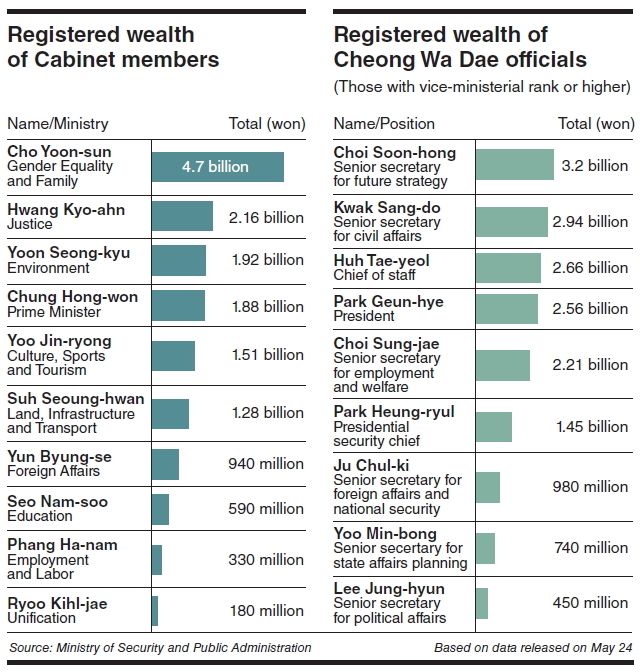
Top Korean civil servants’ wealth averages $2mil

Top Korean civil servants’ wealth averages $2mil

President Park saw an increase in wealth of 120 million won to 2.56 billion won, compared to before taking her post. -Korea Herald/ANN

Oh Kyu-wook
Sun, May 26, 2013
The Korea Herald/Asia News Network

20130526.132651_20130524000709_0

The average wealth of the government’s top officials is 1.83 billion won (S$2 million), a government report has showed. The government’s Public Ethic Committee disclosed on Friday the assets of 27 top senior civil servants, including President Park Geun-hye, Prime Minister Chung Hong-won and other Cabinet members. Read more of this post

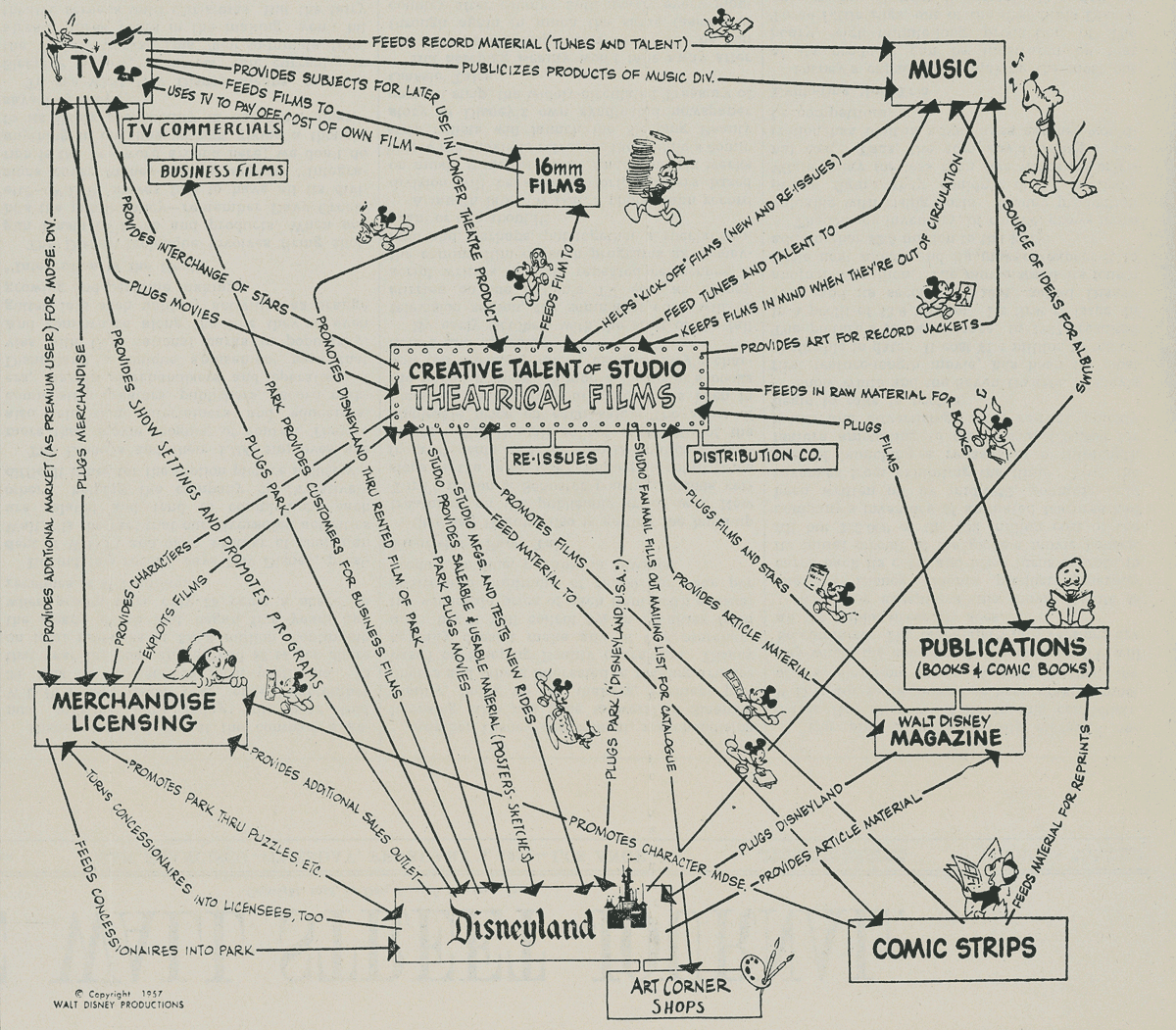
What Is the Theory of Your Firm? Walt Disney’s Theory of Value Creation in Entertainment (1957 Illustration)

What Is the Theory of Your Firm?

by Todd Zenger

R1306D_A_LG

Illustration: © 1957 Disney

If asked to define strategy, most executives would probably come up with something like this: Strategy involves discovering and targeting attractive markets and then crafting positions that deliver sustained competitive advantage in them. Companies achieve these positions by configuring and arranging resources and activities to provide either unique value to customers or common value at a uniquely low cost. This view of strategy as position remains central in business school curricula around the globe: Valuable positions, protected from imitation and appropriation, provide sustained profit streams.

Unfortunately, investors don’t reward senior managers for simply occupying and defending positions. Equity markets are full of companies with powerful positions and sluggish stock prices. The retail giant Walmart is a case in point. Few people would dispute that it remains a remarkable firm. Its early focus on building a regionally dense network of stores in small towns delivered a strong positional advantage. Complementary choices regarding advertising, pricing, and information technology all continue to support its low-cost and flexibly merchandised stores. Read more of this post

The Wave of Transient Advantage

Transient Advantage

by Rita Gunther McGrath
R1306C_B_LG

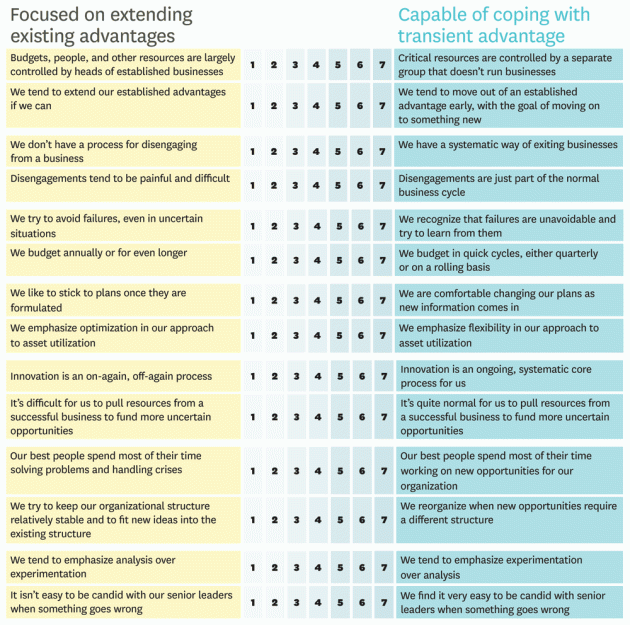
Strategy is stuck. For too long the business world has been obsessed with the notion of building a sustainable competitive advantage. That idea is at the core of most strategy textbooks; it forms the basis of Warren Buffett’s investment strategy; it’s central to the success of companies on the “most admired” lists. I’m not arguing that it’s a bad idea—obviously, it’s marvelous to compete in a way that others can’t imitate. And even today there are companies that create a strong position and defend it for extended periods of time—firms such as GE, IKEA, Unilever, Tsingtao Brewery, and Swiss Re. But it’s now rare for a company to maintain a truly lasting advantage. Competitors and customers have become too unpredictable, and industries too amorphous. The forces at work here are familiar: the digital revolution, a “flat” world, fewer barriers to entry, globalization.

Strategy is still useful in turbulent industries like consumer electronics, fast-moving consumer goods, television, publishing, photography, and…well, you get the idea. Leaders in these businesses can compete effectively—but not by sticking to the same old playbook. In a world where a competitive advantage often evaporates in less than a year, companies can’t afford to spend months at a time crafting a single long-term strategy. To stay ahead, they need to constantly start new strategic initiatives, building and exploiting many transient competitive advantages at once. Though individually temporary, these advantages, as a portfolio, can keep companies in the lead over the long run. Firms that have figured this out—such as Milliken & Company, a U.S.-based textiles and chemicals company; Cognizant, a global IT services company; and Brambles, a logistics company based in Australia—have abandoned the assumption that stability in business is the norm. They don’t even think it should be a goal. Instead, they work to spark continuous change, avoiding dangerous rigidity. They view strategy differently—as more fluid, more customer-centric, less industry-bound. And the ways they formulate it—the lens they use to define the competitive playing field, their methods for evaluating new business opportunities, their approach to innovation—are different as well. Read more of this post


You Make Better Decisions If You “See” Your Senior Self

You Make Better Decisions If You “See” Your Senior Self

by Hal Hershfield

F1306D_A

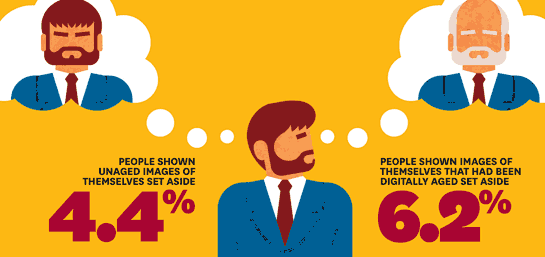
The finding: Many people feel disconnected from the individuals they’ll be in the future and, as a result, discount rewards that would later benefit them. But brief exposure to aged images of the self can change that behavior. 

The research: Hal Hershfield ran fMRI scans on subjects and found that the neural patterns seen when they described themselves 10 years in the future were markedly different from those seen when they described their current selves (but similar to those seen when they talked about actors). In a later asset allocation task, people whose brain activity changed the most when they began discussing their future selves were the least likely to favor large long-term gains over small immediate ones. However, in follow-up experiments, when subjects were shown aged images of themselves, that tendency disappeared. Read more of this post

The Fractalist: Memoir of a Scientific Maverick

He Conceived the Mathematics of Roughness

MAY 23, 2013 Jim Holt

The Fractalist: Memoir of a Scientific Maverick
by Benoit B. Mandelbrot
Pantheon, 324 pp., $30.00

holt_1-052313_jpg_230x1466_q85

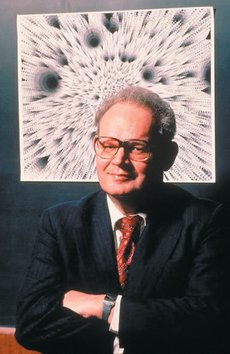
Benoit Mandelbrot, the brilliant Polish-French-American mathematician who died in 2010, had a poet’s taste for complexity and strangeness. His genius for noticing deep links among far-flung phenomena led him to create a new branch of geometry, one that has deepened our understanding of both natural forms and patterns of human behavior. The key to it is a simple yet elusive idea, that of self-similarity.

To see what self-similarity means, consider a homely example: the cauliflower. Take a head of this vegetable and observe its form—the way it is composed of florets. Pull off one of those florets. What does it look like? It looks like a little head of cauliflower, with its own subflorets. Now pull off one of those subflorets. What does that look like? A still tinier cauliflower. If you continue this process—and you may soon need a magnifying glass—you’ll find that the smaller and smaller pieces all resemble the head you started with. The cauliflower is thus said to be self-similar. Each of its parts echoes the whole. Read more of this post

TED curator Chris Anderson: How to Give a Killer Presentation

How to Give a Killer Presentation

by Chris Anderson

A little more than a year ago, on a trip to Nairobi, Kenya, some colleagues and I met a 12-year-old Masai boy named Richard Turere, who told us a fascinating story. His family raises livestock on the edge of a vast national park, and one of the biggest challenges is protecting the animals from lions—especially at night. Richard had noticed that placing lamps in a field didn’t deter lion attacks, but when he walked the field with a torch, the lions stayed away. From a young age, he’d been interested in electronics, teaching himself by, for example, taking apart his parents’ radio. He used that experience to devise a system of lights that would turn on and off in sequence—using solar panels, a car battery, and a motorcycle indicator box—and thereby create a sense of movement that he hoped would scare off the lions. He installed the lights, and the lions stopped attacking. Soon villages elsewhere in Kenya began installing Richard’s “lion lights.”

The story was inspiring and worthy of the broader audience that our TED conference could offer, but on the surface, Richard seemed an unlikely candidate to give a TED Talk. He was painfully shy. His English was halting. When he tried to describe his invention, the sentences tumbled out incoherently. And frankly, it was hard to imagine a preteenager standing on a stage in front of 1,400 people accustomed to hearing from polished speakers such as Bill Gates, Sir Ken Robinson, and Jill Bolte Taylor. Read more of this post

Romancing Alpha, Forsaking Beta

What Eisenhower Taught Me About Decision-Making; Bill Marriott Jr. says a 1954 chat with President Eisenhower taught him that when it comes to making decisions, it’s always important to be inclusive of others

May 25, 2013

What Eisenhower Taught Me About Decision-Making

By ADAM BRYANT

26-CORNER-popup

This interview with J.W. Marriott Jr., known as Bill, executive chairman and former C.E.O. of Marriott International, was conducted and condensed by Adam Bryant.

J.W. Marriott Jr., known as Bill, is executive chairman and former C.E.O. of Marriott International, says a brief chat with President Eisenhower in 1954 taught him the importance of always asking others, “What do you think we should do?

Q. Do you remember the first time you were somebody’s boss?

A. I guess it was in the Navy. I was in the Navy Supply Corps on an aircraft carrier. I eventually took over the officers’ mess. I had worked in my dad’s restaurant when I was in college, and I had all the recipe cards sent to me because I didn’t like the food they were serving on board. I went to these Navy stewards and said, “I want you guys to follow the recipes.” And they looked at me, they didn’t say much, and they didn’t follow the recipes. I came back a few weeks later and said, “You’ve got to start following these recipes.” And they didn’t follow the recipes. They were all World War II veterans, they’d been everywhere and they had learned not to pay attention to all these green, young ensigns. In later years, I realized I’d failed to get them on the team. I had walked in and said: “Here, do it. I’m an officer. Salute and do it.” They ignored me and didn’t do it, and we still had lousy food when I left the ship. I realized that I should have sat down with them and said, “What do you think we can do to improve the food?” Read more of this post

Intuition Pumps And Other Tools for Thinking

Intuition Pumps And Other Tools for Thinking [Kindle Edition]

Daniel C. Dennett (Author)

16241139

Publication Date: May 6, 2013

One of the world’s leading philosophers offers aspiring thinkers his personal trove of mind-stretching thought experiments. Over a storied career, Daniel C. Dennett has engaged questions about science and the workings of the mind. His answers have combined rigorous argument with strong empirical grounding. And a lot of fun.

Intuition Pumps and Other Tools for Thinking offers seventy-seven of Dennett’s most successful “imagination-extenders and focus-holders” meant to guide you through some of life’s most treacherous subject matter: evolution, meaning, mind, and free will. With patience and wit, Dennett deftly deploys his thinking tools to gain traction on these thorny issues while offering readers insight into how and why each tool was built.

Alongside well-known favorites like Occam’s Razor and reductio ad absurdum lie thrilling descriptions of Dennett’s own creations: Trapped in the Robot Control Room, Beware of the Prime Mammal, and The Wandering Two-Bitser. Ranging across disciplines as diverse as psychology, biology, computer science, and physics, Dennett’s tools embrace in equal measure light-heartedness and accessibility as they welcome uninitiated and seasoned readers alike. As always, his goal remains to teach you how to “think reliably and even gracefully about really hard questions.”

A sweeping work of intellectual seriousness that’s also studded with impish delights, Intuition Pumps offers intrepid thinkers—in all walks of life—delicious opportunities to explore their pet ideas with new powers. Read more of this post

Philosopher Daniel Dennett Presents Seven Tools For Critical Thinking

Philosopher Daniel Dennett Presents Seven Tools For Critical Thinking

in Philosophy | May 21st, 2013 7 Comments

Love him or hate him, many of our readers may know enough about Daniel C. Dennett to have formed some opinion of his work. While Dennett can be a soft-spoken, jovial presence, he doesn’t suffer fuzzy thinking or banal platitudes— what he calls “deepities”—lightly. Whether he’s explaining (or explaining away) consciousness, religion, or free will, Dennett’s materialist philosophy leaves little-to-no room for mystical speculation or sentimentalism. So it should come as no surprise that his latest book,Intuition Pumps And Other Tools for Thinking, is a hard-headed how-to for cutting through common cognitive biases and logical fallacies. In a recent Guardian article, Dennett excerpts seven tools for thinking from the new book. Having taught critical thinking and argumentation to undergraduates for years, I can say that his advice is pretty much standard fare of critical reasoning. But Dennett’s formulations are uniquely—and bluntly—his own. Below is a brief summary of his seven tools.

1. Use Your Mistakes

Dennett’s first tool recommends rigorous intellectual honesty, self-scrutiny, and trial and error. In typical fashion, he puts it this way: “when you make a mistake, you should learn to take a deep breath, grit your teeth and then examine your own recollections of the mistake as ruthlessly and as dispassionately as you can manage.” This tool is a close relative of the scientific method, in which every error offers an opportunity to learn, rather than a chance to mope and grumble. Read more of this post

What Gets You Up in the Morning? Purpose is a uniquely powerful source of fuel – and satisfaction. That’s why we resonate so strongly with exhortations that speak to it

MAY 24, 2013, 11:41 AM

What Gets You Up in the Morning?

By TONY SCHWARTZ

In the last several weeks, I had two radically different experiences spending extended time with leaders at two large, global companies. A long, alcohol-fueled dinner with the first group was a pure downer: dull, rote and devoid of positive energy.

The day with the second — a group of young managers at Google — was utterly exhilarating. After eight hours together, discussing what it takes to be an inspiring leader, the conversation was still going strong.

What accounts for the difference?

The Google leaders were considerably younger than their counterparts in the first group, who worked for a financial services company. Also, Google is regularly recognized as a great place to work. But the most powerful difference, I’m convinced, is that the Googlers – hundreds of whom I’ve worked with over the years – feel they’re contributing to something meaningful and larger than themselves, and the other executives evinced no passion whatsoever for their work. Read more of this post

Hone the Job You Have Into One You Love

May 25, 2013

Hone the Job You Have Into One You Love

By SHANE J. LOPEZ

OVER the past few months, American workers have been suffering from a major case of spring fever. Many of them, for the first time in years, are thinking about testing the waters of the slowly improving economy. They are looking for better jobs than those they’ve been clinging to throughout the recession. Maybe, they think, they can even find a job they love. Read more of this post