Following defaults, Chinese Banks Cut Back on wealth-management products which grew from close to zero a few years ago to $1.2 trillion has rung alarm bells about growing risks for banks and retail investors

Updated May 27, 2013, 5:53 p.m. ET

Chinese Banks Cut Back on Wealth-Management Products

BEIJING—New rules aimed at reducing risks in China’s financial-services industry have dented the appeal of high-yield alternatives to deposits and threaten to crimp profits for banks.

Bank issuance of wealth-management products—retail investments that offer some of the security of deposit accounts but higher yields—dropped 8.8% in April from March, according to Cnbenefit, a research firm in the city of Chengdu. The average yield edged down to 4.3% in May from 4.4% in March, Cnbenefit said.

A default on a product sold by Huaxia Bank last year fanned concerns over inadequate disclosure and opaque investment structures.

China’s banking regulator introduced strict new rules in March governing where wealth-management products can be invested, how assets are managed, and standards of disclosure to investors. The rules give China’s banks until the end of the year to reduce the share of wealth-management products invested in illiquid assets to 35% of wealth products, or 4% of total assets. If they don’t, they could be forced to make moves that reduce their profitability, such as allocating more capital to back those assets.

The prospect of lower growth in the sector, combined with reduced returns and higher management costs, gives China’s banks with an unpalatable choice: reduce returns to investors and risk losing market share, or keep returns high and accept lower margins.

Smaller banks could be particularly hard hit. Small and medium-size banks collectively have a 60% share of the wealth-management market, and 15% of their products are in breach of the new rules, according to estimates from Bernstein Research. Read more of this post

Power struggle in Beijing leaves China Investment Corp (CIC) leaderless; Empty chair in sovereign wealth fund’s corner office worries investment industry observers and casts shadow over economic reform plans

Power struggle in Beijing leaves CIC leaderless

Monday, 27 May, 2013, 12:00am

George Chen george.chen@scmp.com

Empty chair in sovereign wealth fund’s corner office worries investment industry observers and casts shadow over economic reform plans

China’s US$480 billion sovereign wealth fund may well have to wait a few more months before it gets its new chairman, thanks to a power struggle in Beijing.

The chairman’s office at China Investment Corp (CIC) has been empty for about three months since former chairman Lou Jiwei , who helped establish CIC in 2007, was promoted to become finance minister as part of the Communist Party’s once-a-decade leadership transition earlier this year. Read more of this post

As the economy slows and midtier brands lose favor with consumers who are switching to premium brands and to shopping online, China’s retail sector is changing

Updated May 27, 2013, 11:07 a.m. ET

Change Afoot for Investors in China’s Retail Sector

By CHAO DENG

AM-AY684_AMONEY_NS_20130527030010

As the economy slows and midtier brands lose favor with consumers who are switching to premium brands and to shopping online, China’s retail sector is changing. The result is that private-equity firms that once bet on sky-high consumer growth are now buying into restructuring situations or into companies that cater to more-sophisticated tastes. “Going from a founder focused on growth to a team focused on modern management techniques is a hard curve for Chinese companies,” said André Loesekrug-Pietri, chairman of private-equity firm A Capital, which has invested in the sector. “Retail is not only about branding and fast growth but about efficient inventory management and logistics.” Read more of this post

New Tools to Hunt New Viruses

May 27, 2013

New Tools to Hunt New Viruses

By DONALD G. McNEIL Jr.

A new flu, H7N9, has killed 36 people since it was first found in China two months ago. A new virus from the SARS family has killed 22 people since it was found on the Arabian Peninsula last summer.

In past years, this might have been occasion for panic. Yet chicken and pork sales have not plummeted, as they did during flus linked to swine and birds. Travel to Shanghai or Mecca has not been curtailed, nor have there been alarmist calls to close national borders.

Is this relatively calm response in order? Or does the simultaneous emergence of two new diseases suggest something more dire?

Actually, experts say, the answer to both questions may well be yes. Read more of this post

WordPress is 10 years old today: Here’s how it’s changed the Web

WordPress is 10 years old today: Here’s how it’s changed the Web

Ken Yeung

27 May 2013

WordPress, the blogging and content management system, is 10-years old today. The platform has evolved in the past decade from being a basic blogging service to something that has helped people and brands become more social and changed how we communicate on the Web. Started by Matt Mullenweg and Mike Little, WordPress is an open source service where anyone can make modifications to the code to improve their blog and make it something that works for them. Bloggers who use WordPress are able to apply design themes to their sites while also integrating third-party plugins easily. Since it’s open source software, there isn’t a need for an approval process before someone can implement a new feature. As of this writing, the latest version of WordPress has been downloadedmore than 21 million times. Read more of this post

A Push to Quickly Switch Video-On-Demand Ads

Updated May 27, 2013, 8:42 p.m. ET

A Push to Quickly Switch Video-On-Demand Ads

19%: The average percentage VOD viewing has increased annually since 2009.

By AMOL SHARMA and SUZANNE VRANICA

A few weeks ago, Travel Channel viewers using cable video-on-demand services started seeing Land Rover ads. Viewers wouldn’t know it, but the spots were the result of a significant advance in TV-advertising technology that media companies hope will help shore up their bottom lines.

Scripps Networks Interactive Inc.,SNI +0.54% the owner of Travel Channel, is among several media companies also including ComcastCorp.’s CMCSA +0.31% NBCUniversal, A+E Networks, News Corp NWSA +0.67% .’s Fox broadcast and cable networks, and AMC NetworksAMCX -1.18% rolling out “dynamic ad-insertion” or working toward doing so, according to people familiar with the matter. The new technology is being introduced by a cable operator-owned venture that lets TV networks switch out and replace ads on programs that air on video-on-demand in as little as 24 hours—instead of having to wait weeks as is currently the case. Read more of this post

400 Million Users Strong: UCWeb CEO Shares Turning Points of the Company

400 Million Users Strong: UCWeb CEO Shares Turning Points of the Company

May 28, 2013

by Willis Wee

With more than 400 million users of its UC Browser, China’s UCWeb is probably one of most popular mobile browser makers in the world. UCWeb CEO Yu Yongfu tells us that that the company’s first product started as a BlackBerry Messenger type of service called UCMail. Unfortunately, it didn’t take off. But the team was quick to realize that people weren’t using UCMail. Rather, they wanted an application that could help them browse the web. So in 2004, UCMail rebranded to UCWeb, which stands for “U Can Web”, to being a full-fledged mobile browser. In 2006, with a team of 12, Yu Yongfu reorganized UCWeb and took over as the founder and CEO role. Today, under Yongfu, UCWeb has grown into a 1,500 employees company with 400 million users globally. Prior to UCWeb, Yongfu was a venture capitalist for six years focusing on the mobile internet sector. But he saw a lot of potential in the young company, so he chose to switch to the other side of the table to become an entrepreneur.

Read more of this post

Technology executives could be the next public enemies

May 27, 2013 4:41 pm

Technology executives could be the next public enemies

By Andrew Hill

About a year ago I was in San Francisco’s Pacific Heights, gazing down at the Golden Gate Bridge from one of Larry Ellison’s many spectacular homes. The Oracle chief executive wasn’t there – he had lent the house out for a reception. In any case, he would be the last person to apologise for enjoying the fruits of his success. But the view from technology executives’ balconies is getting stormier. After banks and bankers, could they be next to feel the sting of a populist backlash?

It sounds unlikely. For the tablet-toting, smartphone-stroking, Amazon-and-Googling masses – you and me, in other words – to attack companies that provide the products and services we love would be a case of biting the data feed they hand us. Read more of this post

Social commerce strategies: Wishbuuk showed how to convert followers into customers

May 27, 2013 4:41 pm

Social commerce strategies

By José Luis Nueno

The story

Wishbuuk is a Facebook application which was created after Fnac, the French books and music retailer, approached Flash2Flash digital, a marketing agency, for help introducing its brand into social networks. While marketing agencies such as Flash2Flash have helped brands create Facebook fan pages to attract followers, converting these followers into customers has proved difficult. Social commerce – using social media to buy products – is forecast to become a $30bn sector worldwide by 2015. Read more of this post

The Age of Big Data Has Created a Myth of Technocratic Infallibility

The Age of Big Data Has Created a Myth of Technocratic Infallibility

By Chrystia Freeland on 11:30 am May 27, 2013.
We are living in the age of the technocrats.

In business, Big Data, and the Big Brains who can parse it, rule. In government, the technocrats are on top, too.

From Washington to Frankfurt to Rome, technocrats have stepped in where politicians feared to tread, rescuing economies or at least propping them up.

Technocrats are in vogue within the intelligentsia, too. It is well nigh impossible to pick up a book about any social or political issue nowadays (including my own) without coming across some data-heavy social science research. Read more of this post

Bidding war between Tencent and LINE for Kakao; Tencent already own nearly a third of Kakao

Thomas Clayton: Bidding war between Tencent and LINE for Kakao

BY JACKY YAP | MAY 28, 2013 | ASIA

Thomas Clayton, CEO and founder of Bubble Motion shares his thoughts on Asian startups and the impending bidding war between LINE and Tencent for Kakao.

There are only a handful of companies in the region which managed to grow and subsequently raise multiple round of fundings. Singapore-based Bubble Motion is one of them. Founded back in 2005, Bubble Motion is the Twitter for Voice, and raised a total of US$50 million in funding from investors such as Sequoia Capital, Comcast Ventures, SingTel Innov8, JAFCO Asia, and many others. Bubble Motion now serves over 19 million users globally.

Of course, a great company is led by a great team. CEO and founder Thomas Clayton has had extensive experience and prior to starting Bubble Motion, Tom has started, worked for and ran numerous high-tech companies. Thomas also recently wrote an article on “Why the Largest Social Network in 2015 Won’t be Facebook, and Will Be From Asia“. Prior to his keynote at Echelon, we spoke to Thomas about the opportunities in Asia. Read more of this post

South Korea’s Plastic Surgery Fad Goes Extreme

South Korea’s Plastic Surgery Fad Goes Extreme

By Jung Ha-Won on 10:56 am May 27, 2013.

Seoul. South Korea’s obsession with plastic surgery is moving on from standard eye and nose jobs to embrace a radical surgical procedure that requires months of often painful recovery. A stream of celebrities boast on TV shows how it gave them a “new life,” while advertisements extolling its cosmetic benefits are everywhere from street billboards to subway stations, magazines and popular Internet sites.

But there’s nothing really “cosmetic” about double-jaw surgery. A radical solution to congenital facial deformities or for people unable to chew properly due to excessive over or underbite, the operation involves realigning the upper and lower jaws. Read more of this post

Korean chaebols including Samsung tense over economic bills; restrictions of shareholders’ voting rights could have a major impact on its web of cross shareholdings among affiliates

2013-05-27 17:10

Chaebol tense over economic bills

By Jun Ji-hye
Ruling Saenuri Party and main opposition Democratic Party (DP) will open an extraordinary session on June 3 to handle bills on key economic issues.
Conglomerates and financial firms are paying keen attention on which bills will be legislated into laws as they will influence their business substantially.
Both parties have in principle agreed to handle bills aimed at removing unfair business practices by chaebol. However, they have yet to narrow differences on key issues before passing them.
One of the sensitive bills on “economic democratization” is the one to restrict voting rights of major shareholders of financial companies if they are caught embezzling corporate funds. Read more of this post

Korean chaebol CJ, Home Plus and other large companies received the lowest rating in terms of relationship with SME

2013-05-27 17:03

Home Plus, CJ among worst in SME relationship

By Yi Whan-woo
Home Plus and seven other large companies received the lowest rating from a corporate watchdog on Monday in terms of relationship with smaller business groups.
Also on the list were CJ O Shopping, Hyundai Home Shopping, Hyundai Department Store, KCC Corp., STX Heavy Industries, LSIS and Kolon Global.
The National Commission for Corporate Partnership (NCCP) made the evaluation of 73 firms on the basis of a survey of some 9,500 small- and medium-sized enterprises (SMEs).
They were the subcontractors of those large firms. Read more of this post

Why Turkey is Thriving; There is nothing flashy about Turkey’s rise, which has been based on fundamentals, rather than bubbles or resource discoveries

Jeffrey D. Sachs, Professor of Sustainable Development, Professor of Health Policy and Management, and Director of the Earth Institute at Columbia University, is also Special Adviser to the United Nations Secretary-General on the Millennium Development Goals. His books include The End of Poverty and Common Wealth.

Why Turkey is Thriving

27 May 2013

NEW YORK – A recent visit to Turkey reminded me of its enormous economic successes during the last decade. The economy has grown rapidly, inequality is declining, and innovation is on the rise.

Turkey’s achievements are all the more remarkable when one considers its neighborhood. Its neighbors to the west, Cyprus and Greece, are at the epicenter of the eurozone crisis. To the southeast is war-torn Syria, which has already disgorged almost 400,000 refugees into Turkey. To the east lie Iraq and Iran. And to the northeast lie Armenia and Georgia. If there is a more complicated neighborhood in the world, it would be difficult to find it. Read more of this post

Sony’s Bread and Butter? It’s Not Electronics; selling life, auto and health insurance accounts for 63 percent of Sony’s total operating profit

May 27, 2013

Sony’s Bread and Butter? It’s Not Electronics

By HIROKO TABUCHI

TOKYO — Sony is best known as a consumer electronics company, making PlayStation game consoles and televisions. And it loses money on almost every gadget it sells.

Sony has made money making Hollywood movies and selling music. That profitable part of the business is what Daniel S. Loeb, an American investor and manager of the hedge fund Third Point, wants Sony to spin off to raise cash to resuscitate its electronics business.

But as Mr. Loeb pressures Sony executives to do more to revive the company’s ailing electronics arm, some analysts are asking, Why bother?

Sony, it is suggested, might be better off just selling insurance. Or just making movies and music. But not electronics. Read more of this post

Financial innovation for once works for the investor

Financial innovation for once works for the investor

Posted by: abnormalreturns, May 27th, 2013 at 4:08 pm

True, long-lasting innovations ares a rare thing in the world of finance. In my book I argue that the introduction of the ETF or exchange-traded fund was exactly that. It has taken two some decades but we are now seeing real changes in how people invest due to ETFs. I wrote:

Like all upheavals, the ETF revolution has both its benefits and its drawbacks. On the whole, ETFs have made investing easier, more diverse, and cheaper. On the other hand, the introduction of ETFs has changed the actual underlying nature of some markets, and the rapid introduction of new ETFs has diluted the benefits seen early on. Unlike many revolutions, we are not likely to see a counterrevolution unseating the ETF regime any time soon.

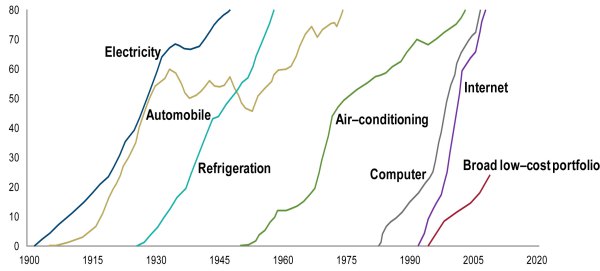
You can see how the introduction of ETFs has driven the adoption of “broadly diversified, low-cost portfolios.”Joe Davis and Andy Clarke at the Vanguard Blog compare the rise of these portfolios to other “great ideas. They write:

The adoption of great ideas typically follows an “S” curve, starting slowly, then accelerating. Eventually, the great idea becomes commonplace. The adoption of the “broad low-cost portfolio” seems to be following this pattern.

MPR_0513

Source: Vanguard. Adapted from Visualizing Economics and The New York Times. Vanguard calculated the growth in the low-cost portfolio based on data from Morningstar, Inc. The calculation represents the percentage of U.S. mutual fund and ETF assets under management with annual expense ratios of less than 25 basis points.

They note that we are still in the “second or third” inning of this process. Of course there is a limit as to just how much of the asset management industry can (or will) shift towards this approach. To be clear the definition of these portfolios is low cost, not necessarily indexed. In any event if too much money becomes indexed there should be a resulting increase in opportunities to generate alpha. Read more of this post

U.S. securities regulators are turning back toward Main Street, renewing their focus on accounting fraud and other financial-disclosure failings

May 27, 2013, 5:56 p.m. ET

Accounting Fraud Targeted

With Crisis-Related Enforcement Ebbing, SEC Is Turning Back to Main Street

By JEAN EAGLESHAM

U.S. securities regulators are turning back toward Main Street, renewing their focus on accounting fraud and other financial-disclosure failings.

Such cases were long a staple of the Securities and Exchange Commission’s enforcement efforts, leading to more than 25% of civil-enforcement actions filed by the agency in its 2003 to 2005 financial years. The financial crisis shifted attention and money elsewhere. In the year ended last September, accounting fraud and financial-disclosure problems made up just 11% of SEC enforcement actions. Read more of this post

Over-optimism raises risk of global recession

Over-optimism raises risk of global recession

In April 2010, the International Monetary Fund’s World Economic Outlook offered an optimistic assessment of the global economy, describing a multi-speed recovery strong enough to support roughly 4.5 per cent annual GDP growth for the foreseeable future — a higher pace than during the bubble years of 2000-2007.

27 MAY

In April 2010, the International Monetary Fund’s World Economic Outlook offered an optimistic assessment of the global economy, describing a multi-speed recovery strong enough to support roughly 4.5 per cent annual GDP growth for the foreseeable future — a higher pace than during the bubble years of 2000-2007.

But, since then, the IMF has steadily pared its economic projections. Indeed, this year’s expected GDP growth rate of 3.3 per cent — which was revised downward in the most recent WEO — will probably not be met.

Persistent optimism reflects a serious misdiagnosis of the global economy’s troubles. Most notably, economic projections have vastly underestimated the severity of the eurozone crisis, as well as its impact on the rest of the world. And recovery prospects continue to depend on the emerging economies, even as they experience a sharp slowdown. The WEO’s prediction of a strengthening recovery this year continues the misdiagnosis. Read more of this post

Li Says China Confronts ’Huge Challenges’ as Growth Levels Slow

Li Says China Confronts ’Huge Challenges’ as Growth Levels Slow

Chinese Premier Li Keqiang said his country is confronted by “huge challenges” as it opens up the economy and that the new government’s reform measures will be accompanied by tapered-off levels of growth.

Speaking in Berlin during his first trip abroad as premier, Li said the Chinese government will move forward with market-oriented reforms to generate stable growth after the economy unexpectedly slowed in the first quarter. Read more of this post

Asia seen as least creditworthy relative to their global peers

‘Asia seen as least creditworthy relative to their global peers’

Published: 2013/05/28

BEIJING: Borrowers in Asia are seen as the least creditworthy relative to their global peers in almost a year on signs of faltering growth in China.

The Markit iTraxx Asia index of credit-default swaps traded as much as 20 basis points higher than the average of four others from around the world this month, the biggest premium since June, according to data provider CMA. As recently as March, Asian borrowers were seen as better credits than the rest of the world.

Confidence in Asia is being dented by slowing growth in the region’s biggest economy, where manufacturing is contracting for the first time in seven months.  Read more of this post

Idea Entrepreneur: The New 21st Century Career

Idea Entrepreneur: The New 21st Century Career

by John Butman  |  10:00 AM May 27, 2013

There is a new player emerging on the cultural and business scene today: the idea entrepreneur. Perhaps you are one yourself — or would like to be. The idea entrepreneur is an individual, usually a content expert and often a maverick, whose main goal is to influence how other people think and behave in relation to their cherished topic. These people don’t seek power over others and they’re not motivated by the prospect of achieving great wealth. Their goal is to make a difference, to change the world in some way.

Idea entrepreneurs are popping up everywhere. They’re people like Sheryl Sandberg (Facebook COO and author of Lean In), who is advocating a big new idea from within an organization. And like Atul Gawande (the checklist doctor), who is working to transform a professional discipline. Or like Blake Mycoskie (founder of TOMS shoes), who has created an unconventional business model. In my research into this phenomenon (which forms the basis of my book, Breaking Out), I have been amazed at how many different kinds of people aspire to be idea entrepreneurs. I have met with, interviewed, emailed or tweeted with librarians, salespeople, educators, thirteen-year-old kids, marketers, technologists, consultants, business leaders, social entrepreneurs — from countries all over the world — who have an idea, want to go public with it, and, in some cases, build a sustainable enterprise around it.

Read more of this post

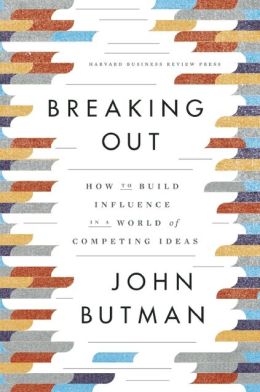
Breaking Out: How to Build Influence in a World of Competing Ideas

Breaking Out: How to Build Influence in a World of Competing Ideas [Hardcover]

John Butman (Author)

9781422172803_p0_v2_s260x420

Publication Date: May 21, 2013

How do you gain influence for an idea?
In Breaking Out, idea developer and adviser John Butman shows how the methods of today’s most popular “idea entrepreneurs”—including dog psychologist Cesar Millan, French lifestyle guru Mireille Guiliano (French Women Don’t Get Fat), TOMS founder Blake Mycoskie, and many others—can help you take an idea public and build influence for it.
It isn’t easy. Butman argues that the rise of the “ideaplex” (TED, Twitter, NPR, YouTube, online learning, and all the rest) has caused such an explosion in the creation and sharing of ideas that it has become much easier to go public—yet much harder to gain influence. But it can be done.
Based on his own experience in advising content experts worldwide, Butman shows how the idea entrepreneur breaks out—by combining personal narrative with rich content, creating many forms of expression (from books to live events), developing real-world practices, and creating “respiration” around the idea such that other people can breathe it in and make it their own. The resulting idea platform can reach many different audience groups and continue to build influence for many years and even decades.
If you have an idea and want to make a difference in your organization, build a change movement in your community, or improve the world in some way—this book will get you started on the journey to idea entrepreneurship. Read more of this post

Mudslinging in China’s Heavy-Machinery Sector

May 27, 2013, 9:21 a.m. ET

Mudslinging in China’s Heavy-Machinery Sector

By DUNCAN MAVIN

Digging for dirt on China’s machinery sector can be productive, especially when the economy’s stuck in the mud. Several companies that supply excavators, loaders and other construction equipment ran into trouble in 2012 and in the first few months of this year. The main problem was slowing economic growth, though oversupply of equipment was a big factor too. That led to slumping sales, rising inventory levels and a sharp uptick in accounts receivable as hard-up customers took longer to pay. Read more of this post

Why Extravagant New HQs Planned At Apple, Google, Amazon And Facebook Are Negative Indicators

Why Extravagant New HQs Planned At Apple, Google, Amazon And Facebook Are Negative Indicators

Bill Rigby and Alistair Barr, Reuters | May 27, 2013, 8:41 AM | 2,027 | 1

SEATTLE/SAN FRANCISCO (Reuters) – While much of corporate America is retrenching on the real estate front, the four most influential technology companies in America are each planning headquarters that could win a Pritzker Architecture Prize for hubris.

Amazon.com this week revealed plans for three verdant bubbles in downtown Seattle, joining Apple’s circular “spaceship,” Facebook’s Frank Gehry-designed open-office complex and a new Googleplex on the list of planned trophy offices.

“It signals a desire, a statement, to say that we’re special, we’re different. We have changed the world and we are going to continue to change it,” said Margaret O’Mara, associate professor of history at the University of Washington, who has written about the building of Silicon Valley. Read more of this post

GeoPay used the messaging ability that led to the earliest cellphones to create a mobile-banking platform in Central Asia

Reston firm turns to decades-old technology to set up mobile banking in Central Asia

By Abha Bhattarai, Monday, May 27, 5:31 AM

Not all new ideas for technology have to be, well, new.

As the start-ups around it tinkered with the cutting edge, a Reston company called GeoPay stuck by decades-old technology — the same used in messaging systems that led to the earliest cellphones — to create a mobile-banking platform.

The start-up, founded in 2011, provides cellphone-based banking services for people who might not otherwise have accounts at financial institutions. The simpler the interface, the more people the system could reach in the developing world, GeoPay said. Read more of this post

Advice on Life and Creative Integrity from Calvin and Hobbes Creator Bill Watterson

May 20, 1990: Advice on Life and Creative Integrity from Calvin and Hobbes Creator Bill Watterson

by Maria Popova

billwattersoncalvinandhobbes1

“The truth is, most of us discover where we are headed when we arrive.”

‘Tis the season for glorious life advicedispensed by cap-and-gown-clad elders to cap-and-gown-clad youngsters, emanating a halo effect of timeless wisdom the rest of us can absorb any day, at any stage of life. On May 20, 1990, Bill Watterson, creator of the beloved Calvin and Hobbes comic strip, took the podium at Kenyon College — the same stage David Foster Wallace would occupy 15 years later to deliver one of history’s most memorable commencement addresses — and gave the graduating class a gift of equally remarkable insight and impact.

Watterson begins the speech by articulating the same sentiment at the heart ofthe most unforgettable commencement addresses: the notion that not-knowing is not only a part of the journey, but an integral part:

I have a recurring dream about Kenyon. In it, I’m walking to the post office on the way to my first class at the start of the school year. Suddenly it occurs to me that I don’t have my schedule memorized, and I’m not sure which classes I’m taking, or where exactly I’m supposed to be going.
As I walk up the steps to the postoffice, I realize I don’t have my box key, and in fact, I can’t remember what my box number is. I’m certain that everyone I know has written me a letter, but I can’t get them. I get more flustered and annoyed by the minute. I head back to Middle Path, racking my brains and asking myself, “How many more years until I graduate? …Wait, didn’t I graduate already?? How old AM I?” Then I wake up.

Experience is food for the brain. And four years at Kenyon is a rich meal. I suppose it should be no surprise that your brains will probably burp up Kenyon for a long time. And I think the reason I keep having the dream is because its central image is a metaphor for a good part of life: that is, not knowing where you’re going or what you’re doing. Read more of this post

Surfaces and Essences: Analogy as the Fuel and Fire of Thinking

Surfaces and Essences: Analogy as the Fuel and Fire of Thinking [Hardcover]

Douglas Hofstadter (Author), Emmanuel Sander (Author)

7711871

Release date: April 23, 2013

Analogy is the core of all thinking.

This is the simple but unorthodox premise that Pulitzer Prize–winning author Douglas Hofstadter and French psychologist Emmanuel Sander defend in their new work. Hofstadter has been grappling with the mysteries of human thought for over thirty years. Now, with his trademark wit and special talent for making complex ideas vivid, he has partnered with Sander to put forth a highly novel perspective on cognition.

We are constantly faced with a swirling and intermingling multitude of ill-defined situations. Our brain’s job is to try to make sense of this unpredictable, swarming chaos of stimuli. How does it do so? The ceaseless hail of input triggers analogies galore, helping us to pinpoint the essence of what is going on. Often this means the spontaneous evocation of words, sometimes idioms, sometimes the triggering of nameless, long-buried memories.

Why did two-year-old Camille proudly exclaim, “I undressed the banana!”? Why do people who hear a story often blurt out, “Exactly the same thing happened to me!” when it was a completely different event? How do we recognize an aggressive driver from a split-second glance in our rearview mirror? What in a friend’s remark triggers the offhand reply, “That’s just sour grapes”? What did Albert Einstein see that made him suspect that light consists of particles when a century of research had driven the final nail in the coffin of that long-dead idea?

The answer to all these questions, of course, is analogy-making—the meat and potatoes, the heart and soul, the fuel and fire, the gist and the crux, the lifeblood and the wellsprings of thought. Analogy-making, far from happening at rare intervals, occurs at all moments, defining thinking from top to toe, from the tiniest and most fleeting thoughts to the most creative scientific insights.

Like Gödel, Escher, Bach before it, Surfaces and Essences will profoundly enrich our understanding of our own minds. By plunging the reader into an extraordinary variety of colorful situations involving language, thought, and memory, by revealing bit by bit the constantly churning cognitive mechanisms normally completely hidden from view, and by discovering in them one central, invariant core—the incessant, unconscious quest for strong analogical links to past experiences—this book puts forth a radical and deeply surprising new vision of the act of thinking. Read more of this post

Uncommon Genius: Stephen Jay Gould On Why Connections Are The Key to Creativity; “The trick to creativity is to identify your own peculiar talent and then to settle down to work with it for a good long time.”

Uncommon Genius: Stephen Jay Gould On Why Connections Are The Key to Creativity

by Maria Popova

“The trick to creativity, if there is a single useful thing to say about it, is to identify your own peculiar talent and then to settle down to work with it for a good long time.”

“Originality often consists in linking up ideas whose connection was not previously suspected,” wrote W. I. B. Beveridge in the fantastic 1957 tomeThe Art of Scientific Investigation. “The role of the imagination is to create new meanings and to discover connections that, even if obvious, seem to escape detection,” legendary graphic designerPaul Rand seconded. Indeed, longer ago than I can remember, I intuited the conviction that creativity is a combinatorial force — it thrives on cross-pollinating existing ideas, often across divergent disciplines and sensibilities, and combining them into something new, into what we proudly call our “original” creations. Paula Scher has likened the process to a slot machine; Dorion Sagan has asserted that science is about connections; Gutenberg has embodied it. And some of history’s most celebrated creators have attested to it with the nature of their genius. Read more of this post

Good Writing vs. Talented Writing; “Talented writing makes things happen in the reader’s mind — vividly, forcefully — that good writing, which stops with clarity and logic, doesn’t.”

Good Writing vs. Talented Writing

by Maria Popova

“Talented writing makes things happen in the reader’s mind — vividly, forcefully — that good writing, which stops with clarity and logic, doesn’t.”

The secrets of good writing have been debatedagain and again and again. But “good writing” might, after all, be the wrong ideal to aim for. In About Writing: Seven Essays, Four Letters, and Five Interviews (public library), celebrated author and literary critic Samuel Delany — who, for a fascinating factlet, penned thecontroversial 1972 “women’s liberation” issue of Wonder Woman — synthesizes his most valuable insights from thirty-five years of teaching creative writing, a fine addition tobeloved writers’ advice on writing. One of his key observations is the crucial difference between “good writing” and “talented writing,” the former being largely the product of technique (and we know from H.P. Lovecraft that “no aspiring author should content himself with a mere acquisition of technical rules”), the other a matter of linguistic and aesthetic sensitivity:

Though they have things in common, good writing andtalented writing are not the same. Read more of this post