Amma’s Multifaceted Empire, Built on Hugs; Amma is best known for literally embracing the masses; she has hugged millions of people around the world, a feat that has earned her the nickname “the hugging saint.”

May 25, 2013

Amma’s Multifaceted Empire, Built on Hugs

By JAKE HALPERN

26-AMMA-slide-VSMB-articleLarge

THERE are entourages — and then there is the retinue of Mata Amritanandamayi, a 59-year-old Indian guru known simply as Amma, or “mother.” On Friday, she began a two-month North American tour during which she will be accompanied by 275 volunteers. They plan to ride in four buses across the continent from Bellevue, Wash., to Marlborough, Mass., visiting 11 cities, including New York. And at each stop along the way, Amma will sit on stage for 15 hours at a stretch, greeting her thousands of devotees.

Amma is best known for literally embracing the masses; she has hugged millions of people around the world, a feat that has earned her the nickname “the hugging saint.” Her status as a spiritual therapist has attracted a large following in the United States. In India, however, what Amma offers is far more significant and complex. She has built a vast organization that is the envy of both India’s public and private sectors. As Oommen Chandy, the chief minister of the state of Kerala, told me: “From nothing, she has built an empire.” Read more of this post
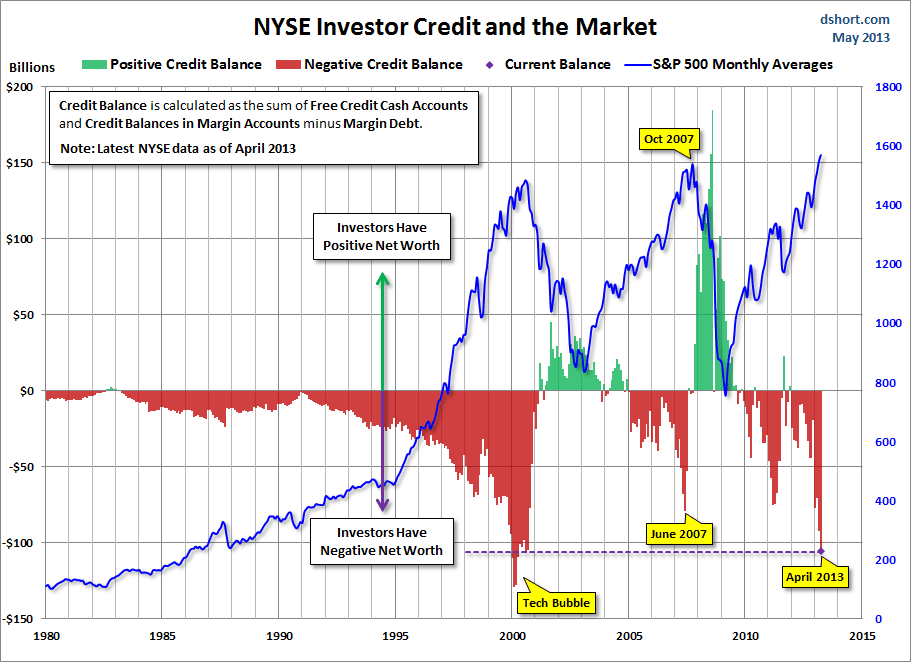
Investors Are Borrowing Like Crazy To Leverage Up Their Stock Market Bets

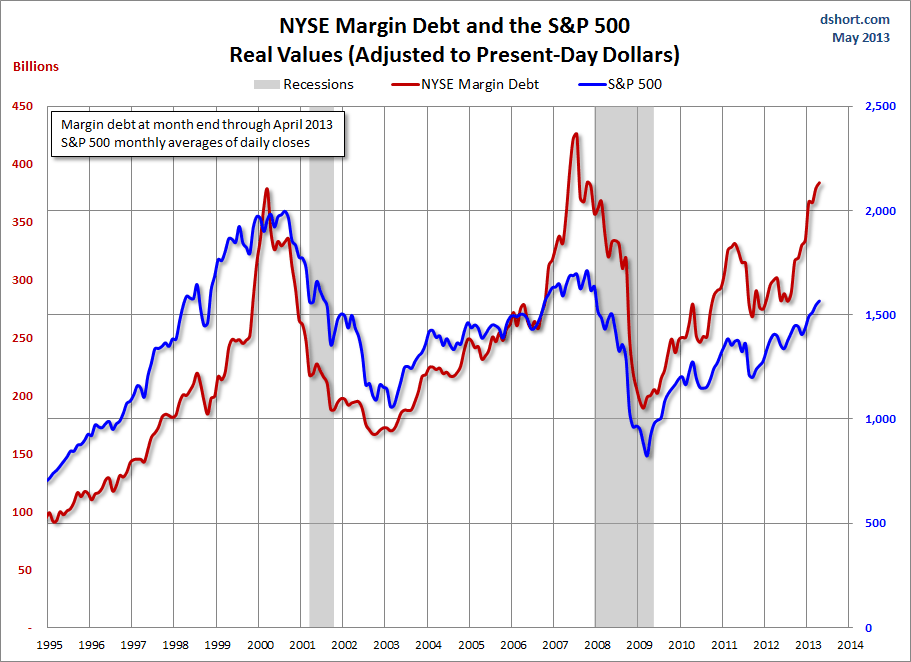
Investors Are Borrowing Like Crazy To Leverage Up Their Stock Market Bets

Doug Short, Advisor Perspectives | May 25, 2013, 7:06 AM | 3,695 | 7

Note from dshort: One of my economic correspondents, James Ross, called my attention to the fact that the NYSE has released new data for margin debt, now available through April. I’ve updated the charts in this commentary to include the new numbers.

NYSE-margin-debt-SPX-since-1995NYSE-margin-debt-SPX-growth-since-1995NYSE-investor-credit-SPX-since-1980 Read more of this post

Why a hold recommendation is no recommendation at all

Why a hold recommendation is no recommendation at all

David Kaufman | 13/05/24 | Last Updated: 13/05/24 3:55 PM ET
It is part of the human condition to want to classify things. In the world of finance, where many analysts suffer from what is referred to as “physics envy,” there is an inescapable draw to being able to reduce any problem, large or small, into a neat box that can be labelled with a simple word or phrase. Hence the infatuation with recommending investments as either a buy, sell or hold. If this made sense, that would be one thing. But it doesn’t. There is no such thing as a hold.

The hold recommendation on a stock, at best, gives investors mixed signals. At worst, it makes them suspicious. Either way, the go-between rating is here to stay and knowing how to read it may add considerable value to a portfolio.
The proof of this statement requires an exercise for which three assumptions are necessary. First, that the set of possible investment choices is far greater than the number of required investments. Second, that there are little or no transaction costs (whether in the form of commissions, redemption fees or taxes) that apply in moving from one investment to another. And third, that there is enough liquidity in any investment to buy and sell it without having an impact on its value. Read more of this post

Making Sense Of The Internet Of Things

Making Sense Of The Internet Of Things

MATT TURCK

posted 1 hour ago

Editor’s note: Matt Turck is a managing director of FirstMark Capital. Follow him on Twitter@mattturck.

The emerging Internet of Things — essentially, the world of physical devices connected to the network/Internet, from your Fitbit or Nest to industrial machines — is experiencing a burst of activity and creativity that is getting entrepreneurs, VCs and the press equally excited. The space looks like a boisterous hodgepodge of smart hobbyists, new startups and large corporations that are eager to be a part of what could be a huge market, and all sorts of enabling products and technologies, some of which, including crowdfunding and 3D printing, are themselves far from established. The chart to the right is an attempt at making sense of this frenetic activity. From bottom to top, I see three broad areas – building blocks, verticals and horizontals:

internetofthings2 Read more of this post

Bond Turbulence Complicates Life for Japan’s Insurers

May 24, 2013, 8:27 a.m. ET

Bond Turbulence Complicates Life for Japan’s Insurers

By ELEANOR WARNOCK And KOSAKU NARIOKA

TOKYO—Japanese life-insurance companies, among the country’s biggest institutional investors, say market turbulence is making it harder to purchase Japanese government bonds—though recent yield rises may have made domestic debt more attractive.

Yields have gyrated since the Bank of Japan early last month introduced an easing program by which it will buy JGBs equal to more than 70% of all new issuance this year. But very much contrary to the expectations of both the bank and market participants, the overall effect has been higher yields, amid concerns about the program’s effects on the market. Read more of this post

Shareholders? Fuhgeddaboudit! It’s that time of year when shareholders speak their minds at annual meetings. But that doesn’t mean the companies’ boards are always listening.

May 25, 2013

Shareholders? Fuhgeddaboudit!

By GRETCHEN MORGENSON

WE are nearing the end of proxy season, that once-a-year moment when shareholders can speak their minds, sort of, to the officers and directors overseeing their companies. But that doesn’t mean corporate boards always listen.

Consider what happened after the May 14 annual meeting of the CommonWealth Real Estate Investment Trust. Joseph L. Morea, a CommonWealth trustee, was up for re-election, and more than three quarters of the shares voted were cast against him. Under the company’s guidelines, this meant that he had to resign. CommonWealth, as is typical at many companies, requires that its independent directors resign if they don’t receive majority support from shareholders for their re-election. Read more of this post

The Hunt for Steve Cohen, founder of SAC Capital, the $14 billion hedge fund, who some regard as the most successful stock picker of his time.

June 2013

The Hunt for Steve Cohen

i.0.steve-cohen-andre-carrilho_0

With arrest after arrest in a massive, seven-year insider-trading investigation, U.S. Attorney Preet Bharara is getting closer to the biggest fish of them all: Steve Cohen, founder of SAC Capital, the $14 billion hedge fund, who some regard as the most successful stock picker of his time. C.E.O.’s have fallen, lives and companies have been upturned, but Cohen has thus far escaped. Bryan Burrough and Bethany McLean go deep inside Bharara’s probe—and SAC’s org chart—to reveal just how much blood is in Wall Street’s waters.

By Bryan Burrough AND Bethany McLeanIllustration by André Carrilho

THAR SHE BLOWS Steve Cohen has become a focal point of a seven-year probe into insider trading, led by U.S. Attorney Preet Bharara. So far, 71 people have been convicted or admitted guilt.  Twenty-five years ago Wall Street, and much of America, was transfixed by a sweeping set of insider-trading investigations centered on the greatest financier of the age, junk-bond king Michael Milken, of Drexel Burnham Lambert. Day after day, week after week, month after month, stories of U.S. Attorney Rudolph Giuliani’s relentless investigation dribbled out to the press. One by one, Giuliani picked off Milken’s minions, confronting them at their homes, handcuffing them at their offices, pulling them before secret grand juries, indicting a few, pressing for evidence that Milken had broken the law. It all took on an inexorable quality. In their hearts, most everyone knew that Milken was going down sooner or later—and he did, paying more than $1 billion in fines and spending 22 months in prison. He was banned for life from the securities industry, and his firm was dismantled. Read more of this post

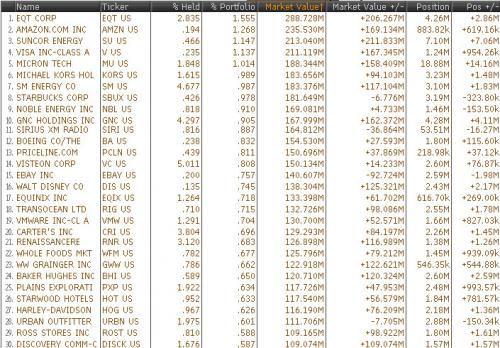
With The Unwind Approaching, Here Are $18.6 Billion SAC Capital’s Largest Stock Positions

With The Unwind Approaching, Here Are $18.6 Billion SAC Capital’s Largest Stock Positions

Tyler Durden on 05/25/2013 16:46 -0400

20130525_SAC1_0

Nearly three years ago, following the publishing of “Is The SEC’s Insider Trading Case Implicating FrontPoint A Sting Operation Aimed At S.A.C. Capital?” which exposed the key aspects of SAC’s insider trading strategy, and which linked SAC, and the hedge fund world in general, to expert networks three weeks before virtually anyone outside of the 2 and 20 (or 3 and 50 as the case may be) world had heard of them and before they became a household euphemism for insider trading, we expected the full rabid fury of the world’s best paid legal team to fall upon us. It didn’t, which meant only one thing: we were correct, or they had bigger fish (to avoid harpooning) on their mind. Turns out it was both. In the months and years following our publication, what we speculated has become fact, and as Vanity Fair’s Bryan Burroughs reports, some 71 people have now been convicted or admitted guilt in the case of the government vs Stevie Cohen. But the final blow against the formerly infallible hedge fund that redefined the concept of “information arbitrage”, and whose track record was almost as successful as that of Bernie Madoff, came from Blackstone, which as Reuters reported moments ago, has decided to pull all its money from SAC, which is the official end of SAC as an outside investment asset management operation. Read more of this post

What Detroit crisis? Pension fund trustees spend $22,000 of retirement system funds to hang out in Hawaii

What Detroit crisis? Pension fund trustees hang out in Hawaii

8:08am EDT

By Malia Mattoch McManus

HONOLULU (Reuters) – The city of Detroit may be facing a deepening financial crisis but that hasn’t stopped four trustees of its public pension funds from spending $22,000 of retirement system funds to attend a conference in Hawaii this week.

The trip 4,500 miles west to a four-star resort on the world-famous Waikiki Beach in Honolulu doesn’t sit well with the top officials now running Detroit’s finances under an emergency order from the state of Michigan. Emergency Manager Kevyn Orr has not ruled out a bankruptcy as the city struggles under a $15 billion debt burden, which is being strained further by its hefty pension obligations. Read more of this post

Chinese premier faces clash with local crime gangs; ‘In each of the other five provinces we studied, we found crime syndicates and underworld networks acting in a sort of symbiosis with local states’

Chinese premier faces clash with local crime gangs

May 24, 2013

John Garnaut

The good news for China, and economies such as Australia that rely on it, is that the new Chinese Premier has been conditioning his troops for a bracing round of market-oriented reforms.

”Reforming is about curbing government power, it is a self-imposed revolution, it will require real sacrifice, and it will be painful,” said Li Keqiang, setting the tone with his first comments as Premier on March 17. ”We need to leave to the market and society what they can do well.”

The bad news is that it was easier for Li’s predecessors to give power and resources away than it will be for him to take them back. The post-financial crisis mutation of the China model – rivers of credit, unfettered administrative power and appropriated household land – may have saved the economy in 2009 but it also entrenched a resource-extracting monster that will not easily be constrained. Read more of this post

A tussle in China over the Communist Party bowing to the Constitution; A movement in China to make the Communist Party subordinate to the national constitution has conservatives fighting back

A tussle in China over the Communist Party bowing to the Constitution

A movement in China to make the Communist Party subordinate to the national constitution has conservatives fighting back.

By Peter Ford, Staff writer / May 24, 2013

BEIJING

It is hard to imagine bloggers and tweeters in most parts of the world working themselves into a lather of intellectual excitement about “constitutional government.” Yet in China last Wednesday, the phrase was a trending search term on the country’s most popular social media platform, Sina weibo, yielding nearly 6 million results. By Friday, official censors had deleted nearly three quarters of those comments, in a sign that the subject is of more than academic interest. Indeed, it poses a question central to China’s future: Could the ruling Communist Party maintain its grip on power if it respected the national Constitution? Read more of this post

How Twitter Is Reshaping The Future Of Storytelling

How Twitter Is Reshaping The Future Of Storytelling

WRITTEN BY: Rita J. King

We might have fewer characters to work with, but we still hunger for narrative. New mediums aren’t destroying fiction, they’re allowing us to innovate even more in how we create and consume our stories. Plus: an appearance by John Hodgman!

Every five days, a billion tiny stories are generated by people around the world. Those messages aren’t just being lost in the ether, like the imaginary output of monkeys randomly attempting to produce the works of Shakespeare. Instead, the tweets are being archived by the Library of Congress as part of the organization’s mission to tell the story of America. The archive now includes 170 billion posts and counting.

The patterns of human life will be stored in this Twitter archive like a form of digital sediment. Every meme and revelation will leave an imprint in the record constructed of posts by half a billion Twitter users around the world (and over 150,000 more signing up every day).

How has the future of storytelling been influenced by Twitter? Read more of this post

Loyal cat won’t leave side of fatally struck companion

Loyal cat won’t leave side of fatally struck companion

2013-05-25 04:13:12 GMT2013-05-25 12:13:12(Beijing Time)  SINA.com

A pregnant cat was fatally struck by a vehicle and died on the side of a road in Changchun city, NE China’s Jilin province on May 23rd. A brown cat refused to leave the side of his companion for at least 7 hours and wouldn’t let any one, not even a dog, come close to the scene of tragedy.U47P5029T2D593509F28DT20130525121312U47P5029T2D593509F31DT20130525121312

The age of smart machines: Brain work may be going the way of manual work

The age of smart machines: Brain work may be going the way of manual work

May 25th 2013 |From the print edition

20130525_WBD000_0

IN HIS first novel, “Player Piano” (1952), Kurt Vonnegut foresaw that industry might one day resemble a “stupendous Rube Goldberg machine” (or as Brits would say, a Heath Robinson contraption). His story describes a dystopia in which machines have taken over brain work as well as manual work, and a giant computer, EPICAC XIV, makes all the decisions. A few managers and engineers are still employed to tend their new masters. But most people live in homesteads where they spend their time doing make-work jobs, watching television and “breeding like rabbits”.

It is impossible to read “Player Piano” today without wondering whether Vonnegut’s stupendous machine is being assembled before our eyes. Google has designed self-driving cars. America’s military-security complex has pioneered self-flying killing machines. Educational entrepreneurs are putting enlightenment online. Are we increasingly living in Vonnegut’s dystopia? Or are the techno-enthusiasts right to argue that life is about to get a lot better? Read more of this post

P&G Looks for Steve Jobs-Like Sequel by Recalling ex-CEO

P&G Looks for Steve Jobs-Like Sequel by Recalling ex-CEO

Much like turning to Star Trek and Iron Man sequels for a safe way to ensure box-office sales, recalling popular former leaders has become a reliable corporate script in times of crisis.

“It’s about confidence,” said James Post, a professor at Boston University School of Management. “People have the confidence that they understand the challenges. They can put their reputation on the table and help stabilize the ship.” Read more of this post

China’s First Modern: Lu Xun was his country’s foremost revolutionary in literature, if not always in politics

May 24, 2013, 12:54 p.m. ET

China’s First Modern

Lu Xun was his country’s foremost revolutionary in literature, if not always in politics.

By JULIA LOVELL

It’s hard to find a precise Western analogue for Lu Xun (1881-1936). He is China’s Dickens, for his mercilessly sharp portrayals of the era he lived through; he is Joyce, a re-maker of language and form. He has a good deal of Orwell, too, for his political commentary and the plain vernacular style that he championed. And, as a writer who in his final years became a figurehead of the literary left and was sanctified by his the Chinese communist leadership after his death, he has a touch of Gorky.

Lu Xun owes his immense literary reputation in mainland China primarily to his satirical fiction but also to the prose poems and polemical essays that he wrote in the last two decades of his life. In 1918, his surreal first short story in vernacular Chinese, “Diary of a Madman,” portrayed Chinese culture as cannibalistically eating its young. Its iconoclastic premise propelled him to the center of the New Culture Movement of the late 1910s. The two volumes of short fiction he produced between 1918 and 1925, “Outcry” and “Hesitation,” were admired for their portrayals of a China in a state of spiritual emergency: backward, impoverished and complacent. Read more of this post

How to Set the Foundations for B Grimm’s Next 135 years; B Grimm was established in 1878 and now is one of the oldest corporate citizens in Thailand.

Ways to sustain family business

Kwanchai Rungfapaisarn
The Nation May 25, 2013 1:00 am

Academic offers advice at workshop on B Grimm

In the era of globalisation, family-owned businesses are facing major challenges to ensure long-term sustainability. Christine Blondel, adjunct professor of entrepreneurship and family enterprise at the global business school INSEAD, said family businesses had some specific strengths and weaknesses. She said the major problems in such ventures were caused by family fights that flared up because they had no clear rules of the game. These internal battles occur because some family members work for the business while some do not, and they have not communicated enough. They do not understand enough what is going on in the business. Another risk occurs when family members lose the entrepreneurial spirit that made their business a success. One of the most important points is that they have to ensure that this spirit is kept alive from generation to generation. Blondel this week held a workshop titled “How to Set the Foundations for B Grimm’s Next 135 years” for the management and executives of that family-owned business, which was established in 1878 and now is one of the oldest corporate citizens in Thailand. Owned by the third generation of the Link family – Harald Link, chairman of B Grimm, and Caroline Link, president of B Grimm Real Estate – it is a multifaceted business active in the fields of energy, cooling, healthcare, lifestyle, transport and real estate. Read more of this post

‘Meddling’ business owners hold back growth

‘Meddling’ business owners hold back growth

Entrepreneurs need to stop being “meddlers, heroes and artisans” and adopt more of a hands-off, “strategic” role so their businesses can grow, according to the Cranfield School of Management. Cranfield said “becoming a strategist is necessary for leaders to outline a vision in order to grow the business and effectively motivate employees”. Photo: © Chris Ryan / Alamy

By James Hurley

1:28PM BST 24 May 2013

Too many British business owners can’t let go of routine tasks and spend too little time managing staff and planning their organisation’s future, the business school said. Research by Cranfield, based on its work with more than 1,500 business owners, identified four common leadership styles among business leaders: ‘strategists’, ‘meddlers’, ‘heroes’ and ‘artisans’. Only a small proportion of entrepreneurs are ‘strategists’, the ideal category, Cranfield said. This group “gives their managers the tools to do their job”, leaving the business owner to carry out future planning. ‘Meddlers’ hold back the growth of their business by holding on to day-to-day management tasks. “Staff are hired to take responsibility but are not empowered to do so and the boss isn’t making time to plan,” Cranfield said. Read more of this post

Growth in Options Trading Helps Brokers but Not Small Investors; Brokerage firms say that options, traditionally used by professional traders, can be profitable for ordinary investors, but this does not square with many investors’ experience

May 24, 2013

Growth in Options Trading Helps Brokers but Not Small Investors

By NATHANIEL POPPER

Some of the brokerage firms that helped pique American’s interest in stocks are now luring them into something much riskier: stock options.

As the stock market soars to new heights, E*Trade, Ameritrade and Charles Schwab are advertising the potential rewards of options, which give buyers the right to buy or sell stocks at predetermined prices in the future. Options, like their cousins, futures, have traditionally been the domain of Wall Street traders. But the brokerage firms say futures and options can be profitable for ordinary investors, too — a claim that, while true, does not square with many investors’ actual experience. Read more of this post

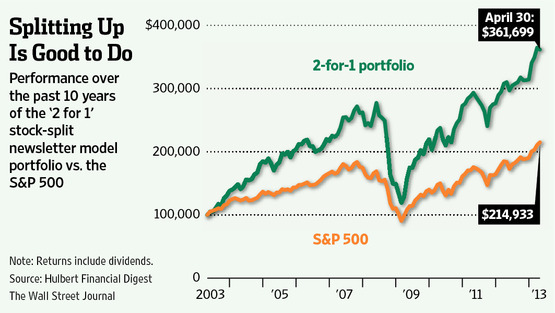
How to Use Stock Splits to Build a Winning Portfolio

May 24, 2013, 5:29 p.m. ET

How to Use Stock Splits to Build a Winning Portfolio

By MARK HULBERT

BF-AF027_HULBER_G_20130524130303

The price of Noble Energy NBL -1.15% shares will be cut in half this coming Wednesday, when the oil-and-gas-exploration company’s previously announced 2-for-1 split goes into effect. This will follow close on the heels of two other companies whose stocks this past week also fell because of 2-for-1 splits: consumer-products company Colgate-Palmolive CL +0.33% and A.O. Smith, AOS -0.10% a water-heater manufacturer. In fact, so far this year 25 NYSE or Nasdaq National Market companies have split their shares by 2 for 1 or more, according to data provider Mergent. The number of such companies has been rising steadily along with the bull market; for all of 2009, for example, there were just 12 such splits. Should you change your opinion of Noble Energy, or any of these other companies, just because they split their shares? It is difficult to see why you should. A 2-for-1 split, for example, merely means you now own twice as many shares that are worth half as much. But try telling that to Neil Macneale, editor of an investment-advisory service called “2 for 1,” whose model portfolio contains only those stocks that have recently split their shares, holding them for 30 months. Over the past decade, according to the Hulbert Financial Digest, that portfolio has produced a 14% annualized return, far outpacing the 8% gain of the Standard & Poor’s 500-stock index, including dividends. Read more of this post

Beware of ‘Bargain’ Stocks; Why a Low Share Price Alone Doesn’t Make for a Good Value

May 24, 2013, 6:14 p.m. ET

Beware of ‘Bargain’ Stocks

Why a Low Share Price Alone Doesn’t Make for a Good Value

By LIAM PLEVEN

BF-AF028_BARGAI_G_20130524174804

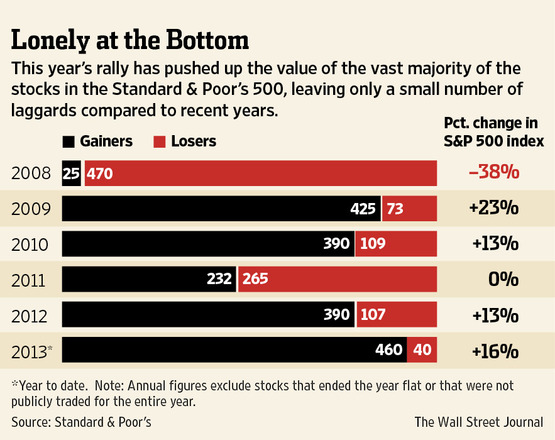
Bargain hunters shopping for underpriced U.S. stocks in the ongoing rally could end up with less than they bargained for. The pool of large-company stocks with prices that are lower than they were at the end of 2012 is getting perilously small. All but 40 of the stocks in the Standard & Poor’s 500-stock index are up so far this year. Just 35 others are up by less than 5%. The S&P 500 has jumped 16%, not including dividends, so far this year. U.S. stocks held firm Thursday despite a 7.3% drop in Japan, though the S&P lost 1.1% for the week. That so few stocks are in the red so far this year suggests the stragglers are unlikely to catch up to the overall market soon, experts say. For investors, that makes the discount bin a potentially risky place to buy. “I don’t believe the laggards are going to arise from the dead any time soon,” says Kim Forrest, a senior equity analyst at Fort Pitt Capital Group in Pittsburgh, which manages about $1.3 billion. Value investors like Ms. Forrest hunt for stocks of companies that are underappreciated and undervalued. It is an approach championed by Warren Buffettand many other bargain hunters. But a low share price isn’t the same thing as a good value, particularly if the weakness reflects some fundamental problem facing a company or its industry. Read more of this post

China’s consumers look for alternatives for their savings and their smartphones, at the expense of state firms

Updated May 24, 2013, 7:03 p.m. ET

China’s Consumers Fight Back, Explore Options

By TOM ORLIK And PAUL MOZUR

WO-AN907_CCONSU_G_20130524175703

BEIJING—On a freezing winter evening, Philip Chow jumped a long taxi line at Beijing’s airport by using an app on his smartphone that signaled to drivers he would pay a tip for a quick pickup. The app, called Didi Dache—Honk Honk, Catch a Cab—is among the latest examples of a new force sweeping China: consumer power. Chinese households are signaling impatience with government controls that cut against their interests. They have started to win important victories, not just finding ways around artificially low fare levels that reduce the number of taxis on Beijing’s streets, but also alternatives to high cellphone costs by state-run telecom firms and low interest on their savings in state-run banks. Read more of this post

Guns and sugar: More governments are insisting that weapons-sellers invest in side deals to help them develop their industries. This is a bad idea

Guns and sugar: More governments are insisting that weapons-sellers invest in side deals to help them develop their industries. This is a bad idea

May 25th 2013 | NEW YORK |From the print edition

20130525_WBD001_0

IMAGINE that Apple could sell iPhones in Brazil only if it ploughed 20% of its projected revenues there into local technology firms. That may sound absurd, but this is what happens when governments buy arms from foreign contractors. In procurement it is standard to supplement the main deal with a side contract, usually undisclosed, that outlines additional investments that the winning bidder must make in local projects or else pay a penalty. Welcome to the murky world of “offsets”.

The practice came of age in the 1950s, when Dwight Eisenhower forced West Germany to buy American-made defence gear to compensate for the costs of stationing troops in Europe. Since then it has grown steadily and is now accepted practice in 120 countries. It has its own industry newsletter and feeds a lively conference circuit. The latest jamboree, hosted by the Global Offset and Countertrade Association, was held this week in Florida. Defence executives, officials and middlemen gathered there amid forecasts that the industry could double in size over the next few years. Yet its very structure serves to mask a build-up in the unrecognised financial liabilities of companies. It also, critics argue, fosters corruption, especially in poorer parts of the world. Read more of this post

China’s SOEs face poor profit prospects

China’s SOEs face poor profit prospects

English.news.cn   2013-05-24

BEIJING, May 24 (Xinhua) — With China’s state-owned enterprises (SOEs) posting growth of just 5.3 percent from January to April this year, prospects for the SOEs’ profitability in 2013 remain poor, analysts said. The SOEs saw their total profit growth slow to 5.3 percent year on year to reach 689.13 billion yuan (111.32 billion U.S. dollars) in the first four months, according to the Ministry of Finance (MOF). The growth rate was lower than the 7.7-percent increase recorded for the first quarter and average growth of 5.8 percent in 2012, official data showed. The SOEs lost their position as the country’s most profitable sector in 2012, when China COSCO Holdings Co., the country’s largest shipping company, lost 9.56 billion yuan after a deficit of 10.45 billion yuan for 2011. Read more of this post

Phil Mathews, the Sydney-based hedge fund manager of Sabre Fund nominated by Barron’s as the best performing manager in the world, is under investigation by the corporate watchdog ASIC

Hedge fund manager under investigation by ASIC

PUBLISHED: 16 HOURS 9 MINUTES AGO | UPDATE: 4 HOURS 47 MINUTES AGO

Exclusive | Reclusive hedge fund manager Phil Mathews, who made his fortune punting on speculative energy stocks, is under commercial pressure and his trading practices are being investigated by the corporate watchdog.

Phil Mathews’ $1 billion oil win

Alan Kohler10 Jun 2008, 7:35 AM1

Phil Mathews, the Sydney-based fund manager nominated by Barron’s as the best performing manager in the world, seems to have made a billion dollars in May alone from oil futures. It looks like he is now personally worth as much as $2 billion as a result of his incredible oil bet. That would make him Australia’s 13th richest person, just ahead of Lang Walker and behind John Gandel, except the BRW rich list editors haven’t discovered him yet. His Sabre Fund ended April with $906 million; it is now worth around $2 billion. He has told me that the three funds he manages are now worth around $3 billion. About two-thirds of the money in the funds is believed to be in his name. Read more of this post

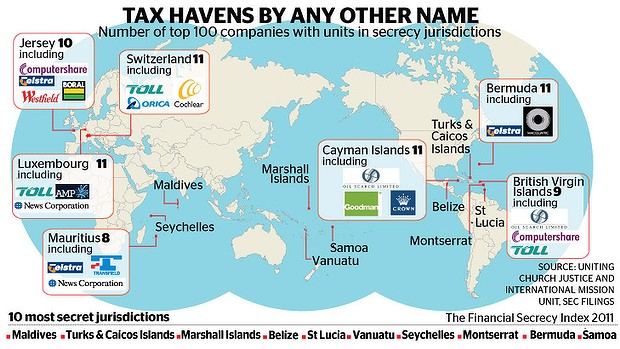
With almost two-thirds of Australia’s top 100 companies listed on the stock exchange have subsidiaries in tax havens or low-tax jurisdictions, there are fears the structures are being used to minimise tax

Island allure: The tax secrets of big business

May 25, 2013

Georgia Wilkins and Ben Butler

2505tax_729px--1--620x349

With many of Australia’s largest companies owning offshore subsidiaries in exotic locations, there are fears the structures are being used to minimise tax. ‘The rules… were developed for the industrial age’ said Assistant Treasurer David Bradbury. Very few Australians will have heard of Burdekin Investments, one of the thousands of low-profile post-box companies that makes its home at Ugland House, a resort-style office building in George Town, the capital of Caribbean tax haven the Cayman Islands. It keeps a much lower profile than its parent, Australia’s biggest company, Commonwealth Bank, whose logo is proudly borne by the group’s branches on shopping strips across the country. But thanks to tax authorities and governments desperate to plug budget gaps, tax-haven companies such as Burdekin are getting more attention. There have already been investigations into the tax paid by technology multinationals in Britain and Australia, and this week the US followed suit, with the powerful Senate permanent subcommittee on investigations inquiring into the tax affairs of Apple.

Read more of this post

Korea’s prosecution may seek an arrest for CJ Group Chairman Lee Jay-hyun on charges of tax evasion, stock manipulation and breach of trust

2013-05-24 18:26

CJ chairman may face arrest

The prosecution may seek an arrest for CJ Group Chairman Lee Jay-hyun on charges of tax evasion, stock manipulation and breach of trust, a senior prosecutor said Friday.
The Seoul Central District Prosecutors’ Office (SCDPO) wants to take the 53-year-old businessman into custody for questioning about his role in dodging tens of billions of won of income tax, manipulating stocks of CJ’s affiliates and damaging the group’s interest by helping his siblings, the prosecutor said. Investigators suspect Lee did not pay at least 10 billion won of income tax while trading stocks of affiliates, such as CJ Corp., CJ CheilJedang and CJ E&M, using “borrowed” names. CJ Corp. is the group’s holding company, while CJ CheilJedang and CJ E&M are its flagship food and entertainment firms. Lee is suspected of manipulating those stock prices using slush funds hidden in foreign banks based in Switzerland, Singapore and Hong Kong. As the funds are from foreign countries, they were taken to be foreign investors, which helped boost the stock prices of the companies. In Korea, foreign investors’ stock purchases are seen as a “buy signal” for local investors, and their trade patterns affect the market greatly. In terms of the breach of trust allegation, investigators are looking into why CJ Corp. bought CJ America’s financially-weak affiliate, which Lee’s sister Lee Mi-kyung owned, damaging the company’s value. Chairman Lee is the major shareholder of CJ Corp., the holding company of the group. Lee may face up to 11 years in prison if the allegations are true. According to the related laws, those who take more than 30 billion won in illegal gains from stock manipulation are subject to up to 11 years jail term. Charges of breach of trust and tax evasion vary from four to 11 years in prison according to the amount of money. Investigators have obtained credible evidence, including testimony from a former executive who handled the company’s finances, that Lee hid as much as 350 billion won in more than 300 different bank accounts in Hong Kong, according to prosecution sources. They suspect CJ also established special purpose companies in the British Virgin Islands, a well-known tax haven, to evade taxes and create slush funds. Prosecutors are also expanding their probe into allegations Lee transferred part of a secret fund worth 50 billion won to his two offspring, without paying gift taxes. Read more of this post

Newstapa, also known as the Korea Center for Investigative Journalism (KCIJ), is at the center of a storm of controversy after it published the first list of 245 Koreans who own offshore front companies

2013-05-23 17:07

‘Newstapa’ rocks nation

By Kang Hyun-kyung

Newstapa, also known as the Korea Center for Investigative Journalism (KCIJ), is at the center of a storm of controversy after it published the first list of Koreans who own offshore front companies.

The independent Internet news provider is the only Korean media outlet which is part of the global project, “Secrecy for Sale: Inside the Global Offshore Money Maze,” spearheaded by the International Consortium for Investigative Journalism (ICIJ). Read more of this post

China Plans to Reduce the State’s Role in the Economy? Prime minister Li Keqiang’s speech to party cadres contains some of the boldest pro-market rhetoric they have heard in more than a decade

May 24, 2013

China Plans to Reduce the State’s Role in the Economy

By DAVID BARBOZA and CHRIS BUCKLEY

SHANGHAI — The Chinese government is planning for private businesses and market forces to play a larger role in its economy, in a major policy shift intended to improve living conditions for the middle class and to make China an even stronger competitor on the global stage.

In a speech to party cadres containing some of the boldest pro-market rhetoric they have heard in more than a decade, the country’s new prime minister, Li Keqiang, said this month that the central government would reduce the state’s role in economic matters in the hope of unleashing the creative energies of a nation with the world’s second-largest economy after that of the United States. Read more of this post

Myanmar’s currency has plunged more than 7% over the past month to the lowest since it was floated last year, raising concern about economic stability in Asia’s newest democracy

Saturday May 25, 2013

Kyat slumps as imports flood into Myanmar

YANGON: Myanmar’s currency has plunged more than 7% over the past month to the lowest since it was floated last year, raising concern about economic stability in Asia’s newest democracy.

The drop coincides with a construction boom in Myanmar’s commercial capital, Yangon, which is fuelling demand for dollars as builders import equipment and materials, part of a scramble by investors to tap one of the world’s last frontier markets after an easing of sanctions by Western countries.

Money changers such as Kyaw Naing say people are hoarding dollars, expecting further rises, in the first major bout of currency speculation since Myanmar emerged from military rule in March 2011 and introduced political and economic reforms. Read more of this post