What You Need To Learn From Groupon’s Unprofitable Business Model

What You Need To Learn From Groupon’s Unprofitable Business Model

George Roberts, OpenView Venture Partners | Mar. 21, 2013, 5:36 PM | 1,587 | 4

A little more than two years ago, Groupon was the apple of the startup community’s eye. It had turned down a $6 billion acquisition offer from Google and was headed for a remarkable IPO. Today, no one really knows what Groupon’s future holds. But it doesn’t look good.

Since its IPO in November of 2011 (the largest by a U.S. Internet company since Google raised $1.7 billion in 2004), the company’s stock has plummeted. After debuting at $20, Groupon’s stock can now be had for less than $6 a share. Adding insult to injury, Groupon’s market cap is now almost $2.5 billion less than Google’s original offer.

Now, to be fair, Groupon’s current stock price of around $5.38 is more than double what it was in November when it hit rock bottom. But I’m guessing that nice gain doesn’t quite make up for the billions that investors have watched fly out the window in the last year.

Where Did Groupon Go So Wrong?

When it comes to entrepreneur leadership lessons (which is the theme of this series of posts), the company’s management team — including its much-maligned former CEO, Andrew Mason — forgot that building a sustainable business is a marathon, not a sprint.

Ultimately, that led to a series of bad decisions, many of which Fast Company’s Noah Fleming does a great job of highlighting in a post from last October. But the business’s most damning mistake was its disproportionate focus on new customer acquisition, often at the expense of customer retention.

Groupon was obsessed with growing as fast and as big as it possibly could, which resulted in high churn and, as Slate’s Farhad Manjoo points out, a business model that is just about anything but profitable. Read more of this post

AD OF THE DAY: What If Men Had Women’s Hair?

AD OF THE DAY: What If Men Had Women’s Hair?

Dominic Green | Mar. 21, 2013, 8:51 PM | 3,495 | 4

A new Dove commercial from Brazil investigates the question of what it would be like if men had hair like that seen in commercials for shampoo. It spends a lot of time waving seductively in the breeze, it turns out, even if you’re just sitting in the office. Upon realizing his hair has become long, shiny, and altogether too beautiful, the male protagonist sprints home to fix the problem with Dove Men + Care.

Lies, Damned Lies, and Chinese Statistics; Who’s cooking Beijing’s books? Ingrained belief that boosting morale through exaggerated claims was more important than reporting reality

Lies, Damned Lies, and Chinese Statistics

Who’s cooking Beijing’s books?

BY TOM ORLIK | MARCH 20, 2013

On Wednesday, U.S. Treasury Secretary Jack Lew met with China’s Premier Li Keqiang, a crucial first meeting between new representatives of the world’s two biggest economic powers. Lew’s interlocutor sits at the top of the world’s second-largest economy — a country whose GDP reachedapproximately $8.3 trillion in 2012. But how accurate are the statistics that illuminate China’s growth? Even Li himself has said (as quoted in a U.S. State Department cable published by WikiLeaks) that China’s GDP figures are “man-made” and therefore unreliable. In this excerpt from his book, Understanding China’s Economic Indicators, Wall Street Journal China reporter Tom Orlik explains how to get to grips with China’s data. Read more of this post

What Should China Do with 18 Mln Pigs Carcasses Every Year?

03.21.2013 19:40

Closer Look: What Should China Do with 18 Mln Pigs Carcasses Every Year?

The appearance of thousands of carcasses in a Shanghai river shows how much work the government has to do on a major public health issue

By staff reporter Gong Jing

More than 10,000 dead pigs have been pulled out of a Shanghai river that provides drinking water to 23 million people over two weeks, raising health concerns. Even worse, there have been reports that many dead pigs were processed and sent to people’s dining tables.

Behind all of this is the issue of disposing of pigs that dies from disease, an area that regulators have long neglected.

Yu Kangzhen, an expert from the Ministry of Agriculture, said that an investigation has not found an epidemic at farms in Jiaxing, a city in Zhejiang Province believed to be the source of the animals found in Shanghai’s Huangpu River.

Information from other sources backs Yu. There has been no significant rise in pig deaths in Jiaxing this year. As a major pig farming city, Jiaxing raised about 4 million of the animals every year. If a normal death rate from disease is used, about 3 percent, this means the city has to handle about 120,000 dead pigs per year.

China raises more pigs than any other country in the world. Rough statistics show that it had nearly 700 million pigs in 2012. That means, about 18 million pigs died of disease every year.

How does China handle such a large number? The ministry says pigs that die from disease are usually buried or burned. But in reality, many farmers illegally sell them or simply dump the carcasses. Read more of this post

As Pollution Worsens in China, Solutions Succumb to Infighting

March 21, 2013

As Pollution Worsens in China, Solutions Succumb to Infighting

By EDWARD WONG

Pollution-articleLarge

Smog veiled the China Central Television Building in Beijing last week. Air pollution hit record levels in north China last month.

BEIJING — China’s state leadership transition took place this month against an ominous backdrop. More than 13,000 dead pigs were found floating in a river that provides drinking water to Shanghai. A haze akin to volcanic fumes cloaked the capital, causing convulsive coughing and obscuring the portrait ofMao Zedong on the gate to the Forbidden City.

So severe are China’s environmental woes, especially the noxious air, that top government officials have been forced to openly acknowledge them. Fu Ying, the spokeswoman for the National People’s Congress, said she checked for smog every morning after opening her curtains and kept at home face masks for her daughter and herself. Li Keqiang, the new prime minister, said the air pollution had made him “quite upset” and vowed to “show even greater resolve and make more vigorous efforts” to clean it up.

What the leaders neglect to say is that infighting within the government bureaucracy is one of the biggest obstacles to enacting stronger environmental policies. Even as some officials push for tighter restrictions on pollutants, state-owned enterprises — especially China’s oil and power companies — have been putting profits ahead of health in working to outflank new rules, according to government data and interviews with people involved in policy negotiations. Read more of this post

LME copper inventories at 10-year high; Level is the highest since China’s industrialisation was in its infancy

March 21, 2013 8:02 pm

LME copper inventories at 10-year high

By Jack Farchy in London

Copper inventories on the London Metal Exchange have risen to their highest level since 2003, in the latest sign of the copper market’s shift into oversupply.

LME copper stocks have risen 165 per cent since October, amid an increase global mine production and slower purchases from China, which has seen a rapid build-up of copper stocks in recent years.

On Thursday stocks on the LME rose 6,625 tonnes to 557,450 – the highest since October 2003, when the commodities supercycle driven by China’s industrialisation was still in its infancy.

Although LME stocks only represent one chunk of global inventories, they are closely watched by traders and analysts as an indication of the amount of surplus metal that is readily available to deliver into the market. Read more of this post

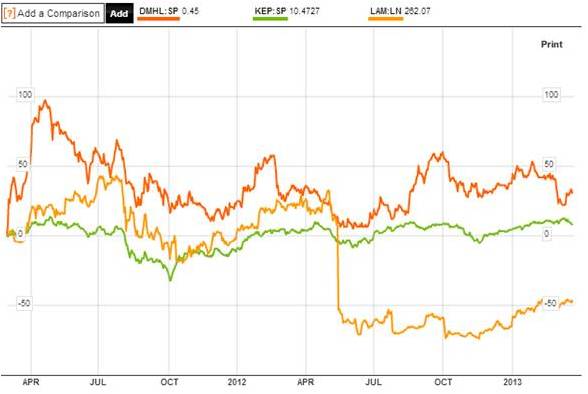
Offshore Marine Boom? Oil rig engineering specialist Lamprell posts $110m loss on cost overruns

March 21, 2013 4:31 pm

Lamprell posts $110m loss on cost overruns

By Michael Kavanagh

Picture2Picture1

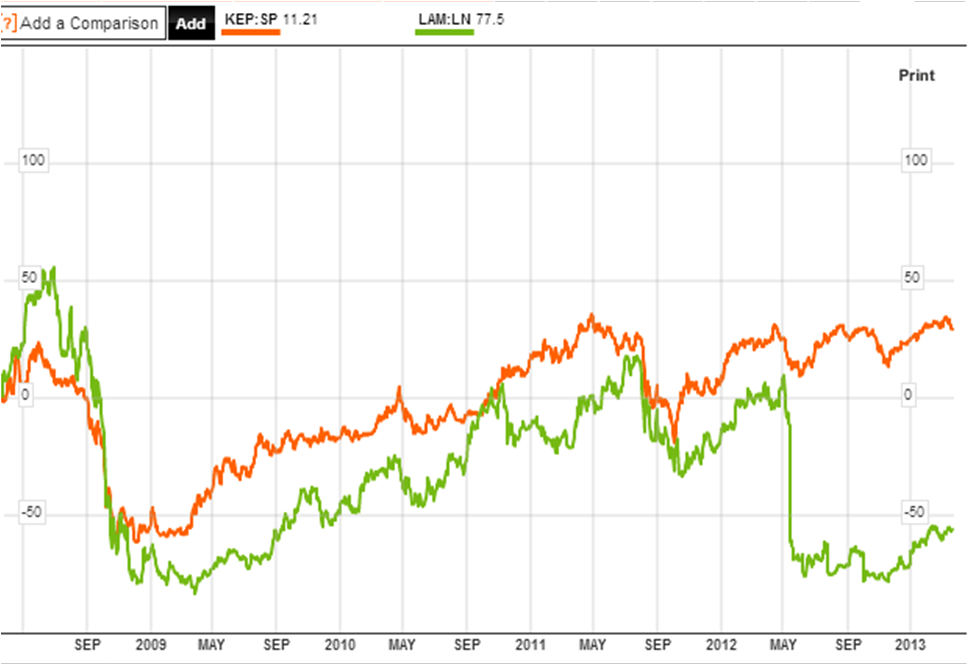
Lamprell, the specialist engineering group, set out plans for a return to break-even on trading this year after delivering a $110m loss prompted by cost overruns and penalties on key projects.

The Dubai-based contractor, which specialises in oil and gas rig construction and repair and the building of vessels used to install wind turbines, was on Monday fined £2.4m by the Financial Services Authority for failing to update the market properly on its worsening financial position in early 2012. Read more of this post

A Strange Computer Promises Great Speed

March 21, 2013

A Strange Computer Promises Great Speed

By QUENTIN HARDY

QUANTUM-articleLarge-v2

VANCOUVER, British Columbia — Our digital age is all about bits, those precise ones and zeros that are the stuff of modern computer code.

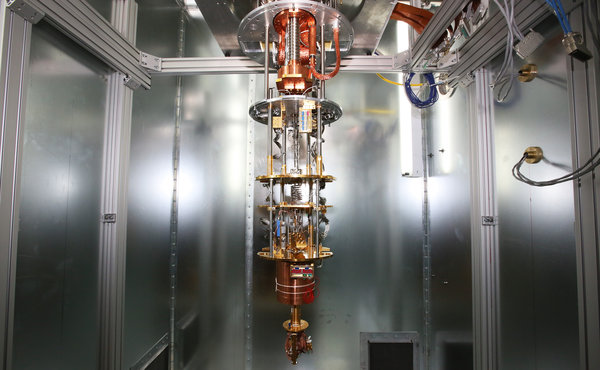
But a powerful new type of computer that is about to be commercially deployed by a major American military contractor is taking computing into the strange, subatomic realm of quantum mechanics. In that infinitesimal neighborhood, common sense logic no longer seems to apply. A one can be a one, or it can be a one and a zero and everything in between — all at the same time.

It sounds preposterous, particularly to those familiar with the yes/no world of conventional computing. But academic researchers and scientists at companies like Microsoft, I.B.M. and Hewlett-Packard have been working to develop quantum computers.

Now, Lockheed Martin — which bought an early version of such a computer from the Canadian company D-Wave Systems two years ago — is confident enough in the technology to upgrade it to commercial scale, becoming the first company to use quantum computing as part of its business. Read more of this post

China’s rail reform skirts big question: Who pays? China’s massive high-speed rail expansion is likely to cost over $100 billion a year. The funding for it has been pure folly.

China’s rail reform skirts big question: Who pays?

March 21, 2013: 12:36 PM ET

China’s massive high-speed rail expansion is likely to cost over $100 billion a year. The funding for it has been pure folly.

By John Foley, Reuters Breakingviews

FORTUNE — China’s massive rail expansion is good for the economy. Burying it under $420 billion of debt isn’t. The long awaited dismantling of China’s sprawling Ministry of Railways and creation of a new rail company, announced on March 10, is a good moment to change track.

A grand plan to double track length to 120,000 kilometres between 2010 and 2015 is likely to cost over $100 billion a year. It’s worth it. As well as comfort, prestige and low emissions, rail is the ticket to better urbanization. A recent World Bank report calculated that the benefits to a city of better connectivity from high-speed rail could be almost as large as those from saving passengers time and operating costs.

The funding, though, has been pure folly. Projects depend on borrowing from Chinese state banks and issuing bonds — which in turn are mostly bought by the banks. The resulting debt, on a notional 6% interest rate, would require $25 billion a year of interest payments. Passengers aren’t rich enough to cover that cost. Read more of this post

Formula 1 racing driver Jenson Button has urged young people to study science, technology, engineering and maths in school, arguing that the drama and glamour of racing wouldn’t exist without the world’s cleverest scientists and engineers.

Jenson Button: Young people should stick with science and maths

Formula 1 racing driver Jenson Button has urged young people to study science, technology, engineering and maths in school, arguing that the drama and glamour of racing wouldn’t exist without the world’s cleverest scientists and engineers.

jenson-button_2514713b

By Louisa Peacock

1:37PM GMT 21 Mar 2013

The McLaren driver is backing a campaign, run by Britain’s biggest pharmaceuticals company GlaxoSmithKline in partnership with McLaren, to inspire young people to stick with STEM subjects in school.

As part of the campaign, budding scientists are being challenged to devise a test which could be used to improve a Formula 1 driver’s reactions.

Winning schools will be given an opportunity to visit the McLaren Technology Centre and put their test into action with one of the team.

Mr Button said: “The speed, drama, noise and glamour of Formula 1 may seem very different from a school science lesson, but our sport wouldn’t exist without the tireless work and dedication of some of the world’s cleverest scientists, engineers and mathematicians.

“That’s why I think it’s so important for young people to stick with maths and science at school. In the future they might just find themselves designing a new grand prix car, or working in the pits analysing telemetry data. And, while not everyone can be a racing driver or work in Formula 1, maths and science can open up some amazing opportunities.” Read more of this post

Volio Aims for Videos That Simulate Conversation

Volio Aims for Videos That Simulate Conversation

By Brad Stone on March 21, 2013

tech_volio13__01__630x420

Rodney Cutler, hairstylist and grooming columnist for Esquire magazine, is giving styling advice via iPad. “I’ll be honest, curly long hair is tricky,” he says in his Australian brogue. “But we can make it work so you don’t look like a throwback from the ’80s. We’ve got to make sure you are using the right product. What are you using in your hair at the moment?”

“Head & Shoulders,” says the iPad user.

“You know, that’s why I’m here,” he grimaces. “For me, that’s not the best product for the look you are trying to achieve.” He recommends a leave-in conditioner. Except “he” isn’t Cutler at all, but a series of videos designed to simulate a conversation with him.

For years the technology world has promised the ability to speak with computers. Services like Siri and Google (GOOG)Voice Search allow people to convey specific commands and receive answers. Volio, a San Francisco startup that produced Cutler’s conversational grooming video for the new Talk to Esquire iPad app, has a more ambitious goal: creating an entirely new media format it calls participatory video. Companies will be able to use Volio’s tools to set up conversational videos of people that users can interact with, learn from, and, if they’re mischievous, try to stump. “We’re not trying to fool anybody,” says Ronald Croen, Volio’s founder and chief executive officer. “But if this is done well, we’ll create the experience of talking to a real human being.” Read more of this post

Fab.com: Winning in E-Commerce With Whimsy

Fab.com: Winning in E-Commerce With Whimsy

By Brad Stone on March 21, 2013

tech_fab13__01__304tech_fab13__04inline__605

Photograph by Jeremy Liebman for Bloomberg BusinessweekBradford Shellhammer (left) and Jason Goldberg

Products on shopping site Fab.com are often so campy and overstylized that words fail to describe them: They are … fabsurd? Colorfully described in daily e-mails to Fab’s 12 million registered customers are items such as “In the Seam Animal Pals” (pillows molded into shapes of pets) and the “Awmoo Red” (a spherical bong fashioned by designers “after years of hiding their unsightly water pipes”). In mid-March, the site’s supply of dangling, sterling silver earrings in the shape of attacking sharks, priced at $58, sold out in an hour.

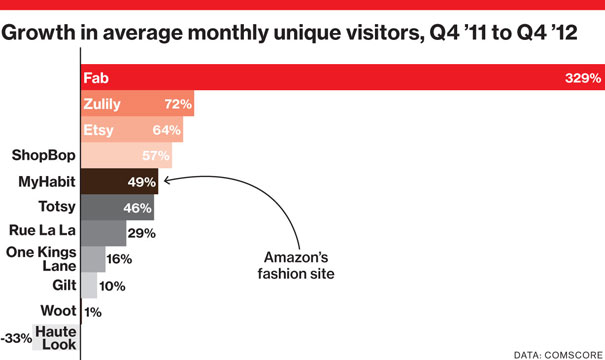
While it’s tempting to dismiss such items as hipster indulgences, Fab.com is as close as it gets to a hot new e-commerce property. The store “for everyday design” is packed with kitsch in kitchenware, furniture, fashion, and electronics. It tripled its customer base last year and now gets close to 3 million visitors a month, according to ComScore (SCOR). The 600-employee company has amassed $150 million in venture capital to build warehouses, improve shipping time, expand into Europe, and team up with manufacturers. This spring it will depart the ranks of aggregated retail and unveil lines of private-label goods, including luggage, linens, and jewelry, branded with its name and sensibility—edgy, amusing, and typically over the top. Read more of this post

Biosimilars Lure Major Drugmakers Into the Generics Biz; Generic medicine makers may have a harder time succeeding with biologic drugs, which are dynamic and more difficult to replicate.

Biosimilars Lure Major Drugmakers Into the Generics Biz

By Makiko Kitamura and David Wainer on March 21, 2013http://www.businessweek.com/articles/2013-03-21/biosimilars-lure-major-drugmakers-into-the-generics-biz

Call it the Revenge of Big Pharma. Generic drug companies such as Teva Pharmaceutical Industries (TEVA) have made billions since the late 1980s by reverse engineering best-selling drugs that came off patent—escaping hefty development and marketing costs—and selling them cheaply. When it comes to copying the best-selling treatments that are coming off patent today—a category known as biologics, medicines produced using the body’s own cells rather than through chemical reactions in a lab—the companies with the expertise to develop and market them are pharmaceutical giants. That leaves companies like Israel-based Teva, the largest maker of generics, increasingly on the sidelines.

The biologics losing patent protection over the next six years had total annual sales of $47 billion in 2012, according to Bloomberg Industries. However, the rules of the lucrative knockoff drug game are being altered. The derivatives of biologics, known as biosimilars, are far more complex to make than chemical generics. Drug companies that want to sell copies of biologic medicines such as Roche Holding’s (RHHBF) $7 billion-a-year rheumatoid arthritis treatment Rituxan require expertise and money to produce and market to the public and physicians. “There’s this dawning realization that biosimilars are in many ways the same as branded products,” says Duncan Emerton, Datamonitor Consulting’s biosimilars practice leader. Read more of this post

IMF: borrowing is back to pre-crisis levels; Meier didn’t actually invite listeners to read between the lines of all the numbers he was presenting, but the meaning was clear to the veterans in the auditorium.

IMF: borrowing is back to pre-crisis levels

22 March 2013

Author: Simon Osborne

Are we meant to cheer, or boo? Borrowing is back to where it was in 2007. In Asia, gearing ratios are back at 96%, the same level as they were pre-crisis. Is that good or bad? Was it not borrowing that got us into this fine mess? “It might be ok now, but given a few years of that trend, that view might change,” says Andre Meier, the International Monetary Fund’s resident representative in Hong Kong, at the Private Equity International Asia Forum. He adds the Chinese are gearing up, last year recording 17% bank loan growth, 80% for Trust loans, 40% for corporate bonds and 30% for entrusted loans. He looked mellow about the bank loan growth, but was that a flicker of a conservative frown for the other three? “These markets are yet to be tested in strained scenarios. For example, there has been no default yet in Chinese domestic corporate bonds.” He pointed a stern finger at a slide with vertiginous lines showing that Dim Sum Bond issuance was $25bn in 2011, $250bn now, and QFII was $75bn in 2011, $140bn now. “The average ratio of credit to GDP is higher now than it was in 1997, the boom is striking.” All those in the audience who were in high school in 1997 smiled. Yes, yes, this is all good news of boom and prosperity……….isn’t it? Capital flows in funds are rushing back to Asia at a rate of $1.75bn per week this year, compared to outflows in 2011. That money is chasing the 7.5% GDP growth that the IMF predicts for Asia in each of the next two years. However, if some “reversal” took place, (could he mean a once-in-a-century crisis that-nobody-sees-coming that now seems to happen every other year), then Asia is vulnerable, as money could be pulled out again. Non-resident holdings of Indonesian, Malaysian and Thai government debt are at 35%, 30% and 25%. Would foreigners whisk their money out of Asia if something goes wrong? Tick, that sounds plausible. He sees less tail risk in Europe, thanks to the ECB medicine in 2012, and growth being shored up elsewhere, and a slump being prevented – by the Bank of England quadrupling the size of its balance sheet, and the Fed multiplying its by 3.5x. Meier didn’t actually invite listeners to read between the lines of all the numbers he was presenting, but the meaning was clear to the veterans in the auditorium.

The Odd, Enduring Power of ‘Praying Hands’; How a 16th-century sketch became an international symbol for piety—and an inspiration for kitsch; “Without a doubt, it’s the most famous drawing in the world. In every gas station, in every bank behind the teller, you have an image of the ‘Praying Hands’.”

Updated March 21, 2013, 8:32 p.m. ET

The Odd, Enduring Power of ‘Praying Hands’

How a 16th-century sketch became an international symbol for piety—and an inspiration for kitsch

By ANNA RUSSELL

AR-AB849_Bottom_DV_20130321174906AR-AB850_Prayer_G_20130321175148

DRAWING POWER: Albrecht Dürer

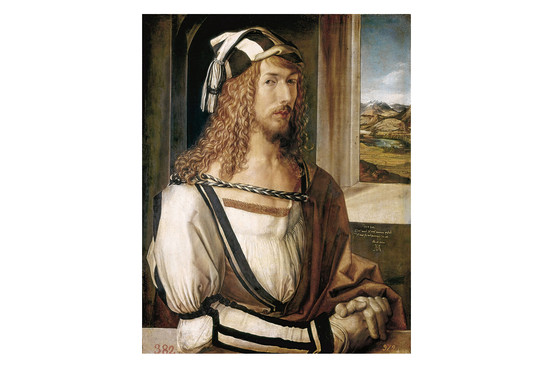
The image at the center of Albrecht Dürer’s drawing “Praying Hands” has traveled a long way from its roots in the German Renaissance. It is the most enduring work by one of the greatest draftsmen in the history of Western art, but it has also taken on a pop-culture life of its own, all over the world.

It is found on posters, dishes, washcloths, urns, aprons, coffee mugs, cellphone cases and pocketknives—and tattooed onto Justin Bieber‘s leg. Its likeness appears on Andy Warhol’s tombstone. Singer and songwriter Trey Bruce has a song called “Velvet Elvis and Prayin’ Hands.” Of the many tattoo takes on the image, one of the more exotic is that of pro basketball player Stephen Jackson, of the San Antonio Spurs, who has on his torso a rendering of “Praying Hands”—holding a handgun.

Now, the real thing will be on view at the National Gallery in Washington. The last time the drawing came to the U.S. was in 1984-85, when it was shown in Washington and New York. From Sunday through June 9, the museum will host “Albrecht Dürer: Master Drawings, Watercolors, and Prints From the Albertina,” comprising 118 works on loan from the Albertina Museum in Vienna.

“Without a doubt, it’s the most famous drawing in the world,” says Andrew Robison, a senior curator of prints and drawings at the museum. And one of the most appropriated. “In every gas station in the South, in every bank behind the teller, you have an image of the ‘Praying Hands,’ ” says Mr. Robison, who grew up in Memphis, Tenn. Read more of this post

Because of bias and ignorance, Western companies in Singapore have failed to build up local leadership and talent in their management

PUBLISHED MARCH 22, 2013

Western firms don’t build up local talent: study

Their competitive edge in Asia may be hurt in long haul if such practices stay

BY CHUANG PECK MINGPRINT |EMAIL THIS ARTICLE

[SINGAPORE] Because of bias and ignorance, Western companies in Singapore have failed to build up local leadership and talent in their management, says a study backed by the Tripartite Alliance for Fair Employment. And it warns that this may blunt the competitive edge of these multinational corporations in Asia in the long haul. “Our research shows that Singaporean talent brings unique strengths to leadership and organisational success, yet we observe that local employees often do not rise up through organisations to secure leadership positions,” says Kate Verson, a co-author of the study titled “Adopting an Asian lens to talent development – a Singapore study”. “There is a concern that approaches towards talent development may not be truly inclusive and that companies are potentially overlooking key local talent in the pipeline,” she adds.

Keep flats simple and affordable: Ex-HDB chief Dr Liu Thai Ker; the man who played a pivotal role in Singapore’s successful public housing programme in the early years yesterday made the call to return to the basics.

Keep flats simple and affordable: Ex-HDB chief

SINGAPORE — As the debate rages on over the role and nature of public housing, following National Development Minister Khaw Boon Wan’s call earlier this month to relook the long-term direction, the man who played a pivotal role in the Republic’s successful public housing programme in the early years yesterday made the call to return to the basics.

BY NG JING YNG –

4 HOURS 52 MIN AGO

SINGAPORE — As the debate rages on over the role and nature of public housing, following National Development Minister Khaw Boon Wan’s call earlier this month to relook the long-term direction, the man who played a pivotal role in the Republic’s successful public housing programme in the early years yesterday made the call to return to the basics.

Forget the bells and the whistles, and build more flats than needed — the end goal is affordability, said Dr Liu Thai Ker, whose 20-year career in the Housing and Development Board (HDB) began in 1969 when he was the head of the Design and Research Section.

He rose through the ranks to become its Chief Architect and ultimately, the Chief Executive Officer, before he left in 1989 to become the CEO and Chief Planner of the Urban Redevelopment Authority.

And his call was backed by former Senior Minister of State and HDB Chairman Aline Wong, who reiterated that the purpose of public housing is to “provide a shelter over everybody’s heads”.

“The asset part comes along because … property appreciates over a long time. But that is not our primary objective. People make money, accumulate savings … but we cannot promise that they will not lose (value in their property), depending on the property cycle,” she said. Read more of this post

Chinese university invents world’s lightest material; It is also exceptionally strong and is able to recover its original form after being compressed up to 80% over a thousand times. It can absorb oil 250-900x its volume

Chinese university invents world’s lightest material

Staff Reporter

2013-03-21

102474838-184804F_2013資料照片_copy1

The aerogel produced by Chinese scientists is so light that it can be placed on a flower. (Photo/Xinhua)

Chinese scientists have successful developed an aerogel that they claim is the lightest material in the world. The density of the gel is only one sixth of air at 0.16 milligrams per cubic centimeter, 0.04 milligrams lighter than aerographite, a substance produced by German scientists last year which hitherto held the record.

Scientists led by professor Gao Chao from the Department of Polymer Science and Engineering at Zhejiang University, produced the aerogel by freezing graphene with a carbon nanotube, removing their liquid components and keeping only their structures, according to Chinese science website Science and Technology Daily.

The aerogel is so light that a mug made of the material would be able to perch on a green foxtail and would not bend a hair of the plant, said professor Gao.

It is also exceptionally strong and is able to recover its original form after being compressed up to 80% over a thousand times. It can absorb oil 250-900x its volume. Existing oil absorbers can only take in up to 10x their volume.

Professor Gao said that the material could be used to soak up oil leaks in the world’s oceans. Once the aerogel is soaked with the oil, people can squeeze the oil out and reuse the aerogel, according to the Chinese-language Dushi Kuaibao, published by the local Hangzhou Daily. Read more of this post

McDonald’s franchises in China need 5 years to break even

McDonald’s franchises in China need 5 years to break even

Staff Reporter

2013-03-21

McDonald’s franchises in China may need up to five years before they break even, according to the Shanghai-based First Financial Daily. Chinese investors interested in taking up a new McDonald’s franchise must pay an initial fee of 2 million yuan (US$320,000) and must also pay for the building itself, equipment and other additional costs, including monthly franchising operations and advertising fees. An outlet may need to operate for five years before it starts to see a profit, based on the current sales of a typical McDonald’s restaurant and the increasing cost of running a business in the country, analysts say. The US fast food giant is continuing to expand its China network, with new franchises licensed in Hunan province last September, and the Jiangsu Rongjin Group obtaining franchise rights last October. McDonald’s has also opened more outlets in Fujian and Sichuan provinces, according to sources familiar with the business.

McDonald’s is one of the world’s highest-grossing fast food chains and derives its profits from other channels in addition to its burgers, selling franchising and property as well as renting out its outlets. The company reported operating revenue of US$9.9 billion in 2011. Total business from its restaurants, franchising fees and rents accounted for 32%, 23% and 45% of operating revenue, respectively. However, the company has failed to successfully apply its standard business model in China. Rival KFC beat McDonald’s into China and has held the lead in terms of revenue and expanding its franchises over the past 20 years. McDonald’s hopes to expand its network in mainland China from 1,500 to 2,000 restaurants by the end of 2013 and 20%-30% of its restaurants will be franchise outlets by 2015. According to analysts, McDonald’s should work more closely with agents within China to better understand the local market.

Chart Of The Day: China PMI Vs Electricity Production

Chart Of The Day: China PMI Vs Electricity Production

Tyler Durden on 03/20/2013 22:13 -0400

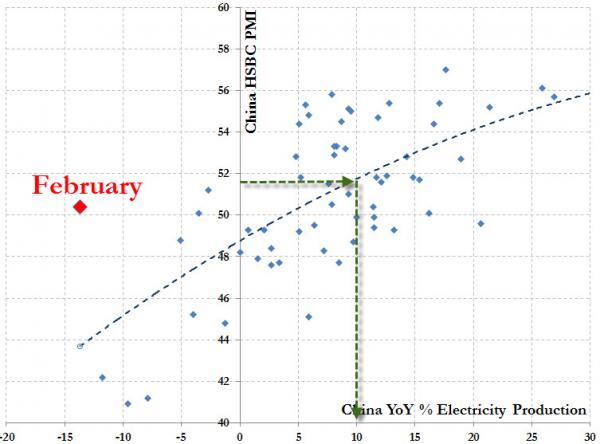
HSBC’s China Flash PMI just printed above expectations at 51.7, disappointing those hoping for more stimulus but just Goldilocks enough to satisfy the world that China is firing on all cylinders… But, and there’s always a but, the following chart suggests that the diffusion-driven survey-based PMI data may be just a little different from the hard data on the ground. Of course, everything could have magically turned around in the last 3 weeks (aside from Copper demand and PBoC repo/rev. repo that is). For now, we tip our hat to the well planned PMI print as indicative that all is well in the smog-ridden pig-barren nation but scratch our chin at just what is powering all this growthiness… HSBC’s Flash PMI upticked more than expected but remains in that neverland zone… and here are the stunning sub-indices showing the ‘surges’ – hhmm – employment? pricing? even New Export Orders are in ‘fence-sitting’ mode… But when judged against the history of a relatively tight relationship to Electricity production… is it any wonder we call it the Chart of the Day… It seems we are about to witness a jump from -13% YoY decline (as we discussed here the largest ever) to a +10% YoY rise in the span of just one month…

20130320_chinapmi_2_0

Brene Brown, author of “Daring Greatly: How the Courage to be Vulnerable Transforms the Way We Live, Love, Lead”, interviewed by Oprah in a two-part episode of “Super Soul Sunday”

Brene Brown interviewed by Oprah in a two-part episode of “Super Soul Sunday”

Posted by: Kate Torgovnick
March 20, 2013 at 5:30 pm EDT

On Sunday, Oprah Winfrey revealed that she and TED speaker Brené Brown are “soul mates.” As the pair sat down for an in-depth discussion on Super Soul Sunday— part one of which aired last Sunday, with part two to air next Sunday — they excitedly talked about many of the concepts which Brown raised in her classic TED Talk, “The power of vulnerability.” One interesting moment came when Brown shared a counterintuitive thought on what scares us the most. “As someone who studies shame and scarcity and fear, if you asked me, ‘What is the most terrifying, difficult emotion we experience as humans?,’ I would say joy,” says Brown. “When we lose our tolerance for vulnerability, joy becomes foreboding. So what we do in moments of joyfulness is we try to beat vulnerability to the punch … We try to dress-rehearse tragedy.” In fact, says Brown during the first part of this intervie,  fear seems to be an ever-present part of our experience. “I think there’s a thin film of terror wrapped around us,” says Brown. “If it’s not, ‘I’m not safe enough’ or ‘I’m not secure enough,’ it’s ‘I’m not liked enough,’ ‘I’m not promoted enough,’ ‘I’m not loved enough’ … at the very bottom, ‘I’m not good enough.’”

The most unbelievable rainbows around the world

The most unbelievable rainbows around the world

(People’s Daily Online)  08:18, March 21, 2013  

F201303210808553273936227

A rare picture of beautiful rainbow clouds floating over Mount Everest. 

F201303210808551149510252

A double rainbow hangs on the sky of Dartmouth, Devon, UK. The British photographer has spent seven years for this moment. He had taken more than 2,000 similar photos before he successfully captured the perfect moment of the double rainbow

F201303210808541170712402

A rainbow observed in Ishigaki City, Okinawa, Japan. The rainbow was reflected by the moonlight.

F201303210808553247111431

A rainbow shows above the Niagara Falls while an American is performing tightrope walking

How emoji conquered the world; The story of the smiley face from the man who invented it

How emoji conquered the world

The story of the smiley face from the man who invented it

By Jeff Blagdon on March 4, 2013 11:46 am Email @jeffblagdon

emoji1_1020

In 1995, sales of pagers were booming among Japan’s teenagers, and NTT Docomo’s decision to add the heart symbol to its Pocket Bell devices let high school kids across the country inject a new level of sentiment (and cuteness) into the millions of messages they were keying into telephones every day. Docomo was thriving, with a bona fide must-have gadget on its hands and market share in the neighborhood of 40 percent. But when new versions of the Pocket Bell abandoned the heart symbol in favor of more business-friendly features like kanji and Latin alphabet support, the teenagers that made up Docomo’s core customer base had no problem leaving for upstart competitor Tokyo Telemessage. By the time Docomo realized it had misjudged the demand for business-focused pagers, it was badly in need of a new killer app. What it came up with was emoji.

Shigetaka Kurita is the man who created emoji, and during his time at Docomo he saw the shift happen first-hand. He was part of the team working on i-mode — a project that was just beginning to take shape, but would be the world’s first widespread mobile internet platform, combining features like weather forecasts, entertainment reservations, news, and email. i-mode would prove so popular that it would completely engulf the country, giving Japan’s mobile internet a nearly 10-year lead internationally. Initially, though, the i-mode team needed ideas, and in order to get a look at other work already being done on mobile internet applications, Kurita and others visited San Francisco in 1998 to check out AT&T’s Pocket Net.

It was the first service in the world to provide amenities like email and weather forecasts over a cellular network, and using AT&T’s new cellular digital packet data (CDPD) service, it was capable of transfer speeds of 19.2Kbps. (In comparison, an average US LTE connection today is around 9.6Mbps, or about 500 times faster). “At the time, the specs on the devices were really poor, so they weren’t able to display images, for example,” Kurita explains. Pocket Net had weather news, but things like ‘cloudy’ and ‘sunny’ were just spelled out in text. The lack of visual cues made the service more difficult to use than it ought to be, and Kurita recognized that AT&T’s mobile experience would benefit majorly from some extra characters for contextual information. Read more of this post

China’s Hidden Debt Risk

China’s Hidden Debt Risk

20 March 2013

Zhang Monan. Zhang Monan is a fellow of the China Information Center, a fellow of the China Foundation for International Studies, and a researcher at the China Macroeconomic Research Platform.

BEIJING – In the last 200 years, there have been more than 250 cases of sovereign-debt default, and 68 cases of domestic-debt default. None of these was an isolated incident. Indeed, such defaults – combined with factors like large current-account or fiscal deficits, overvalued currencies, high public-sector debt, and insufficient foreign-exchange reserves – have always triggered financial crises, from the Mexican peso crisis in 1994 to the Russian ruble crisis in 1998 to the American subprime mortgage crisis in 2008.

Since China’s era of reform and opening up began, the country has experienced three instances of large-scale public-finance problems. In the late 1970’s, the country faced a debilitating fiscal deficit. In the 1990’s, its corporate sector was plagued by “triangular debts” (when a manufacturer that has not been paid for its product is unable to pay its suppliers, which in turn struggle to pay their suppliers). Later that decade, financial institutions were burdened by bad debts generated by state-owned enterprises.

Now China is experiencing a fourth instance of elevated debt risk, this time characterized by high levels of accumulated local-government and corporate debt. To be sure, China’s national balance sheet, which boasts positive net assets, has garnered significant attention in recent years. But, in order to assess China’s financial risk accurately, policymakers and economists must consider the risks that lie in the country’s asset structure – and the liabilities that are not included on its balance sheet. Read more of this post

Swedish business is being cast as a model for long-term stability and growth; the Swedish model of active ownership of companies – the distinctive way Sweden has placed corporate power not with management but with shareholders who are obliged to elect board directors and be involved in big strategic decisions

March 20, 2013 6:52 pm

Scandinavia: Model management

By Richard Milne

Swedish business is being cast as a model for long-term stability and growth

The two men joke, finish each other’s sentences and defend the other from attack. “You start!” jokes one when the subject turns sensitive.

But behind this veneer of camaraderie, the two are rivals: Börje Ekholm and Anders Nyrén are two of Sweden’s most important businessmen, heading the holding companies that together control more than half of Stockholm’s stock exchange.

For the first time in the 69 years that their two companies – Mr Ekholm’s Investorand Mr Nyrén’s Industrivärden – have existed side by side their chief executives have agreed to give a joint interview.

The subject that has brought them together is the Swedish model of active ownership of companies – the distinctive way Sweden has placed corporate power not with management but with shareholders who are obliged to elect board directors and be involved in big strategic decisions.

With a structure that promotes long-term thinking, the Swedish model is attracting interest worldwide from regulators and governments looking to head off financial crashes. Some think that adapting the model’s tenets could reduce the short-term thinking that can damage companies, while also boosting local industry. Read more of this post

Big Data Can Bring Patients to Water But It Can’t Make Them Think; Aetna can tell its members if they’re likely to develop cardiovascular disease. It does this by tracking data from lab results, pharmacy data and claims data of its 18 million members

March 20, 2013, 7:30 PM ET

Big Data Can Bring Patients to Water But It Can’t Make Them Think

Michael Hickins

As it prepares to vie for new business from some of the 30 million additional people entering health exchanges through the Affordable Care Act next year Aetna Inc. is looking to analytics as a means of lowering the cost of some coverage. According to Michael Palmer, head of innovation for the Hartford, Conn.-based insurance company, Aetna is using a new analytic platform to predict which ailments its members are likely to contract over the coming year in order to lower the odds that they will develop cardiovascular disease, one of the more expensive and endemic diseases it has to cover.

This information could help improve health outcomes for patients, dramatically lowering health care costs for themselves, their employers and Aetna itself, says Mr. Palmer. “Better outcomes also lead to better costs. It’s a virtuous cycle,” he told CIO Journal Wednesday after a presentation at the Structure: Data conference in New York. But Mr. Palmer also noted that it’s difficult to get people to act on the information they’re given, even if it’s for their own good.

For example, Aetna can tell its members if they’re likely to develop cardiovascular disease. It does this by tracking data from lab results, pharmacy data and claims data of its 18 million members, looking for data showing that a given individual suffers from three of any of five factors – high cholesterol, high blood pressure, low HDL (so-called good cholesterol), high triglyceride levels, and abdominal girth – all of which are indicative of metabolic syndrome. “We found we can predict at the individual level the probability of their getting metabolic syndrome in the coming year,” Mr. Palmer said. Read more of this post

Biggest Solar Collapse in China Imperils $1.28 Billion; China’s Solar Billionaire Undone as Banks Push Suntech to Brink

Biggest Solar Collapse in China Imperils $1.28 Billion: Energy

Investors stand to lose most of the $1.28 billion they put into Suntech Power Holdings Co. (STP) after the solar manufacturer said it wouldn’t resist a bankruptcy petition filed in China.

The company, based in Wuxi, outside Shanghai, had more than $2 billion in debt and defaulted on $541 million in bonds due on March 15, prompting eight Chinese banks to ask a local court to push Suntech’s main unit into insolvency.

“There’s a host of companies that have gone to Wall Street investors and gotten billions of dollars, and these investors are ultimately going to be on the hook and get nothing out of it,” Angelo Zino, an analyst at Standard & Poor’s Financial Services LLC in New York, said in an interview yesterday. Read more of this post

Facebook Targeted in U.S. as Asian Chat App Line Invades

Facebook Targeted in U.S. as Asian Chat App Line Invades

Line, the Asian chat app that reached 100 million users about three times faster than Facebook Inc. (FB), is putting growth before profit to take on the U.S. social-networking giant and Twitter Inc. in their own backyard.

With 38 percent of its users in Japan, developer NHN Japan Corp. is honing plans to expand Line’s reach, setting up a U.S. marketing team and planning joint promotions and content- delivery agreements with local companies. NHN Japan is still at an investment phase as it targets as many as 1 billion customers globally, said Jun Masuda, chief strategy and marketing officer.

“This year, we want to capture North America,” Masuda said. “We’re not focused on being in the black. It isn’t time to cash in yet.”

Known for cartoon characters and other “stickers” that users can include in chat messages, Line is among several apps from Asia challenging Facebook, Twitter and Microsoft Corp.’s Skype as a way of communicating via mobile devices. South Korea’s KakaoTalk is looking to Vietnam and Indonesia to expand past 82 million users; China’s WeChat has about 300 million.

Line reached the 100 million-user mark 19 months after its June 2011 debut, compared with 49 months for Twitter and 54 months for Facebook, according to NHN Japan. Read more of this post

Easy money over for Asian junk bonds; 50% of January deals are now trading underwater

Easy money over for Asian junk bonds

Bankers and investors warn high-yield bonds from Asian issuers face headwinds due to compressed spreads.

By Jame DiBiasio | 21 March 2013

After a banner year of issuance, capped by a record $10.6 billion issued in January 2013, investors in Asian high-yield debt face a tougher environment.

“Income will dominate and capital appreciation will be limited,” says Bryan Collins, portfolio manager at Fidelity Worldwide Investments.

Tim Jagger, head of Asian fixed income at Aviva Investors, says that in contrast to the equity-like returns that investors enjoyed in 2012, this year they will only make money from the coupon of Asian high-yield bonds.

Julian Trott, head of debt syndication for Asia ex-Japan at Goldman Sachs, says 50% of those January deals are now trading underwater. He expects credit investors will return to high grade instruments. “There will be more discrimination of high yield by investors,” he says. Read more of this post

Alibaba’s Jack Ma outlines e-commerce vision for China

Jack Ma outlines e-commerce vision for China

The founder of Alibaba Group speaks to investors at an annual Credit Suisse conference ahead of stepping down as CEO in May.

By Anette Jönsson | 21 March 2013

In five years, e-commerce will account for 30% of total retail sales in China, Alibaba chairman and CEO Jack Ma said yesterday in a passionate speech that displayed his unwavering belief in the continuing development of the sector.

“Traditional businesses still think e-commerce is a business model. It is not, it is a lifestyle,” he told the audience at Credit Suisse’s Asian Investment Conference, adding that in 10 years nobody will talk about e-commerce as it will be a natural part of everyone’s lives, just like nobody is talking about electricity today.

The Alibaba Group, which includes Taobao, the popular consumer-to-consumer online shopping platform, and business-to-consumer sales platform Tmall.com, currently account for about 5% of total retail sales in China, said Ma, who called his 30% forecast “very conservative.”

According to Ma, e-commerce in the US is like a dessert – a supplement for traditional businesses. The infrastructure is so good in the US that it is difficult for a pure online company to grow to surpass the traditional businesses. But in China, because the infrastructure is so bad, e-commerce becomes the main course, he said. Read more of this post