Buffett Says Bet on Natural Juices of Market; “Never bet against what humans can accomplish if they’re operating in the right soil. And we have the right soil.”

Buffett Says Bet on Natural Juices of Market

Warren Buffett, the billionaire chairman of Berkshire Hathaway Inc. (BRK/A), said investors should bet on the “natural juices” of capitalism in the U.S. even as lawmakers struggle to narrow the budget deficit.

People tend to “focus too much on what the government’s done, and to give them either credit or blame,” Buffett said in an interview conducted by the chief executive officer of Business Wire, the Berkshire subsidiary that distributes press releases. “The real credit belongs to our system.”

Buffett, 82, has used annual letters to shareholders and public appearances to highlight the prospects for the world’s largest economy, where most of Berkshire’s operations are based. He’s also called for an increase in taxes on the wealthiest individuals to help reduce budget deficits and forestall cuts, an approach that Republicans say would hurt growth.

The U.S. economy “is coming back because of the natural juices of capitalism and not because of government,” Buffett told Business Wire’s Cathy Baron Tamraz in a video interview posted online today. “We have a wonderful system that eventually is self-cleansing and always moves forward.” Read more of this post


Fending off university-attacking zombies; Educators worldwide are moving away from a narrow and term-limited skills focus, and towards what one might call “renewable competencies”

Fending off university-attacking zombies

naylor

David Naylor, Special to Financial Post | 13/03/14 | Last Updated:13/03/14 3:26 PM ET

Last week, David Naylor, the president of the University of Toronto, made a speech to Empire Club of Canada members about what he describes as educational zombies — government and industry calls for more job-specific education at universities and more research aligned with industry needs. His speech was timely in that it responded to a growing chorus of criticism in the media and industry circles that a university education is no longer a ticket to meaningful and gainful employment, and that the ideals of a liberal arts education are no longer sufficient to prepare graduates for the workforce. Following is the abridged text of Mr. Naylor’s remarks.

12

Earlier this week, the University of Toronto made a wonderful decision in naming Meric Gertler as my successor as President.  As my term winds down, I have to say that it has been an extraordinary privilege to serve the University of Toronto community.

At the same time, impending retirement does mean that I am now something of a zombie…lurching around for a while in a transitional state.  And who better than a zombie president to tackle two zombie ideas about higher education and advanced research?

You may ask:  What’s a zombie idea?  Well, it’s one of those persistent and infectious pieces of misinformation, a meme that shouldn’t be alive but just won’t die.

There are two zombie ideas that trouble me these days.

Zombie 1:  Universities ought to produce more job-ready, skills-focused graduates.  Stop all this liberal arts guff and this social science silliness.  What Canada needs to compete and win in the world economy are more folks with college diplomas, and universities that focus on preparing people for careers — for the real world.

Or, as the Governor of Florida memorably put in a radio interview 18 months ago: “You know, we don’t need a lot more anthropologists in the state.  It’s a great degree if people want to get it, but we don’t need them here.”

Zombie 2:  Those ivory towers full of fat-cat academics and loopy students asking unanswerable questions.  Their wilful irrelevance is a waste of taxpayers’ money.  Get them out of the public trough and get them doing things that Canadian business can really use.

The reason these zombie ideas are dangerous is not just because decision makers in the U.S. and Canada have been infected by them.  They are also hard to destroy because there is unquestionably some truth, and therefore some life, to both of them. Read more of this post

Meet the next generation of Indian technology firms—and the obstacles they face

Meet the next generation of Indian technology firms—and the obstacles they face

Mar 16th 2013 | MUMBAI |From the print edition

20130316_WBT903_020130316_WBC239_0

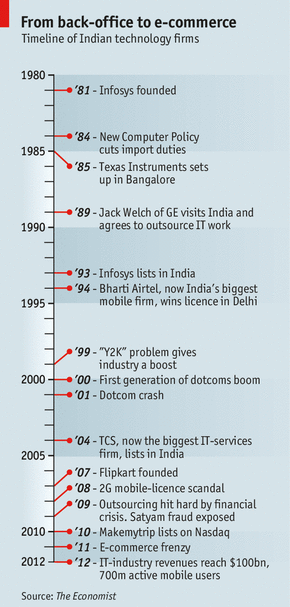
SIGNS of middle age were obvious at a recent gathering of Nasscom, the club for India’s giant IT industry, which now has sales of $100 billion and is dominated by outsourcing firms. The venue was a hotel in Mumbai, a five-star fortress of foyers and finger food. The guests of honour were politicians. Grey-haired, well-fed executives sat and talked in jargon. It was hard to spot anyone close to India’s median age of 26. Things have come a long way since 1981 when Infosys, a bellwether Indian IT firm, was founded in a flat by seven hungry engineers with $250.

Yet if you walk to the exit of that hotel and reject the option of an expensive limousine, or of hailing a bashed-up street taxi, and instead press “Book now” on your phone screen, another Indian tech scene appears. The application links a network of taxis using satellite positioning, cheap Chinese-made smartphones, souped-up Google maps and credit cards. A 6km (4-mile) drive north in a modern car will deliver you to a snack shop, above which is the firm that runs the system. Olacabs was set up in 2010. Its co-founder, Bhavish Aggarwal, is a 26-year-old engineer who has worked for Microsoft in Seattle. He has raised a slug of venture capital, some of it American, and says business is growing at 30% a month. “When you start you are viewed as a fool,” he says. “But if you are worried about that, you’re in the wrong line of work.” His goal is to transform transport in India’s congested cities.

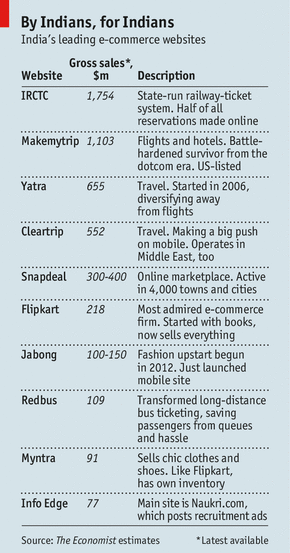
India needs a million Olacabs: start-ups that use technology to overcome everyday problems. The economic benefits would be huge. And in a country with a stuffy business culture, in which commercial and political dynasties are all too common, a technology revolution would be a colossal breath of fresh air. It would help unleash the energy of a generation of young people. But will it happen? Read more of this post

Brainbox nation: America remains the world’s biggest spender on R&D, though others are inching up

Brainbox nation: America remains the world’s biggest spender on R&D, though others are inching up

Mar 16th 2013 |From the print edition

20130316_SRC098

IT IS NOT much to look at: an anonymous suburban office building, wedged between a shopping mall and a car dealership. Yet the Defence Advanced Research Projects Agency, or DARPA, has had a hand in many of the most celebrated technologies of the age, from the internet to global positioning systems to radar-foiling stealth aircraft. Its boss, Arati Prabhakar, jokes about having invented fire.

DARPA remains gamely engaged in research that to outsiders sounds like science fiction. Its Living Foundries programme, for example, is trying to work out how to use microbes to detect and repair worn or corroded materials. Blood Pharming aims to create a kit to grow blood from a culture for battlefield transfusions. ChemBots is investigating robots that can change their shape to squeeze through small openings and then reconstitute themselves on the other side.

America puts more into R&D than any other country, and agencies like DARPA are in the vanguard. Yet by the National Science Foundation’s latest count, in 2009, the country’s share of global spending on R&D had fallen to 31%, from 38% in 1999. As a share of GDP its expenditure now ranks only ninth in the world, at almost 2.9%. Investment in research even fell slightly in absolute terms for a couple of years during the recession, whereas in other countries it continued to grow quickly. China’s outlays, for instance, raced ahead by 20% a year in the decade to 2009. Read more of this post

IBM Spent A Million Dollars Renovating And Staffing Its Former CEO’s Office

IBM Spent A Million Dollars Renovating And Staffing Its Former CEO’s Office

Max Nisen | Mar. 20, 2013, 8:21 AM | 1,843 | 1

Sam Palmisano was an excellent CEO for IBM. During his decade or so in charge of the company, he successfully transitioned it away from hardware into a services and software powerhouse.

Still, details in IBM’s latest proxy statement raised eyebrows this week. In addition to providing a historically large exit salary, the company disclosed it is paying around a million dollars to staff and furnish an office for its retired CEO.

Palmisano’s retirement package is worth approximately $271 million, according to Footnoted.com‘s Michelle Leder, who has been analyzing SEC filings since 2003.

According to the Wall Street Journal, if that figure is correct, Palmisano’s would be one of the 10 highest CEO pay packages in history. Only six US CEOs have left with packages valued in excess of $200 million.  Read more of this post

SocGen’s Black Swan Risk Map

HERE IT IS: SocGen’s Black Swan Risk Map

Sam Ro | Mar. 19, 2013, 8:49 AM | 3,543 | 4

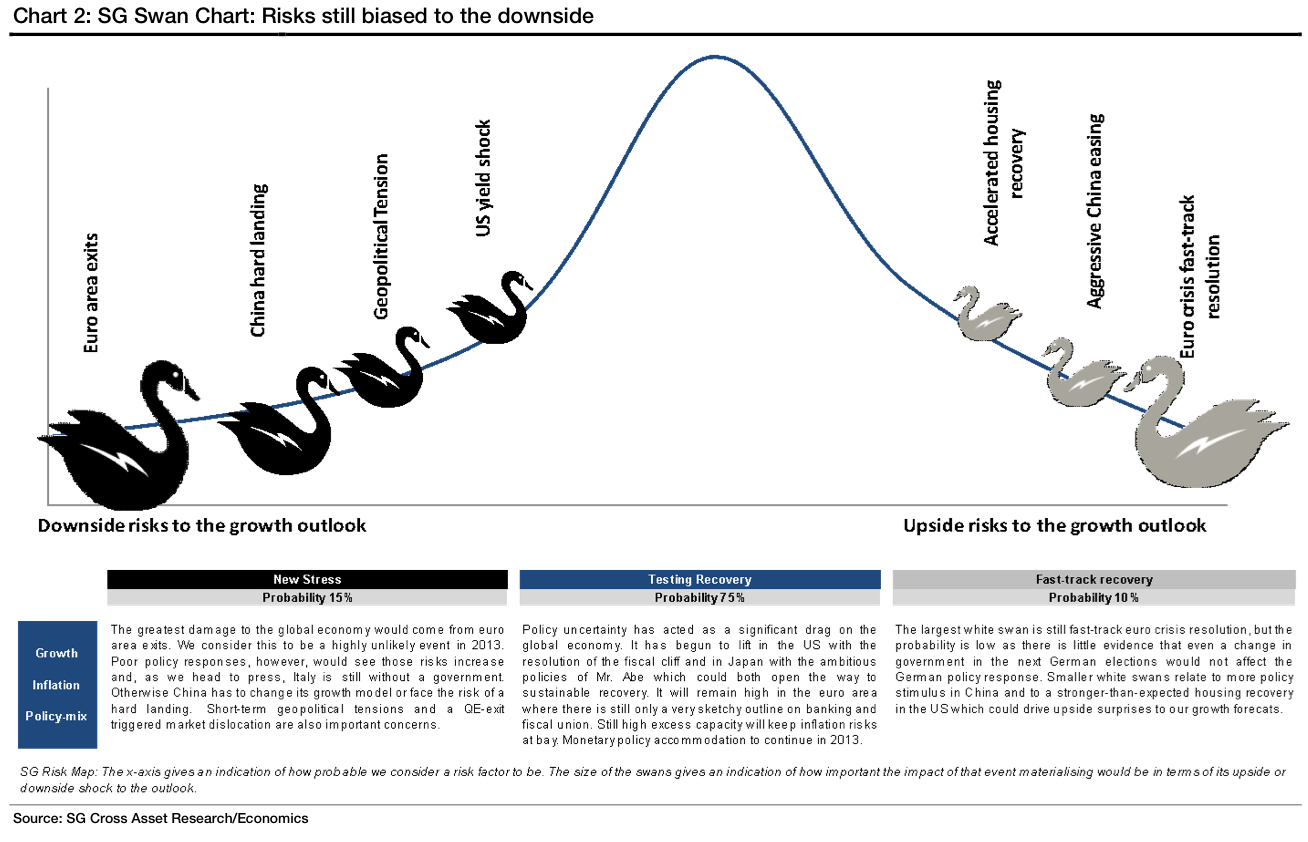
Here’s Societe Generale’s review of some of the tail risks, or unlikely scenarios, out there.  For now, they believe we should be more worried about the downside risks.

screen shot 2013-03-19 at 8.23.34 am

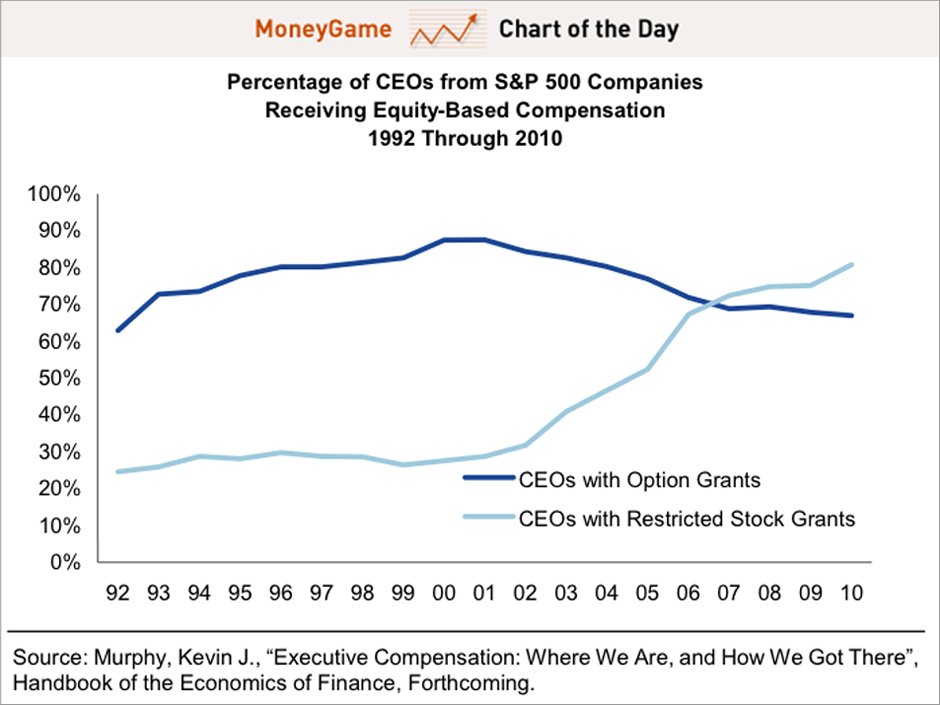
CHART OF THE DAY: The Most Outrageous Reason Why A Company Would Raise Its Dividend; senior management are compensated in options that are much more likely to increase dividends

CHART OF THE DAY: The Most Outrageous Reason Why A Company Would Raise Its Dividend

Sam Ro | Mar. 19, 2013, 8:18 AM | 1,477 | 

moneygame-cotd-031913 Read more of this post

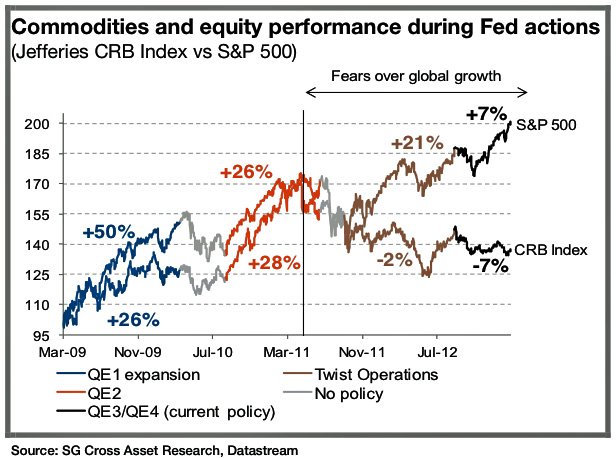
The Fed’s Effect On Commodity Prices Has Vanished

The Fed’s Effect On Commodity Prices Has Vanished

Sam Ro | Mar. 18, 2013, 10:04 PM | 3,682 | 5

chart-625 Read more of this post

How Data Science Is Advancing the “Nudge” to Influence Mobile Behaviors

How Data Science Is Advancing the “Nudge” to Influence Mobile Behaviors

MARCH 19, 2013 AT 2:43 PM PT

Dr. Olly Downs is SVP of Data Sciences for Globys, a big data analytics company that specializes in contextual marketing for mobile operators.

Have you added two dollars to your grocery bill to benefit a local charity? Decreased your power usage after being shown how much your neighbors were using? Had better aim when using a urinal with the image of a fly etched into the porcelain? If you answered yes, then consider yourself “Nudged.” And yes, the urinal approach is actually being used in Amsterdam’s Schiphol Airport restrooms.

Attributed to Richard Thaler and Cass Sunstein in their best-selling book “Nudge: Improving Decisions about Health, Wealth, and Happiness,” a “Nudge” is a signal — which could be contextual or environmental versus written or verbal — that changes the behavior or decision that a human will make.

The original test of this theory was in a Chicago school district where they changed how food was laid out in the school cafeteria. This had a 35 percent positive impact in the consumption of healthier foods, without actually restricting the overall choices of foods available.

Leveraging a variety of different strategies, such as default settings, information as incentive and right context, companies have proven the ability to change someone’s behavior through a successful Nudge. Read more of this post

India’s World Startup Report Is Released And The Future Of Technology Looks Bright For The Country

India’s World Startup Report Is Released And The Future Of Technology Looks Bright For The Country

DREW OLANOFF

posted yesterday

Read more of this post

Singapore’s leading inventor Nelson Cheng: ‘I go around looking for trouble’

Singapore’s leading inventor: ‘I go around looking for trouble’

pspatent01

S’pore’s leading inventor Nelson Cheng reveals how he comes up with ideas. -TNP
Jennifer Dhanaraj

Wed, Mar 20, 2013
The New Paper

SINGAPORE – Meet Singapore’s leading inventor.

And when he says “eureka” – it is potentially worth a couple of million dollars.

Mr Nelson Cheng, 56, is the president and founder of local chemical company Magna International.

According to the Intellectual Property Office of Singapore (Ipos), while the Agency for Science, Technology and Research (A*Star) – the nation’s lead agency for scientific research – has consistently been the local leader in applying for patents, the individual who has obtained the most patents is Mr Cheng.

He has eight patents locally – which, according to him, already have a commercial value of “hundreds of millions”.

When we meet him in his office on Enterprise Road, the wall of its conference room is adorned with gold and silver certificate plaques of successful patent grants from all over the world.

In all, he has filed 16 patents worldwide. These include ones in Taiwan and the European Union for the same inventions that he has patented here. This is to “protect his inventions” in overseas markets.

“Every time I am awarded a patent, I still feel immense joy. It never gets old,” he says with a twinkle in his eye.

His innovations range from biodiesel lubricants to corrosion inhibitors that can be used in the commercial, industrial and even military sectors.

Mr Cheng filed his first patent with Ipos in 2007 – and it was a long, drawn out process. Read more of this post

Why Workers Welcomed Long Hours of Industrial Revolution

Why Workers Welcomed Long Hours of Industrial Revolution

Writers and academics often show an interesting ambivalence about industrialization. Today, they regard it as a blessing, the single-most-effective way to lift people out of poverty. But in thinking about Britain’s Industrial Revolution, they have tended to reach the opposite conclusion: The rise of the factory, they argue, caused the end of more “natural” working hours, introduced more exploitative employment patterns and dehumanized the experience of labor. It robbed workers of their autonomy and dignity.

Yet if we turn to the writing of laborers themselves, we find that they didn’t share the historians’ gloomy assessment. Starting in the early 19th century, working people in Britain began to write autobiographies and memoirs in ever greater numbers. Men (and occasionally women) who worked in factories and mines, as shoemakers and carpenters, and on the land, penned their stories, and inevitably touched on the large part of their life devoted to labor. In the process, they produced a remarkable account of the Industrial Revolution from the perspective of those who felt its effects firsthand — one that looks very different from the standard historical narrative.

More Hours

First, working-class writers put a very different spin on the increase in working hours that accompanied industrialization. The autobiographies make clear that in pre- industrial Britain, there simply wasn’t enough work to go around. As a result, few people were fully employed throughout the year. This gave them leisure time, but it also left most families eking out an uncomfortable living on the margins. Read more of this post

Is Bali losing its allure? There have been several reports this year already that indicate the island has seen the number of foreign visitors retreat to levels not seen for several years

Is Bali losing its allure?

There have been several reports this year already that indicate the island has seen the number of foreign visitors retreat to levels not seen for several years. -Jakarta Post/ANN

Chris O’Connor
Wed, Mar 20, 2013
The Jakarta Post/Asia News Network

20130320.100208_wiki_bali20

The Tirtha Empul Temple in Bali draws tourists who seek its holy waters.

BALI – There have been several reports this year already that indicate the island has seen the number of foreign visitors retreat to levels not seen for several years.

Specific groups, such as Chinese and European visitors, have been highlighted and a variety of explanations offered as to why.

Certainly the cafes and restaurants do appear quieter than normal and even the steady stream of domestic bus tours seems reduced.

Analyses of relevant data are very important if any industry is to develop its market and adjust its planning and policies accordingly, and statements made by key players within the sector can be taken as a measure of understanding of both businesses and the administration. Read more of this post

Indian awarded its highest civilian award, Bharat Tatna (Jewel of India) to ex-chairman of the Tata group Mr Ratan Naval Tata

Jewel of corporate India

20130318.162351_sph_st_ratantata_bg

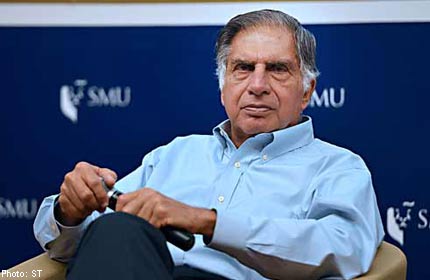
Indian awarded its highest civilian award, Bharat Tatna (Jewel of India) to ex-chairman of the Tata group Mr Ratan Naval Tata. -ST
Ravi Velloor

Tue, Mar 19, 2013
The Straits Times

It has been a few years since India announced its highest civilian award, Bharat Ratna, which, from the Hindi, translates as Jewel of India. But at some point, it may well go to the man who just stepped down as chairman of the Tata Group, the salt-to-software conglomerate.

For Mr Ratan Naval Tata, who was in Singapore last week, is no ordinary man. And the Tata Group, no ordinary enterprise.

You could start your morning with Tetley Tea, sprinkle Tata Salt on your fried egg, live in a home constructed with quality metal from Tata-owned NatSteel, call your secretary from a Tata phone, travel on an airline whose computer systems are supported by Tata Consultancy Services, stay in a Taj luxury hotel, watch television on Tata Sky direct-to-home service and if you are wealthy enough – own a Jaguar, also a Tata brand. At the other end of the spectrum, those aspiring to trade up from a motorcycle may consider the Tata Nano, the world’s cheapest car.

Such is the brand universe of the group, whose turnover, at more than US$100 billion (S$124 billion) annually accounts for a little more than 5 per cent of the gross domestic product of India, Asia’s No. 3 economy after China and Japan. Read more of this post

Chinese Premier Li Cutting Wrist and pledging to cut the “hand” of the state in the economy pushes borrowing costs of railway network up; yield of 3.95% is lower than the 8.99% for similar-maturity notes of Indian Railway and slightly higher than Suntech’s 3% CB in China’s first high-profile bond default

Li Cutting Wrist Lifts Rail Costs Most in 16 Weeks: China Credit

China’s railway network became the first test case for Premier Li Keqiang’s pledge to cut the “hand” of the state in the economy, pushing its borrowing costs up the most in 16 weeks.

The yield premium over government notes for one-year bonds from the former Ministry of Railways, whose debt was transferred to the newly created China Railway Corp. on March 17, jumped 10 basis points last week to 118, the biggest rise since the period ended Nov. 23, data compiled by Bloomberg show. The yield of 3.95 percent is lower than the 8.99 percent for similar-maturity notes of Indian Railway Finance Corp.

China Railway will take over commercial operations from the ministry, according to a March 14 cabinet statement. The authority had more than 2 million employees and 2.66 trillion yuan ($427.8 billion) of debt that’s larger than Denmark’s economy. While the government offered assurances the company will receive its backing, Premier Li said three days later that he would act when the “hand” of the state shouldn’t be involved in the market, even if it feels like “cutting one’s wrist.”

“Previously creditors legally had recourse to the ministry,” said Ivan Chung, a Hong Kong-based senior credit officer at Moody’s Investors Service. “While investors expect there will be very strong support from the government for China Railway Corp., they no longer have a direct claim on the government as they used to.” Read more of this post

More bond investors bet on US rate rise

March 19, 2013 7:37 pm

More bond investors bet on US rate rise

By Stephen Foley, Michael Mackenzie and Dan McCrum in New York

More US bond investors are seeking new ways to hedge against the risk of a sharp rise in interest rates in case growth in the world’s largest economy picks up and the Federal Reserve starts to wind up its current stimulus policies.

The US central bank is expected on Wednesday to maintain its current level of bond purchases, which have pushed up bond prices and kept rates low. However, some investors are taking positions in exchange traded funds and leveraged loans that are designed to profit if market interest rates spike higher. Read more of this post

The ghosts of ’94: Veteran bond traders fear the omens point to a repeat of the catastrophic collapse of the mid-nineties

March 19, 2013 6:32 pm

Markets: The ghosts of ’94

By Michael Mackenzie, Robin Wigglesworth and Stephen Foley

Veteran bond traders fear the omens point to a repeat of the catastrophic collapse of the mid-nineties

Nineteen-ninety four. Nelson Mandela was inaugurated South Africa’s first black president. Ace of Base dominated the pop charts on both sides of the Atlantic. And Pulp Fiction introduced “Royale with cheese” to the vernacular. On Wall Street, 1994 was the year many money managers lost their shirts.

A sharp, unexpected rise in interest rates wrecked the value of bond portfolios and turned profitable trades into money losers. Hedge funds blew up, banks plunged into the red and the resulting shockwaves even hurt the equity market, which reversed a strong start to end down on the year.

It was, in other words, a year for investors to forget. But it is also a year that is important to remember. Today, with interest rates at rock-bottom thanks to the US Federal Reserve and other central banks, some bond market veterans are hearing echoes of 1994. What will happen, they ask, when the Fed decides it has done enough to stimulate the economy? Could there be another shock?

Richard Tang, now head of North America sales at RBS Securities, recalls the “gigantic roar” that went up across the trading floor at Salomon Brothers on February 4, 1994, when the Fed unexpectedly raised rates.

“I remember 1994 very well, clearly like it was yesterday. It was my first bear market in the business,” he says.

The Fed kept tightening through the year, as the US economy picked up steam and the central bank decided to put down a marker against inflation. Traders who had loaded up on debt, notably in mortgage securities, were squeezed, and the leverage in the nascent securitisation market meant the pain was magnified. Read more of this post

Indonesians left to pick up the pieces; “I want to become smart, I want to make my parents proud. I want to take them on the Hajj.”

March 19, 2013 8:36 am

Indonesians left to pick up the pieces

By Ben Bland in Bantar Gebang

©AFP

Rastinah lives in the midst of Indonesia’s decade-long economic boom, without being part of it.

Along with her husband and five children, the 40-year-old ekes out a living as a scavenger at the vast Bantar Gebang landfill site on the outskirts of Jakarta, scouring a mountain of trash every day to find material that she can sell for recycling.

Even in a good month, her family rarely earns more than $180. So, when it costs about Rp30,000 ($3) for a very basic family meal, life is a struggle.

“It’s barely enough for food, sometimes it’s not enough,” she says as she picks plastic bags from the trash heap, a foul stench in the air and the midday sun beating down, the only shade provided by a Komatsu digger operating perilously close by.

Mrs Rastinah and her family are among the tens of millions of people who have been left behind as Indonesia’s economy has taken off on the back of a fast-growing middle class and Indonesia’s plentiful natural resources. Read more of this post

China: Politicizing discovery: A system of political patronage often forces scientists to choose between career advancement and real innovation

Politicizing discovery

Wednesday, March 20, 2013

A system of political patronage often forces scientists to choose between career advancement and real innovation

Bill Dodson is chief China industry analyst at market research firm TrendsAsia in greater Shanghai and author of several books, most recently “China Fast Forward: The Technologies, Green Industries and Innovations Driving the Mainland’s Future,” published last August.

Throughout 2010, Fang Shimin – China’s self-appointed “Science Cop “ – had been relentless in his pursuit of Dr Xiao Chuanguo. Fang Shimin had publicly accused the medical researcher of falsifying test data in trials with children. The doctor had retaliated against Fang Shimin by hiring thugs to beat the Science Cop to “send him a message.” Despite Xiao Chuanguo’s confession, the court had shown great leniency toward the doctor.

The public accusations against Xiao Chuanguo, his confessed attacks on his accusers and the court’s light sentences for his crimes point to a fundamental flaw in China’s plan to surpass the United States as a preeminent innovation nation. The country lacks checks and balances within its own scientific community and society. Science prides itself on its scientific method of repeatable results rigorously tested and approved by a group of peers.

As Thomas Kuhn wrote in his seminal study of the work of scientists, “The Structure of Scientific Revolutions,” most often discoveries are resisted by peers who have vested interests, yet eventually the community of scientists adapts – typically in nonviolent ways – as the discovery becomes a fact that expands on previous understanding. The scientific method is supposed to weed out wrong or misleading results and researchers to contribute to a base of standing knowledge upon which others may continue to build. The court systems in a civil society function similarly, with judgments passed based on a body of evidence that is indisputable in its objectivity and certainty.

Both science and society in China are based on patronage, though. Read more of this post

Garbled Texting as a Sign of Stroke

MARCH 19, 2013, 12:01 PM

Garbled Texting as a Sign of Stroke

By ANAHAD O’CONNOR

Slurred and incoherent speech is one of the classic signs of a stroke. But new research finds that another symptom may be garbled and disjointed text messages, which could provide early clues to the onset of a stroke.

In Detroit, doctors encountered a 40-year-old patient who had no trouble reading, writing or understanding language. His only consistent problem was that he had lost the ability to type coherent text messages on his phone. An imaging scan showed that he had suffered a mild ischemic stroke, caused by a clot or blockage in his brain.

The case represents at least the second instance of what doctors are calling “dystextia.” In December, a report in The Archives of Neurology described a 25-year-old pregnant woman whose husband grew concerned after she sent him a series of incoherent text messages. Doctors found that the woman had also been experiencing weakness in her right arm and leg, and that she had earlier had difficulty filling out an intake form at her obstetrician’s office.

The case in Detroit was particularly unusual because garbled texting appeared to be the only conspicuous problem, at least initially, said Dr. Omran Kaskar, a senior neurology resident at Henry Ford Hospital who treated the patient in late 2011. “Stroke patients usually present with multiple neurologic deficits,” he said.

The findings suggest that text messaging may be a unique form of language controlled by a distinct part of the brain. And because texts are time-stamped, they may potentially be useful as a way of helping doctors determine precisely when a patient’s stroke symptoms began. Read more of this post

CEO Jim Donald’s Memo to Staff: Take More Risks; Growth and innovation come from daring ideas and calculated gambles, but boldness is getting harder to come by at some companies.

March 19, 2013, 6:54 p.m. ET

Memo to Staff: Take More Risks

MK-CB740_RISK_DV_20130319154202

CEOs Urge Employees to Embrace Failure and Keep Trying

By LESLIE KWOH

When Jim Donald took the helm at Extended Stay America a year ago, he sensed fear.

Many employees at the national hotel chain, which had recently emerged from bankruptcy, were still stuck in survival mode. Worried about losing their jobs, they avoided decisions that might cost the company money, such as making property repairs or appeasing a disgruntled guest with a free night’s stay.

“They were waiting to be told what to do,” recalls the former Starbucks Corp.SBUX -0.18% chief executive. “They were afraid to do things.”

So Mr. Donald gave everyone a safety net: He created a batch of miniature “Get Out of Jail, Free” cards, and is gradually handing them out to his 9,000 employees. All they had to do, he told them, was call in the card when they took a big risk on behalf of the company—no questions asked.

Growth and innovation come from daring ideas and calculated gambles, but boldness is getting harder to come by at some companies. After years of high unemployment and scarred from rounds of company cost-cutting and layoffs, managers say their workers seem to have become allergic to risk. Read more of this post

SEC Digging Into Fund Fees; Focus on Expenses Billed to Investors by Hedge Funds and Private-Equity Firms

  • Updated March 19, 2013, 7:57 p.m. ET

SEC Digging Into Fund Fees

Focus on Expenses Billed to Investors by Hedge Funds and Private-Equity Firms

By JULIE STEINBERG

The Securities and Exchange Commission is closely scrutinizing the fees and expenses, including travel and entertainment, that hedge funds and private-equity firms charge to their investors.

Many managers of hedge funds and private-equity funds—collectively called “private investment advisers”—had long been largely unregulated and therefore had less oversight in how they billed their investors.

As part of the Dodd-Frank financial law, the SEC now oversees more than 1,500 additional such advisers that were required to register with the agency. In that capacity, the SEC is checking to ensure they are charging their investors reasonable expenses.

“Exotic” expenses like travel, entertainment and consulting arrangements are more likely to attract the agency’s attention than routine charges like legal and accounting fees, say compliance consultants who advise funds on registration and reporting requirements. Read more of this post

Kirsten Han: “Joseph Stiglitz’s Singapore is hardly the one I grew up in; Perhaps the real Singapore, too, could learn a few lessons from Stiglitz’s Singapore.”

Joseph Stiglitz’s Singapore is hardly the one I grew up in

By Kirsten Han — 7 hours ago

Kirsten Han is currently a graduate student in journalism at Cardiff University in Wales. She was born and raised in Singapore.

Joseph E. Stiglitz may be a brilliant economist, but familiar with Singapore he is not.

This fact could not be more glaring than in his piece in the New York Times urging the United States to emulate the tiny city-state. His description paints Singapore as practically utopian: the rich willingly contribute to help the poor, everyone puts money aside to pay for healthcare and retirement, and the government makes sure that workers are not disadvantaged by cunning employers.

The policies and measures praised sound good in theory, but don’t actually work that way in reality. As a matter of fact, the issues singled out by Stiglitz—wages, the Central Provident Fund (CPF), housing and labour relations—are the very things keeping Singaporeans up at night.

Singapore is far from being an equal society. When considered in the global context, Singapore cannot be considered a society with “fewer economic disparities.” Its Gini coefficient, which measures inequality, is the second highest among developed countries. Read more of this post

1,000-year-old Chinese bowl bought for US$3 at a garage sale in New York and sold for US$2.2mil

Updated: Wednesday March 20, 2013 MYT 9:12:44 AM

1,000-year-old Chinese bowl bought for US$3 and sold for US$2.2mil

bowl-auction-sothbey-latest

This handout photo obtained courtesy of Sotheby’s shows a small Chinese pottery bowl that started as a $3 tag sale only to turn into a massive windfall that sold for $2.23 million during an auction at Sotheby’s on March 19, 2013 in New York. – AFP

NEW YORK: A 1,000-year-old Chinese bowl that was bought for US$3 at a garage sale in New York state sold for more than US$2.2 million at an auction on Tuesday. An unnamed New York family bought the “Ding” bowl, which is from the Northern Song Dynasty, for no more than $3 in 2007 and displayed it on a mantelpiece with no idea as to its real worth, Sotheby’s said. After consulting with experts, the owners consigned the bowl for auction. Sotheby’s estimated it would sell for $200,000 to $300,000. London dealer Giuseppe Eskenazi paid $2,225,000 including commission for the bowl, which measures just over five inches (12.7 cm) in diameter, at the auction in New York City. Sotheby’s said the only known bowl of the same form, size and almost identical decoration has been in the collection of the British Museum in London for more than 60 years. – Reuters

How Fair are the Valuations of Private Equity Funds? Investors should be extremely wary of basing investment decisions on the returns – especially IRRs – of the current fund.

How Fair are the Valuations of Private Equity Funds?

Tim Jenkinson University of Oxford – Said Business School; Centre for Economic Policy Research (CEPR); European Corporate Governance Institute (ECGI)

Miguel Sousa University of Oxford – Said Business School; School of Economics and Management, University of Porto

Rüdiger Stucke University of Oxford – Said Business School

February 27, 2013

Abstract: 
The ultimate performance of private equity funds is only known once all investments have been sold, and the cash returned to investors. This typically takes over a decade. In the meantime, the reported performance depends on the valuation of the remaining portfolio companies. Private equity houses market their next fund on the basis of these interim valuations of their current fund. In this paper we analyze whether these valuations are fair, whether the extent of conservative or aggressive valuations differ during the life of the fund, and at what stage interim performance measures predict ultimate performance. This paper is the first to use the quarterly valuations and cash flows for the entire history of 761 fund investments made by Calpers – the largest U.S. investor in private equity. Our main findings are as follows. First, over the entire life of the fund we find evidence that fund valuations are conservative, and tend to be smoothed (relative to movements in public markets): valuations understate subsequent distributions by around 35% on average. We find a significant jump in valuations in the fourth-quarter, when funds are normally audited. Second, the exception to this general conservatism is the period when follow-on funds are being raised. We find that valuations, and reported returns, are inflated during fundraising, with a gradual reversal once the follow-on fund has been closed. Third, we find that the performance figures reported by funds during fund-raising have little power to predict ultimate returns. This is especially true when performance is measured by IRR. Using public market equivalent measures increases predictability significantly. Our results show that investors should be extremely wary of basing investment decisions on the returns – especially IRRs – of the current fund.

Information Flows in Dark Markets: Dissecting Customer Currency Trades

Information Flows in Dark Markets: Dissecting Customer Currency Trades

Lukas Menkhoff Leibniz Universitaet Hannover – Department of Economics; CESifo (Center for Economic Studies and Ifo Institute for Economic Research)

Lucio Sarno City University London – Sir John Cass Business School; Centre for Economic Policy Research (CEPR)

Maik Schmeling City University London – Sir John Cass Business School

Andreas Schrimpf Bank for International Settlements (BIS) – Monetary and Economic Department

March 5, 2013

Abstract: 
We study the information in order flows of different customer segments in the world’s largest over-the-counter market, the foreign exchange market. The analysis draws on a unique dataset covering a broad cross-section of currency pairs and distinguishing trades by key types of foreign exchange end-users. We find that order flows are highly informative about future exchange rates and provide significant economic value for the few large dealers who have access to these flows. Moreover, customer groups systematically engage in risk sharing with each other and differ markedly in their predictive ability, trading styles, and risk exposure.

Largest pension fund considers dumping active management

Largest pension fund considers dumping active management

CalPERS’ review keeps pressure on from passive funds

By Jason Kephart

Mar 19, 2013 @ 1:35 pm (Updated 3:46 pm) EST

In the latest sign of the apocalypse for active management, the largest pension fund in the United States is mulling a move to an all-passive portfolio.

The California Public Employees Retirement System’s investment committee is evaluating whether the fees it pays its active managers are worth it or if paying less fees for passive management will lead to better long-term results, according to sister publication Pensions & Investments.

The pension fund, commonly referred to as CalPERS, oversees about $255 billion in assets, more than half of which already is invested in passive strategies.

The critique of active management is part of a review of the fund’s investment beliefs, which began yesterday, P&I said.

At the heart of the review of active management is whether taking the trouble to pick the right managers is worth it. Read more of this post

Canada Pension Plan Investment Board (CPPIB) laments dearth of investments for pension funds’ ‘patient capital’; “How can we think and act long term when the world around us is caught up in this ‘myopia of the moment’?

CPPIB laments dearth of investments for pension funds’ ‘patient capital’

19 March 2013

Author: Jonathan Williams

GLOBAL – The short-termist focus of governments and investors is creating problems for pension funds to invest their “patient capital”, the head of the CAD172bn (€130bn) Canada Pension Plan Investment Board (CPPIB) has said.

Mark Wiseman, chief executive and president of CPPIB, said the focus on the short term – due to shorter election cycles, quarterly profit reports and a “revolving door” of chief executives within listed companies – was causing problems, and that there was a need for longer-term thinking.

During a speech to the Canadian Australian Chamber of Commerce in Sydney, he asked: “How can we think and act long term when the world around us is caught up in this ‘myopia of the moment’?

“All market participants – be they investors or governments – desperately need a long-term lens,” he added. “While we may discuss practical, actionable items for reform, I am convinced that, unless we first address this short-term, structural paradigm, we will fail to create a policy environment that supports fundamental and lasting change.” Read more of this post

Malaysian PM Najib Sees Early Achievement of Mahathir Vision: Southeast Asia

Najib Sees Early Achievement of Mahathir Vision: Southeast Asia

Malaysian Prime Minister Najib Razak said the nation may reach high-income status two years ahead of target, as he seeks to convince voters of his economic achievements before elections due within weeks.

Gross national income could rise to $15,000 per capita in 2018, earlier than a target of 2020, Najib said in a televised speech late yesterday. The measure has increased 49 percent since 2009, to $9,970 last year, the government estimates. Najib also pledged to give annual cash handouts to low-wage earners.

“The time has come for Malaysians to make a decision and I hope you make the right choice,” said Najib, 59, without indicating when the election will be held. He must dissolve parliament by April 28 and hold a vote by the end of June.

Najib, who inherited a country in recession when he replaced Abdullah Ahmad Badawi as leader in 2009, is focusing voters on his efforts to boost investment and improve incomes as he seeks a popular mandate for the first time. The ruling National Front coalition won the last election in 2008 by its narrowest margin in more than five decades, prompting Abdullah to hand over the leadership mid-term. Read more of this post

Leveraged Asian Investors May Spur Bond Price Slump: Barclays

Leveraged Asian Investors May Spur Bond Price Slump: Barclays

Wealthy Asian investors who’ve borrowed against their houses to buy bonds may find themselves among forced sellers if interest rates rise, spurring a price slump in vulnerable securities, according to Barclays Plc.

U.S. dollar-denominated notes sold by more than 20 companies including Olam International Ltd. and Henderson Land Development Co. are some of those most exposed if private bank clients move money out of the fixed-income market, Barclays said in a research note dated March 14. Private banks hold 15 percent to 20 percent of total corporate bonds in Asia and as much as 30 percent of high-yield, or junk, notes.

Low borrowing costs have been one of the main factors driving the strong demand for Asia credit and many high net worth investors went further into debt to buy the securities, according to the report. In the past six months, equities have generated solid returns while credit has lagged, creating a risk fund flows will rotate out of bonds in a quest for higher returns and compound the price slump.

“U.S. rates are already beginning to rise, albeit gradually, and leveraged lending could be scaled back if risk committees begin to focus on the quality of such lending,” according to analysts led by Krishna Hegde, Barclays’ Singapore- based head of Asia credit research. Furthermore, any sharp or sustained sell-off in Treasuries would impact bond prices and raise borrowing costs. Considering most private bank investors don’t hedge rates, “this is an important risk factor,” they wrote. Read more of this post