The Holocaust: FDR’s indelible failure

The Holocaust: FDR’s indelible failure

By Richard Cohen, Tuesday, March 12, 7:31 AM

On April 12, 1945, my grandfather approached me as I played outside the house and asked where my mother was. He looked stricken, and so I quickly followed him inside and heard him say words that made my mother burst into tears: President Roosevelt had died. My mother’s grief and panic were so palpable — her brother was fighting in the Pacific, her brother-in-law was fighting in Europe — that it scared me. In our house, FDR was not merely the president. He was a god.

He is a god no more. His New Deal is no longer solely credited with ending the Great Depression — World War II did that — and the war in Europe was not won, as we all once thought, primarily by the United States but more so by the Soviet Union. Yet these, to my mind, are trifles compared to the criticism that Roosevelt was passive in the face of the Holocaust. It’s not that he did nothing, it’s that he did nothing much.

This accusation of immense moral failure — or indifference — is now being addressed by a new book, “FDR and the Jews,” by Richard Breitman and Allan J. Lichtman. It sets out to find a middle ground and instead makes things worse. It is a portrait of a president who, in the authors’ own words, “did not forthrightly inform the American people of Hitler’s grisly ‘Final Solution’ or respond decisively to his crimes.” This is a Roosevelt who almost always had a more pressing political concern — American isolationism, American anti-Semitism, a fear and hatred of immigrants — and who stayed mum while a bill to allow 20,000 Jewish children into the United States died in Congress.

Roosevelt inattentively also permitted a cabal of heartless anti-Semites in the State Department to control the country’s visa policies. Desperate Jews, fleeing from the Nazis, were denied asylum in the United States. One of them was Otto Frank. His daughter Anne perished at the Bergen-Belsen concentration camp. Read more of this post

How Google makes money from mobile

Read more of this post

‘Despite All the Money, I’m Not Happy.’ Startup Lessons from Sohu CEO Charles Zhang; 张朝阳精神危机:我什么都有 但居然这么痛苦

‘Despite All the Money, I’m Not Happy.’ Startup Lessons from Sohu CEO Charles Zhang

Mar 12, 2013 at 14:00 PM by C. Custer, in Opinion, Startups

47761464hd6d50b261387&690

Sohu founder and CEO Charles Zhang is, by the standards of most tech entrepreneurs, doing very well. His startup has long since blossomed into a full-blown tech giant, and success has brought him both prestige and heaps of money. Yet in a recent interview on Yang Lan One-on-One, Zhang told the host that he is actually miserable:

I think there’s something wrong with me. I truly have everything, and yet I am so miserable. Happiness is totally unrelated to how much money you have.

Zhang has reportedly removed himself from the day-to-day operations of the company and has stayed out of the public limelight (for the most part) over the past year. In the Yang Lan interview, he revealed that this was because his anxiety was making it impossible for him to work. He also said that he had found his success was changing him:

Successful people often have this need to do things their own way. [After I became successful] I became more of a perfectionist; I wanted to control the outcome of everything, and even felt that I could live to the age of 150.

More details and quotes from the interview are here for those who can read Chinese, but instead of speculating about Zhang’s mental state, I just want to highlight a couple of the things we can learn from this interview. Many of us are entrepreneurs searching for that big breakthrough or investors working hard to turn money into more money, and Zhang’s reminder that money cannot buy happiness might be cliche, but it’s important to remember. Of course, that’s not to say that having lots of money isn’t nice (or at least I imagine it’s nice; if anyone wants to send me a huge sum of money I’d be happy to give that lifestyle a try and review it here). But if money is your endgame, it’s possible you’ll end up like Zhang, standing at the top of a pyramid and wondering why bothered to climb it in the first place. The other thing Zhang’s interview reminds is that success can and does change people. Maybe Zhang’s issues are deeper than that and maybe they aren’t — I’m not qualified to speculate on anyone’s mental state one way or the other. But it’s important to keep an eye on your own psyche as you move through the entrepreneurship process and make sure that you’re OK with any changes that are happening. Becoming more of a perfectionist might be a good thing to some people, but others may want to avoid becoming a domineering control freak (and let’s be honest, there are plenty of startup founders who fit that description even before they’re successful). We wish Zhang the best, as we do to all entrepreneurs at every stage of the game from bootstrappers to billionaires. At the same time, though, I wish that everyone in the startup scene would spend a little more time thinking about their own definitions of happiness and the effects being an entrepreneur can have on their psyche. We spend so much time talking about what technology is innovative, and yet many of us are chasing the exact same goal: make a globally relevant product and get rich. Perhaps sometimes we should approach our own thinking patterns with the same spirit of disruption and innovation we bring to hackathons and tech conferences.

张朝阳精神危机:我什么都有 但居然这么痛苦

2013年03月05日 01:59  新浪科技 爱文

“我觉得我出问题了,我是真的什么都有,但是我居然这么痛苦。幸福跟钱的多少真的是没关系。”经过一年多的“闭关”,搜狐董事局主席张朝阳在接受《杨澜访谈录》专访时首次披露内心的精神危机。 Read more of this post

Smokescreen: How Managers Behave When They Have Something to Hide

Smokescreen: How Managers Behave When They Have Something to Hide

Tanja Artiga Gonzalez University of St. Gallen

Markus M. Schmid University of St. Gallen – Swiss Institute of Banking and Finance

David Yermack NYU Stern School of Business

March 6, 2013

Abstract: 
We study financial reporting and corporate governance in 216 U.S. companies accused of price fixing by antitrust authorities. We document a range of strategies used by these firms when reporting financial results, including frequent earnings smoothing, segment reclassification, and restatements. In corporate governance, cartel firms favor outside directors who are likely to be inattentive monitors due to their status as foreign or “busy.” When directors resign, they are often not replaced, and new auditors are rarely engaged. Cartel managers exercise their stock options faster than managers of other firms. While our results are based only upon firms engaged in price fixing, we expect that they should apply generally to all companies in which managers seek to conceal poor performance or personal wrongdoing.

The New Power of Memory; Sharp Recall Skills Prove Key to Future Success; Some Excel at ‘Mental Time Travel’

March 11, 2013, 7:12 p.m. ET

The New Power of Memory

Sharp Recall Skills Prove Key to Future Success; Some Excel at ‘Mental Time Travel’

By SHIRLEY S. WANG

A key purpose for memory isn’t to just remember the past, but to be able to imagine the future. Shirley Wang reports on Lunch Break. Photo: AP.

Memory allows for a kind of mental time travel, a way for us to picture not just the past but also a version of the future, according to a growing body of research.

The studies suggest that the purpose of memory is far more extensive than simply helping us store and recall information about what has already happened.

Researchers from University College London and Harvard University have made strides charting how memory helps us draw a mental sketch of someone’s personality and imagine how that person might behave in a future social situation. They detailed their latest findings in work published in the journal Cerebral Cortex last week.

What the scientists showed could have implications not just for those who suffer memory loss, like the elderly, but young adults and their ability to plan and socialize. The researchers are also following up what they’ve found by trying to see whether the ability to recall past events may be related to creativity and imagination.

The body of work is “broadening out our view of how we use memory,” says Daniel Schacter, a psychology professor at Harvard.

This ability to imagine or anticipate what may come is important to our ability to plan and problem-solve and helps us make better decisions in social situations. The researchers also hope to uncover new ways of improving human memory.

“Using past experiences to anticipate possible future happenings” lets people weigh approaches to a coming situation without needing to try out the actual behaviors, Dr. Schacter says.

Little is known about why some people might naturally have better abilities to recall experiences or imagine future ones. Read more of this post

CLAY CHRISTENSEN: Jeff Bezos, Scott Cook, And Steve Jobs Got Disruption Right; “Data is heavy. People want to solve problems and tell their bosses they solved it, not bring them issues all the time. As a result, the higher you get, the less real information you receive

CLAY CHRISTENSEN: Jeff Bezos, Scott Cook, And Steve Jobs Got Disruption Right

Max Nisen | Mar. 11, 2013, 6:31 PM | 1,255 | 1

It’s been some 16 years since Clay Christensen published “The Innovator’s Dilemma” and brought the concept of disruptive innovation to the wider world. Despite that, many companies and executives still haven’t managed to take its core lesson to heart, that it’s not enough to just look at the data. You have to constantly ask questions and look to the future. In an interview appearing at strategy+business, Christensen argues that many executives are pushed to make decisions that are quick and profitable, and they frequently rely heavily on incomplete data. “Data is heavy,” Christensen says. People want to solve problems and tell their bosses they solved it, not bring them issues all the time. As a result, the higher you get, the less real information you receive.

The most successful executives think about why things might turn out differently, have a theory, and constantly update it. Few people are good at that. They don’t ask the right questions, and they aren’t paranoid enough.  Read more of this post

Solving the Puzzles of Mimicry in Nature; Analyzing the DNA of dangerous butterflies who copy other unpalatable species, scientists have found that some shared color-controlling genes, signaling past interbreeding

March 11, 2013

Solving the Puzzles of Mimicry in Nature

By SEAN B. CARROLL

12CREA-articleLarge

The wing patterns of two unpalatable butterfly species, Heliconius erato, top row, and Heliconius melpomene, show striking similarities. DNA studies suggest that some species generated similar patterns independently; others share color-controlling genes.

Perhaps no destination has attracted and inspired more great naturalists than Brazil. Charles Darwin, on his epic voyage on the H.M.S. Beagle, first made landfall at Bahia in 1832; two fellow Englishmen, Alfred Russel Wallace and Henry Walter Bates, arrived at Pará in 1848. Wallace roamed the Amazon for four years, and the indefatigable Bates for 11.

In 1852, a naturalist named Fritz Müller arrived from Germany. Much less known today, Müller, unlike his English contemporaries, moved to Brazil with his wife and young child and had no intention of ever returning to Prussia. A freethinker who refused to swear an oath to God required for his medical graduation, Müller traded a medical career in Europe for a mud-floor hut at the edge of virgin forest in the Blumenau colony in Santa Catarina.

While Darwin and Wallace would conceive of the theory of evolution by natural selection, its acceptance was aided greatly by Bates and Müller. And thanks to Bates and Müller, perhaps no group of animals contributed more to the early growth of evolutionary science than butterflies. Their ideas continue to inspire naturalists today and have led to surprising new insights into how evolution works.

Both men found Brazil ablaze with colorful butterflies. Bates noticed among his collections certain species whose bright wing patterns closely resembled those of other butterfly families in the area. In puzzling out why one species would mimic another, he realized that harmless butterflies were mimicking noxious species that were unpalatable to birds and lizards, and therefore not attacked by predators.

Only a few years after Darwin published “On the Origin of Species,” Bates suggested that this sort of mimicry — now called “Batesian” — was timely proof of the principle of natural selection. Read more of this post

The Fashion Retail Competition Should Be Terrified Of Forever 21

The Competition Should Be Terrified Of Forever 21

Kim Bhasin | Mar. 11, 2013, 1:31 PM | 3,529 | 4

Forever 21 is growing like crazy, and the fast fashion retailer is becoming a major threat to the rest of the industry.

Analysts Lorraine Hutchinson, Paul Alexander, and Jessica A. Lebo at Bank of America warned that competitors need to start paying attention to the privately-held retailer right now.

They declared Forever 21 “the most transformative retail concept” in a note to clients.

“Forever 21 is becoming too big for the specialty retailers to ignore,” the analysts wrote. “At this size, rapid growth could have ripple effects on the other retailers as Forever 21 takes more share.” Read more of this post

Korea’s binge drinking culture changes toward tasting

2013-03-11 17:45

Binge drinking culture changes toward tasting

By Cho Mu-hyun

Following increased awareness among the public about the benefits of living a healthy lifestyle, Korea’s infamous binge drinking is slowly but steadily changing toward consuming less alcohol while savoring flavor more.

Many Koreans, especially younger consumers, prefer brand name drinks such as Glenfiddich, Remy Martin or Matarromera, while ignoring soju, Korea’s rice distilled liquor.

Firms are advertising their products in a different way due to the rise of amateur connoisseurs with increasingly diverse tastes. Makers of beer are now responding to this demand.

The Oriental Brewery (OB), known for brands Cass and OB Lager, is pushing its Golden Lager brand with two words in mind _ young and tasty. Read more of this post

Pepsi, The No.1 Soda In Thailand, Just Had Its Market Share Wiped Out By A Lookalike Brand as market share plunged from 48% to 15%

Pepsi, The No.1 Soda In Thailand, Just Had Its Market Share Wiped Out By A Lookalike Brand

Jim Edwards | Mar. 11, 2013, 10:42 AM | 2,602 | 4

top9

For years, Pepsi was the No.1 soda in Thailand, with a 48 percent market share. Coke was only the second most popular drink there, with 42 percent.

But all that changed late last year when PepsiCo failed to renew a distribution contract. Pepsi’s main retail distributor withdrew all Pepsi products from its shelves and replaced them with “Est,” its own Pepsi-lookalike brand.

By the end of the year, it became difficult to find Pepsi in Thailand, Reuters reports.

Now, Pepsi has only a 15 percent share of the market. Coke is No.1. Est is probably the No.2 brand, with a 19 percent share, and something called “Big Cola” had a 16 percent share at the end of 2012, according to the Bangkok Post. Read more of this post

Henan peasants ask local environmental officials to drink the “pure underground water” in his village; 河南农民请环保厅长喝地下“纯净水”

1363009494305533_840_560

China launches probe on banks’ wealth management products

China launches probe on banks’ wealth management products: paper

Mon, Mar 11 2013

SHANGHAI (Reuters) – China’s banking regulator has launched a nationwide probe of banks’ wealth management products, the China Securities Journal reported on Tuesday, citing unidentified sources. The inspection by the China Banking Regulatory Commission (CBRC) is focused on those products that channel depositors’ money into a pool of assets, rather than a single account, according to the newspaper. Such products are not transparent and could create room for illegal operations, it said. CBRC is urging banks to stop selling wealth management products that don’t conform to rules by the end of April, the newspaper said. China has strengthened supervision of its fast-growing wealth management sector since late last year, when one wealth product sold through Hua Xia Bank (600015.SS: Quote, Profile, Research, Stock Buzz) failed to pay its annualized return.


Dead-Pig Tide and the Ongoing Danger of China Epidemics

Dead-Pig Tide and the Ongoing Danger of China Epidemics

The dead pigs started appearing on the riverbanks of Shanghai’s iconic Huangpu River on March 4, and by the weekend, state media were reporting that 900 had been found floating in the river, the source of much of the city’s water supply. The reports didn’t offer an explanation for where the dead pigs had come from or how they had died. Still, one thing was absolutely certain in the articles and the social- media chatter: Nothing good comes from a dead-pig tide.

Early today, Shanghai Daily reported that the number of dead pigs floating in the river had increased to 1,200. Later in the morning, the Global Times, a national paper, reported that the number had crossed “at least 2,200” and was expected to rise. By early evening, the government had retrieved 3,323 carcasses from the river, with more still floating toward downtown.

Most disturbing of all was news — first reported by local suburban papers and spread through microblogs — that upstream pig farms had been struck by an epidemic that had killed 20,000 pigs in January and February. According to these reports, as far back as January, dead pigs were appearing on the sides of roads in suburban Shanghai. News of the epidemic was partly confirmed by state media today. Read more of this post

Pull the Plug on Bailouts for Power Companies; The government gave billions in public funds to state-owned firms, a practice that would end if the market set electricity prices

03.11.2013 18:58

Closer Look: Pull the Plug on Bailouts for Power Companies

The government gave billions in public funds to state-owned firms, a practice that would end if the market set electricity prices

By staff reporter Pu Jun

(Beijing) – Last year reports that the State-owned Assets Supervision and Administration Commission (SASAC) might give 10 billion yuan to five major state-owned power companies started to circulate. On March 5, we learned the bailout happened. Read more of this post

On the Brink in Italy; Among Italy’s estimated six million companies, businesses of all sizes have been going belly up at the rate of 1,000 a day over the last year

March 11, 2013

On the Brink in Italy

By LIZ ALDERMAN

GUIDONIA, Italy — Emanuele Tedeschi wiped sawdust from his hands and gestured around the cavernous woodworking factory that has been in his family for two generations. The big machines, which used to run overtime carving custom furnishings for private homes, Roman palazzi and even the Vatican, sat idle on a shop floor nearly devoid of workers.

“A year and a half ago, the noise from production was so loud that you had to shout to be heard,” said Mr. Tedeschi, walking amid pallets of cherry and other fine woods stacked up and waiting for a purpose.

Since a government austerity plan took hold last year, the Italian economy has tumbled into one of the worst recessions of any euro zone country. Mr. Tedeschi’s orders have all but dried up. His company, Temeca, is still in business, but barely.

Businesses of all sizes have been going belly up at the rate of 1,000 a day over the last year; especially hard hit among Italy’s estimated six million companies are the small and midsize companies that represent the backbone of Italy’s $2 trillion economy. Read more of this post

Western Firms Rethink Asia Approach

March 11, 2013, 4:55 p.m. ET

Western Firms Rethink Asia Approach

Industrial Titans GE, Honeywell Boost Presence in Region to Prevent Market-Share Erosion

By KATHY CHU

JAKARTA—After 60 years supplying locomotives to Indonesia’s state-owned railway,General Electric Co. GE -0.63% faced a serious threat to its dominance in the country’s locomotive market last year.

Indonesian railroad operator PT Kereta Api needed 100 locomotives to alleviate overcrowding on trains where riders often spill into the aisles and climb on the roofs. European and Canadian companies offered competitive technology, while a Chinese company promised low prices.

GE won the $250 million contract—thanks, in part, to its long relationship with the railroad operator—but “we had a very close call,” says Stuart Dean, the Fairfield, Conn., conglomerate’s chief executive in Southeast Asia. “When a railroad buys five or six locomotives, no one cares, but when it wants 100 engines, everyone comes to play.”

The rapid advance of competitors isforcing one of the world’s largest companies to change the way it does business across Asia and emerging markets.

“Historically, we’ve taken global solutions and sold them all over the world,” says Mr. Dean. “But we’re competing with local companies and we need to fine-tune our strategy.”

Multinationals have been increasing their footprint in Asia for years, as they have moved from selling into the region to also investing here. But the transformation is gaining critical mass as Western companies’ market-share leads in Asia over cash-flush local competitors narrow, forcing Western firms to invest more, tailor their products and transfer top executives to Asia. Read more of this post

China’s nightmare scenario: By 2025, air quality could be much, much worse

China’s nightmare scenario: By 2025, air quality could be much, much worse

By Lily Kuo — March 12, 2013

china-air-pollution-db

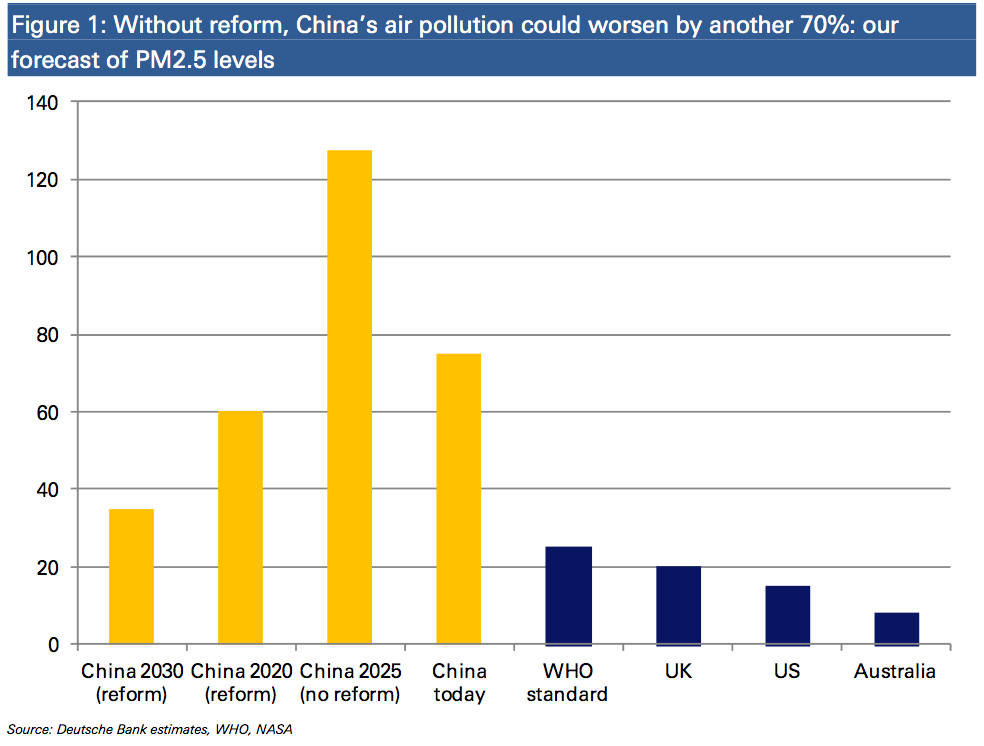
China’s myriad plans to deal with pollution don’t look so promising. In a research note today, Deutsche Bank analysts gloomily conclude that, barring extreme reforms, Chinese coal consumption and increased car ownership will push pollution levels 70% higher by 2025. Even if China’s economy slowed to 5% growth each year, its annual coal consumption would still rise to 6 billion tons (5.4 tonnes) by 2022, from the current 3.8 billion tons. Car ownership is expected to increase over the years to 400 million in 2030 from the current 90 million. With those two figures, it will be very difficult for the government to reduce the national average of PM2.5, or air pollution that is small enough to enter the bloodstream. The current national average is 75 micrograms per cubic meter. In January, PM2.5 levels in Beijing reached 900 micrograms per cubic meter. Read more of this post

There is a new move initiated by major consumer goods and retailer groups to completely avoid using palm. Norway’s $710 billion sovereign wealth fund has pulled out of 23 Asian palm oil companies

Tuesday March 12, 2013

Market access poser for palm oil, new move by major consumers to completely avoid using palm oil

Commodities Talk – By Hanim Adnan

There is a new move initiated by major consumer goods and retailer groups to completely avoid using palm.

THE market access for palm oil has become a growing debate of late, especially since global palm oil inventories from major producers are bursting at the seams.

In the European Union (EU), there is a new move initiated by major consumer goods and retailer groups to completely avoid using palm oil on the stale grounds of deforestation and biodiversity often championed by non-government organisations.

The biggest fear now is that big names like Unilever, Carrefour, Sainsbury, Wal-Mart and Kraft in the EU could also influence and jeopardise stronghold markets like China, India and Asean in the near term, given their big presence there. Read more of this post

Fear rising with rates; Bond market sell-off likely a question of when, not if, and investors ‘have no idea what’s about to happen’; Bond bomb survival guide; New investment strategies that are intended to thrive in a rising-rate environment are fast emerging

Fear rising with rates

Bond market sell-off likely a question of when, not if, and investors ‘have no idea what’s about to happen’

By Andrew Osterland

Mar 10, 2013 @ 12:01 am (Updated 4:58 pm) EST

Fear among financial advisers of a bond market crash that could devastate the portfolios of millions of investors is growing amid improving economic news and rising U.S. bond yields.

The yield on the 10-year U.S. Treasury note is climbing after hitting an all-time low of 1.43% last July. As bond prices move in the opposite direction of yields, the rise in market yields could spell huge losses for investors — especially for those in bond mutual funds, where portfolio managers would be forced to sell their holdings at a loss to meet redemption demands.

Over much of the past three decades, falling interest rates have fueled a rally in the bond market. In the years following the 2008-09 financial crisis, investors — lured by the perceived safety of bonds — poured billions of dollars in retirement and other assets into bond funds.

In 2012, for example, net inflows into bond funds totaled $304 billion, compared with outflows of $153 billion for stock funds. Investors’ enduring appetite for bonds is particularly striking in light of the fact that the Barclays U.S. Aggregate Bond Index gained 4.2% in 2012, versus the S&P 500’s 16% advance.

Over the past five years, net inflows into bond funds topped $1 trillion, while outflows from stock funds totaled $421 billion, according to the Investment Company Institute.

MORE VOLATILITY

For many, if not most, it’s a question of when the bond market sells off — not if.

“Bonds are a big problem, and most people don’t understand that yet,” said Harry Clark, chief executive of Clark Capital Management Inc. “The public thinks bonds are safe, but they’re not. They have no idea what’s about to happen to them.” Read more of this post

The Dark Side of ETF Investing: A World-Wide Analysis

Si Cheng National University of Singapore (NUS) – Department of Finance
Massimo Massa INSEAD – Finance
Hong Zhang INSEAD – Finance
March 8, 2013
INSEAD Working Paper No. 2013/39/FIN
Abstract: 
We study conflicts of interest in the exchange-traded fund (ETF) industry around the world. We provide evidence that ETFs provide cheap funding resources to benefit the other members of the financial groups to which they belong. We identify three channels via which this happens. First, the ETF’s assets are used by the affiliated bank to leverage its (lending-related) information. Second, ETFs subsidize affiliated banks when the latter are in need, i.e., unprofitable or poorly rated. Third, the ETFs help affiliated OEFs through cross-trading, that is, they load up on unnecessary (to track the benchmark) volatility that will expose them in the event that the affiliated bank becomes distressed. The effects prevail in ETFs that do not fully replicate their benchmark holdings and that domiciled in Europe. Market awareness of this risk is reflected in reduced flows and a lower ETF price premium. These results have important normative implications for both consumer protection and financial stability.

Mutual Funds Win and Investors Lose

John A. Haslem

University of Maryland – Robert H. Smith School of Business

February 25, 2013
Journal of Index Investing, Vol.3, No. 4 (Spring 2013), pp. 31-40 

Abstract: 
This study provides in-depth coverage of important findings surrounding the question of why investors continue to buy underperforming actively managed mutual funds. This issue is complicated by the finding that active managers have skill that allows them to add fund value, but that is not shared with investors, who continue to earn negative alphas. So why do investors persist in earning below market returns? Four possible answers are discussed: 1) investor overconfidence; 2) strategic fund repricing decisions; 3) fund “sentiment contrarian behavior;” and 4) investor dependence on brokers with agency conflicted incentives.

Equity Manager Selection and Portfolio Formation: Interviews with Investment Staff

F. Douglas Foster

University of Technology, Sydney

Geoff Warren

Australian National University (ANU) – School of Finance & Applied Statistics; Financial Research Network (FIRN)

January 24, 2013
Abstract:      

We interview professional institutional investors to generate insights into how they choose between active and passive management, select active equity managers and construct multi-manager portfolios. We find that subjective judgment plays a central role in decision-making. Particularly important is the evaluation of people when selecting managers, the role of confidence in retaining managers, and self-perceptions about capability to identify skilled managers. Key evaluations are often made conditionally, notably including the response to past performance where the aim is to understand return sources. Stated reasons for preferring active management relate to whether a handful of skilled active managers can be identified and combined to generate a better expected portfolio outcome; and are only vaguely associated with the performance of the average manager.

iBamboo is an Electricity-Free iPhone Speaker Made from a Piece of Bamboo

iBamboo is an Electricity-Free iPhone Speaker Made from a Piece of Bamboo

by Mark Boyer, 04/20/12

iBamboo-speaker-lead-537x358ibamboo-urban-2-537x358

iPhone users aren’t exactly at a loss when looking for a place to dock their phones these days. But even in a market that’s flooded with a myriad docking and music amplification systems, theiBamboo Speaker by designer Anatoliy Omelchenko of Triangle Tree manages to separate itself from the pack. The simple-yet-chic design consists of a single piece of bamboo — one of the world’s greenest natural materials — with a slot cut into it where the iPhone is placed. The natural shape of the speaker amplifies the tunes, producing a pseudo-stereo effect that requires no electricity.

This isn’t the first electricity-free iPhone speaker we’ve encountered, but the iBamboo has some notable advantages over the competition. The one-foot-long bamboo tube is lightweight and durable, and because it’s made from natural material, no two speakers will be identical. Bamboo is one of the fastest-growing plants in the world, and it produces more oxygen than an equivalent mass of trees.

Earlier this year, Omelchenko told Gizmag that in response to requests for plastic versions of the iBamboo Speaker he was working on prototyping a new version of the speaker that’s made from recycled plastic. The iBamboo Urban design is shaped exactly like the natural bamboo version, and it’s reportedly even more durable. Unlike the original iBamboo speaker, which adds warmth to music and is good for listening to jazz and folk music, Omelchenko tells Gizmagthe that the Urban design has a crisper sound. According to the iBamboo website, the original iBamboo design is currently out of stock, and once it hits the market, the recycled plastic version will retail for $30.

Norway $713bn Sovereign Wealth Fund Flees Currencies Tainted by Stimulus Addiction; Adds Turkey, Taiwan

Norway Fund Flees Currencies Tainted by Stimulus Addiction

Norway’s $713 billion sovereign wealth fund is turning away from the world’s biggest currencies and their debt-laden governments as policy makers undermine their exchange rates through unprecedented stimulus measures.

The Government Pension Fund Global, the world’s largest wealth fund, cut its holdings in French and U.K. government bonds by almost half last year as it raised its share of government bonds in emerging-market currencies to 10 percent of its fixed-income holdings by adding investments in Turkey, Russia and Taiwan.

“It’s what we perceive as a risk-reducing investment strategy,” Yngve Slyngstad, chief executive officer of Norges Bank Investment Management, said in a March 8 interview in Oslo. Cutting dollar, yen, euro and pound investments is a “prudent” move, he said. “These four major currencies all have structural issues, with regards to government debt, to private sector debt, to unconventional monetary policy, and to growth and the demographic profile of the countries.”

At issue is how central bankers across the globe will eventually unwind the uncharted stimulus measures enacted to prop up global growth since the onset of the financial crisis in 2008. Debt levels have soared for governments across much of the developed world. In Europe, political leaders are trying to save the region from a fiscal crisis now in its fourth year. Read more of this post

Future of China Railways Ministry’s US$426bn debt unclear

Future of China Railways Ministry’s US$426bn debt unclear

Staff Reporter

2013-03-11

China’s plan to break up its Ministry of Railways has led to concerns about the ministry’s bulging debt, which it accumulated during the rapid expansion of the railway system in recent years, the Shanghai-based First Financial Daily reports.

The Chinese government announced a restructuring plan on Mar. 10, with one of the main proposed changes being splitting up the Ministry of Railways into a State Railway Administration under the Ministry of Transportation and a state-owned enterprise that will be called China Railway Corp.

The proposed railway administration will play a managerial role at the Railways Ministry, while the state-owned company will be tasked with running railway operations, according to the government announcement.

Since the Ministry of Railways had accrued a total debt of 2.66 trillion yuan (US$426 billion), compared with its total assets of 4.3 trillion yuan (US$689 billion) at the end of September, how this debt will be paid off had become a hot topic of discussion, the newspaper said.

“This is a very important issue. As the Ministry of Railways will cease to exist, the party liable to repay the debt will be different, giving creditors the right to seek immediate repayment or even bring up subsequent litigation,” said Mao Zhenghua, a co-director at the Institute of Economic Research at Renmin University of China. Read more of this post

The vacancy rate of China’s New South China Mall, also known as the world’s largest shopping mall, has reached 99% since its opening in 2005

World’s largest mall is ghostly quiet

Staff Reporter

2013-03-11

The vacancy rate of China’s New South China Mall, also known as the world’s largest shopping mall, has reached 99% since its opening in 2005, reports caijing.com, a Chinese-language website specializing in financial news.

The shopping mall — which was built off of a total of 4.5 billion yuan (US$723.7 billion) in investments — is located in Dongguan of China’s southern Guangdong province. The 450,000 square meter mammoth can accommodate 2,350 stores and 8,000 parking lots. However, the near 99% vacancy rate has earned it the less fortunate name of “ghost mall” by the Chinese people. Read more of this post

China hoarding over half of global cotton reserves

China hoarding over half of global cotton reserves

Staff Reporter

2013-03-11

China’s cotton reserves reached 9.28 million tons in February, accounting for 52% of global reserves, according to the United States Department of Agriculture.

As of Feb. 1, reserves stood at 6.15 million tons, accounting for 83% of the country’s cotton reserves expected in 2013, according to texnet.com.cn, a leading Chinese-language textile website. The record stockpiles will make it difficult for the country to control its reserves for the rest of the year.

The partial release of national reserves of cotton into the textile industry in February further lowered the market price, leading to a record low turnover rate. Read more of this post

Technology forecasting: A new “step and wait” model claims to outperform industry rules of thumb in predictive power; advances in performance are often followed by a waiting period before the next step forward

Predicting the Path of Technological Innovation: SAW Versus Moore, Bass, Gompertz, and Kryder

Ashish Sood, Gareth M. James, Gerard J. Tellis, and Ji Zhu*

Marketing Science

Abstract

Competition is intense among rival technologies and success depends on predicting their future trajectory of performance. To resolve this challenge, managers often follow popular heuristics, generalizations, or “laws” like the Moore’s Law. We propose a model, Step And Wait (SAW), for predicting the path of technological innovation and compare its performance against eight models for 25 technologies and 804 technologies-years across six markets. The estimates of the model provide four important results. First, Moore’s Law and Kryder’s law do not generalize across markets; none holds for all technologies even in a single market. Second, SAW produces superior predictions over traditional methods, such as the Bass model or Gompertz law, and can form predictions for a completely new technology, by incorporating information from other categories on time varying covariates. Third, analysis of the model parameters suggests that: i) recent technologies improve at a faster rate than old technologies; ii) as the number of competitors increases, performance improves in smaller steps and longer waits; iii) later entrants and technologies that have a number of prior steps tend to have smaller steps and shorter waits; but iv) technologies with long average wait time continue to have large steps. Fourth, technologies cluster in their performance by market.

The law and the profits

Technology forecasting: A new “step and wait” model claims to outperform industry rules of thumb in predictive power

Mar 9th 2013 |From the print edition

PREDICTING the course of technological progress can be a risky business. Scorn the latest advances and you risk being left behind, as when Sony kept investing in flat-screen versions of cathode-ray televisions in the 1990s while Samsung piled into liquid-crystal displays (LCDs), and eventually replaced Sony as market leader. Embrace new ideas too early, though, and you may be left with egg on your face, as when General Motors spent more than $1 billion developing hydrogen fuel cells a decade ago, only to see them overtaken by lithium-ion batteries as the preferred power source for electric and hybrid vehicles.

To determine when to proceed with a new technology many managers and engineers employ popular heuristics, some of which are seen as “laws”. The best known is Moore’s law, proposed in 1965 by Gordon Moore, a co-founder of Intel. At first it stated that as more transistors are crammed onto the surface of silicon chips, the devices double in performance every year. This law was later revised to two years, and chip performance is now usually reckoned to double every 18 months. Other laws use “S” curves and various other calculations to predict how technologies will evolve.

Many of these laws have become widely accepted and are now applied when drawing conclusions about a broad range of technologies. Some have become self-fulfilling. Chipmakers, for example, use Moore’s law to co-ordinate their research and development (R&D) activity and plan their capital investment. In reality, however, such laws are unreliable because progress is rarely smooth. So Ashish Sood of the Goizueta School of Business at Emory University, Atlanta, and his colleagues have come up with their own law, which is explicitly based on the tendency of technology to progress in stops and starts.

Their “step and wait” (SAW) model, recently published in Marketing Science, notes that advances in performance are often followed by a waiting period before the next step forward. The steps can be big or small, and the waiting periods long or short. The researchers also hypothesise that greater support for innovation means new technologies improve in larger and more frequent steps than old technologies did. This is the result of higher R&D spending, the existence of better tools and the fact that more countries are undertaking research. But as the number of competitors in a new field increases, both the size of the steps and the length of the wait for the next step can change. Read more of this post


A new invention lets pacemakers scavenge the energy to power their circuitry from the motion of the beating heart itself

Let’s have a heart-to-heart

Medical technology: A new invention lets pacemakers scavenge the energy to power their circuitry from the motion of the beating heart itself

Mar 9th 2013 |From the print edition

IN 1958 a priest named Gerardo Flórez, then 70 years old, was blessed with the world’s first artificial pacemaker. The device kept his heart ticking in good order for another 18 years. It connected to the heart externally, weighed 45kg (100lb) and was powered by a 12-volt battery that had to be lugged around on a cart and recharged every 72 hours.

Since the 1950s pacemakers, which use electrical impulses to regulate a beating heart, have shrunk substantially, as have their power packs. But scientists would dearly love to get rid of the batteries altogether. Even the best modern ones run out every 7-10 years and patients must undergo surgery to have replacements installed. The process can be painful, expensive and can lead to infection.

One approach, being pursued by some researchers, is to deliver the necessary energy wirelessly. Some designs beam energy to a receiving coil in an implanted device, and others use an external pacemaker that wirelessly stimulates an electrode implanted in the heart.

Another possibility is to scavenge energy from the natural processes occurring in the patient’s body. In 2011 a group of Swiss engineers installed a tiny turbine inside a simulated artery which was propelled by a bloodlike fluid flowing through it. And now Amin Karami and his colleagues at the University of Michigan have figured out a way to power a pacemaker by harvesting energy produced by the very heart it is nudging along.

This is not a new idea, and Dr Karami’s approach, like previous attempts, relies on so-called piezoelectric materials, which produce a current when subjected to mechanical stress—in this case the vibrations caused by a beating heart. Those earlier efforts stumbled, however, because the piezoelectric components were only able to harvest enough energy to power a pacemaker if the vibrations fell within a narrow frequency range. As a result, they worked for a limited range of heart rates, typically between 58 and 63 beats per minute. Any lower (as when sleeping) or higher (during physical exertion, say) and the piezoelectric elements did not produce enough oomph. Dr Karami’s “non-linear harvester”, by contrast, still works at heart rates of 20 to 600 beats per minute. Read more of this post

New tricks allow hearing aids to cope better with high frequencies, making speech and music more comprehensible

Music to the ear

Medical technology: New tricks allow hearing aids to cope better with high frequencies, making speech and music more comprehensible

Mar 9th 2013 |From the print edition

THE human voice, like any sound produced by thrumming a stretched string, has a fundamental frequency. For voice, the centre of that frequency lies mostly below 300Hz depending on the speaker’s sex and the sounds in question. Information is conveyed through simultaneous higher-frequency overtones and additional components that can stretch up to 20,000Hz (20kHz). Modern hearing aids are able to distinguish only a small part of that range, typically between 300Hz and 6kHz, reducing noise and amplifying those frequencies where the wearer’s hearing is weakest.

But differentiating elements of many common parts of speech occur in higher frequencies. This is the result both of harmonics that ripple out from the main tone, and from non-voiced elements used to utter consonants, which employ the tongue, teeth, cheeks and lips. Take the words “sailing” and “failing”. Cut off the higher frequencies and the two are indistinguishable. The problem is compounded on telephone calls, which do not transmit frequencies below 300Hz or above 3.3kHz, resulting in the need for cues like “S for Sierra, F for Foxtrot”.

People with hearing aids experience this problem constantly, says Brian Moore of the University of Cambridge. Typical hearing loss tends to be most acute at frequencies above 10kHz, which contain quieter sounds but where speech can still include important cues (as well as progressively less important ones extending up to 20kHz). Older hearing aids cut off at no higher than 6kHz, but much modern equipment stretches this range to 8-10kHz. However, a problem remains, Dr Moore says, because bespoke hearing-aid calibrations for individual users, called “fittings”, do not properly boost the gain of these higher frequencies. So Dr Moore and his colleagues have come up with a better method. Their approach can be applied to many existing devices, and is also being built into some newer ones.

A key step in any fitting involves testing an individual’s ability to hear sounds in different frequency bands. Each hearing loss is unique, and for most users a standard profile would be too loud in some ranges and too soft in others. But current tests pay scant attention to the higher frequencies that a device’s tiny speaker can produce, regardless of whether the user needs a boost. Dr Moore’s new test, known as CAM2, which is both a set of specifications and an implementation in software, extends and modifies fittings to include frequencies as high as 10kHz. When the results are used to calibrate a modern hearing aid, the result is greater intelligibility of speech compared with existing alternatives. CAM2 also improves the experience of listening to music, which makes greater use of higher frequencies than speech does. Read more of this post