Fugitive Fund Manager Stuffed Underwear With Cash, Fled; founder and former chief investment officer of Absolute Capital is accused of “cross trading” hundreds of millions of shares of penny stocks between the company’s funds to boost the value of the otherwise illiquid stocks

Fugitive Hedge Fund Manager Homm Arrested at Gallery

Florian Wilhelm Jurgen Homm, the German hedge-fund manager who has been a fugitive for more than five years, was arrested at the Uffizi Gallery in Florence on U.S. fraud charges.

Homm, 53, allegedly caused at least $200 million in losses to investors in hedge funds operated by Absolute Capital Management Holdings Ltd., according to a statement by the U.S. attorney’s office in Los Angeles. Homm was arrested yesterday by Italian authorities following a U.S. request, according to the statement.

Federal prosecutors in Los Angeles filed a criminal complaint March 6, charging Homm with conspiracy and fraud. The founder and former chief investment officer of Absolute Capital is accused of “cross trading” hundreds of millions of shares of penny stocks between the company’s funds to boost the value of the otherwise illiquid stocks.

The trades, through a Los Angeles-based broker-dealer that Homm co-owned, generated fees for Homm and Absolute Capital and also inflated the price of Absolute Capital on the London Stock Exchange, Alternative Investment Market, according to the statement. Homm “dumped” his shares and resigned from Absolute Capital on Sept. 18, 2007, “in the middle of the night,” according to the statement. Read more of this post

Getting the Journalism You Pay For; What happens to in-depth reporting in the age of the blog post? We need to find ways of paying for it.

March 10, 2013, 7:07 p.m. ET

Getting the Journalism You Pay For

What happens to in-depth reporting in the age of the blog post?

By L. GORDON CROVITZ

Journalists naturally worry about the future of journalism as technology upends traditional business models, resulting in huge job losses. A recent kerfuffle involving a veteran foreign correspondent turned freelance journalist illustrates why readers also should care how serious journalism will be funded.

An editor of The Atlantic magazine’s website last week asked Nate Thayer to rewrite a 4,000-word article he had published on another site (about 25 years of U.S.-North Korean diplomacy) into a 1,000-word version for The Atlantic. Mr. Thayer balked and instead posted the email exchange on his blog site under the headline, “A Day in the Life of a Freelance Journalist—2013.”

The Atlantic’s Web editor wrote: “We unfortunately can’t pay you for it, but we do reach 13 million readers a month.” Mr. Thayer responded: “I am a professional journalist who has made my living by writing for 25 years and am not in the habit of giving my services for free to for-profit media outlets so they can make money by using my work and efforts by removing my ability to pay my bills and feed my children.” Mr. Thayer suggested, “I am sure you can do what is the common practice these days and just have one of your interns rewrite the story as it was published elsewhere, but hopefully stating that is how the information was acquired.” Read more of this post

Sportswear brands in China feeling the heat; the days when Chinese sportswear brands could compete against international peers through price advantages have gone. Overseas sportswear brands like Nike drawing up ambitious plans to enter smaller markets

Sportswear brands in China feeling the heat

Overseas sportswear brands like Nike drawing up ambitious plans to enter smaller markets. -China Daily/ANN
Wang Zhuoqiong and Tang Zhihao

Sun, Mar 10, 2013
China Daily/Asia News Network

Nike’s advertisement is seen at a chain store in Yichang, Hubei province, Oct 27, 2012. The US sportswear maker plans to open 40 to 50 factory outlets to clear its high inventory in China.

BEIJING – US sportswear maker Nike Inc’s plans to open 40 to 50 factory outlets to clear its high inventory in China is a sign that the days when Chinese sportswear brands could compete against international peers through price advantages have gone.

At a Nike factory outlet store in downtown Beijing, a men’s sports sweater is selling for 199 yuan (S$40), down 300 yuan from its original price. A pair of sports shoes cost around 300 yuan, a price range found more often among domestic brands. Read more of this post

How Paypal co-founder and billionaire Elon Musk Hires: ‘It Matters Whether Someone Has A Good Heart’

How Elon Musk Hires: ‘It Matters Whether Someone Has A Good Heart’

Alyson Shontell | Mar. 9, 2013, 4:23 PM | 5,562 | 2

Technology entrepreneur and SpaceX founder Elon Musk told the audience at South by Southwest, a large conference in Austin, the biggest mistake he’s ever made.

It has to do with hiring the wrong people.

For a long time, Musk says he hired talented people over kind people, but he tries to balance that now.

“[My biggest mistake is probably] weighing too much on someone’s talent and not someone’s personality,” said Musk. “I think it matters whether someone has a good heart.” Read more of this post

Elron: The pioneer turns 50; Legendary founder Uzia Galil (“I’ve never sold a share”) and CEO Ari Bronshtein look back, but mainly forward

Elron: The pioneer turns 50

Legendary founder Uzia Galil (“I’ve never sold a share”) and CEO Ari Bronshtein look back, but mainly forward.

Elron past and present

Uzia Galil: What we did then is not the right thing to do now; CEO Ari Bronshtein: Elron is an incubator of new technologies.

10 March 13 19:25, Shlomit Lan

Uzia Galil was pleasantly surprised. The man who laid one of the cornerstones of Israeli high tech, Elron Electronic Industries Ltd. (TASE: ELRN), from which Elscint, Elbit Systems Ltd. (Nasdaq: ESLT; TASE: ESLT), and many other companies were spun off, was skeptical as he arrived for the gala meeting with Elron CEO Ari Bronshtein, to mark the company’s 50th anniversary.

“I came here,” said Galil near the end of the interview with “Globes”, “with reservations; the only thing I thought I was about to hear from him (Bronshtein) was how to make money. It’s not that that isn’t important, but I thought to myself, for heaven’s sake, every signal the company sends isn’t of a company that wants to build, but a signal that there is someone who needs money which can be taken from it. Instead, I see that he believes in innovation and in investment in new things.”

From the perspective of his 88 years and his legendary track record, Galil can allow himself to speak with complete frankness, while citing examples of his mistakes rather than his successes. Bronshtein, who is half Galil’s age, is much more calculating in his remarks and gently tries to turn the conversation in the directions he wants, without forgetting to honor Galil and explain how much contemporary Elron retains the vision of its founder.

Elron is not the high-tech powerhouse that it once was, but a mid-sized investment company with a market cap of NIS 570 million, which has put up for sale its most important portfolio company, Given Imaging Ltd. (Nasdaq: GIVN; TASE: GIVN). A sale could greatly help Elron’s parent company, IDB Holding Corp. Ltd. (TASE:IDBH) get through its current crisis.

Galil is not only Elron’s founder, but also a shareholder. “I’ve never sold an Elron share,” he says. “There were times when the share was at $50, and you know where it is now (its current share price is NIS 19.86). These are called sentimental shares. Fortunately, I have another sentimental share, Elbit Systems.” (An Elron spin-off controlled by the Federmann family, and which is doing great business and has a market cap of NIS 6 billion).

Galil not only created a high-tech industry before the term was coined, but before Israel had a real knowledge-intensive industry at all. Elron began as a laboratory in 1957, and it was established as a company in 1962. Moshe Arens introduced Galil to Dan Tolkowsky, a former Air Force commander and subsequently a VP at Discount Investment Corporation (TASE: DISI) (he would go on to become its CEO), which was owned by the Recanati family at the time. Through Michael Doron, Israel’s economic attaché in New York, Galil approached Laurance and David Rockefeller. “Between the Recanatis and Rockefellers, I raised $160,000, which was a lot of money at the time,” he laughs. Read more of this post

Will We Ever See Another Four Great Inventions from China? Examining Chinese innovation from the consumers’ point-of-view

Will We Ever See Another Four Great Inventions from China?

Examining Chinese innovation from the consumers’ point-of-view.

By Brandon Berry Edwards 艾顿, Lilian Tse 谢丽欣, and Vivian Weng 翁维蔬

will-we-ever-see-2

China’s Four Great Inventions—papermaking, the compass, gunpowder, and printing—were innovations from bygone eras. When looking at China’s history over the past 50 years, it’s very difficult to find a single innovation that has made a significant impact on the world. Instead, the “Chinese version of something Western” phenomenon has characterized much of China’s recent product launches. For example, there is Taobao.com, which is essentially the Chinese version of eBay. Whether China can shed its copycat reputation and become a source of global innovation has become a constant source of debate. While the country’s economy has been growing at an astonishing rate, with an increasingly sophisticated domestic market, the country’s highly centralized government and weak intellectual property system have severely hampered China’s standing as a global innovator.

It may be too simplistic to assume that the notion of innovation is understood, standardized, and commonly defined across the world. China is considered the world’s largest developing market, displaying both characteristics of other emerging markets as well as its own wholly unique notions of success. The simple concept of innovation is very nuanced in China and is most deeply understood by listening to Chinese consumers directly and analyzing what has and hasn’t worked in the marketplace thus far.

Chinese consumers now set new standards

While the macro-economic view of China’s innovation is well covered, the point of view of the Chinese consumer is less known. Read more of this post

China’s coffee industry is in a key stage of development after trying to crack the global industry chain for the past two decades

Yunnan coffee industry in key stage of development

Staff Reporter

2013-03-11

China’s coffee industry is in a key stage of development after trying to crack the global industry chain for the past two decades, reports the Guangzhou-based 21st Century Business Herald. One of the landmark developments in China’s coffee industry took place in the southwestern province of Yunnan, which produces 98% of all coffee beans in the country, when coffee chain Starbucks opened its third international Farmer Support Center in the area, the magazine said. Starbucks has also set up a joint venture with a local company to establish bean processing facilities in Yunnan. However, local industry leader Dehong Hogood Coffee Co has been undergoing turmoil as a result of a dispute between the company’s founder and private equity investors. Though it was resolved at the end of 2012, the dispute caused serious damage to the company’s operations. Dehong Hogood’s rapid expansion by boosting the scale of the coffee farms it owns, and efforts to develop its own brand by building the country’s largest instant coffee production line, resulted in a tight funding situation that forced it to bring in outside investors.

Local growers shifting from tea to coffee after the Pu-erh tea price bubble burst in 2008, had also expanded the scale of coffee farms from around 64,000 acres to 165,000 acres, the magazine said. The expansion dragged down local coffee prices last year, which more than halved from peak prices. According to the magazine, because of the focus on instant coffee products, Yunnan has not grown high-quality coffee varieties on a large scale, even though the plateau environment in the subtropical region is ideal for such planting. In addition, tea is still the dominant drink in China, despite the country’s growing consumption of coffee, which has resulted in a large number of local coffee outlets being sold mainly to overseas buyers. Read more of this post

Relive the Financial Crisis Four Years Later through Collapse! — The Commemorative Game of the Financial Crisis

Relive the Financial Crisis Four Years Later

SUNDAY, MARCH 10, 2013 AT 01:15PM

The bull market turned four this weekend, and in honor of the anniversary what better way is there to relive the events of the Financial Crisis than by having a little fun.  One way is through Collapse! — The Commemorative Game of the Financial Crisis.

collapse-1

Collapse! is the commemorative game that takes a lighthearted approach to the very serious events of the financial crisis.  The game uses a Jenga like format and allows players to relive the tension, anxiety, and second-guessing characterized by this crazy period in history.  While global markets currently find themselves in a frenzy over the debt crisis in Europe, Collapse! allows investors to relive and reminisce about our own “bad old days.” Read more of this post

Pacific Asset Management MD Shawn Mesaros: Why stimulus won’t make gardeners work faster

Why stimulus won’t make gardeners work faster

Created: 2013-3-11 0:45:08

Author:Shawn Mesaros, managing director, Pacific Asset Management.

WE would like to consider what US$6 trillion in stimulus has gotten the USA over the past five years.

Same static joblessness of around 14 percent unemployment and a higher stock market despite a record (48 million) Americans on food stamps.

How can this be?

Service sector economies simply do not respond well to stimulus.

Consider the wisdom of lending money to a runner, expecting him to run faster as a result of being more in debt?

Consider the wisdom of lending money to a shoe shine boy expecting him to personally shine more pairs of shoes?

Consider the wisdom of lending money to a group of gardeners expecting them to clip rose bushes faster as a result of their being further indebted?

Rubbish? Absolutely rubbish.  Read more of this post

Preparing for Day When Rates Rise; “We don’t subscribe to the view that once the fire starts, we’ll be able to outrun everybody through the door,”

March 10, 2013, 5:25 p.m. ET

Preparing for Day When Rates Rise

By MATT WIRZ

“Don’t fight the Fed” has been a market mantra for the past four years. But some bond investors are starting to lace on their gloves.

Figuring that the Federal Reserve won’t be able to keep a lid on interest rates forever, large money managers such as BlackRock Inc., BLK -0.08% TCW Group Inc. and Pacific Investment Management Co. are getting ready for the day when rates take their first turn higher.

It isn’t coming anytime soon, these investors say. But when it does, they worry, the ascent will be swift and steep.

Rather than trying to guess exactly when that moment will happen, they are pre-emptively making investments that will pay off when it does. The moves include buying debt with floating interest rates that rise as overall rates climb, as well as interest-rate swaps and inflation-protected bonds that will also increase in value.

Other investors are hedging against potential bond losses by making bearish bets on U.S. Treasury bonds through derivatives that gain when rates rise. As rates rise, prices of bonds fall. Because rates are so low now, many investors are worried that even a small rise could be particularly painful for anyone holding Treasurys.

“We don’t subscribe to the view that once the fire starts, we’ll be able to outrun everybody through the door,” said Stephen Kane, managing director for U.S. fixed income at TCW in Los Angeles. “Rates could be up 50 basis points before your traders can get all the sell orders through.” Read more of this post

Jay Bowen’s stock picking has made the Tampa Firefighters and Police Officers Pension Fund one of the best-performing public pensions in the U.S

March 10, 2013, 6:20 p.m. ET

Oracle of Tampa Is a Rare Breed

By MICHAEL CORKERY

Jay Bowen’s stock picking has made the Tampa Firefighters and Police Officers Pension Fund one of the best-performing public pensions in the U.S. Some retired cops and firefighters attend pension board meetings to catch a glimpse of the money manager they consider their own Warren Buffett.

But in the hypercompetitive industry of pension fund investing, Mr. Bowen is an anomaly. The 51-year-old is the fund’s lone money manager, an unusual arrangement for a retirement system with $1.6 billion in assets.

“There is really nothing like this arrangement in the country,” says Mr. Bowen of the Tampa, Fla., fund, which is by far his largest client.

At a time when pensions are piling into riskier investments such as private equity and hedge funds that tend to carry high management fees, Mr. Bowen and his staff of four senior investment professionals at Bowen Hanes & Co. are a throwback to a bygone era. The firm invests almost entirely in stocks and bonds and doesn’t short stocks or use options or futures. Read more of this post

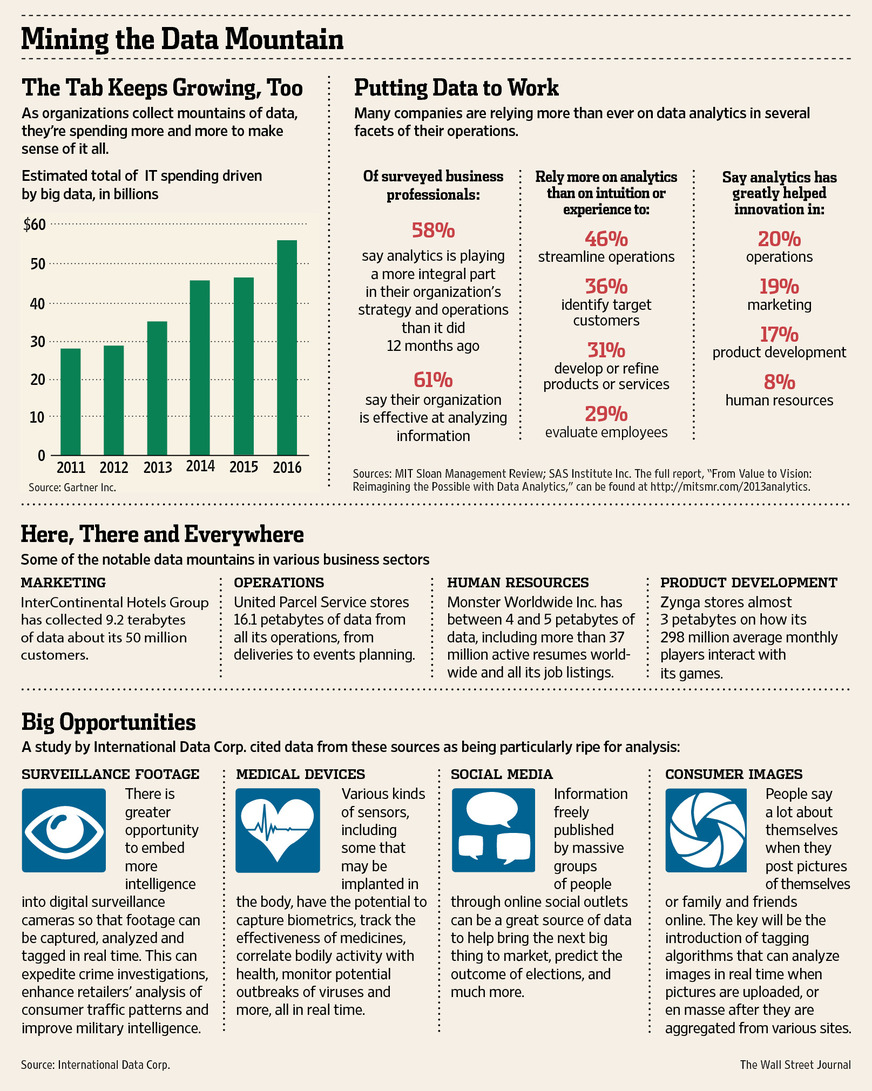
How Big Data Is Changing the Whole Equation for Business; Big Data, Big Blunders

Updated March 8, 2013, 4:22 p.m. ET

How Big Data Is Changing the Whole Equation for Business

By STEVEN ROSENBUSH AND MICHAEL TOTTY

IV-AA349B_TRANS_G_20130308141808 IV-AA365_EXABYT_G_20130307153306

There’s a ton of information out there. And businesses are figuring out how to put it to work.

The experts call this state of affairs big data. The definition is squishy, but it usually boils down to this: Companies have access to vastly more information than they used to, it comes from many more different sources than before, and they can get it almost as soon as it’s generated.

Big data often gets linked to companies that already deal in information, like Google, GOOG -0.13% Facebook FB -2.16%and Amazon. But businesses in a slew of industries are putting it front and center in more and more parts of their operations. They’re gathering huge amounts of information, often meshing traditional measures like sales with things like comments on social-media sites and location information from mobile devices. And they’re scrutinizing it to figure out how to improve their products, cut costs and keep customers coming back.

Shippers are using sensors on trucks to find ways to speed up deliveries. Manufacturers can trawl through thousands of forum posts to figure out if customers will like a new feature on their product. Hiring managers study how candidates answer questions to see if they’d be a good match.

Lots of obstacles remain. Some are technical, but business as usual also can stand in the way. In most companies, decisions are still based on HIPPO—the highest paid person’s opinion—and persuading an executive that data trumps intuition can be a hard sell. Read more of this post

Bamboo Helps Bali Village Stay in Step With Nature; “Bamboo shoots are flexible and strong, and great for low-income housing in earthquake-prone areas,”

Bamboo Helps Bali Village Stay in Step With Nature
Anita Surewicz | March 09, 2013

20130309125510343

\’Bamboo shoots are flexible and strong, and great for low-income housing in earthquake-prone areas,\’ says Green Village creative director Elora Hardy. (Photo courtesy of Green Village)

Those looking for a luxury abode that couples cutting-edge style and environmental sensibility should look no further than the Green Village, located 25 minutes outside the arts community of Ubud. Set on two hectares of land along the Agung river, the striking bamboo villas, each one unique, are designed to blend into the flow of the surrounding landscape. While some of the homes have been constructed specifically for families who have children at the nearby eco-friendly Green School, other residents are attracted to Green Village and see it as a one-of-a-kind community that can’t be found anywhere else in the world. “We started construction of the first house in May 2010 and have since built seven houses, with the eight being constructed across the river,” says Elora Hardy, creative director at Ibuku, the team behind the Green Village and Green School. “All are privately owned, either as residences or holiday homes, and some are available for rent.” The houses are certainly striking: the majority of them have multiple, open-plan living areas, and air-conditioned rooms with woven walls.

Yet their most characteristic feature is that they are made from more than 90 percent bamboo.

“We try to use bamboo as much as possible, for both construction and interior decoration because it is strong, flexible and beautiful,” says the Bali-raised Hardy, who traveled back to the island from New York to work on the project.

With its three-year growth cycle and carbon sequestration capacity, bamboo might just be the most environmentally friendly building material currently available.

“Bamboo grows plentifully in clumps, which grow new shoots each year. If not harvested, the bamboo will eventually disintegrate, making room for a new generation,” Hardy says, adding that the bamboo used for the construction of the Green Village comes from individual farmers in Bali and Java.

Hardy is committed to opening people’s minds to the viability of bamboo as a construction material, and in particular its application possibilities in a tropical climate.

“Bamboo shoots are flexible and strong, and great for low-income housing in earthquake-prone areas,” she says.  Read more of this post

When your company’s incentive system backfires; Narayana Hrudayalaya Hospital is able to produce world-class outcomes at a fraction of the cost of other hospitals. There are no incentives based on volume or revenue for its surgeons and other employees. Purpose is the driver while profits are the enabler

When your company’s incentive system backfires

How many times have you seen an incentive system produce the exact opposite of the desired behaviour? Why does this happen? And why can’t organisations see, let alone fix, these problems?

BY VIJAY GOVINDARAJAN –

4 HOURS 44 MIN AGO

How many times have you seen an incentive system produce the exact opposite of the desired behaviour? Why does this happen? And why can’t organisations see, let alone fix, these problems?

Here’s one example of how incentive systems can backfire. Srikanth went to visit a client in an Asian city. The client suggested that Srikanth catch a bus to his factory. He went to the bus stop and waited. Several buses whizzed by without stopping, even though they all had plenty of empty seats. After half a dozen buses failed to stop. Srikanth finally caught a cab.

Upon arriving late at the factory, he apologised to the client and told him the cause for his delay. The client laughed and said, “The driver’s bonus depends on whether or not he reaches his destination on time. So when drivers find themselves running behind schedule during peak hours, they do not bother picking up passengers.”

This was the height of insanity — an incentive system that succeeded only in defeating its purpose.

During rush hour, the exact time when more passengers needed to be picked up, it was better for the driver to leave them on the curb. Frustrated citizens, lost revenue and increased costs, all thanks to a misaligned incentive system. Furthermore, everyone seemed to be aware of the problem except the organisation that ran the buses. Or, equally baffling, the company knew about the issue but chose to ignore it. Read more of this post

15 Year Old Kid Develops Foolproof Test for Pancreatic, Ovarian and Lung Cancer; Test Costs 3 Cents, Takes 5 Minutes

Saturday, March 09, 2013 11:14 AM

15 Year Old Kid Develops Foolproof Test for Pancreatic, Ovarian and Lung Cancer; Test Costs 3 Cents, Takes 5 Minutes

Here’s an inspiring story for the weekend. Jack Andraka, a fifteen year old freshman in high school, developed a paper sensor that could detect pancreatic, ovarian and lung cancer in five minutes for as little as 3 cents. He conducted his research at John Hopkins University.
Jack got the idea after a friend died of pancreatic cancer. His initial research started on Wikepedia, then after he had an idea, Jack approached 200 research labs. 199 labs turned him down. The 200th said “maybe”.

China: Beyond The Miracle

China: Beyond The Miracle

03/10/2013 20:04 -0400

by Larry Kantor, Head of Research, Barclays,

China has become a key locomotive for global growth, in many ways taking over the role traditionally played by the United States in business cycles. It is now the world’s second largest economy, and has grown much faster than any other major economy over the past couple of decades.China’s role as a key driver of global growth brings with it increased scrutiny by investors and economists: a significant slowdown in China – never mind a collapse – would have significant implications for economies and financial markets around the world. This was most recently seen in 2012, when slower economic growth – fostered in large part by policy tightening to alleviate inflation pressures and structural imbalances – generated fears of a “hard landing” that served as a headwind to financial market performance for much of last year.

The extremely rapid growth in China – as welcome as it has been during an otherwise disappointing recovery from the Great Recession – represents the first stage of development in the evolution of the economy from closed to open, from fully controlled to market, and from agrarian to industrial. This initial stage is already giving way to a new phase of slower, more sustainable growth, with different drivers. It is critical for the global economy and financial markets that China’s transition is managed in a way that allows the necessary adjustments to happen gradually and without de-stabilizing effects.

The Beyond the Miracle series – written by Barclays Yiping Huang, Jian Chang and Steven Lingxiu Yang and launched in September 2011 – carefully analyzes the transition that China is undergoing from various perspectives, and also discusses the economic and financial market implications. It argues that China will successfully make the transition from ‘economic miracle’ to normal development in the next decade (Chapter 1). But there is an important caveat: China must embark on a multi-pronged set of reforms if the country is to move to a slower, more sustainable growth rate that deemphasizes trade, construction and investment and instead places a greater weight on consumer spending as a source of growth.

Each chapter provides an in-depth analysis of the task at hand – from financial reform (Chapter 2), to housing reform (Chapter 3), to the pivotal role of consumption in rebalancing China’s economy (Chapter 4). For China to avoid becoming a source of inflation in the future, its monetary policy-making, too, will need to be reformed (Chapter 5). China’s ageing population will also mean an end to its surplus of cheap labor, heralding a new era of rapidly rising wages (Chapter 6). In turn, this could put additional pressure on the country’s fiscal outlook, as it seeks to meet growing pension liabilities (Chapter 8).

These challenges notwithstanding, the Beyond the Miracle series is optimistic on the outlook for China. It argues that the Chinese economy is in the middle of a major and broad-based structural transformation that will lead the country to a more sustainable growth potential of 6-8%, from a double-digit pace previously. As China continues to grow and upgrade, its outward direct investment should rise quickly (Chapter 7). And by narrowing the technological gap with the advanced economies, China should be able to avoid the “middle income trap” and graduate to the global high-income group within the next decade (Chapter 9).

China’s Beyond the Miracle series is ambitious, both in scope and depth. Given the critical role now played by China in the world economy and financial markets, I highly recommend it as essential reading for investors, as well as anyone interested in current and future economic and market trends. Everything you wanted (and need) to know about China but were afraid to ask…

Heartwarming Video: Lab Chimps’ Jaws Drop Upon Seeing Sunlight For The First Time In Their Lives

Lab Chimps’ Jaws Drop Upon Seeing Sunlight For The First Time In Their Lives

Dina Spector | Mar. 9, 2013, 11:29 AM | 3,952 | 15

The Humane Society has posted this heartwarming video of lab chimpanzees stepping outside for the first time after decades of being cooped up in cages (via @pourmecoffee).

In January the US government said it would release all but 50 chimpanzees used for research. Most of these chimps, some who are more than 50 years old, have never seen sunlight.

The animals will get a new lease on life at a national sanctuary in Louisiana called Chimp Haven.

The sanctuary now has more than 100 chimps in their care, who are free to climb trees, run around and groom each other in a five-acre playground.

Watching the freed chimps step outside for the first time after a lifetime behind bars is a reminder of just how human-like these animals are. You can actually see their jaws drop.

Could Bed Bath & Beyond Be Buffett Bait? With strong profits and steady growth, Bed Bath & Beyond was a great retailing story in the 20th century. The moves it’s making could make it an even better story in the 21st.

SATURDAY, MARCH 9, 2013

Could Bed Bath & Beyond Be Buffett Bait?

By ANDREW BARY | MORE ARTICLES BY AUTHOR
ON-BA282_BBBY03_G_20130309012113

With strong profits and steady growth, Bed Bath & Beyond was a great retailing story in the 20th century. The moves it’s making could make it an even better story in the 21st.

One of the country’s most successful retailers is on the bargain counter.

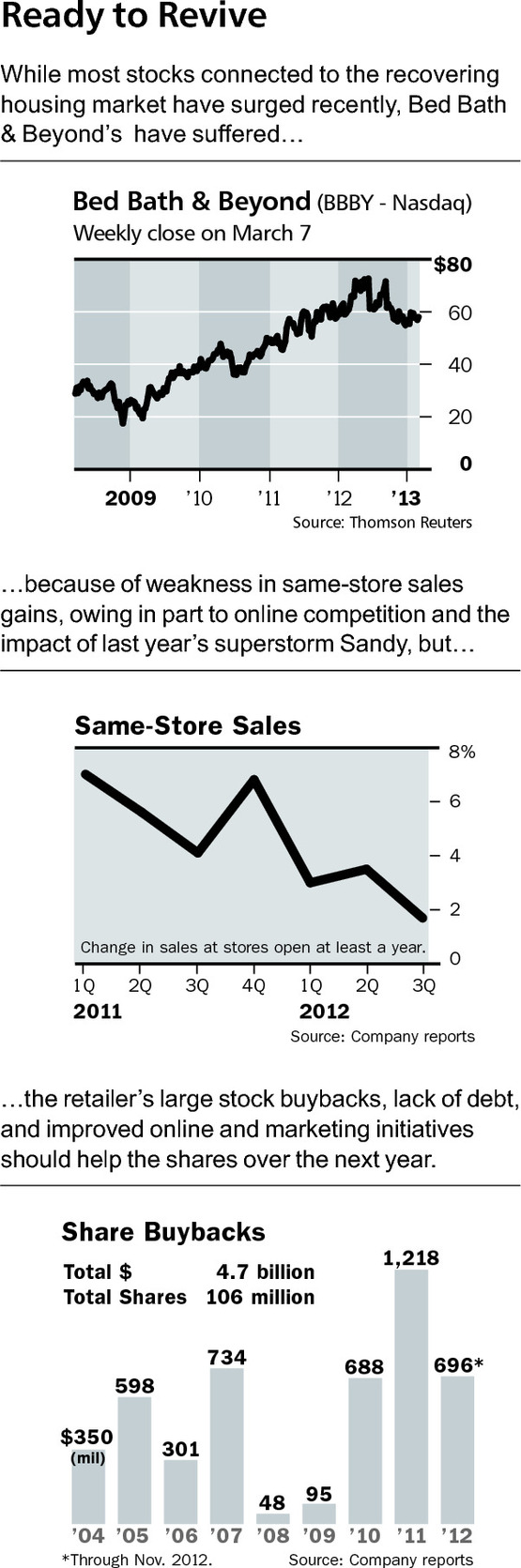
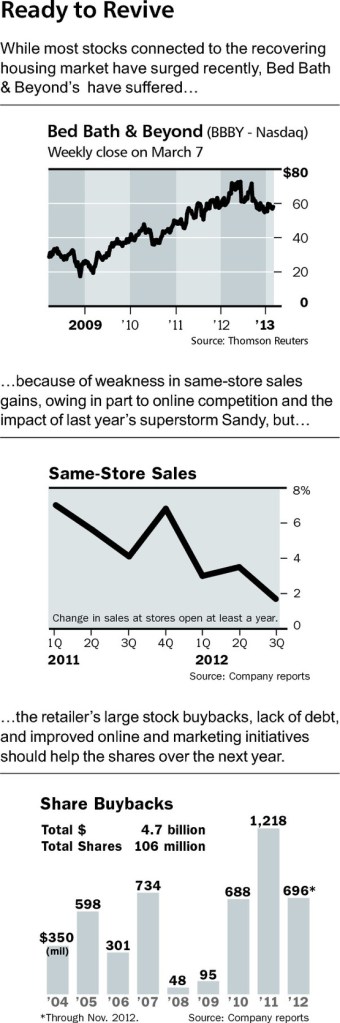
Bed Bath & Beyond has generated 16% annual growth in earnings per share over the past 10 years. But its shares, at $59, trade for less than 12 times projected profit for its fiscal year that ends in February 2014. The stock (ticker: BBBY) trades at a discount to other top retailers’, including Costco Wholesale (COST) and Target (TGT), neither of which has such a good profit history.

The shares could trade into the $70s in the next year, simply based on projected earnings gains and a higher price/earnings multiple. The insular company could attract interest from private-equity investors or even Berkshire Hathaway (BRK.A) if Bed Bath & Beyond’s co-founders, Leonard Feinstein, 75, and Warren Eisenberg, 82, decide to sell. However, there is no indication that the company is looking to sell.

A BUYER MIGHT PAY $85 a share—roughly 10 times this fiscal year’s projected earnings before interest, taxes, depreciation, and amortization (Ebitda)—consistent with prices paid for other quality companies, versus Bed Bath & Beyond’s current modest valuation of 6.5 times. The company’s $13 billion market value makes it large, but digestible. “This is a high-quality, cash-rich company that could see improving margins this year, particularly in the back half,” says Laura Champine, an analyst at Canaccord Genuity who carries a $74 price target on the stock. Bed Bath & Beyond has commanded an average of 15 times forward earnings in the past seven years.

The company, based in Union, N.J., operates 1,469 stores, including 1,004 Bed Bath & Beyonds, in all 50 states. The other 400-plus stores include World Market, which sells home furnishings, wine, and gourmet food; the fast-growing buybuy Baby chain, Christmas Tree Shops, and Harmon discount shops.

Bed Bath & Beyond has fallen from favor on Wall Street because of slowing comparable-store sales gains, mild profit disappointments, and concern that its weak Website makes it vulnerable toAmazon.com (AMZN) and other top Internet retailers. The company’s shares have slid 6% in the past year, even as virtually all stocks connected to the improving housing sector have surged.

Nonetheless, the company’s earnings in its just-concluded fiscal year ended in February likely rose a healthy 12%, to $4.56 a share, and are projected to increase 10% in its current fiscal year to $5.03.

Bed Bath & Beyond could be the most financially conservative big retailer in the U.S. It has no debt and it hasn’t carried a smidgen of debt for nearly all of the two decades since it went public in 1992. And it has $859 million—nearly $4 a share—in cash and marketable securities. The company has grown enormously, with revenue hitting an estimated $10.9 billion last year, versus $216 million in 1992 and it has accomplished this entirely with internally generated funds. Longtime investors have huge gains; the split-adjusted initial-offering price was $1 a share.

Management, led by CEO Steve Temares, plus co-Chairmen Feinstein and Eisenberg, run Bed Bath as if it were a private company. There are no investor days, limited financial disclosure, and no opportunity for questions on earnings conference calls. Want to know the sales breakdown among its chains? Bed Bath doesn’t disclose it. The retailer didn’t return Barron’s calls seeking comment. Read more of this post
Global in background and outlook, Coca-Cola CEO Muhtar Kent knows when to play the diplomat, and when to be the tough guy. Why his own secret formula works

SATURDAY, MARCH 9, 2013

Cultural Ambassador

By DYAN MACHAN | MORE ARTICLES BY AUTHOR

BA-BB285_ceoken_DV_20130309000013ON-BA281_SPOTLI_G_20130309012107

Global in background and outlook, Coca-Cola CEO Muhtar Kent knows when to play the diplomat, and when to be the tough guy. Why his own secret formula works.

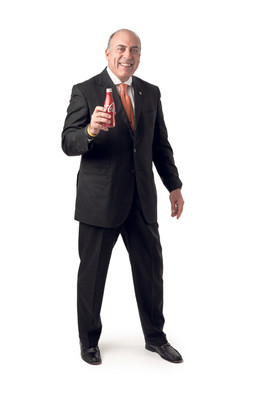
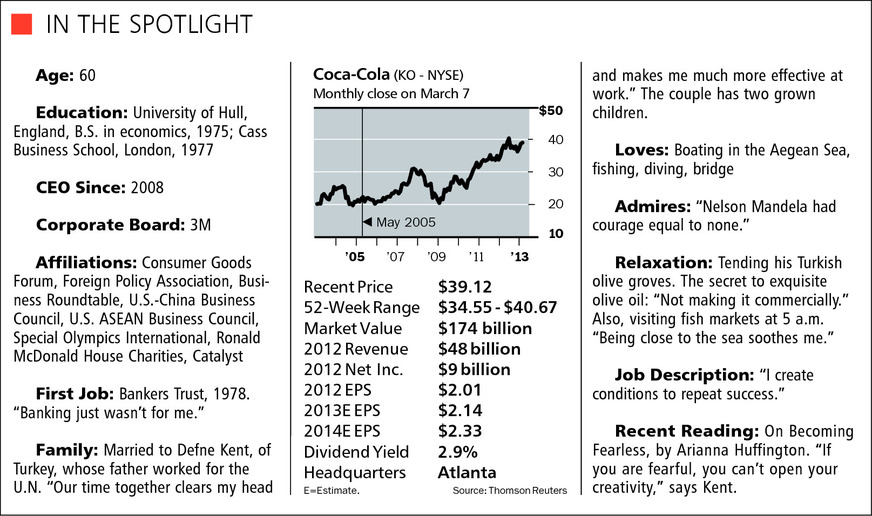
The son of a Turkish diplomat, Coca-Cola Chief Executive Muhtar Kent knows his social etiquette. When served with live, “wiggly” animals at a formal dinner in a foreign country, he recognized he had no choice but to slurp them down. Kent, 60, relates the story over a plate of trout, incontrovertibly dead, in the plush dining room of Coca-Cola headquarters, overlooking Atlanta’s skyline. When representing a product that is served 1.8 billion times a day, and is sold in 207 countries, you behave as a good guest, he says.

A true citizen of the world, Kent has spent his life, and his career, adapting to others’ customs. “His genes are international,” says Dan Moskovitz, a Miami-based operations consultant, who has known Kent for 20 years.

Born in the U.S., Coke’s CEO spent his early childhood in Thailand, India, Iran, and Turkey, and could chatter in Turkish, Urdu, Thai, and Persian, although he has since lost his facility with all but Turkish. He attended an American boarding school in Turkey and British universities, and later added English, French, and Italian to his adult linguistic repertoire.

That cultural immersion alone made Kent well suited to run Coke (ticker: KO), which earns 74 cents of every dollar outside of North America. “He can step off an airplane in Malawi, and will know what to do, and know people there,” says Howard Buffett, a Coca-Cola director and son of Warren Buffett, whose Berkshire Hathaway (BRKA) owns 400 million, or 8.9%, of Coke’s shares. Buffett sees similarities between Kent and his legendarily folksy father. “My dad can speak to 5-year-olds and the toughest New York analyst,” he says. “Muhtar Kent is the same way.”

AS CEO OF COKE since 2008, Kent does what is expected, and then some. But what the world expects of global brands like Coke, the world’s largest beverage company, with $48 billion of annual sales, has changed in the past five years. It isn’t enough for Coke to sell more than 500 beverage brands—the list also includes Powerade, Minute Maid, and Dasani water. The company also must tackle poverty and improve the quality of life wherever Coca-Cola can be found.

Kent is on board with the program. “We have distribution that can get to every corner of the world,” he says. “Why shouldn’t we use some of that capability to make communities get stronger? Communities get stronger, our business gets stronger.”

Instant, interactive communication has sparked the sea change, he adds. There is no going back to the days when consumer-product companies could merely dictate through advertisements what consumers ought to believe. “With social media, consumers talk to each other,” he says. “To the extent that they hold you in a positive light, you win. It’s a huge change.” Read more of this post

Why aren’t colleges and universities educating students for the modern economy? The president of an information-technology search and consulting firm explains

SATURDAY, MARCH 9, 2013

Where the Jobs Are

By JOHN P. MCCREA | MORE ARTICLES BY AUTHOR

Why aren’t colleges and universities educating students for the modern economy? The president of an information-technology search and consulting firm explains.

I interviewed an interesting job candidate recently. He was interesting, well, like a car wreck. It’s always instructive to look at a disaster, especially if you want to avoid one.

I run an information-technology search and consulting firm in Reston, Va., called Achieve-it. The job candidate was a top-20 law school graduate—I’ll call him Mr. Overqualified, Esq.—who was applying for an entry-level information-technology job in the Washington, D.C., area. He was debt-ridden and desperate for work, but it wasn’t because he was unemployable. He arrived in our offices well dressed, had a professional manner, and actually arrived on time.

The ad he responded to asked only for a B.S. in a hard science and an aptitude with computers. So we were perplexed by his application, because not only did he have a J.D. from a top-20 law school, but he had already passed the state bar exam. He was more qualified to sue us than petition us for employment, especially for the job we had open. And that’s where the scary part comes in: Why would a guy with this pedigreed education apply for an entry-level job paying $20 an hour?

YOU KNOW THE ANSWER, of course: He has over $100,000 in student-loan debt. To hold it together for the moment, he was working as an Excel jock for a local firm and living with his parents. He was earning $8 an hour. When Mr. Overqualified stepped off the graduation stage at his law school, he might as well have been stepping off a cliff.

At least he was using his tech skills; he could have been earning the same amount slinging burgers at McDonald’s. Mr. Overqualified told us that yes, he regretted the time he wasted in law school; he wondered if he could ever pay off his student debt. Lawyering was once a reliable route to a big house, a nice car, and a productive life. Now Mr. Overqualified can’t even find the on ramp to the middle class. Read more of this post

Rigging the I.P.O. Game: What a decade-old dot-com I.P.O. case says about Wall Street today

March 9, 2013

Rigging the I.P.O. Game

By JOE NOCERA

ONCE upon a time, in a very different age, an Internet start-up called eToys went public. The date was May 20, 1999. The offering price had been set at $20, but investors in that frenzied era were so eager for eToys shares that the stock immediately shot up to $78. It ended its first day of trading at $77 a share.

The eToys initial public offering raised $164 million, a nice chunk of change for a two-year-old company. But it wasn’t even close to the $600 million-plus the company could have raised if the offering price had more realistically reflected the intense demand for eToys shares. The firm that underwrote the I.P.O. — and effectively set the $20 price — was Goldman Sachs.

After the Internet bubble burst — and eToys, starved for cash, went out of business — lawyers representing eToys’ creditors’ committee sued Goldman Sachs over that I.P.O. That lawsuit, believe it or not, is still going on. Indeed, it has taken on an importance that transcends the rise and fall of one small company during the first Internet craze. Read more of this post

Why fund names can’t always be trusted; ‘Absolute return’ funds that lose money, ‘smaller companies’ funds that hold FTSE 100 members, we look at the funds that don’t live up to their moniker.

Why fund names can’t always be trusted

‘Absolute return’ funds that lose money, ‘smaller companies’ funds that hold FTSE 100 members, we look at the funds that don’t live up to their moniker.

By Emma Wall

7:00AM GMT 09 Mar 2013

Fund managers have received a slap on the wrist for failing to achieve their investment goals. “Absolute return” funds aim to achieve positive returns in all market conditions – but the majority simply have not done what they claimed.

Angry investors accused the industry of misleading advertising, as funds such as BlackRock UK Absolute Alpha and GLG Alpha Select, which both sit in the Absolute Return sector, failed to deliver positive funds over the past three years.

In light of this poor performance, the Investment Management Association (IMA) has changed the sector’s name to “targeted absolute return” – a solution derided by critics.

Gina Miller, a co-founder of SCM Private, the fund manager, and a campaigner for transparency on charges, said the IMA had “taken 643 days to change one word”. She called the review an “absolute farce”. Read more of this post

Bridgewater May Be the Hottest Hedge Fund for Harvard Grads, but It’s Also the Weirdest

Bridgewater May Be the Hottest Hedge Fund for Harvard Grads, but It’s Also the Weirdest

by Daniel Gross Mar 7, 2013 4:45 AM EST

Bridgewater Associates is the $145 billion hedge fund elite college grads are clamoring to work for. Daniel Gross on the oddball firm’s special sauce.

In the Northeast, spring is in the air, and at Ivy League schools, kids are planning their postgraduate futures. But this year, many of the smart young finance things who used to flood to positions at name-brand banks in lower Manhattan are casting their sights elsewhere. It’s not a bank. It’s not in New York. And it’s not a century-old global institution with a patrician name.

It’s Bridgewater Associates. Based in Westport, Connecticut, and founded and led by a person who is equal parts investing savant and shaman, Bridgewater might best be described as an alternative alternative asset-management company. It’s the creation of Ray Dalio, who was memorably described in a great New Yorker profileby John Cassidy thusly: “He looked a bit like an aging member of a British progressive-rock group.” Big shots like Stephen Schwarzman of Blackstone and Steven Cohen of SAC Capital may garner the headlines. But in recent years Dalio and Bridgewater have ridden new investment flows and superior performance to become America’s largest hedge fund, with about $145 billion in assets.

Bridgewater, which has 1,300 employees, isn’t for ex-jocks or day traders. Rather, it tends to attract—and look for—self-styled intellectuals and deep thinkers who like constructing arguments as much as they enjoy constructing portfolios. It’s “the thinking Yalie’s destination,” as one recent Yale graduate put it. Undergrads at Harvard report that the scandal-free firm is more desirable than Goldman Sachs, previously the ne plus ultra for young grads on the make. “Bridgewater is very popular because it is one of the few hedge funds that will accept people right out of college,” says a Harvard undergraduate who interviewed with the firm. “Also, the hours tend to be better. In investment banking you’re working 100 hours a week, and at hedge funds it is more like 70.” (This student may be overestimating the amount of time employees of both investment banks and hedge funds spend working). Read more of this post

How John Lewis found fashion and became never knowingly underdressed; Clothing boss Peter Ruis tells how the stores known for good sense and slippers became the fashionistas’ darling

How John Lewis found fashion and became never knowingly underdressed

Clothing boss Peter Ruis tells how the stores known for good sense and slippers became the fashionistas’ darling

Sarah Butler

The Observer, Sunday 10 March 2013

Peter Ruis

Peter Ruis in the John Lewis chain’s Peter Jones store, Sloane Square. Photograph: David Levene

Fashionistas queuing round the block, a sell-out designer collection and breathless reviews by the style press. Can this really be John Lewis? As 84,700 partners working at the department stores celebrate their 17% bonus this weekend, they can rest assured they are back in fashion in a big way. A 9% rise in clothing sales helped drive a bumper year for John Lewis as it increased its market share, mainly at Marks & Spencer’s expense. The chain accounted for 2.1% of the UK clothing market in 2012, according to retail analysts Verdict, 10% up on a year before.

Once associated with sensible knitwear and cosy slippers, the 40-store chain has polished up its fashion credentials through designer collaborations, classy own-label products and the addition of upmarket brands that had previously steered clear of the store.

As a result, fashion sales topped £1.1bn last year – up from about £700m in 2005. That’s still only about a quarter of what Marks & Spencer sells, but it indicates the kind of growth that rivals can only dream of in the economic downturn.

Under the guidance of buying and brand director Peter Ruis, who took charge of fashion in 2007, John Lewis has created a buzz by recognising that shoppers of all ages now want to look trendy – and that older customers no longer want gold buttons and elasticated waistbands. Read more of this post

Retiring workers are being “ripped off” by financial companies making huge profit margins on annuities, campaigners have warned

Pensioners being ‘ripped off’ by profit margins on annuities

Retiring workers are being “ripped off” by financial companies making huge profit margins on annuities, campaigners have warned.

Experts warn that the industry is concealing large profits. Photo: PA

By Richard Evans, and James Kirkup

9:47PM GMT 08 Mar 2013

A Telegraph investigation has raised concerns about the profits that insurance companies and other firms are making on annuities. Only one annuities provider, Standard Life, has disclosed its margins on annuities, revealing that it pockets almost 20p of every pound a customer pays for an annuity. Other firms refuse to reveal their margins, and experts warn that the industry is concealing large profits. Ros Altmann, a pensions campaigner, said: “These huge margins are outrageous.” Annuities rates have tumbled in recent years as the Bank of England’s quantitative easing programme pushes down returns on the government bonds that are the basis of annuity income. Financial experts say that people can significantly boost their retirement income by shopping around. Steve Webb, the pensions minister, said: “Annuities are increasingly important. More openness on rates should help consumers get a better deal.” Standard Life pays an income of £4,990 on a £100,000 annuity for a 65-year-old. The market leader, Aviva, pays £5,600.

A ‘Politically Explosive’ Secret: Italians Are More Than Twice As Wealthy As Germans

A ‘Politically Explosive’ Secret: Italians Are More Than Twice As Wealthy As Germans

Wolf Richter, Testosterone Pit | Mar. 9, 2013, 7:17 AM | 6,192 | 29

In December 2006, the ECB established the HFSC network of survey specialists, statisticians, and economists from its own ranks, national central banks of the Eurozone, and statistical institutes. The acronym stood for Household Finance and Consumption Survey.

It would collect “micro-level structural information” on household wealth. A massive bureaucratic undertaking. Surveys went out in 2010. Results are now ready. No one in Europe had ever done a survey on that scale before.

And no one might ever do it again. Because, in the era of bailouts and wealth-transfers, the results are so explosive that the Bundesbank is keeping its report secret—and word has leaked out why.

The surveys were conducted on a national basis, with each central bank publishing its own report. They would then be combined and summarized by the ECB into a cohesive picture of how wealthy—or how poor—people in various parts of the Eurozone were. A number of countries already published their reports, including Italy and Austria.

What the Austrian National Bank found was not pretty (20-page PDF). The considerable wealth in Austria was very unevenly distributed. The wealthiest 5% owned nearly half of the country’s wealth. Their median wealth was €1.7 million in diversified assets. The lower 50% owned only 4% of the country’s wealth. Of them, 83% rented their homes. Their median wealth was a measly €11,000 consisting usually of a car and a savings account. That’shalf of the people! And 10% had a net wealth of less than €1,000.

This unequal distribution of wealth created a huge gap between median income (half the people earned more, the other half less) of €76,000 and average income of €265,000 (pushed up by a small number of extremely wealthy households). And that’s why some countries don’t even publish average income values. Too much truth would hurt.

Germany’s data is likely to be similar—but the Bundesbank is treating its report like a secret. Because the results are, let’s say, awkward for two reasons.

The highly unequal distribution of wealth is one of them. The German government already went through wild gyrations late last year, and now again, over its Poverty Report that exposed some inconvenient facts that were then edited out—something that was leaked immediately, and it caused a ruckus [read…. Censored: Poverty Report in Germany].

Italy is the other issue. But it may be too hot for the Bundesbank to touch. Italy’s report (142-page PDF) finds that median household net wealth has increased 56% since 1991. And from 2008 to 2010, it increased by about 5% annually, despite the crisis!

But the wealth of German households stagnated during much of that time while they paid taxes out of their noses. And now they might learn that Italy’s median household wealth is €163,875—while Germany’s is closer to Austria’s, around €76,000. Less than half!

“Politically explosive,” sources at the Bundesbank whispered to the FAZ. Read more of this post

Online Emotions, in Hundreds of New Flavors; Line’s popularity was part of what motivated Lango and MessageMe to bring their own versions of sticker-type messaging to the United States

March 9, 2013

Online Emotions, in Hundreds of New Flavors

By JENNA WORTHAM

10-BITS-articleLarge

TO say that I like to send text messages is like saying Garfield likes lasagna. It is my expressive medium. On Wednesday alone, I sent at least 100 — but I like to send more than just words. I’m a big fan of using emoji, the colorful symbol alphabet that contains nearly a thousand images of cute animals, food items and expressive smiley faces to convey what words cannot.

When a friend recently told me that she was sick, I replied with a cartoon row of steaming bowls of soup and a flexing bicep — my way of wishing her a speedy recovery. Read more of this post

The Price of Marriage in China: China’s economic surge — and vast wealth inequality — have bred a new type of matchmaker, referred to as a love hunter

March 9, 2013

The Price of Marriage in China

By BROOK LARMER

LOVEHUNTERS-articleLarge10-LOVEHUNTERS-JP1-popup

In a Beijing shopping mall, the “love hunter” Yang Jing, right, and an assistant talked to a woman about joining the database of Diamond Love and Marriage, a matchmaking service.

FROM her stakeout near the entrance of an H & M store in Joy City, a Beijing shopping mall, Yang Jing seemed lost in thought, twirling a strand of her auburn-tinted hair, tapping her nails on an aquamarine iPhone 4S. But her eyes kept moving. They tracked the clusters of young women zigzagging from Zara to Calvin Klein Jeans. They lingered on a face, a gesture, and then moved on, darting across the atrium, searching.

“This is a good place to hunt,” she told me. “I always have good luck here.”

For Ms. Yang, Joy City is not so much a consumer mecca as an urban Serengeti that she prowls for potential wives for some of China’s richest bachelors. Ms. Yang, 28, is one of China’s premier love hunters, a new breed of matchmaker that has proliferated in the country’s economic boom. The company she works for, Diamond Love and Marriage, caters to China’s nouveaux riches: men, and occasionally women, willing to pay tens and even hundreds of thousands of dollars to outsource the search for their ideal spouse.

In Joy City, Ms. Yang gave instructions to her eight-scout team, one of six squads the company was deploying in three cities for one Shanghai millionaire. This client had provided a list of requirements for his future wife, including her age (22 to 26), skin color (“white as porcelain”) and sexual history (yes, a virgin).

“These millionaires are very picky, you know?” Ms. Yang said. “Nobody can ever be perfect enough.” Still, the potential reward for Ms. Yang is huge: The love hunter who finds the client’s eventual choice will receive a bonus of more than $30,000, around five times the average annual salary in this line of work.

Suddenly, a signal came.

From across the atrium, a co-worker of Ms. Yang caught her eye and nodded at a woman in a blue dress, walking alone. Ms. Yang had shaken off her colleague’s suggestions several times that day, but this time she circled behind the woman in question.

“Perfect skin,” she whispered. “Elegant face.” When the woman walked into H & M, Ms. Yang intercepted her in the sweater aisle. “I’m so sorry to bother you,” she said with a honeyed smile. “I’m a love hunter. Are you looking for love?”

Three miles away, in a Beijing park near the Temple of Heaven, a woman named Yu Jia jostled for space under a grove of elms. A widowed 67-year-old pensioner, she was clearing a spot on the ground for a sign she had scrawled for her son. “Seeking Marriage,” read the wrinkled sheet of paper, which Ms. Yu held in place with a few fragments of brick and stone. “Male. Single. Born 1972. Height 172 cm. High school education. Job in Beijing.”

Ms. Yu is another kind of love hunter: a parent seeking a spouse for an adult child in the so-called marriage markets that have popped up in parks across the city. Long rows of graying men and women sat in front of signs listing their children’s qualifications. Hundreds of others trudged by, stopping occasionally to make an inquiry. Read more of this post

Chinese consumers account for 50% of all LV sales

Chinese consumers account for 50% of all LV sales

Staff Reporter

2013-03-10

More than half of all Louis Vuitton purchases in the world are made by Chinese people, according to the Hurun Report, a magazine best known for its rankings of wealthy individuals in China. According to Rupert Hoogewerf, founder of the Hurun Report and chairman of the Hurun Research Institute, the 33 billionaires on their new Hurun Luxury Tycoon Rich List owe much of their success to Chinese shoppers and their notorious overseas shopping sprees. “The Chinese luxury consumer is today the most important customer group in the world for luxury brands, especially now that the Chinese luxury consumer has started to travel around the world,” Hoogewerf said. Read more of this post

State-owned firms ignore Beijing order to exit property sector

State-owned firms ignore Beijing order to exit property sector

Staff Reporter

2013-03-10

A 2010 order issued by the Chinese government requiring state-owned companies to exit the property sector if it is not their core business has failed to prevent such companies from winning bids for prime-location land across the country, reports the Guangdong-based Southern Weekly newspaper.

According to recent reports, less than a quarter of the 78 state-owned enterprises asked to terminate their property business operations more three years ago have complied. Read more of this post