China property controls seen in Ping An Bank shift; Local Gov’ts Begin to Face Fiscal Crunch; Chinese Banks’ Bad Loan Ratio to Hit 3Pct in 2013: S&P Report; More Chinese cities ready for property tax pilots

China property controls seen in Ping An Bank shift

2013-02-27 09:29:24 GMT2013-02-27 17:29:24(Beijing Time)  SINA.com

A move by China’s Ping An Bank (000001.SZ) to ban its regional branches from approving mortgages may signal that Beijing is set to tighten controls on the property market to calm record prices, market sources said on Wednesday. Read more of this post

HK’s US$160m milk powder market to face severe clamp down

HK’s US$160m milk powder market to face severe clamp down

Staff Reporter

2013-02-27

Hong Kong will no longer be a safe haven for the baby formula buying craze of mainland Chinese customers. Starting as early as March 1, Hong Kong will limit the amount of baby formula taken from the island city to two tins per person or 1.8kg, following a string of measures proposed in early February to ease milk powder shortages, Guangzhou-based 21st Century Business Herald reports. Read more of this post

Korean chaebol face structural overhaul; Large firms urged to decentralize management control

2013-02-26 18:31

Chaebol face structural overhaul

Large firms urged to decentralize management control
By Kim Tae-jong

President Park Geun-hye Monday reaffirmed her will to facilitate “economic democratization” during Monday’s inauguration speech. To some corporate owners, this is obviously a warning sign, as she is expected to take a hardline stance on unfair business practices among the nation’s family-controlled conglomerates or chaebol.

Experts say that the chaebol need to reform their management structure in accordance with the new government in order to survive.

“Things have changed, and conglomerates should also adapt to such changes,” said Hansung University professor Kim Sang-jo. “They can’t go against this new trend.”

He suggested that conglomerates should decentralize their management by reducing their dependency on the owner or his or her family members.

“Since 1997, a number of companies have faced owner risks, as their chairmen were found to be engaged in irregularities. But those that successfully overcame them and reformed their traditional management structure have prospered,” he said. Read more of this post

The Boats that Did Not Sail: Asset Price Volatility and Market Efficiency in a Natural Experiment

The Boats that Did Not Sail: Asset Price Volatility and Market Efficiency in a Natural Experiment

Peter Koudijs 

Stanford GSB
February 2013
NBER Working Paper No. w18831

Abstract: 
Financial markets are thought to be inefficient when they move too much relative to the arrival of information. How big is this inefficiency? In today’s markets, this is difficult to determine because the arrival of information is hard to identify. In this paper, I present a natural experiment from history in which the flow of information was regularly interrupted for exogenous reasons. This allows me to study volatility in the absence of news, and to identify the degree of inefficiency. During the 18th century a number of English securities were traded on the Amsterdam exchange. Relevant information from England reached Amsterdam on mail boats. I reconstruct their arrival dates. When no mail boats arrived, virtually no other relevant information reached the Amsterdam market. I measure price volatility during periods with and without news. Even in the absence of new information, security prices moved significantly. Between 50 and 75% of overall volatility did not reflect the arrival of news. A significant fraction of this residual is driven by the incorporation of private information into prices. Once this is taken into account, 20 to 50% of the overall return variance is unexplained by information. This suggests that the Amsterdam market moved more than can be explained by the arrival of news but that the majority of price movements was still the result of efficient price discovery.

Deflating shadow credit in China

Deflating shadow credit in China

Kate Mackenzie

| Feb 27 08:59 | 6 comments Share

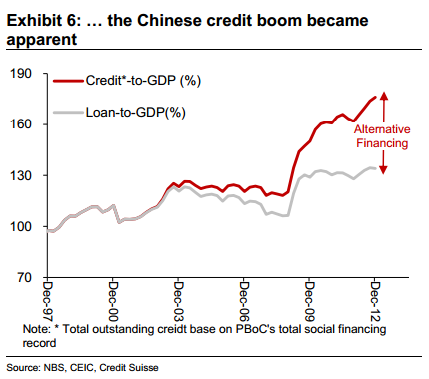
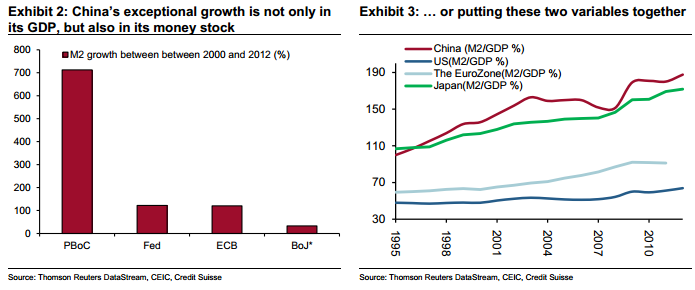
First, a reminder of the degree to which China’s growth has been increasingly fuelled by credit over the past few years:

China-credit-to-GDP-inc-shadow-creditsuissePBoC-money-growth-to-GDP-intl-comparison-CS

The chart above doesn’t quite show it, but non-bank credit growth outpaced bank loans last year. The rise of China’s shadow banking scene has happened very rapidly — much of the growth only happened since 2009.

Shadow banking in China is not all necessarily shadowy; in fact some of it, such as trusts, are legal and regulated at least to a degree. A chunk of shadow loans are also originated by banks (Anne Stevenson-Yang of J Capital Research reckons about 30 per cent).

But it does also include a number of ever more complex and opaque products such as wealth management products. The underlying assets are hard to determine and usually turn out to be property or financial in nature. Investors often assume banks and the state are guaranteeing the principle because of the way they are marketed. Read more of this post

The Starbucks Index – Coffee Price Parity

The Starbucks Index – Coffee Price Parity

Tyler Durden on 02/27/2013 09:44 -0500

20130227_WSJ

Despite Abe’s protestations, it would appear – from WSJ’s index of Starbucks coffee prices around the world – that Japan’s currency ‘value’ is similar to the US while it is Mr. Hollande (in France) that has more reason to hope for a currency devaluation in his country. With India and Mexico showing the lowest price for a grande latte (suggesting undervalued currencies), it appears Europeans (from Madrid to Paris to Athens) pay significantly more for a latte than even the New Yorkers. Forget the Big Mac Index, forget Purchasing Power Parity – the Scandinavians are suffering from over-priced currencies and significant divergence from Coffee Price Parity.

February 21, 2013, 4:49 p.m. ET

On Currencies, What’s Fair Is Hard to Say

Countries’ Heated Rhetoric Points Out Lack of a Universal Measuring Stick

By IRA IOSEBASHVILI

What’s the fair value of a euro? That depends on whether the answer comes from Berlin or Paris. Read more of this post

Developing Corporate Governance Research Through Qualitative Methods: A Review of Previous Studies

Developing Corporate Governance Research Through Qualitative Methods: A Review of Previous Studies

Terry McNulty 

University of Liverpool

Alessandro Zattoni 

University of Bocconi – Strategic and Entrepreneurial Management 

Thomas Douglas 

affiliation not provided to SSRN

March 2013
Corporate Governance: An International Review, Vol. 21, Issue 2, pp. 183-198, 2013

Abstract: 
Manuscript Type. Review. Research Question/Issue. The article is concerned with the prevalence, character, and development of qualitative research within the field of corporate governance. The paper provides an overview of published qualitative research in the field of corporate governance based on a structured literature search of papers published in scholarly peer‐reviewed journals between 1986 and 2011. Research Findings/Insights. A fine‐grained search based on key words resulted in a sample of 78 qualitative corporate governance studies. A review and content analysis of these studies show that qualitative studies in governance have grown in number since the 1990s, but remain a small fraction of the published work on corporate governance. Studies are mostly developed by UK and European scholars, published in European journals and tend to explore boards of directors more than other governance related actors and mechanisms. These studies utilize a range of disciplines, predominantly management, adopting a wide range of methods, the most prevalent being that of the interview, often in combination with other methods to get a better account of the empirical phenomenon. Theoretical/Academic Implications. The search reveals an eclectic range of theories, spanning several disciplines, which is serving to generate, elaborate, and refine theorizing about corporate governance and the associated meanings, mechanisms, processes and relationships. There is much scope and need for more qualitative studies of significant rigor and relevance which explore the array of interactions and processes involved in corporate governance, across different levels of analysis and contexts. Practitioner/Policy Implications. After over two decades of research and reform of corporate governance, problems of practice remain, and corporate governance prescription via codes and other forms of regulation is increasing in search of better governance. Qualitative research can assist policy‐makers and practitioners to develop more efficient governance mechanisms, by shedding light on the efficacy of policy prescription. Qualitative research provides a basis for rethinking and challenging some of the dominant assumptions and meanings about how governance actors and institutions actually function.

Wealth Transfers via Equity Transactions

Wealth Transfers via Equity Transactions

Richard G. Sloan 

University of California at Berkeley – Haas School of Business

Haifeng You 

Hong Kong University of Science & Technology (HKUST) – Department of Accounting
February 15, 2013

Abstract: 
Previous research indicates that firms issue (repurchase) shares when their stock is overpriced (underpriced). Such transactions transfer wealth from transacting stockholders to ongoing stockholders. We quantify the magnitude of these wealth transfers and analyze their implications. The wealth transfers are economically significant, averaging approximately 6% of pre-transaction market capitalization for equity issuers. They are particularly large for equity issuers with ex ante indications of overpricing, where they average 14% of pre-transaction market capitalization. We analyze the implications of these wealth transfers for equity valuation, corporate financial policy and value-oriented investment strategies.

Textual Sentiment Analysis in Finance: A Survey of Methods and Models

Textual Sentiment Analysis in Finance: A Survey of Methods and Models

Colm Kearney 

Monash University – Faculty of Business and Economics

Sha Liu 

Trinity College Dublin – School of Business
January 31, 2013

Abstract: 
The study of sentiment in qualitative information has implications for both the efficient market hypothesis and the behavioural finance. It provides an alternative perspective to test market efficiency over and above quantitative information, and may help explain the ‘anomalies’ in the market. In this paper, we survey the textual sentiment analysis literature, compare and discuss the information sources, content analysis methods, and financial models that have been used. We then summarize the essential findings of the interrelations between textual sentiment and firm performance or stock market activities. We believe that textual sentiment is a potential pricing factor because it captures hard-to-quantify aspects of material information. We also suggest the promising directions for future research.

Stockholders’ Unrealized Capital Gains Position and the Market Response to Earnings Announcements

Stockholders’ Unrealized Capital Gains Position and the Market Response to Earnings Announcements

Eric Weisbrod 

University of Miami – Department of Accounting
February 4, 2013

Abstract: 
I examine whether stockholders’ average unrealized capital gains position in the equity of a given firm affects their response to the firm’s quarterly earnings announcements. Stockholders’ unrealized capital gains can affect their individual trading decisions via the capital gains tax “lock-in effect” or the tax-irrational bias known as the “disposition effect.” Prior literature is unclear about whether these two effects are significant determinants of the market reaction to earnings news. I design new tests that incorporate trade-by-trade data as well as quarterly institutional holdings data, and find robust evidence supporting the disposition effect. However, I also find that this announcement-window disposition effect is mitigated when tax incentives are stronger or more salient. Finally, I demonstrate that the disposition effect has important implications for measuring the degree to which the market incorporates earnings news. First, the disposition effect moderates the degree to which both opinion divergence and the differential precision of pre-announcement earnings information are reflected in abnormal trading volume. Second, the disposition effect diminishes the price adjustment to earnings news during the announcement window.

Want to Change the World? Be Resilient.

Want to Change the World? Be Resilient.

by John McKinley  |   1:00 PM February 26, 2013

What’s the difference between someone with a good idea and a person who can transform their ideas into real impact? To tackle the world’s biggest problems, we need to be able to identify and support the people who are capable of creating lasting change. At Acumen Fund, we spend a lot of time trying to find and train aspiring and established leaders from around the world who have the right mix of talent, ideas, and passion.

And what we’ve found time and again is: Resilience matters most.

Resilient leaders have three key characteristics:

  1. Grit: Short-term focus on tasks at hand, a willingness to slog through broken systems with limited resources, and pragmatic problem-solving skills.
  2. Courage: Action in the face of fear and embracing the unknown.
  3. Commitment: Long-term optimism and focus on big-picture goals.

Read more of this post

Is traditional leadership on its way out? Today leadership is about Creativeship, which he defines as “the creation of sustainable cultures and business models.”

Is traditional leadership on its way out?

Ray Williams | Feb 26, 2013 5:47 PM ET
In an earlier article in the Financial Post, I argued “If management is so good at predicting outcomes through analytical and scientific methods why have so few public companies performed well?” The leadership of today’s business institutions has increasingly been put under the microscope.

“Companies that are managed the traditional way — by executives developing analytically driven strategy and shaping the organization to meet the needs of the business as they see them — are obsolete. Management as we have known it, is too cumbersome,” argues Thomas Hout in an article in the Harvard Business Review.  That sentiment is also held by Alan Murray, who in an article in the Wall Street Journalwrites that management, as an innovation, won’t survive the 21st century.

Barbara Kellerman, author of The End of Leadership, contends that the leadership industry is a $50 billion a year business, that has been unable to produce true leaders and in essence, failed. Kellerman argues while leaders once dominated and controlled followers, now followers are more educated and independent, and leaders must now rely on influence and persuasion.

Bob Kelleher, author of Creativeship: A Novel for Evolving Leaders contends the definition of leadership as “the ability to lead people, build fellowship and make money” is archaic and so “yesterday.” Read more of this post

Are IPOs Good for Innovation? A Stanford scholar says going public often slows innovation

Are IPOs Good for Innovation?

by Edmund L. Andrews | Feb 27, 2013

A Stanford scholar says going public often slows innovation

For many entrepreneurs, it is a dream on par with finding the Holy Grail: an initial public stock offering that can turn a startup into the next Google and a 20-something founder into the next mega-millionaire.

Yet, for all that money and drama, do initial public offerings — IPOs — speed up technological innovation?

Not necessarily. An eye-popping new study by Shai Bernstein, an assistant professor of finance at the Stanford Graduate School of Business, finds that innovation slowed down by about 40% at tech companies after they went public.

In a meticulous analysis of patent data from nearly 2,000 companies, Bernstein found that newly public companies became noticeably more incremental and less ambitious with their in-house research than comparable firms that stayed private. Read more of this post

Getting Cities Right

Mahmoud Mohieldin, Zoubida Allaoua

Getting Cities Right

26 February 2013

WASHINGTON, DC – The developing world is experiencing rapid urbanization, with the number of city dwellers set to reach four billion in 2030 – double its 2000 level. But unplanned and uncoordinated urban development is risky, threatening to replace migrants’ hopes for a better life with unsanitary living conditions, joblessness, and high exposure to natural disasters.

In many respects, urbanization is rational. After all, cities are the hubs of prosperity, where more than 80% of global economic activity is concentrated. And their density facilitates the delivery of public services, including education, health care, and basic services. Indeed, it costs $0.70-0.80 per cubic meter to provide piped water in urban areas, compared to $2 in sparsely populated areas.

But the high concentration of assets and people, especially in coastal areas, is an economic liability, with around $3 trillion in assets at risk from natural hazards. Vulnerability will increase further over the next two decades, as cities triple their built-up land, to 600,000 square kilometers, often without basic infrastructure or policies to prevent construction and settlement on disaster-prone and vulnerable sites.

To get urbanization right, policymakers must take urgent action to build sustainable cities. Read more of this post
Will Programmers Rule?

Raghuram Rajan, Professor of Finance at the University of Chicago Booth School of Business and the chief economic adviser in India’s finance ministry, served as the International Monetary Fund’s youngest-ever chief economist and was Chairman of India’s Committee on Financial Sector Reforms. He is the author ofFault Lines: How Hidden Fractures Still Threaten the World Economy.

Will Programmers Rule?

26 February 2013

NEW DELHI – Marc Andreessen made his first fortune writing the code that became Netscape Navigator, the Internet browser. He is now a venture capitalist who evangelizes about the growing importance of software in business today. Indeed, he proclaims that software is taking over the world – that it will be the primary source of added value – and offers the following prediction: the global economy will one day be divided between people who tell computers what to do and people who are told by computers what to do.

Andreessen’s aim is to shock his listeners – not just for effect, but to get them to do something about it. To stop the world from being divided between a few alpha programmers and many drones, he wants the potential drones to stop taking easy liberal arts courses in college. Instead, he wants them to focus on courses in science, technology, engineering, and math (STEM), where the good jobs will be. But will this solve the problem that he poses?

Perhaps not. Two attributes of software creation allow a few talented programmers to corner the market and take all the associated profits. Read more of this post

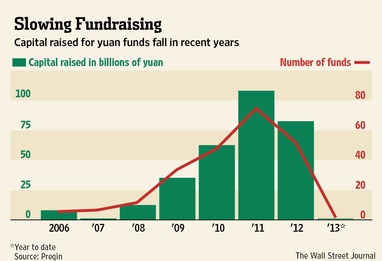
Doubts Over Returns Hit Fundraising in China

February 26, 2013, 5:36 PM

Doubts Over Returns Hit Fundraising in China

By Chao Deng

AM-AX364_ASIADE_NS_20130226213311

Investors are growing skeptical that private equity in China can keep giving them high returns, and local funds are bearing the brunt of their reluctance to pump in more cash.

The reasons: China’s market for initial public offerings has stalled, making it harder for private-equity firms to cash out of investments, and investors are growing disillusioned with the idea that China’s economy is in line for continued spectacular growth. Growth has already slowed slightly from previous years. Read more of this post

Finding the Just-Right Level of Self-Esteem for a Child

Updated February 26, 2013, 7:35 p.m. ET

Finding the Just-Right Level of Self-Esteem for a Child

By SUE SHELLENBARGER

Is high self-esteem the key ingredient to your child’s success? New research reveals heaping on the praise doesn’t necessary lead to happiness down the road. WSJ Work & Family columnist Sue Shellenbarger, and parents Jason and Cara Greene, join Lunch Break to discuss. Photo: Jason Greene.

A wave of recent research has pointed to the risks of overpraising a child. But for parents, drawing the line between too little praise and too much has become a high-pressure balancing act.

Cara Greene, a mother of three children ages 1 to 8, is wary of deliberately pumping up her kids’ egos, for fear of instilling the sense of entitlement she sees in young adults “who have been told they’re wonderful and they can do anything.” But she also wants them to have healthy self-esteem. Read more of this post

Mao’s $300 Red Army Liquor Suffers Before China Congress: Retail

Mao’s $300 Red Army Liquor Suffers Before China Congress: Retail

By Bloomberg News  Feb 26, 2013

Kong Guoqing hasn’t seen a quieter Chinese New Year in the 12 years his family has been running their small liquor and tobacco shop in downtown Shanghai.

They didn’t sell a single bottle of the high-end spirit made by Kweichow Moutai Co. (600519) that has become synonymous with banquets and gift-giving during China’s national holiday. Kong blames the vanished sales on incoming President Xi Jinping’s crackdown on extravagant spending by officials: Moutai’s sorghum spirit can fetch $300 a bottle — about a third of an average weekly wage in China’s financial hub.

“Demand for the most expensive liquors and cigarettes this New Year seemed to have just dried up,” said Kong, pointing to red boxes of cigarettes costing about $10 a pack, or more than six times the price of regular brands. “People are afraid to accept gifts.” Read more of this post

CBC Raises Deposit Rates, First Among Big State Lenders; significant move reflects building pressures even on the powerful state-owned banks as they scramble for deposits to meet regulatory requirement following a lending spurt at the beginning of the year

CBC Raises Deposit Rates, First Among Big State Lenders

02-26 19:25 Caijing

The significant move reflects building pressures even on the powerful state-owned banks as they scramble for deposits to meet regulatory requirement following a lending spurt at the beginning of the year.

Read more of this post

Why Do Incumbents Sometimes Succeed? Investigating the Role of Interorganizational Trust in the Adoption of Disruptive Technology

Why Do Incumbents Sometimes Succeed? Investigating the Role of Interorganizational Trust in the Adoption of Disruptive Technology

Michael W. Obal 

Temple University – Department of Marketing and Supply Chain Management
February 11, 2013

Abstract: 
Previous research has noted that new firms traditionally have more success with the diffusion of disruptive technologies than do incumbent firms. For the development of disruptive technologies, newer firms appear to be advantageous as they are generally more flexible in resource allocation. However, exceptions can be found in various industries in which incumbents have been able to succeed with their own disruptive technologies. One possible explanation for these exceptions is the influence of pre-existing levels of trust already developed between incumbents and potential buyers of disruptive technologies. In order to explore this further, this article provides a link between interorganizational trust and the adoption of new, disruptive technologies in industrial markets. We show how pre-existing, interorganizational trust impacts the perceptions a potential buyer has towards a disruptive technology and how these perceptions influence a buyers’ intention to adopt a new, disruptive technology. Beyond trust, we use perceived ease of use, perceived value, perceived usefulness and financial stability to create a predictive model for intention to adopt. Holistically, this article provides insight on how buyer-supplier relationships generally favor incumbent firms and can impact a buyers’ perception of a new, disruptive technology.

‘By a Silken Thread’: Regional Banking Integration and Pathways to Financial Development in Japan’s Great Recession

‘By a Silken Thread’: Regional Banking Integration and Pathways to Financial Development in Japan’s Great Recession

Mathias Hoffmann 

University of Zurich – Department of Economics Library; CESifo (Center for Economic Studies and Ifo Institute for Economic Research)

Toshihiro Okubo 

University of Geneva – Graduate Institute of International Studies (HEI)
January 31, 2013
CESifo Working Paper Series No. 4090

Abstract: 
How do financial development and financial integration interact? We focus on Japan’s Great Recession after 1990 to study this question. Regional differences in banking integration affected how the recession spread across the country: financing frictions for credit-dependent firms were more severe in less integrated prefectures, which saw larger decreases in lending by nationwide banks and lower GDP growth. We explain these cross-prefectural differences in banking integration by reference to prefectures’ different historical pathways to financial development. After Japan’s opening to trade in the 19th century, silk reeling emerged as the main export industry. The silk reeling industry depended heavily on credit for working capital but comprised many small firms that could not borrow directly from larger banks. Instead, silk merchants in Yokohama, the main export hub for silk, provided silk reelers with trade loans. Many regional banks in Japan were founded as local clearing houses for such loans, and regional banks continued to account for above-average shares in lending in the formerly silk-exporting prefectures long after the decline of the silk industry. Using the cross-prefectural variation in the number of silk filatures in 1895 as an instrument, we confirm that the post-1990 decline was worse in prefectures where credit constraints were tightened through low levels of banking integration. Our findings suggest that different pathways to financial development can lead to long-term differences in de facto financial integration, even if there are no formal barriers to capital mobility between regions, as is the case in modern Japan.

Leaked conversation reveals insiders’ secret A-share pessimism; “China no longer has any resilience as it has become a heavily indebted economy”

Leaked conversation reveals insiders’ secret A-share pessimism

The recording of two financial professionals sharing a bearish outlook during a private chat is made public.

By Lillian Liu | 27 February 2013

The leak of two industry experts’ private conversation about the outlook for A-shares has spooked the market, with retail investors waking up to the fact that domestic stocks may not be as attractive as many Chinese professionals would publicly claim.

The supposedly off-the-record chat between Cheng Dinghua, a well respected strategist at Essence Securities, and Xu Xiang, an influential fund manager at Zexi Investment, was recorded by a third party and released on the internet last week.

The conversation offers a rare opportunity into the true sentiment of Chinese industry professionals towards a market where only those with the right connections are able to make big profits, while the majority of retail investors are at the mercy of market conditions. Read more of this post

China turns to all-boys classes as girls progress

China turns to all-boys classes as girls progress
By Bill Savadove | Posted: 26 February 2013 1242 hrs

SHANGHAI: Teenage boys in a Shanghai school are on the front line of teaching reform after the world’s top-scoring education system introduced male-only classes over worries they are lagging girls.

Rows of white-shirted boys are put through their paces as they are called up individually to complete a chemical formula by teacher Shen Huimin, who hopes that a switch to male-only classes will help them overcome their reticence.

“We give boys a chance to change,” she said.

The Shanghai school system topped the Organisation for Economic Co-Operation and Development’s (OECD) worldwide assessment tests of 15-year-olds in 2009, the most recent available, ahead of Korea, Finland, Hong Kong and Singapore. Read more of this post

The Most Ridiculous Service Fees … for Now

The Most Ridiculous Service Fees … for Now

By Eric Spitznagel on February 21, 2013

Exorbitant corkage fees at restaurants are only the beginning. A look at some of the most preposterous service charges in recent memory.

etc_upcharge09__01__950

Two Cows: The Infographic to provide everything you need to know about ecomoomics.

Two Cows: The Infographic

Tyler Durden on 02/26/2013 14:01 -0500

There are many complexities in the socio-economic structures that the nations (and corporations) of the world have used (and abused) over the years. Volumes have been written to explain the intricacies of Capitalism, Fascism, Communism, and Socialism; and how these impact various corporations from Iran to Greece to Australia. However, in the interest of brevity, the following infographic – utilizing nothing more than two cows (which perhaps should now be horses, considering their inflationary displacement capacity for firms like IKEA and Nestle) to provide everything you need to know about ecomoomics.

6653870_700b

Watch Zuck, Bill Gates, Jack Dorsey, & Others In Short Film To Inspire Kids To Learn How To Code

Watch Zuck, Bill Gates, Jack Dorsey, & Others In Short Film To Inspire Kids To Learn How To Code

COLLEEN TAYLOR

posted 2 hours ago

Code.org, the new non-profit aimed at encouraging computer science education launched last month by entrepreneur and investor brothers Ali and Hadi Partovi, has assembled an all-star group of the world’s most well-known and successful folks with programming skills to talk about how learning to code has changed their lives — and isn’t quite as hard as people might think.

As you can see in the five minute clip embedded above, the short film (nine minutes in its full length version) which was directed by Lesley Chilcott, known as the producer of Waiting for Supermanand An Inconvenient Truth, is a who’s who featuring Mark ZuckerbergBill GatesJack Dorsey,Drew HoustonTony Hsieh, Miami Heat player Chris Bosh (he studied computer imaging at Georgia Tech before joining the NBA), and many more. It’s a very human look at what can certainly seem to many as a dry or intimidating subject, and it’s really a pleasure to watch. Read more of this post

Great Leaders Know When to Forgive

Great Leaders Know When to Forgive

by Rosabeth Moss Kanter  |   8:00 AM February 26, 2013

Leaders must be firm and foster accountability, but they also must know when to forgive past wrongs in the service of building a brighter future. One of the most courageous acts of leadership is to forgo the temptation to take revenge on those on the other side of an issue or those who opposed the leader’s rise to power.

Instead of settling scores, great leaders make gestures of reconciliation that heal wounds and get on with business. This is essential for turnarounds or to prevent mergers from turning into rebellions against acquirers who act like conquering armies.

Nelson Mandela famously forgave his oppressors. After the end of apartheid, which had fostered racial separation and kept blacks impoverished, Mandela became South Africa’s first democratically elected President. Some in his political party clamored for revenge against members of the previous regime or perhaps even all privileged white people. Instead, to avoid violence, stabilize and unite the nation, and attract investment in the economy, Mandela appointed a racially integrated cabinet, visited the widow of one of the top apartheid leaders, and created the Truth and Reconciliation Commission that would clear the air and permit moving forward. Read more of this post

A Nation of Gamblers: Real Estate Speculation and American History

A Nation of Gamblers: Real Estate Speculation and American History

Edward L. Glaeser 

Harvard University – John F. Kennedy School of Government, Department of Economics; Brookings Institution; National Bureau of Economic Research (NBER)
February 2013
NBER Working Paper No. w18825 

Abstract:      
The great housing convulsion that buffeted America between 2000 and 2010 has historical precedents, from the frontier land boom of the 1790s to the skyscraper craze of the 1920s. But this time was different. There was far less far less real uncertainty about fundamental economic and geographic trends, making the convulsion even more puzzling. During historic and recent booms, sensible models could justify high prices on the basis of seemingly reasonable projections about stable or growing prices. The recurring error appears to be a failure to anticipate the impact that elastic supply will eventually have on prices, whether for cotton in Alabama in 1820 or land in Las Vegas in 2006. Buyers don’t appear to be irrational but rather cognitively limited investors who work with simple heuristic models, instead of a comprehensive general equilibrium framework. Low interest rates rarely seem to drive price growth; under-priced default options are a more common contributor to high prices. The primary cost of booms has not typically been overbuilding, but rather the financial chaos that accompanies housing downturns.

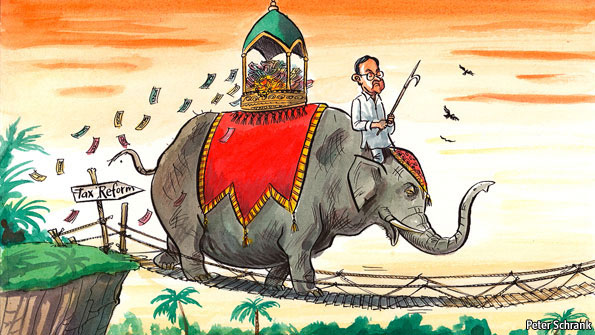
India: Government borrowing generates inflation, widens the external deficit and crowds out much-needed investment. Can India now overcome its debt addiction?

India’s public finances

A walk on the wild side

Government borrowing generates inflation, widens the external deficit and crowds out much-needed investment. Can India now overcome its debt addiction?

Feb 23rd 2013 | MUMBAI |From the print edition

20130223_ASC110 20130223_ASD001_0

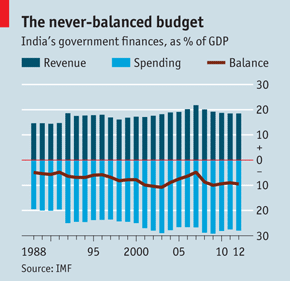
INDIA has grappled with its public finances for long enough. When presenting its first budget after independence in 1947, the finance minister of the day insisted that the country was not living beyond its means. Yet every budget since has failed to produce a surplus. India borrows more heavily than typical big emerging economies and faces more periodic crises. Palaniappan Chidambaram is the latest to try to tame the fiscal beast. He became finance minister, for the third time, last July. On February 28th he will present his budget, possibly the last one before the ruling Congress Party goes to the polls, which must take place by mid-2014.

India’s economy is a concern. Growth is running at about 5%, nearly half what it once was. The external deficit is at a record, while inflation remains stubbornly high. Last year India faced the threat of a downgrade of its credit rating to “junk” status. Thankfully, Mr Chidambaram has shaken Congress from its stupor. The party is to blame for the present budget mess, having launched a pre-election spending spree in 2008 that continued. Subsidies, mainly of fuel, almost doubled, to 2.4% of GDP. The central government’s deficit has been 5-6.5% of GDP. Add in spending by the states, and India’s overall budget deficit has been running at a wild 8-10% of GDP. Read more of this post

Indonesia: Gloomy politics, so how long can the bright economics last?

Indonesia’s economy

Gloomy politics, so how long can the bright economics last?

Feb 23rd 2013 | JAKARTA |From the print edition

20130223_ASC106

ITS public life is dismal, but Indonesia’s economy is, for now, among the brighter performers in Asia. The corruption scandals engulfing the ruling Democratic Party underscore the disappointment of Susilo Bambang Yudhoyono’s second and final term. The president exercises only a weak grip on the helm, and conservatives in government have manoeuvred economic modernisers to the sidelines. Yet the economy zips along. It grew by 6.2% last year, and the government now aims for growth of 6.8% in 2013.

After a decade of painful restructuring for banks and companies, Indonesian businesses are ramping up spending on new factories and infrastructure. Investment now accounts for nearly a third of GDP. Annual imports of things like machinery and mechanical equipment are growing at double-digit rates.

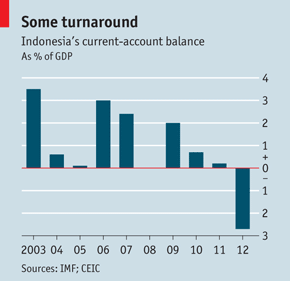
Yet Indonesia’s investment-led boom is now posing problems. Exports are weak, because of depressed global demand and lower prices for many of the natural resources that the country sells to the world. Merchandise imports are growing strongly. The result is a collapse in the trade balance. After a surplus of almost $26 billion in 2011, Indonesia posted a trade deficit last year—its first annual deficit since the late 1960s. The current account, too, swung into deficit in 2012, ending a 14-year run of surpluses (see chart). It has all put pressure on the rupiah, recently one of Asia’s worst-performing currencies. Read more of this post